Water Supply and Wastewater
Management
or Environment Engineering
(Sewer Material & Strength )
SEWER MATERIAL
Types of Pipes based on material:
PVC, AC (Asbestos Cement), PCC, RCC, C.I., Steel,
Clay
PCC Pipes:
 Normally used for small storm drains and sanitary
sewers.
 Made in three classes with three wall thicknesses.
 Sizes: 100 mm – 610 mm.
 Concrete pipes > 610 mm in size are reinforced.
RCC Pipes:
 Normally used for combined, large storm
drains and sanitary sewers in urban areas.
 Made in five classes with two wall
thicknesses in class-I and three wall
thicknesses in other four classes.
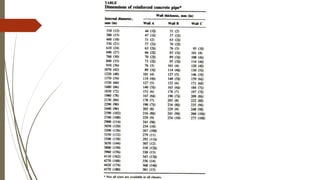
Dimensions available for RCC pipes are shown in Table.
SEWER MATERIAL
STRENGTH OF RCC PIPES
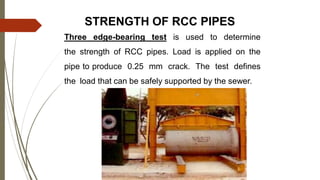
Three edge-bearing test is used to determine
the strength of RCC pipes. Load is applied on the
pipe to produce 0.25 mm crack. The test defines
the load that can be safely supported by the sewer.
JOINTS IN RCC SEWERS
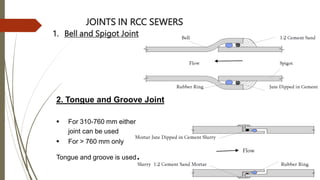
1. Bell and Spigot Joint
2. Tongue and Groove Joint
 For 310-760 mm either
joint can be used
 For > 760 mm only
Tongue and groove is used.
LOADS ON BURIED PIPES
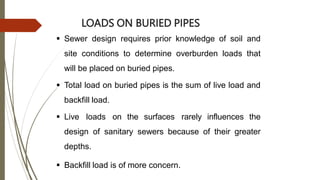
 Sewer design requires prior knowledge of soil and
site conditions to determine overburden loads that
will be placed on buried pipes.
 Total load on buried pipes is the sum of live load and
backfill load.
 Live loads on the surfaces rarely influences the
design of sanitary sewers because of their greater
depths.
 Backfill load is of more concern.
Backfill Load on Sewers:
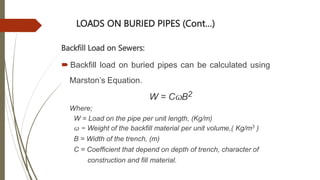
 Backfill load on buried pipes can be calculated using
Marston’s Equation.
W = CωB2
Where;
W = Load on the pipe per unit length, (Kg/m)
ω = Weight of the backfill material per unit volume,( Kg/m3 )
B = Width of the trench, (m)
C = Coefficient that depend on depth of trench, character of
construction and fill material.
LOADS ON BURIED PIPES (Cont…)
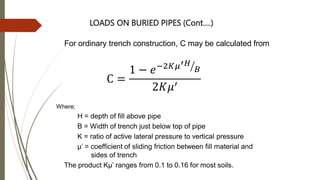
For ordinary trench construction, C may be calculated from
Where;
H = depth of fill above pipe
B = Width of trench just below top of pipe
K = ratio of active lateral pressure to vertical pressure
µ’ = coefficient of sliding friction between fill material and
sides of trench
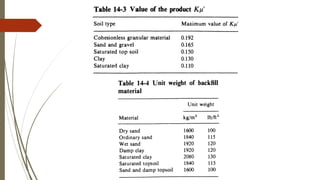
The product Kµ’ ranges from 0.1 to 0.16 for most soils.
LOADS ON BURIED PIPES (Cont….)
C =
1 − 𝑒−2𝐾𝜇′𝐻
𝐵
2𝐾𝜇′
SEWER BEDDINGS
Provision of proper bedding is very important;
 in developing the strength of the pipe,
 assuring it is laid to the proper grade, and
 preventing subsequent settlement.
In unfavorable soil conditions, bedding is particularly
important.
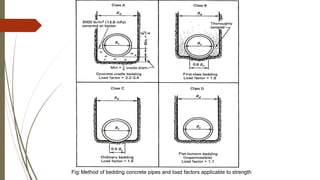
Load Factor:
Load Factor expresses the increase
sewer by provision of proper bedding.
in strength of
Fig:Method of bedding concrete pipes and load factors applicable to strength
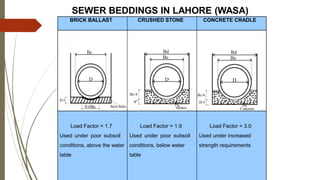
SEWER BEDDINGS IN LAHORE (WASA)
BRICK BALLAST CRUSHED STONE CONCRETE CRADLE
Load Factor = 1.7
Used under poor subsoil
conditions, above the water
table
Load Factor = 1.9
Used under poor subsoil
conditions, below water
table
Load Factor = 3.0
Used under increased
strength requirements
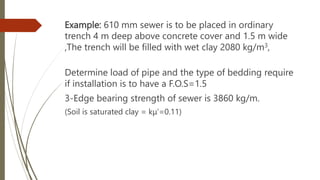
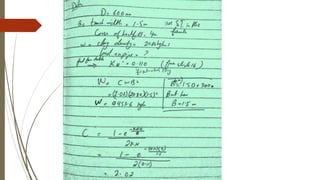
Example: 610 mm sewer is to be placed in ordinary
trench 4 m deep above concrete cover and 1.5 m wide
,The trench will be filled with wet clay 2080 kg/m3,
Determine load of pipe and the type of bedding require
if installation is to have a F.O.S=1.5
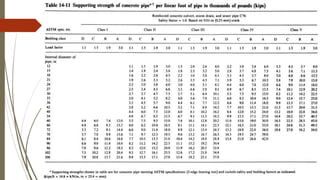
3-Edge bearing strength of sewer is 3860 kg/m.
(Soil is saturated clay = kμ’=0.11)
4- Sewer Material & Strength03.pptx

4- Sewer Material & Strength03.pptx

  • 1.
    Water Supply andWastewater Management or Environment Engineering (Sewer Material & Strength )
  • 2.
    SEWER MATERIAL Types ofPipes based on material: PVC, AC (Asbestos Cement), PCC, RCC, C.I., Steel, Clay PCC Pipes:  Normally used for small storm drains and sanitary sewers.  Made in three classes with three wall thicknesses.  Sizes: 100 mm – 610 mm.  Concrete pipes > 610 mm in size are reinforced.
  • 3.
    RCC Pipes:  Normallyused for combined, large storm drains and sanitary sewers in urban areas.  Made in five classes with two wall thicknesses in class-I and three wall thicknesses in other four classes. Dimensions available for RCC pipes are shown in Table. SEWER MATERIAL
  • 5.
    STRENGTH OF RCCPIPES Three edge-bearing test is used to determine the strength of RCC pipes. Load is applied on the pipe to produce 0.25 mm crack. The test defines the load that can be safely supported by the sewer.
  • 7.
    JOINTS IN RCCSEWERS 1. Bell and Spigot Joint 2. Tongue and Groove Joint  For 310-760 mm either joint can be used  For > 760 mm only Tongue and groove is used.
  • 8.
    LOADS ON BURIEDPIPES  Sewer design requires prior knowledge of soil and site conditions to determine overburden loads that will be placed on buried pipes.  Total load on buried pipes is the sum of live load and backfill load.  Live loads on the surfaces rarely influences the design of sanitary sewers because of their greater depths.  Backfill load is of more concern.
  • 9.
    Backfill Load onSewers:  Backfill load on buried pipes can be calculated using Marston’s Equation. W = CωB2 Where; W = Load on the pipe per unit length, (Kg/m) ω = Weight of the backfill material per unit volume,( Kg/m3 ) B = Width of the trench, (m) C = Coefficient that depend on depth of trench, character of construction and fill material. LOADS ON BURIED PIPES (Cont…)
  • 10.
    For ordinary trenchconstruction, C may be calculated from Where; H = depth of fill above pipe B = Width of trench just below top of pipe K = ratio of active lateral pressure to vertical pressure µ’ = coefficient of sliding friction between fill material and sides of trench The product Kµ’ ranges from 0.1 to 0.16 for most soils. LOADS ON BURIED PIPES (Cont….) C = 1 − 𝑒−2𝐾𝜇′𝐻 𝐵 2𝐾𝜇′
  • 12.
    SEWER BEDDINGS Provision ofproper bedding is very important;  in developing the strength of the pipe,  assuring it is laid to the proper grade, and  preventing subsequent settlement. In unfavorable soil conditions, bedding is particularly important. Load Factor: Load Factor expresses the increase sewer by provision of proper bedding. in strength of
  • 13.
    Fig:Method of beddingconcrete pipes and load factors applicable to strength
  • 14.
    SEWER BEDDINGS INLAHORE (WASA) BRICK BALLAST CRUSHED STONE CONCRETE CRADLE Load Factor = 1.7 Used under poor subsoil conditions, above the water table Load Factor = 1.9 Used under poor subsoil conditions, below water table Load Factor = 3.0 Used under increased strength requirements
  • 15.
    Example: 610 mmsewer is to be placed in ordinary trench 4 m deep above concrete cover and 1.5 m wide ,The trench will be filled with wet clay 2080 kg/m3, Determine load of pipe and the type of bedding require if installation is to have a F.O.S=1.5 3-Edge bearing strength of sewer is 3860 kg/m. (Soil is saturated clay = kμ’=0.11)