Centrilift
ESP Run Life Factors
Centrilift
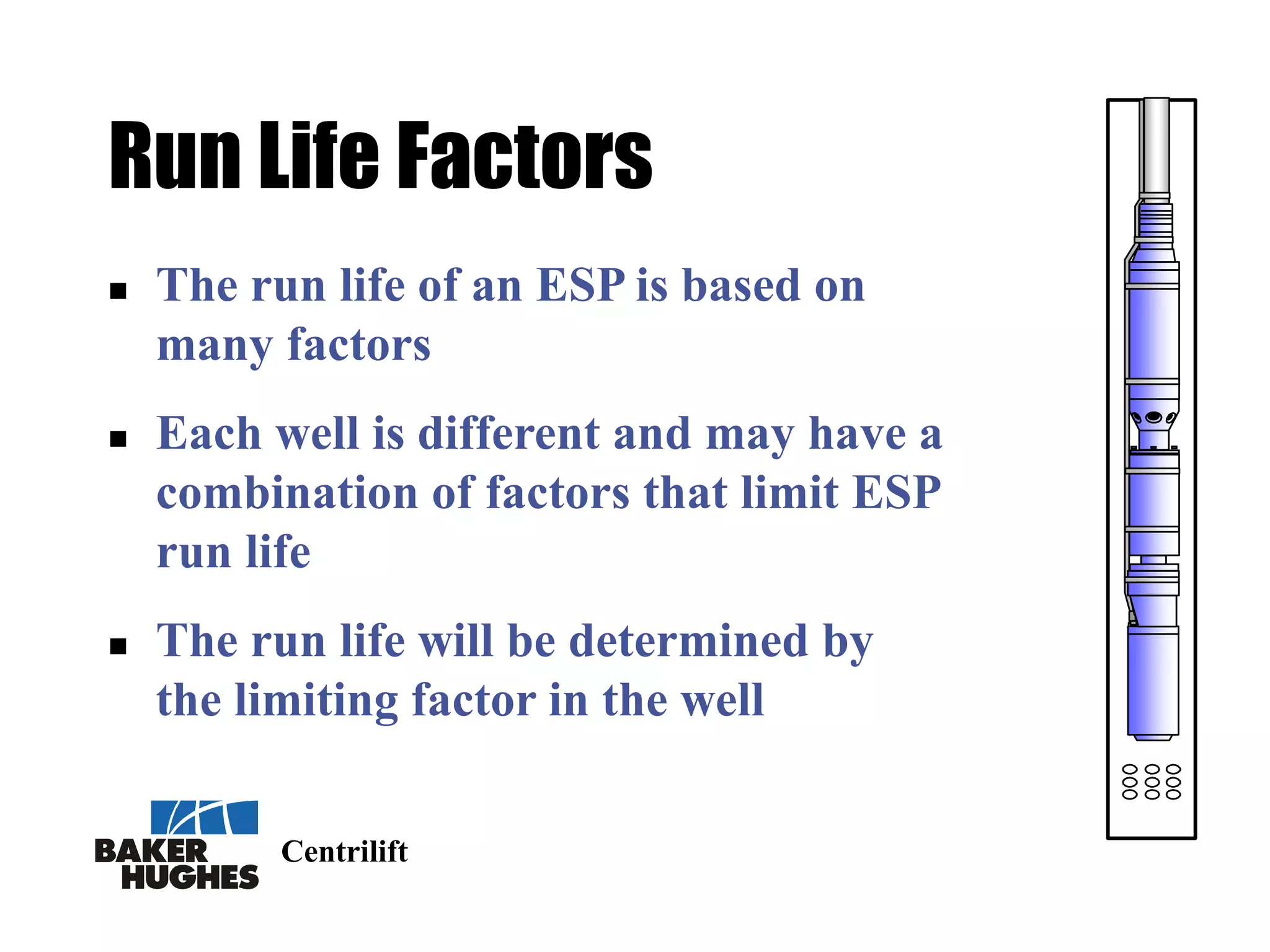
Run Life Factors
 The run life of an ESP is based on
many factors
 Each well is different and may have a
combination of factors that limit ESP
run life
 The run life will be determined by
the limiting factor in the well
Centrilift
Common Run Life Factors
 Proper Sizing of Equipment
 Well (BHT) Temperature
 Free Gas
 Viscosity
 Corrosion
 Sand / Foreign Material Production
 Deposition Tendencies
 Electrical Failures
 Operational Problems
 Old Age
Centrilift
Proper Sizing
 Proper sizing of the ESP unit is the first factor in achieving
a long run life
 The unit must be sized to operate within the recommended
flow range
 Well productivity data must be accurate in order to
properly size the equipment
 Improper sizing can cause the ESP to run outside of
operating range causing accelerated pump wear
 Inaccurate fluid data can cause the BHP of the pump to be
more than predicted which could cause motor overload, and
eventually failure
Centrilift
Total Dynamic Head ( TDH )
Centrilift
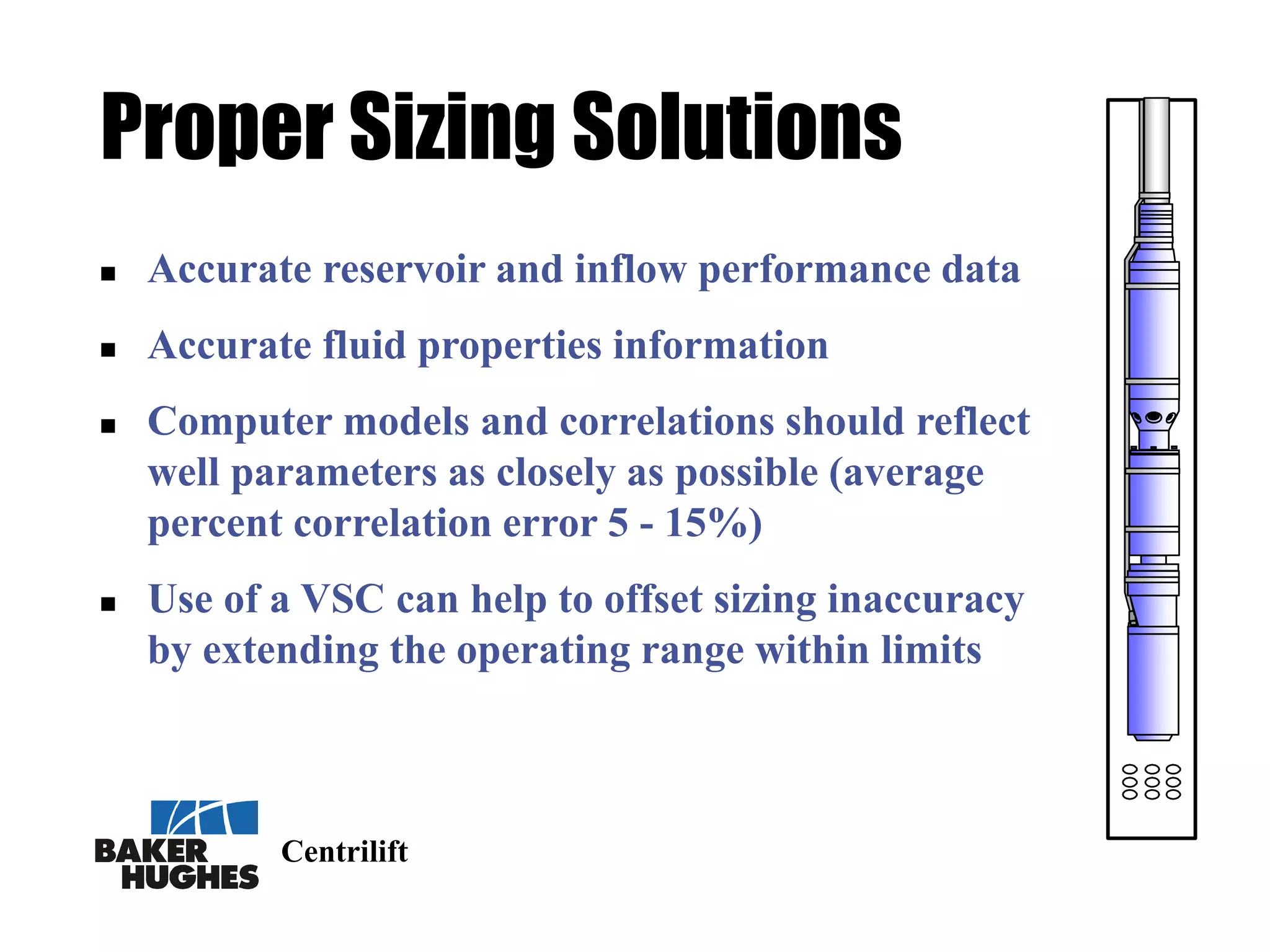
Proper Sizing Solutions
 Accurate reservoir and inflow performance data
 Accurate fluid properties information
 Computer models and correlations should reflect
well parameters as closely as possible (average
percent correlation error 5 - 15%)
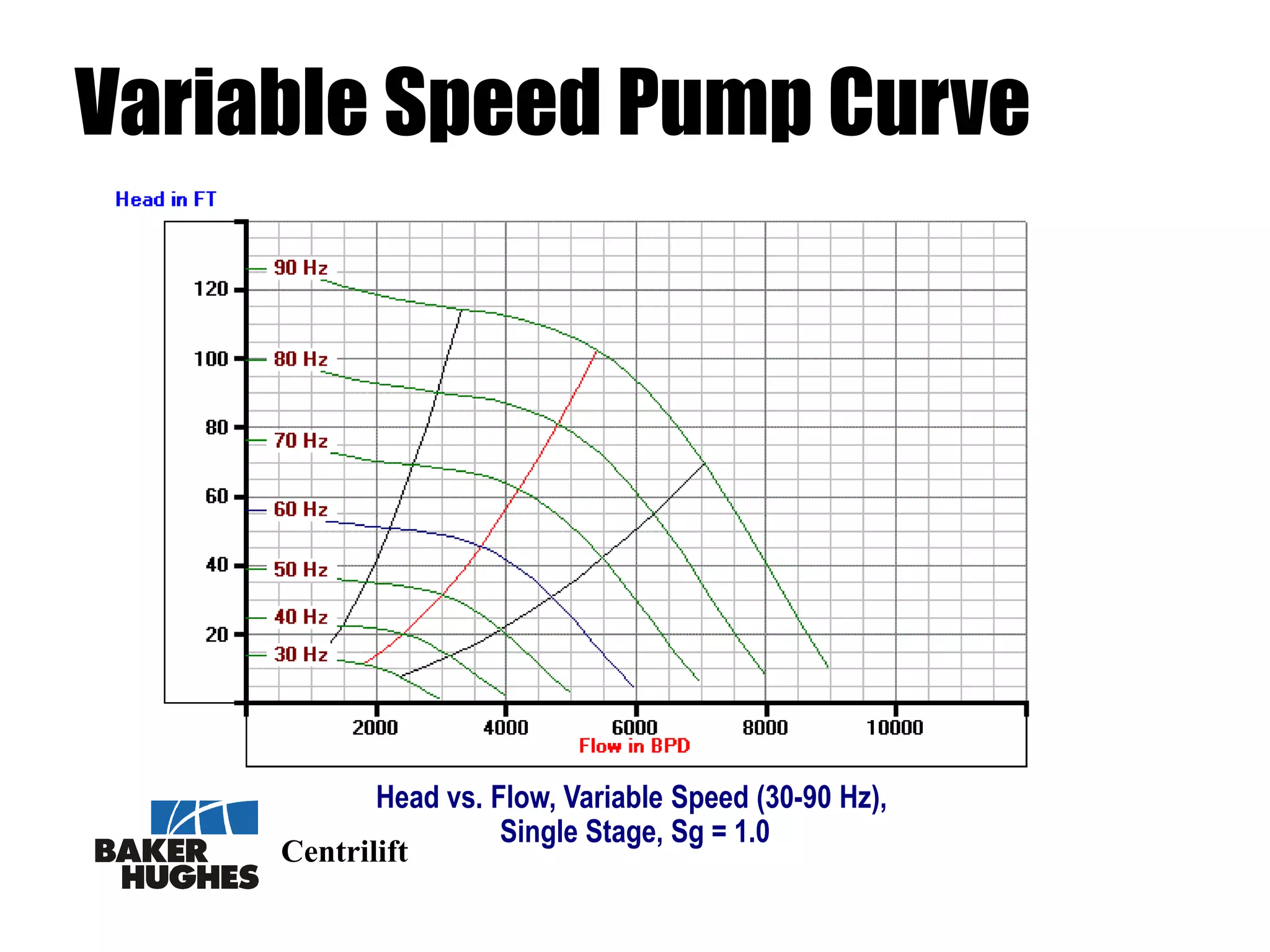
 Use of a VSC can help to offset sizing inaccuracy
by extending the operating range within limits
Centrilift
Variable Speed Pump Curve
Head vs. Flow, Variable Speed (30-90 Hz),
Single Stage, Sg = 1.0
Centrilift
High Temperature
 Bottom hole temperatures greater than 220o F are considered
high temperature applications for ESPs
 Motor operating temperature is also effected by
– % load versus nameplate motor horsepower
– Fluid velocity past the motor
– % water, % oil, % gas of well fluid past motor
– Power quality (unbalanced current, distorted wave form)
 The combination of all above factors determines the unit
operating temperature
Centrilift
High Temp Solutions
ESPs can run for long periods of time in high temperatures wells
if the proper equipment is used. The following equipment
features are recommended
High temp motor oil - retains viscosity at higher temperatures
(also has good low temp properties)
 High temperature elastomers - EPDM cable insulation and
jacket, O-rings, Aflas seal bags
 Special construction of rotor assembly in motor to insure
proper bearing clearances
 De-rating motors for very high temperatures, if required
Centrilift
Free Gas
The presence of free gas can effect the ESPs in many ways...
 The pump flow will be reduced or completely stopped as the free
gas increases. This is called “gas locking”
 The motor will run hotter as the fluid velocity decreases past the
motor
 The fluid’s cooling properties will decrease as the free gas
increases
Gassy Well Solutions ...
 Separate free gas before it enters the pump stages by rotary or
reverse flow separators
 Utilize tapered pump stage designs to handle the increased gas
volume through the pump
Centrilift
Viscosity
High fluid viscosity can cause many problems ...
 The specific gravity of the fluid increases, therefore
increasing pump brake horsepower
 High viscosity also reduces the pumps ability to lift the
fluid and its efficiency
 Viscous fluid produces more friction loss in the tubing
causing the pump to work much harder
Viscosity Solutions ...
 Size pumps with higher flow stages and higher HP motors
 Dilute well fluid with low viscosity crude
Centrilift
Corrosion
Corrosive fluid effects ESPs when ...
 CO2 causes corrosion of housings, heads, bases,
and fasteners of the downhole assembly
 CO2 causes corrosion of galvanized cable armor
on the power cable, connectors, and MLE
 H2S chemically reacts with copper components
causing cable conductors to disintegrate
 H2S causes sulfide corrosion cracking with certain
steels which effects shafts and bolts
Centrilift
Corrosion Solutions
For corrosive wells ESPs should have ...
 Corrosion resistant housings (9% Cr minimum)
 Stainless steel heads, bases, and fasteners
 Stainless Steel or Monel cable armor
 Monel or Inconel pump and seal shafts to address
sulfide corrosion cracking
 Lead sheath cable for high H2S environments
(defined as above 3% & 180o F or greater)
Centrilift
Sand Abrasion
The production of sand causes ...
 Abrasive wear on the pump stages
 Excessive shaft pump shaft vibration
 Mechanical seal leakage in the seal section
 Motor burns due to fluid migration
Solutions for sand production are ...
 Abrasion resistant pump design which provides for downthrust
support and radial shaft stabilization
 Slow, steady increase in production of well on initial start up to
limit inflow of unconsolidated sand
Centrilift
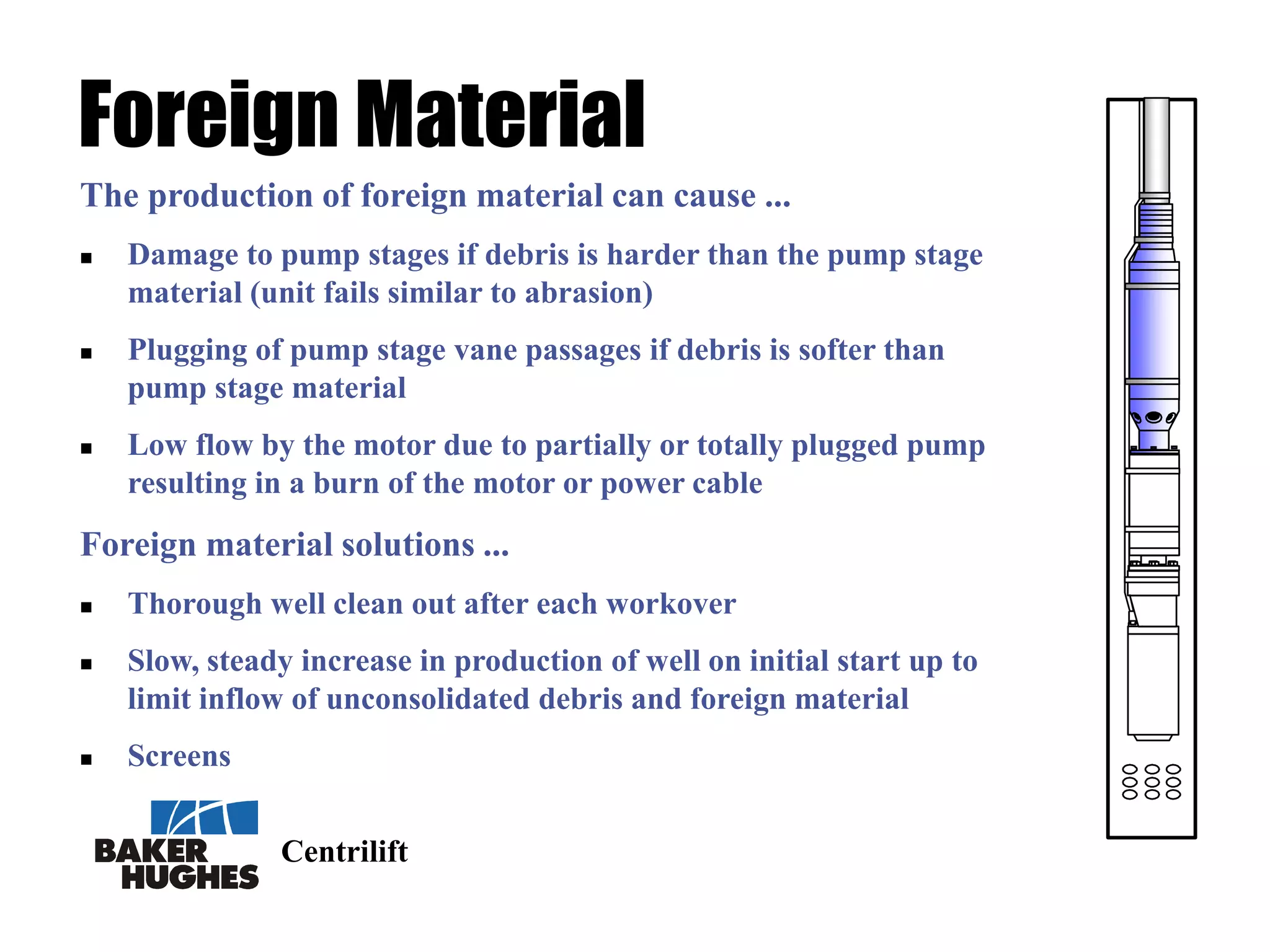
Foreign Material
The production of foreign material can cause ...
 Damage to pump stages if debris is harder than the pump stage
material (unit fails similar to abrasion)
 Plugging of pump stage vane passages if debris is softer than
pump stage material
 Low flow by the motor due to partially or totally plugged pump
resulting in a burn of the motor or power cable
Foreign material solutions ...
 Thorough well clean out after each workover
 Slow, steady increase in production of well on initial start up to
limit inflow of unconsolidated debris and foreign material
 Screens
Centrilift
Deposition
Deposition on pump stages cause high brake horsepower,
locked stages, &/or restrict pump or tubing
Types of deposition are ...
 Scale
 Asphaltenes
 Paraffin
 Hydrate / Ice Plugs
Deposition Solutions …
 Chemical treatment
 Tubing heat (except for scale)
 Control pump intake pressure (except for hydrates)
Centrilift
Electrical Failures
Electrical failures are caused by factors
such as ...
 Surface electrical or electronic component
failure
 Poor Power such as voltage imbalance
 Cable failure due to decompression damage
or voltage spikes
 Overload of the controller or transformer due
to changes in downhole or unit conditions
Centrilift
Operating Practices
Poor operating practices can cause failure of ESPs.
The most common are ...
 Operating the unit against the closed surface valve for an
extended length of time (no flow by the motor will cause the
motor or MLE to burn)
 Operating the unit in a no-flow or low flow condition with
no underload protection (same as above)
 Rapid decreases in well bore pressure (can cause
decompression damage of power cable, MLE, or
penetrators)
 Increasing unit production quickly cause rapid inflow of
sand or foreign material
Centrilift
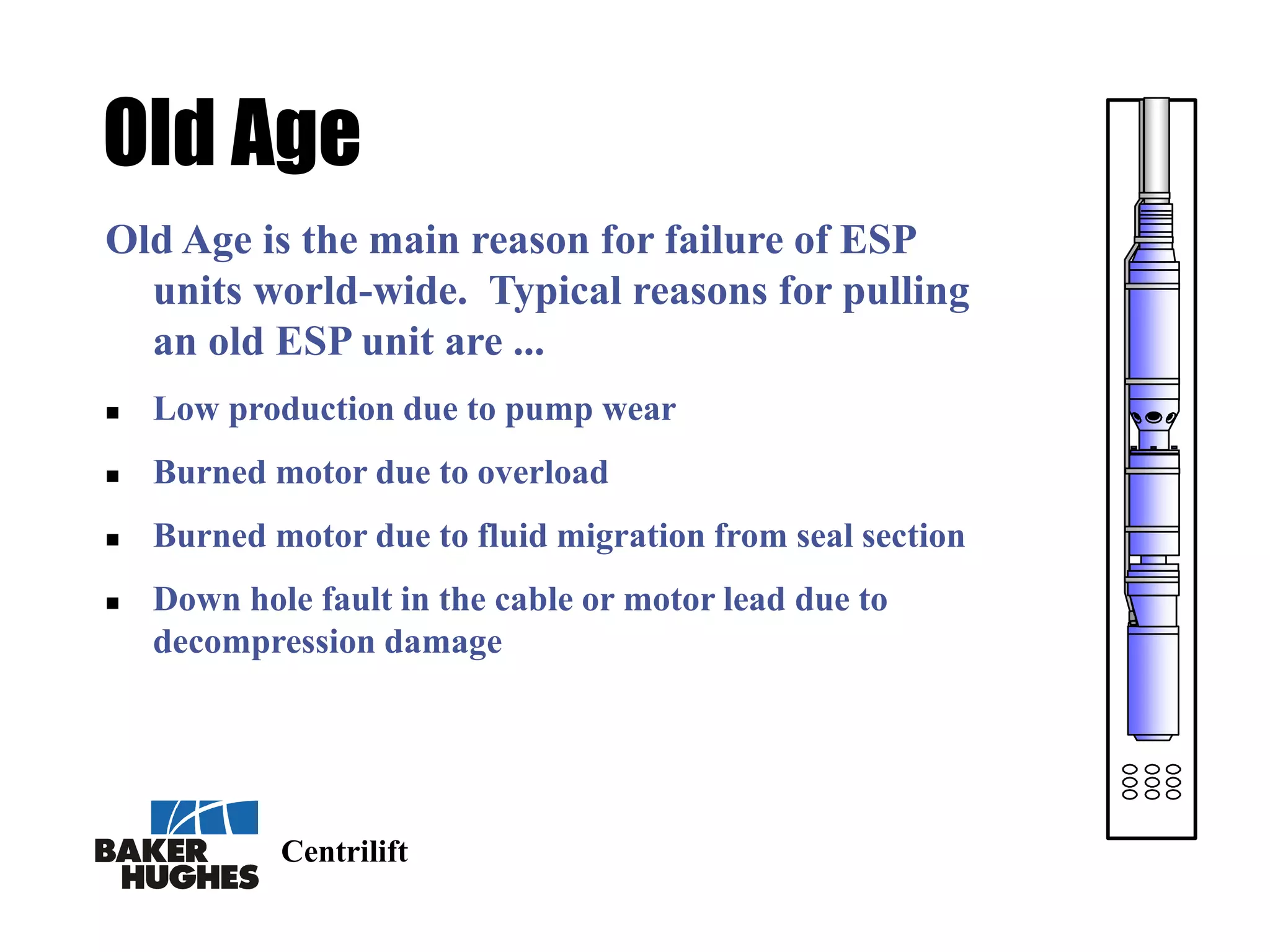
Old Age
Old Age is the main reason for failure of ESP
units world-wide. Typical reasons for pulling
an old ESP unit are ...
 Low production due to pump wear
 Burned motor due to overload
 Burned motor due to fluid migration from seal section
 Down hole fault in the cable or motor lead due to
decompression damage
Centrilift
ESP Operating Parameters and
Troubleshooting
Centrilift
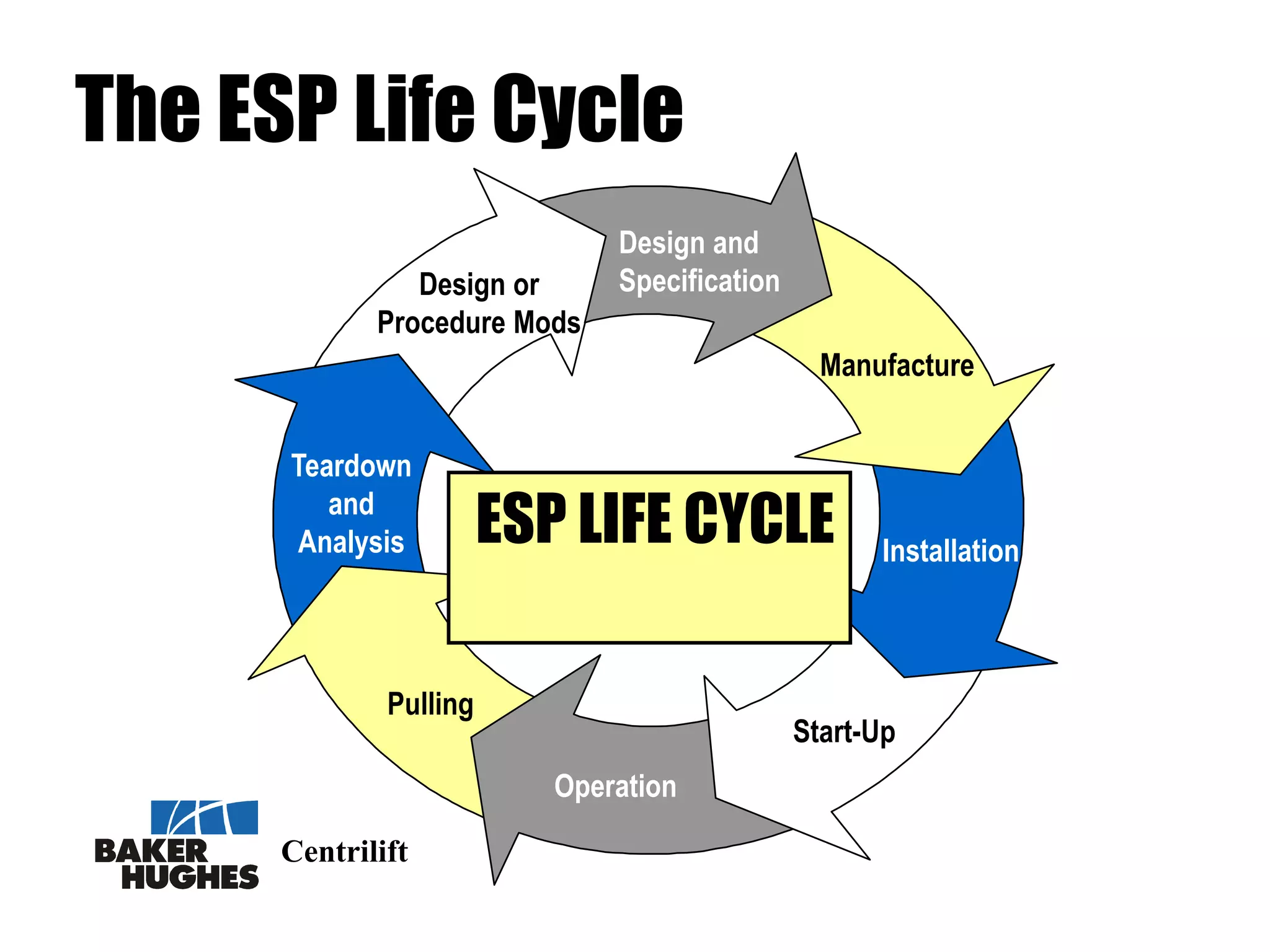
The ESP Life Cycle
Manufacture
Start-Up
Operation
Pulling
Design or
Procedure Mods
Installation
Design and
Specification
Teardown
and
Analysis ESP LIFE CYCLE
Centrilift
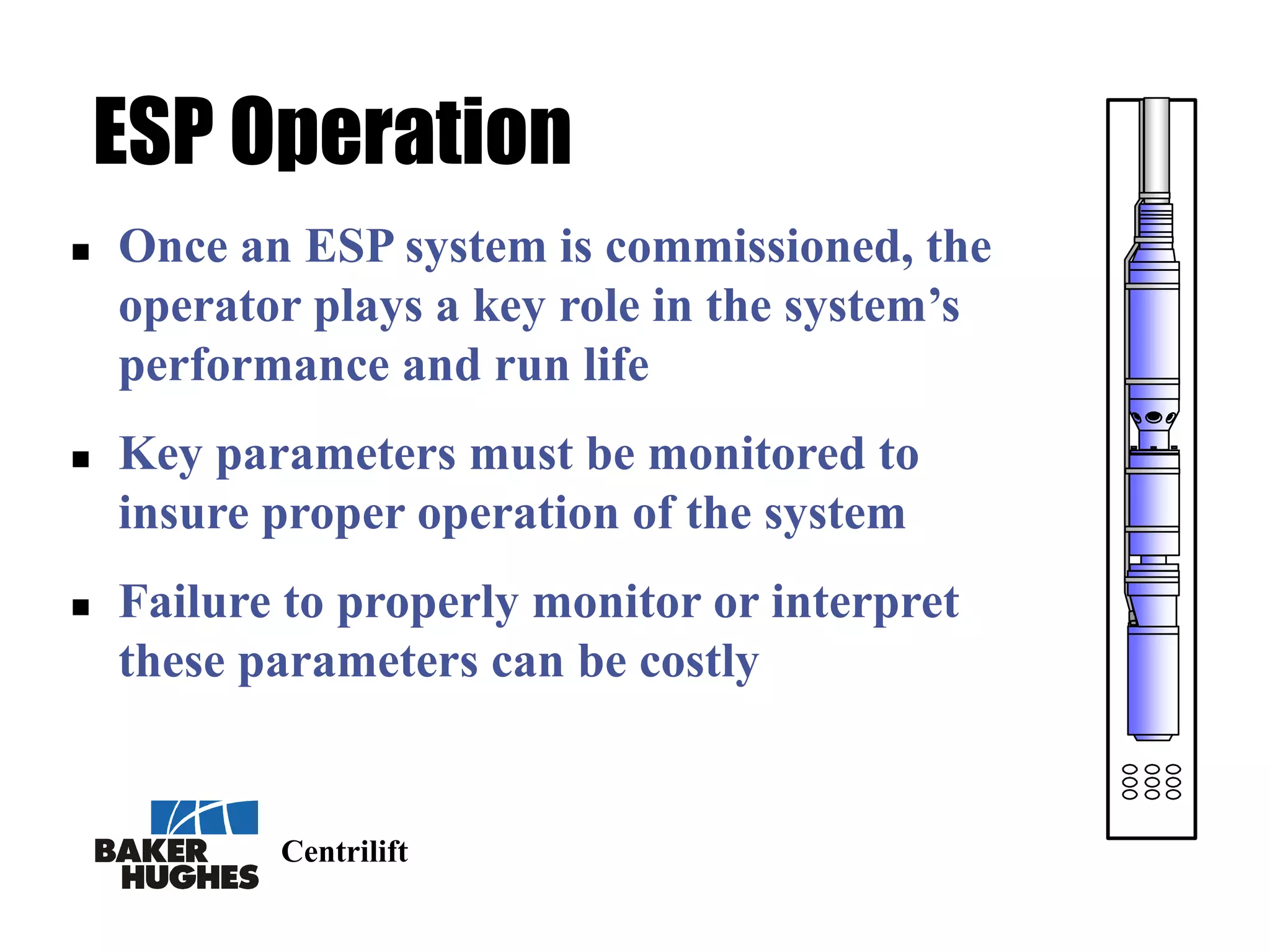
ESP Operation
 Once an ESP system is commissioned, the
operator plays a key role in the system’s
performance and run life
 Key parameters must be monitored to
insure proper operation of the system
 Failure to properly monitor or interpret
these parameters can be costly
Centrilift
Operating Parameters
Three basic ESP operating parameters are …
 Gross Production Rate
 Pump Intake Pressure
 Operating Motor Current
By monitoring these parameters, an Operator can
better determine the relative condition of an ESP or
anticipate possible problems
Centrilift
Production Rate
By monitoring the production rate an operator can …
 Determine the approximate operating point on the pump
curve
 Trend the rate of declining production
 Look for possible pump wear, tubing leaks, etc.
Loss of production is usually the first indicator of a
downhole problem with an ESP
Centrilift
Pump Intake Pressure
By monitoring PIP, an Operator can ...
 Determine relative unit sizing accuracy by comparing
with the computer sizing
 Anticipate unit cycling
 Look for tubing leak, pump plugging and/or wear
Increases or decreases in PIP can indicate a change
in the pump performance, well inflow, or
installation integrity
Centrilift
Motor Current
By monitoring motor current, an Operator can ...
 Look for trends in unit loading
 Spot possible motor damage due to electrical or mechanical problems
 Determine relative pump load or spot changes in loading
 Detect changes in downhole fluid condition
Changes in operating current indicate that the motor is
reacting to a new input from the pump, well, or electrical
system. The Motor Controller should shut the unit off if
the current varies beyond acceptable limits
Centrilift
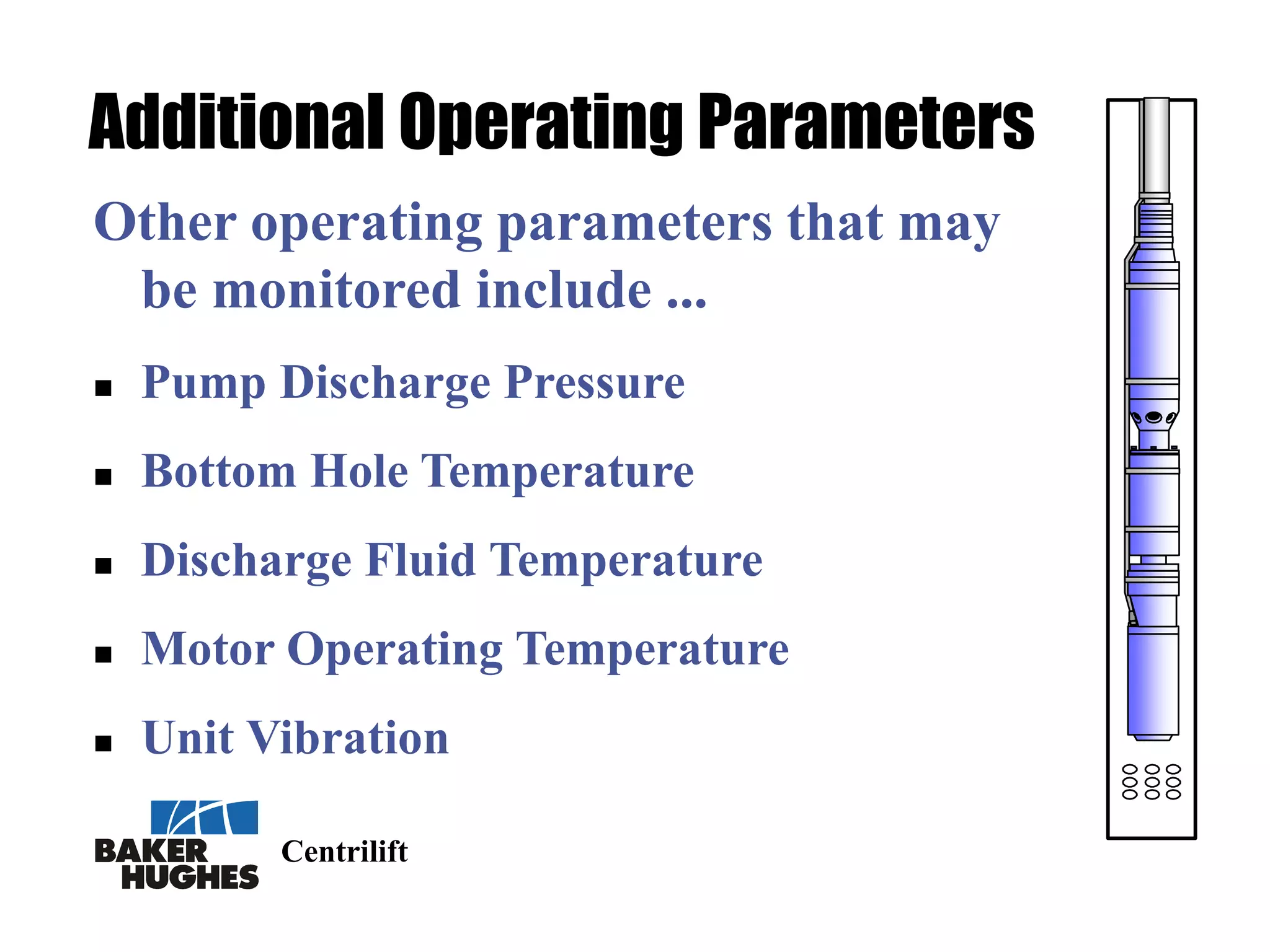
Additional Operating Parameters
Other operating parameters that may
be monitored include ...
 Pump Discharge Pressure
 Bottom Hole Temperature
 Discharge Fluid Temperature
 Motor Operating Temperature
 Unit Vibration
Centrilift
Troubleshooting
 Troubleshooting by an Operator involves looking at
the unit operating parameters, as a group, to
determine a possible cause
 By process of elimination, a cause and affect
sequence can be developed when ESP operating
problems occur
 Failure to check all parameters and/or call for
assistance when required can result in premature
failure of a unit
Centrilift
Troubleshooting Tools
Troubleshooting any system requires the proper tools. In
the case of an ESP system this means information which
includes …
 Well history (including workovers, treatments, etc.)
 Previous ESP run life and failure modes
 Amp charts (prior to and during time of failure)
 Production data and historic trends
 Available bottom hole and surface pressure data
 Information on starts & stops or operator intervention
SPH, p.165-192

4 Run Life Ops.ppt

  • 1.
  • 2.
    Centrilift Run Life Factors The run life of an ESP is based on many factors  Each well is different and may have a combination of factors that limit ESP run life  The run life will be determined by the limiting factor in the well
  • 3.
    Centrilift Common Run LifeFactors  Proper Sizing of Equipment  Well (BHT) Temperature  Free Gas  Viscosity  Corrosion  Sand / Foreign Material Production  Deposition Tendencies  Electrical Failures  Operational Problems  Old Age
  • 4.
    Centrilift Proper Sizing  Propersizing of the ESP unit is the first factor in achieving a long run life  The unit must be sized to operate within the recommended flow range  Well productivity data must be accurate in order to properly size the equipment  Improper sizing can cause the ESP to run outside of operating range causing accelerated pump wear  Inaccurate fluid data can cause the BHP of the pump to be more than predicted which could cause motor overload, and eventually failure
  • 5.
  • 6.
    Centrilift Proper Sizing Solutions Accurate reservoir and inflow performance data  Accurate fluid properties information  Computer models and correlations should reflect well parameters as closely as possible (average percent correlation error 5 - 15%)  Use of a VSC can help to offset sizing inaccuracy by extending the operating range within limits
  • 7.
    Centrilift Variable Speed PumpCurve Head vs. Flow, Variable Speed (30-90 Hz), Single Stage, Sg = 1.0
  • 8.
    Centrilift High Temperature  Bottomhole temperatures greater than 220o F are considered high temperature applications for ESPs  Motor operating temperature is also effected by – % load versus nameplate motor horsepower – Fluid velocity past the motor – % water, % oil, % gas of well fluid past motor – Power quality (unbalanced current, distorted wave form)  The combination of all above factors determines the unit operating temperature
  • 9.
    Centrilift High Temp Solutions ESPscan run for long periods of time in high temperatures wells if the proper equipment is used. The following equipment features are recommended High temp motor oil - retains viscosity at higher temperatures (also has good low temp properties)  High temperature elastomers - EPDM cable insulation and jacket, O-rings, Aflas seal bags  Special construction of rotor assembly in motor to insure proper bearing clearances  De-rating motors for very high temperatures, if required
  • 10.
    Centrilift Free Gas The presenceof free gas can effect the ESPs in many ways...  The pump flow will be reduced or completely stopped as the free gas increases. This is called “gas locking”  The motor will run hotter as the fluid velocity decreases past the motor  The fluid’s cooling properties will decrease as the free gas increases Gassy Well Solutions ...  Separate free gas before it enters the pump stages by rotary or reverse flow separators  Utilize tapered pump stage designs to handle the increased gas volume through the pump
  • 11.
    Centrilift Viscosity High fluid viscositycan cause many problems ...  The specific gravity of the fluid increases, therefore increasing pump brake horsepower  High viscosity also reduces the pumps ability to lift the fluid and its efficiency  Viscous fluid produces more friction loss in the tubing causing the pump to work much harder Viscosity Solutions ...  Size pumps with higher flow stages and higher HP motors  Dilute well fluid with low viscosity crude
  • 12.
    Centrilift Corrosion Corrosive fluid effectsESPs when ...  CO2 causes corrosion of housings, heads, bases, and fasteners of the downhole assembly  CO2 causes corrosion of galvanized cable armor on the power cable, connectors, and MLE  H2S chemically reacts with copper components causing cable conductors to disintegrate  H2S causes sulfide corrosion cracking with certain steels which effects shafts and bolts
  • 13.
    Centrilift Corrosion Solutions For corrosivewells ESPs should have ...  Corrosion resistant housings (9% Cr minimum)  Stainless steel heads, bases, and fasteners  Stainless Steel or Monel cable armor  Monel or Inconel pump and seal shafts to address sulfide corrosion cracking  Lead sheath cable for high H2S environments (defined as above 3% & 180o F or greater)
  • 14.
    Centrilift Sand Abrasion The productionof sand causes ...  Abrasive wear on the pump stages  Excessive shaft pump shaft vibration  Mechanical seal leakage in the seal section  Motor burns due to fluid migration Solutions for sand production are ...  Abrasion resistant pump design which provides for downthrust support and radial shaft stabilization  Slow, steady increase in production of well on initial start up to limit inflow of unconsolidated sand
  • 15.
    Centrilift Foreign Material The productionof foreign material can cause ...  Damage to pump stages if debris is harder than the pump stage material (unit fails similar to abrasion)  Plugging of pump stage vane passages if debris is softer than pump stage material  Low flow by the motor due to partially or totally plugged pump resulting in a burn of the motor or power cable Foreign material solutions ...  Thorough well clean out after each workover  Slow, steady increase in production of well on initial start up to limit inflow of unconsolidated debris and foreign material  Screens
  • 16.
    Centrilift Deposition Deposition on pumpstages cause high brake horsepower, locked stages, &/or restrict pump or tubing Types of deposition are ...  Scale  Asphaltenes  Paraffin  Hydrate / Ice Plugs Deposition Solutions …  Chemical treatment  Tubing heat (except for scale)  Control pump intake pressure (except for hydrates)
  • 17.
    Centrilift Electrical Failures Electrical failuresare caused by factors such as ...  Surface electrical or electronic component failure  Poor Power such as voltage imbalance  Cable failure due to decompression damage or voltage spikes  Overload of the controller or transformer due to changes in downhole or unit conditions
  • 18.
    Centrilift Operating Practices Poor operatingpractices can cause failure of ESPs. The most common are ...  Operating the unit against the closed surface valve for an extended length of time (no flow by the motor will cause the motor or MLE to burn)  Operating the unit in a no-flow or low flow condition with no underload protection (same as above)  Rapid decreases in well bore pressure (can cause decompression damage of power cable, MLE, or penetrators)  Increasing unit production quickly cause rapid inflow of sand or foreign material
  • 19.
    Centrilift Old Age Old Ageis the main reason for failure of ESP units world-wide. Typical reasons for pulling an old ESP unit are ...  Low production due to pump wear  Burned motor due to overload  Burned motor due to fluid migration from seal section  Down hole fault in the cable or motor lead due to decompression damage
  • 20.
  • 21.
    Centrilift The ESP LifeCycle Manufacture Start-Up Operation Pulling Design or Procedure Mods Installation Design and Specification Teardown and Analysis ESP LIFE CYCLE
  • 22.
    Centrilift ESP Operation  Oncean ESP system is commissioned, the operator plays a key role in the system’s performance and run life  Key parameters must be monitored to insure proper operation of the system  Failure to properly monitor or interpret these parameters can be costly
  • 23.
    Centrilift Operating Parameters Three basicESP operating parameters are …  Gross Production Rate  Pump Intake Pressure  Operating Motor Current By monitoring these parameters, an Operator can better determine the relative condition of an ESP or anticipate possible problems
  • 24.
    Centrilift Production Rate By monitoringthe production rate an operator can …  Determine the approximate operating point on the pump curve  Trend the rate of declining production  Look for possible pump wear, tubing leaks, etc. Loss of production is usually the first indicator of a downhole problem with an ESP
  • 25.
    Centrilift Pump Intake Pressure Bymonitoring PIP, an Operator can ...  Determine relative unit sizing accuracy by comparing with the computer sizing  Anticipate unit cycling  Look for tubing leak, pump plugging and/or wear Increases or decreases in PIP can indicate a change in the pump performance, well inflow, or installation integrity
  • 26.
    Centrilift Motor Current By monitoringmotor current, an Operator can ...  Look for trends in unit loading  Spot possible motor damage due to electrical or mechanical problems  Determine relative pump load or spot changes in loading  Detect changes in downhole fluid condition Changes in operating current indicate that the motor is reacting to a new input from the pump, well, or electrical system. The Motor Controller should shut the unit off if the current varies beyond acceptable limits
  • 27.
    Centrilift Additional Operating Parameters Otheroperating parameters that may be monitored include ...  Pump Discharge Pressure  Bottom Hole Temperature  Discharge Fluid Temperature  Motor Operating Temperature  Unit Vibration
  • 28.
    Centrilift Troubleshooting  Troubleshooting byan Operator involves looking at the unit operating parameters, as a group, to determine a possible cause  By process of elimination, a cause and affect sequence can be developed when ESP operating problems occur  Failure to check all parameters and/or call for assistance when required can result in premature failure of a unit
  • 29.
    Centrilift Troubleshooting Tools Troubleshooting anysystem requires the proper tools. In the case of an ESP system this means information which includes …  Well history (including workovers, treatments, etc.)  Previous ESP run life and failure modes  Amp charts (prior to and during time of failure)  Production data and historic trends  Available bottom hole and surface pressure data  Information on starts & stops or operator intervention SPH, p.165-192