Electric Submersible
Pump Overview
Presented by Eng. Mohamed Ibrahim
14th
December 2014
Outlines
Productivity index
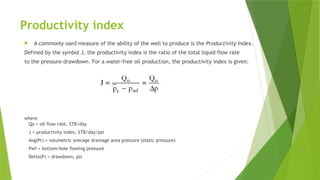
 A commonly used measure of the ability of the well to produce is the Productivity Index.
Defined by the symbol J, the productivity index is the ratio of the total liquid flow rate
to the pressure drawdown. For a water-free oil production, the productivity index is given:
where
Qo = oil flow rate, STB/day
J = productivity index, STB/day/psi
Avg(Pr) = volumetric average drainage area pressure (static pressure)
Pwf = bottom-hole flowing pressure
Delta(P) = drawdown, psi
Well performance:
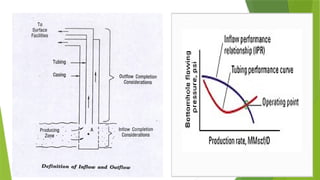
 The inflow system
 The outflow system
Inflow Performance Relationship (IPR)
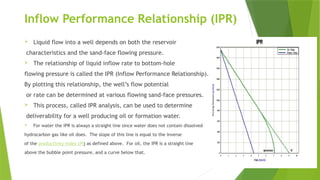
 Liquid flow into a well depends on both the reservoir
characteristics and the sand-face flowing pressure.
 The relationship of liquid inflow rate to bottom-hole
flowing pressure is called the IPR (Inflow Performance Relationship).
By plotting this relationship, the well’s flow potential
or rate can be determined at various flowing sand-face pressures.
 This process, called IPR analysis, can be used to determine
deliverability for a well producing oil or formation water.
 For water the IPR is always a straight line since water does not contain dissolved
hydrocarbon gas like oil does. The slope of this line is equal to the inverse
of the productivity index (PI) as defined above. For oil, the IPR is a straight line
above the bubble point pressure, and a curve below that.
Out-Flow Performance Curve
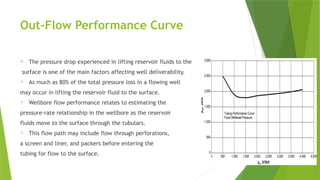
 The pressure drop experienced in lifting reservoir fluids to the
surface is one of the main factors affecting well deliverability.
 As much as 80% of the total pressure loss in a flowing well
may occur in lifting the reservoir fluid to the surface.
 Wellbore flow performance relates to estimating the
pressure-rate relationship in the wellbore as the reservoir
fluids move to the surface through the tubulars.
 This flow path may include flow through perforations,
a screen and liner, and packers before entering the
tubing for flow to the surface.
Artificial lift system:
 It is the use of additional energy to produce reservoir
fluids (original reservoir pressure not sufficient to produce
it or optimize the produced reservoir fluids flowing rates
below allowable or forecasted)
What is needed before artificial lift ?
 Investigate the need of artificial lift.
 Selecting the suitable lift system.
 Determine its size and capacity
Production forecast for fields
Max. capacity for prod. facilities
Objective of artificial lift:
 Decrease bottom hole flowing pressure.
 Increase production rate.
 Extend reservoir life time.
Factors to be considered before start
artificial lift project:
 Fluids volumes
 Well depth
 Expected GLR
 Tubular size
 Hole deviation
 Solids (sand,…) corrosive materials
Methods of artificial lift:
 Rod pumping.
 Electric submersible pump (ESP).
 Jet pump
 Gas lift
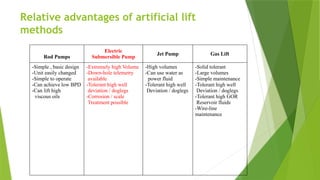
Relative advantages of artificial lift
methods
Rod Pumps
Electric
Submersible Pump
Jet Pump Gas Lift
-Simple , basic design
-Unit easily changed
-Simple to operate
-Can achieve low BPD
-Can lift high
viscous oils
-Extremely high Volume
-Down-hole telemetry
available
-Tolerant high well
deviation / doglegs
-Corrosion / scale
Treatment possible
-High volumes
-Can use water as
power fluid
-Tolerant high well
Deviation / doglegs
-Solid tolerant
-Large volumes
-Simple maintenance
-Tolerant high well
Deviation / doglegs
-Tolerant high GOR
Reservoir fluids
-Wire-line
maintenance
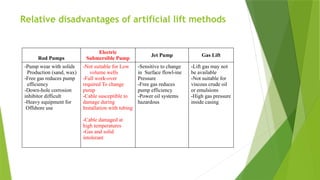
Relative disadvantages of artificial lift methods
Rod Pumps
Electric
Submersible Pump
Jet Pump Gas Lift
-Pump wear with solids
Production (sand, wax)
-Free gas reduces pump
efficiency
-Down-hole corrosion
inhibitor difficult
-Heavy equipment for
Offshore use
-Not suitable for Low
volume wells
-Full work-over
required To change
pump
-Cable susceptible to
damage during
Installation with tubing
-Cable damaged at
high temperatures
-Gas and solid
intolerant
-Sensitive to change
in Surface flowl-ine
Pressure
-Free gas reduces
pump efficiency
-Power oil systems
hazardous
-Lift gas may not
be available
-Not suitable for
viscous crude oil
or emulsions
-High gas pressure
inside casing
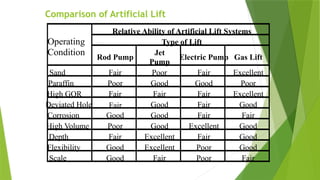
Comparison of Artificial Lift
Relative Ability of Artificial Lift Systems
Type of Lift
Operating
Condition Rod Pump
Jet
Pump
Electric Pump Gas Lift
Sand Fair Poor Fair Excellent
Paraffin Poor Good Good Poor
High GOR Fair Fair Fair Excellent
Deviated Hole Good Fair Good
Corrosion Good Good Fair Fair
High Volume Poor Good Excellent Good
Depth Fair Excellent Fair Good
Flexibility Good Excellent Poor Good
Scale Good Fair Poor Fair
Fair
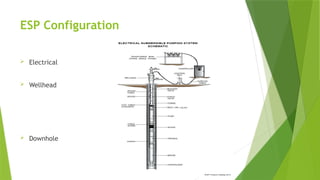
ESP Configuration
 Electrical
 Wellhead
 Downhole
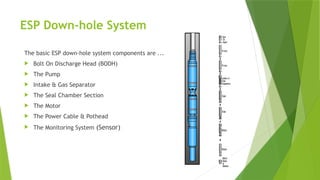
ESP Down-hole System
The basic ESP down-hole system components are ...
 Bolt On Discharge Head (BODH)
 The Pump
 Intake & Gas Separator
 The Seal Chamber Section
 The Motor
 The Power Cable & Pothead
 The Monitoring System (Sensor)
ESP Down-hole System
The system …
 Should be set above the perforations of the well for unit
cooling.
 Must be sized to specific well data like (Fluid Level, Fluid
gradient/composition, Viscosity, GOR, Corrosives, Scale /
Asphaltene / Paraffin).
 Should be monitored for changes in well and/or unit
performance.
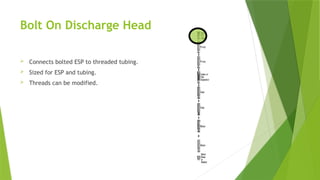
Bolt On Discharge Head
 Connects bolted ESP to threaded tubing.
 Sized for ESP and tubing.
 Threads can be modified.
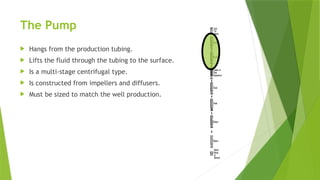
The Pump
 Hangs from the production tubing.
 Lifts the fluid through the tubing to the surface.
 Is a multi-stage centrifugal type.
 Is constructed from impellers and diffusers.
 Must be sized to match the well production.
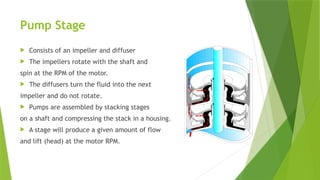
Pump Stage
 Consists of an impeller and diffuser
 The impellers rotate with the shaft and
spin at the RPM of the motor.
 The diffusers turn the fluid into the next
impeller and do not rotate.
 Pumps are assembled by stacking stages
on a shaft and compressing the stack in a housing.
 A stage will produce a given amount of flow
and lift (head) at the motor RPM.
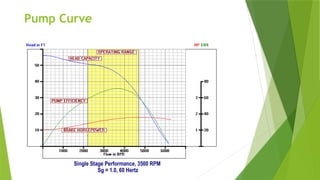
Pump Performance
 Pump stage performance has three measured parameters which are…
 Flow Rate
 Lift (aka “Head”) or Discharge Pressure
 Brake Horsepower or Motor Load
 From the above, Hydraulic Efficiency may be calculated
 The following slide shows these parameters plotted on a single stage
performance curve.
Single Stage Performance, 3500 RPM
Sg = 1.0, 60 Hertz
Pump Curve
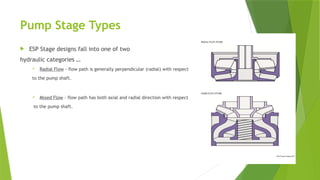
Pump Stage Types
 ESP Stage designs fall into one of two
hydraulic categories …
 Radial Flow - flow path is generally perpendicular (radial) with respect
to the pump shaft.
 Mixed Flow - flow path has both axial and radial direction with respect
to the pump shaft.
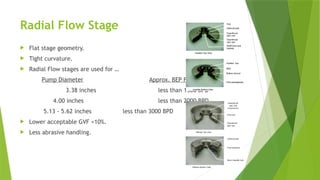
Radial Flow Stage
 Flat stage geometry.
 Tight curvature.
 Radial Flow stages are used for …
Pump Diameter Approx. BEP Flow
3.38 inches less than 1500 BPD
4.00 inches less than 2000 BPD
5.13 - 5.62 inches less than 3000 BPD
 Lower acceptable GVF <10%.
 Less abrasive handling.
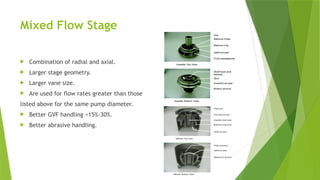
Mixed Flow Stage
 Combination of radial and axial.
 Larger stage geometry.
 Larger vane size.
 Are used for flow rates greater than those
listed above for the same pump diameter.
 Better GVF handling <15%-30%.
 Better abrasive handling.
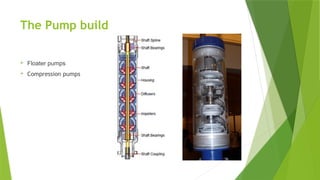
The Pump build
 Floater pumps
 Compression pumps
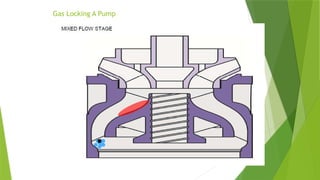
Gas Locking A Pump
Pump Thrust Load
 Under normal operating conditions, fluid recirculation on the top and bottom
side of the impeller cause forces to be applied on the upper and lower
impeller shrouds.
 When the recirculation forces are greater on the upper shroud, the impeller is
moved down which is termed “downthrust”.
 When the recirculation forces are greater on the lower shroud, the impeller is
moved up which is termed “upthrust”.
 The magnitude recirculation forces depends upon the flow rate going thru the
impeller vs. its hydraulic capacity, i.e., its operating range.
Variable Speed Operation
ESPs may also be ran at variable speeds. Changing the speed or frequency of an
ESP system follows the “Affinity Laws” …
 New Flow Rate = Old Flow (New Hz/Old Hz)
 New Head = Old Head (New Hz/Old Hz)2
 New Brake HP = Old BHP (New Hz/Old Hz)3
 New Motor HP = Old MHP (New Hz/Old Hz)
As can be seen above, the pump load or brake HP changes at a greater rate than
the motor HP. This makes matching the motor and pump size at maximum
frequency critical to a good application and long run life.
Variable Speed Performance
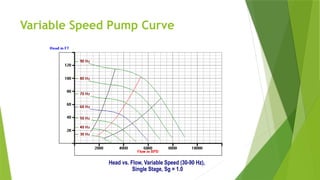
 Using the Affinity Laws, a single stage performance curve may be plotted
using the 60 Hz fixed speed performance data as a reference.
 Head versus Flow is plotted resulting in a new operating range for the
recommended frequency limits (30 - 90 Hertz).
 The shape of the operating range is known as the “Tornado”. Variable speed
curves are sometimes called “Tornado Curves”.
Variable Speed Pump Curve
Head vs. Flow, Variable Speed (30-90 Hz),
Single Stage, Sg = 1.0
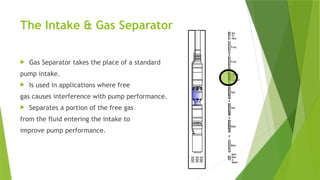
The Intake & Gas Separator
 Gas Separator takes the place of a standard
pump intake.
 Is used in applications where free
gas causes interference with pump performance.
 Separates a portion of the free gas
from the fluid entering the intake to
improve pump performance.
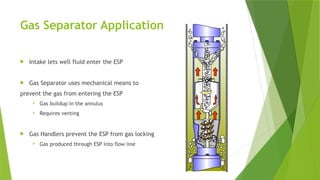
Gas Separator Application
 Intake lets well fluid enter the ESP
 Gas Separator uses mechanical means to
prevent the gas from entering the ESP
 Gas buildup in the annulus
 Requires venting
 Gas Handlers prevent the ESP from gas locking
 Gas produced through ESP into flow line
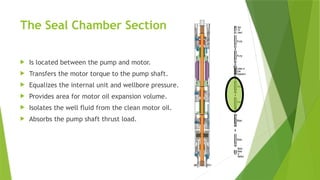
The Seal Chamber Section
 Is located between the pump and motor.
 Transfers the motor torque to the pump shaft.
 Equalizes the internal unit and wellbore pressure.
 Provides area for motor oil expansion volume.
 Isolates the well fluid from the clean motor oil.
 Absorbs the pump shaft thrust load.
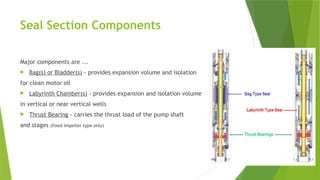
Seal Section Components
Major components are ...
 Bag(s) or Bladder(s) - provides expansion volume and isolation
for clean motor oil
 Labyrinth Chamber(s) - provides expansion and isolation volume
in vertical or near vertical wells
 Thrust Bearing - carries the thrust load of the pump shaft
and stages (fixed impeller type only)
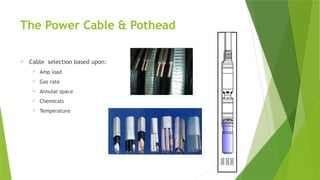
The Power Cable & Pothead
 Cable selection based upon:
 Amp load
 Gas rate
 Annular space
 Chemicals
 Temperature
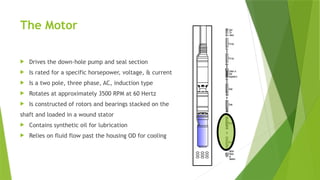
The Motor
 Drives the down-hole pump and seal section
 Is rated for a specific horsepower, voltage, & current
 Is a two pole, three phase, AC, induction type
 Rotates at approximately 3500 RPM at 60 Hertz
 Is constructed of rotors and bearings stacked on the
shaft and loaded in a wound stator
 Contains synthetic oil for lubrication
 Relies on fluid flow past the housing OD for cooling
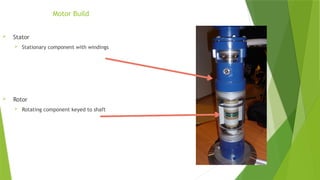
Motor Build
 Stator
 Stationary component with windings
 Rotor
 Rotating component keyed to shaft
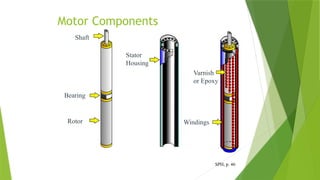
Motor Components
Bearing
Shaft
Rotor
Varnish
or Epoxy
Windings
Stator
Housing
SPH, p. 46
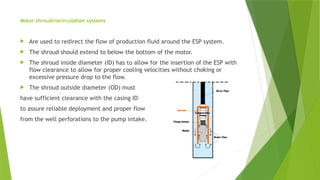
Motor shroud/recirculation systems
 Are used to redirect the flow of production fluid around the ESP system.
 The shroud should extend to below the bottom of the motor.
 The shroud inside diameter (ID) has to allow for the insertion of the ESP with
flow clearance to allow for proper cooling velocities without choking or
excessive pressure drop to the flow.
 The shroud outside diameter (OD) must
have sufficient clearance with the casing ID
to assure reliable deployment and proper flow
from the well perforations to the pump intake.
Motor Operation
 Motors are rated by horsepower, voltage, & current.
 At a constant voltage, by varying the pump load or brake horsepower applied to the motor,
current will change.
 At a constant load, by varying voltage, current will vary, as well.
Motor operating temperature is determined by 5 factors
 Wellbore Temperature
 Load percentage.
 Fluid Velocity Past Motor (flow rate vs. unit/casing diameter)
 Cooling Properties of the Well Fluid (% gas, water cut, scaling tendencies, etc.)
 Motors can operate at 163 °C well temperature
 Special motors can operate up to 250 °C well temperature.
 During operation, even hot fluid will remove excess heat from the motor, cooling it.
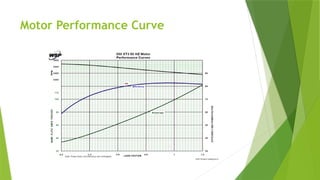
Motor Performance Curve
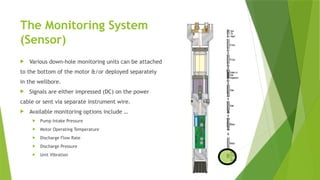
The Monitoring System
(Sensor)
 Various down-hole monitoring units can be attached
to the bottom of the motor &/or deployed separately
in the wellbore.
 Signals are either impressed (DC) on the power
cable or sent via separate instrument wire.
 Available monitoring options include …
 Pump Intake Pressure
 Motor Operating Temperature
 Discharge Flow Rate
 Discharge Pressure
 Unit Vibration
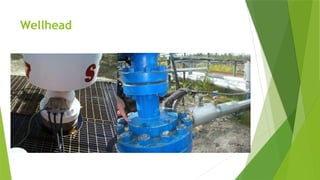
Wellhead
The Surface Equipment
 The Motor Controller
 The Transformer(s)
 The Junction or “Vent” Box
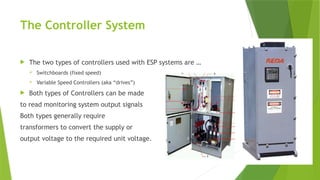
The Controller System
 The two types of controllers used with ESP systems are …
 Switchboards (fixed speed)
 Variable Speed Controllers (aka “drives”)
 Both types of Controllers can be made
to read monitoring system output signals
Both types generally require
transformers to convert the supply or
output voltage to the required unit voltage.
The Transformer
 Converts supply voltage and current to a level at or near
the required system voltage and current
 Must be of a special design to work properly with VSCs
 Should be sized to be greater than or equal to the
required total KVA of the down-hole system
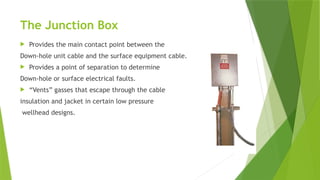
The Junction Box
 Provides the main contact point between the
Down-hole unit cable and the surface equipment cable.
 Provides a point of separation to determine
Down-hole or surface electrical faults.
 “Vents” gasses that escape through the cable
insulation and jacket in certain low pressure
wellhead designs.
For Your Information
 In any discussion of centrifugal pumps you will find that there are several terms that are interrelated:
 Head
 Capacity
 Horsepower consumption
 Efficiency
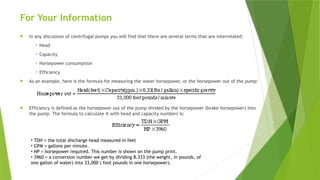
 As an example, here is the formula for measuring the water horsepower, or the horsepower out of the pump:
 Efficiency is defined as the horsepower out of the pump divided by the horsepower (brake horsepower) into
the pump. The formula to calculate it with head and capacity numbers is:
• TDH = the total discharge head measured in feet
• GPM = gallons per minute.
• HP = horsepower required. This number is shown on the pump print.
• 3960 = a conversion number we get by dividing 8.333 (the weight, in pounds, of
one gallon of water) into 33,000 ( foot pounds in one horsepower).
Electric Submersible Pump Overview  Pump Overview

Electric Submersible Pump Overview Pump Overview

  • 1.
    Electric Submersible Pump Overview Presentedby Eng. Mohamed Ibrahim 14th December 2014
  • 2.
  • 3.
    Productivity index  Acommonly used measure of the ability of the well to produce is the Productivity Index. Defined by the symbol J, the productivity index is the ratio of the total liquid flow rate to the pressure drawdown. For a water-free oil production, the productivity index is given: where Qo = oil flow rate, STB/day J = productivity index, STB/day/psi Avg(Pr) = volumetric average drainage area pressure (static pressure) Pwf = bottom-hole flowing pressure Delta(P) = drawdown, psi
  • 4.
    Well performance:  Theinflow system  The outflow system
  • 5.
    Inflow Performance Relationship(IPR)  Liquid flow into a well depends on both the reservoir characteristics and the sand-face flowing pressure.  The relationship of liquid inflow rate to bottom-hole flowing pressure is called the IPR (Inflow Performance Relationship). By plotting this relationship, the well’s flow potential or rate can be determined at various flowing sand-face pressures.  This process, called IPR analysis, can be used to determine deliverability for a well producing oil or formation water.  For water the IPR is always a straight line since water does not contain dissolved hydrocarbon gas like oil does. The slope of this line is equal to the inverse of the productivity index (PI) as defined above. For oil, the IPR is a straight line above the bubble point pressure, and a curve below that.
  • 6.
    Out-Flow Performance Curve The pressure drop experienced in lifting reservoir fluids to the surface is one of the main factors affecting well deliverability.  As much as 80% of the total pressure loss in a flowing well may occur in lifting the reservoir fluid to the surface.  Wellbore flow performance relates to estimating the pressure-rate relationship in the wellbore as the reservoir fluids move to the surface through the tubulars.  This flow path may include flow through perforations, a screen and liner, and packers before entering the tubing for flow to the surface.
  • 8.
    Artificial lift system: It is the use of additional energy to produce reservoir fluids (original reservoir pressure not sufficient to produce it or optimize the produced reservoir fluids flowing rates below allowable or forecasted)
  • 9.
    What is neededbefore artificial lift ?  Investigate the need of artificial lift.  Selecting the suitable lift system.  Determine its size and capacity Production forecast for fields Max. capacity for prod. facilities
  • 10.
    Objective of artificiallift:  Decrease bottom hole flowing pressure.  Increase production rate.  Extend reservoir life time.
  • 11.
    Factors to beconsidered before start artificial lift project:  Fluids volumes  Well depth  Expected GLR  Tubular size  Hole deviation  Solids (sand,…) corrosive materials
  • 12.
    Methods of artificiallift:  Rod pumping.  Electric submersible pump (ESP).  Jet pump  Gas lift
  • 13.
    Relative advantages ofartificial lift methods Rod Pumps Electric Submersible Pump Jet Pump Gas Lift -Simple , basic design -Unit easily changed -Simple to operate -Can achieve low BPD -Can lift high viscous oils -Extremely high Volume -Down-hole telemetry available -Tolerant high well deviation / doglegs -Corrosion / scale Treatment possible -High volumes -Can use water as power fluid -Tolerant high well Deviation / doglegs -Solid tolerant -Large volumes -Simple maintenance -Tolerant high well Deviation / doglegs -Tolerant high GOR Reservoir fluids -Wire-line maintenance
  • 14.
    Relative disadvantages ofartificial lift methods Rod Pumps Electric Submersible Pump Jet Pump Gas Lift -Pump wear with solids Production (sand, wax) -Free gas reduces pump efficiency -Down-hole corrosion inhibitor difficult -Heavy equipment for Offshore use -Not suitable for Low volume wells -Full work-over required To change pump -Cable susceptible to damage during Installation with tubing -Cable damaged at high temperatures -Gas and solid intolerant -Sensitive to change in Surface flowl-ine Pressure -Free gas reduces pump efficiency -Power oil systems hazardous -Lift gas may not be available -Not suitable for viscous crude oil or emulsions -High gas pressure inside casing
  • 15.
    Comparison of ArtificialLift Relative Ability of Artificial Lift Systems Type of Lift Operating Condition Rod Pump Jet Pump Electric Pump Gas Lift Sand Fair Poor Fair Excellent Paraffin Poor Good Good Poor High GOR Fair Fair Fair Excellent Deviated Hole Good Fair Good Corrosion Good Good Fair Fair High Volume Poor Good Excellent Good Depth Fair Excellent Fair Good Flexibility Good Excellent Poor Good Scale Good Fair Poor Fair Fair
  • 16.
  • 17.
    ESP Down-hole System Thebasic ESP down-hole system components are ...  Bolt On Discharge Head (BODH)  The Pump  Intake & Gas Separator  The Seal Chamber Section  The Motor  The Power Cable & Pothead  The Monitoring System (Sensor)
  • 18.
    ESP Down-hole System Thesystem …  Should be set above the perforations of the well for unit cooling.  Must be sized to specific well data like (Fluid Level, Fluid gradient/composition, Viscosity, GOR, Corrosives, Scale / Asphaltene / Paraffin).  Should be monitored for changes in well and/or unit performance.
  • 19.
    Bolt On DischargeHead  Connects bolted ESP to threaded tubing.  Sized for ESP and tubing.  Threads can be modified.
  • 20.
    The Pump  Hangsfrom the production tubing.  Lifts the fluid through the tubing to the surface.  Is a multi-stage centrifugal type.  Is constructed from impellers and diffusers.  Must be sized to match the well production.
  • 21.
    Pump Stage  Consistsof an impeller and diffuser  The impellers rotate with the shaft and spin at the RPM of the motor.  The diffusers turn the fluid into the next impeller and do not rotate.  Pumps are assembled by stacking stages on a shaft and compressing the stack in a housing.  A stage will produce a given amount of flow and lift (head) at the motor RPM.
  • 22.
    Pump Performance  Pumpstage performance has three measured parameters which are…  Flow Rate  Lift (aka “Head”) or Discharge Pressure  Brake Horsepower or Motor Load  From the above, Hydraulic Efficiency may be calculated  The following slide shows these parameters plotted on a single stage performance curve.
  • 23.
    Single Stage Performance,3500 RPM Sg = 1.0, 60 Hertz Pump Curve
  • 24.
    Pump Stage Types ESP Stage designs fall into one of two hydraulic categories …  Radial Flow - flow path is generally perpendicular (radial) with respect to the pump shaft.  Mixed Flow - flow path has both axial and radial direction with respect to the pump shaft.
  • 25.
    Radial Flow Stage Flat stage geometry.  Tight curvature.  Radial Flow stages are used for … Pump Diameter Approx. BEP Flow 3.38 inches less than 1500 BPD 4.00 inches less than 2000 BPD 5.13 - 5.62 inches less than 3000 BPD  Lower acceptable GVF <10%.  Less abrasive handling.
  • 26.
    Mixed Flow Stage Combination of radial and axial.  Larger stage geometry.  Larger vane size.  Are used for flow rates greater than those listed above for the same pump diameter.  Better GVF handling <15%-30%.  Better abrasive handling.
  • 27.
    The Pump build Floater pumps  Compression pumps
  • 28.
  • 29.
    Pump Thrust Load Under normal operating conditions, fluid recirculation on the top and bottom side of the impeller cause forces to be applied on the upper and lower impeller shrouds.  When the recirculation forces are greater on the upper shroud, the impeller is moved down which is termed “downthrust”.  When the recirculation forces are greater on the lower shroud, the impeller is moved up which is termed “upthrust”.  The magnitude recirculation forces depends upon the flow rate going thru the impeller vs. its hydraulic capacity, i.e., its operating range.
  • 30.
    Variable Speed Operation ESPsmay also be ran at variable speeds. Changing the speed or frequency of an ESP system follows the “Affinity Laws” …  New Flow Rate = Old Flow (New Hz/Old Hz)  New Head = Old Head (New Hz/Old Hz)2  New Brake HP = Old BHP (New Hz/Old Hz)3  New Motor HP = Old MHP (New Hz/Old Hz) As can be seen above, the pump load or brake HP changes at a greater rate than the motor HP. This makes matching the motor and pump size at maximum frequency critical to a good application and long run life.
  • 31.
    Variable Speed Performance Using the Affinity Laws, a single stage performance curve may be plotted using the 60 Hz fixed speed performance data as a reference.  Head versus Flow is plotted resulting in a new operating range for the recommended frequency limits (30 - 90 Hertz).  The shape of the operating range is known as the “Tornado”. Variable speed curves are sometimes called “Tornado Curves”.
  • 32.
    Variable Speed PumpCurve Head vs. Flow, Variable Speed (30-90 Hz), Single Stage, Sg = 1.0
  • 33.
    The Intake &Gas Separator  Gas Separator takes the place of a standard pump intake.  Is used in applications where free gas causes interference with pump performance.  Separates a portion of the free gas from the fluid entering the intake to improve pump performance.
  • 34.
    Gas Separator Application Intake lets well fluid enter the ESP  Gas Separator uses mechanical means to prevent the gas from entering the ESP  Gas buildup in the annulus  Requires venting  Gas Handlers prevent the ESP from gas locking  Gas produced through ESP into flow line
  • 35.
    The Seal ChamberSection  Is located between the pump and motor.  Transfers the motor torque to the pump shaft.  Equalizes the internal unit and wellbore pressure.  Provides area for motor oil expansion volume.  Isolates the well fluid from the clean motor oil.  Absorbs the pump shaft thrust load.
  • 36.
    Seal Section Components Majorcomponents are ...  Bag(s) or Bladder(s) - provides expansion volume and isolation for clean motor oil  Labyrinth Chamber(s) - provides expansion and isolation volume in vertical or near vertical wells  Thrust Bearing - carries the thrust load of the pump shaft and stages (fixed impeller type only)
  • 37.
    The Power Cable& Pothead  Cable selection based upon:  Amp load  Gas rate  Annular space  Chemicals  Temperature
  • 38.
    The Motor  Drivesthe down-hole pump and seal section  Is rated for a specific horsepower, voltage, & current  Is a two pole, three phase, AC, induction type  Rotates at approximately 3500 RPM at 60 Hertz  Is constructed of rotors and bearings stacked on the shaft and loaded in a wound stator  Contains synthetic oil for lubrication  Relies on fluid flow past the housing OD for cooling
  • 39.
    Motor Build  Stator Stationary component with windings  Rotor  Rotating component keyed to shaft
  • 40.
  • 41.
    Motor shroud/recirculation systems Are used to redirect the flow of production fluid around the ESP system.  The shroud should extend to below the bottom of the motor.  The shroud inside diameter (ID) has to allow for the insertion of the ESP with flow clearance to allow for proper cooling velocities without choking or excessive pressure drop to the flow.  The shroud outside diameter (OD) must have sufficient clearance with the casing ID to assure reliable deployment and proper flow from the well perforations to the pump intake.
  • 42.
    Motor Operation  Motorsare rated by horsepower, voltage, & current.  At a constant voltage, by varying the pump load or brake horsepower applied to the motor, current will change.  At a constant load, by varying voltage, current will vary, as well. Motor operating temperature is determined by 5 factors  Wellbore Temperature  Load percentage.  Fluid Velocity Past Motor (flow rate vs. unit/casing diameter)  Cooling Properties of the Well Fluid (% gas, water cut, scaling tendencies, etc.)  Motors can operate at 163 °C well temperature  Special motors can operate up to 250 °C well temperature.  During operation, even hot fluid will remove excess heat from the motor, cooling it.
  • 43.
  • 44.
    The Monitoring System (Sensor) Various down-hole monitoring units can be attached to the bottom of the motor &/or deployed separately in the wellbore.  Signals are either impressed (DC) on the power cable or sent via separate instrument wire.  Available monitoring options include …  Pump Intake Pressure  Motor Operating Temperature  Discharge Flow Rate  Discharge Pressure  Unit Vibration
  • 45.
  • 46.
    The Surface Equipment The Motor Controller  The Transformer(s)  The Junction or “Vent” Box
  • 47.
    The Controller System The two types of controllers used with ESP systems are …  Switchboards (fixed speed)  Variable Speed Controllers (aka “drives”)  Both types of Controllers can be made to read monitoring system output signals Both types generally require transformers to convert the supply or output voltage to the required unit voltage.
  • 48.
    The Transformer  Convertssupply voltage and current to a level at or near the required system voltage and current  Must be of a special design to work properly with VSCs  Should be sized to be greater than or equal to the required total KVA of the down-hole system
  • 49.
    The Junction Box Provides the main contact point between the Down-hole unit cable and the surface equipment cable.  Provides a point of separation to determine Down-hole or surface electrical faults.  “Vents” gasses that escape through the cable insulation and jacket in certain low pressure wellhead designs.
  • 50.
    For Your Information In any discussion of centrifugal pumps you will find that there are several terms that are interrelated:  Head  Capacity  Horsepower consumption  Efficiency  As an example, here is the formula for measuring the water horsepower, or the horsepower out of the pump:  Efficiency is defined as the horsepower out of the pump divided by the horsepower (brake horsepower) into the pump. The formula to calculate it with head and capacity numbers is: • TDH = the total discharge head measured in feet • GPM = gallons per minute. • HP = horsepower required. This number is shown on the pump print. • 3960 = a conversion number we get by dividing 8.333 (the weight, in pounds, of one gallon of water) into 33,000 ( foot pounds in one horsepower).