Lecture 4
Self-exploration
as the Process for
Value Education
2
About this workshop/course
Process of self-exploration
(in more detail)
We will also explore:
Do we have the potential to
recognize what is right?
Can we be self-referential?
इस शिशिर/course क
े बारे
अध्ययन प्रशिया
(शिस्तार)
हम लोग यह भी जाांचेंगे शक:
क्या हम में सही को पहचान पाने की क्षमता
है?
क्या हम स्वतांत्र हो सकते हैं?
Content of this Session इस सत्र कि किषय-िास्तु
3
What is this Workshop / Course ;g f'kfOkj D;k gS
1. It is a process of dialogue – between me and you, to begin with
;g laokn dh izfØ;k gSA ;g laokn vkids vkSj esjs chp 'kq: gksrk
gSA
2. It soon becomes a dialogue within your own Self…
“kh?kz gh ;g laokn vkids Lo;a eas pyus yxrk gSA
4
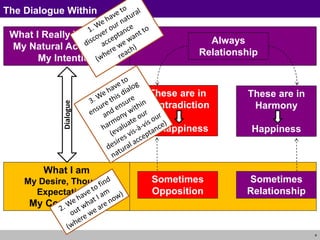
The Dialogue Within
What I Really Want to Be
My Natural Acceptance
My Intention
What I am
My Desire, Thought,
Expectation…
My Competence
Dialogue
Always
Relationship
Sometimes
Relationship
Sometimes
Opposition
These are in
Harmony
Happiness
These are in
Contradiction
Unhappiness
5
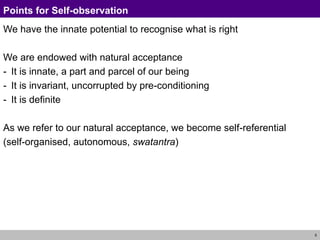
Points for Self-observation
We have the innate potential to recognise what is right
We are endowed with natural acceptance
- It is innate, a part and parcel of our being
- It is invariant, uncorrupted by pre-conditioning
- It is definite
As we refer to our natural acceptance, we become self-referential
(self-organised, autonomous, swatantra)
6
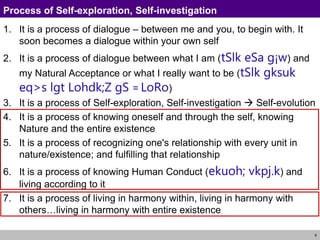
1. It is a process of dialogue – between me and you, to begin with. It
soon becomes a dialogue within your own self
2. It is a process of dialogue between what I am (tSlk eSa g¡w) and
my Natural Acceptance or what I really want to be (tSlk gksuk
eq>s lgt Lohdk;Z gS = LoRo)
3. It is a process of Self-exploration, Self-investigation  Self-evolution
4. It is a process of knowing oneself and through the self, knowing
Nature and the entire existence
5. It is a process of recognizing one's relationship with every unit in
nature/existence; and fulfilling that relationship
6. It is a process of knowing Human Conduct (ekuoh; vkpj.k) and
living according to it
7. It is a process of living in harmony within, living in harmony with
others…living in harmony with entire existence
Process of Self-exploration, Self-investigation
8
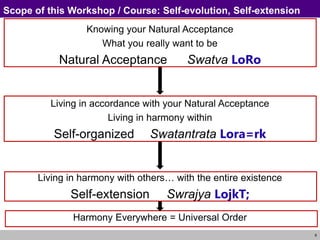
Scope of this Workshop / Course: Self-evolution, Self-extension
Knowing your Natural Acceptance
What you really want to be
Natural Acceptance Swatva LoRo
Living in accordance with your Natural Acceptance
Living in harmony within
Self-organized Swatantrata Lora=rk
Living in harmony with others… with the entire existence
Self-extension Swrajya LojkT;
Harmony Everywhere = Universal Order
11
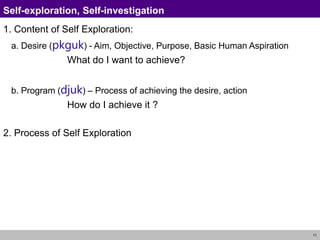
Self-exploration, Self-investigation
1. Content of Self Exploration:
a. Desire (pkguk) - Aim, Objective, Purpose, Basic Human Aspiration
What do I want to achieve?
b. Program (djuk) – Process of achieving the desire, action
How do I achieve it ?
2. Process of Self Exploration
12
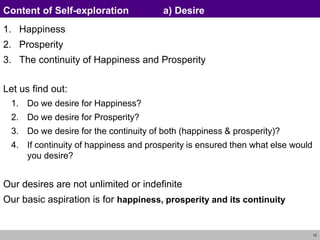
Content of Self-exploration a) Desire
1. Happiness
2. Prosperity
3. The continuity of Happiness and Prosperity
Let us find out:
1. Do we desire for Happiness?
2. Do we desire for Prosperity?
3. Do we desire for the continuity of both (happiness & prosperity)?
4. If continuity of happiness and prosperity is ensured then what else would
you desire?
Our desires are not unlimited or indefinite
Our basic aspiration is for happiness, prosperity and its continuity
13
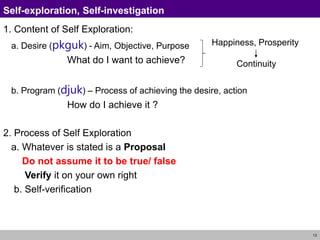
Self-exploration, Self-investigation
1. Content of Self Exploration:
a. Desire (pkguk) - Aim, Objective, Purpose
What do I want to achieve?
b. Program (djuk) – Process of achieving the desire, action
How do I achieve it ?
2. Process of Self Exploration
a. Whatever is stated is a Proposal
Do not assume it to be true/ false
Verify it on your own right
b. Self-verification
Happiness, Prosperity
Continuity
14
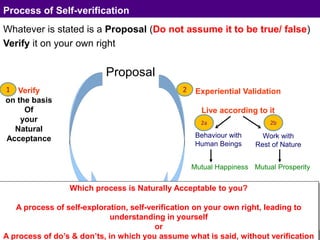
Process of Self-verification
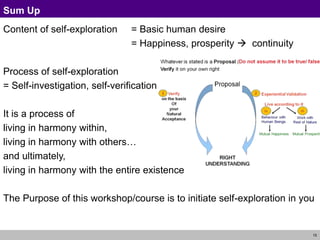
Whatever is stated is a Proposal (Do not assume it to be true/ false)
Verify it on your own right
Proposal
Verify
on the basis
Of
your
Natural
Acceptance Work with
Rest of Nature
Mutual Prosperity
Experiential Validation
Live according to it
Behaviour with
Human Beings
Mutual Happiness
2
1
2a 2b
RIGHT
UNDERSTANDING
Which process is Naturally Acceptable to you?
A process of self-exploration, self-verification on your own right, leading to
understanding in yourself
or
A process of do’s & don’ts, in which you assume what is said, without verification
15
Sum Up
Content of self-exploration = Basic human desire
= Happiness, prosperity  continuity
Process of self-exploration
= Self-investigation, self-verification
It is a process of
living in harmony within,
living in harmony with others…
and ultimately,
living in harmony with the entire existence
The Purpose of this workshop/course is to initiate self-exploration in you
Self Reflection
17
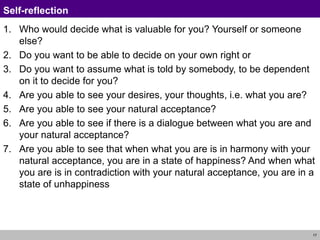
Self-reflection
1. Who would decide what is valuable for you? Yourself or someone
else?
2. Do you want to be able to decide on your own right or
3. Do you want to assume what is told by somebody, to be dependent
on it to decide for you?
4. Are you able to see your desires, your thoughts, i.e. what you are?
5. Are you able to see your natural acceptance?
6. Are you able to see if there is a dialogue between what you are and
your natural acceptance?
7. Are you able to see that when what you are is in harmony with your
natural acceptance, you are in a state of happiness? And when what
you are is in contradiction with your natural acceptance, you are in a
state of unhappiness
FAQ
19
FAQ
1. We have to follow social norms and live as per family traditions to be
accepted in the society, or even in the family. This has been working for a
long time. Do we need to verify these norms and traditions also?
2. What is the source of the proposals? If the source is verified, is authentic,
then we can accept the proposals – and do we don’t need to verify them
again. Right?
3. What we accept is something quite subjective, different things appeal to
different people – How can we say that natural acceptance is same for
everybody? Actually what is this natural acceptance?
4. How is it possible to understand everything by through the self? Just being
aware of “what I am” and “what I really want to be” itself is so difficult.
5. Isn’t swatantrata and freedom the same? (please give examples of
swatantrata at each level of being – individual, family, society and nature)
20
Self-Discipline, Self-Confidence Lovuq'kklu] vkRefo”okl
Imitate vuqlj.k (0-3)
Self Discipline (10…)
Lo&vuq'kklu
Self-confidence
vkRefo”okl
Follow vuqdj.k (3-6)
Obedience/Discipline
vkKkikyu@vuq'kklu (5-
9)
Right
lgh
Self-verif
Tkk¡p
Family
ifjokj
School
fo|ky;
University
fo”o&fo|k
y;
Society
lekt
Assuming
ekuuk
Knowing
tkuuk
Relationship
laca/k
The child is swatantra…
Knowing, not just assuming
Is following internally guided
discipline (right understanding)
…
which is fulfilling for the child &
for others
21
Self-Discipline, Self-Confidence Lovuq'kklu] vkRefo”okl
Imitate vuqlj.k (0-3)
Self Discipline (10…)
Lo&vuq'kklu
Self-confidence
vkRefo”okl
Follow vuqdj.k (3-6)
Obedience/Discipline
vkKkikyu@vuq'kklu (5-
9)
Right
lgh
Self-verif
Tkk¡p
Family
ifjokj
School
fo|ky;
University
fo”o&fo|k
y;
Society
lekt
Assuming
ekuuk
Knowing
tkuuk
Next
Generation
Relationship
laca/k
Every next generation is more
developed
In harmony within
In harmony with family
In harmony with society
In harmony with nature/existence
22
Self-Discipline, Self-Confidence Lovuq'kklu] vkRefo”okl
Imitate vuqlj.k (0-3)
Follow vuqdj.k (3-6)
Obedience/Discipline
vkKkikyu@vuq'kklu (5-
9)
Wrong
xyr
Self-verif
Tkk¡p
Family
ifjokj
School
fo|ky;
University
fo”o&fo|k
y;
Society
lekt
Arbitrariness euekuh
Domination
'kklu
Assuming
ekuuk
23
Self-Discipline, Self-Confidence Lovuq'kklu] vkRefo”okl
Imitate vuqlj.k (0-3)
Follow vuqdj.k (3-6)
Obedience/Discipline
vkKkikyu@vuq'kklu (5-
9)
Wrong
xyr
Self-verif
Tkk¡p
Family
ifjokj
School
fo|ky;
University
fo”o&fo|ky
;
Society
lekt
Domination
'kklu
Arbitrariness euekuh
Opposition nz®g (8-12)
Revolt fonz®g (by
other)
Struggle lađkZ (13-30)
War ;q) (30…)
Assuming
ekuuk
The child is partantra…
Is still assuming, not knowing
Is still going by externally
enforced discipline (fear/
incentive)… which may not be
fulfilling for the child nor for others
24
Self-Discipline, Self-Confidence Lovuq'kklu] vkRefo”okl
Imitate vuqlj.k (0-3)
Follow vuqdj.k (3-6)
Obedience/Discipline
vkKkikyu@vuq'kklu (5-
9)
Wrong
xyr
Self-verif
Tkk¡p
Family
ifjokj
School
fo|ky;
University
fo”o&fo|k
y;
Society
lekt
Domination
'kklu
Arbitrariness euekuh
Opposition nz®g (8-12)
Revolt fonz®g (by
other)
Struggle lađkZ (13-30)
War ;q) (30…)
Assuming
ekuuk Next
Generation
Every next generation is less
developed
In more contradiction within
In more opposition with family
More struggle in society
More conflict with nature/
existence
25
Self-Discipline, Self-Confidence Lovuq'kklu] vkRefo”okl
Imitate vuqlj.k (0-3)
Self Discipline (10…)
Lovuq'kklu
Self-confidence
vkRefo”okl
Follow vuqdj.k (3-6)
Obedience/Discipline
vkKkikyu@vuq'kklu (5-
9)
Wrong
xyr
Right
lgh
Self-verif
Tkk¡p
Family
ifjokj
School
fo|ky;
University
fo”o&fo|k
y;
Society
lekt
Relationship
laca/k
Human
Education-sanskar
ekuoh;
f”k{kk-laLdkj
Domination
'kklu
Arbitrariness euekuh
Opposition nz®g (8-12)
Revolt fonz®g (by
other)
Struggle lađkZ (13-30)
War ;q) (30…)
Assuming
ekuuk
Knowing
tkuuk
Next
Generation

4 Process of Self-Exploration.ppt

  • 1.
    Lecture 4 Self-exploration as theProcess for Value Education
  • 2.
    2 About this workshop/course Processof self-exploration (in more detail) We will also explore: Do we have the potential to recognize what is right? Can we be self-referential? इस शिशिर/course क े बारे अध्ययन प्रशिया (शिस्तार) हम लोग यह भी जाांचेंगे शक: क्या हम में सही को पहचान पाने की क्षमता है? क्या हम स्वतांत्र हो सकते हैं? Content of this Session इस सत्र कि किषय-िास्तु
  • 3.
    3 What is thisWorkshop / Course ;g f'kfOkj D;k gS 1. It is a process of dialogue – between me and you, to begin with ;g laokn dh izfØ;k gSA ;g laokn vkids vkSj esjs chp 'kq: gksrk gSA 2. It soon becomes a dialogue within your own Self… “kh?kz gh ;g laokn vkids Lo;a eas pyus yxrk gSA
  • 4.
    4 The Dialogue Within WhatI Really Want to Be My Natural Acceptance My Intention What I am My Desire, Thought, Expectation… My Competence Dialogue Always Relationship Sometimes Relationship Sometimes Opposition These are in Harmony Happiness These are in Contradiction Unhappiness
  • 5.
    5 Points for Self-observation Wehave the innate potential to recognise what is right We are endowed with natural acceptance - It is innate, a part and parcel of our being - It is invariant, uncorrupted by pre-conditioning - It is definite As we refer to our natural acceptance, we become self-referential (self-organised, autonomous, swatantra)
  • 6.
    6 1. It isa process of dialogue – between me and you, to begin with. It soon becomes a dialogue within your own self 2. It is a process of dialogue between what I am (tSlk eSa g¡w) and my Natural Acceptance or what I really want to be (tSlk gksuk eq>s lgt Lohdk;Z gS = LoRo) 3. It is a process of Self-exploration, Self-investigation  Self-evolution 4. It is a process of knowing oneself and through the self, knowing Nature and the entire existence 5. It is a process of recognizing one's relationship with every unit in nature/existence; and fulfilling that relationship 6. It is a process of knowing Human Conduct (ekuoh; vkpj.k) and living according to it 7. It is a process of living in harmony within, living in harmony with others…living in harmony with entire existence Process of Self-exploration, Self-investigation
  • 7.
    8 Scope of thisWorkshop / Course: Self-evolution, Self-extension Knowing your Natural Acceptance What you really want to be Natural Acceptance Swatva LoRo Living in accordance with your Natural Acceptance Living in harmony within Self-organized Swatantrata Lora=rk Living in harmony with others… with the entire existence Self-extension Swrajya LojkT; Harmony Everywhere = Universal Order
  • 8.
    11 Self-exploration, Self-investigation 1. Contentof Self Exploration: a. Desire (pkguk) - Aim, Objective, Purpose, Basic Human Aspiration What do I want to achieve? b. Program (djuk) – Process of achieving the desire, action How do I achieve it ? 2. Process of Self Exploration
  • 9.
    12 Content of Self-explorationa) Desire 1. Happiness 2. Prosperity 3. The continuity of Happiness and Prosperity Let us find out: 1. Do we desire for Happiness? 2. Do we desire for Prosperity? 3. Do we desire for the continuity of both (happiness & prosperity)? 4. If continuity of happiness and prosperity is ensured then what else would you desire? Our desires are not unlimited or indefinite Our basic aspiration is for happiness, prosperity and its continuity
  • 10.
    13 Self-exploration, Self-investigation 1. Contentof Self Exploration: a. Desire (pkguk) - Aim, Objective, Purpose What do I want to achieve? b. Program (djuk) – Process of achieving the desire, action How do I achieve it ? 2. Process of Self Exploration a. Whatever is stated is a Proposal Do not assume it to be true/ false Verify it on your own right b. Self-verification Happiness, Prosperity Continuity
  • 11.
    14 Process of Self-verification Whateveris stated is a Proposal (Do not assume it to be true/ false) Verify it on your own right Proposal Verify on the basis Of your Natural Acceptance Work with Rest of Nature Mutual Prosperity Experiential Validation Live according to it Behaviour with Human Beings Mutual Happiness 2 1 2a 2b RIGHT UNDERSTANDING Which process is Naturally Acceptable to you? A process of self-exploration, self-verification on your own right, leading to understanding in yourself or A process of do’s & don’ts, in which you assume what is said, without verification
  • 12.
    15 Sum Up Content ofself-exploration = Basic human desire = Happiness, prosperity  continuity Process of self-exploration = Self-investigation, self-verification It is a process of living in harmony within, living in harmony with others… and ultimately, living in harmony with the entire existence The Purpose of this workshop/course is to initiate self-exploration in you
  • 13.
  • 14.
    17 Self-reflection 1. Who woulddecide what is valuable for you? Yourself or someone else? 2. Do you want to be able to decide on your own right or 3. Do you want to assume what is told by somebody, to be dependent on it to decide for you? 4. Are you able to see your desires, your thoughts, i.e. what you are? 5. Are you able to see your natural acceptance? 6. Are you able to see if there is a dialogue between what you are and your natural acceptance? 7. Are you able to see that when what you are is in harmony with your natural acceptance, you are in a state of happiness? And when what you are is in contradiction with your natural acceptance, you are in a state of unhappiness
  • 15.
  • 16.
    19 FAQ 1. We haveto follow social norms and live as per family traditions to be accepted in the society, or even in the family. This has been working for a long time. Do we need to verify these norms and traditions also? 2. What is the source of the proposals? If the source is verified, is authentic, then we can accept the proposals – and do we don’t need to verify them again. Right? 3. What we accept is something quite subjective, different things appeal to different people – How can we say that natural acceptance is same for everybody? Actually what is this natural acceptance? 4. How is it possible to understand everything by through the self? Just being aware of “what I am” and “what I really want to be” itself is so difficult. 5. Isn’t swatantrata and freedom the same? (please give examples of swatantrata at each level of being – individual, family, society and nature)
  • 17.
    20 Self-Discipline, Self-Confidence Lovuq'kklu]vkRefo”okl Imitate vuqlj.k (0-3) Self Discipline (10…) Lo&vuq'kklu Self-confidence vkRefo”okl Follow vuqdj.k (3-6) Obedience/Discipline vkKkikyu@vuq'kklu (5- 9) Right lgh Self-verif Tkk¡p Family ifjokj School fo|ky; University fo”o&fo|k y; Society lekt Assuming ekuuk Knowing tkuuk Relationship laca/k The child is swatantra… Knowing, not just assuming Is following internally guided discipline (right understanding) … which is fulfilling for the child & for others
  • 18.
    21 Self-Discipline, Self-Confidence Lovuq'kklu]vkRefo”okl Imitate vuqlj.k (0-3) Self Discipline (10…) Lo&vuq'kklu Self-confidence vkRefo”okl Follow vuqdj.k (3-6) Obedience/Discipline vkKkikyu@vuq'kklu (5- 9) Right lgh Self-verif Tkk¡p Family ifjokj School fo|ky; University fo”o&fo|k y; Society lekt Assuming ekuuk Knowing tkuuk Next Generation Relationship laca/k Every next generation is more developed In harmony within In harmony with family In harmony with society In harmony with nature/existence
  • 19.
    22 Self-Discipline, Self-Confidence Lovuq'kklu]vkRefo”okl Imitate vuqlj.k (0-3) Follow vuqdj.k (3-6) Obedience/Discipline vkKkikyu@vuq'kklu (5- 9) Wrong xyr Self-verif Tkk¡p Family ifjokj School fo|ky; University fo”o&fo|k y; Society lekt Arbitrariness euekuh Domination 'kklu Assuming ekuuk
  • 20.
    23 Self-Discipline, Self-Confidence Lovuq'kklu]vkRefo”okl Imitate vuqlj.k (0-3) Follow vuqdj.k (3-6) Obedience/Discipline vkKkikyu@vuq'kklu (5- 9) Wrong xyr Self-verif Tkk¡p Family ifjokj School fo|ky; University fo”o&fo|ky ; Society lekt Domination 'kklu Arbitrariness euekuh Opposition nz®g (8-12) Revolt fonz®g (by other) Struggle laÄ‘kZ (13-30) War ;q) (30…) Assuming ekuuk The child is partantra… Is still assuming, not knowing Is still going by externally enforced discipline (fear/ incentive)… which may not be fulfilling for the child nor for others
  • 21.
    24 Self-Discipline, Self-Confidence Lovuq'kklu]vkRefo”okl Imitate vuqlj.k (0-3) Follow vuqdj.k (3-6) Obedience/Discipline vkKkikyu@vuq'kklu (5- 9) Wrong xyr Self-verif Tkk¡p Family ifjokj School fo|ky; University fo”o&fo|k y; Society lekt Domination 'kklu Arbitrariness euekuh Opposition nz®g (8-12) Revolt fonz®g (by other) Struggle laÄ‘kZ (13-30) War ;q) (30…) Assuming ekuuk Next Generation Every next generation is less developed In more contradiction within In more opposition with family More struggle in society More conflict with nature/ existence
  • 22.
    25 Self-Discipline, Self-Confidence Lovuq'kklu]vkRefo”okl Imitate vuqlj.k (0-3) Self Discipline (10…) Lovuq'kklu Self-confidence vkRefo”okl Follow vuqdj.k (3-6) Obedience/Discipline vkKkikyu@vuq'kklu (5- 9) Wrong xyr Right lgh Self-verif Tkk¡p Family ifjokj School fo|ky; University fo”o&fo|k y; Society lekt Relationship laca/k Human Education-sanskar ekuoh; f”k{kk-laLdkj Domination 'kklu Arbitrariness euekuh Opposition nz®g (8-12) Revolt fonz®g (by other) Struggle laÄ‘kZ (13-30) War ;q) (30…) Assuming ekuuk Knowing tkuuk Next Generation