Molecular Genetics
Lecture 4
PCR types
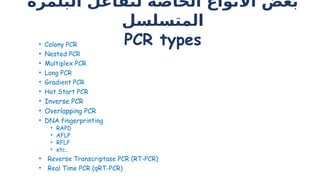
• Colony PCR
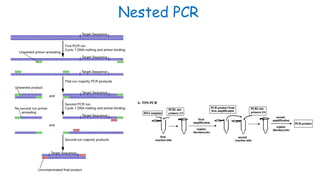
• Nested PCR
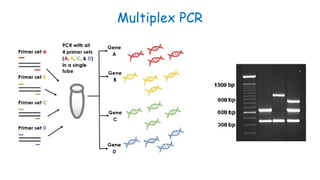
• Multiplex PCR
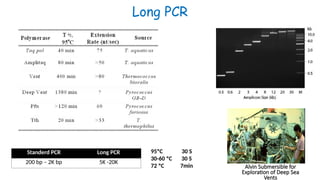
• Long PCR
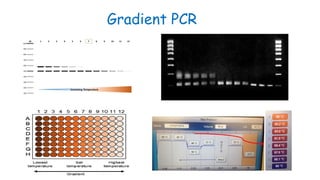
• Gradient PCR
• Hot Start PCR
• Inverse PCR
• Overlapping PCR
• DNA fingerprinting
• RAPD
• AFLP
• RFLP
• etc..
• Reverse Transcriptase PCR (RT-PCR)
• Real Time PCR (qRT-PCR)
‫البلمرة‬ ‫لتفاعل‬ ‫الخاصة‬ ‫االنواع‬ ‫بعض‬
‫المتسلسل‬
PCR types
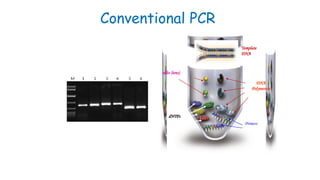
salts (ions)
dNTPs
Primers
DNA
Polymerase
Template
DNA
Conventional PCR
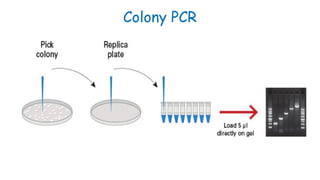
Colony PCR
Nested PCR
Multiplex PCR
Gradient PCR
Hot Start PCR
Used to optimize the yield
of the desired amplified
product in PCR and
simultaneously to suppress
nonspecific amplification.
hotstart
normal
Long PCR
Standerd PCR Long PCR
200 bp – 2K bp 5K -20K
Alvin Submersible for
Exploration of Deep Sea
Vents
95ºC 30 S
30-60 ºC 30 S
72 ºC 7min
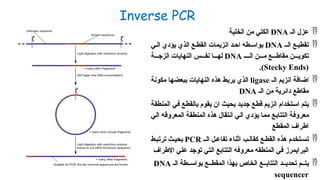
Inverse PCR

‫الـ‬ ‫عزل‬
DNA
‫الخلية‬ ‫من‬ ‫الكلي‬

‫الــ‬ ‫تقطيـع‬
DNA
‫الـي‬ ‫يؤدي‬ ‫الذي‬ ‫القطـع‬ ‫انزيمات‬ ‫احـد‬ ‫بواسـطه‬
‫الــــ‬ ‫مـــن‬ ‫مقاطـــع‬ ‫تكويـــن‬
DNA
‫الزجـــة‬ ‫النهايات‬ ‫نفـــس‬ ‫لهـــا‬
(
Stecky Ends
.)

‫الـ‬ ‫انزيم‬ ‫اضافة‬
ligase
‫مكونة‬ ‫ببعضها‬ ‫النهايات‬ ‫هذه‬ ‫يربط‬ ‫الذي‬
‫الـ‬ ‫من‬ ‫دائرية‬ ‫مقاطع‬
DNA

‫ـة‬‫ق‬‫المنط‬ ‫ـي‬‫ف‬ ‫ـع‬‫ط‬‫بالق‬ ‫يقوم‬ ‫ان‬ ‫ـث‬‫ي‬‫بح‬ ‫ـد‬‫ي‬‫جد‬ ‫ـع‬‫ط‬‫ق‬ ‫ـم‬‫ي‬‫انز‬ ‫ـتخدام‬‫س‬‫ا‬ ‫ـم‬‫ت‬‫ي‬
‫ـي‬‫ل‬‫ا‬ ‫ـه‬‫ق‬‫المعرو‬ ‫ـة‬‫ق‬‫المنط‬ ‫هذه‬ ‫انتقال‬ ‫ـي‬‫ل‬‫ا‬ ‫يؤدي‬ ‫ـا‬‫م‬‫م‬ ‫ـع‬‫ب‬‫التتا‬ ‫ـة‬‫ف‬‫معرو‬
‫المقطع‬ ‫اطراف‬

‫الــ‬ ‫تفاعـل‬ ‫اثناء‬ ‫كقالـب‬ ‫القطـع‬ ‫هذه‬ ‫تسـتخدم‬
PCR
‫ترتبـط‬ ‫بحيـث‬
‫االطراف‬ ‫علي‬ ‫توجد‬ ‫التي‬ ‫التتابع‬ ‫معروفه‬ ‫المنطقه‬ ‫في‬ ‫البرايمرز‬

‫الـ‬ ‫بواســطة‬ ‫المقطــع‬ ‫بهذا‬ ‫الخاص‬ ‫التتابــع‬ ‫تحديــد‬ ‫يتــم‬
DNA
sequencer
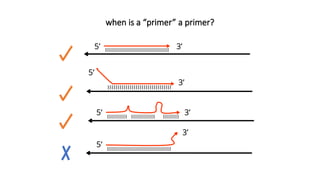
when is a “primer” a primer?
5’ 3’
5’
5’
5’
3’
3’
3’
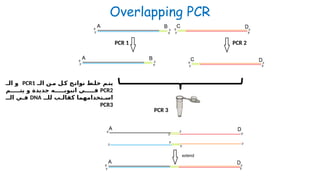
Overlapping PCR
PCR 1 PCR 2
‫الـ‬ ‫ن‬‫م‬ ‫ل‬‫ك‬ ‫ج‬‫نوات‬ ‫ط‬‫خل‬ ‫م‬‫يت‬
PCR1
‫الـ‬ ‫و‬
PCR2
‫م‬ ‫يت‬ ‫و‬ ‫جديدة‬ ‫ه‬ ‫انبوب‬ ‫ي‬ ‫ف‬
‫للـ‬ ‫ب‬ ‫كقال‬ ‫تخدامهما‬ ‫اس‬
DNA
‫الـ‬ ‫ي‬ ‫ف‬
PCR3
PCR 3
AFLP
RAPD
S
S
R
ISSR
R
F
L
P
MASAP
VNTR
CAPS
S
R
A
P
SSCP
SNP
COS
DArT
S
C
A
R
RDA
S
A
M
P
L
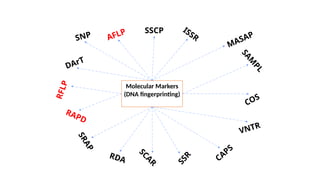
Molecular Markers
(DNA fingerprinting)
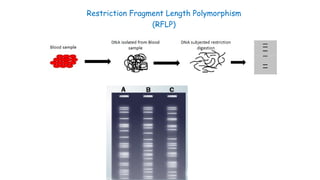
Restriction Fragment Length Polymorphism
(RFLP)
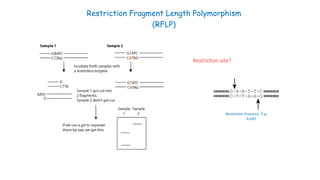
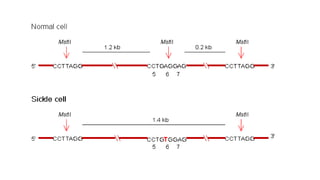
Restriction Fragment Length Polymorphism
(RFLP)
Restriction site?
Restriction Enzymes: E.g.,
EcoR1
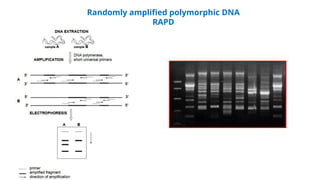
Randomly amplified polymorphic DNA
RAPD
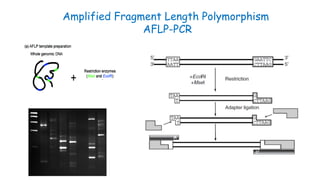
Amplified Fragment Length Polymorphism
AFLP-PCR
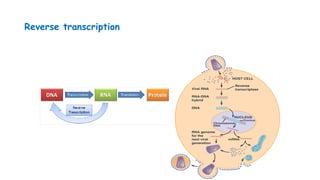
Reverse transcription
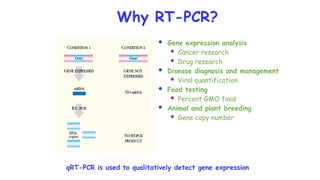
qRT-PCR is used to qualitatively detect gene expression
Why RT-PCR?
 Gene expression analysis
 Cancer research
 Drug research
 Disease diagnosis and management
 Viral quantification
 Food testing
 Percent GMO food
 Animal and plant breeding
 Gene copy number
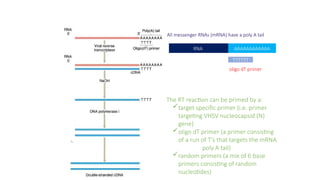
RNA AAAAAAAAAAAA
TTTTTT
oligo dT primer
All messenger RNAs (mRNA) have a poly A tail
The RT reaction can be primed by a:
target specific primer (i.e. primer
targeting VHSV nucleocapsid (N)
gene)
oligo dT primer (a primer consisting
of a run of T’s that targets the mRNA
poly A tail)
random primers (a mix of 6 base
primers consisting of random
nucleotides)
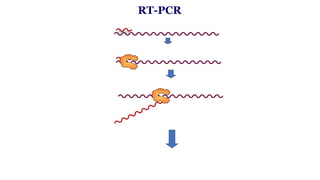
RT-PCR
mRNA
oligo dT
RT: Reverse transcriptase
cDNA
mRNA
5´
3´
5´ 3´
Templat for RT- PCR
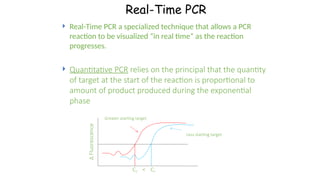
 Real-Time PCR a specialized technique that allows a PCR
reaction to be visualized “in real time” as the reaction
progresses.
 Quantitative PCR relies on the principal that the quantity
of target at the start of the reaction is proportional to
amount of product produced during the exponential
phase
∆
Fluorescence
CT CT
Greater starting target
Less starting target
<
Real-Time PCR
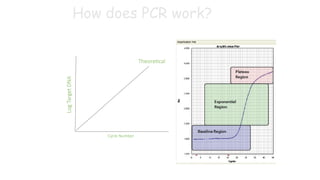
How does PCR work?
Log
Target
DNA
Cycle Number
Theoretical
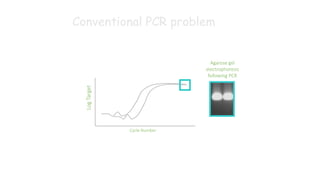
Conventional PCR problem
Log
Target
Agarose gel
electrophoresis
following PCR
Cycle Number
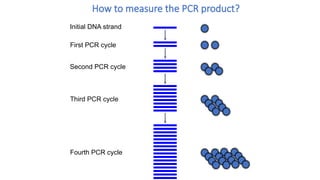
Initial DNA strand
First PCR cycle
Second PCR cycle
Third PCR cycle
Fourth PCR cycle
How to measure the PCR product?
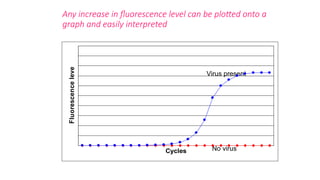
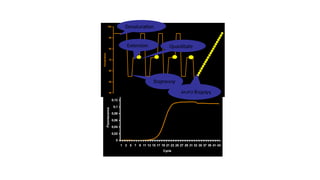
Any increase in fluorescence level can be plotted onto a
graph and easily interpreted
Virus present
No virus
Cycles
Fluorescence
level
0
0,02
0,04
0,06
0,08
0,1
0,12
0,14
1 3 5 7 9 11 13 15 17 19 21 23 25 27 29 31 33 35 37 39 41 43
Cycle
Fluorescence
40
50
60
70
80
90
100
Temperature
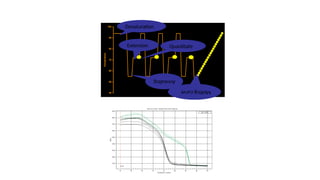
Denaturation
Extension Quantitate
Melting
curve
Annealing
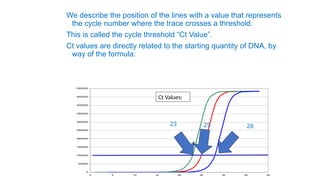
We describe the position of the lines with a value that represents
the cycle number where the trace crosses a threshold.
This is called the cycle threshold “Ct Value”.
Ct values are directly related to the starting quantity of DNA, by
way of the formula:
0
500000
1000000
1500000
2000000
2500000
3000000
3500000
4000000
4500000
5000000
0 5 10 15 20 25 30 35 40
23 25 28
Ct Values:
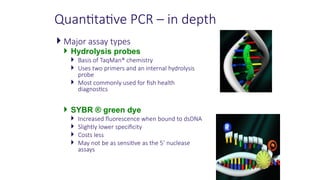
Quantitative PCR – in depth
 Major assay types
 Hydrolysis probes
 Basis of TaqMan® chemistry
 Uses two primers and an internal hydrolysis
probe
 Most commonly used for fish health
diagnostics
 SYBR ® green dye
 Increased fluorescence when bound to dsDNA
 Slightly lower specificity
 Costs less
 May not be as sensitive as the 5’ nuclease
assays
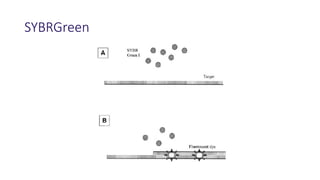
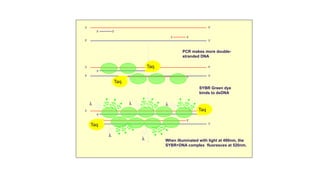
SYBRGreen
PCR makes more double-
stranded DNA
SYBR Green dye
binds to dsDNA
When illuminated with light at 490nm, the
SYBR+DNA complex fluoresces at 520nm.
5’ 3’
5’
3’
5’ 3’
5’
3’
5’ 3’
5’
3’
5’
5’
Taq
Taq
3’
5’
3’
Taq
Taq
5’
5’
l l l
l
l
40
50
60
70
80
90
100
Temperature
Denaturation
Extension Quantitate
Melting
curve
Annealing
5’ 5’
3’
3’
5’
5’
3’
3’
ID ID
ID
5’
5’
3’
3’ ID
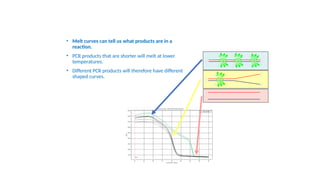
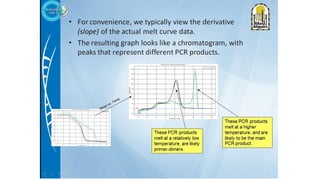
• Melt curves can tell us what products are in a
reaction.
• PCR products that are shorter will melt at lower
temperatures.
• Different PCR products will therefore have different
shaped curves.
4- pcr types.pptxMolecular geatics PCR Types Basic scince

4- pcr types.pptxMolecular geatics PCR Types Basic scince

  • 1.
  • 2.
    • Colony PCR •Nested PCR • Multiplex PCR • Long PCR • Gradient PCR • Hot Start PCR • Inverse PCR • Overlapping PCR • DNA fingerprinting • RAPD • AFLP • RFLP • etc.. • Reverse Transcriptase PCR (RT-PCR) • Real Time PCR (qRT-PCR) ‫البلمرة‬ ‫لتفاعل‬ ‫الخاصة‬ ‫االنواع‬ ‫بعض‬ ‫المتسلسل‬ PCR types
  • 3.
  • 4.
  • 5.
  • 6.
  • 7.
  • 8.
    Hot Start PCR Usedto optimize the yield of the desired amplified product in PCR and simultaneously to suppress nonspecific amplification. hotstart normal
  • 9.
    Long PCR Standerd PCRLong PCR 200 bp – 2K bp 5K -20K Alvin Submersible for Exploration of Deep Sea Vents 95ºC 30 S 30-60 ºC 30 S 72 ºC 7min
  • 10.
    Inverse PCR  ‫الـ‬ ‫عزل‬ DNA ‫الخلية‬‫من‬ ‫الكلي‬  ‫الــ‬ ‫تقطيـع‬ DNA ‫الـي‬ ‫يؤدي‬ ‫الذي‬ ‫القطـع‬ ‫انزيمات‬ ‫احـد‬ ‫بواسـطه‬ ‫الــــ‬ ‫مـــن‬ ‫مقاطـــع‬ ‫تكويـــن‬ DNA ‫الزجـــة‬ ‫النهايات‬ ‫نفـــس‬ ‫لهـــا‬ ( Stecky Ends .)  ‫الـ‬ ‫انزيم‬ ‫اضافة‬ ligase ‫مكونة‬ ‫ببعضها‬ ‫النهايات‬ ‫هذه‬ ‫يربط‬ ‫الذي‬ ‫الـ‬ ‫من‬ ‫دائرية‬ ‫مقاطع‬ DNA  ‫ـة‬‫ق‬‫المنط‬ ‫ـي‬‫ف‬ ‫ـع‬‫ط‬‫بالق‬ ‫يقوم‬ ‫ان‬ ‫ـث‬‫ي‬‫بح‬ ‫ـد‬‫ي‬‫جد‬ ‫ـع‬‫ط‬‫ق‬ ‫ـم‬‫ي‬‫انز‬ ‫ـتخدام‬‫س‬‫ا‬ ‫ـم‬‫ت‬‫ي‬ ‫ـي‬‫ل‬‫ا‬ ‫ـه‬‫ق‬‫المعرو‬ ‫ـة‬‫ق‬‫المنط‬ ‫هذه‬ ‫انتقال‬ ‫ـي‬‫ل‬‫ا‬ ‫يؤدي‬ ‫ـا‬‫م‬‫م‬ ‫ـع‬‫ب‬‫التتا‬ ‫ـة‬‫ف‬‫معرو‬ ‫المقطع‬ ‫اطراف‬  ‫الــ‬ ‫تفاعـل‬ ‫اثناء‬ ‫كقالـب‬ ‫القطـع‬ ‫هذه‬ ‫تسـتخدم‬ PCR ‫ترتبـط‬ ‫بحيـث‬ ‫االطراف‬ ‫علي‬ ‫توجد‬ ‫التي‬ ‫التتابع‬ ‫معروفه‬ ‫المنطقه‬ ‫في‬ ‫البرايمرز‬  ‫الـ‬ ‫بواســطة‬ ‫المقطــع‬ ‫بهذا‬ ‫الخاص‬ ‫التتابــع‬ ‫تحديــد‬ ‫يتــم‬ DNA sequencer
  • 11.
    when is a“primer” a primer? 5’ 3’ 5’ 5’ 5’ 3’ 3’ 3’
  • 12.
    Overlapping PCR PCR 1PCR 2 ‫الـ‬ ‫ن‬‫م‬ ‫ل‬‫ك‬ ‫ج‬‫نوات‬ ‫ط‬‫خل‬ ‫م‬‫يت‬ PCR1 ‫الـ‬ ‫و‬ PCR2 ‫م‬ ‫يت‬ ‫و‬ ‫جديدة‬ ‫ه‬ ‫انبوب‬ ‫ي‬ ‫ف‬ ‫للـ‬ ‫ب‬ ‫كقال‬ ‫تخدامهما‬ ‫اس‬ DNA ‫الـ‬ ‫ي‬ ‫ف‬ PCR3 PCR 3
  • 13.
  • 14.
    Restriction Fragment LengthPolymorphism (RFLP)
  • 15.
    Restriction Fragment LengthPolymorphism (RFLP) Restriction site? Restriction Enzymes: E.g., EcoR1
  • 17.
  • 18.
    Amplified Fragment LengthPolymorphism AFLP-PCR
  • 19.
  • 20.
    qRT-PCR is usedto qualitatively detect gene expression Why RT-PCR?  Gene expression analysis  Cancer research  Drug research  Disease diagnosis and management  Viral quantification  Food testing  Percent GMO food  Animal and plant breeding  Gene copy number
  • 22.
    RNA AAAAAAAAAAAA TTTTTT oligo dTprimer All messenger RNAs (mRNA) have a poly A tail The RT reaction can be primed by a: target specific primer (i.e. primer targeting VHSV nucleocapsid (N) gene) oligo dT primer (a primer consisting of a run of T’s that targets the mRNA poly A tail) random primers (a mix of 6 base primers consisting of random nucleotides)
  • 23.
    RT-PCR mRNA oligo dT RT: Reversetranscriptase cDNA mRNA 5´ 3´ 5´ 3´ Templat for RT- PCR
  • 24.
     Real-Time PCRa specialized technique that allows a PCR reaction to be visualized “in real time” as the reaction progresses.  Quantitative PCR relies on the principal that the quantity of target at the start of the reaction is proportional to amount of product produced during the exponential phase ∆ Fluorescence CT CT Greater starting target Less starting target < Real-Time PCR
  • 25.
    How does PCRwork? Log Target DNA Cycle Number Theoretical
  • 26.
    Conventional PCR problem Log Target Agarosegel electrophoresis following PCR Cycle Number
  • 27.
    Initial DNA strand FirstPCR cycle Second PCR cycle Third PCR cycle Fourth PCR cycle How to measure the PCR product?
  • 29.
    Any increase influorescence level can be plotted onto a graph and easily interpreted Virus present No virus Cycles Fluorescence level
  • 30.
    0 0,02 0,04 0,06 0,08 0,1 0,12 0,14 1 3 57 9 11 13 15 17 19 21 23 25 27 29 31 33 35 37 39 41 43 Cycle Fluorescence 40 50 60 70 80 90 100 Temperature Denaturation Extension Quantitate Melting curve Annealing
  • 31.
    We describe theposition of the lines with a value that represents the cycle number where the trace crosses a threshold. This is called the cycle threshold “Ct Value”. Ct values are directly related to the starting quantity of DNA, by way of the formula: 0 500000 1000000 1500000 2000000 2500000 3000000 3500000 4000000 4500000 5000000 0 5 10 15 20 25 30 35 40 23 25 28 Ct Values:
  • 32.
    Quantitative PCR –in depth  Major assay types  Hydrolysis probes  Basis of TaqMan® chemistry  Uses two primers and an internal hydrolysis probe  Most commonly used for fish health diagnostics  SYBR ® green dye  Increased fluorescence when bound to dsDNA  Slightly lower specificity  Costs less  May not be as sensitive as the 5’ nuclease assays
  • 33.
  • 34.
    PCR makes moredouble- stranded DNA SYBR Green dye binds to dsDNA When illuminated with light at 490nm, the SYBR+DNA complex fluoresces at 520nm. 5’ 3’ 5’ 3’ 5’ 3’ 5’ 3’ 5’ 3’ 5’ 3’ 5’ 5’ Taq Taq 3’ 5’ 3’ Taq Taq 5’ 5’ l l l l l
  • 36.
  • 37.
    5’ 5’ 3’ 3’ 5’ 5’ 3’ 3’ ID ID ID 5’ 5’ 3’ 3’ID • Melt curves can tell us what products are in a reaction. • PCR products that are shorter will melt at lower temperatures. • Different PCR products will therefore have different shaped curves.

Editor's Notes

  • #3 DNA nucleotides, the building blocks for the new DNA Template DNA, the DNA sequence that you want to amplify Primers, single-stranded DNAs between 18 and 30 nucleotides long (oligonucleotides) that are complementary to a short region on either side of the template DNA DNA polymerase, a heat stable enzyme that drives, or catalyzes, the synthesis of new DNA