CHEMICAL THERMODYNAMICS.
FREE ENERGY,
FREE ENERGY AND EQUILIBRIUM
Lecture 4
17 March 2023 PHYSICAL CHEMISTRY 1
PLAN
- Gibbs free energy function
- Gibbs Free Energy of Reaction System
- Chemical equilibrium
- Relationship between Gibbs Free Energy and
chemical equilibrium
17 March 2023 PHYSICAL CHEMISTRY 2
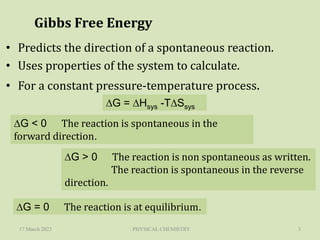
Gibbs Free Energy
• Predicts the direction of a spontaneous reaction.
• Uses properties of the system to calculate.
• For a constant pressure-temperature process.
17 March 2023 : PHYSICAL CHEMISTRY 3
DG = DHsys -TDSsys
DG < 0 The reaction is spontaneous in the
forward direction.
DG > 0 The reaction is non spontaneous as written.
The reaction is spontaneous in the reverse
direction.
DG = 0 The reaction is at equilibrium.
17 March 2023 PHYSICAL CHEMISTRY 4
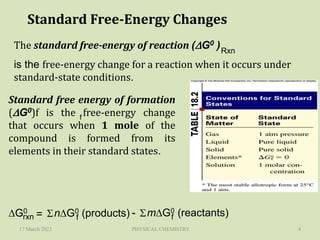
Standard Free-Energy Changes
The standard free-energy of reaction (DG0 )
is the free-energy change for a reaction when it occurs under
standard-state conditions.
Rxn
Standard free energy of formation
(DG0)f is the free-energy change
that occurs when 1 mole of the
compound is formed from its
elements in their standard states.
f
DG0
rxn nDG0 (products)
f
= S mDG0 (reactants)
f
S
-
5
Gibbs Free Energy of Reaction System
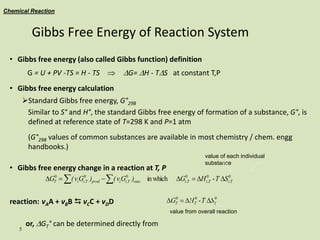
• Gibbs free energy (also called Gibbs function) definition
G = U + PV -TS = H - TS DG= DH - TDS at constant T,P
• Gibbs free energy calculation
Standard Gibbs free energy, G°298
Similar to S° and H°, the standard Gibbs free energy of formation of a substance, G°, is
defined at reference state of T=298 K and P=1 atm
(G°298 values of common substances are available in most chemistry / chem. engg
handbooks.)
• Gibbs free energy change in a reaction at T, P
reaction: vAA + vBB D vCC + vDD
or, DGT° can be determined directly from
Chemical Reaction
- 0
0
0
T
T
T S
T
H
G D
D

D
-
inwhich 0
0
0
0
0
0
T
,
i
T
,
i
T
,
i
reac
T
,
i
i
prod
T
,
i
i
T S
T
H
G
)
G
v
(
)
G
v
(
G D
D

D


D 

value of each individual
substance
value from overall reaction
6
Gibbs Free Energy of Reaction System (2)
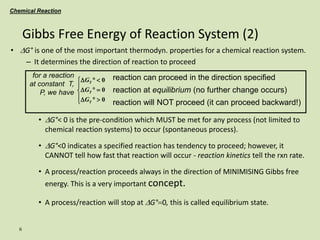
• DG° is one of the most important thermodyn. properties for a chemical reaction system.
– It determines the direction of reaction to proceed
• DG°< 0 is the pre-condition which MUST be met for any process (not limited to
chemical reaction systems) to occur (spontaneous process).
• DG°<0 indicates a specified reaction has tendency to proceed; however, it
CANNOT tell how fast that reaction will occur - reaction kinetics tell the rxn rate.
• A process/reaction proceeds always in the direction of MINIMISING Gibbs free
energy. This is a very important concept.
• A process/reaction will stop at DG°0, this is called equilibrium state.
Chemical Reaction
reaction can proceed in the direction specified
reaction at equilibrium (no further change occurs)
reaction will NOT proceed (it can proceed backward!)







D


D


D
0
0
0
T
T
T
G
G
G
for a reaction
at constant T,
P, we have
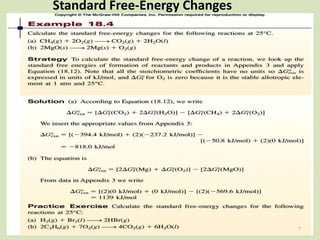
Standard Free-Energy Changes
7
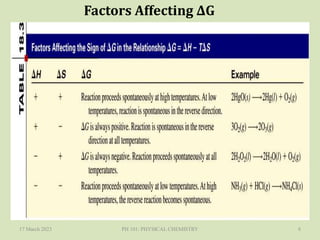
Factors Affecting ΔG
17 March 2023 PH 101: PHYSICAL CHEMISTRY 8
9
Important Notes about DS, DH and DG
• DS, DH and DG are widely used in analysing various systems. Our current discussion of
these function is limited to the application to a reaction system.
• A clear definition of the reaction conditions is necessary before start calculation of
these properties.
• There are many ways these thermodynamic properties can be determined. Only most
commonly used ones in relation to a chemical reaction are given.
• It is very important to understand the study a chemical reaction by means of
thermodynamics tells only state - a ‘snapshot’ of system, and how a process proceeds
from one state to another (reversible-irreversible, with or without work done /
exchange heat with surrounding). There is no factor of time involved.
Chemical Reaction
10
• For a chemical reaction vAA + vBB D vCC + vDD
when G°T =0, we say the reaction is in chemical reaction equilibrium
- What is a chemical reaction equilibrium?
Example 1: NH3(aq)+H2O(l) D NH4
+(l)+OH-(aq)
At constant T and P, when t
Example 2: 2NO(g) + O2(g) D 2NO2(g)
At constant T and P, when t
The concentration of a gas is usually measured as partial pressure
At an equilibrium the reaction quotient becomes constant
Chemical Reaction - The Equilibrium
t
NO2
NO
O2
t
NH4
NH3
constant
2
2
2
2

O
NO
NO
P
P
P
constant
O]
][H
[NH
]
][OH
[NH
2
3
4



reaction quotient
11
Equilibrium Constant (1)
• Definition of equilibrium constant, K
The equilibrium constant is the reaction quotient at G°T =0.
• Expressions of equilibrium constant for various reactions
– gas phase 2NO(g) + O2(g) D 2NO2(g)
– gas-solid phase CaCO3(s) D CaO (s)+CO2(g)
– liquid phase NH3(aq)+H2O(l) D NH4
+(l)+OH-(aq)
– liquid-solid Cu(OH)2(s) D Cu2+(aq)+2OH- (aq)
– gas-liquid NH3(g)+H2O(l) D NH4OH(aq)
– general vAA + vBB D vCC + vDD
Chemical Reaction equilibrium
2
2
2
2
O
NO
NO
p
P
P
P
K 
O]
][H
[NH
]
][OH
[NH
2
3
4



c
K
2
CO
p P
K 
2
2
]
][OH
[Cu 


c
K
3
1 NH
p P
/
K 
B
A
D
C
B
A
D
C
v
B
v
A
v
D
v
C
v
v
v
v
c
P
P
P
P
D
C
K 

[B]
[A]
]
[
]
[
12
• Equilibrium constant, Kp, and Gibbs free energy DG
A gas phase reaction vAA + vBB  vCC + vDD
– When at equilibrium, assuming all the gases follow the ideal gas law
at P=1 atm, DG°=S(viG°i)prod-S(viG°i)reac=0
and at any P(1) DG=S(viGi)prod-S(viGi)reac=0
– when reaction occurs at constant temperature (isothermal reaction)
dG=VdP-SdT dG=VdP dG=RTdP/P DG=RTln(P/P0)
– G° is defined at P0=1 atm, so that DG=G-G°=RTln(P/1) Gi=Gi°+RTlnPi
S(vi(G°i+RTln(PCPD))prod-S(vi (G°i+RTln(PAPB))reac=0
S(viG°i)prod-S(vi G°i)reac=-[S(viRTln(PCPD))prod-S(vi RTln(PAPB))reac]
– By definition:
Equilibrium Constant (2)
Chemical Reaction equilibrium





















D B
A
D
C
B
A
D
C
v
B
v
A
v
D
v
C
v
B
v
A
v
D
v
C
P
P
P
P
ln
RT
)
atm
/
P
(
)
atm
/
P
(
)
atm
/
P
(
)
atm
/
P
(
ln
RT
G
p
K
RT
G ln



D









B
A
D
C
v
B
v
A
v
D
v
C
p
P
P
P
P
K
T=const PV=RT intergration
17 March 2023 PHYSICAL CHEMISTRY 13
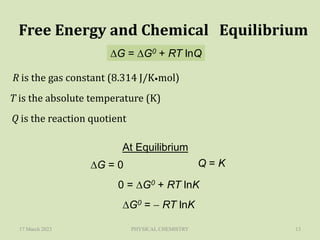
Free Energy and Chemical Equilibrium
DG = DG0 + RT lnQ
R is the gas constant (8.314 J/K•mol)
T is the absolute temperature (K)
Q is the reaction quotient
At Equilibrium
DG = 0 Q = K
0 = DG0 + RT lnK
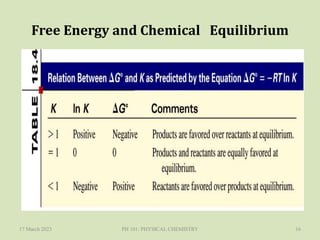
DG0 =  RT lnK
14
• Equilibrium constant, Kc, and Gibbs free energy DG
– Ideal solution (liquid and solid)
Raoult’s law Pi=xiPi* or xi=Pi / Pi* where
thus for a solution we can also write Gi=(Gi°+RTln xi) (compare to gas Gi=Gi°+RTlnPi)
which lead to, in a similar way, the relation between DG and Kc,
• Summary of G calculation for ideal gas and solution
– For a pure substance at const T & P, G=G°+RTlnP (1)
– For a mixture of ideal gas at const T and P G =SGi=S(Gi°+RTln Pi) (2-1)
– For a mixture of ideal solution at const T and P G =SGi=S(Gi°+RTln xi) (2-2)
 For a situation that a mixture (gas or solution) under concern is not ideal, the Pi or xi cannot be
related to G by expressions (2-1) & (2-2). How do you calculate G?
Equilibrium Constant (3)
Chemical Reaction equilibrium
Pi - vapour pressure of component i
xi - mole fraction of component i in solution
Pi* - equil. vapour pressure of pure component i
B
A
D
C
B
A
D
C
B
A
D
C
v
v
v
v
v
v
v
v
v
B
v
A
v
D
v
C
K
K
RT
RT
x
x
x
x
RT
G
[B]
[A]
[D]
[C]
where
)
ln(
[B]
[A]
[D]
[C]
ln
ln c
c 























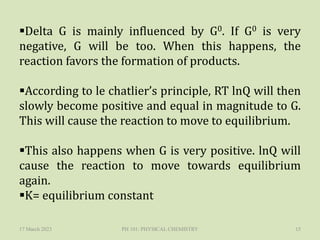
D
Delta G is mainly influenced by G0. If G0 is very
negative, G will be too. When this happens, the
reaction favors the formation of products.
According to le chatlier’s principle, RT lnQ will then
slowly become positive and equal in magnitude to G.
This will cause the reaction to move to equilibrium.
This also happens when G is very positive. lnQ will
cause the reaction to move towards equilibrium
again.
K= equilibrium constant
17 March 2023 PH 101: PHYSICAL CHEMISTRY 15
Free Energy and Chemical Equilibrium
17 March 2023 PH 101: PHYSICAL CHEMISTRY 16
Free Energy and Chemical Equilibrium
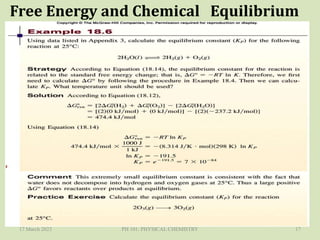
17 March 2023 PH 101: PHYSICAL CHEMISTRY 17
Free Energy and Chemical Equilibrium
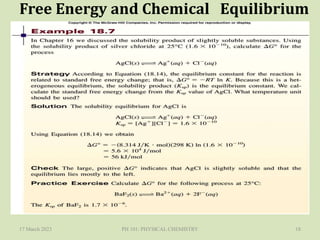
17 March 2023 PH 101: PHYSICAL CHEMISTRY 18
…..Ending
Thanks for your attention!
17 March 2023 PH 101: PHYSICAL CHEMISTRY 19

4 PCh Lecture.ppt

  • 1.
    CHEMICAL THERMODYNAMICS. FREE ENERGY, FREEENERGY AND EQUILIBRIUM Lecture 4 17 March 2023 PHYSICAL CHEMISTRY 1
  • 2.
    PLAN - Gibbs freeenergy function - Gibbs Free Energy of Reaction System - Chemical equilibrium - Relationship between Gibbs Free Energy and chemical equilibrium 17 March 2023 PHYSICAL CHEMISTRY 2
  • 3.
    Gibbs Free Energy •Predicts the direction of a spontaneous reaction. • Uses properties of the system to calculate. • For a constant pressure-temperature process. 17 March 2023 : PHYSICAL CHEMISTRY 3 DG = DHsys -TDSsys DG < 0 The reaction is spontaneous in the forward direction. DG > 0 The reaction is non spontaneous as written. The reaction is spontaneous in the reverse direction. DG = 0 The reaction is at equilibrium.
  • 4.
    17 March 2023PHYSICAL CHEMISTRY 4 Standard Free-Energy Changes The standard free-energy of reaction (DG0 ) is the free-energy change for a reaction when it occurs under standard-state conditions. Rxn Standard free energy of formation (DG0)f is the free-energy change that occurs when 1 mole of the compound is formed from its elements in their standard states. f DG0 rxn nDG0 (products) f = S mDG0 (reactants) f S -
  • 5.
    5 Gibbs Free Energyof Reaction System • Gibbs free energy (also called Gibbs function) definition G = U + PV -TS = H - TS DG= DH - TDS at constant T,P • Gibbs free energy calculation Standard Gibbs free energy, G°298 Similar to S° and H°, the standard Gibbs free energy of formation of a substance, G°, is defined at reference state of T=298 K and P=1 atm (G°298 values of common substances are available in most chemistry / chem. engg handbooks.) • Gibbs free energy change in a reaction at T, P reaction: vAA + vBB D vCC + vDD or, DGT° can be determined directly from Chemical Reaction - 0 0 0 T T T S T H G D D  D - inwhich 0 0 0 0 0 0 T , i T , i T , i reac T , i i prod T , i i T S T H G ) G v ( ) G v ( G D D  D   D   value of each individual substance value from overall reaction
  • 6.
    6 Gibbs Free Energyof Reaction System (2) • DG° is one of the most important thermodyn. properties for a chemical reaction system. – It determines the direction of reaction to proceed • DG°< 0 is the pre-condition which MUST be met for any process (not limited to chemical reaction systems) to occur (spontaneous process). • DG°<0 indicates a specified reaction has tendency to proceed; however, it CANNOT tell how fast that reaction will occur - reaction kinetics tell the rxn rate. • A process/reaction proceeds always in the direction of MINIMISING Gibbs free energy. This is a very important concept. • A process/reaction will stop at DG°0, this is called equilibrium state. Chemical Reaction reaction can proceed in the direction specified reaction at equilibrium (no further change occurs) reaction will NOT proceed (it can proceed backward!)        D   D   D 0 0 0 T T T G G G for a reaction at constant T, P, we have
  • 7.
  • 8.
    Factors Affecting ΔG 17March 2023 PH 101: PHYSICAL CHEMISTRY 8
  • 9.
    9 Important Notes aboutDS, DH and DG • DS, DH and DG are widely used in analysing various systems. Our current discussion of these function is limited to the application to a reaction system. • A clear definition of the reaction conditions is necessary before start calculation of these properties. • There are many ways these thermodynamic properties can be determined. Only most commonly used ones in relation to a chemical reaction are given. • It is very important to understand the study a chemical reaction by means of thermodynamics tells only state - a ‘snapshot’ of system, and how a process proceeds from one state to another (reversible-irreversible, with or without work done / exchange heat with surrounding). There is no factor of time involved. Chemical Reaction
  • 10.
    10 • For achemical reaction vAA + vBB D vCC + vDD when G°T =0, we say the reaction is in chemical reaction equilibrium - What is a chemical reaction equilibrium? Example 1: NH3(aq)+H2O(l) D NH4 +(l)+OH-(aq) At constant T and P, when t Example 2: 2NO(g) + O2(g) D 2NO2(g) At constant T and P, when t The concentration of a gas is usually measured as partial pressure At an equilibrium the reaction quotient becomes constant Chemical Reaction - The Equilibrium t NO2 NO O2 t NH4 NH3 constant 2 2 2 2  O NO NO P P P constant O] ][H [NH ] ][OH [NH 2 3 4    reaction quotient
  • 11.
    11 Equilibrium Constant (1) •Definition of equilibrium constant, K The equilibrium constant is the reaction quotient at G°T =0. • Expressions of equilibrium constant for various reactions – gas phase 2NO(g) + O2(g) D 2NO2(g) – gas-solid phase CaCO3(s) D CaO (s)+CO2(g) – liquid phase NH3(aq)+H2O(l) D NH4 +(l)+OH-(aq) – liquid-solid Cu(OH)2(s) D Cu2+(aq)+2OH- (aq) – gas-liquid NH3(g)+H2O(l) D NH4OH(aq) – general vAA + vBB D vCC + vDD Chemical Reaction equilibrium 2 2 2 2 O NO NO p P P P K  O] ][H [NH ] ][OH [NH 2 3 4    c K 2 CO p P K  2 2 ] ][OH [Cu    c K 3 1 NH p P / K  B A D C B A D C v B v A v D v C v v v v c P P P P D C K   [B] [A] ] [ ] [
  • 12.
    12 • Equilibrium constant,Kp, and Gibbs free energy DG A gas phase reaction vAA + vBB  vCC + vDD – When at equilibrium, assuming all the gases follow the ideal gas law at P=1 atm, DG°=S(viG°i)prod-S(viG°i)reac=0 and at any P(1) DG=S(viGi)prod-S(viGi)reac=0 – when reaction occurs at constant temperature (isothermal reaction) dG=VdP-SdT dG=VdP dG=RTdP/P DG=RTln(P/P0) – G° is defined at P0=1 atm, so that DG=G-G°=RTln(P/1) Gi=Gi°+RTlnPi S(vi(G°i+RTln(PCPD))prod-S(vi (G°i+RTln(PAPB))reac=0 S(viG°i)prod-S(vi G°i)reac=-[S(viRTln(PCPD))prod-S(vi RTln(PAPB))reac] – By definition: Equilibrium Constant (2) Chemical Reaction equilibrium                      D B A D C B A D C v B v A v D v C v B v A v D v C P P P P ln RT ) atm / P ( ) atm / P ( ) atm / P ( ) atm / P ( ln RT G p K RT G ln    D          B A D C v B v A v D v C p P P P P K T=const PV=RT intergration
  • 13.
    17 March 2023PHYSICAL CHEMISTRY 13 Free Energy and Chemical Equilibrium DG = DG0 + RT lnQ R is the gas constant (8.314 J/K•mol) T is the absolute temperature (K) Q is the reaction quotient At Equilibrium DG = 0 Q = K 0 = DG0 + RT lnK DG0 =  RT lnK
  • 14.
    14 • Equilibrium constant,Kc, and Gibbs free energy DG – Ideal solution (liquid and solid) Raoult’s law Pi=xiPi* or xi=Pi / Pi* where thus for a solution we can also write Gi=(Gi°+RTln xi) (compare to gas Gi=Gi°+RTlnPi) which lead to, in a similar way, the relation between DG and Kc, • Summary of G calculation for ideal gas and solution – For a pure substance at const T & P, G=G°+RTlnP (1) – For a mixture of ideal gas at const T and P G =SGi=S(Gi°+RTln Pi) (2-1) – For a mixture of ideal solution at const T and P G =SGi=S(Gi°+RTln xi) (2-2)  For a situation that a mixture (gas or solution) under concern is not ideal, the Pi or xi cannot be related to G by expressions (2-1) & (2-2). How do you calculate G? Equilibrium Constant (3) Chemical Reaction equilibrium Pi - vapour pressure of component i xi - mole fraction of component i in solution Pi* - equil. vapour pressure of pure component i B A D C B A D C B A D C v v v v v v v v v B v A v D v C K K RT RT x x x x RT G [B] [A] [D] [C] where ) ln( [B] [A] [D] [C] ln ln c c                         D
  • 15.
    Delta G ismainly influenced by G0. If G0 is very negative, G will be too. When this happens, the reaction favors the formation of products. According to le chatlier’s principle, RT lnQ will then slowly become positive and equal in magnitude to G. This will cause the reaction to move to equilibrium. This also happens when G is very positive. lnQ will cause the reaction to move towards equilibrium again. K= equilibrium constant 17 March 2023 PH 101: PHYSICAL CHEMISTRY 15
  • 16.
    Free Energy andChemical Equilibrium 17 March 2023 PH 101: PHYSICAL CHEMISTRY 16
  • 17.
    Free Energy andChemical Equilibrium 17 March 2023 PH 101: PHYSICAL CHEMISTRY 17
  • 18.
    Free Energy andChemical Equilibrium 17 March 2023 PH 101: PHYSICAL CHEMISTRY 18
  • 19.
    …..Ending Thanks for yourattention! 17 March 2023 PH 101: PHYSICAL CHEMISTRY 19