PROTECTING THE THERAPEUTIC ALLIANCE,
ONE CHEEK SWAB AT A TIME.
ToxProtect™ DNA-verified Urine Drug Testing
revolutionizes medication and sobriety monitoring,
and protects the physician-patient relationship by:
• Definitively authenticating samples
• Revealing mislabeling errors
• Detecting urine sample substitutions
“TRUST, BUT VERIFY”
UDT can help or hinder the therapeutic
alliance—but what’s your UDT not telling you?
The value of building strong physician-patient
relationships—and the dilemmas
Pain management physicians know the benefits
that trust, open dialogue, and mutual respect can
bring to a therapeutic relationship—particularly
in a specialty where important patient information
regarding pain levels and drug effects are often
dependent on personal communication.
Providers must constantly probe for warning
signs of the growing problems with opioid
misuse, abuse, and diversion—making the use of
urine drug tests (UDT) both indispensable and
potentially controversial. Although a necessary
tool for medication and sobriety monitoring, it’s
also one that can challenge the physician-patient
relationship, especially when disagreements arise
over results.
Since current methods for UDT testing aren’t
telling the whole story—partly because current
validity tests can’t reliably identify synthetic or
substitute human urine—current estimates of drug
diversion (12.8%1
) are likely low. In the meantime,
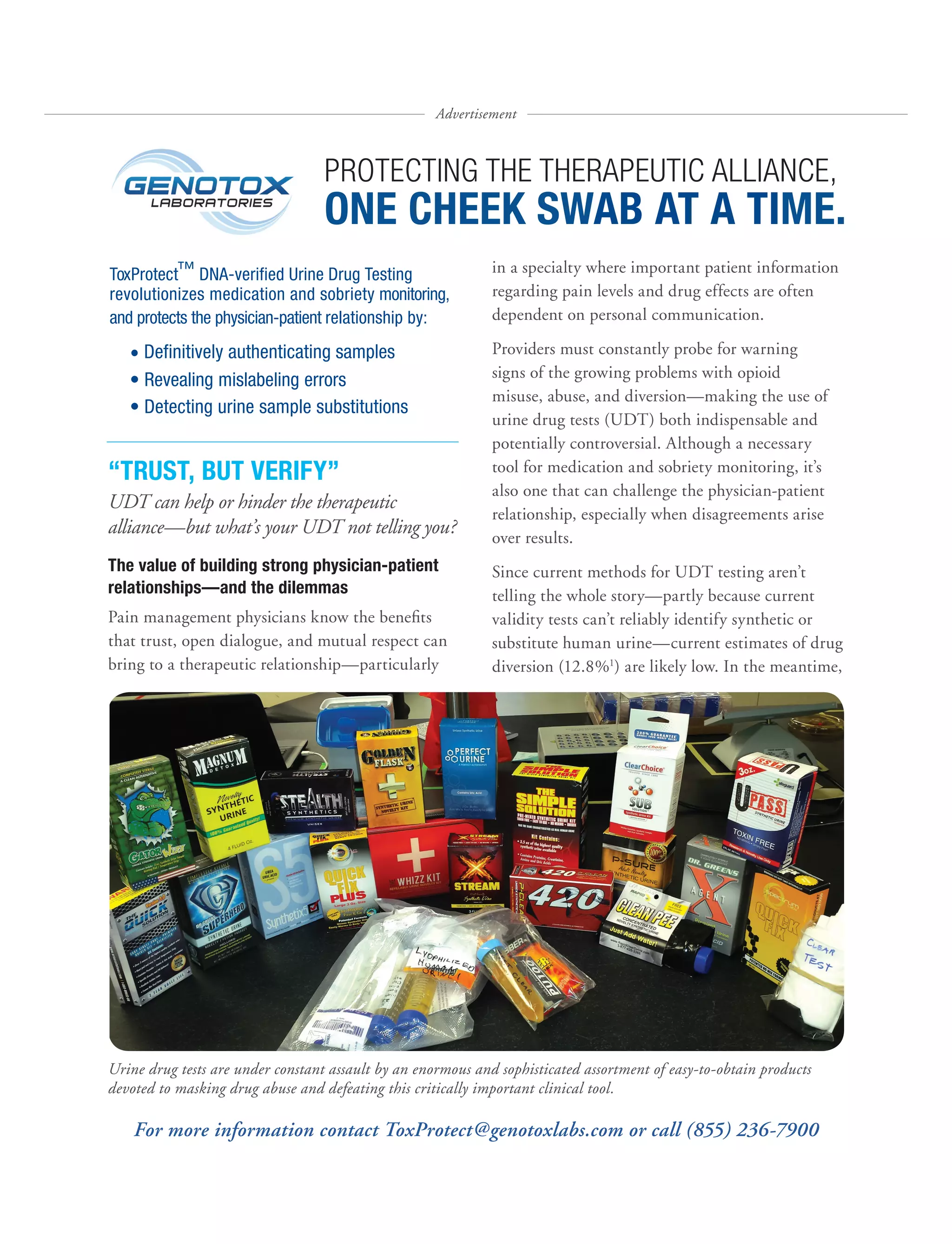
Urine drug tests are under constant assault by an enormous and sophisticated assortment of easy-to-obtain products
devoted to masking drug abuse and defeating this critically important clinical tool.
Advertisement
For more information contact ToxProtect@genotoxlabs.com or call (855) 236-7900
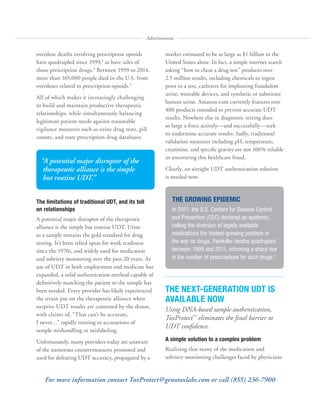
overdose deaths involving prescription opioids
have quadrupled since 1999,2
as have sales of
those prescription drugs.3
Between 1999 to 2014,
more than 165,000 people died in the U.S. from
overdoses related to prescription opioids.2
All of which makes it increasingly challenging
to build and maintain productive therapeutic
relationships, while simultaneously balancing
legitimate patient needs against reasonable
vigilance measures such as urine drug tests, pill
counts, and state prescription drug databases.
The limitations of traditional UDT, and its toll
on relationships
A potential major disruptor of the therapeutic
alliance is the simple but routine UDT. Urine
as a sample remains the gold standard for drug
testing. It’s been relied upon for work readiness
since the 1970s, and widely used for medication
and sobriety monitoring over the past 20 years. As
use of UDT in both employment and medicine has
expanded, a solid authentication method capable of
definitively matching the patient to the sample has
been needed. Every provider has likely experienced
the strain put on the therapeutic alliance when
surprise UDT results are contested by the donor,
with claims of, “That can’t be accurate,
I never…” rapidly turning to accusations of
sample mishandling or mislabeling.
Unfortunately, many providers today are unaware
of the numerous countermeasures promoted and
used for defeating UDT accuracy, propagated by a
market estimated to be as large as $1 billion in the
United States alone. In fact, a simple internet search
asking “how to cheat a drug test” produces over
2.5 million results, including chemicals to ingest
prior to a test, catheters for implanting fraudulent
urine, wearable devices, and synthetic or substitute
human urine. Amazon.com currently features over
400 products intended to prevent accurate UDT
results. Nowhere else in diagnostic testing does
so large a force actively—and successfully—seek
to undermine accurate results. Sadly, traditional
validation measures including pH, temperature,
creatinine, and specific gravity are not 100% reliable
in uncovering this healthcare fraud.
Clearly, an airtight UDT authentication solution
is needed now.
THE NEXT-GENERATION UDT IS
AVAILABLE NOW
Using DNA-based sample authentication,
ToxProtect™
eliminates the final barrier to
UDT confidence.
A simple solution to a complex problem
Realizing that many of the medication and
sobriety monitoring challenges faced by physicians
Advertisement
For more information contact ToxProtect@genotoxlabs.com or call (855) 236-7900
“A potential major disruptor of the
therapeutic alliance is the simple
but routine UDT.”
THE GROWING EPIDEMIC
In 2011, the U.S. Centers for Disease Control
and Prevention (CDC) declared an epidemic,
calling the diversion of legally available
medications the fastest-growing problem in
the war on drugs. Painkiller deaths quadrupled
between 1999 and 2011, mirroring a sharp rise
in the number of prescriptions for such drugs.2
GENOMIC SCIENCE CREATING
WIN-WIN SCENARIOS
Patients adhering to their treatment plan
will be grateful for the certainty provided by
ToxProtect. At the same time, its mere presence
establishes a powerful and indisputable
deterrent to cheating within a practice or clinic,
and helps advance the therapeutic alliance
between physician and patient.
substitute human urine is used, and confirms for
a comprehensive and continuously expanding set
of over 100 controlled, illicit, and over-the-counter
substances, and their metabolites.
Precise sample matching with 100% certainty
represents the most important innovation for
urine drug testing in the last decade, and is only
available at Genotox Laboratories. Now physicians
CAN know for certain.
Protecting therapeutic alliances while
preventing abuse
Perhaps ToxProtect’s most important benefits
extend into the physician-patient relationship.
While sample mislabeling rarely occurs, it is
possible. Unfavorable results can be challenged by
a patient with accusations of sample mishandling
leveled at the physician, clinic, rehab facility, or
lab. Most may never be resolved, leading to hurt
feelings, fractured trust, patient discomfort, or a
healthcare provider ignoring the situation to spare
the relationship.
But with ToxProtect, physicians can explain
the new DNA collection step as a quality
assurance measure intended to prevent the kind
of errors which could lead to stigmatization.
could be solved with a urine drug test that
conclusively verifies sample authenticity, one
toxicology company—Genotox Laboratories—has
developed a method that’s both easy and effective.
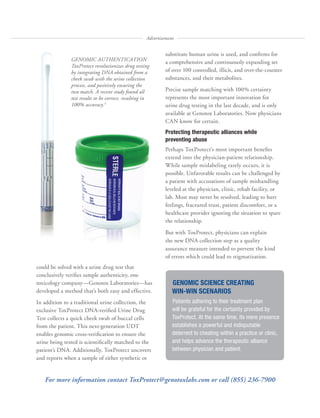
In addition to a traditional urine collection, the
exclusive ToxProtect DNA-verified Urine Drug
Test collects a quick cheek swab of buccal cells
from the patient. This next-generation UDT
enables genomic cross-verification to ensure the
urine being tested is scientifically matched to the
patient’s DNA. Additionally, ToxProtect uncovers
and reports when a sample of either synthetic or
GENOMIC AUTHENTICATION
ToxProtect revolutionizes drug testing
by integrating DNA obtained from a
cheek swab with the urine collection
process, and positively ensuring the
two match. A recent study found all
test results to be correct, resulting in
100% accuracy.4
Advertisement
For more information contact ToxProtect@genotoxlabs.com or call (855) 236-7900
The conversation can center around the ability
of ToxProtect™
to positively match each patient
to his or her urine sample, in order to uncover
any sample mislabeling. It can be explained that
urine testing with genomic matching is being
implemented to protect patients from unjustified
recriminations or treatment interruptions,
and support an atmosphere of mutual trust.
THE WIDESPREAD BENEFITS
OF IMPROVED MEDICATION
AND SOBRIETY MONITORING
ToxProtect shows a tangible commitment
to patients and the community.
ToxProtect patients
By scientifically ensuring sample authenticity, the
presence of ToxProtect can enhance the reliability
and value of medication and sobriety monitoring,
preserve the therapies needed to treat patients
effectively and compassionately, and foster a
positive therapeutic alliance. Moreover, ToxProtect
alleviates physician doubts surrounding a result,
allowing a focus on care versus suspicion, and on
continuation of treatment goals instead of conflict.
ToxProtect practices
From new FDA and state regulations to DOJ
actions and crippling lawsuits, physicians
nationwide are well aware of the increased
Advertisement
scrutiny given to their narcotic prescriptions.
That’s why an effective medication and sobriety
monitoring process built on the airtight DNA-
based authentication of ToxProtect can facilitate
a practice’s commitment to patient safety,
intolerance of abuse, and dedication to
eradicating diversion.
ToxProtect the community
The final step in a physician’s education is an oath
promising to “do no harm.” Using ToxProtect
empowers physicians to know they’re part of the
solution, not the problem. It identifies when drug
test cheating occurs, interrupts possible diversions,
and provides an easy and effective tool to help
build the therapeutic alliance.
All of which goes well beyond doing no harm,
to deliver profoundly important benefits for the
community at large.
“ToxProtect alleviates physician
doubts surrounding a result, allowing
a focus on care versus suspicion, and
on continuation of treatment goals
instead of conflict.”
“Using ToxProtect empowers
physicians to know they’re part of
the solution, not the problem.”
REFERENCES:
1.	 McDonald DC, Carlson KE. Estimating the prevalence of
opioid diversion by “doctor shoppers” in the United States.
PLoS ONE. 2013;8(7). doi:10.1371/journal.pone.0069241.
2.	 CDC. Wide-ranging online data for epidemiologic research
(WONDER). Atlanta, GA: CDC, National Center for
Health Statistics; 2016. Available at http://wonder.cdc.gov.
3.	 Frank SM, Porter KS, Palazzo LJ. Prescription opioid
analgesic use among adults: United States, 1999–2012.
NCHS data brief, no 189. Hyattsville, MD: National Center
for Health Statistics. 2015.
4.	 Gregg K, McCarty M, Rhodes R, et al. (2016).
A New and Valuable Validity Test for Urine Drug Testing.
Presentation, Annual Academy of Pain Medicine Annual
Meeting, Palm Springs, CA.
For more information contact ToxProtect@genotoxlabs.com or call (855) 236-7900

4 Page ToxProtect Advertorial

  • 1.
    PROTECTING THE THERAPEUTICALLIANCE, ONE CHEEK SWAB AT A TIME. ToxProtect™ DNA-verified Urine Drug Testing revolutionizes medication and sobriety monitoring, and protects the physician-patient relationship by: • Definitively authenticating samples • Revealing mislabeling errors • Detecting urine sample substitutions “TRUST, BUT VERIFY” UDT can help or hinder the therapeutic alliance—but what’s your UDT not telling you? The value of building strong physician-patient relationships—and the dilemmas Pain management physicians know the benefits that trust, open dialogue, and mutual respect can bring to a therapeutic relationship—particularly in a specialty where important patient information regarding pain levels and drug effects are often dependent on personal communication. Providers must constantly probe for warning signs of the growing problems with opioid misuse, abuse, and diversion—making the use of urine drug tests (UDT) both indispensable and potentially controversial. Although a necessary tool for medication and sobriety monitoring, it’s also one that can challenge the physician-patient relationship, especially when disagreements arise over results. Since current methods for UDT testing aren’t telling the whole story—partly because current validity tests can’t reliably identify synthetic or substitute human urine—current estimates of drug diversion (12.8%1 ) are likely low. In the meantime, Urine drug tests are under constant assault by an enormous and sophisticated assortment of easy-to-obtain products devoted to masking drug abuse and defeating this critically important clinical tool. Advertisement For more information contact ToxProtect@genotoxlabs.com or call (855) 236-7900
  • 2.
    overdose deaths involvingprescription opioids have quadrupled since 1999,2 as have sales of those prescription drugs.3 Between 1999 to 2014, more than 165,000 people died in the U.S. from overdoses related to prescription opioids.2 All of which makes it increasingly challenging to build and maintain productive therapeutic relationships, while simultaneously balancing legitimate patient needs against reasonable vigilance measures such as urine drug tests, pill counts, and state prescription drug databases. The limitations of traditional UDT, and its toll on relationships A potential major disruptor of the therapeutic alliance is the simple but routine UDT. Urine as a sample remains the gold standard for drug testing. It’s been relied upon for work readiness since the 1970s, and widely used for medication and sobriety monitoring over the past 20 years. As use of UDT in both employment and medicine has expanded, a solid authentication method capable of definitively matching the patient to the sample has been needed. Every provider has likely experienced the strain put on the therapeutic alliance when surprise UDT results are contested by the donor, with claims of, “That can’t be accurate, I never…” rapidly turning to accusations of sample mishandling or mislabeling. Unfortunately, many providers today are unaware of the numerous countermeasures promoted and used for defeating UDT accuracy, propagated by a market estimated to be as large as $1 billion in the United States alone. In fact, a simple internet search asking “how to cheat a drug test” produces over 2.5 million results, including chemicals to ingest prior to a test, catheters for implanting fraudulent urine, wearable devices, and synthetic or substitute human urine. Amazon.com currently features over 400 products intended to prevent accurate UDT results. Nowhere else in diagnostic testing does so large a force actively—and successfully—seek to undermine accurate results. Sadly, traditional validation measures including pH, temperature, creatinine, and specific gravity are not 100% reliable in uncovering this healthcare fraud. Clearly, an airtight UDT authentication solution is needed now. THE NEXT-GENERATION UDT IS AVAILABLE NOW Using DNA-based sample authentication, ToxProtect™ eliminates the final barrier to UDT confidence. A simple solution to a complex problem Realizing that many of the medication and sobriety monitoring challenges faced by physicians Advertisement For more information contact ToxProtect@genotoxlabs.com or call (855) 236-7900 “A potential major disruptor of the therapeutic alliance is the simple but routine UDT.” THE GROWING EPIDEMIC In 2011, the U.S. Centers for Disease Control and Prevention (CDC) declared an epidemic, calling the diversion of legally available medications the fastest-growing problem in the war on drugs. Painkiller deaths quadrupled between 1999 and 2011, mirroring a sharp rise in the number of prescriptions for such drugs.2
  • 3.
    GENOMIC SCIENCE CREATING WIN-WINSCENARIOS Patients adhering to their treatment plan will be grateful for the certainty provided by ToxProtect. At the same time, its mere presence establishes a powerful and indisputable deterrent to cheating within a practice or clinic, and helps advance the therapeutic alliance between physician and patient. substitute human urine is used, and confirms for a comprehensive and continuously expanding set of over 100 controlled, illicit, and over-the-counter substances, and their metabolites. Precise sample matching with 100% certainty represents the most important innovation for urine drug testing in the last decade, and is only available at Genotox Laboratories. Now physicians CAN know for certain. Protecting therapeutic alliances while preventing abuse Perhaps ToxProtect’s most important benefits extend into the physician-patient relationship. While sample mislabeling rarely occurs, it is possible. Unfavorable results can be challenged by a patient with accusations of sample mishandling leveled at the physician, clinic, rehab facility, or lab. Most may never be resolved, leading to hurt feelings, fractured trust, patient discomfort, or a healthcare provider ignoring the situation to spare the relationship. But with ToxProtect, physicians can explain the new DNA collection step as a quality assurance measure intended to prevent the kind of errors which could lead to stigmatization. could be solved with a urine drug test that conclusively verifies sample authenticity, one toxicology company—Genotox Laboratories—has developed a method that’s both easy and effective. In addition to a traditional urine collection, the exclusive ToxProtect DNA-verified Urine Drug Test collects a quick cheek swab of buccal cells from the patient. This next-generation UDT enables genomic cross-verification to ensure the urine being tested is scientifically matched to the patient’s DNA. Additionally, ToxProtect uncovers and reports when a sample of either synthetic or GENOMIC AUTHENTICATION ToxProtect revolutionizes drug testing by integrating DNA obtained from a cheek swab with the urine collection process, and positively ensuring the two match. A recent study found all test results to be correct, resulting in 100% accuracy.4 Advertisement For more information contact ToxProtect@genotoxlabs.com or call (855) 236-7900
  • 4.
    The conversation cancenter around the ability of ToxProtect™ to positively match each patient to his or her urine sample, in order to uncover any sample mislabeling. It can be explained that urine testing with genomic matching is being implemented to protect patients from unjustified recriminations or treatment interruptions, and support an atmosphere of mutual trust. THE WIDESPREAD BENEFITS OF IMPROVED MEDICATION AND SOBRIETY MONITORING ToxProtect shows a tangible commitment to patients and the community. ToxProtect patients By scientifically ensuring sample authenticity, the presence of ToxProtect can enhance the reliability and value of medication and sobriety monitoring, preserve the therapies needed to treat patients effectively and compassionately, and foster a positive therapeutic alliance. Moreover, ToxProtect alleviates physician doubts surrounding a result, allowing a focus on care versus suspicion, and on continuation of treatment goals instead of conflict. ToxProtect practices From new FDA and state regulations to DOJ actions and crippling lawsuits, physicians nationwide are well aware of the increased Advertisement scrutiny given to their narcotic prescriptions. That’s why an effective medication and sobriety monitoring process built on the airtight DNA- based authentication of ToxProtect can facilitate a practice’s commitment to patient safety, intolerance of abuse, and dedication to eradicating diversion. ToxProtect the community The final step in a physician’s education is an oath promising to “do no harm.” Using ToxProtect empowers physicians to know they’re part of the solution, not the problem. It identifies when drug test cheating occurs, interrupts possible diversions, and provides an easy and effective tool to help build the therapeutic alliance. All of which goes well beyond doing no harm, to deliver profoundly important benefits for the community at large. “ToxProtect alleviates physician doubts surrounding a result, allowing a focus on care versus suspicion, and on continuation of treatment goals instead of conflict.” “Using ToxProtect empowers physicians to know they’re part of the solution, not the problem.” REFERENCES: 1. McDonald DC, Carlson KE. Estimating the prevalence of opioid diversion by “doctor shoppers” in the United States. PLoS ONE. 2013;8(7). doi:10.1371/journal.pone.0069241. 2. CDC. Wide-ranging online data for epidemiologic research (WONDER). Atlanta, GA: CDC, National Center for Health Statistics; 2016. Available at http://wonder.cdc.gov. 3. Frank SM, Porter KS, Palazzo LJ. Prescription opioid analgesic use among adults: United States, 1999–2012. NCHS data brief, no 189. Hyattsville, MD: National Center for Health Statistics. 2015. 4. Gregg K, McCarty M, Rhodes R, et al. (2016). A New and Valuable Validity Test for Urine Drug Testing. Presentation, Annual Academy of Pain Medicine Annual Meeting, Palm Springs, CA. For more information contact ToxProtect@genotoxlabs.com or call (855) 236-7900