1. Flash a
4 Leaks to Plug for Collection
Prioritization and Improve
Productivity by 130%
This e-book uncovers the leaks in account
prioritization, which can inflate past-due A/R by
150% and the means to seal the leaks through
industry best practices and smart segmenting factors
to increase team productivity and ensure faster
collections
e – b o o k
4 Leaks to Plug for Collection Prioritization and Improve 130%
2
© 2020 HighRadius Corporation
e – b o ok
Contents
1. Collections at A Glance....................................................................................................................... 3
1.1 The Evolution of Collections Process......................................................................................................................
3
1.2 Connect between Collections and other Credit-to-CashProcesses...............................................................................3
2. Collections Today.............................................................................................................................5
2.1 The Current Collections Scenario........................................................................................................................... 5
2.2 The Leaks in Account Prioritization........................................................................................................................ 5
2.3 Conclusion.............................................................................................................................................................. 6
3. Four Leaks to Plug for Collection Prioritization...............................................................................7
3.1Overview.................................................................................................................................................................7
3.2 Credit History..........................................................................................................................................................7
3.3 Deductions and Claims...........................................................................................................................................8
3.4 Cash Application..................................................................................................................................................... 8
3.5 Best Practices in Internal Collections Process .............................................................. Error! Bookmark not defined.
4. Conclusion..................................................................................................................................... 10
4.1 Executive Summary.............................................................................................................................................. 10
4.2 Future of Collections............................................................................................................................................ 11
5. About HighRadius.......................................................................................................................... 12
4 Leaks to Plug for Collection Prioritization and Improve 130% e – b o ok
1. Collections at A Glance
1. The Evolutionof Collections Process
Collections is one the most important processes in Accounts Receivables. Fora business to havea leading
growth graph, a business ‘needs’ to put efforts into Collections Management.It doesn’t matter howwell a
company’s marketingefforts are goingor how manysales they make if they are unable to collect anyof their
open invoices. With the changingeconomictimes,the collections process has evolvedover the decades from
1st generation to the 3rd generation.The evolution focuses on howcollectionshas grown from a fully manual
and limited ‘dialfor dollars’approach to a reactiveprocess with semi-automation.
1st generation collections teams leveragedcustomprograms writtenovermainframe or ERP databases to
prepare agingreports on a dailyor weekly basis. The team would then ‘dial for dollars’via phone calls.
2nd generation in the early 2000s saw the emergence of Data Warehousingand Business Intelligence tools
which added additional insightsto regular aging reports.However,the analysiswas still manual and the
teams would still ‘dial for dollars’ but had a better context to filter ‘who’ and ‘what’in calls.
3rd generation from 2010 onwards sawdedicatedsoftware products for CollectionsManagement which
became the defacto standardfor collectionsand brought fundamental automationintothe picture. Email
adoption addedvalue byshiftinga good proportionofphone calls to emails. This enabled 30-40% collections
automationand an average 10% DSO improvement.
The focus over the years in the collections process has been on improvingthe accessibility ofdata and
enablingsome amount ofautomation.With the onset of collections evolution,the other accounts
receivables process in the credit-to-cash cycle have also matured overtime. The readers wouldagree that
the days when A/R processes were siloed are far behind us.The next section takes a closer look.
3
1.2 Connect betweenCollections and other Credit-to-CashProcesses
In the developingA/R scenario, it is no longer possible for collectionsprocessto remain isolated. The inter-
department connect is of paramountimportance when it comes to collections as the process needs data
fromother departments fornot only slicingand segmentingthe informationfor better worklists but also for
efficient correspondence with the customers.
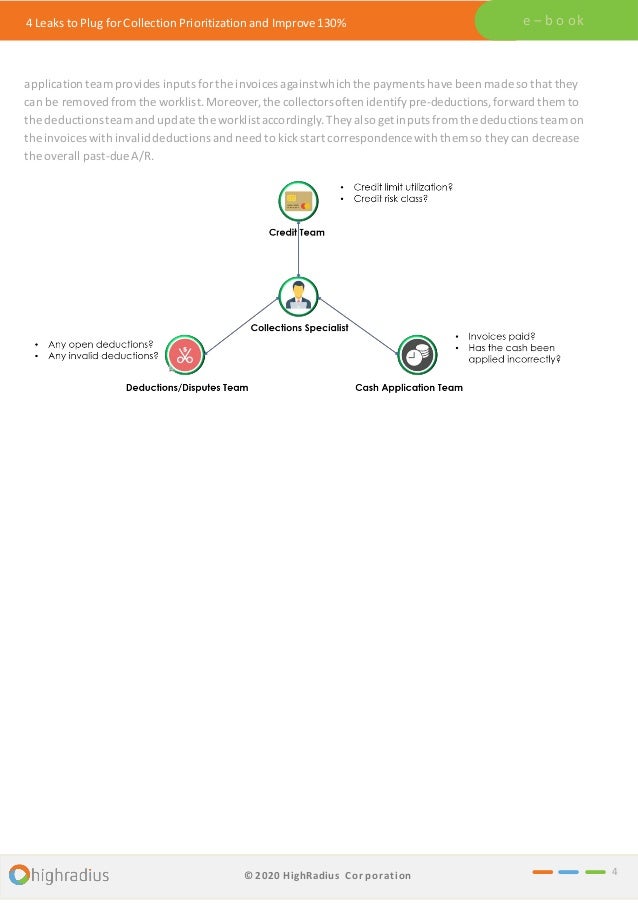
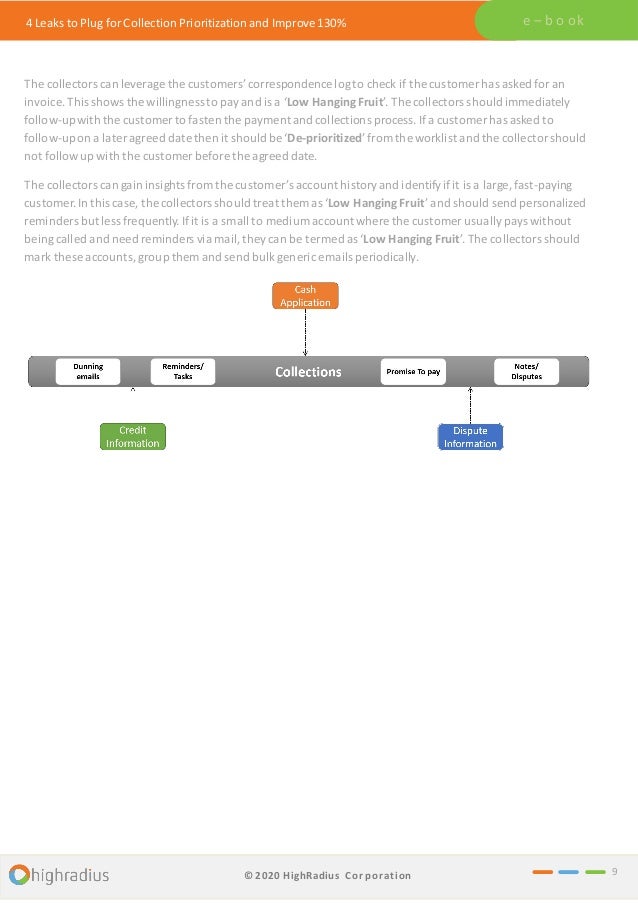
The collections team interacts with the credit team to get information regardingcredit riskclass and credit
limit utilizationto formulate a fruitfulcorrespondence strategy. The credit team in return also needs the
support fromcollections teamsto correspond with the customers for releasingblocked orders.The cash
© 2020 HighRadius Corporation
4 Leaks to Plug for Collection Prioritization and Improve 130% e – b o ok
application team provides inputs forthe invoices againstwhich the paymentshavebeen made so that they
can be removed from the worklist.Moreover,the collectorsoften identifypre-deductions,forward them to
the deductionsteamand update the worklistaccordingly.Theyalso get inputs from the deductions team on
the invoices with invaliddeductions and need to kick start correspondence with them so they can decrease
the overall past-due A/R.
4
© 2020 HighRadius Corporation
4 Leaks to Plug for Collection Prioritization and Improve 130% e – b o ok
2. Collections Today
1. The currentscenario in Collections
As much as the collections process has evolved,the pitfalls in the process fail to disappear. The collectors
still struggle across the roadblocks like too manydelinquentaccounts anda shortage oftime to cover all
accounts in the worklist. While the majority oftheir time is spent in sendingemail reminders,the use of
Excel or spreadsheets as a main system of record further slows down the process. Amidst all the
shortcomings in the collections process, DSO, past-due A/R and account coverageremainkey concerns for
the collections team.
The golden rule in collections states ‘The longer a debt is owed, the less likely it is to be repaid’ and rightlyso
as per the reports by Atradius that state that 52% of 90-days past-due invoice values are usuallywritten-off.
As per McKinsey’s report, more than 70% collection calls are wasted! These calls are made for accounts
where the customer would havepaid even in the absence ofthese calls. These facts and figures alongwith
the identifiedprocess pitfalls pose an undeniable threat to the scalabilityand seamless workingofthe
collections process. At a closer look, it can be identified that there is somethingwrongwith the waythe
collections worklistprioritizationworks today,leading to wasted phone calls,increasingpast-due A/R and
insufficient account coverage. The next section explores the root causes ofthe problem.
2. The Leaks in Account Prioritization
The collections teams have traditionally used agingdata and invoice value as the two pillars to slice and dice
the invoice data extractedfrom the ERP. While this technique mayseem reasonable and insightfulenough
from a top-levelview, the industrial statistics disagree.
When aging data is used to prioritize a collections worklist,it mayprioritize accounts in the worklist which
have a claim or dispute associatedwith it.Now the collections process for these types of accounts cannot
proceed or start unless the corresponding dispute has been resolved bythe deductions team.However, the
worklist prioritizedbased on agingwould show up these accounts at the top for every collector.
If the collections team focuses on invoicevalue while prioritizingthe day’s worklist,the small and medium
accounts are left unaddressedand this may lead to increasingpast-due A/R due to their accumulatedinvoice
value. Moreover,there is a high probabilitythat these customers would havepaidifthey had been sent a
reminder or email about the same. What is more interestingis the fact that in a collections worklist 20%
accounts on an average have high invoicevalue while 80% are small to mediumaccounts. The collectorswho
focus on only the large accounts often end up delayingnumerous paymentsbysmall and medium customers.
The combinationofaging data and invoice value also doesn’t supportaccount prioritizationin an optimized
manner as they are laggingindicators ofdelinquency byan account.Moreover,usingthis tacticdoesn’t
identify or segregate the fast-payingcustomers,slow-payingcustomers or the regularlydelinquent account.
5
© 2020 HighRadius Corporation
4 Leaks to Plug for Collection Prioritization and Improve 130% e – b o ok
Conclusion
In conclusion, the staticmethodofprioritizingaccounts based on just the aging data and invoice value does
more harm than any benefit to the collections process and are the leaks in accounts prioritization.This
leaves room for more dynamicand leadingindicators ofdelinquency as factors while prioritizingaccounts.
The next chapter discusses the plugs to seal the leaks.
6
© 2020 HighRadius Corporation
4 Leaks to Plug for Collection Prioritization and Improve 130% e – b o ok
3. Four Leaks to Plug for Collection Prioritization
7
As discussed in the previous chapter, account prioritizationis inefficient in the presence of laggingfactors
like aging data and invoice value and needs more insight. But what ifthe collectors could trackthe payment
history ofan account and decide the priorityfor that account based on whether it is a fast-payingcustomer
or one with consistent delinquencies? This kind ofstrategy in segmentingthe accountsprovides better
judgement aboutthe priorityassociatedwith the account.Moreover,since the collections process isn’t
insulatedfrom other credit-to-cash processes,some of these leadingfactors in account prioritization can be
derived from other A/R processes.
The accounts can also be classified as:
At Risk Accounts: This is the case where there is a high probability ofcustomernot payingand the invoice
fallingintoa larger aging bucket with time.
De-prioritized Accounts:This is the scenario where the account can be pushed backon the prioritylist and
the collectors can spend timeon more strategicaccounts.
Low Hanging Fruit: This refers to the scenario where collecting might be easy or the customer has an
incentivemake payments.
3.1 Leveraging Credit History
The collections team can leverage credit historyofthe customers to identifytheir financialposition and
notice any downward trends in the financial healthofthe account.If a customer has a history oflate
payments and has a high credit risk, the financial health ofthat account might be unstable makingit an
‘At Risk’ account. In this scenario,the collector should flagthe customer as a high-riskcustomer, entice
them to make early payments to get discounts and offer different modes ofpayment so that theydon’tend
up fallingin larger past-duebuckets and are not written offin theend!
Moreover,the collections team can obtainthe credit limit utilizationfrom the credit managementteam. If a
customer with a growingbusiness and lowcredit risk is approachinga credit hold, the collections team can
motivate the customer for clearingtheir invoices to prevent their next order from gettingblocked.The
collections team can leverage credit limit utilization ofall customers to find these ‘Low Hanging Fruits’ and
eliminate them from their collections worklist.
© 2020 HighRadius Corporation
4 Leaks to Plug for Collection Prioritization and Improve 130% e – b o ok
3.2 Insights from Deductions and Claims
The collections team can leverage inputsfrom the deductions management and claims processingto
pinpointthe customers with open disputes or unresolved deductions which need to be reviewed by the
deductionanalysts.These accounts can be ‘De-prioritized’since theycannot be worked upon by collectors
unless the disputesor claims are resolved.
However, if it is found that a deductionor dispute is invalid, the account becomes an ‘At Risk’ account where
the collections teammust prioritize thisaccount and follow-up with the customer. The reason behind is that
the disputedinvoices have alreadybeen open while the deductions team worked on them, and any further
delay in closingthem would onlyput them in a larger agingbucket and increase the past-dueA/R.
8
3. Inputs from Cash Application
The collectors often hear from the customers that they have alreadymade payments against the invoice in
question. This scenario occurs when the cash is applied in batchesand the real-time updatedinformation is
unavailable to the collectors or when the cash has been applied incorrectly. The collectors should‘De-
prioritize’ such accounts and check with the cash applicationteam before followingup with these customers.
4. Best Practices in Internal Collections Process
Some best practices can be incorporatedinto the collections process to de-clutter the collections worklist
and improveaccount prioritization.
The collections teamshould havea means of collecting Promise-to-Pays against invoices from the customers.
The collectors can add the promised payment datefor such accounts in the calendar and set remindersfor
themselves while classifying the account as ‘De-prioritized’from the worklist.However,if a customer has
broken a promise-to-paythat is failed to make payment bythe promised paymentdate, it shouldbe treated as
an ‘At Risk’ account where the customershouldbe called on the same dayand the account should be
escalated internally.
If a customerhas an open dunningnotice theyshould be ‘De-prioritized’from the collectionsworklist while
the collector should add a follow-up datein the calendaras a reminder for himself.If a customer has been
sent multiple notices and reminders and has been contactedthroughcalls and the payment is still pending,
it should be treatedas an ‘At Risk’ account since the customer is showingreluctance to pay. The collector
should further call the customer,offer incentives like discounts and recommendother modes ofpayment to
the customer.
© 2020 HighRadius Corporation
4 Leaks to Plug for Collection Prioritization and Improve 130% e – b o ok
The collectors can leverage the customers’correspondence logto check if the customerhas asked for an
invoice. This shows the willingnessto payand is a ‘Low Hanging Fruit’. The collectors shouldimmediately
follow-upwith the customerto fasten the paymentand collections process.If a customerhas asked to
follow-upon a later agreed date then it shouldbe ‘De-prioritized’from the worklist and the collector should
not followup with the customer beforethe agreed date.
The collectors can gain insights from the customer’s account history and identify ifit is a large, fast-paying
customer.In this case, the collectors should treat them as ‘Low Hanging Fruit’ and should send personalized
reminders but less frequently.If it is a small to medium account where the customer usuallypays without
beingcalled and need reminders via mail,they can be termed as ‘Low Hanging Fruit’. The collectors should
mark these accounts, group them and send bulkgeneric emails periodically.
9
© 2020 HighRadius Corporation
4 Leaks to Plug for Collection Prioritization and Improve 130% e – b o ok
4. Conclusion
1. Summary
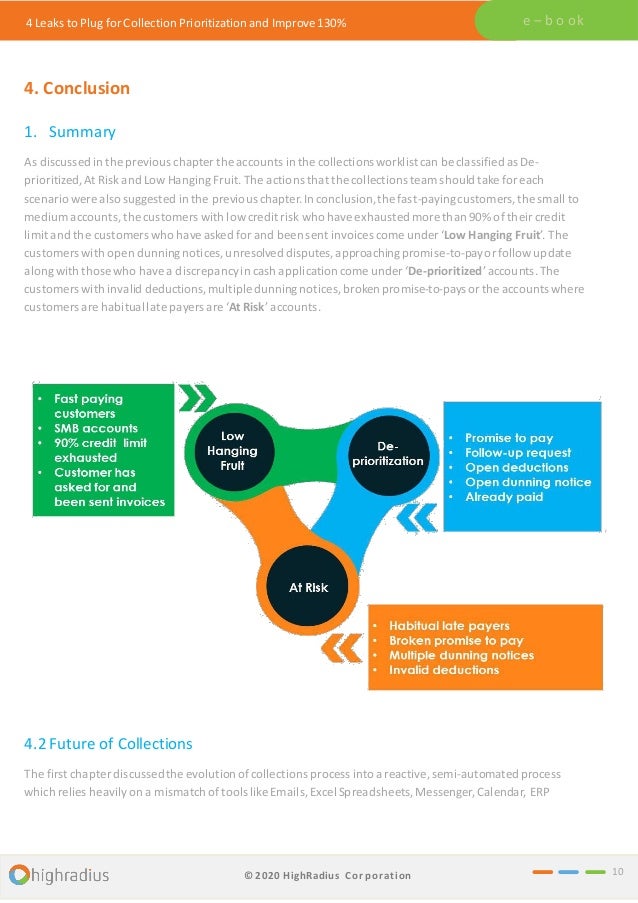
As discussed in the previous chapter the accounts in the collections worklistcan be classified as De-
prioritized, At Risk and Low Hanging Fruit. The actions that the collections team should take for each
scenario were also suggested in the previous chapter.In conclusion,the fast-payingcustomers, the small to
mediumaccounts, the customers with lowcredit risk who have exhaustedmore than 90% of their credit
limit and the customers who have asked for and been sent invoices comeunder ‘Low Hanging Fruit’. The
customers with open dunningnotices,unresolved disputes,approachingpromise-to-payor followupdate
alongwith those who havea discrepancyin cash application comeunder ‘De-prioritized’accounts. The
customers with invalid deductions,multiple dunningnotices, brokenpromise-to-pays orthe accounts where
customers are habituallate payers are ‘At Risk’ accounts.
10
4.2 Future of Collections
The first chapter discussedthe evolutionofcollections process intoa reactive,semi-automatedprocess
which relies heavilyon a mismatch oftools like Emails,Excel Spreadsheets,Messenger,Calendar, ERP
© 2020 HighRadius Corporation
4 Leaks to Plug for Collection Prioritization and Improve 130% e – b o ok
system,To-do lists,Stickynotes,Notepads, etc. However, are these tools reallya necessity in the future of
collections?
Technology is the futureofthe collections process where all the data,analysis,strategies,correspondence
and information are onlya click away. HighRadius Collections Cloudsolution provides a complete set of tools
to optimize and automate the collections managementprocess. All the informationyou need like invoices,
dispute information,PODs,claims,trackinginfo,etc.on each case is automaticallypresentedin a collections
work-space and readyfor use with a single click.
Key Features Include:
• Rules-basedCollections Optimizationautomatically prioritizesand assignscollections activities to
analysts basedon predefinedbusinessrules.
• IntegratedCollections Work-space tracks promises-to-pay and tasks andreminders for everyaccount
and collection effort.
• PredictiveRisk Scoring Model identifies ‘at-risk’customers who might be current on their account
and integrates the risklevel into prioritization.
• DunningCorrespondence Automation generates and sends out correspondence packages containing
needed documentationbased on predefinedtemplates.
• Easyintegration with ERP,Accounting, and other systems
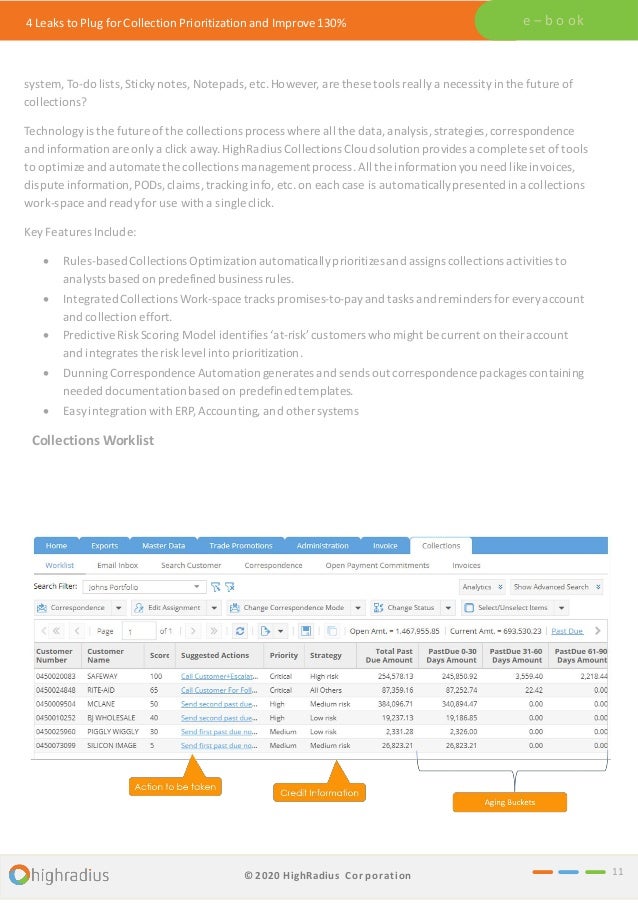
Collections Worklist
11
© 2020 HighRadius Corporation
4 Leaks to Plug for Collection Prioritization and Improve 130% e – b o ok
5. About HighRadius
HighRadius is a Fintech enterprise Software-as-a-Service (SaaS)company.The HighRadius™Integrated
Receivables platformoptimizes cash flowthrough automationofreceivables and paymentsprocesses across
credit, collections,cash application,deductions, electronicbilling and payment processing.
Powered by Rivana™ArtificialIntelligence Engine and Freda™Virtual Assistantfor Credit-to-Cash, HighRadius
IntegratedReceivables enables teams to leverage machine learningfor accurate decision making andfuture
outcomes. The radiusOne™B2B payment networkallows suppliers to digitallyconnect with buyers,closing
the loop from supplier receivable processesto buyerpayable processes.
HighRadius solutions havea proven trackrecord of optimizingcash flow,reducing days sales outstanding
(DSO) and bad debt,and increasingoperationalefficiencyso that companies may achieve strongROI in just a
few months. To learn more, please visit https://www.highradius.com/.
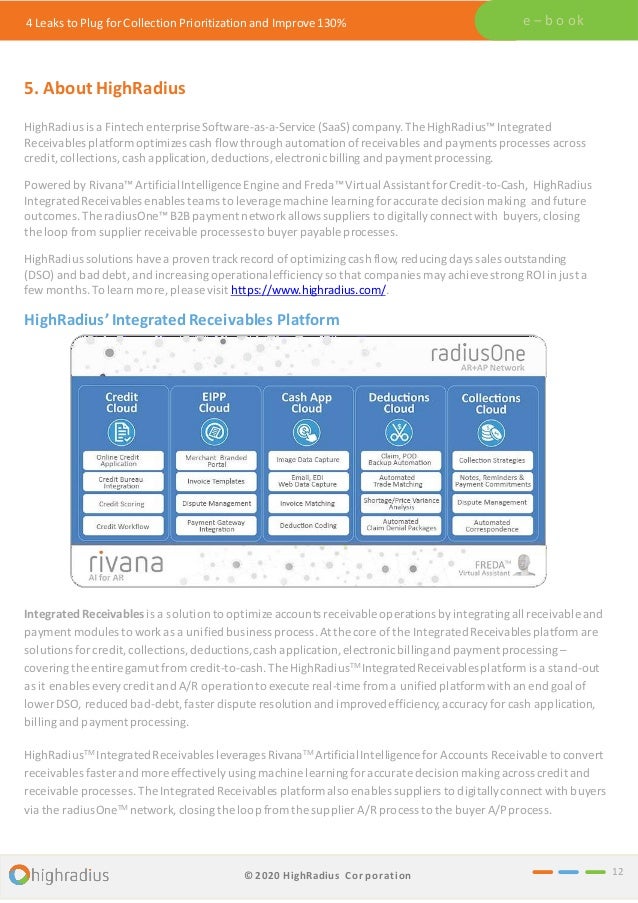
HighRadius’IntegratedReceivables Platform
Integrated Receivables is a solution to optimize accounts receivable operations byintegratingall receivable and
payment modules to workas a unified business process.At the core of the IntegratedReceivables platform are
solutions for credit,collections,deductions,cash application,electronicbillingand paymentprocessing–
coveringthe entire gamut from credit-to-cash. The HighRadiusTMIntegratedReceivablesplatform is a stand-out
as it enables every credit and A/R operationto execute real-time froma unified platformwith an end goal of
lower DSO, reduced bad-debt,faster dispute resolution and improvedefficiency,accuracy forcash application,
billingand paymentprocessing.
HighRadiusTMIntegratedReceivables leveragesRivanaTMArtificialIntelligence forAccounts Receivable to convert
receivables faster and more effectivelyusingmachine learningfor accurate decision makingacross credit and
receivable processes. The IntegratedReceivables platformalso enables suppliers to digitallyconnect with buyers
via the radiusOneTMnetwork,closingthe loop from the supplier A/R process to the buyerA/Pprocess.
12
© 2020 HighRadius Corporation

4 Leaks to Plug for Collection Prioritization and a 130% Increase in Productivity

  • 1.
    1. Flash a 4Leaks to Plug for Collection Prioritization and Improve Productivity by 130% This e-book uncovers the leaks in account prioritization, which can inflate past-due A/R by 150% and the means to seal the leaks through industry best practices and smart segmenting factors to increase team productivity and ensure faster collections e – b o o k
  • 2.
    4 Leaks toPlug for Collection Prioritization and Improve 130% 2 © 2020 HighRadius Corporation e – b o ok Contents 1. Collections at A Glance....................................................................................................................... 3 1.1 The Evolution of Collections Process...................................................................................................................... 3 1.2 Connect between Collections and other Credit-to-CashProcesses...............................................................................3 2. Collections Today.............................................................................................................................5 2.1 The Current Collections Scenario........................................................................................................................... 5 2.2 The Leaks in Account Prioritization........................................................................................................................ 5 2.3 Conclusion.............................................................................................................................................................. 6 3. Four Leaks to Plug for Collection Prioritization...............................................................................7 3.1Overview.................................................................................................................................................................7 3.2 Credit History..........................................................................................................................................................7 3.3 Deductions and Claims...........................................................................................................................................8 3.4 Cash Application..................................................................................................................................................... 8 3.5 Best Practices in Internal Collections Process .............................................................. Error! Bookmark not defined. 4. Conclusion..................................................................................................................................... 10 4.1 Executive Summary.............................................................................................................................................. 10 4.2 Future of Collections............................................................................................................................................ 11 5. About HighRadius.......................................................................................................................... 12
  • 3.
    4 Leaks toPlug for Collection Prioritization and Improve 130% e – b o ok 1. Collections at A Glance 1. The Evolutionof Collections Process Collections is one the most important processes in Accounts Receivables. Fora business to havea leading growth graph, a business ‘needs’ to put efforts into Collections Management.It doesn’t matter howwell a company’s marketingefforts are goingor how manysales they make if they are unable to collect anyof their open invoices. With the changingeconomictimes,the collections process has evolvedover the decades from 1st generation to the 3rd generation.The evolution focuses on howcollectionshas grown from a fully manual and limited ‘dialfor dollars’approach to a reactiveprocess with semi-automation. 1st generation collections teams leveragedcustomprograms writtenovermainframe or ERP databases to prepare agingreports on a dailyor weekly basis. The team would then ‘dial for dollars’via phone calls. 2nd generation in the early 2000s saw the emergence of Data Warehousingand Business Intelligence tools which added additional insightsto regular aging reports.However,the analysiswas still manual and the teams would still ‘dial for dollars’ but had a better context to filter ‘who’ and ‘what’in calls. 3rd generation from 2010 onwards sawdedicatedsoftware products for CollectionsManagement which became the defacto standardfor collectionsand brought fundamental automationintothe picture. Email adoption addedvalue byshiftinga good proportionofphone calls to emails. This enabled 30-40% collections automationand an average 10% DSO improvement. The focus over the years in the collections process has been on improvingthe accessibility ofdata and enablingsome amount ofautomation.With the onset of collections evolution,the other accounts receivables process in the credit-to-cash cycle have also matured overtime. The readers wouldagree that the days when A/R processes were siloed are far behind us.The next section takes a closer look. 3 1.2 Connect betweenCollections and other Credit-to-CashProcesses In the developingA/R scenario, it is no longer possible for collectionsprocessto remain isolated. The inter- department connect is of paramountimportance when it comes to collections as the process needs data fromother departments fornot only slicingand segmentingthe informationfor better worklists but also for efficient correspondence with the customers. The collections team interacts with the credit team to get information regardingcredit riskclass and credit limit utilizationto formulate a fruitfulcorrespondence strategy. The credit team in return also needs the support fromcollections teamsto correspond with the customers for releasingblocked orders.The cash © 2020 HighRadius Corporation
  • 4.
    4 Leaks toPlug for Collection Prioritization and Improve 130% e – b o ok application team provides inputs forthe invoices againstwhich the paymentshavebeen made so that they can be removed from the worklist.Moreover,the collectorsoften identifypre-deductions,forward them to the deductionsteamand update the worklistaccordingly.Theyalso get inputs from the deductions team on the invoices with invaliddeductions and need to kick start correspondence with them so they can decrease the overall past-due A/R. 4 © 2020 HighRadius Corporation
  • 5.
    4 Leaks toPlug for Collection Prioritization and Improve 130% e – b o ok 2. Collections Today 1. The currentscenario in Collections As much as the collections process has evolved,the pitfalls in the process fail to disappear. The collectors still struggle across the roadblocks like too manydelinquentaccounts anda shortage oftime to cover all accounts in the worklist. While the majority oftheir time is spent in sendingemail reminders,the use of Excel or spreadsheets as a main system of record further slows down the process. Amidst all the shortcomings in the collections process, DSO, past-due A/R and account coverageremainkey concerns for the collections team. The golden rule in collections states ‘The longer a debt is owed, the less likely it is to be repaid’ and rightlyso as per the reports by Atradius that state that 52% of 90-days past-due invoice values are usuallywritten-off. As per McKinsey’s report, more than 70% collection calls are wasted! These calls are made for accounts where the customer would havepaid even in the absence ofthese calls. These facts and figures alongwith the identifiedprocess pitfalls pose an undeniable threat to the scalabilityand seamless workingofthe collections process. At a closer look, it can be identified that there is somethingwrongwith the waythe collections worklistprioritizationworks today,leading to wasted phone calls,increasingpast-due A/R and insufficient account coverage. The next section explores the root causes ofthe problem. 2. The Leaks in Account Prioritization The collections teams have traditionally used agingdata and invoice value as the two pillars to slice and dice the invoice data extractedfrom the ERP. While this technique mayseem reasonable and insightfulenough from a top-levelview, the industrial statistics disagree. When aging data is used to prioritize a collections worklist,it mayprioritize accounts in the worklist which have a claim or dispute associatedwith it.Now the collections process for these types of accounts cannot proceed or start unless the corresponding dispute has been resolved bythe deductions team.However, the worklist prioritizedbased on agingwould show up these accounts at the top for every collector. If the collections team focuses on invoicevalue while prioritizingthe day’s worklist,the small and medium accounts are left unaddressedand this may lead to increasingpast-due A/R due to their accumulatedinvoice value. Moreover,there is a high probabilitythat these customers would havepaidifthey had been sent a reminder or email about the same. What is more interestingis the fact that in a collections worklist 20% accounts on an average have high invoicevalue while 80% are small to mediumaccounts. The collectorswho focus on only the large accounts often end up delayingnumerous paymentsbysmall and medium customers. The combinationofaging data and invoice value also doesn’t supportaccount prioritizationin an optimized manner as they are laggingindicators ofdelinquency byan account.Moreover,usingthis tacticdoesn’t identify or segregate the fast-payingcustomers,slow-payingcustomers or the regularlydelinquent account. 5 © 2020 HighRadius Corporation
  • 6.
    4 Leaks toPlug for Collection Prioritization and Improve 130% e – b o ok Conclusion In conclusion, the staticmethodofprioritizingaccounts based on just the aging data and invoice value does more harm than any benefit to the collections process and are the leaks in accounts prioritization.This leaves room for more dynamicand leadingindicators ofdelinquency as factors while prioritizingaccounts. The next chapter discusses the plugs to seal the leaks. 6 © 2020 HighRadius Corporation
  • 7.
    4 Leaks toPlug for Collection Prioritization and Improve 130% e – b o ok 3. Four Leaks to Plug for Collection Prioritization 7 As discussed in the previous chapter, account prioritizationis inefficient in the presence of laggingfactors like aging data and invoice value and needs more insight. But what ifthe collectors could trackthe payment history ofan account and decide the priorityfor that account based on whether it is a fast-payingcustomer or one with consistent delinquencies? This kind ofstrategy in segmentingthe accountsprovides better judgement aboutthe priorityassociatedwith the account.Moreover,since the collections process isn’t insulatedfrom other credit-to-cash processes,some of these leadingfactors in account prioritization can be derived from other A/R processes. The accounts can also be classified as: At Risk Accounts: This is the case where there is a high probability ofcustomernot payingand the invoice fallingintoa larger aging bucket with time. De-prioritized Accounts:This is the scenario where the account can be pushed backon the prioritylist and the collectors can spend timeon more strategicaccounts. Low Hanging Fruit: This refers to the scenario where collecting might be easy or the customer has an incentivemake payments. 3.1 Leveraging Credit History The collections team can leverage credit historyofthe customers to identifytheir financialposition and notice any downward trends in the financial healthofthe account.If a customer has a history oflate payments and has a high credit risk, the financial health ofthat account might be unstable makingit an ‘At Risk’ account. In this scenario,the collector should flagthe customer as a high-riskcustomer, entice them to make early payments to get discounts and offer different modes ofpayment so that theydon’tend up fallingin larger past-duebuckets and are not written offin theend! Moreover,the collections team can obtainthe credit limit utilizationfrom the credit managementteam. If a customer with a growingbusiness and lowcredit risk is approachinga credit hold, the collections team can motivate the customer for clearingtheir invoices to prevent their next order from gettingblocked.The collections team can leverage credit limit utilization ofall customers to find these ‘Low Hanging Fruits’ and eliminate them from their collections worklist. © 2020 HighRadius Corporation
  • 8.
    4 Leaks toPlug for Collection Prioritization and Improve 130% e – b o ok 3.2 Insights from Deductions and Claims The collections team can leverage inputsfrom the deductions management and claims processingto pinpointthe customers with open disputes or unresolved deductions which need to be reviewed by the deductionanalysts.These accounts can be ‘De-prioritized’since theycannot be worked upon by collectors unless the disputesor claims are resolved. However, if it is found that a deductionor dispute is invalid, the account becomes an ‘At Risk’ account where the collections teammust prioritize thisaccount and follow-up with the customer. The reason behind is that the disputedinvoices have alreadybeen open while the deductions team worked on them, and any further delay in closingthem would onlyput them in a larger agingbucket and increase the past-dueA/R. 8 3. Inputs from Cash Application The collectors often hear from the customers that they have alreadymade payments against the invoice in question. This scenario occurs when the cash is applied in batchesand the real-time updatedinformation is unavailable to the collectors or when the cash has been applied incorrectly. The collectors should‘De- prioritize’ such accounts and check with the cash applicationteam before followingup with these customers. 4. Best Practices in Internal Collections Process Some best practices can be incorporatedinto the collections process to de-clutter the collections worklist and improveaccount prioritization. The collections teamshould havea means of collecting Promise-to-Pays against invoices from the customers. The collectors can add the promised payment datefor such accounts in the calendar and set remindersfor themselves while classifying the account as ‘De-prioritized’from the worklist.However,if a customer has broken a promise-to-paythat is failed to make payment bythe promised paymentdate, it shouldbe treated as an ‘At Risk’ account where the customershouldbe called on the same dayand the account should be escalated internally. If a customerhas an open dunningnotice theyshould be ‘De-prioritized’from the collectionsworklist while the collector should add a follow-up datein the calendaras a reminder for himself.If a customer has been sent multiple notices and reminders and has been contactedthroughcalls and the payment is still pending, it should be treatedas an ‘At Risk’ account since the customer is showingreluctance to pay. The collector should further call the customer,offer incentives like discounts and recommendother modes ofpayment to the customer. © 2020 HighRadius Corporation
  • 9.
    4 Leaks toPlug for Collection Prioritization and Improve 130% e – b o ok The collectors can leverage the customers’correspondence logto check if the customerhas asked for an invoice. This shows the willingnessto payand is a ‘Low Hanging Fruit’. The collectors shouldimmediately follow-upwith the customerto fasten the paymentand collections process.If a customerhas asked to follow-upon a later agreed date then it shouldbe ‘De-prioritized’from the worklist and the collector should not followup with the customer beforethe agreed date. The collectors can gain insights from the customer’s account history and identify ifit is a large, fast-paying customer.In this case, the collectors should treat them as ‘Low Hanging Fruit’ and should send personalized reminders but less frequently.If it is a small to medium account where the customer usuallypays without beingcalled and need reminders via mail,they can be termed as ‘Low Hanging Fruit’. The collectors should mark these accounts, group them and send bulkgeneric emails periodically. 9 © 2020 HighRadius Corporation
  • 10.
    4 Leaks toPlug for Collection Prioritization and Improve 130% e – b o ok 4. Conclusion 1. Summary As discussed in the previous chapter the accounts in the collections worklistcan be classified as De- prioritized, At Risk and Low Hanging Fruit. The actions that the collections team should take for each scenario were also suggested in the previous chapter.In conclusion,the fast-payingcustomers, the small to mediumaccounts, the customers with lowcredit risk who have exhaustedmore than 90% of their credit limit and the customers who have asked for and been sent invoices comeunder ‘Low Hanging Fruit’. The customers with open dunningnotices,unresolved disputes,approachingpromise-to-payor followupdate alongwith those who havea discrepancyin cash application comeunder ‘De-prioritized’accounts. The customers with invalid deductions,multiple dunningnotices, brokenpromise-to-pays orthe accounts where customers are habituallate payers are ‘At Risk’ accounts. 10 4.2 Future of Collections The first chapter discussedthe evolutionofcollections process intoa reactive,semi-automatedprocess which relies heavilyon a mismatch oftools like Emails,Excel Spreadsheets,Messenger,Calendar, ERP © 2020 HighRadius Corporation
  • 11.
    4 Leaks toPlug for Collection Prioritization and Improve 130% e – b o ok system,To-do lists,Stickynotes,Notepads, etc. However, are these tools reallya necessity in the future of collections? Technology is the futureofthe collections process where all the data,analysis,strategies,correspondence and information are onlya click away. HighRadius Collections Cloudsolution provides a complete set of tools to optimize and automate the collections managementprocess. All the informationyou need like invoices, dispute information,PODs,claims,trackinginfo,etc.on each case is automaticallypresentedin a collections work-space and readyfor use with a single click. Key Features Include: • Rules-basedCollections Optimizationautomatically prioritizesand assignscollections activities to analysts basedon predefinedbusinessrules. • IntegratedCollections Work-space tracks promises-to-pay and tasks andreminders for everyaccount and collection effort. • PredictiveRisk Scoring Model identifies ‘at-risk’customers who might be current on their account and integrates the risklevel into prioritization. • DunningCorrespondence Automation generates and sends out correspondence packages containing needed documentationbased on predefinedtemplates. • Easyintegration with ERP,Accounting, and other systems Collections Worklist 11 © 2020 HighRadius Corporation
  • 12.
    4 Leaks toPlug for Collection Prioritization and Improve 130% e – b o ok 5. About HighRadius HighRadius is a Fintech enterprise Software-as-a-Service (SaaS)company.The HighRadius™Integrated Receivables platformoptimizes cash flowthrough automationofreceivables and paymentsprocesses across credit, collections,cash application,deductions, electronicbilling and payment processing. Powered by Rivana™ArtificialIntelligence Engine and Freda™Virtual Assistantfor Credit-to-Cash, HighRadius IntegratedReceivables enables teams to leverage machine learningfor accurate decision making andfuture outcomes. The radiusOne™B2B payment networkallows suppliers to digitallyconnect with buyers,closing the loop from supplier receivable processesto buyerpayable processes. HighRadius solutions havea proven trackrecord of optimizingcash flow,reducing days sales outstanding (DSO) and bad debt,and increasingoperationalefficiencyso that companies may achieve strongROI in just a few months. To learn more, please visit https://www.highradius.com/. HighRadius’IntegratedReceivables Platform Integrated Receivables is a solution to optimize accounts receivable operations byintegratingall receivable and payment modules to workas a unified business process.At the core of the IntegratedReceivables platform are solutions for credit,collections,deductions,cash application,electronicbillingand paymentprocessing– coveringthe entire gamut from credit-to-cash. The HighRadiusTMIntegratedReceivablesplatform is a stand-out as it enables every credit and A/R operationto execute real-time froma unified platformwith an end goal of lower DSO, reduced bad-debt,faster dispute resolution and improvedefficiency,accuracy forcash application, billingand paymentprocessing. HighRadiusTMIntegratedReceivables leveragesRivanaTMArtificialIntelligence forAccounts Receivable to convert receivables faster and more effectivelyusingmachine learningfor accurate decision makingacross credit and receivable processes. The IntegratedReceivables platformalso enables suppliers to digitallyconnect with buyers via the radiusOneTMnetwork,closingthe loop from the supplier A/R process to the buyerA/Pprocess. 12 © 2020 HighRadius Corporation