L E AR N I N G I N T E N T I O N S
• Round answers to a number of decimal places
• Order decimals using knowledge of place value
• Carry out calculations with decimals in the context of money.
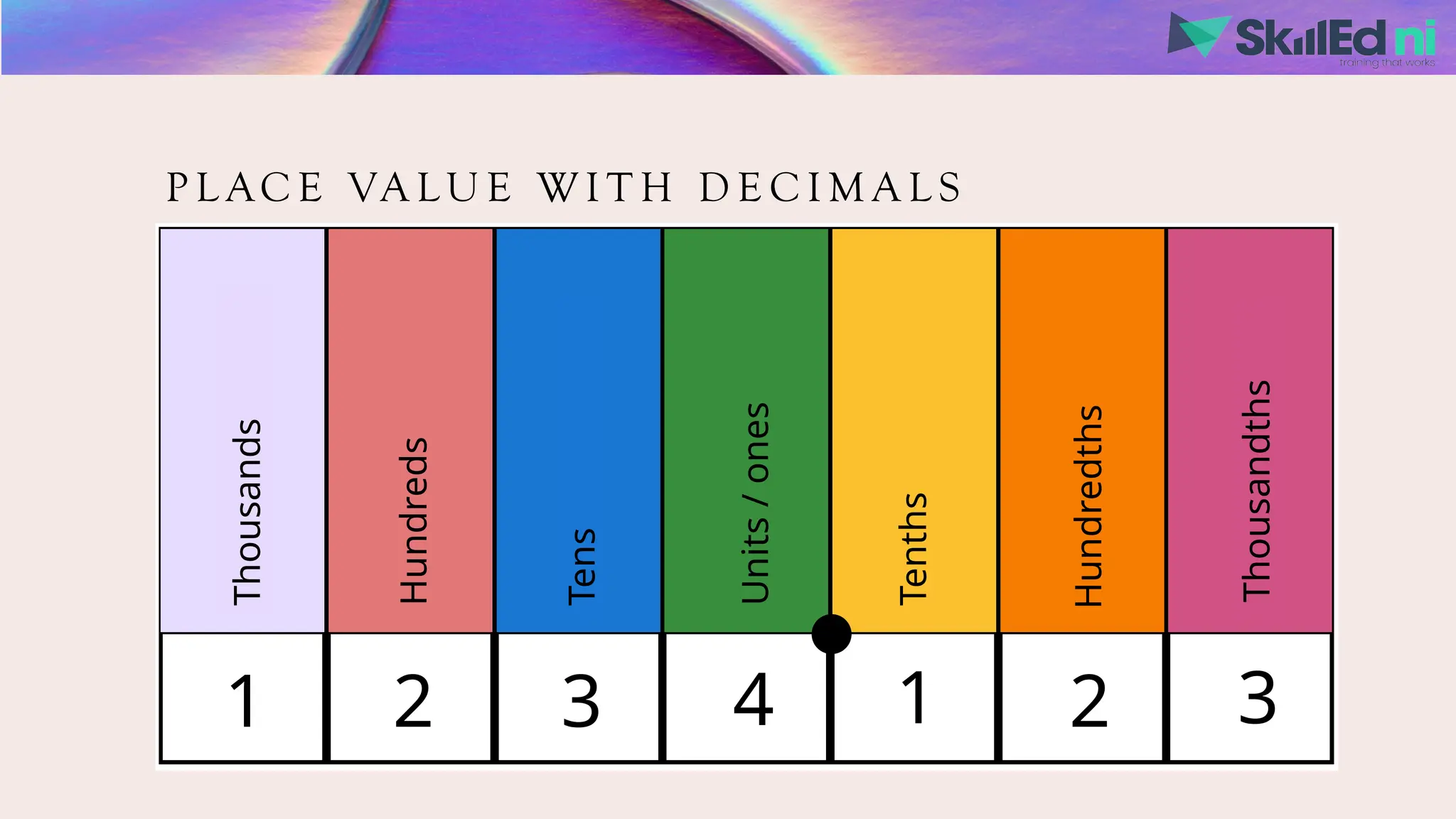
P L ACE VA L U E W I T H D E C I M A L S
4
2
1 3
2
1
3
Units
/
ones
Tens
Hundreds
Thousands
Tenths
Hundredths
Thousandths
5.
W H ATA R E D E C I M A L S ?
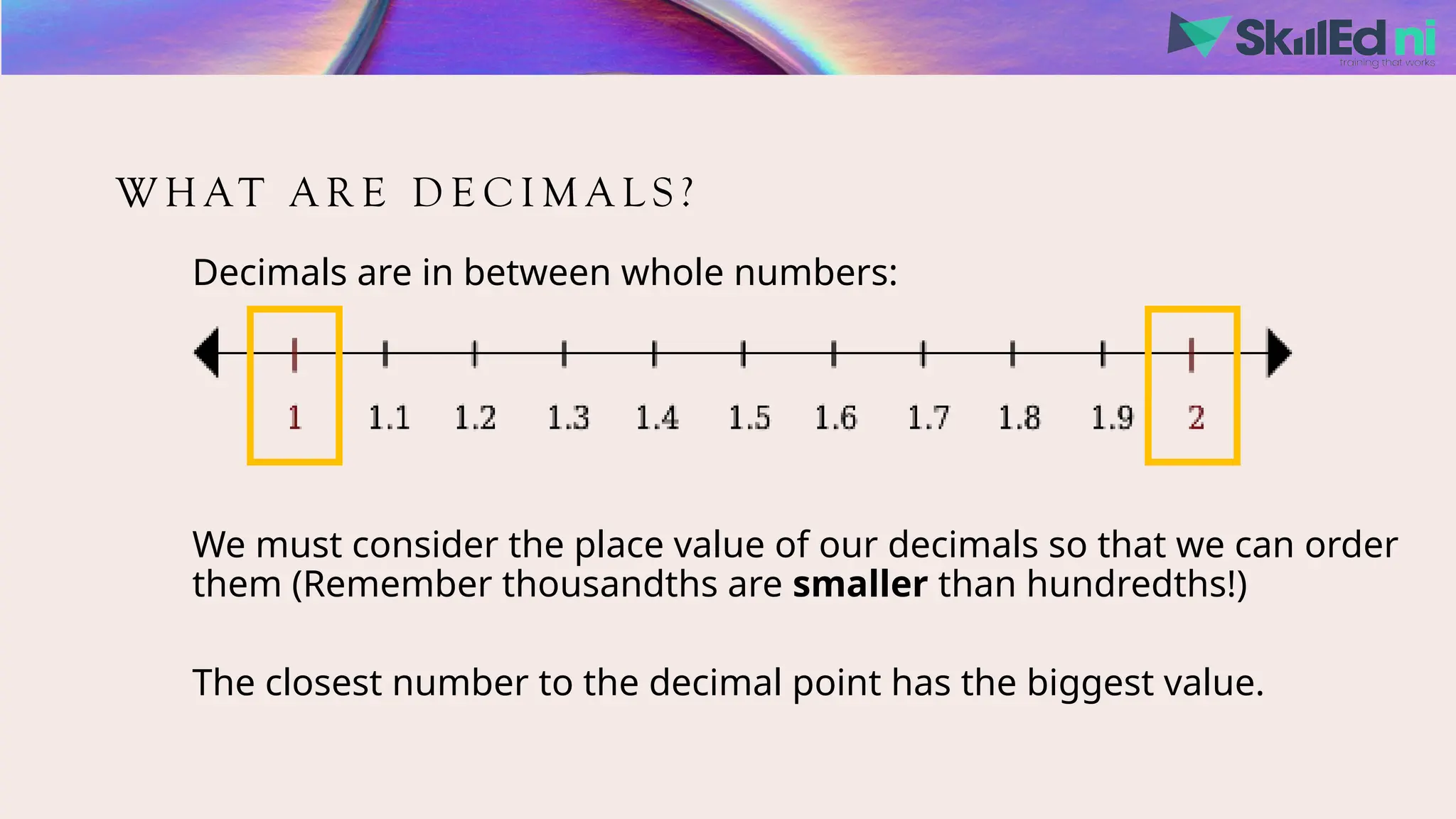
Decimals are in between whole numbers:
We must consider the place value of our decimals so that we can order
them (Remember thousandths are smaller than hundredths!)
The closest number to the decimal point has the biggest value.
6.
W H ATA R E D E C I M A L S ?
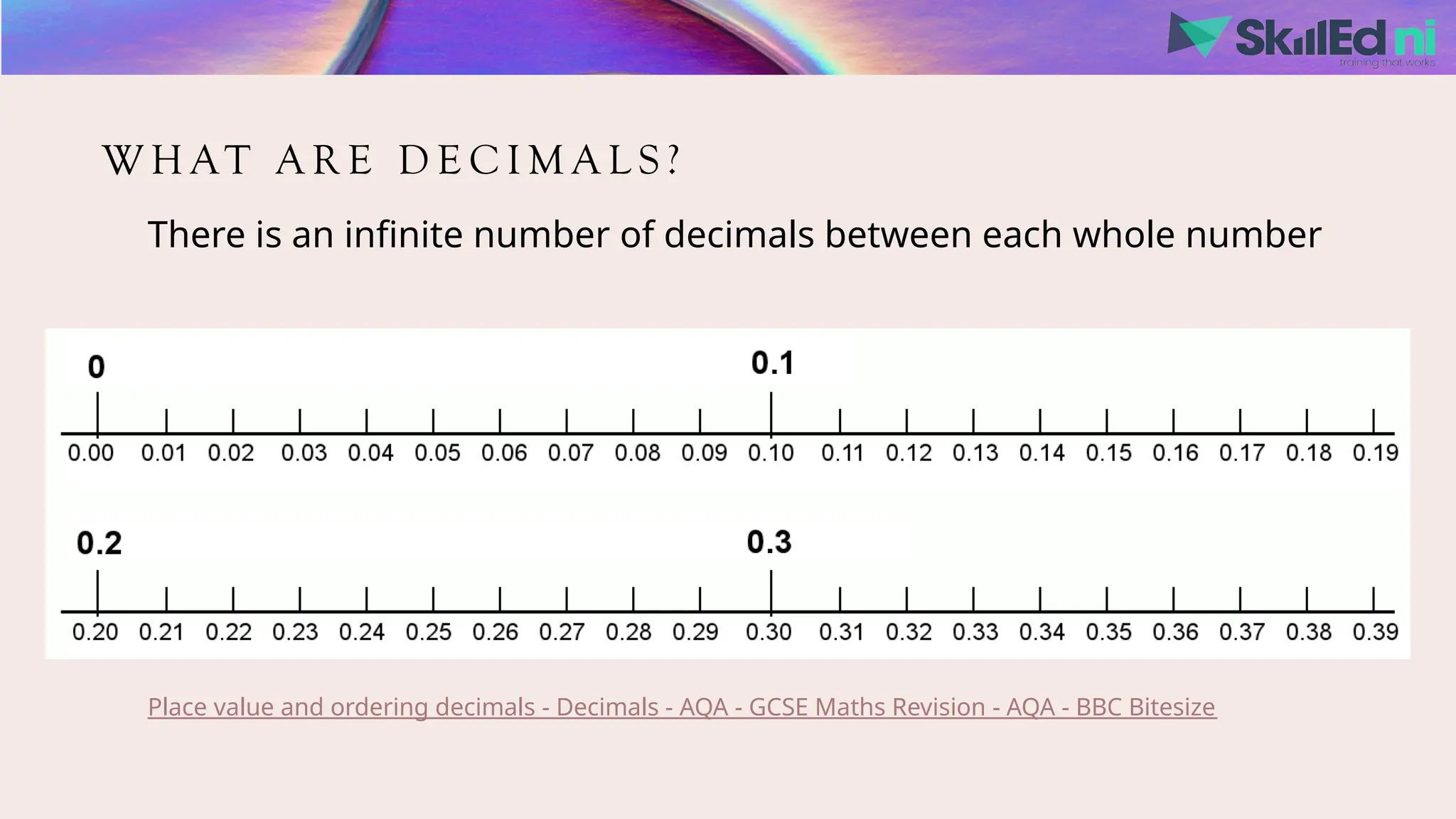
There is an infinite number of decimals between each whole number
Place value and ordering decimals - Decimals - AQA - GCSE Maths Revision - AQA - BBC Bitesize
7.
B I GG E R O R S M A L L E R ?
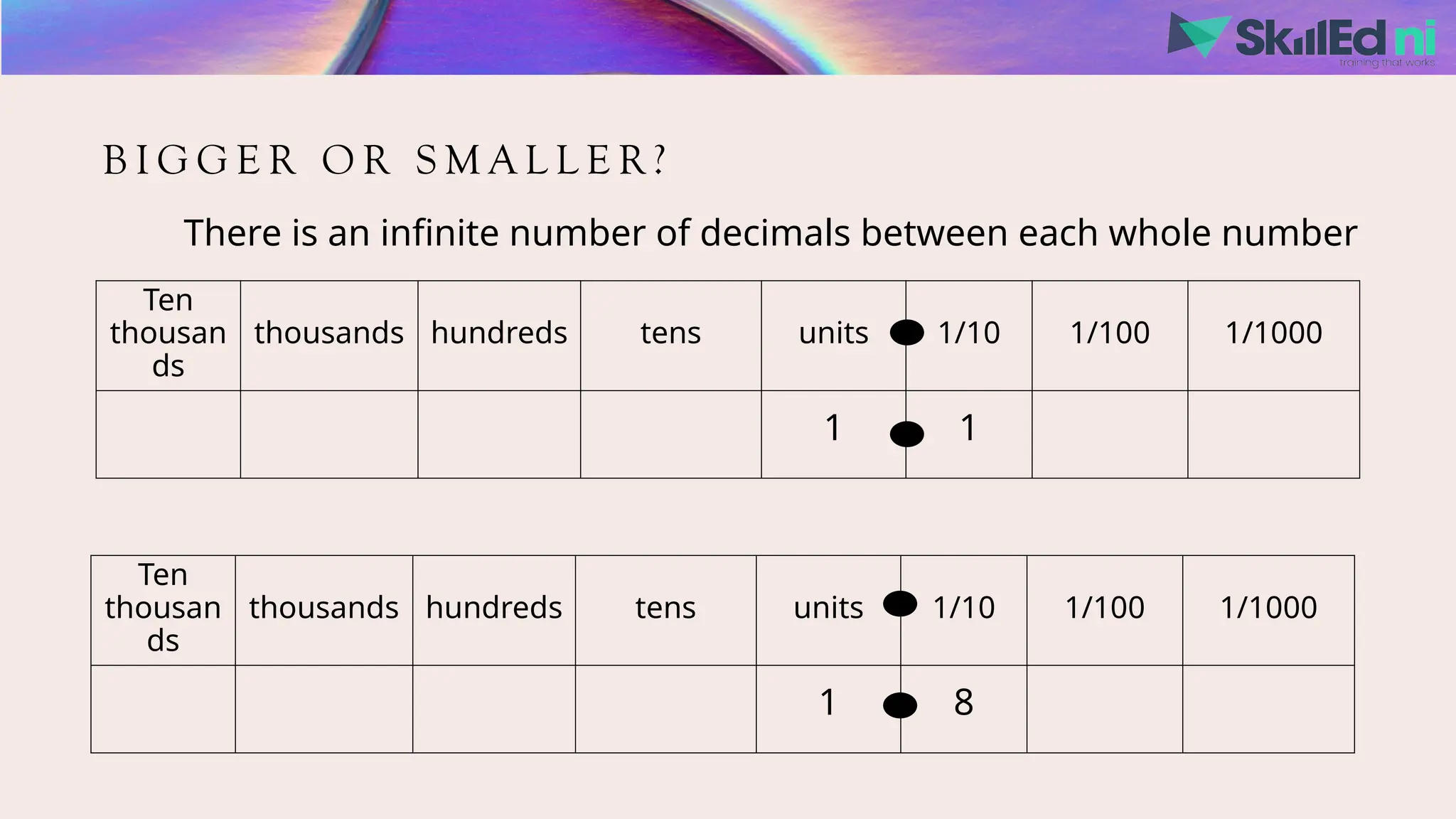
There is an infinite number of decimals between each whole number
Ten
thousan
ds
thousands hundreds tens units 1/10 1/100 1/1000
1 1
Ten
thousan
ds
thousands hundreds tens units 1/10 1/100 1/1000
1 8
8.
B I GG E R O R S M A L L E R ?
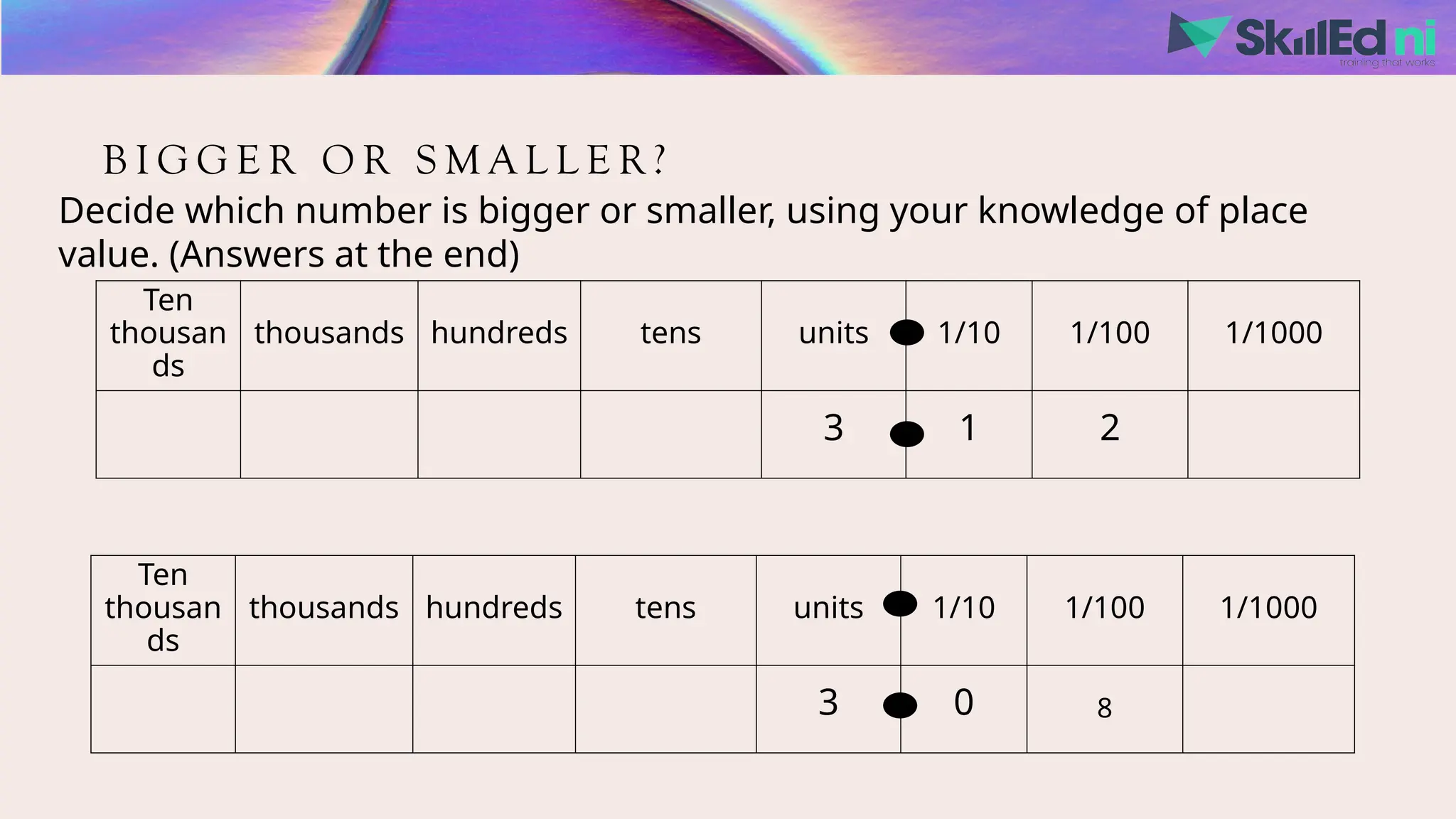
Decide which number is bigger or smaller, using your knowledge of place
value. (Answers at the end)
Ten
thousan
ds
thousands hundreds tens units 1/10 1/100 1/1000
3 1 2
Ten
thousan
ds
thousands hundreds tens units 1/10 1/100 1/1000
3 0 8
9.
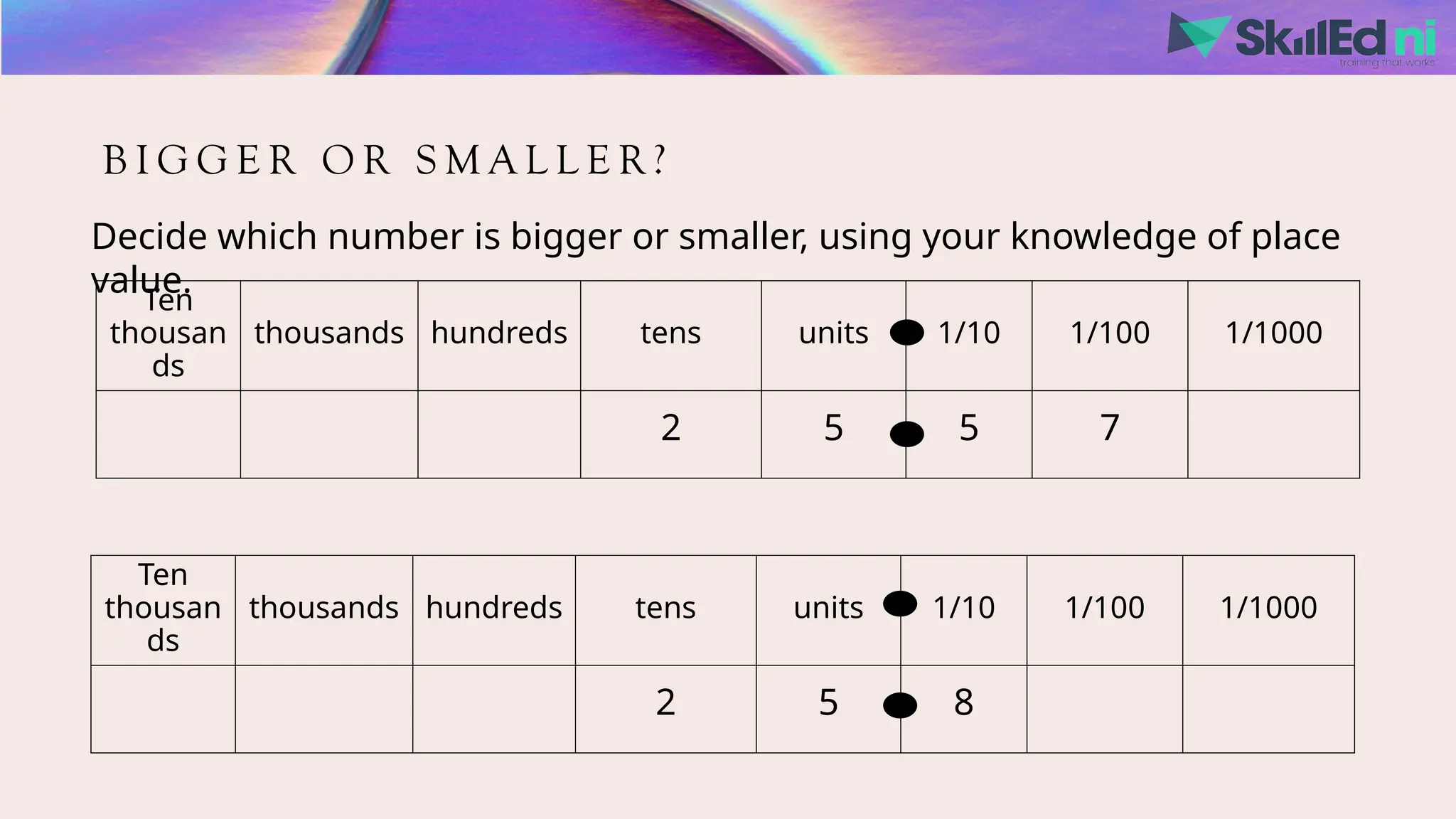
B I GG E R O R S M A L L E R ?
Decide which number is bigger or smaller, using your knowledge of place
value.
Ten
thousan
ds
thousands hundreds tens units 1/10 1/100 1/1000
2 5 5 7
Ten
thousan
ds
thousands hundreds tens units 1/10 1/100 1/1000
2 5 8
10.
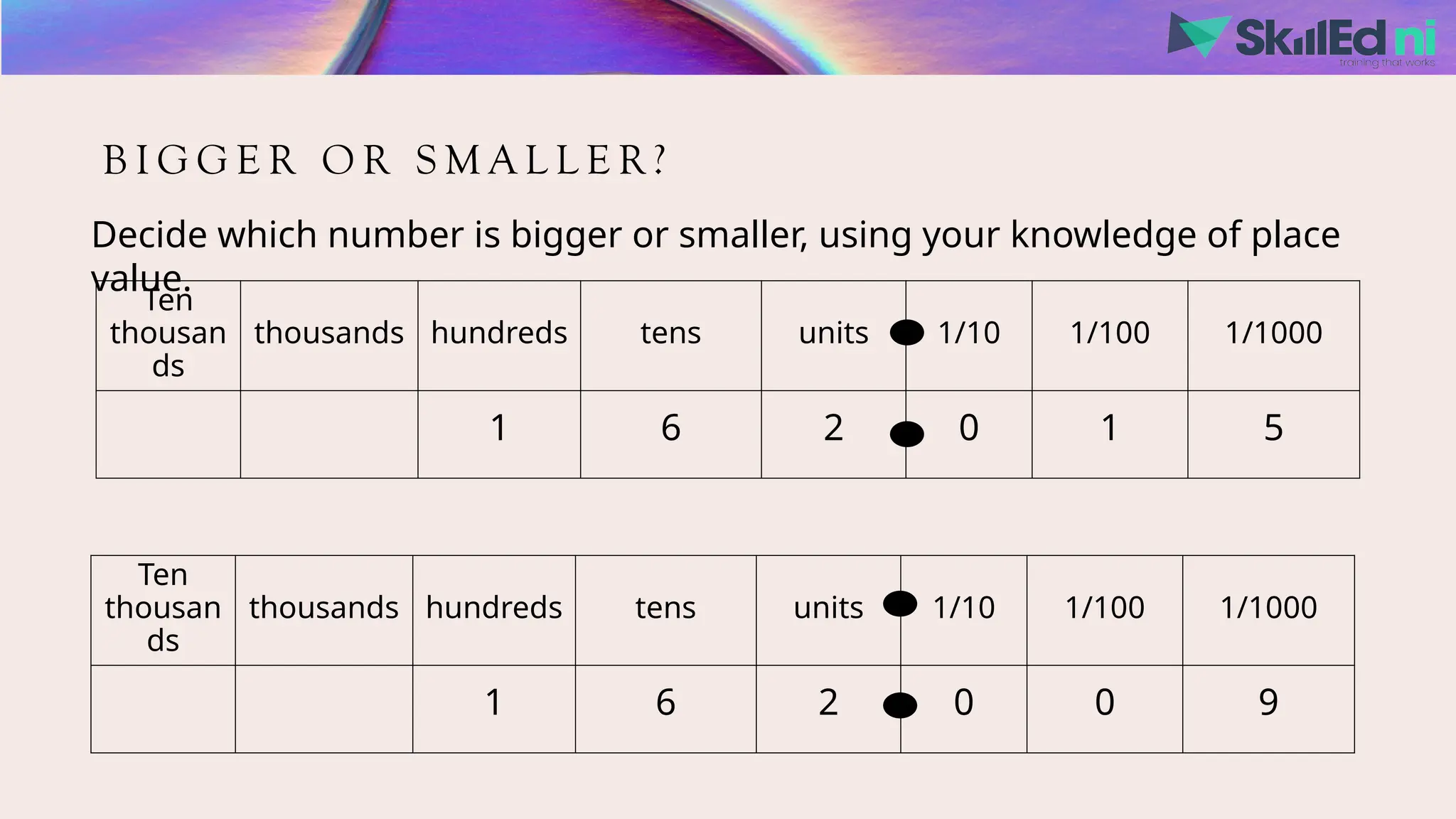
B I GG E R O R S M A L L E R ?
Ten
thousan
ds
thousands hundreds tens units 1/10 1/100 1/1000
1 6 2 0 1 5
Ten
thousan
ds
thousands hundreds tens units 1/10 1/100 1/1000
1 6 2 0 0 9
Decide which number is bigger or smaller, using your knowledge of place
value.
11.
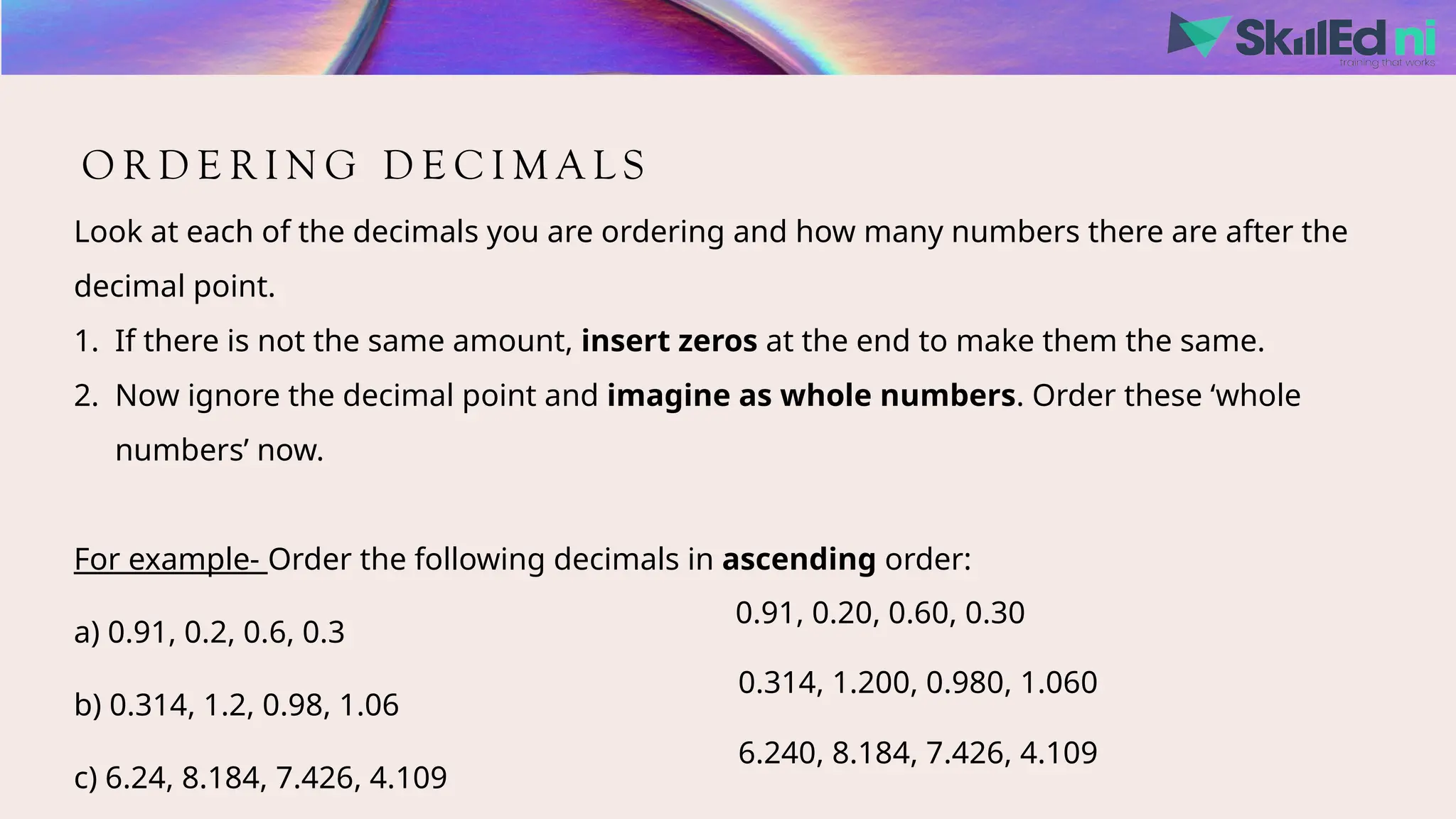
O R DE R I N G D E C I M A L S
Look at each of the decimals you are ordering and how many numbers there are after the
decimal point.
1. If there is not the same amount, insert zeros at the end to make them the same.
2. Now ignore the decimal point and imagine as whole numbers. Order these ‘whole
numbers’ now.
For example- Order the following decimals in ascending order:
a) 0.91, 0.2, 0.6, 0.3
b) 0.314, 1.2, 0.98, 1.06
c) 6.24, 8.184, 7.426, 4.109
0.91, 0.20, 0.60, 0.30
0.314, 1.200, 0.980, 1.060
6.240, 8.184, 7.426, 4.109
12.
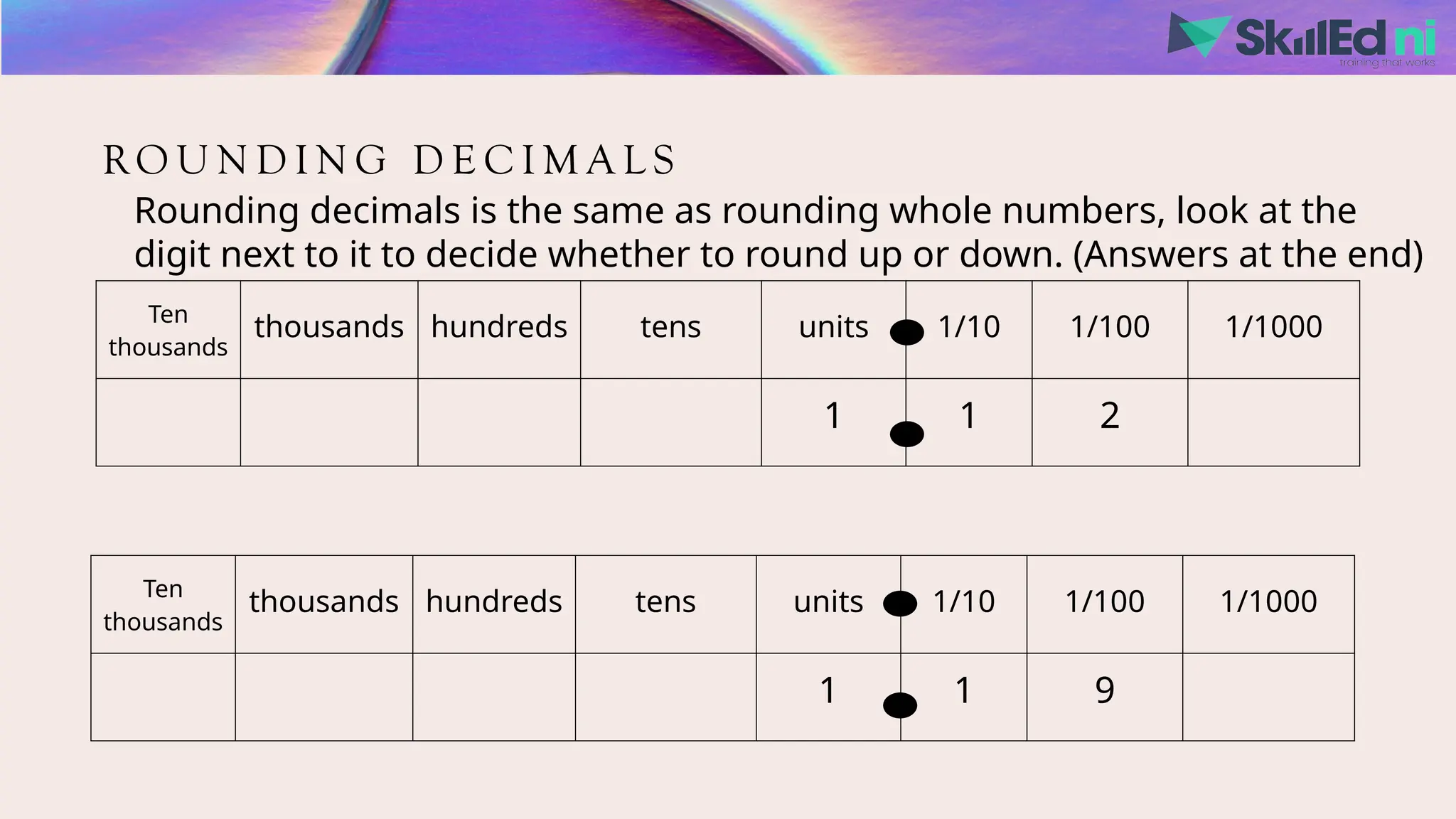
RO U ND I N G D E C I M A L S
Rounding decimals is the same as rounding whole numbers, look at the
digit next to it to decide whether to round up or down. (Answers at the end)
Ten
thousands
thousands hundreds tens units 1/10 1/100 1/1000
1 1 2
Ten
thousands
thousands hundreds tens units 1/10 1/100 1/1000
1 1 9
13.
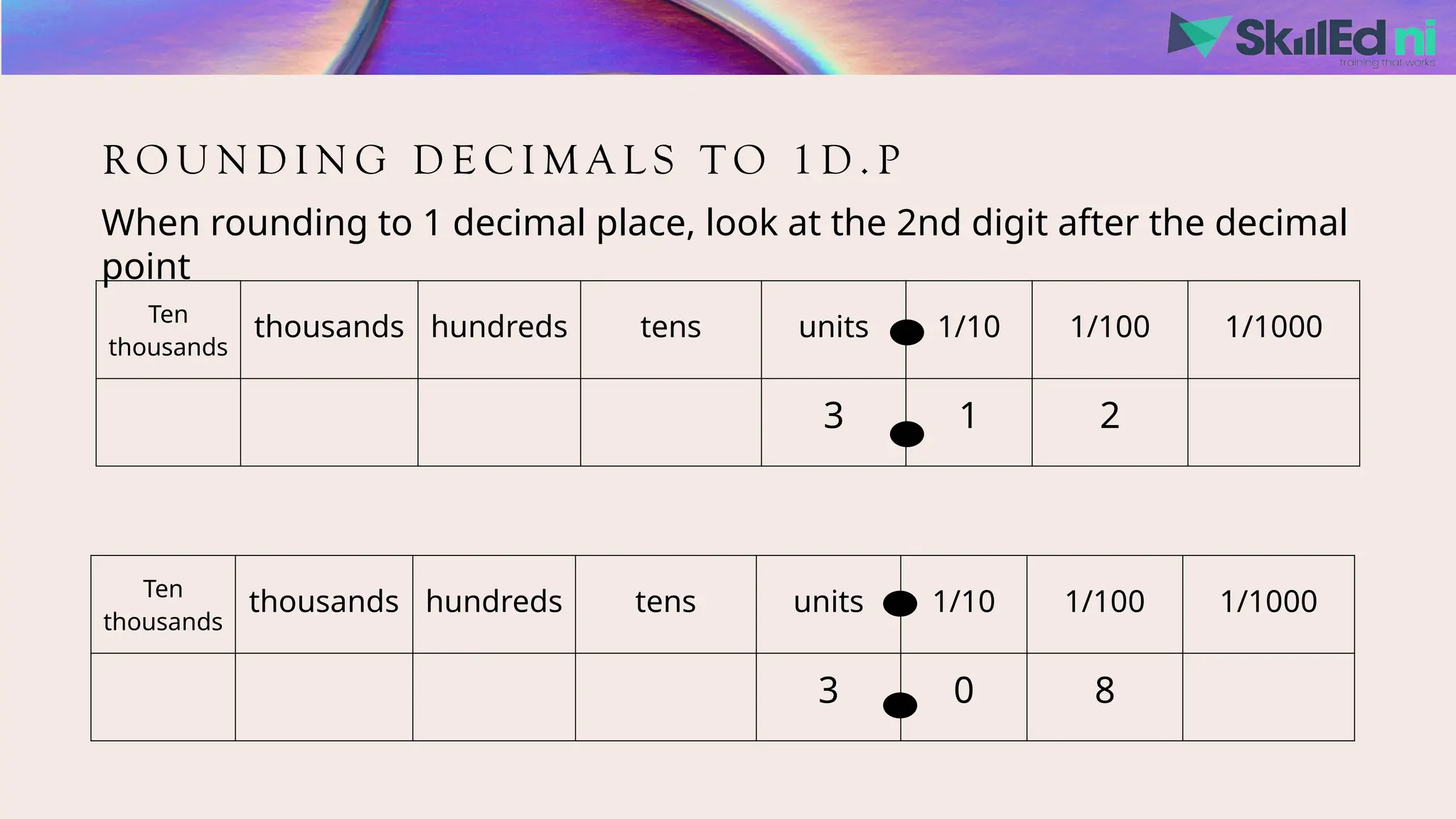
RO U ND I N G D E C I M A L S T O 1 D . P
When rounding to 1 decimal place, look at the 2nd digit after the decimal
point
Ten
thousands
thousands hundreds tens units 1/10 1/100 1/1000
3 1 2
Ten
thousands
thousands hundreds tens units 1/10 1/100 1/1000
3 0 8
14.
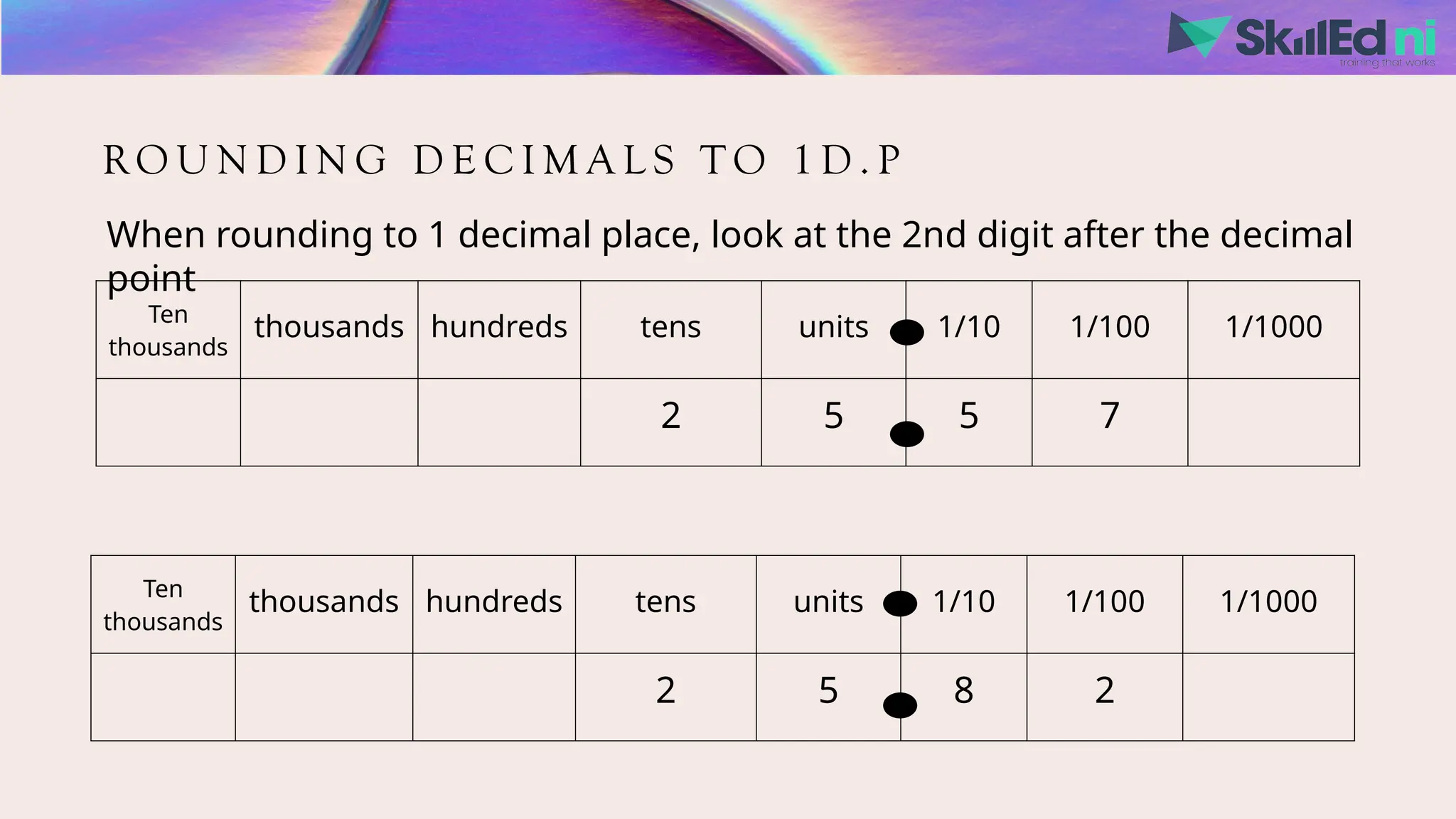
RO U ND I N G D E C I M A L S T O 1 D . P
When rounding to 1 decimal place, look at the 2nd digit after the decimal
point
Ten
thousands
thousands hundreds tens units 1/10 1/100 1/1000
2 5 5 7
Ten
thousands
thousands hundreds tens units 1/10 1/100 1/1000
2 5 8 2
15.
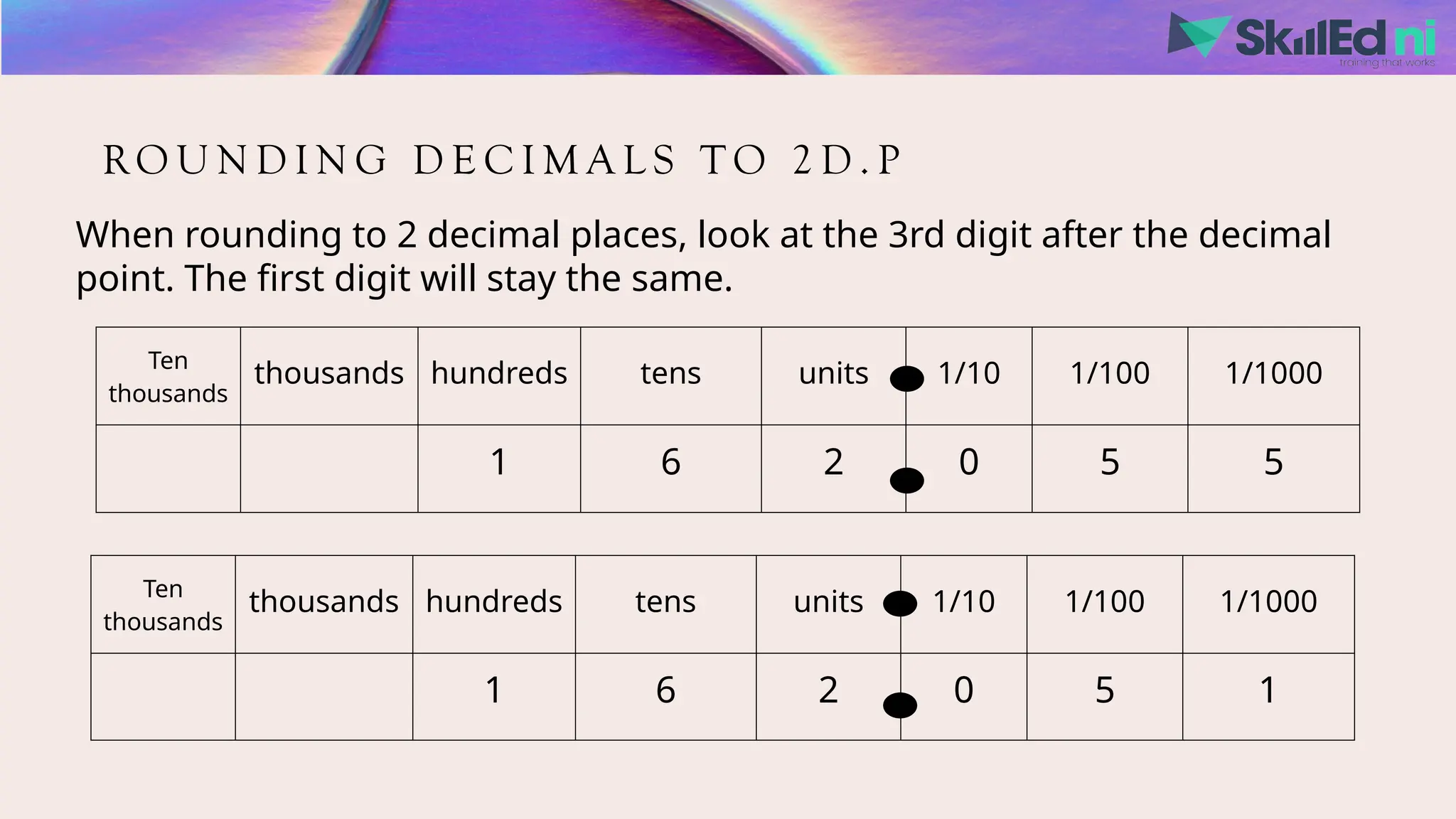
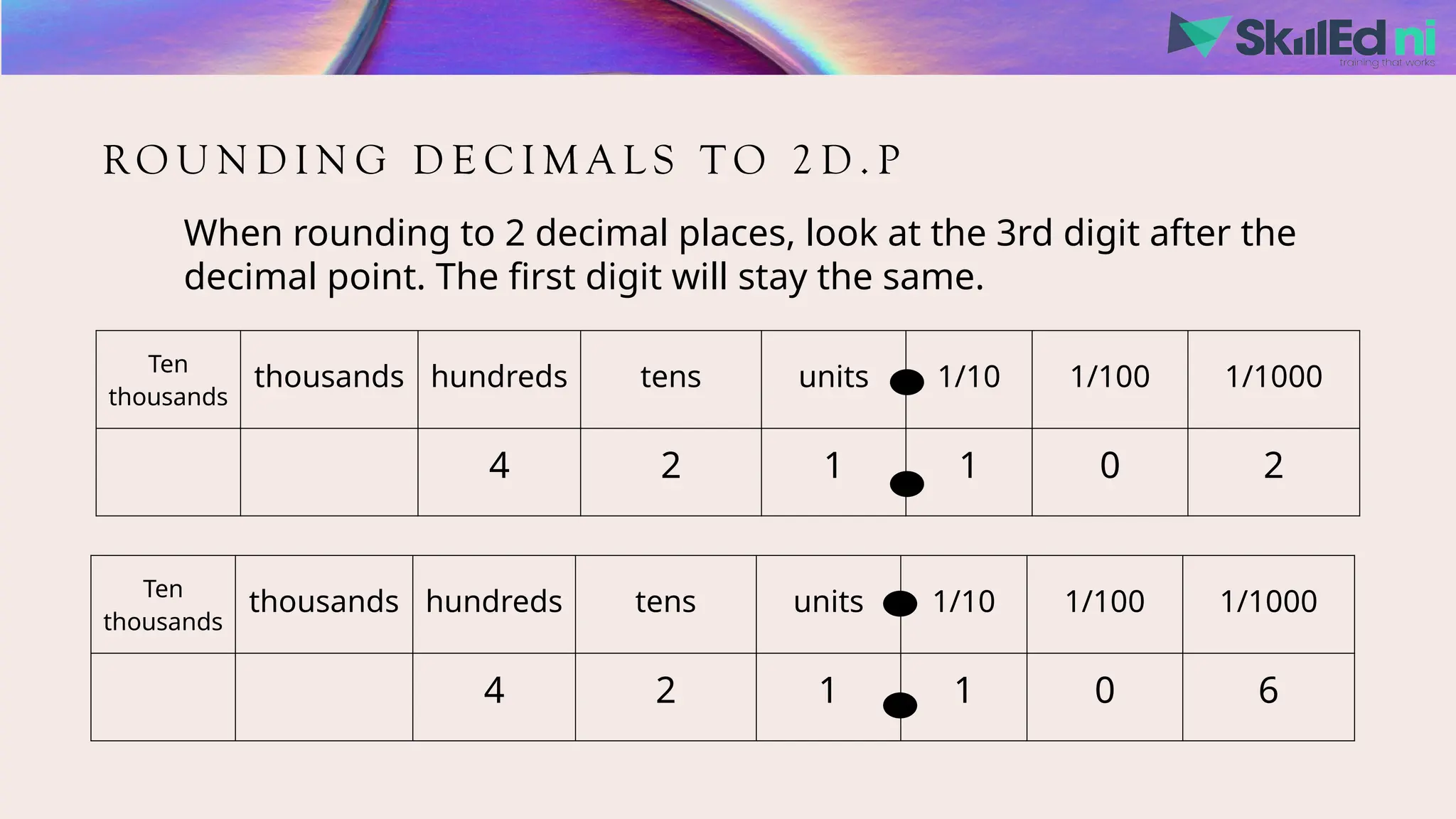
RO U ND I N G D E C I M A L S T O 2 D . P
When rounding to 2 decimal places, look at the 3rd digit after the decimal
point. The first digit will stay the same.
Ten
thousands
thousands hundreds tens units 1/10 1/100 1/1000
1 6 2 0 5 5
Ten
thousands
thousands hundreds tens units 1/10 1/100 1/1000
1 6 2 0 5 1
16.
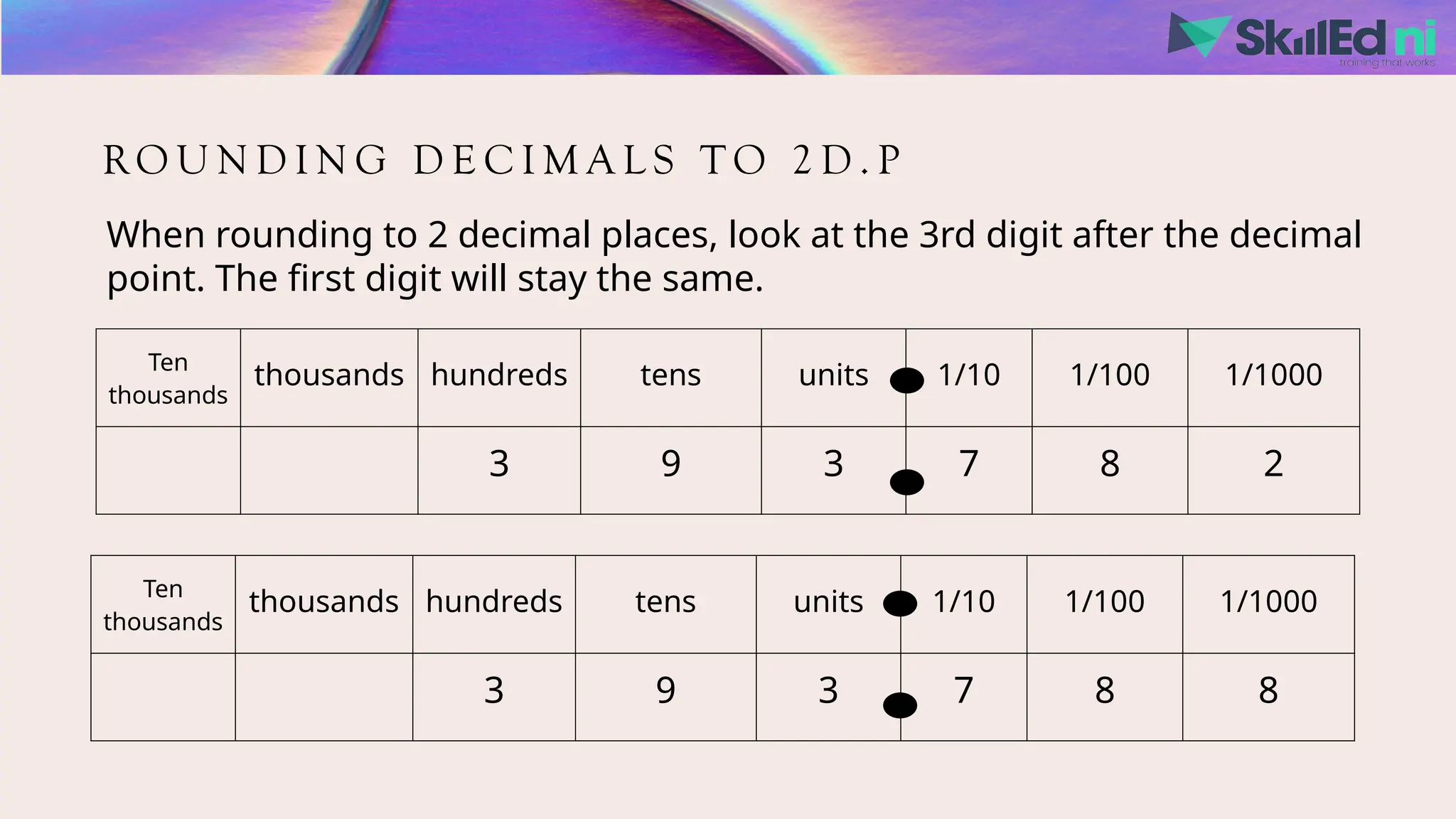
RO U ND I N G D E C I M A L S T O 2 D . P
When rounding to 2 decimal places, look at the 3rd digit after the decimal
point. The first digit will stay the same.
Ten
thousands
thousands hundreds tens units 1/10 1/100 1/1000
3 9 3 7 8 2
Ten
thousands
thousands hundreds tens units 1/10 1/100 1/1000
3 9 3 7 8 8
17.
RO U ND I N G D E C I M A L S T O 2 D . P
When rounding to 2 decimal places, look at the 3rd digit after the
decimal point. The first digit will stay the same.
Ten
thousands
thousands hundreds tens units 1/10 1/100 1/1000
4 2 1 1 0 2
Ten
thousands
thousands hundreds tens units 1/10 1/100 1/1000
4 2 1 1 0 6
D E CI M A L S I N M O N E Y C O N T E X T S
In the context of money, there must always be 2 numbers after the decimal
point.
You may need to round answers to 2 decimal points or add in a 0 to make the
two digits, for example:
1. If one tint brush costs £9.90, how much will 5 tint brushes cost?
2. A stylist carries out a perm on 3 clients and the total comes to
£231.90, what is the average cost of each perm?
3. A group of 5 friends each order a cocktail and the total comes to
£51.78. If they want to split the bill evenly, how much will each friend
have to pay?
20.
Learning Intentions
• Roundanswers to a number of decimal places
• Order decimals using knowledge of place value
• Carry out calculations with decimals in the context of money.
21.
A N SW E R S
Slide 7:
Slide 8:
Slide 9:
Slide 10:
Slide 11:
1.1 is less than 1.8
3.12 is greater than 3.08
25.57 is less than 25.8
162.015 is greater than 162.009
0.2, 0.3, 0.6, 0.91
0.314, 0.98, 1.06, 1.2
4.109, 6.24, 7.426, 8.184
22.
A N SW E R S
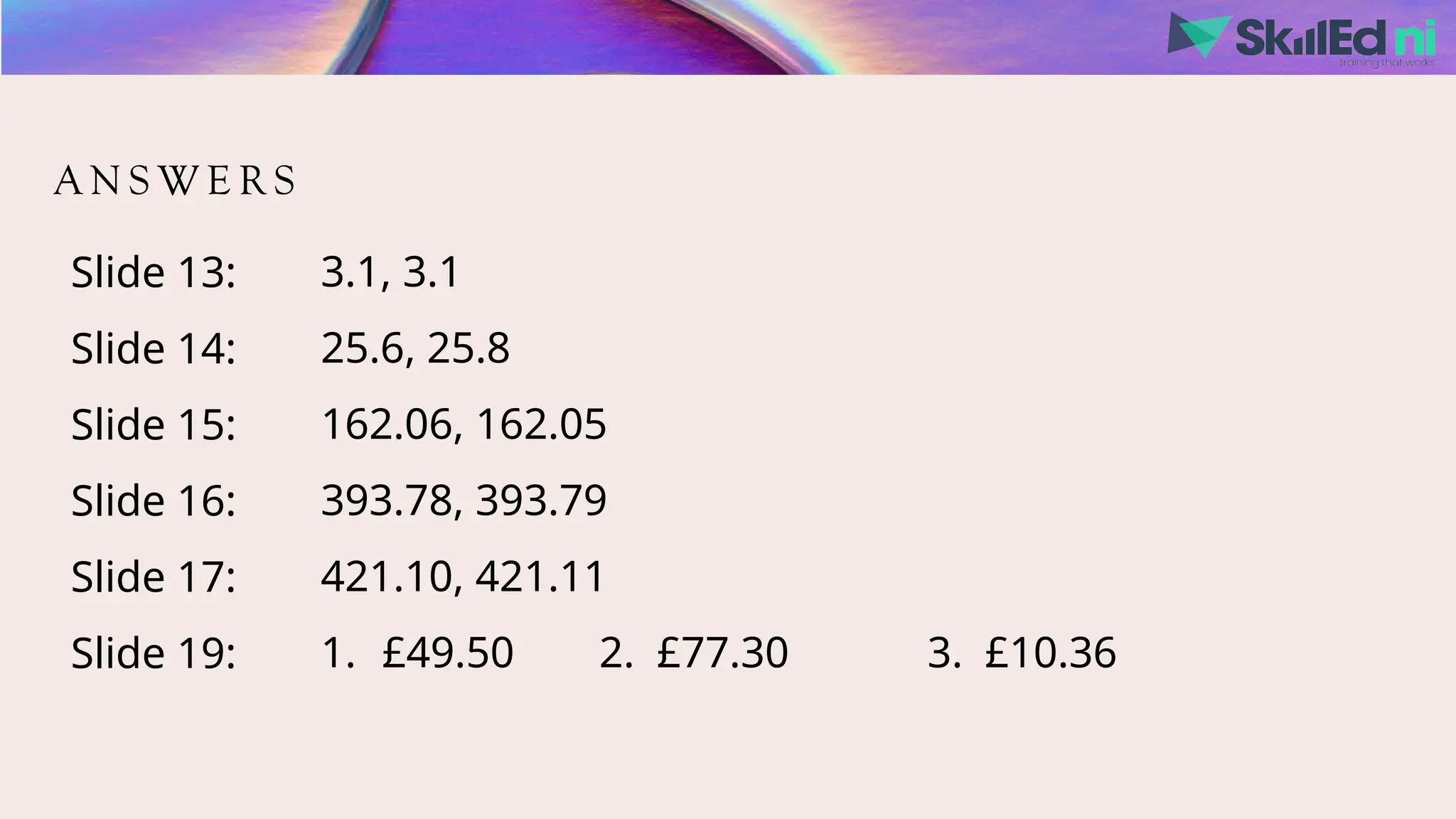
Slide 13:
Slide 14:
Slide 15:
Slide 16:
Slide 17:
Slide 19:
3.1, 3.1
25.6, 25.8
162.06, 162.05
393.78, 393.79
421.10, 421.11
1. £49.50 2. £77.30 3. £10.36
#8 Work across the columns from highest value to lowest:
Units are the same
Tenths are different – which one is bigger?
#9 Work across the columns from highest value to lowest:
Tens are the same
Units are the same
Tenths are different – which one is bigger?
#10 Work across the columns from highest value to lowest:
Hundreds are the same
Tens are the same
Units are the same
Tenths are the same
Hundredths are different – which one is bigger?
#13 If we are rounding to 1 decimal place, we look at the 2nd digit after the decimal point
3.12 would round down to 3.1 because 2 rounds down so 1 stays the same.
3.08 would round up to 3.1 because 8 rounds up and 0 becomes 1.
#14 If we are rounding to 1 decimal place, we look at the 2nd digit after the decimal point
25.57 would round up to 25.6 because 7 rounds up and 5 becomes 6.
25.82 would round down to 25.8 because 2 rounds down so 8 stays the same.
#15 If we are rounding to 2 decimal places, we look at the 3rd digit after the decimal point
162.055 would round up to 162.06 because the 5 in the 1/1000 column rounds up and the 5 in the 1/100 column becomes 6.
162.051 would round down to 162.05 because 1 rounds down so 5 stays the same.
#16 If we are rounding to 2 decimal places, we look at the 3rd digit after the decimal point
393.782 would round down to 393.78 because 2 rounds down so 8 stays the same.
393.788 would round up to 393.79 because the 8 in the 1/1000 column rounds up and the 8 in the 1/100 column becomes 9.
#17 If we are rounding to 2 decimal places, we look at the 3rd digit after the decimal point
421.102 would round down to 421.10 because 2 rounds down so 0 stays the same.
421.106 would round up to 421.11 because 6 rounds up so 0 becomes 1.