FRACTIONS
Application of Number Unit 1
Leigh McQuaid
L E A R N I N G I N T E N T I O N S :
• Recall factors and multiples of a number
• Recognise fractions of shapes
• Write fractions in their simplest form

M U LT I P L E S
Multiples of a number are that number times tables.
For example, multiples of 3 are:
3, 6, 9, 12, 15, 18, 21 …....
Work out multiples of 4 by doing times tables:
1 x 4 =
2 x 4 =
3 x 4 =
etc
FAC T O R S
Factors of a number are numbers that divide exactly into it.
For example, factors of 10 would be 1, 2, 5 and 10 because:
1 x 10 = 10 2 x 5 = 10 5 x 2 = 10 10 x 1 = 10
Another way of thinking about factors is what times tables a number appear
in, eg. 10 appears in the 2, 5 and 10 times tables.
Find factors of 12 by working out which times tables have 12 in them:
H I N T
Multiples always start with the number itself and increase
(they are always bigger than the number)
Factors always start with 1 and go up to the number itself
(they are always smaller than the number)
H I N T
Factors and multiples of 2 are always even
Factors and multiples of 10 are always even
Multiples of 5 always end in 5 or 0
Multiples of 10 always end in 0
Q U I Z T I M E – FAC T O R S A N D M U LT I P L E S
https://wordwall.net/play/85140/991/
822
W H AT A R E F R AC T I O N S ?
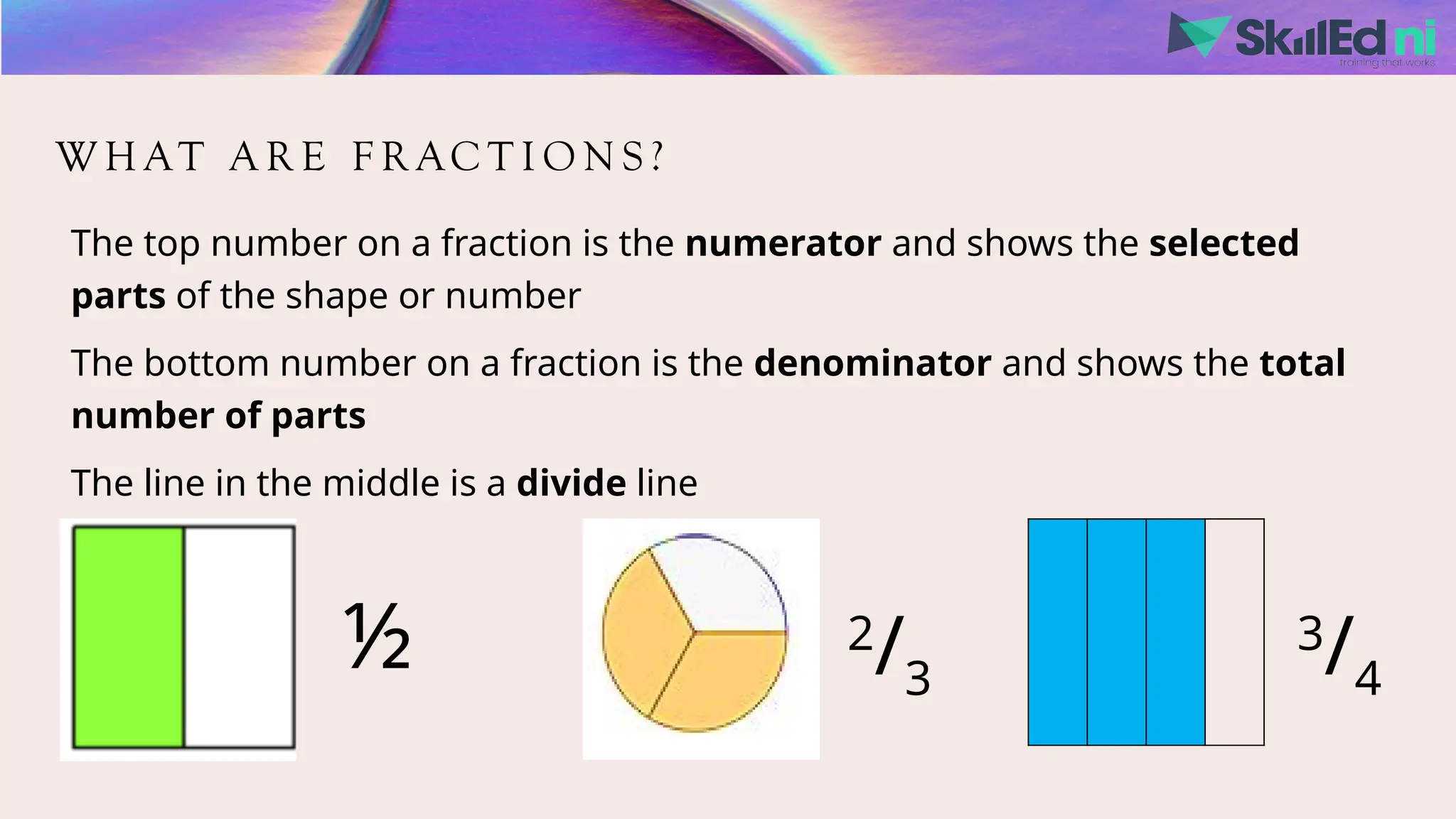
The top number on a fraction is the numerator and shows the selected
parts of the shape or number
The bottom number on a fraction is the denominator and shows the total
number of parts
The line in the middle is a divide line
½ 2
/3
3
/4
Complete the first column in the page entitled 'Shaded Fractions'
S I M P L I F Y I N G F R AC T I O N S
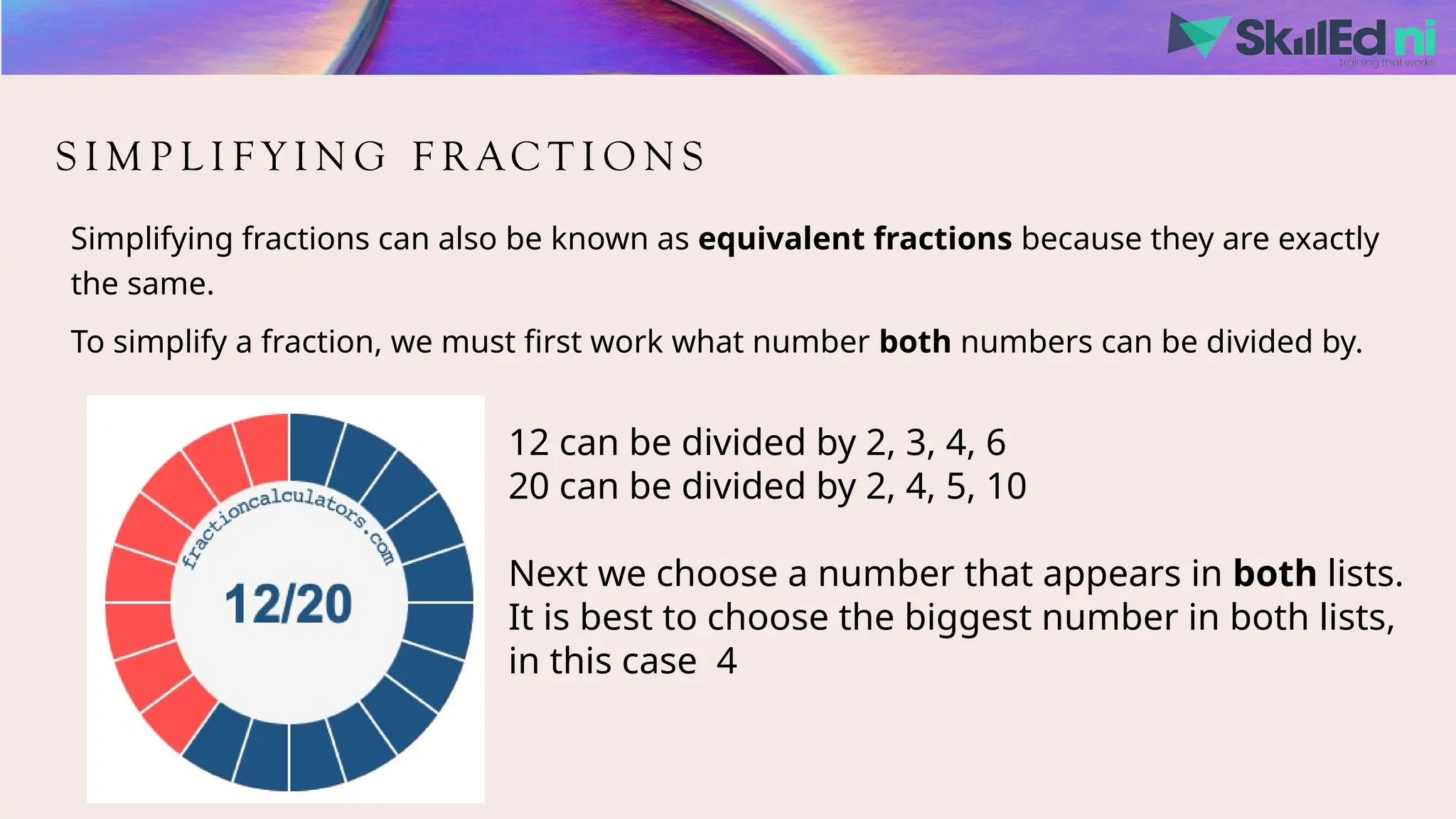
Simplifying fractions can also be known as equivalent fractions because they are exactly
the same.
To simplify a fraction, we must first work what number both numbers can be divided by.
12 can be divided by 2, 3, 4, 6
20 can be divided by 2, 4, 5, 10
Next we choose a number that appears in both lists.
It is best to choose the biggest number in both lists,
in this case 4
S I M P L I F Y I N G F R AC T I O N S
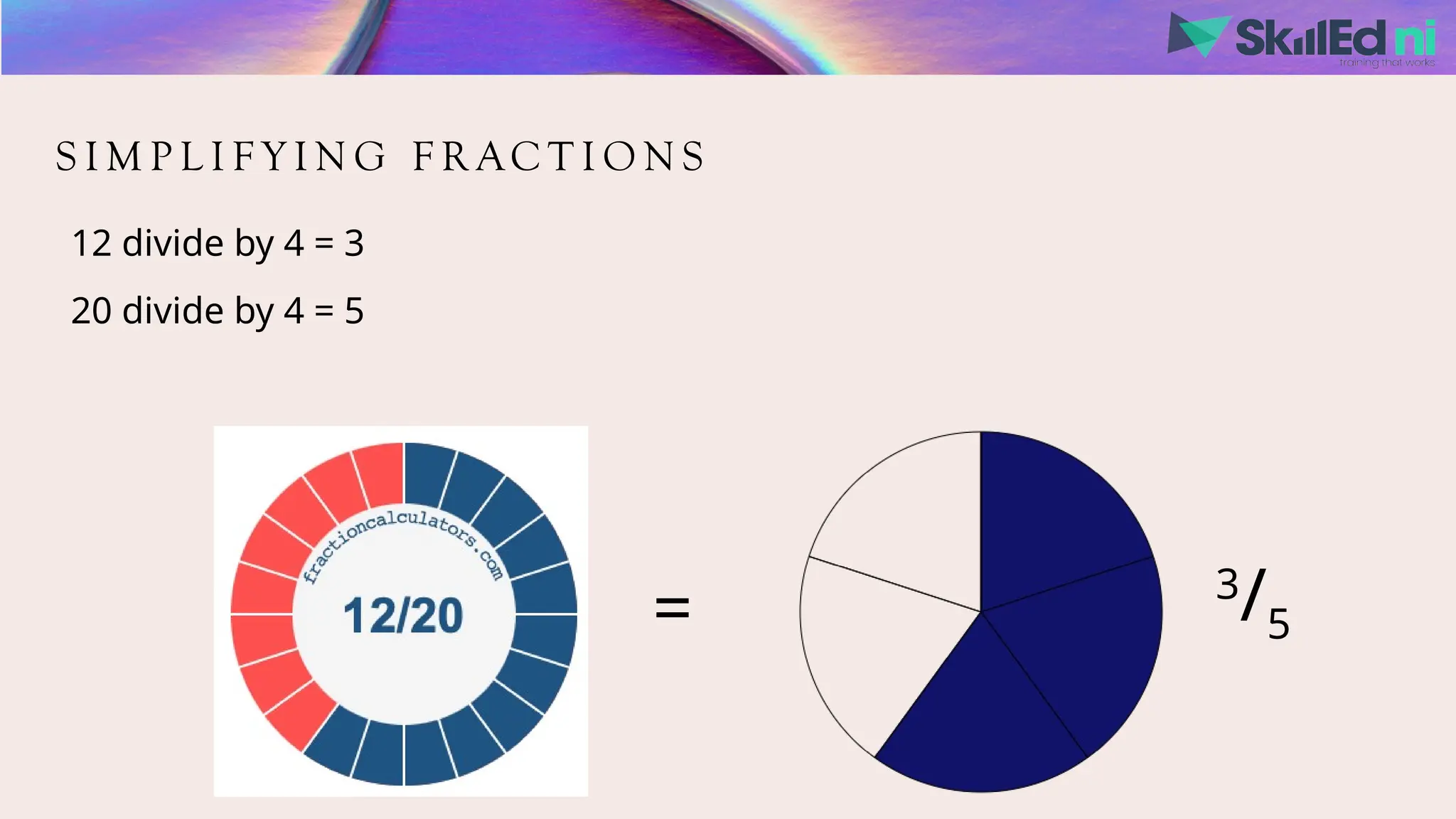
12 divide by 4 = 3
20 divide by 4 = 5
3
/5
=
S I M P L I F Y I N G F R AC T I O N S
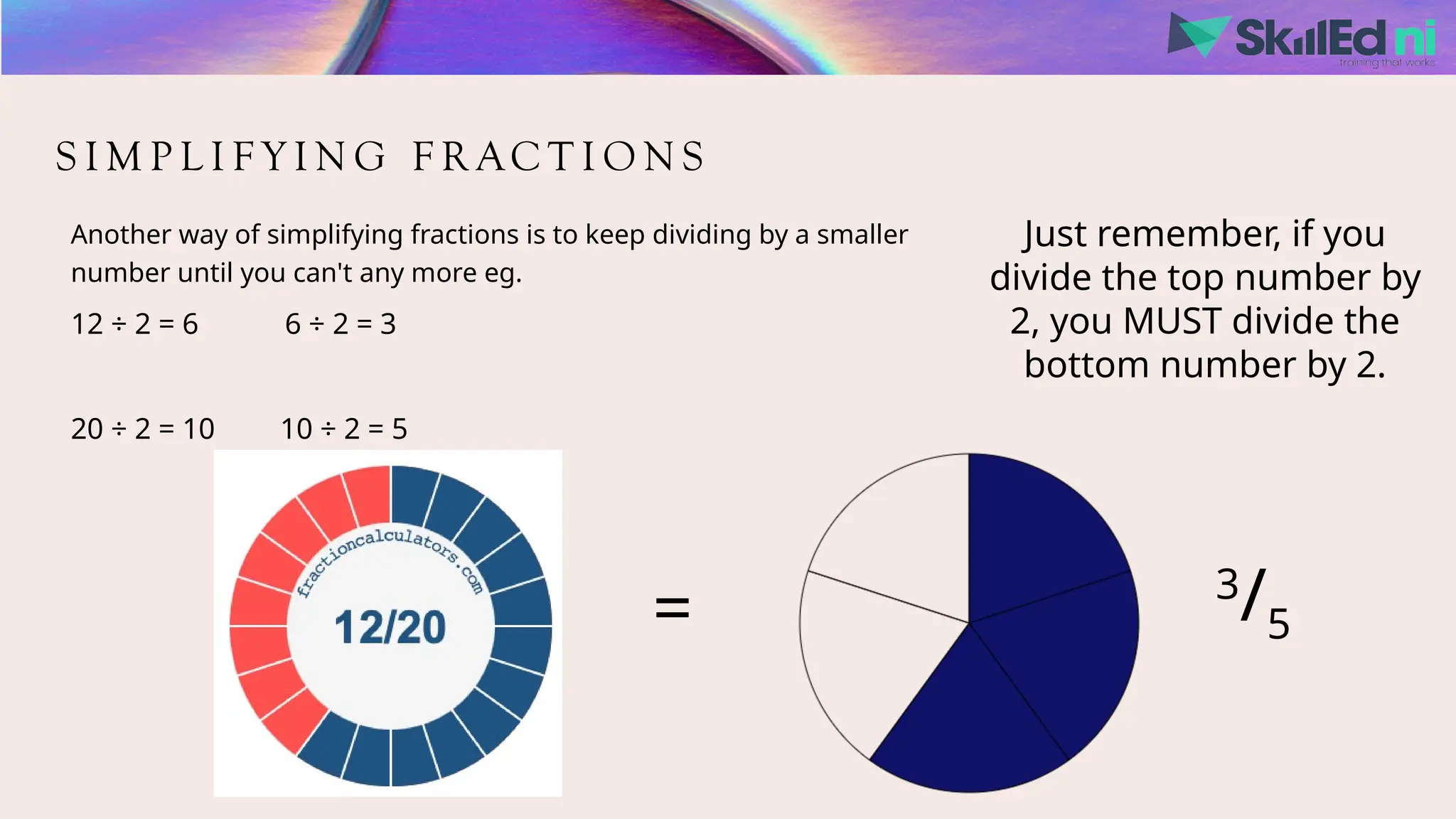
Another way of simplifying fractions is to keep dividing by a smaller
number until you can't any more eg.
12 ÷ 2 = 6 6 ÷ 2 = 3
20 ÷ 2 = 10 10 ÷ 2 = 5
3
/5
=
Just remember, if you
divide the top number by
2, you MUST divide the
bottom number by 2.
S I M P L I F Y I N G F R AC T I O N S
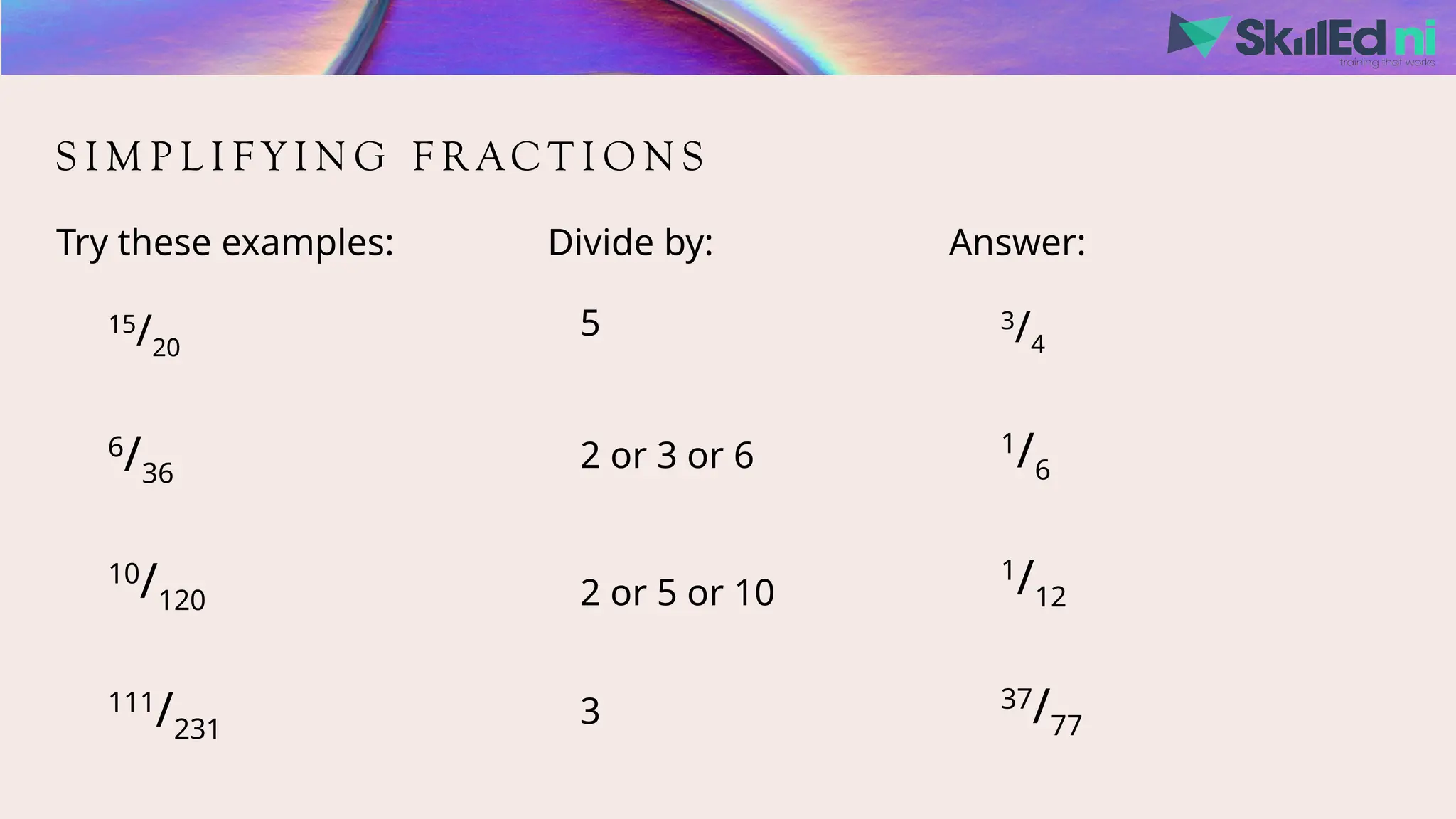
Try these examples:
15
/20
6
/36
10
/120
111
/231
Divide by:
5
2 or 3 or 6
2 or 5 or 10
3
Answer:
3
/4
1
/6
1
/12
37
/77
Complete the next two columns on the page entitled ' Shaded
fractions'
L E A R N I N G I N T E N T I O N S :
• Recall factors and multiples of a number
• Recognise fractions of shapes
• Write fractions in their simplest form

5. ES: Application of Number: Fractions Part 1

  • 1.
    FRACTIONS Application of NumberUnit 1 Leigh McQuaid
  • 2.
    L E AR N I N G I N T E N T I O N S : • Recall factors and multiples of a number • Recognise fractions of shapes • Write fractions in their simplest form
  • 3.
    M U LTI P L E S Multiples of a number are that number times tables. For example, multiples of 3 are: 3, 6, 9, 12, 15, 18, 21 ….... Work out multiples of 4 by doing times tables: 1 x 4 = 2 x 4 = 3 x 4 = etc
  • 4.
    FAC T OR S Factors of a number are numbers that divide exactly into it. For example, factors of 10 would be 1, 2, 5 and 10 because: 1 x 10 = 10 2 x 5 = 10 5 x 2 = 10 10 x 1 = 10 Another way of thinking about factors is what times tables a number appear in, eg. 10 appears in the 2, 5 and 10 times tables. Find factors of 12 by working out which times tables have 12 in them:
  • 5.
    H I NT Multiples always start with the number itself and increase (they are always bigger than the number) Factors always start with 1 and go up to the number itself (they are always smaller than the number)
  • 6.
    H I NT Factors and multiples of 2 are always even Factors and multiples of 10 are always even Multiples of 5 always end in 5 or 0 Multiples of 10 always end in 0
  • 7.
    Q U IZ T I M E – FAC T O R S A N D M U LT I P L E S https://wordwall.net/play/85140/991/ 822
  • 8.
    W H ATA R E F R AC T I O N S ? The top number on a fraction is the numerator and shows the selected parts of the shape or number The bottom number on a fraction is the denominator and shows the total number of parts The line in the middle is a divide line ½ 2 /3 3 /4
  • 9.
    Complete the firstcolumn in the page entitled 'Shaded Fractions'
  • 10.
    S I MP L I F Y I N G F R AC T I O N S Simplifying fractions can also be known as equivalent fractions because they are exactly the same. To simplify a fraction, we must first work what number both numbers can be divided by. 12 can be divided by 2, 3, 4, 6 20 can be divided by 2, 4, 5, 10 Next we choose a number that appears in both lists. It is best to choose the biggest number in both lists, in this case 4
  • 11.
    S I MP L I F Y I N G F R AC T I O N S 12 divide by 4 = 3 20 divide by 4 = 5 3 /5 =
  • 12.
    S I MP L I F Y I N G F R AC T I O N S Another way of simplifying fractions is to keep dividing by a smaller number until you can't any more eg. 12 ÷ 2 = 6 6 ÷ 2 = 3 20 ÷ 2 = 10 10 ÷ 2 = 5 3 /5 = Just remember, if you divide the top number by 2, you MUST divide the bottom number by 2.
  • 13.
    S I MP L I F Y I N G F R AC T I O N S Try these examples: 15 /20 6 /36 10 /120 111 /231 Divide by: 5 2 or 3 or 6 2 or 5 or 10 3 Answer: 3 /4 1 /6 1 /12 37 /77
  • 14.
    Complete the nexttwo columns on the page entitled ' Shaded fractions'
  • 15.
    L E AR N I N G I N T E N T I O N S : • Recall factors and multiples of a number • Recognise fractions of shapes • Write fractions in their simplest form
Editor's Notes