Subject: Human Anatomy & Physiology-I (HAP-I)
Topic: Cell Structure
MR. S. PATHAK
Department of Pharmacy
LECTURE-04
Learning Objectives
1. Describe the structure and function of the cell membrane, including its regulation
of materials into and out of the cell
2. Describe the functions of the various cytoplasmic organelles
3. Explain the structure and contents of the nucleus, as well as the process of DNA
replication
4. Explain the process by which a cell builds proteins using the DNA code
5. List the stages of the cell cycle in order, including the steps of cell division in
somatic cells
6. Discuss how a cell differentiates and becomes more specialized
7. List the morphological and physiological characteristics of some representative
cell types in the human body
3/13/2023 UNIT-01 2
Learning Outcomes
 On completion of this course, the student will be able to:
1. Understands about the structure and function of the cell membrane,
including its regulation of materials into and out of the cell
2. Understands about the functions of the various cytoplasmic
organelles
3. Understands about the structure and contents of the nucleus, as well
as the process of DNA replication
4. Understands about the morphological and physiological
characteristics of some representative cell types in the human body
3/13/2023 UNIT-01 3
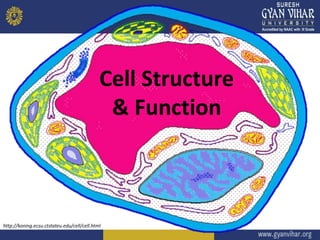
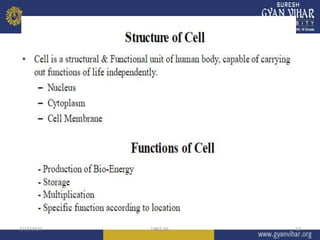
Cell Structure
& Function
http://koning.ecsu.ctstateu.edu/cell/cell.html
Cell Theory
• All living things are made up of cells.
• Cells are the smallest working units of all living
things.
• All cells come from preexisting cells through
cell division.
3/13/2023 UNIT-01 5
Definition of Cell
A cell is the smallest unit that is
capable of performing life functions.
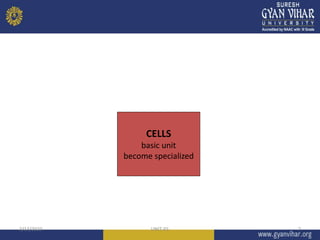
CELLS
basic unit
become specialized
3/13/2023 UNIT-01 7
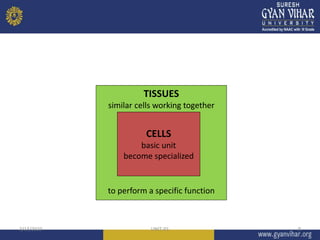
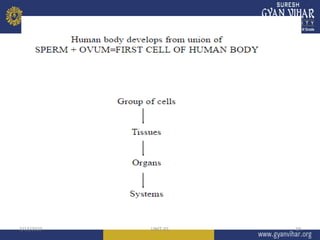
TISSUES
similar cells working together
to perform a specific function
CELLS
basic unit
become specialized
3/13/2023 UNIT-01 8
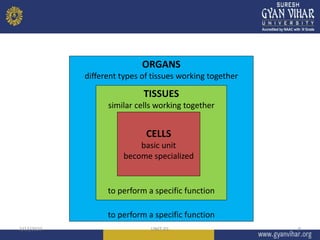
ORGANS
different types of tissues working together
to perform a specific function
TISSUES
similar cells working together
to perform a specific function
3/13/2023 UNIT-01 9
CELLS
basic unit
become specialized
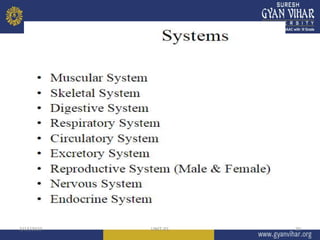
ORGAN SYSTEMS
different organs working together
to perform a specific function
ORGANS
different types of tissues working together
to perform a specific function
TISSUES
similar cells working together
to perform a specific function
CELLS
basic unit
become specialized
3/13/2023 UNIT-01 10
ORGANISM
different organ systems working together
ORGAN SYSTEMS
different organs working together
to perform a specific function
ORGANS
different types of tissues working together
to perform a specific function
TISSUES
similar cells working together
to perform a specific function
CELLS
basic unit
become specialized
3/13/2023 UNIT-01 11
3/13/2023 UNIT-01 12
PARTS OF A CELL
For ease of study, we divide the cell into three main parts: plasma membrane,
cytoplasm, and nucleus.
1. The plasma membrane forms the cell’s flexible outer surface,
separating the cell’s internal environment (inside the cell) from the
external environment (outside the cell). It is a selective barrier that
regulates the flow of materials into and out of a cell. This
selectivity helps establish and maintain the appropriate
environment for normal cellular activities. The plasma membrane
also plays a key role in communication among cells and between
cells and their external environment.
3/13/2023 UNIT-01 13
2. The cytoplasm (plasm- formed or molded) consists of all the cellular
contents between the plasma membrane and the nucleus.
 This compartment has two components: cytosol and organelles.
 Cytosol the fluid portion of cytoplasm, contains water, dissolved
solutes, and suspended particles. Surrounded by cytosol are several
different types of organelles (little organs).
 Each type of organelle has a characteristic shape and specific functions.
Examples include the cytoskeleton, ribosomes, endoplasmic reticulum,
Golgi complex, lysosomes, peroxisomes, and mitochondria.
3/13/2023 UNIT-01 14
3. The nucleus (nut kernel) is a large organelle that
houses most of a cell’s DNA. Within the nucleus,
each chromosome (chromo-colored), a single
molecule of DNA associated with several proteins,
contains thousands of hereditary units called genes
that control most aspects of cellular structure and
function.
3/13/2023 UNIT-01 15
3/13/2023 UNIT-01 16
3/13/2023 UNIT-01 17
Examples of Cells
3/13/2023 UNIT-01 18
Amoeba Proteus
Plant Stem
Red Blood Cell
Nerve Cell
Bacteria
3/13/2023 UNIT-01 19
3/13/2023 UNIT-01 20
Two Types of Cells
•Prokaryotic
•Eukaryotic
Prokaryotic
• Do not have
structures
surrounded by
membranes
• Few internal
structures
• One-celled
organisms, Bacteria
3/13/2023 UNIT-01 22
http://library.thinkquest.org/C004535/prokaryotic_cells.html
Eukaryotic
• Contain organelles surrounded by membranes
• Most living organisms
3/13/2023 UNIT-01 23
Plant Animal
http://library.thinkquest.org/C004535/eukaryotic_cells.html
“Typical” Animal Cell
3/13/2023 UNIT-01 24
http://web.jjay.cuny.edu/~acarpi/NSC/images/cell.gif
http://waynesword.palomar.edu/images/plant3.gif
“Typical” Plant Cell
3/13/2023 UNIT-01 25
Cell Parts
Organelles
Surrounding the Cell
Cell Membrane
• Outer membrane of cell
that controls movement in
and out of the cell
• Double layer
3/13/2023 UNIT-01 28
http://library.thinkquest.org/12413/structures.html
Cell Wall
• Most commonly found
in plant cells & bacteria
• Supports & protects
cells
• Surrounds plasma
membrane
3/13/2023 UNIT-01 29
http://library.thinkquest.org/12413/structures.html
Inside the Cell
Nucleus
• Directs cell activities
• Separated from cytoplasm by nuclear
membrane
• Control center of cell
• Double membrane
• Contains genetic material – DNA
• Contains
–Chromosomes
–Nucleolus
3/13/2023 UNIT-01 31
Nuclear Membrane
• Surrounds nucleus
• Made of two layers
• Openings allow material
to enter and leave
nucleus
3/13/2023 UNIT-01 32
http://library.thinkquest.org/12413/structures.html
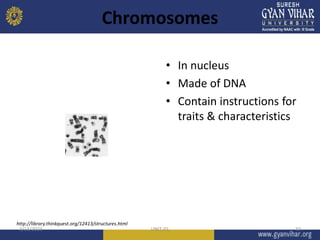
Chromosomes
• In nucleus
• Made of DNA
• Contain instructions for
traits & characteristics
3/13/2023 UNIT-01 33
http://library.thinkquest.org/12413/structures.html
Nucleolus
• Inside nucleus
• Contains RNA to build
proteins
• Most cells have 2 or
more
3/13/2023 UNIT-01 34
http://library.thinkquest.org/12413/structures.html
Cytoplasm
• Gel-like mixture (Viscous fluid containing
organelles)
• Surrounded by cell membrane
• Contains hereditary material
• components of cytoplasm
– Interconnected filaments & fibers
– Fluid = cytosol
– Organelles (not nucleus)
– storage substances
3/13/2023 UNIT-01 35
Endoplasmic Reticulum
• Helps move substances
within cells
• Network of
interconnected
membranes
• Two types
– Rough endoplasmic
reticulum
– Smooth endoplasmic
reticulum
3/13/2023 UNIT-01 36
http://library.thinkquest.org/12413/structures.html
Ribosomes
• Each cell contains
thousands
• Make proteins
• Found on ribosomes &
floating throughout the
cell
3/13/2023 UNIT-01 37
http://library.thinkquest.org/12413/structures.html
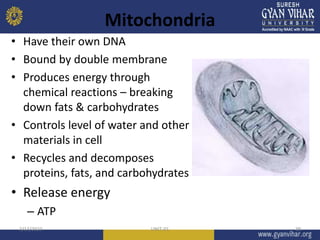
Mitochondria
• Have their own DNA
• Bound by double membrane
• Produces energy through
chemical reactions – breaking
down fats & carbohydrates
• Controls level of water and other
materials in cell
• Recycles and decomposes
proteins, fats, and carbohydrates
• Release energy
– ATP
3/13/2023 UNIT-01 38
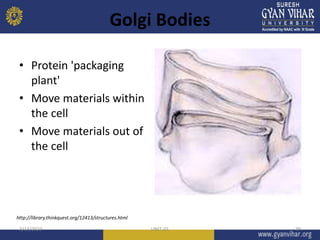
Golgi Bodies
• Protein 'packaging
plant'
• Move materials within
the cell
• Move materials out of
the cell
3/13/2023 UNIT-01 39
http://library.thinkquest.org/12413/structures.html
Lysosome
• Contain digestive
enzymes
• Functions
– Aid in cell renewal
– Break down old cell
parts
– Digests invaders
• Transports undigested
material to cell membrane
for removal
3/13/2023 UNIT-01 40
http://library.thinkquest.org/12413/structures.html
Vacuoles
• Membrane-bound sacs
for storage, digestion,
and waste removal
• More common in plants
than animals
• Contains water solution
• Help plants maintain
shape
3/13/2023 UNIT-01 41
http://library.thinkquest.org/12413/structures.html
Chloroplast
• Usually found in plant
cells
• Contains green
chlorophyll
• Where photosynthesis
takes place
3/13/2023 UNIT-01 42
http://library.thinkquest.org/12413/structures.html

4. Cell Structure.pptx

  • 1.
    Subject: Human Anatomy& Physiology-I (HAP-I) Topic: Cell Structure MR. S. PATHAK Department of Pharmacy LECTURE-04
  • 2.
    Learning Objectives 1. Describethe structure and function of the cell membrane, including its regulation of materials into and out of the cell 2. Describe the functions of the various cytoplasmic organelles 3. Explain the structure and contents of the nucleus, as well as the process of DNA replication 4. Explain the process by which a cell builds proteins using the DNA code 5. List the stages of the cell cycle in order, including the steps of cell division in somatic cells 6. Discuss how a cell differentiates and becomes more specialized 7. List the morphological and physiological characteristics of some representative cell types in the human body 3/13/2023 UNIT-01 2
  • 3.
    Learning Outcomes  Oncompletion of this course, the student will be able to: 1. Understands about the structure and function of the cell membrane, including its regulation of materials into and out of the cell 2. Understands about the functions of the various cytoplasmic organelles 3. Understands about the structure and contents of the nucleus, as well as the process of DNA replication 4. Understands about the morphological and physiological characteristics of some representative cell types in the human body 3/13/2023 UNIT-01 3
  • 4.
  • 5.
    Cell Theory • Allliving things are made up of cells. • Cells are the smallest working units of all living things. • All cells come from preexisting cells through cell division. 3/13/2023 UNIT-01 5
  • 6.
    Definition of Cell Acell is the smallest unit that is capable of performing life functions.
  • 7.
  • 8.
    TISSUES similar cells workingtogether to perform a specific function CELLS basic unit become specialized 3/13/2023 UNIT-01 8
  • 9.
    ORGANS different types oftissues working together to perform a specific function TISSUES similar cells working together to perform a specific function 3/13/2023 UNIT-01 9 CELLS basic unit become specialized
  • 10.
    ORGAN SYSTEMS different organsworking together to perform a specific function ORGANS different types of tissues working together to perform a specific function TISSUES similar cells working together to perform a specific function CELLS basic unit become specialized 3/13/2023 UNIT-01 10
  • 11.
    ORGANISM different organ systemsworking together ORGAN SYSTEMS different organs working together to perform a specific function ORGANS different types of tissues working together to perform a specific function TISSUES similar cells working together to perform a specific function CELLS basic unit become specialized 3/13/2023 UNIT-01 11
  • 12.
  • 13.
    PARTS OF ACELL For ease of study, we divide the cell into three main parts: plasma membrane, cytoplasm, and nucleus. 1. The plasma membrane forms the cell’s flexible outer surface, separating the cell’s internal environment (inside the cell) from the external environment (outside the cell). It is a selective barrier that regulates the flow of materials into and out of a cell. This selectivity helps establish and maintain the appropriate environment for normal cellular activities. The plasma membrane also plays a key role in communication among cells and between cells and their external environment. 3/13/2023 UNIT-01 13
  • 14.
    2. The cytoplasm(plasm- formed or molded) consists of all the cellular contents between the plasma membrane and the nucleus.  This compartment has two components: cytosol and organelles.  Cytosol the fluid portion of cytoplasm, contains water, dissolved solutes, and suspended particles. Surrounded by cytosol are several different types of organelles (little organs).  Each type of organelle has a characteristic shape and specific functions. Examples include the cytoskeleton, ribosomes, endoplasmic reticulum, Golgi complex, lysosomes, peroxisomes, and mitochondria. 3/13/2023 UNIT-01 14
  • 15.
    3. The nucleus(nut kernel) is a large organelle that houses most of a cell’s DNA. Within the nucleus, each chromosome (chromo-colored), a single molecule of DNA associated with several proteins, contains thousands of hereditary units called genes that control most aspects of cellular structure and function. 3/13/2023 UNIT-01 15
  • 16.
  • 17.
  • 18.
    Examples of Cells 3/13/2023UNIT-01 18 Amoeba Proteus Plant Stem Red Blood Cell Nerve Cell Bacteria
  • 19.
  • 20.
  • 21.
    Two Types ofCells •Prokaryotic •Eukaryotic
  • 22.
    Prokaryotic • Do nothave structures surrounded by membranes • Few internal structures • One-celled organisms, Bacteria 3/13/2023 UNIT-01 22 http://library.thinkquest.org/C004535/prokaryotic_cells.html
  • 23.
    Eukaryotic • Contain organellessurrounded by membranes • Most living organisms 3/13/2023 UNIT-01 23 Plant Animal http://library.thinkquest.org/C004535/eukaryotic_cells.html
  • 24.
    “Typical” Animal Cell 3/13/2023UNIT-01 24 http://web.jjay.cuny.edu/~acarpi/NSC/images/cell.gif
  • 25.
  • 26.
  • 27.
  • 28.
    Cell Membrane • Outermembrane of cell that controls movement in and out of the cell • Double layer 3/13/2023 UNIT-01 28 http://library.thinkquest.org/12413/structures.html
  • 29.
    Cell Wall • Mostcommonly found in plant cells & bacteria • Supports & protects cells • Surrounds plasma membrane 3/13/2023 UNIT-01 29 http://library.thinkquest.org/12413/structures.html
  • 30.
  • 31.
    Nucleus • Directs cellactivities • Separated from cytoplasm by nuclear membrane • Control center of cell • Double membrane • Contains genetic material – DNA • Contains –Chromosomes –Nucleolus 3/13/2023 UNIT-01 31
  • 32.
    Nuclear Membrane • Surroundsnucleus • Made of two layers • Openings allow material to enter and leave nucleus 3/13/2023 UNIT-01 32 http://library.thinkquest.org/12413/structures.html
  • 33.
    Chromosomes • In nucleus •Made of DNA • Contain instructions for traits & characteristics 3/13/2023 UNIT-01 33 http://library.thinkquest.org/12413/structures.html
  • 34.
    Nucleolus • Inside nucleus •Contains RNA to build proteins • Most cells have 2 or more 3/13/2023 UNIT-01 34 http://library.thinkquest.org/12413/structures.html
  • 35.
    Cytoplasm • Gel-like mixture(Viscous fluid containing organelles) • Surrounded by cell membrane • Contains hereditary material • components of cytoplasm – Interconnected filaments & fibers – Fluid = cytosol – Organelles (not nucleus) – storage substances 3/13/2023 UNIT-01 35
  • 36.
    Endoplasmic Reticulum • Helpsmove substances within cells • Network of interconnected membranes • Two types – Rough endoplasmic reticulum – Smooth endoplasmic reticulum 3/13/2023 UNIT-01 36 http://library.thinkquest.org/12413/structures.html
  • 37.
    Ribosomes • Each cellcontains thousands • Make proteins • Found on ribosomes & floating throughout the cell 3/13/2023 UNIT-01 37 http://library.thinkquest.org/12413/structures.html
  • 38.
    Mitochondria • Have theirown DNA • Bound by double membrane • Produces energy through chemical reactions – breaking down fats & carbohydrates • Controls level of water and other materials in cell • Recycles and decomposes proteins, fats, and carbohydrates • Release energy – ATP 3/13/2023 UNIT-01 38
  • 39.
    Golgi Bodies • Protein'packaging plant' • Move materials within the cell • Move materials out of the cell 3/13/2023 UNIT-01 39 http://library.thinkquest.org/12413/structures.html
  • 40.
    Lysosome • Contain digestive enzymes •Functions – Aid in cell renewal – Break down old cell parts – Digests invaders • Transports undigested material to cell membrane for removal 3/13/2023 UNIT-01 40 http://library.thinkquest.org/12413/structures.html
  • 41.
    Vacuoles • Membrane-bound sacs forstorage, digestion, and waste removal • More common in plants than animals • Contains water solution • Help plants maintain shape 3/13/2023 UNIT-01 41 http://library.thinkquest.org/12413/structures.html
  • 42.
    Chloroplast • Usually foundin plant cells • Contains green chlorophyll • Where photosynthesis takes place 3/13/2023 UNIT-01 42 http://library.thinkquest.org/12413/structures.html