“Speaking and Having Fun
with Young Children”
- TOPIC: From the use of L1 to the
promotion of oral skills in the L2 with YLE in
public schools: challenges and changing
practices.
- MEMBERS OF THE GROUP: Schmidt Candela
and Rubio Florencia
- School n°218 - 3rd grade C and D
- SUBJECT: Practice II
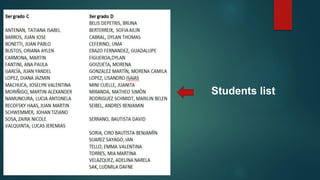
Students list
Our class experience:
-Our concern: The teacher and the students speaking
Spanish during the whole English lesson.
- Our focus: The development of student’s oral skill
in the foreign language: English.
- Topics that students learned:
- Colours and numbers.
- Family members.
- Parts of the house and pieces of furniture.
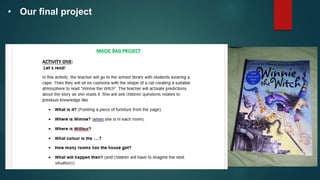
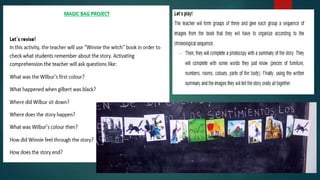
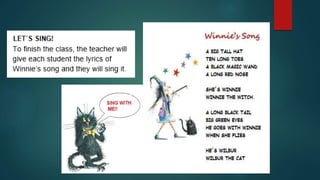
- Literature: “Winnie the Witch” (the “Magic Bag Project”).
- Our routine:
• Greeting pupils.
• Asking how they felt.
• Writing the date and what was the weather like on the board:
(flashcards)
• Checking the contents of the previous class activating
prior knowledge.
• Providing students with activities.
- Why routines are important:
• Chapter: “How children think and learn”by
Brewster,J, Ellis,G, and Girard,D (2002).
- Using the L2
• We had to speak always in English
• We created a comfortable atmosphere to the students so they
could express themselves freely
• We did not overcorrect them, we focused on communication
• We used almost the same grammatical structures and some
idioms so as they could appropriate them “Ready?” “Please”
• We repeated what students said in Spanish but in English
• We encouraged students to talk in English the vocabulary they
already learned “And in English...?”
- Affective Acquisition Activities
- Activities:
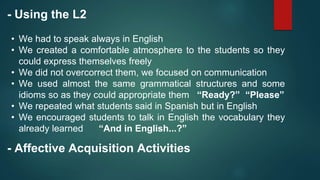
• In this activity, children
had to answer
questions about their
family orally.
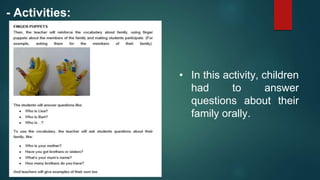
• In this activity, learners had to
make their own Family Tree
and then present their family
orally.
• Translanguaging theory by
Ofelia Garcia.
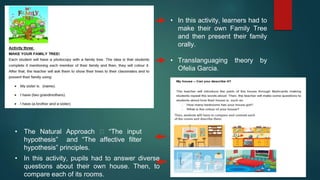
• In this activity, pupils had to answer diverse
questions about their own house. Then, to
compare each of its rooms.
• The Natural Approach 🡪 “The input
hypothesis” and “The affective filter
hypothesis” principles.
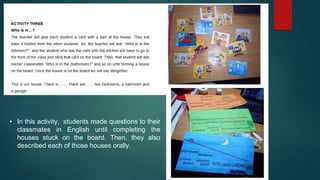
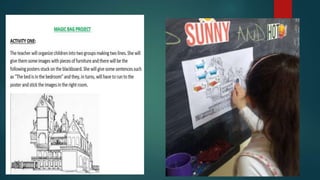
• In this activity, students made questions to their
classmates in English until completing the
houses stuck on the board. Then, they also
described each of those houses orally.
- Giving Instructions
• Using gestures, flashcards, body movements and facial
expressions
• Ask another student to explain what they had to do. Some of
them used their L1 to do that and we repeated it in English
• Our final project
Cameron’s (2010) point of view “The repeated use of
the same words in different physical and language
contexts helps to construct in the child’s mind the
sound, shape, and use of the word.” (p.51)
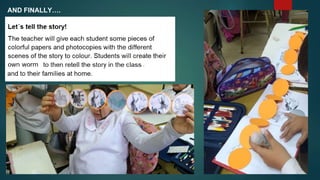
• Students applied the vocabulary and structures
learned in listening comprehension activities, talking,
reading and songs.
AND FINALLY….
The End….

3rd mid term (1)

  • 1.
    “Speaking and HavingFun with Young Children” - TOPIC: From the use of L1 to the promotion of oral skills in the L2 with YLE in public schools: challenges and changing practices. - MEMBERS OF THE GROUP: Schmidt Candela and Rubio Florencia - School n°218 - 3rd grade C and D - SUBJECT: Practice II
  • 2.
  • 3.
    Our class experience: -Ourconcern: The teacher and the students speaking Spanish during the whole English lesson. - Our focus: The development of student’s oral skill in the foreign language: English. - Topics that students learned: - Colours and numbers. - Family members. - Parts of the house and pieces of furniture. - Literature: “Winnie the Witch” (the “Magic Bag Project”).
  • 4.
    - Our routine: •Greeting pupils. • Asking how they felt. • Writing the date and what was the weather like on the board: (flashcards) • Checking the contents of the previous class activating prior knowledge. • Providing students with activities. - Why routines are important: • Chapter: “How children think and learn”by Brewster,J, Ellis,G, and Girard,D (2002).
  • 5.
    - Using theL2 • We had to speak always in English • We created a comfortable atmosphere to the students so they could express themselves freely • We did not overcorrect them, we focused on communication • We used almost the same grammatical structures and some idioms so as they could appropriate them “Ready?” “Please” • We repeated what students said in Spanish but in English • We encouraged students to talk in English the vocabulary they already learned “And in English...?” - Affective Acquisition Activities
  • 6.
    - Activities: • Inthis activity, children had to answer questions about their family orally.
  • 7.
    • In thisactivity, learners had to make their own Family Tree and then present their family orally. • Translanguaging theory by Ofelia Garcia. • In this activity, pupils had to answer diverse questions about their own house. Then, to compare each of its rooms. • The Natural Approach 🡪 “The input hypothesis” and “The affective filter hypothesis” principles.
  • 8.
    • In thisactivity, students made questions to their classmates in English until completing the houses stuck on the board. Then, they also described each of those houses orally.
  • 9.
    - Giving Instructions •Using gestures, flashcards, body movements and facial expressions • Ask another student to explain what they had to do. Some of them used their L1 to do that and we repeated it in English
  • 10.
  • 11.
    Cameron’s (2010) pointof view “The repeated use of the same words in different physical and language contexts helps to construct in the child’s mind the sound, shape, and use of the word.” (p.51) • Students applied the vocabulary and structures learned in listening comprehension activities, talking, reading and songs.
  • 15.
  • 16.