Geothermal
Energy
3Q-SCIENCE 9-WEEK 3
T. JHANEL
LESSON OBJECTIVES:
At end of the lesson, students should be able to;
1. Explain geothermal energy as an abundant source
of energy.
2. Compare geothermal energy to other forms of
energy.
3. Discuss how a geothermal energy power plant
works in terms of energy transformation.
4. Describe the advantages and disadvantages of
geothermal energy.
LESSON GUIDE
1
Warm-up
activity
2 3
Review
Lesson
proper
4
Activity
Review on
Volcanoes
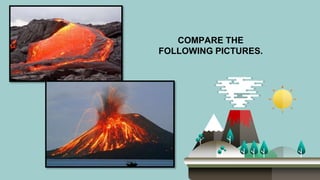
COMPARE THE
FOLLOWING PICTURES.
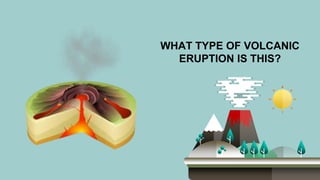
WHAT TYPE OF VOLCANIC
ERUPTION IS THIS?
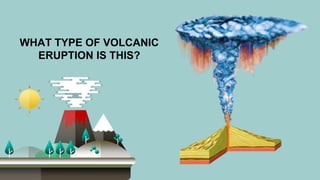
WHAT TYPE OF VOLCANIC
ERUPTION IS THIS?
WHAT TYPE OF
VOLCANIC ERUPTION IS
A STEAM-DRIVEN
EXPLOSION THAT
USUALLY LEADS TO
ANOTHER TYPE OF
ERUPTION?
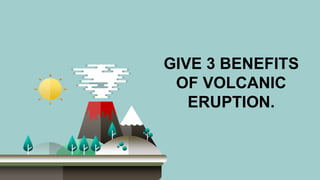
GIVE 3 BENEFITS
OF VOLCANIC
ERUPTION.
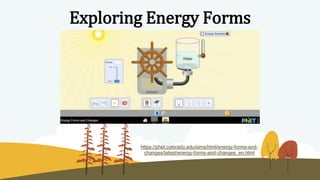
https://phet.colorado.edu/sims/html/energy-forms-and-
changes/latest/energy-forms-and-changes_en.html
Exploring Energy Forms
- The energy derived from the
center of the Earth.
- 2 Greek words
“Geo” – Earth
“Thermal” - Heat
Geothermal
Energy
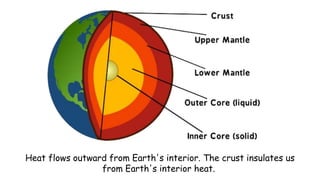
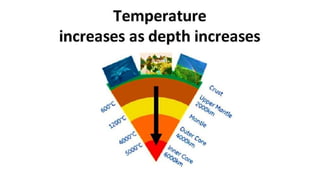
Heat flows outward from Earth's interior. The crust insulates us
from Earth's interior heat.
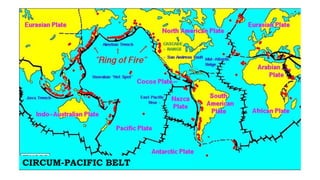
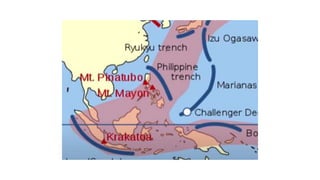
CIRCUM-PACIFIC BELT
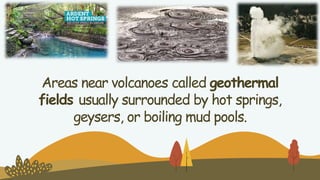
Areas near volcanoes called geothermal
fields usually surrounded by hot springs,
geysers, or boiling mud pools.
- Provides an alternative
source of energy, which is
greener and more eco-
friendly than coal and
fossils.
Geothermal
Energy
How is Geothermal
Energy generated?
CREDITS: This presentation template was created by Slidesgo, including icons by Flaticon, and infographics &
images by Freepik
Geothermal Energy is generated in 2 ways:
1.Geothermal Powerplants
2.Geothermal Heat Pumps
Geothermal Power plants
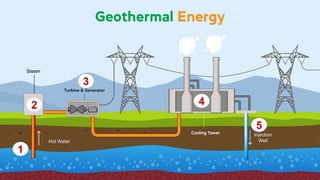
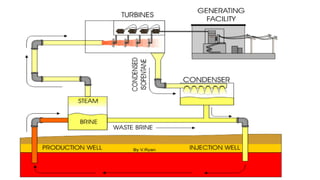
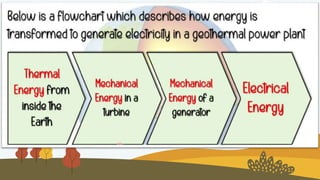
- It is where heat from within the
Earth changes water into steam,
which turns steam turbines that
generates electricity.
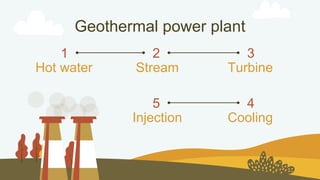
Geothermal power plant
Hot water Stream Turbine
1 2 3
Injection Cooling
5 4
1
2
3
4
5
1
2
3
4
5
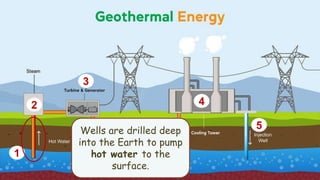
Wells are drilled deep
into the Earth to pump
hot water to the
surface.
1
2
3
4
5
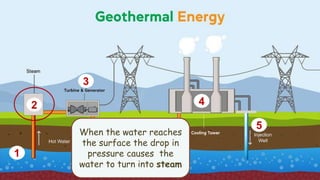
When the water reaches
the surface the drop in
pressure causes the
water to turn into steam
1
2
3
4
5
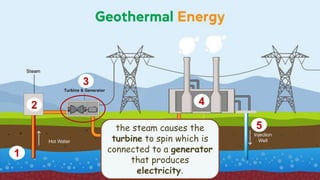
the steam causes the
turbine to spin which is
connected to a generator
that produces
electricity.
1
2
3
4
5
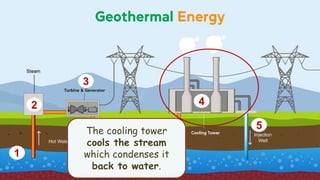
The cooling tower
cools the stream
which condenses it
back to water.
1
2
3
4
5
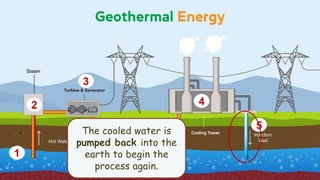
The cooled water is
pumped back into the
earth to begin the
process again.
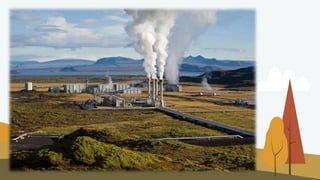
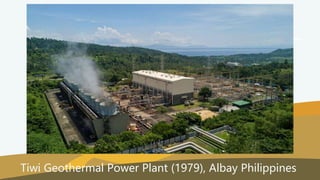
Tiwi Geothermal Power Plant (1979), Albay Philippines
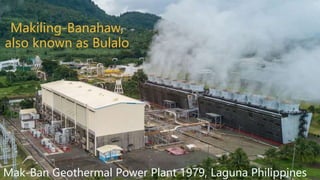
Mak-Ban Geothermal Power Plant 1979, Laguna Philippines
Makiling-Banahaw,
also known as Bulalo
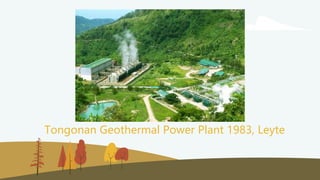
Tongonan Geothermal Power Plant 1983, Leyte
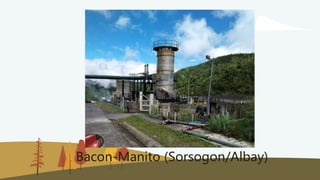
Bacon-Manito (Sorsogon/Albay)
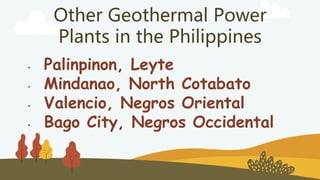
Other Geothermal Power
Plants in the Philippines
• Palinpinon, Leyte
• Mindanao, North Cotabato
• Valencio, Negros Oriental
• Bago City, Negros Occidental
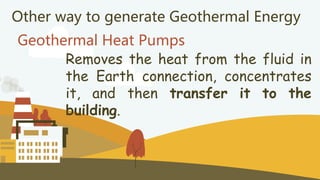
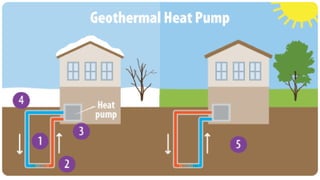
Geothermal Heat Pumps
Removes the heat from the fluid in
the Earth connection, concentrates
it, and then transfer it to the
building.
Other way to generate Geothermal Energy
Advantages and
Disadvantages of
Geothermal Energy
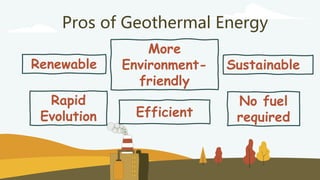
Pros of Geothermal Energy
Renewable
Rapid
Evolution
Sustainable
Efficient
No fuel
required
More
Environment-
friendly
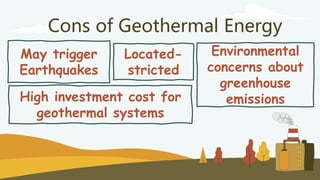
Cons of Geothermal Energy
May trigger
Earthquakes
Environmental
concerns about
greenhouse
emissions
High investment cost for
geothermal systems
Located-
stricted
ACTIVITY TIME!
Make a flowchart showing the process
of geothermal energy generation.
HOMEWORK
● Answer Page 226, Checkpoint
and Reflect Upon; and Page 228-
229, Let’s Organize and
Reflective Questions.
CREDITS: This presentation template was created by Slidesgo, including icons by Flaticon, and infographics &
images by Freepik
teacherjhanel@integratedmontessori.edu.ph
Do you have any questions?
Please keep this slide for attribution
Thank You!
Alternative resources
Here’s an assortment of alternative resources whose
style fits that of this template
3Q-SCIENCE 9-WEEK 4.pptx

3Q-SCIENCE 9-WEEK 4.pptx

Editor's Notes

  • #40 Water or a refrigerant moves through a loop of pipes. When the weather is cold, the water or refrigerant heats up as it travels through the part of the loop that's buried underground. Once it gets back above ground, the warmed water or refrigerant transfers heat into the building. The water or refrigerant cools down after its heat is transferred. It is pumped back underground where it heats up once more, starting the process again. On a hot day, the system can run in reverse. The water or refrigerant cools the building and then is pumped underground where extra heat is transferred to the ground around the pipes.