Overhead lines
Underground cable
Dr. P. K. Sahu
Associate Professor
SCHOOL OF ELECTRICAL ENGG, KIIT-DU
• Electrical power is transmitted through
either overhead power lines or
underground cables.
• Each of the two types of cables has its
benefits as well as disadvantages as well
as places where they are commonly used.
• The choice of which method to use is
influenced by voltage, cost, safety, type of
application, and other factors.
• While the overhead lines are cheap, easy
to install, troubleshoot and upgrade, the
same cannot be said about the
underground cables.
• Underground cables have their place too,
and despite being expensive, they have
several advantages.
• These are mostly used where it is
dangerous to have overhead lines such as
densely populated areas as well as in
providing the missing link in areas where
overhead lines cannot be used.
• Due to cost, physical and environmental
factors, the two types of cables are usually
combined together in most situations.
• Construction:
– Underground cables are more expensive to
construct since they have to be electrically
insulated and have protection against
moisture, corrosion, mechanical damage and
other environmental impacts from the soil.
– Construction of the cables is more
complicated compared to the overhead cables
which are simple to construct, and do not
require insulation and sheathing.
protective casing or
covering
• Installation:
– The installation of overhead lines on poles is
easier and straightforward.
– However, the underground cables require
digging trenches and this may be complicated
by other utility service lines such as water
pipes, oil and gas pipelines, sewer lines.
– Other complications may arise due to rocks,
loose soil and water along the routes, making
them more expensive to install.
• Heat dissipation:
– Heat dissipation in underground cables is
limited by the layers of insulation and protection
such as armoring and sheaths.
– Most of the heat is therefore retained near the
cable unlike the overhead cables where most of
the heat is released to the surrounding and
automatic natural cooling is provided by the air.
• Size of Conductors:
– Underground cables have larger conductor
sizes compared to overhead lines for the same
amount of power.
– This is due to the fact that the overhead lines
have a natural cooling and hence the ability to
carry more power without heating up.
• Voltage carrying capacity:
– The overhead lines are better suited to carry
higher voltages compared to the underground
cables, which are limited by the expensive
construction and limited heat dissipation.
– For these reasons, the underground cables
are mostly used for transmitting up to 33KV.
• Fault detection and repair:
– It is easier to detect and repair faults in
overhead cables.
– It is more complicated and takes more time to
locate and repair the underground systems.
• Public safety:
– Underground cables are safer to the public,
animals and environment compared to the
overhead lines i.e. there are no issues such
as people getting in contact with fallen lines.
• Effect of lightning discharges:
– Overhead cables are more prone to lightning
strikes whereas the underground cables are
not affected by the discharges.
• Interference:
– Overhead lines interfere with communication
lines that are in close proximity, have corona
discharge, radio and TV interference which
does not happen with the underground lines.
• Land use
– The underground cables allow better use of
land coupled with better views without the
sight of poles and cables. This leads to
improved property values.
• Life expectancy
• Life expectancy
– Overhead lines have a longer life span
compared to undergrounds cables.
• Conclusion
– The underground cables are more expensive
to construct and install, however, they are
convenient, less likely to break and mostly
used to provide the missing link where
overhead cables cannot be used.
– The choice of the cable to use is determined
by the particular situation.
– The overhead lines are widely used due to
their cost and ability to carry more power
compared to the underground.
Sl. No Parameter Overhead Underground
1 Public Safety Not safe Safer than overhead system
2 Initial cost Less Expensive More Expensive
3 Flexibility More flexible Less flexible
COMPARISON BETWEEN OVERHEAD TRANS LINE AND UNDERGROUND CABLE
4 Working Voltage Can be operated for 400kv or higher Cannot be operated above 66kv
5 Maintenance cost High Very low
6
Frequency of
failure
More chance of fault Less chance of fault
11
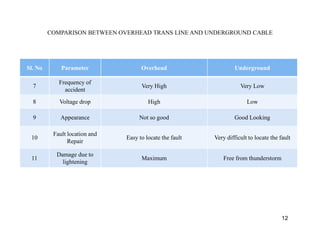
Sl. No Parameter Overhead Underground
7
Frequency of
accident
Very High Very Low
8 Voltage drop High Low
9 Appearance Not so good Good Looking
COMPARISON BETWEEN OVERHEAD TRANS LINE AND UNDERGROUND CABLE
10
Fault location and
Repair
Easy to locate the fault Very difficult to locate the fault
11
Damage due to
lightening
Maximum Free from thunderstorm
12

3.chapter 1 ohtl vs cables

  • 1.
    Overhead lines Underground cable Dr.P. K. Sahu Associate Professor SCHOOL OF ELECTRICAL ENGG, KIIT-DU
  • 2.
    • Electrical poweris transmitted through either overhead power lines or underground cables. • Each of the two types of cables has its benefits as well as disadvantages as well as places where they are commonly used. • The choice of which method to use is • The choice of which method to use is influenced by voltage, cost, safety, type of application, and other factors. • While the overhead lines are cheap, easy to install, troubleshoot and upgrade, the same cannot be said about the underground cables.
  • 3.
    • Underground cableshave their place too, and despite being expensive, they have several advantages. • These are mostly used where it is dangerous to have overhead lines such as densely populated areas as well as in providing the missing link in areas where providing the missing link in areas where overhead lines cannot be used. • Due to cost, physical and environmental factors, the two types of cables are usually combined together in most situations.
  • 4.
    • Construction: – Undergroundcables are more expensive to construct since they have to be electrically insulated and have protection against moisture, corrosion, mechanical damage and other environmental impacts from the soil. – Construction of the cables is more complicated compared to the overhead cables which are simple to construct, and do not require insulation and sheathing. protective casing or covering
  • 5.
    • Installation: – Theinstallation of overhead lines on poles is easier and straightforward. – However, the underground cables require digging trenches and this may be complicated by other utility service lines such as water pipes, oil and gas pipelines, sewer lines. – Other complications may arise due to rocks, loose soil and water along the routes, making them more expensive to install.
  • 6.
    • Heat dissipation: –Heat dissipation in underground cables is limited by the layers of insulation and protection such as armoring and sheaths. – Most of the heat is therefore retained near the cable unlike the overhead cables where most of the heat is released to the surrounding and automatic natural cooling is provided by the air. automatic natural cooling is provided by the air. • Size of Conductors: – Underground cables have larger conductor sizes compared to overhead lines for the same amount of power. – This is due to the fact that the overhead lines have a natural cooling and hence the ability to carry more power without heating up.
  • 7.
    • Voltage carryingcapacity: – The overhead lines are better suited to carry higher voltages compared to the underground cables, which are limited by the expensive construction and limited heat dissipation. – For these reasons, the underground cables are mostly used for transmitting up to 33KV. • Fault detection and repair: – It is easier to detect and repair faults in overhead cables. – It is more complicated and takes more time to locate and repair the underground systems.
  • 8.
    • Public safety: –Underground cables are safer to the public, animals and environment compared to the overhead lines i.e. there are no issues such as people getting in contact with fallen lines. • Effect of lightning discharges: – Overhead cables are more prone to lightning – Overhead cables are more prone to lightning strikes whereas the underground cables are not affected by the discharges. • Interference: – Overhead lines interfere with communication lines that are in close proximity, have corona discharge, radio and TV interference which does not happen with the underground lines.
  • 9.
    • Land use –The underground cables allow better use of land coupled with better views without the sight of poles and cables. This leads to improved property values. • Life expectancy • Life expectancy – Overhead lines have a longer life span compared to undergrounds cables.
  • 10.
    • Conclusion – Theunderground cables are more expensive to construct and install, however, they are convenient, less likely to break and mostly used to provide the missing link where overhead cables cannot be used. overhead cables cannot be used. – The choice of the cable to use is determined by the particular situation. – The overhead lines are widely used due to their cost and ability to carry more power compared to the underground.
  • 11.
    Sl. No ParameterOverhead Underground 1 Public Safety Not safe Safer than overhead system 2 Initial cost Less Expensive More Expensive 3 Flexibility More flexible Less flexible COMPARISON BETWEEN OVERHEAD TRANS LINE AND UNDERGROUND CABLE 4 Working Voltage Can be operated for 400kv or higher Cannot be operated above 66kv 5 Maintenance cost High Very low 6 Frequency of failure More chance of fault Less chance of fault 11
  • 12.
    Sl. No ParameterOverhead Underground 7 Frequency of accident Very High Very Low 8 Voltage drop High Low 9 Appearance Not so good Good Looking COMPARISON BETWEEN OVERHEAD TRANS LINE AND UNDERGROUND CABLE 10 Fault location and Repair Easy to locate the fault Very difficult to locate the fault 11 Damage due to lightening Maximum Free from thunderstorm 12