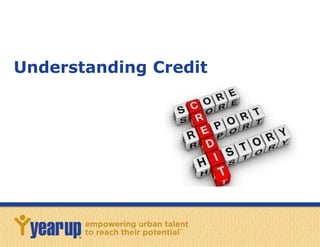
Understanding Credit
2
What is a credit report?
Detailed history of your financial behavior
 How many and the type of loans you have
 Whether you pay your bills on time
 Public records, like bankruptcy filing, court-
ordered judgments, tax liens, etc.
Why do creditors want this information?
Why does it impact your likelihood to get a loan
and/or your interest rate?
3
What is a credit score?
Numerical representation of your creditworthiness
• Higher score = more likely to pay back debt
• Low score = risky borrower
4
What is a FICO score?
Credit score developed by FICO, a company specializing
in predictive analytics. They take info and analyze it to
predict what’s likely to happen
How your FICO
score is
determined:
5
Credit Calculator
Credit is a great thing to build, but over-spending and
carrying a balance each month can cost you far more
than your original purchases
Let’s run through a credit calculator:
http://www.bankrate.com/calculators/credit-
cards/balance-debt-payoff-calculator.aspx
6
Fixing Bad Credit
• If your credit report contains discrepancies, raise a
dispute with the reporting agency
• The number one thing you can do to begin repairing
poor credit is to contact your creditors and begin making
payments on time
• Once you have paid off a credit card, do not close it! 
Why?
If you have no credit, think about
going to your bank and request a
student credit card or other credit
card with a low maximum and low
interest rate.
7
Running Your Credit Report
• You are entitled to a free credit report once a year each of
the major agencies: Experian, TransUnion, and Equifax.
Visit www.annualcreditreport.com to get your request
started.

36 understanding credit

  • 1.
  • 2.
    2 What is acredit report? Detailed history of your financial behavior  How many and the type of loans you have  Whether you pay your bills on time  Public records, like bankruptcy filing, court- ordered judgments, tax liens, etc. Why do creditors want this information? Why does it impact your likelihood to get a loan and/or your interest rate?
  • 3.
    3 What is acredit score? Numerical representation of your creditworthiness • Higher score = more likely to pay back debt • Low score = risky borrower
  • 4.
    4 What is aFICO score? Credit score developed by FICO, a company specializing in predictive analytics. They take info and analyze it to predict what’s likely to happen How your FICO score is determined:
  • 5.
    5 Credit Calculator Credit isa great thing to build, but over-spending and carrying a balance each month can cost you far more than your original purchases Let’s run through a credit calculator: http://www.bankrate.com/calculators/credit- cards/balance-debt-payoff-calculator.aspx
  • 6.
    6 Fixing Bad Credit •If your credit report contains discrepancies, raise a dispute with the reporting agency • The number one thing you can do to begin repairing poor credit is to contact your creditors and begin making payments on time • Once you have paid off a credit card, do not close it!  Why? If you have no credit, think about going to your bank and request a student credit card or other credit card with a low maximum and low interest rate.
  • 7.
    7 Running Your CreditReport • You are entitled to a free credit report once a year each of the major agencies: Experian, TransUnion, and Equifax. Visit www.annualcreditreport.com to get your request started.

Editor's Notes

  • #3 Credit Report: a detailed history of your financial behavior; project “Sample Credit Report” and walk through, being sure to point out legend at top Report how many and what types of loans you have, whether you pay on time, public record information (bankruptcy filings, court-ordered judgments, tax liens) from courthouse records. Ask: Why do creditors want this information? Why does it impact your likelihood to get a loan and/or your interest rate? [Creditors use this information to determine your RISK (meaning how likely you are to pay back a loan)] How risky you are affects their willingness to give you a loan. For example, high risk = high interest rate (higher cost of borrowing money).   Credit Score: a numerical representation of that risk. Higher score = more likely to pay back debt; low score = risky borrower How is the FICO score calculated? 35% = record of paying bills on time the most important thing you can do to maintain and improve your credit 30% = debt-to-credit ratio (money owed vs. available credit) if you have 2 cards with a $3,000 limit each, and you owe $2,500 on each, you have a very high debt-to-credit ratio (are using 83% of your available credit) and are considered a risky borrower 15% = length of credit history If all of your accounts are new, you don’t have a proven record of responsibility yet, making you appear riskier. This is why it’s a good idea to open a credit card with a low maximum to start demonstrating your responsibility You can also ask your bank not to raise your limit to ensure you don’t over spend 10% = new accounts and recent credit applications Lots of accounts opened within a short timeframe suggest over-extension 10% = mix of credit & loans  
  • #4 Credit Score: a numerical representation of that risk. Higher score = more likely to pay back debt; low score = risky borrower
  • #5  How is the FICO score calculated? 35% = record of paying bills on time the most important thing you can do to maintain and improve your credit 30% = debt-to-credit ratio (money owed vs. available credit) if you have 2 cards with a $3,000 limit each, and you owe $2,500 on each, you have a very high debt-to-credit ratio (are using 83% of your available credit) and are considered a risky borrower 15% = length of credit history If all of your accounts are new, you don’t have a proven record of responsibility yet, making you appear riskier. This is why it’s a good idea to open a credit card with a low maximum to start demonstrating your responsibility You can also ask your bank not to raise your limit to ensure you don’t over spend 10% = new accounts and recent credit applications Lots of accounts opened within a short timeframe suggest over-extension 10% = mix of credit & loans  
  • #6 Credit Calculator (10 minutes) Credit is a great thing to build, but over-spending and carrying a balance each month can cost you far more than your original purchases Project http://www.bankrate.com/calculators/credit-cards/credit-card-payoff-calculator.aspx and run through sample scenarios (ex. Putting a vacation on a credit card, new pair of shoes, car repair, etc.)
  • #7 Fixing Bad Credit (20 minutes) If your credit report contains discrepancies, raise a dispute with the reporting agency The number one thing you can do to begin repairing poor credit is to contact your creditors and begin making payments on time Even setting up and agreeing to small monthly payments will bring your accounts “current” and will be reported to the credit agencies, and stop the phone calls Use the budget template to figure out a monthly payment amount you can afford—do not agree to something you can’t afford! Use the script on “Credit: Next Steps” worksheet to get through the call and record the data Have the credit representative confirm your agreement verbally AND in writing via email Use calendar reminders to help organize and track your payments Once you have paid off a credit card, do not close it! This will lower your amount of available credit and thus lower your score Keep it to make one or two small purchases a month and pay the entire card balance monthly If you have no credit, go to your bank and request a student credit card or other credit card with a low maximum and low interest rate.
  • #8 Running Your Credit Report (30 minutes) Students can check credit reports once a year from each of the three agencies Have students log in to www.annualcreditreport.com and click “Request your free credit reports” to begin the process Students should request reports from all agencies and compare them for errors Once students pull their reports, they should complete the “Repairing Your Credit: Next Steps” worksheet; walk around and assist as needed