Bridging the Opportunity Divide:
Direct Action
Year Up Puget Sound’s 2012 Walk for Opportunity
2
Agree/Disagree
• I believe that voting benefits both me individually and
my community.
• I believe that politicians in my city, state, and country
understand and represent my own and my community’s
interests.
• I believe that young adults should be a primary concern
for politicians.
• I believe that everyone who wants to vote is legally able
to do so.
• Voting is an example of Dr. King’s direct action.
3
Who votes in America?
Politics is as much about
those who do vote as it is
about those who don’t.
US politics is dominated by
the wealthy, the old, and
the educated.
4
Why does civic disengagement matter?
Civic
disconnection
Low voter
turnout and
limited self-
advocacy
Political
priorities are
placed
elsewhere
Public funding
follows political
priorities
elsewhere
Low wages and
limited career
prospects
5
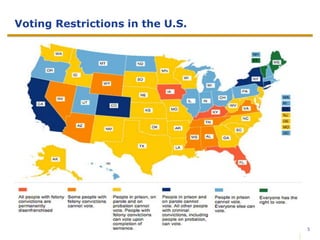
Voting Restrictions in the U.S.
6
Why do these voting restrictions matter?
7
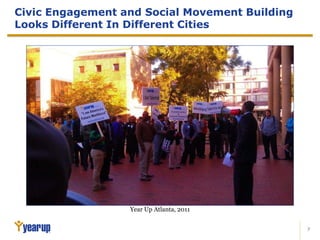
Civic Engagement and Social Movement Building
Looks Different In Different Cities
Year Up Atlanta, 2011
8
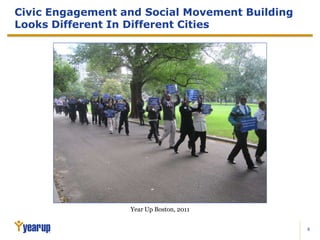
Civic Engagement and Social Movement Building
Looks Different In Different Cities
Year Up Boston, 2011
9
Civic Engagement and Social Movement Building
Looks Different In Different Cities
Year Up National Capital Region, 2011
10
Direct Action & Social Movement Building
What does direct action look
like:
 For you?
 For us?
How do we make sure that we
are no longer bystanders?
 Register to vote
 Talk to our networks
 What else?

22

  • 1.
    Bridging the OpportunityDivide: Direct Action Year Up Puget Sound’s 2012 Walk for Opportunity
  • 2.
    2 Agree/Disagree • I believethat voting benefits both me individually and my community. • I believe that politicians in my city, state, and country understand and represent my own and my community’s interests. • I believe that young adults should be a primary concern for politicians. • I believe that everyone who wants to vote is legally able to do so. • Voting is an example of Dr. King’s direct action.
  • 3.
    3 Who votes inAmerica? Politics is as much about those who do vote as it is about those who don’t. US politics is dominated by the wealthy, the old, and the educated.
  • 4.
    4 Why does civicdisengagement matter? Civic disconnection Low voter turnout and limited self- advocacy Political priorities are placed elsewhere Public funding follows political priorities elsewhere Low wages and limited career prospects
  • 5.
  • 6.
    6 Why do thesevoting restrictions matter?
  • 7.
    7 Civic Engagement andSocial Movement Building Looks Different In Different Cities Year Up Atlanta, 2011
  • 8.
    8 Civic Engagement andSocial Movement Building Looks Different In Different Cities Year Up Boston, 2011
  • 9.
    9 Civic Engagement andSocial Movement Building Looks Different In Different Cities Year Up National Capital Region, 2011
  • 10.
    10 Direct Action &Social Movement Building What does direct action look like:  For you?  For us? How do we make sure that we are no longer bystanders?  Register to vote  Talk to our networks  What else?

Editor's Notes

  • #3 Agree/Disagree Have one side of the room be “agree” and the other side be “disagree.” Students (and participating staff) should move to the side that best matches their answer to each statement.   I believe that voting benefits both me individually and my community. I believe that politicians in my city, state, and country understand and represent my own and my community’s interests.  Representation is determined by who wins elections. I believe that my level of education should determine whether I am heard and understood by my government. I believe that young adults should be a primary concern for politicians.  Politicians overwhelmingly campaign to older Americans, who vote in higher numbers. That’s one reason why funding for education and workforce training has fallen so much over the last thirty years. I believe that everyone who wants to vote is legally able to do so. [Voting laws discussed further on.] Voting is an example of Dr. King’s direct action (Letter from a Birmingham Jail) Use this quote from Dr. King  “Nonviolent direct action seeks to create such a crisis and establish such creative tension that a community that has consistently refused to negotiate is forced to confront the issue. It seeks so to dramatize the issue that it can no longer be ignored. I just referred to the creation of tension as a part of the work of the nonviolent resister. This may sound rather shocking. But I must confess that I am not afraid of the word "tension." I have earnestly worked and preached against violent tension, but there is a type of constructive nonviolent tension that is necessary for growth.”
  • #4 Data from this article: Who doesn’t care about politics? People who would otherwise vote for Democrats (Washington Post) Bystanders are not registered to vote, say seldom or never note, and do not follow government and public affairs most of the time. Ask students: how many of you are bystanders? Why?
  • #5 It’s no laughing matter. Since 1980, investments in education and youth workforce training have plummeted, even as the budget has grown (often fueled by debt that Millennials will pay off). The United States is less socially mobile today than in 1980. The average person born into poverty today faces worse prospects. In part, and at heart, our social movement building builds on top of the program’s improved outcomes to disrupt this cycle and magnify the impact of Year Up Even if we look at great youth advocacy organizations today – think of things like the Roosevelt Institute, Young Invincibles, etc. – they do their recruiting in universities, and overwhelmingly represent the minority of young Americans who are full-time B.A. students. Current and former Opportunity Youth are an extremely marginalized political constituency.
  • #6 Source: Quandt, Katie Rose. 1 in 13 African-Americans Adults Prohibited from Voting in the United States. 24 March 2015 http://billmoyers.com/2015/03/24/felon-disenfranchisement/
  • #7 http://www.prisonpolicy.org/multimedia.html
  • #11 Considering all of the challenges young adults face, especially young adults of color, in making sure their voices are heard, what does civic engagement and direct action look like?   How do we make sure that we are no longer bystanders? Register to vote Talk to our networks What else? Encourage students to develop ideas to engage. Other possible ideas include marches, petitions, volunteering, and awareness raising. Direct students to TurboVote for help registering to vote, updating registration, and to get alerts on upcoming elections: https://yearup.turbovote.org/register.