Understanding
Your
Credit Report
and Score
Presentation
Jessica Aliaga-Froelke
Credit Report Purpose
 Provides a history of your credit
use to current and prospective
lenders.
 Allows lenders to assess risk of
extending credit or lending
money to you
 Used for all forms of credit,
including private and PLUS
student loans, apartment rental,
etc.
Credit Report Information
• Information that is included:
• Identifying info: your name (nickname), current & previous
addresses, phone
• number, ssn, date of birth, current & previous employers
• Specific info about each credit account: date opened, credit
limit/loan
• amount, monthly payment & payment pattern
• Public records: federal district bankruptcy, state & county tax
liens, monetary
• judgments
• Credit inquiries: names of people/companies requesting your
credit history
• Statements of dispute: added only after official consumer
dispute is filed,
• investigated, and agreement between consumer & credit
grantor cannot be reached
Credit score
 What is a Credit Score?
 Summary of credit report info represented as
single number,
 based on mathematical calculation
 Predicts future payment performance (risk to
lender)
 FICO (Fair, Isaac & Co.) most common score
type
 FICO’s range from 300 to 850; the higher the
better
 No single “cut-off” score used by all lenders
to make credit decisions
 Scores are fluid - recalculated each inquiry
 Not physically stored on credit report, but
may be requested
 Credit Score Factors
 Payment History – 35%
 Delinquent payments can have a major
negative impact on scoring.
 Amount Owed – 30%
 Higher credit utilization will negatively
impact credit score.
 Length of Credit History – 15%
 The longer the history, the higher the score.
 New Credit – 10%
 High number of inquiries in 12 month period.
 Type of Credit Used – 10%
 Higher percentage of secured
 Credit
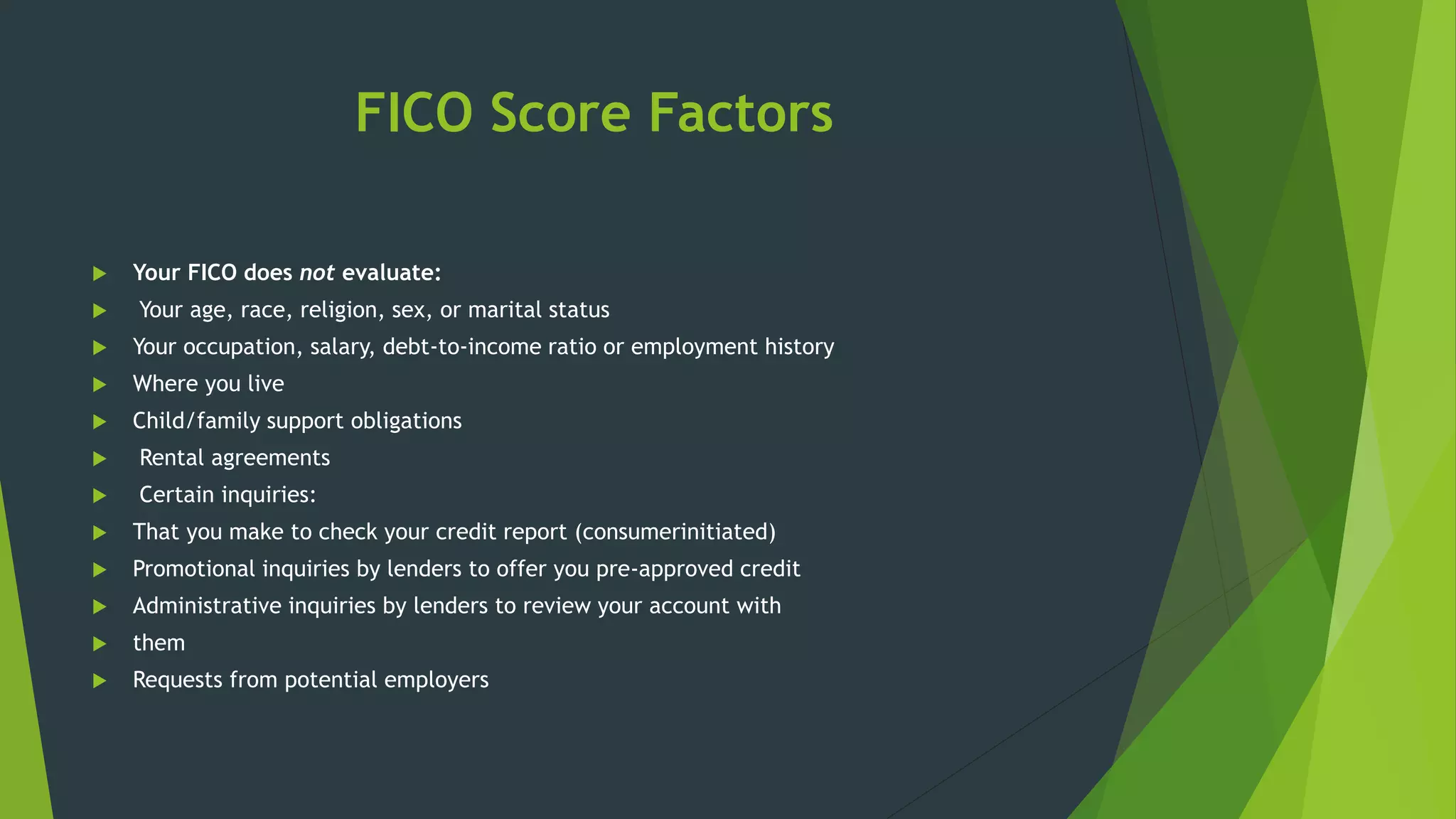
FICO Score Factors
 Your FICO does not evaluate:
 Your age, race, religion, sex, or marital status
 Your occupation, salary, debt-to-income ratio or employment history
 Where you live
 Child/family support obligations
 Rental agreements
 Certain inquiries:
 That you make to check your credit report (consumerinitiated)
 Promotional inquiries by lenders to offer you pre-approved credit
 Administrative inquiries by lenders to review your account with
 them
 Requests from potential employers
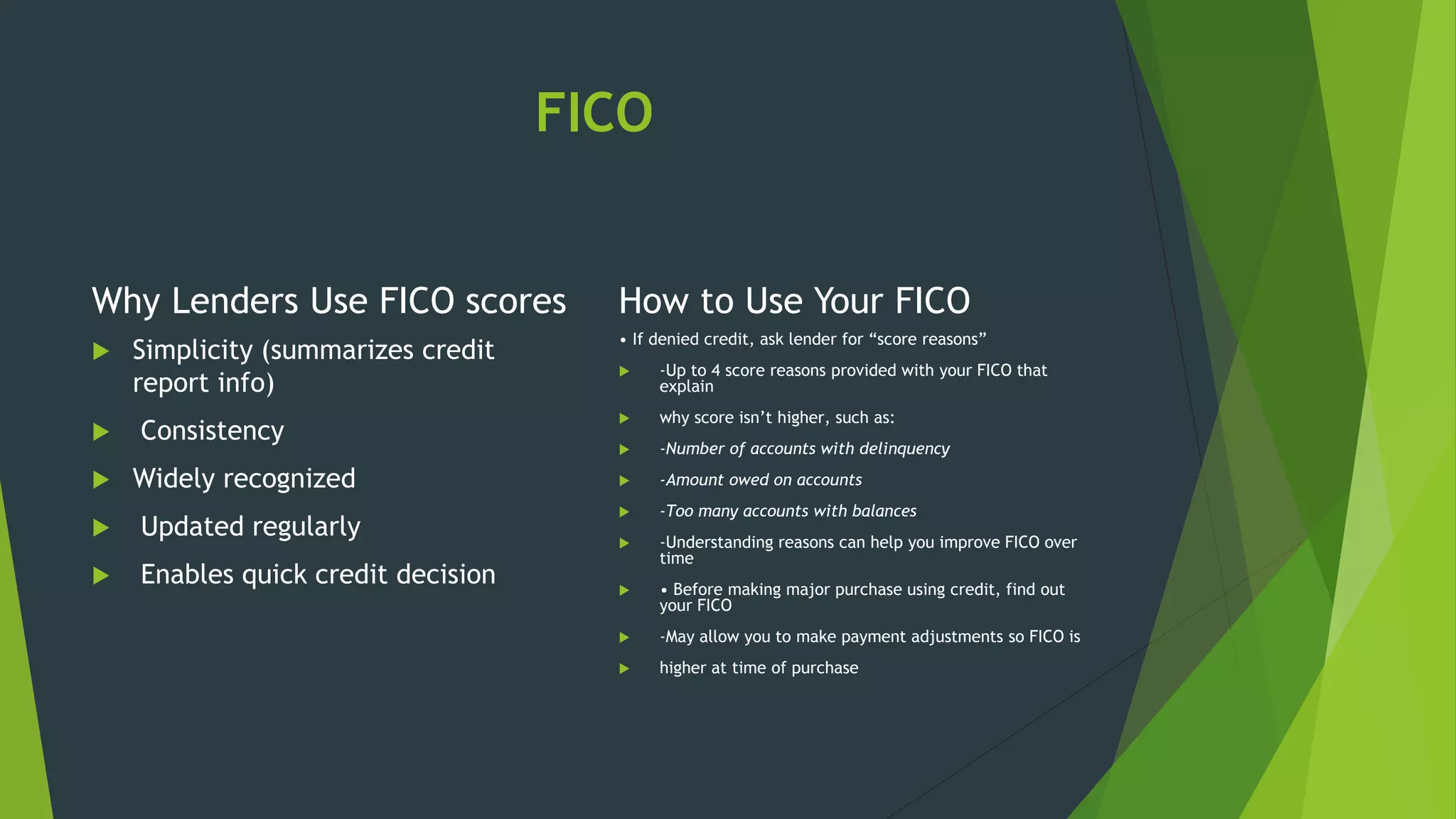
FICO
Why Lenders Use FICO scores
 Simplicity (summarizes credit
report info)
 Consistency
 Widely recognized
 Updated regularly
 Enables quick credit decision
How to Use Your FICO
• If denied credit, ask lender for “score reasons”
 -Up to 4 score reasons provided with your FICO that
explain
 why score isn’t higher, such as:
 -Number of accounts with delinquency
 -Amount owed on accounts
 -Too many accounts with balances
 -Understanding reasons can help you improve FICO over
time
 • Before making major purchase using credit, find out
your FICO
 -May allow you to make payment adjustments so FICO is
 higher at time of purchase
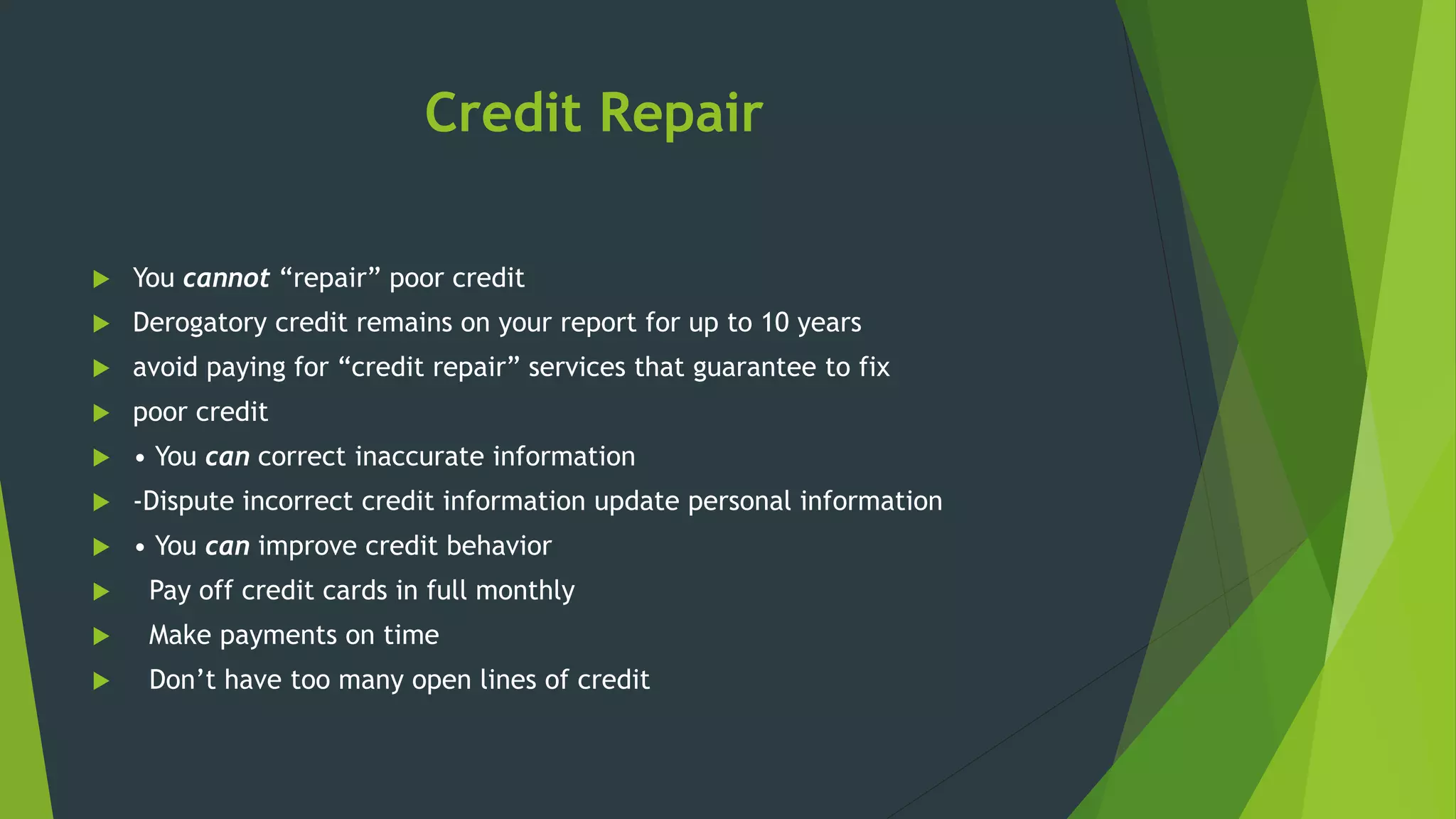
Credit Repair
 You cannot “repair” poor credit
 Derogatory credit remains on your report for up to 10 years
 avoid paying for “credit repair” services that guarantee to fix
 poor credit
 • You can correct inaccurate information
 -Dispute incorrect credit information update personal information
 • You can improve credit behavior
 Pay off credit cards in full monthly
 Make payments on time
 Don’t have too many open lines of credit
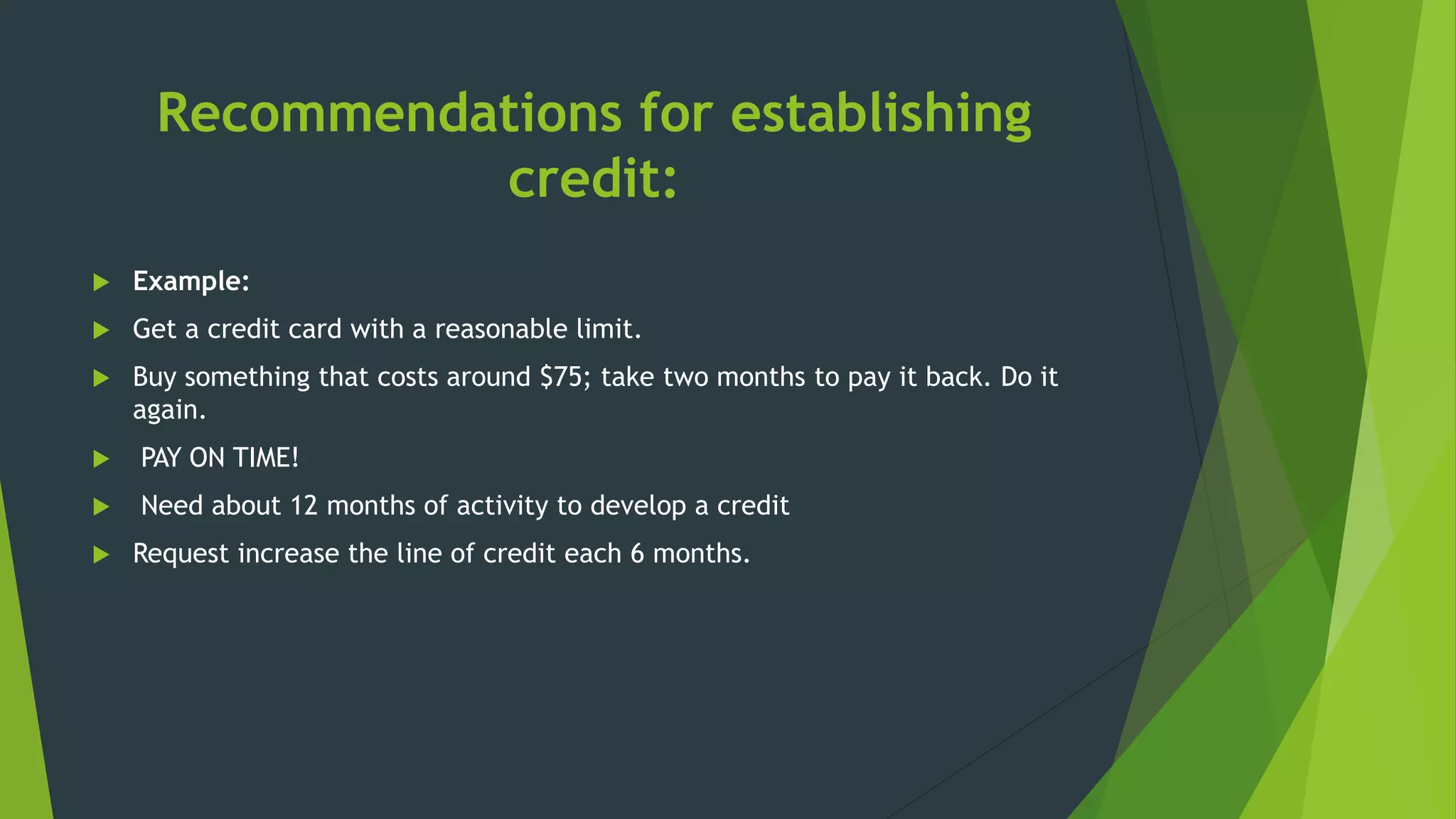
Recommendations for establishing
credit:
 Example:
 Get a credit card with a reasonable limit.
 Buy something that costs around $75; take two months to pay it back. Do it
again.
 PAY ON TIME!
 Need about 12 months of activity to develop a credit
 Request increase the line of credit each 6 months.
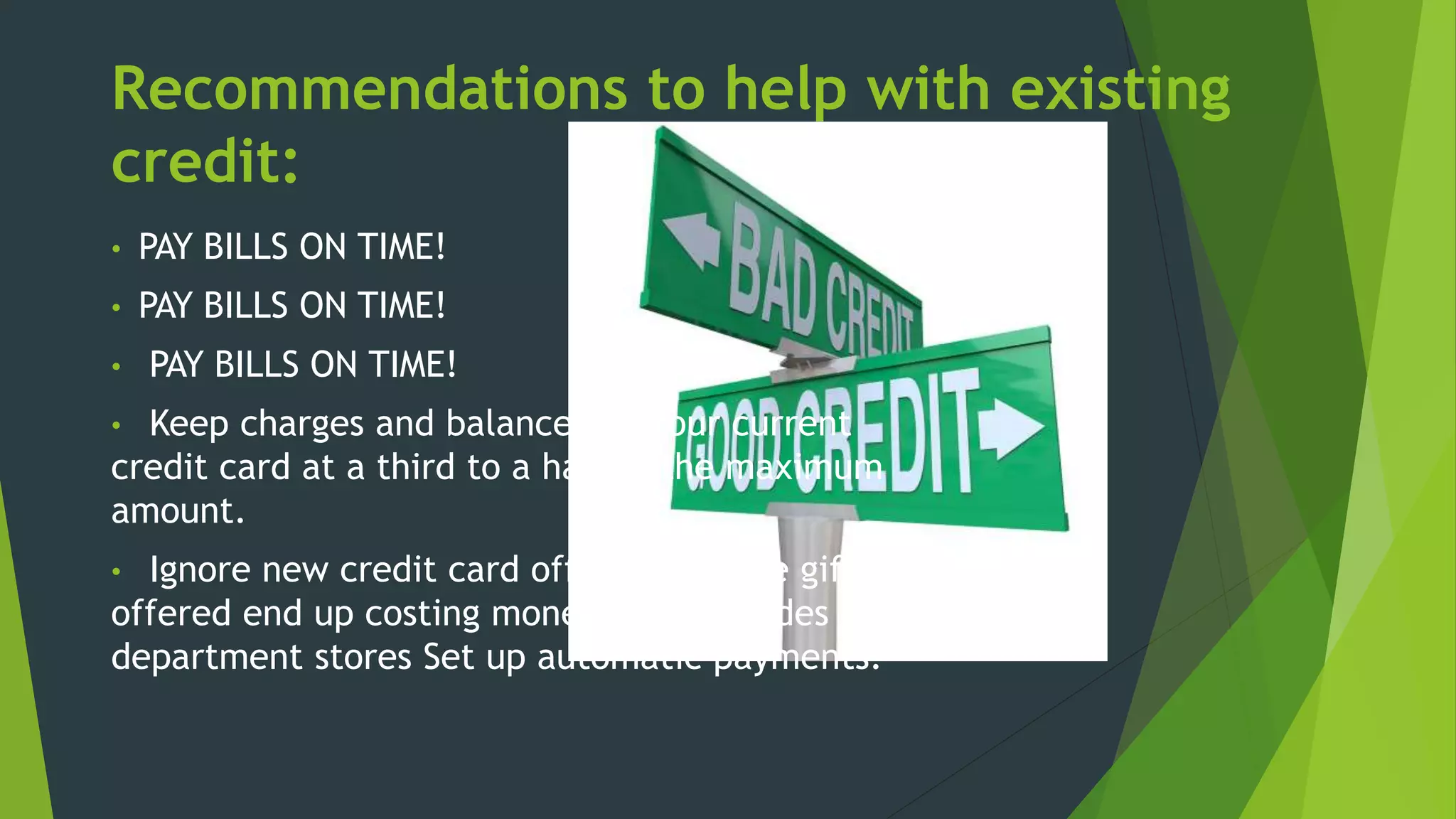
Recommendations to help with existing
credit:
• PAY BILLS ON TIME!
• Keep charges and balances on your current
credit card at a third to a half of the maximum
amount.
• Ignore new credit card offers. The free gifts
offered end up costing money. This includes
department stores Set up automatic payments.
Protecting Your Identity
• When you stop using a credit
card or bank account, formally
close it rather than letting it
become dormant.
• Ask for written confirmation.
• Know where your plastic is.
Inform your bank immediately
if you suspect your credit,
debit and ATM cards are lost or
stolen. Keep your card numbers
and contact info in a safe
place.
• Create passwords that are
difficult to crack. Never write
them down and keep them
with you.
Protecting your identity
 Be careful with old personal documents such as paid bills, bank statements,
and receipts. Shred personal documents you no longer need.
 Store your personal documents securely by keeping them out of sight from
visitors to your home. If your address changes, inform your bank, utility
companies, and everyone who sends you mail.
 Call 888-5OPTOUT (888-567-8688) to be removed from direct mailing lists.
Helpful Resources
 • Federal Trade Commission:
 www.consumer.gov/idtheft/
 • Identity Theft Resource Center:
 www.idtheftcenter.org
 • www.myfico.com
 • www.nationalscoreindex.com
 • www.annualcreditreport.com
 3 Major Credit Reporting Agencies:
 •Equifax 800-685-1111 www.equifax.com
 •Experian 888-397-3742 www.experian.com
 •TransUnion 800-888-4213 www.transunion.com
 Visit www.annualcreditreport.com for a free annual credit report
 Call, write, or access your report online. Report is free if denied credit in past 60 days or live in certain
states.
Information for this PowerPoint
 FTC
 Equifax
 Transunion
 www.consumer.gov
 Google.
“Bad credit is not a life sentence”
• Free consultation
Contacts : Jessica@hispanicsolutionsgroup.com
Spread the word! We’re here to help!
Referral Partners:
 Tax Preparers
 Immigration /Business Attorneys
 Bankers
 Real State Agent
 Loan Officers
 Financial Aid Consultants
 Social Workers
 Insurance Agents
Ideal Referral:
 New Immigrants
 DACA Beneficiaries
 Foreign Students
 People who don’t check credit
 Small Business owners.
 Families with children 14-20
 College Students
 People with Bad/No credit
 People who’ve been denied credit

Understanding your credit.

  • 1.
  • 2.
    Credit Report Purpose Provides a history of your credit use to current and prospective lenders.  Allows lenders to assess risk of extending credit or lending money to you  Used for all forms of credit, including private and PLUS student loans, apartment rental, etc.
  • 3.
    Credit Report Information •Information that is included: • Identifying info: your name (nickname), current & previous addresses, phone • number, ssn, date of birth, current & previous employers • Specific info about each credit account: date opened, credit limit/loan • amount, monthly payment & payment pattern • Public records: federal district bankruptcy, state & county tax liens, monetary • judgments • Credit inquiries: names of people/companies requesting your credit history • Statements of dispute: added only after official consumer dispute is filed, • investigated, and agreement between consumer & credit grantor cannot be reached
  • 4.
    Credit score  Whatis a Credit Score?  Summary of credit report info represented as single number,  based on mathematical calculation  Predicts future payment performance (risk to lender)  FICO (Fair, Isaac & Co.) most common score type  FICO’s range from 300 to 850; the higher the better  No single “cut-off” score used by all lenders to make credit decisions  Scores are fluid - recalculated each inquiry  Not physically stored on credit report, but may be requested  Credit Score Factors  Payment History – 35%  Delinquent payments can have a major negative impact on scoring.  Amount Owed – 30%  Higher credit utilization will negatively impact credit score.  Length of Credit History – 15%  The longer the history, the higher the score.  New Credit – 10%  High number of inquiries in 12 month period.  Type of Credit Used – 10%  Higher percentage of secured  Credit
  • 5.
    FICO Score Factors Your FICO does not evaluate:  Your age, race, religion, sex, or marital status  Your occupation, salary, debt-to-income ratio or employment history  Where you live  Child/family support obligations  Rental agreements  Certain inquiries:  That you make to check your credit report (consumerinitiated)  Promotional inquiries by lenders to offer you pre-approved credit  Administrative inquiries by lenders to review your account with  them  Requests from potential employers
  • 6.
    FICO Why Lenders UseFICO scores  Simplicity (summarizes credit report info)  Consistency  Widely recognized  Updated regularly  Enables quick credit decision How to Use Your FICO • If denied credit, ask lender for “score reasons”  -Up to 4 score reasons provided with your FICO that explain  why score isn’t higher, such as:  -Number of accounts with delinquency  -Amount owed on accounts  -Too many accounts with balances  -Understanding reasons can help you improve FICO over time  • Before making major purchase using credit, find out your FICO  -May allow you to make payment adjustments so FICO is  higher at time of purchase
  • 7.
    Credit Repair  Youcannot “repair” poor credit  Derogatory credit remains on your report for up to 10 years  avoid paying for “credit repair” services that guarantee to fix  poor credit  • You can correct inaccurate information  -Dispute incorrect credit information update personal information  • You can improve credit behavior  Pay off credit cards in full monthly  Make payments on time  Don’t have too many open lines of credit
  • 8.
    Recommendations for establishing credit: Example:  Get a credit card with a reasonable limit.  Buy something that costs around $75; take two months to pay it back. Do it again.  PAY ON TIME!  Need about 12 months of activity to develop a credit  Request increase the line of credit each 6 months.
  • 9.
    Recommendations to helpwith existing credit: • PAY BILLS ON TIME! • PAY BILLS ON TIME! • PAY BILLS ON TIME! • Keep charges and balances on your current credit card at a third to a half of the maximum amount. • Ignore new credit card offers. The free gifts offered end up costing money. This includes department stores Set up automatic payments.
  • 10.
    Protecting Your Identity •When you stop using a credit card or bank account, formally close it rather than letting it become dormant. • Ask for written confirmation. • Know where your plastic is. Inform your bank immediately if you suspect your credit, debit and ATM cards are lost or stolen. Keep your card numbers and contact info in a safe place. • Create passwords that are difficult to crack. Never write them down and keep them with you.
  • 11.
    Protecting your identity Be careful with old personal documents such as paid bills, bank statements, and receipts. Shred personal documents you no longer need.  Store your personal documents securely by keeping them out of sight from visitors to your home. If your address changes, inform your bank, utility companies, and everyone who sends you mail.  Call 888-5OPTOUT (888-567-8688) to be removed from direct mailing lists.
  • 12.
    Helpful Resources  •Federal Trade Commission:  www.consumer.gov/idtheft/  • Identity Theft Resource Center:  www.idtheftcenter.org  • www.myfico.com  • www.nationalscoreindex.com  • www.annualcreditreport.com  3 Major Credit Reporting Agencies:  •Equifax 800-685-1111 www.equifax.com  •Experian 888-397-3742 www.experian.com  •TransUnion 800-888-4213 www.transunion.com  Visit www.annualcreditreport.com for a free annual credit report  Call, write, or access your report online. Report is free if denied credit in past 60 days or live in certain states.
  • 13.
    Information for thisPowerPoint  FTC  Equifax  Transunion  www.consumer.gov  Google.
  • 14.
    “Bad credit isnot a life sentence” • Free consultation Contacts : Jessica@hispanicsolutionsgroup.com
  • 15.
    Spread the word!We’re here to help! Referral Partners:  Tax Preparers  Immigration /Business Attorneys  Bankers  Real State Agent  Loan Officers  Financial Aid Consultants  Social Workers  Insurance Agents Ideal Referral:  New Immigrants  DACA Beneficiaries  Foreign Students  People who don’t check credit  Small Business owners.  Families with children 14-20  College Students  People with Bad/No credit  People who’ve been denied credit