PROJECT OUTLINE
Throughout this presentation we will
be covering the necessary steps to
memorize multiplication skills.
These are very important basic
skills that students must fully
comprehend before moving on to
future lessons.
OBJECTIVE
You have to ask yourself what
exactly do you want your students
to get out of a specific lesson or
activity?
• The objective of this lesson/
tutorial will be that by the end of
the presentation students will be
able to memorize multiplication
skills of the 6,7, 8 and 9 families.
GOAL
Students will have a general
understanding of multiplication facts
using rhymes and song patterns.
Goals aren’t as specific as the objective
stated at the beginning of the lesson, it
is often just an overall idea of what
should be learned.
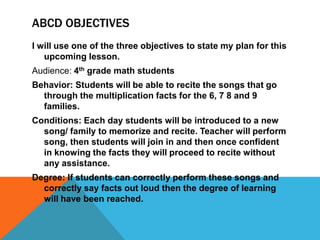
ABCD OBJECTIVES
I will use one of the three objectives to state my plan for this
upcoming lesson.
Audience: 4th grade math students
Behavior: Students will be able to recite the songs that go
through the multiplication facts for the 6, 7 8 and 9
families.
Conditions: Each day students will be introduced to a new
song/ family to memorize and recite. Teacher will perform
song, then students will join in and then once confident
in knowing the facts they will proceed to recite without
any assistance.
Degree: If students can correctly perform these songs and
correctly say facts out loud then the degree of learning
will have been reached.
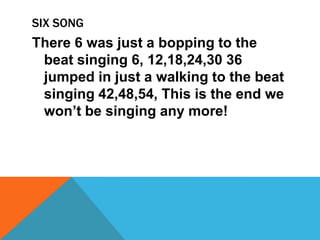
SIX SONG
There 6 was just a bopping to the
beat singing 6, 12,18,24,30 36
jumped in just a walking to the beat
singing 42,48,54, This is the end we
won’t be singing any more!
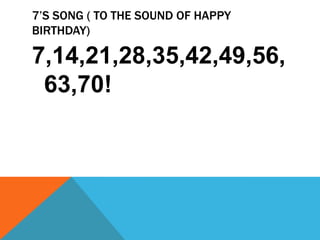
7’S SONG ( TO THE SOUND OF HAPPY
BIRTHDAY)
7,14,21,28,35,42,49,56,
63,70!
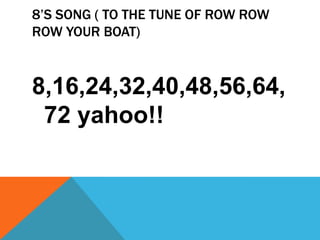
8’S SONG ( TO THE TUNE OF ROW ROW
ROW YOUR BOAT)
8,16,24,32,40,48,56,64,
72 yahoo!!
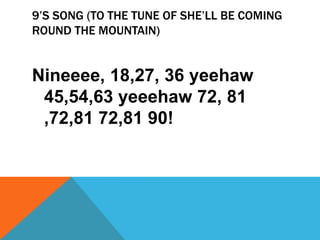
9’S SONG (TO THE TUNE OF SHE’LL BE COMING
ROUND THE MOUNTAIN)
Nineeee, 18,27, 36 yeehaw
45,54,63 yeeehaw 72, 81
,72,81 72,81 90!
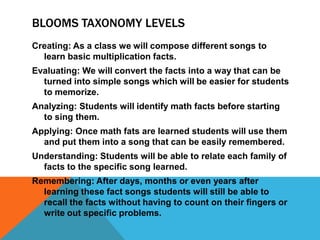
BLOOMS TAXONOMY LEVELS
Creating: As a class we will compose different songs to
learn basic multiplication facts.
Evaluating: We will convert the facts into a way that can be
turned into simple songs which will be easier for students
to memorize.
Analyzing: Students will identify math facts before starting
to sing them.
Applying: Once math fats are learned students will use them
and put them into a song that can be easily remembered.
Understanding: Students will be able to relate each family of
facts to the specific song learned.
Remembering: After days, months or even years after
learning these fact songs students will still be able to
recall the facts without having to count on their fingers or
write out specific problems.
WRAP UP
As this lesson might not seem very in depth with a
specific learning sequence it s something that I
still remember to this day. I learned these facts
in 4th grade and still find myself humming along
to the number songs if I ever need to double
check my answers. I think that incorporating
songs and fun activities to learn important skills
is a great way to use Bloom’s taxonomy and to
understand what objectives and goals are for
the students. The more interactive a lesson can
be I believe the more the student will take from
it.

332 2.2

  • 2.
    PROJECT OUTLINE Throughout thispresentation we will be covering the necessary steps to memorize multiplication skills. These are very important basic skills that students must fully comprehend before moving on to future lessons.
  • 3.
    OBJECTIVE You have toask yourself what exactly do you want your students to get out of a specific lesson or activity? • The objective of this lesson/ tutorial will be that by the end of the presentation students will be able to memorize multiplication skills of the 6,7, 8 and 9 families.
  • 4.
    GOAL Students will havea general understanding of multiplication facts using rhymes and song patterns. Goals aren’t as specific as the objective stated at the beginning of the lesson, it is often just an overall idea of what should be learned.
  • 5.
    ABCD OBJECTIVES I willuse one of the three objectives to state my plan for this upcoming lesson. Audience: 4th grade math students Behavior: Students will be able to recite the songs that go through the multiplication facts for the 6, 7 8 and 9 families. Conditions: Each day students will be introduced to a new song/ family to memorize and recite. Teacher will perform song, then students will join in and then once confident in knowing the facts they will proceed to recite without any assistance. Degree: If students can correctly perform these songs and correctly say facts out loud then the degree of learning will have been reached.
  • 6.
    SIX SONG There 6was just a bopping to the beat singing 6, 12,18,24,30 36 jumped in just a walking to the beat singing 42,48,54, This is the end we won’t be singing any more!
  • 7.
    7’S SONG (TO THE SOUND OF HAPPY BIRTHDAY) 7,14,21,28,35,42,49,56, 63,70!
  • 8.
    8’S SONG (TO THE TUNE OF ROW ROW ROW YOUR BOAT) 8,16,24,32,40,48,56,64, 72 yahoo!!
  • 9.
    9’S SONG (TOTHE TUNE OF SHE’LL BE COMING ROUND THE MOUNTAIN) Nineeee, 18,27, 36 yeehaw 45,54,63 yeeehaw 72, 81 ,72,81 72,81 90!
  • 10.
    BLOOMS TAXONOMY LEVELS Creating:As a class we will compose different songs to learn basic multiplication facts. Evaluating: We will convert the facts into a way that can be turned into simple songs which will be easier for students to memorize. Analyzing: Students will identify math facts before starting to sing them. Applying: Once math fats are learned students will use them and put them into a song that can be easily remembered. Understanding: Students will be able to relate each family of facts to the specific song learned. Remembering: After days, months or even years after learning these fact songs students will still be able to recall the facts without having to count on their fingers or write out specific problems.
  • 11.
    WRAP UP As thislesson might not seem very in depth with a specific learning sequence it s something that I still remember to this day. I learned these facts in 4th grade and still find myself humming along to the number songs if I ever need to double check my answers. I think that incorporating songs and fun activities to learn important skills is a great way to use Bloom’s taxonomy and to understand what objectives and goals are for the students. The more interactive a lesson can be I believe the more the student will take from it.