Dynamic Resource Allocation Using
Virtual Machines For Cloud
Computing Environment
ABSTRACT
Cloud computing allows business customers to scale up and down their
resource usage based on needs. Many of the touted gains in the cloud model
come from resource multiplexing through virtualization technology. In this
paper, we present a system that uses virtualization technology to allocate data
center resources dynamically based on application demands and support green
computing by optimizing the number of servers in use. We introduce the concept
of “skewness” to measure the unevenness in the multi-dimensional resource
utilization of a server. By minimizing skewness, we can combine different types
of workloads nicely and improve the overall utilization of server resources. We
develop a set of heuristics that prevent overload in the system effectively while
saving energy used. Trace driven simulation and experiment results demonstrate
that our algorithm achieves good performance.
EXISTING SYSTEM
Virtual machine monitors (VMMs) like Xen provide a mechanism for mapping
virtual machines (VMs) to physical resources. This mapping is largely hidden
from the cloud users. Users with the Amazon EC2 service [4], for example, do
not know where their VM instances run. It is up to the cloud provider to make
sure the underlying physical machines (PMs) have sufficient resources to meet
their needs. VM live migration technology makes it possible to change the
mapping between VMs and PMs while applications are running.
PROPOSED SYSTEM:
In this paper, we present the design and implementation of an automated
resource management system that achieves a good balance between the two goal:
• Overload avoidance: the capacity of a PM should be sufficient to satisfy
the resource needs of all VMs running on it. Otherwise, the PM is
overloaded and can lead to degraded performance of its VMs.
• Green computing: the number of PMs used should be minimized as long
as they can still satisfy the needs of all VMs. Idle PMs can be turned off to
save energy.
Advantage of Proposed System:
• We develop a resource allocation system that can avoid overload in the
system effectively while minimizing the number of servers used.
• We introduce the concept of “skewness” to measure the uneven
utilization of a server. By minimizing skewness, we can improve the
overall utilization of servers in the face of multi-dimensional resource
constraints.
•
MODULE DESCRIPTION:
Number of Modules
After careful analysis the system has been identified to have the following modules:
1. Cloud Computing Module.
2. Resource Management Module.
3. Virtualization Module.
4. Green Computing Module.
1.Cloud Computing Module:
Cloud computing refers to applications and services offered over the Internet.
These services are offered from data centers all over the world, which collectively
are referred to as the "cloud." Cloud computing is a movement away from
applications needing to be installed on an individual's computer towards the
applications being hosted online. Cloud resources are usually not only shared by
multiple users but as well as dynamically re-allocated as per demand. This can
work for allocating resources to users in different time zones.
2. Resource Management Module:
Dynamic resource management has become an active area of research in the
Cloud Computing paradigm. Cost of resources varies significantly depending on
configuration for using them. Hence efficient management of resources is of
prime interest to both Cloud Providers and Cloud Users. The success of any
cloud management software critically de-pends on the flexibility; scale and
efficiency with which it can utilize the underlying hardware resources while pro-
viding necessary performance isolation. Successful resource management
solution for cloud environments, needs to provide a rich set of resource controls
for better isolation, while doing initial placement and load balancing for efficient
utilization of underlying resources.
3. Virtualization Module:
Virtualization, in computing, is the creation of a virtual (rather than actual)
Version of something, such as a hardware platform, operating system, and a
storage device or network resources.VM live migration is a widely used
technique for dynamic resource allocation in a virtualized environment. The
process of running two or more logical computer system so on one set of
physical hardware. Dynamic placement of virtual servers to minimize SLA
violations.
4. GreenComputing Module:
Many efforts have been made to curtail energy consumption. Hardware based
approaches include novel thermal design for lower cooling power, or adopting
power-proportional and low-power hardware. Dynamic Voltage and Frequency
Scaling (DVFS) to adjust CPU power according to its load in data centers. Our
work belongs to the category of pure-software low-cost Solutions. It requires that
the desktop is virtualized with shared storage. Green computing ensures end
user satisfaction, regulatory compliance, telecommuting, virtualization of server
resources.
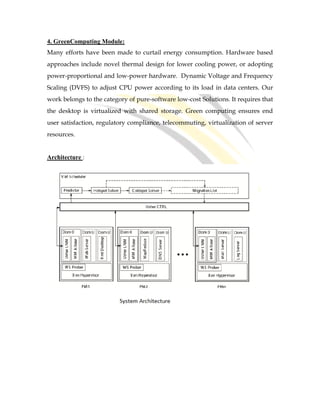
Architecture :
SOFTWARE REQUIREMENTS:
Operating System : Windows
Technology : Java and J2SE
IDE : My Eclipse
Database : My SQL
Java Version : J2SDK1.5
HARDWARE REQUIREMENTS:
Hardware : Pentium
Speed : 1.1 GHz
RAM : 1GB
Hard Disk : 20 GB
Floppy Drive : 1.44 MB
Key Board : Standard Windows Keyboard
Mouse : Two or Three Button Mouse
Monitor : SVGA

33. dynamic resource allocation using virtual machines

  • 1.
    Dynamic Resource AllocationUsing Virtual Machines For Cloud Computing Environment ABSTRACT Cloud computing allows business customers to scale up and down their resource usage based on needs. Many of the touted gains in the cloud model come from resource multiplexing through virtualization technology. In this paper, we present a system that uses virtualization technology to allocate data center resources dynamically based on application demands and support green computing by optimizing the number of servers in use. We introduce the concept of “skewness” to measure the unevenness in the multi-dimensional resource utilization of a server. By minimizing skewness, we can combine different types of workloads nicely and improve the overall utilization of server resources. We develop a set of heuristics that prevent overload in the system effectively while saving energy used. Trace driven simulation and experiment results demonstrate that our algorithm achieves good performance. EXISTING SYSTEM Virtual machine monitors (VMMs) like Xen provide a mechanism for mapping virtual machines (VMs) to physical resources. This mapping is largely hidden from the cloud users. Users with the Amazon EC2 service [4], for example, do not know where their VM instances run. It is up to the cloud provider to make sure the underlying physical machines (PMs) have sufficient resources to meet their needs. VM live migration technology makes it possible to change the mapping between VMs and PMs while applications are running.
  • 2.
    PROPOSED SYSTEM: In thispaper, we present the design and implementation of an automated resource management system that achieves a good balance between the two goal: • Overload avoidance: the capacity of a PM should be sufficient to satisfy the resource needs of all VMs running on it. Otherwise, the PM is overloaded and can lead to degraded performance of its VMs. • Green computing: the number of PMs used should be minimized as long as they can still satisfy the needs of all VMs. Idle PMs can be turned off to save energy. Advantage of Proposed System: • We develop a resource allocation system that can avoid overload in the system effectively while minimizing the number of servers used. • We introduce the concept of “skewness” to measure the uneven utilization of a server. By minimizing skewness, we can improve the overall utilization of servers in the face of multi-dimensional resource constraints. • MODULE DESCRIPTION: Number of Modules After careful analysis the system has been identified to have the following modules: 1. Cloud Computing Module. 2. Resource Management Module. 3. Virtualization Module. 4. Green Computing Module.
  • 3.
    1.Cloud Computing Module: Cloudcomputing refers to applications and services offered over the Internet. These services are offered from data centers all over the world, which collectively are referred to as the "cloud." Cloud computing is a movement away from applications needing to be installed on an individual's computer towards the applications being hosted online. Cloud resources are usually not only shared by multiple users but as well as dynamically re-allocated as per demand. This can work for allocating resources to users in different time zones. 2. Resource Management Module: Dynamic resource management has become an active area of research in the Cloud Computing paradigm. Cost of resources varies significantly depending on configuration for using them. Hence efficient management of resources is of prime interest to both Cloud Providers and Cloud Users. The success of any cloud management software critically de-pends on the flexibility; scale and efficiency with which it can utilize the underlying hardware resources while pro- viding necessary performance isolation. Successful resource management solution for cloud environments, needs to provide a rich set of resource controls for better isolation, while doing initial placement and load balancing for efficient utilization of underlying resources. 3. Virtualization Module: Virtualization, in computing, is the creation of a virtual (rather than actual) Version of something, such as a hardware platform, operating system, and a storage device or network resources.VM live migration is a widely used technique for dynamic resource allocation in a virtualized environment. The process of running two or more logical computer system so on one set of physical hardware. Dynamic placement of virtual servers to minimize SLA violations.
  • 4.
    4. GreenComputing Module: Manyefforts have been made to curtail energy consumption. Hardware based approaches include novel thermal design for lower cooling power, or adopting power-proportional and low-power hardware. Dynamic Voltage and Frequency Scaling (DVFS) to adjust CPU power according to its load in data centers. Our work belongs to the category of pure-software low-cost Solutions. It requires that the desktop is virtualized with shared storage. Green computing ensures end user satisfaction, regulatory compliance, telecommuting, virtualization of server resources. Architecture :
  • 5.
    SOFTWARE REQUIREMENTS: Operating System: Windows Technology : Java and J2SE IDE : My Eclipse Database : My SQL Java Version : J2SDK1.5 HARDWARE REQUIREMENTS: Hardware : Pentium Speed : 1.1 GHz RAM : 1GB Hard Disk : 20 GB Floppy Drive : 1.44 MB Key Board : Standard Windows Keyboard Mouse : Two or Three Button Mouse Monitor : SVGA