PROJECT MANAGEMENT PROFESSIONAL
PMI® PMPSM
CERTIFICATION
PMBOK 5TH EDITION
Training Demo
Xellentro Consulting Services LLP
Demo Program
Agenda
Agenda
 About Xellentro
 About Trainer
 Subject Matter – First Chapter
 Course Details
 How to Contact
 Clients / Testimonials
About Xellentro
 An emerging global provider of project, program and portfolio
management consulting and training services.
 Established in 2012, with Headquarters in Bangalore, India
 Working closely with clients to tackle their most difficult
organizational development challenges and competency
building.
 Classroom Training, Virtual classes and Online courses
 Trainers with hands-on implementation experience of more than
10 years and with extensive training experience
 100% of people pass in first shot
The Coach
Niladri has -
 25+ years of experience in consulting and training
 Consultant in areas of Project Portfolio
Management, Project Management,
PMO setup, IT Governance, Business
Operations improvement
 Certifications- PMP, PRINCE2 Practitioner,
Management of Portfolio Practitioner,
ITIL Expert, COBIT 5 and Lean Six Sigma
Green Belt. Strong knowledge of PMI-ACP
Certification
 A PhD in Project Management and
 MBA in Operations Research
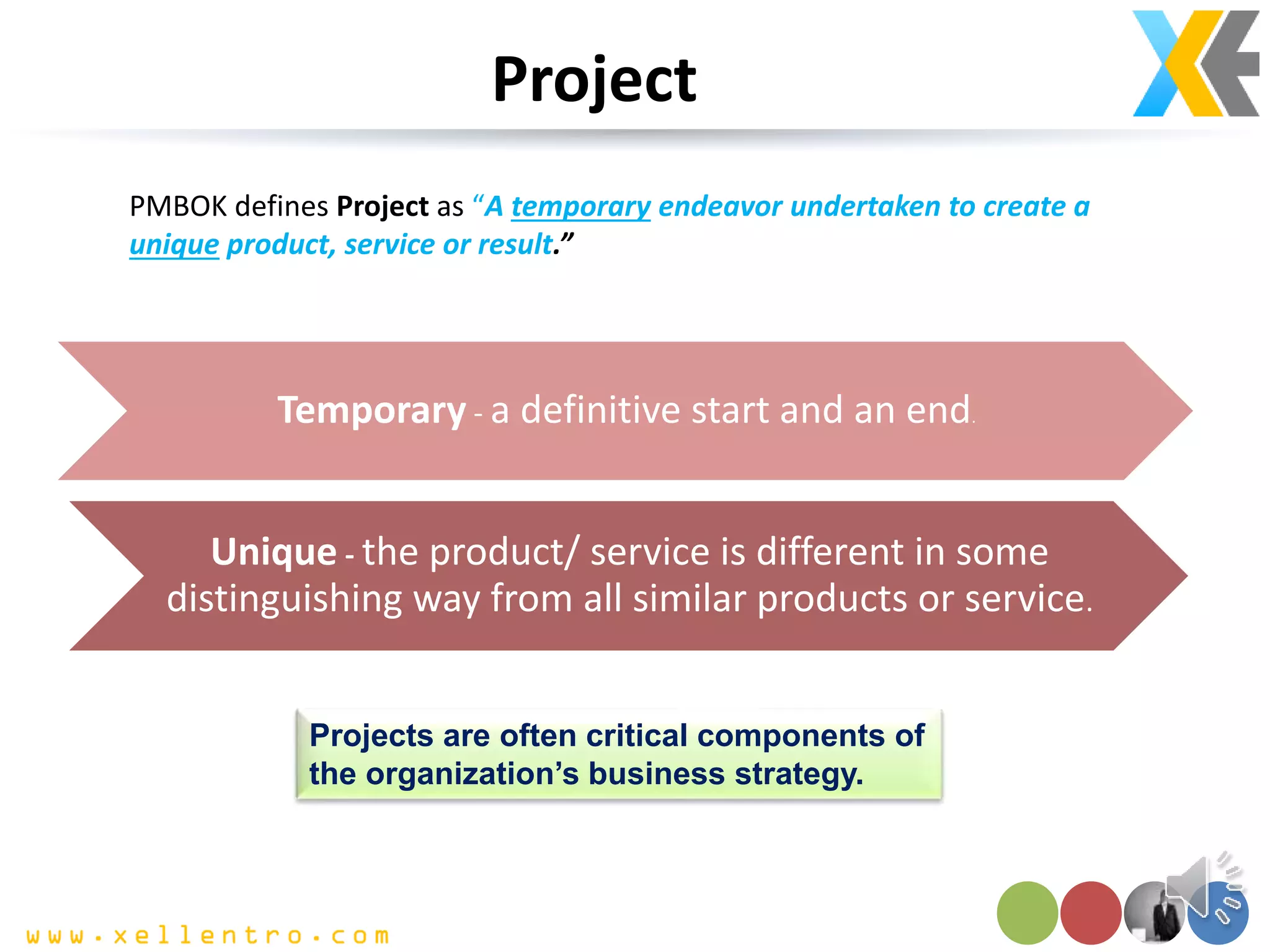
Project
Temporary - a definitive start and an end.
Unique - the product/ service is different in some
distinguishing way from all similar products or service.
PMBOK defines Project as “A temporary endeavor undertaken to create a
unique product, service or result.”
Projects are often critical components of
the organization’s business strategy.
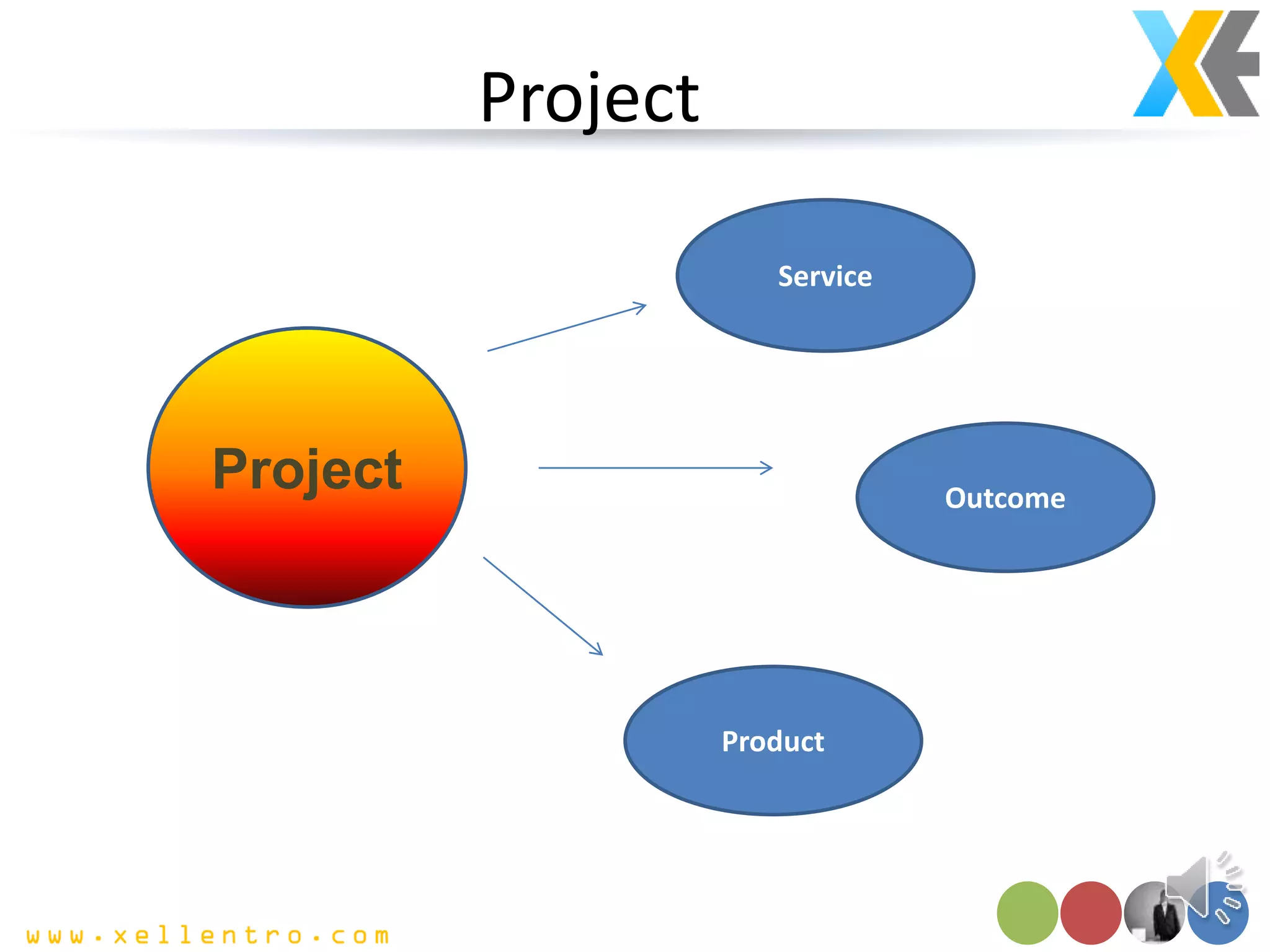
Project
Outcome
Project
Service
Product
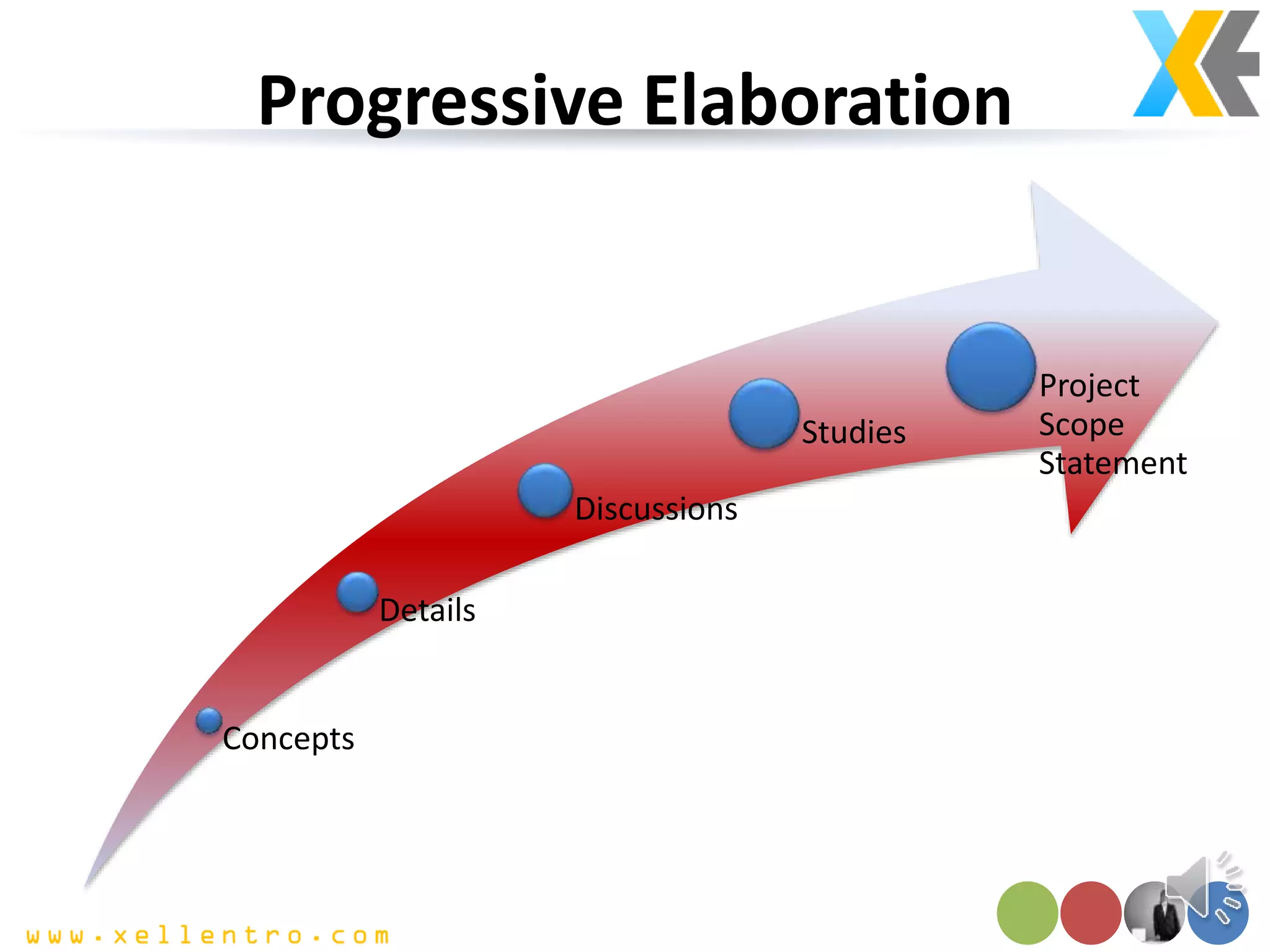
Progressive Elaboration
Concepts
Details
Discussions
Studies
Project
Scope
Statement
Project Management
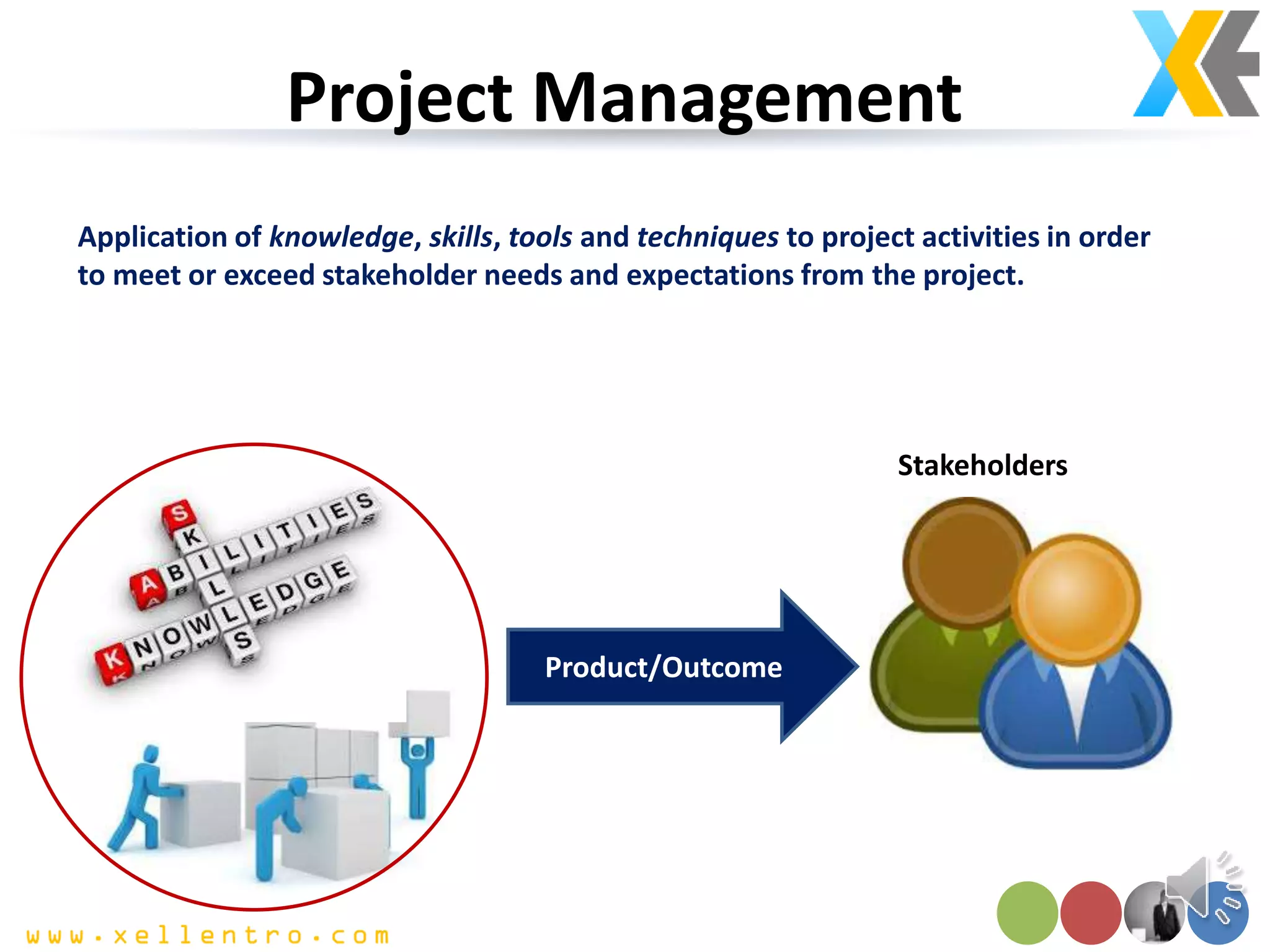
Application of knowledge, skills, tools and techniques to project activities in order
to meet or exceed stakeholder needs and expectations from the project.
Stakeholders
Product/Outcome
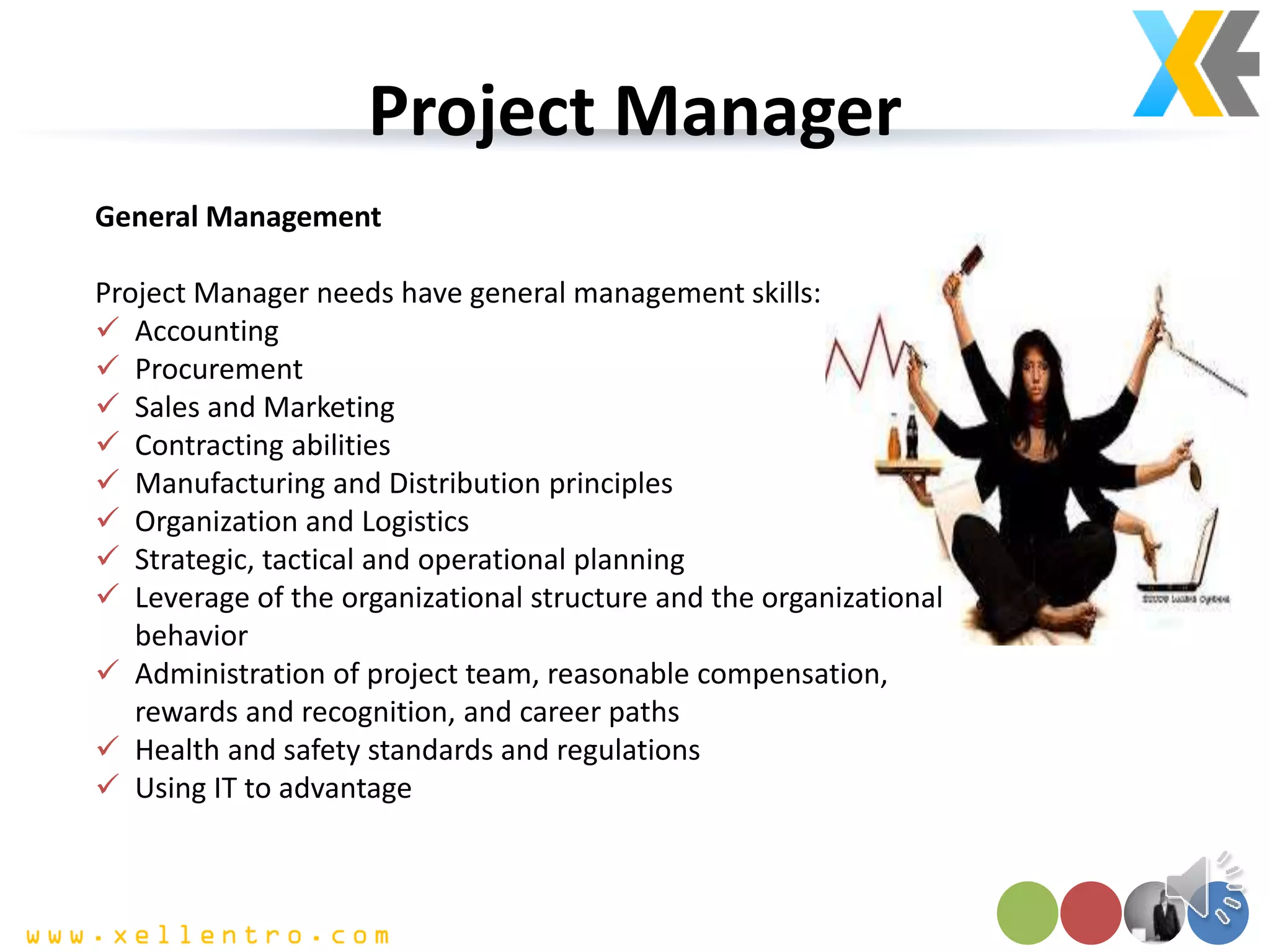
Project Manager
General Management
Project Manager needs have general management skills:
 Accounting
 Procurement
 Sales and Marketing
 Contracting abilities
 Manufacturing and Distribution principles
 Organization and Logistics
 Strategic, tactical and operational planning
 Leverage of the organizational structure and the organizational
behavior
 Administration of project team, reasonable compensation,
rewards and recognition, and career paths
 Health and safety standards and regulations
 Using IT to advantage
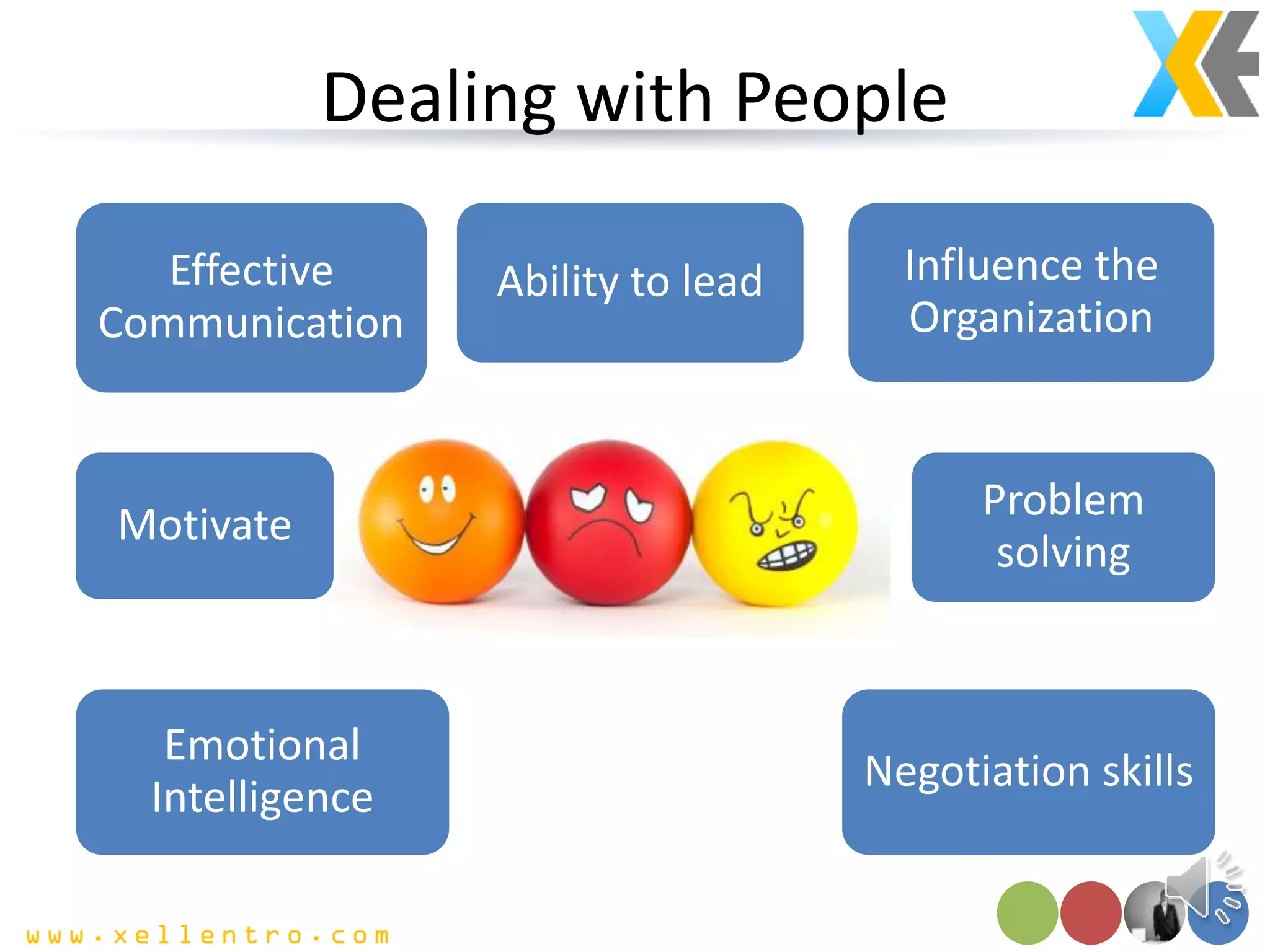
Dealing with People
Motivate
Effective
Communication
Negotiation skills
Influence the
Organization
Ability to lead
Problem
solving
Emotional
Intelligence
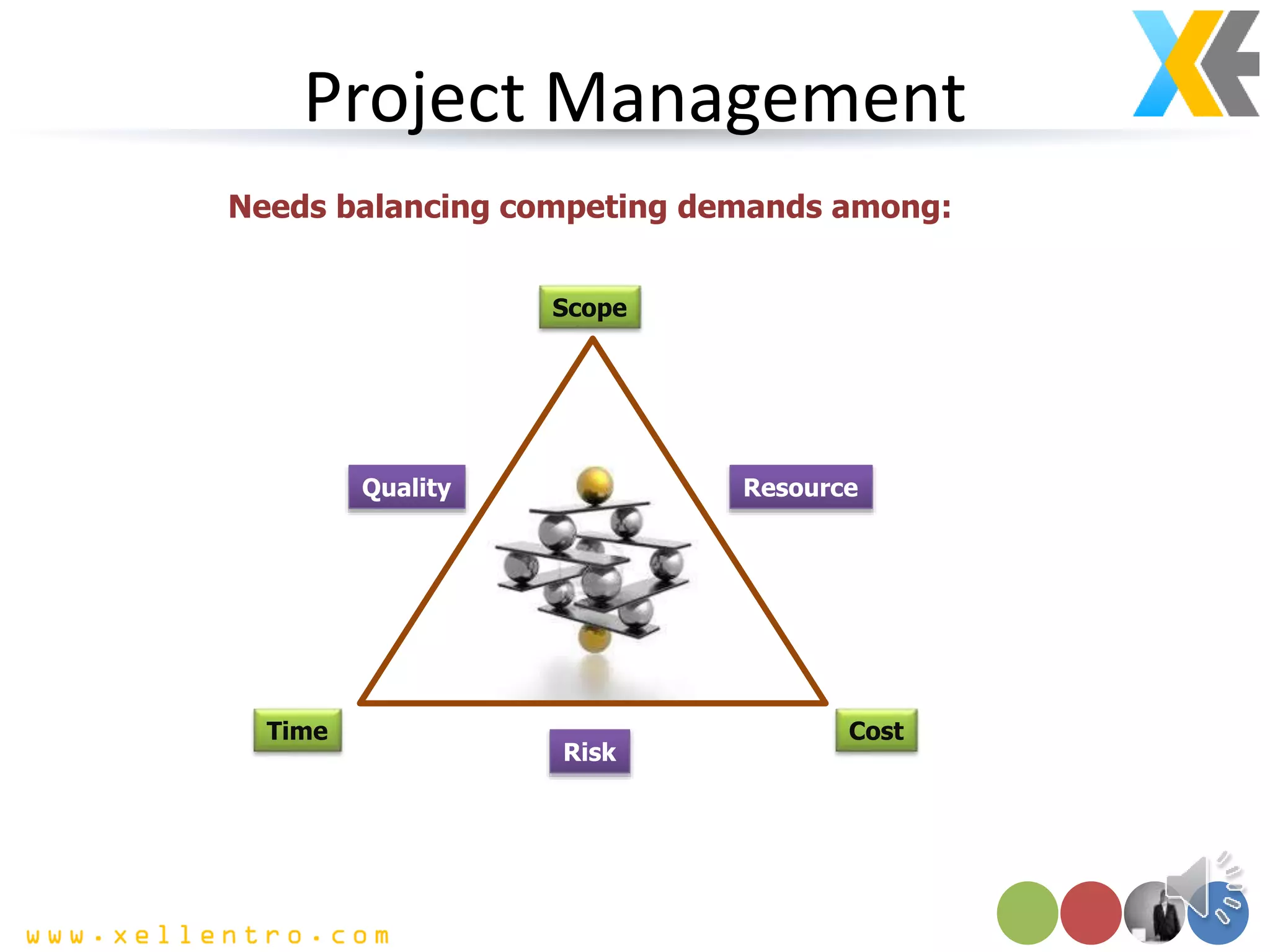
Project Management
Needs balancing competing demands among:
Resource
Quality
Scope
Cost
Time
Risk
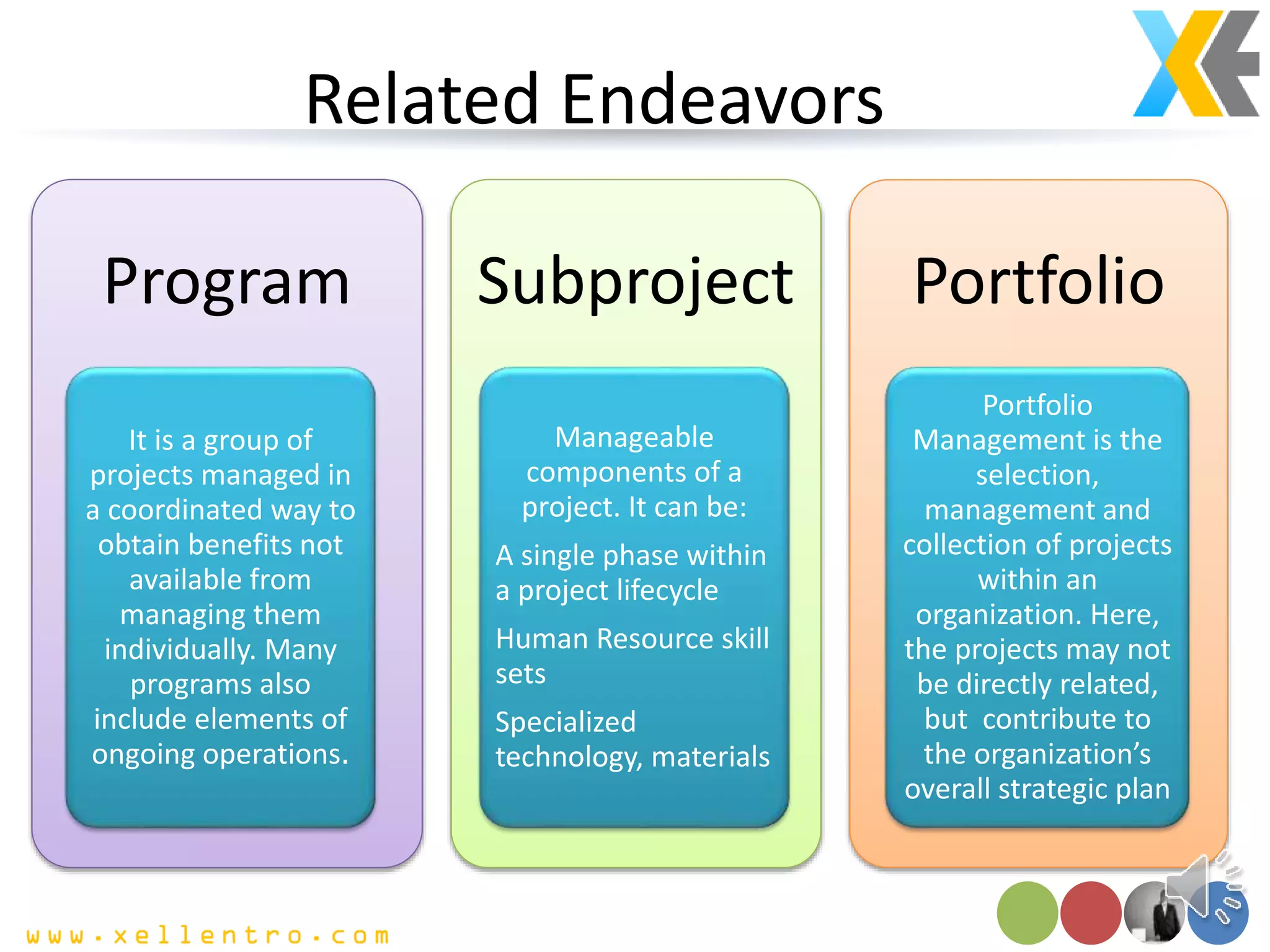
Related Endeavors
Program
It is a group of
projects managed in
a coordinated way to
obtain benefits not
available from
managing them
individually. Many
programs also
include elements of
ongoing operations.
Subproject
Manageable
components of a
project. It can be:
A single phase within
a project lifecycle
Human Resource skill
sets
Specialized
technology, materials
Portfolio
Portfolio
Management is the
selection,
management and
collection of projects
within an
organization. Here,
the projects may not
be directly related,
but contribute to
the organization’s
overall strategic plan
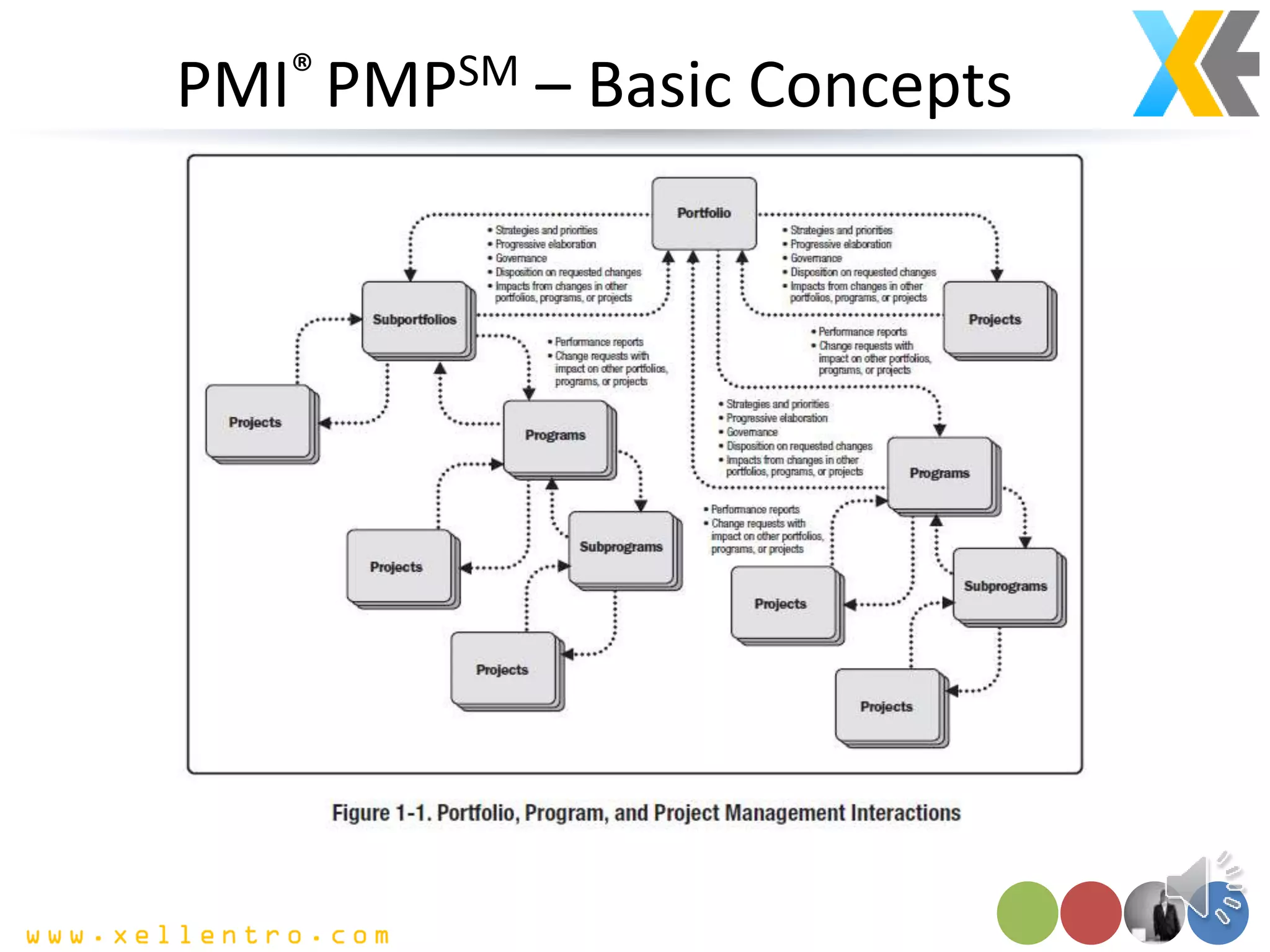
PMI® PMPSM – Basic Concepts
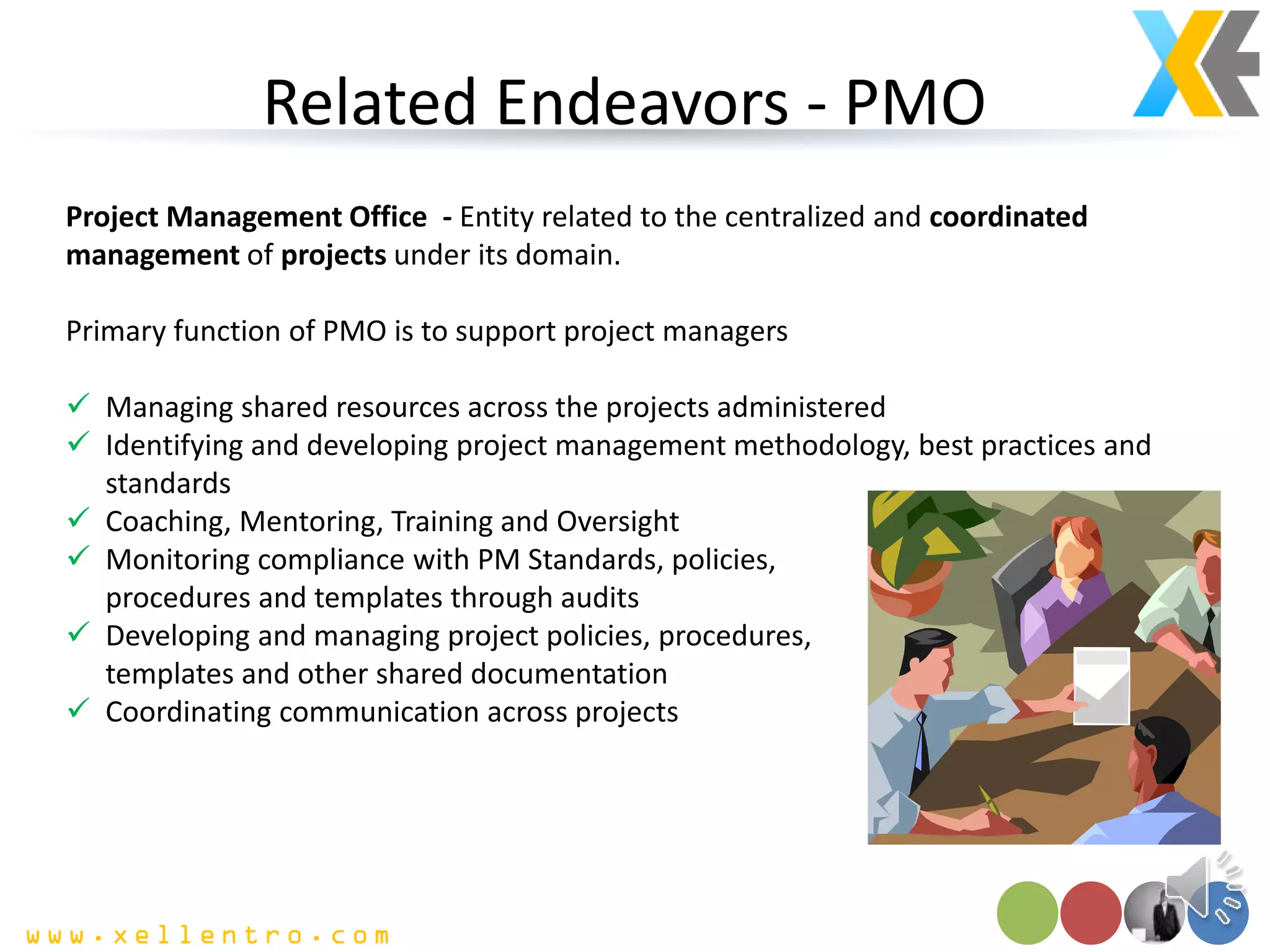
Related Endeavors - PMO
Project Management Office - Entity related to the centralized and coordinated
management of projects under its domain.
Primary function of PMO is to support project managers
 Managing shared resources across the projects administered
 Identifying and developing project management methodology, best practices and
standards
 Coaching, Mentoring, Training and Oversight
 Monitoring compliance with PM Standards, policies,
procedures and templates through audits
 Developing and managing project policies, procedures,
templates and other shared documentation
 Coordinating communication across projects
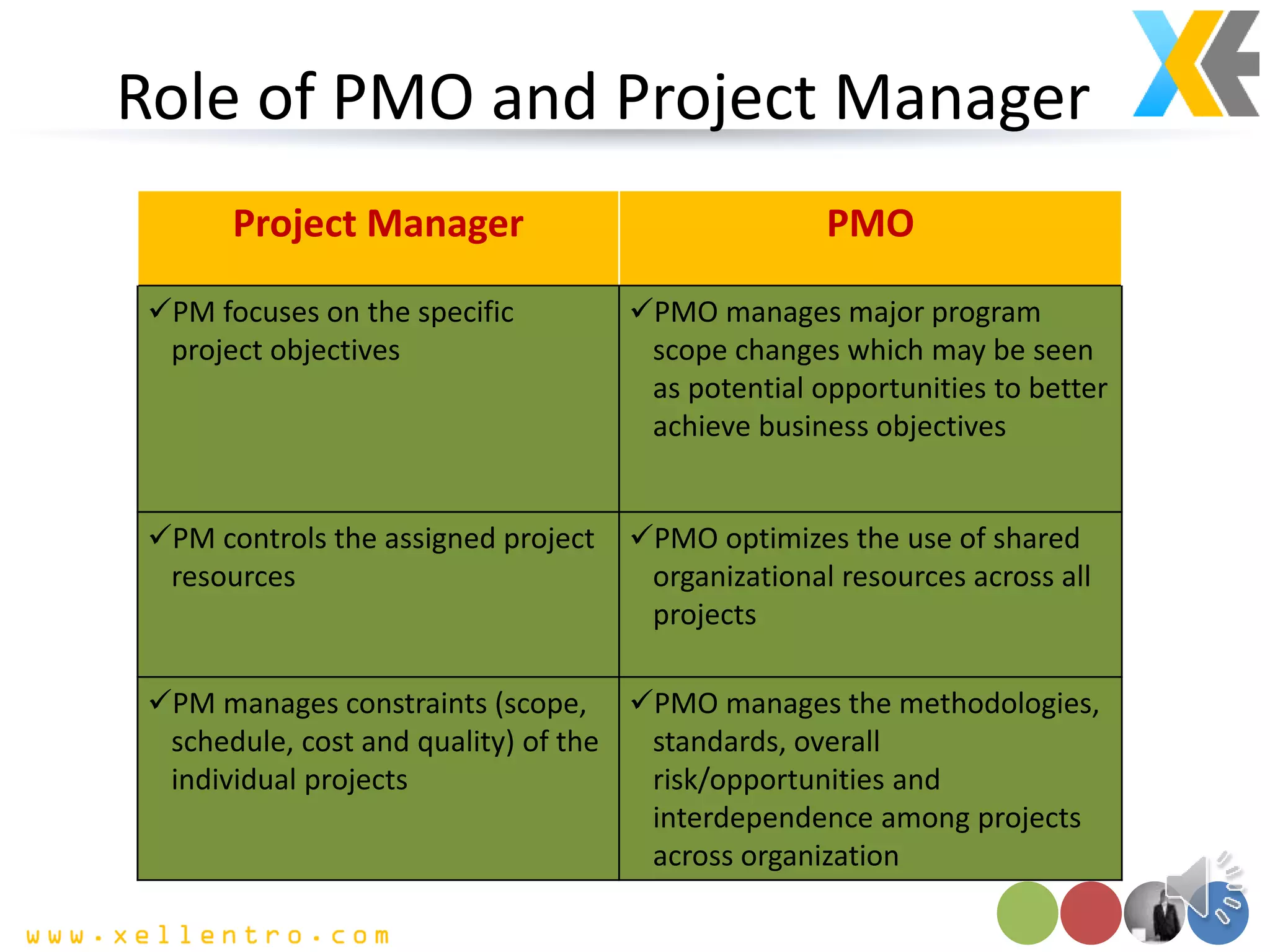
Role of PMO and Project Manager
Project Manager PMO
PM focuses on the specific
project objectives
PMO manages major program
scope changes which may be seen
as potential opportunities to better
achieve business objectives
PM controls the assigned project
resources
PMO optimizes the use of shared
organizational resources across all
projects
PM manages constraints (scope,
schedule, cost and quality) of the
individual projects
PMO manages the methodologies,
standards, overall
risk/opportunities and
interdependence among projects
across organization
Project Management and Operations
Management
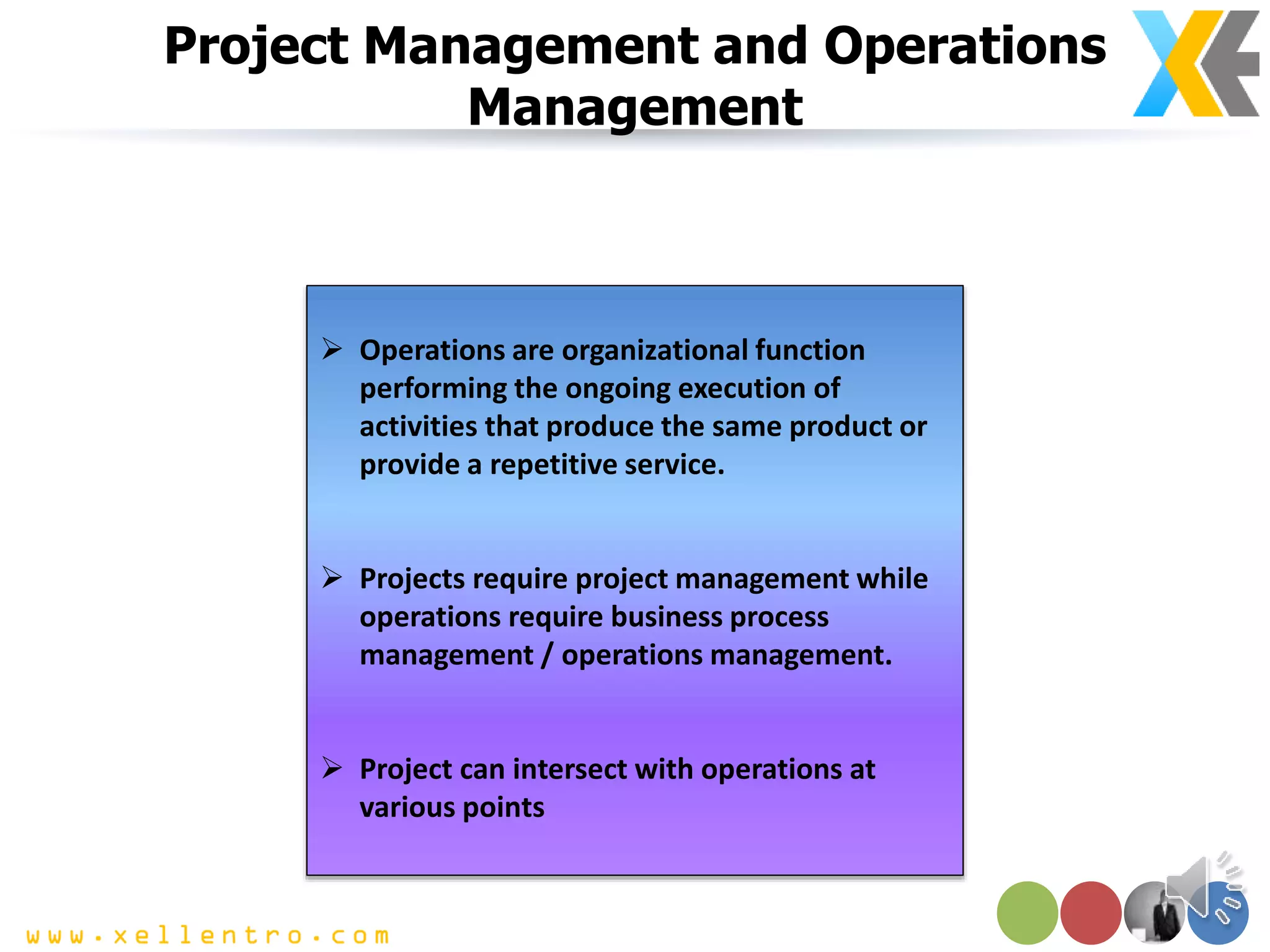
 Operations are organizational function
performing the ongoing execution of
activities that produce the same product or
provide a repetitive service.
 Projects require project management while
operations require business process
management / operations management.
 Project can intersect with operations at
various points
Project Lifecycle
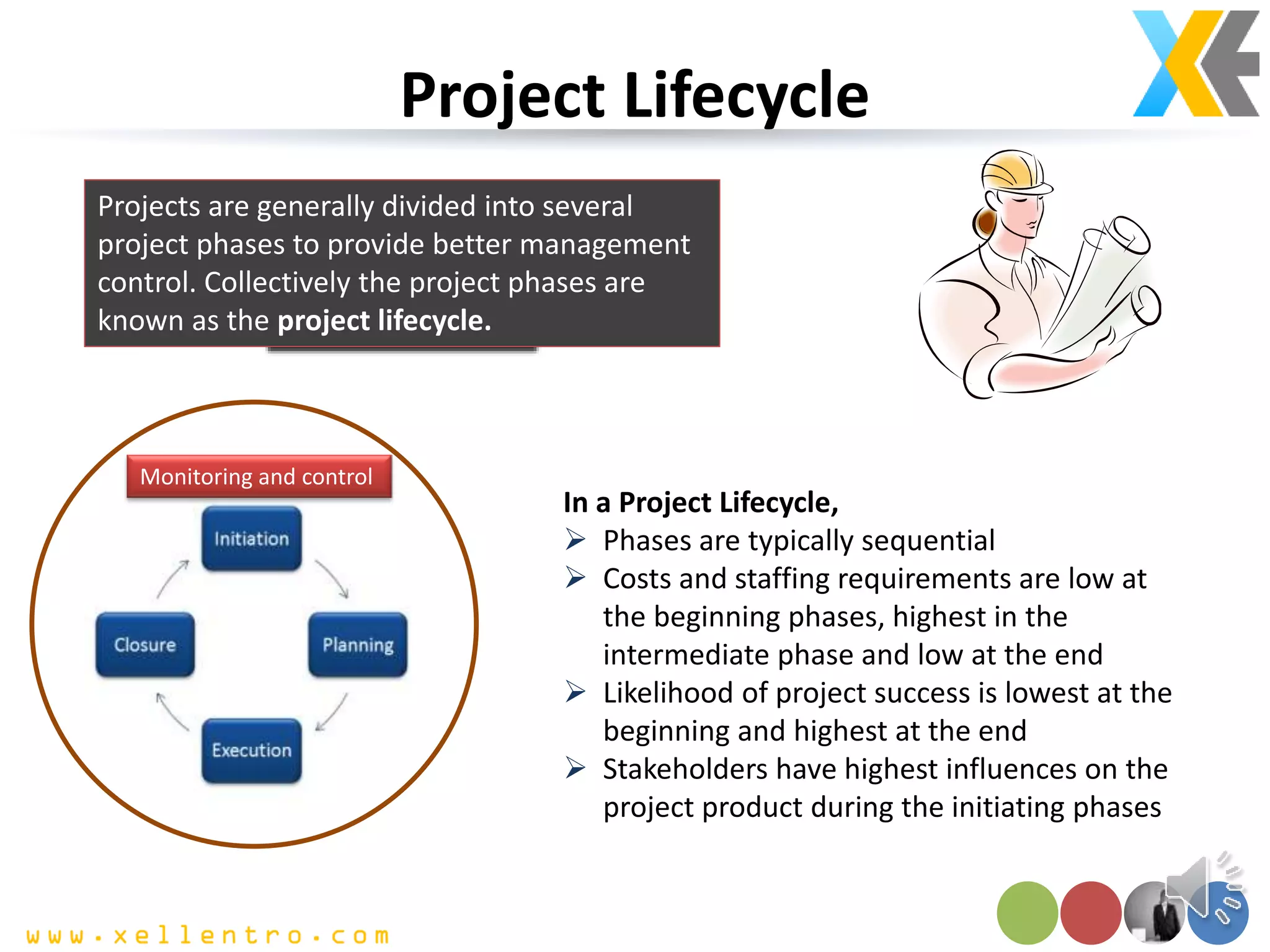
Projects are generally divided into several
project phases to provide better management
control. Collectively the project phases are
known as the project lifecycle.
In a Project Lifecycle,
 Phases are typically sequential
 Costs and staffing requirements are low at
the beginning phases, highest in the
intermediate phase and low at the end
 Likelihood of project success is lowest at the
beginning and highest at the end
 Stakeholders have highest influences on the
project product during the initiating phases
Monitoring and control
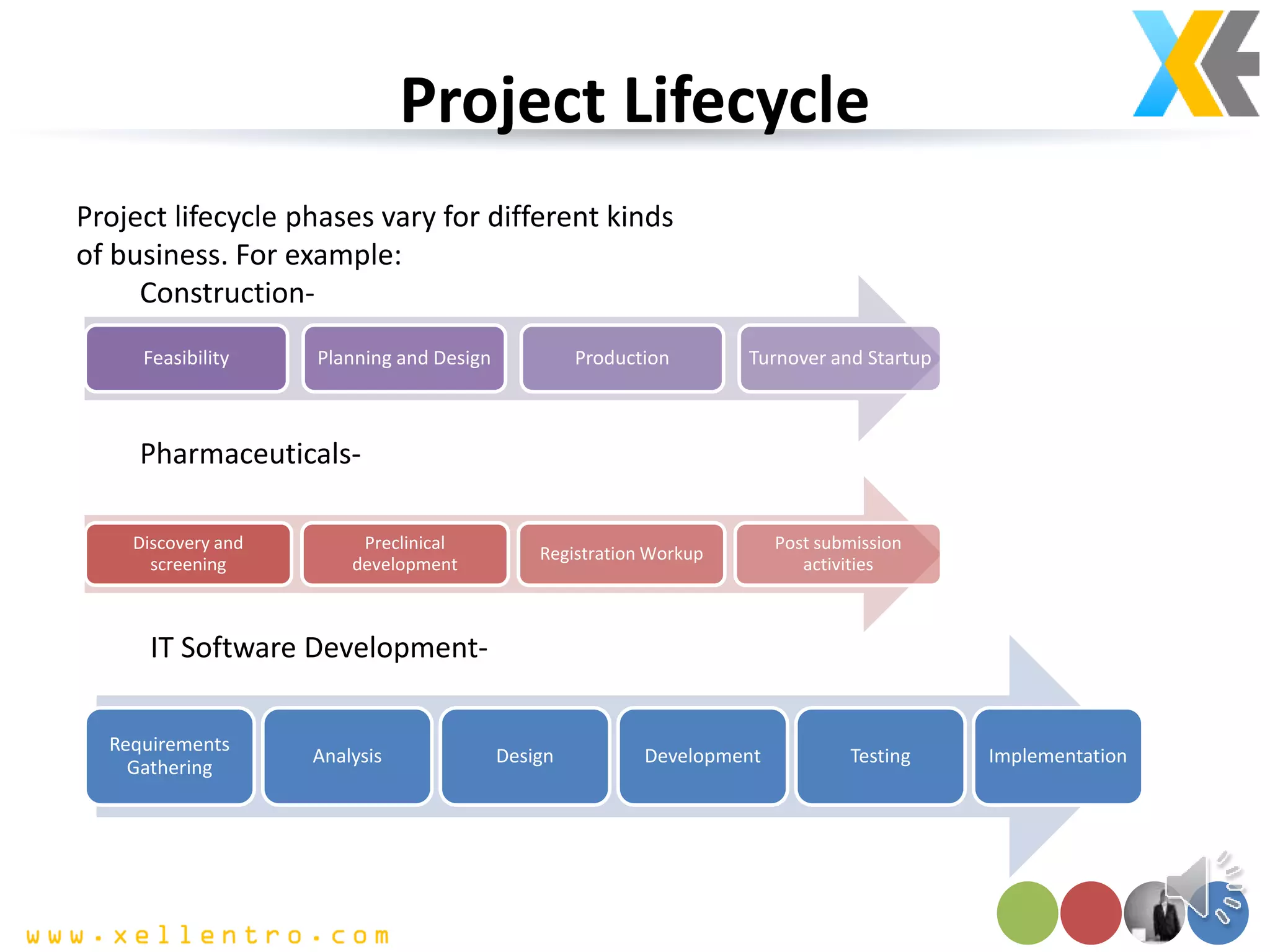
Project Lifecycle
Feasibility Planning and Design Production Turnover and Startup
Project lifecycle phases vary for different kinds
of business. For example:
Construction-
Discovery and
screening
Preclinical
development
Registration Workup
Post submission
activities
Requirements
Gathering
Analysis Design Development Testing Implementation
Pharmaceuticals-
IT Software Development-
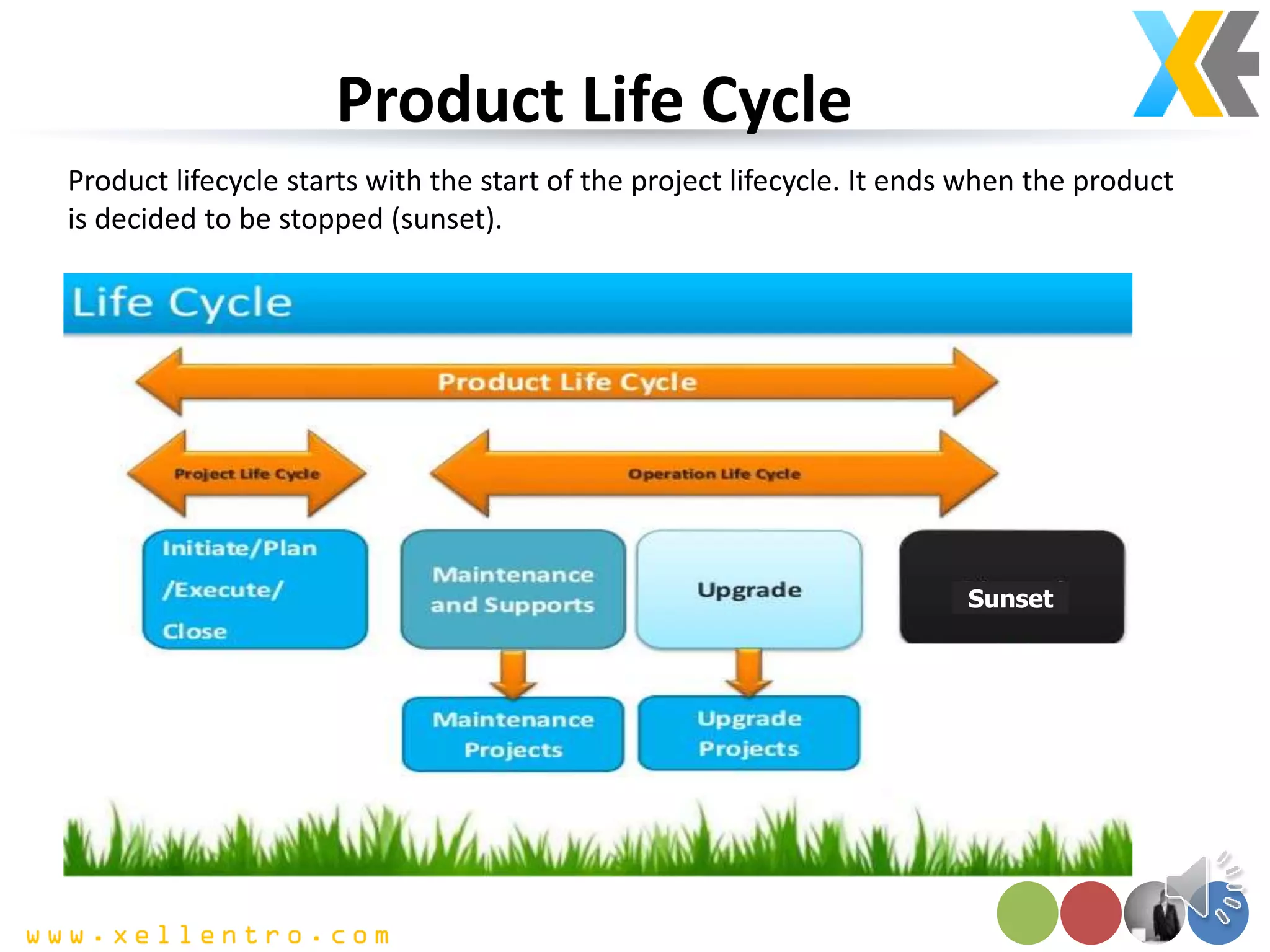
Product Life Cycle
Product lifecycle starts with the start of the project lifecycle. It ends when the product
is decided to be stopped (sunset).
Sunset
Course Details
Globally recognized and demanded, the PMP Credential demonstrates to employers, clients
and colleagues that a project manager possesses project management knowledge,
experience and skills to bring projects to successful completion.
As the demand for skilled project managers is at a critically urgent level, practitioners who
holds the PMP credential are well positioned to provide professional skills necessary to lead
project teams and achieve successful project results.
The PMP recognizes the competence of an individual to perform in the role of a project
manager, specifically experienced in leading and directing projects. Year after year the PMP
credential has garnered global recognition and commanded a higher salary for credentialed
individuals over non-credentialed individuals.
Course Details
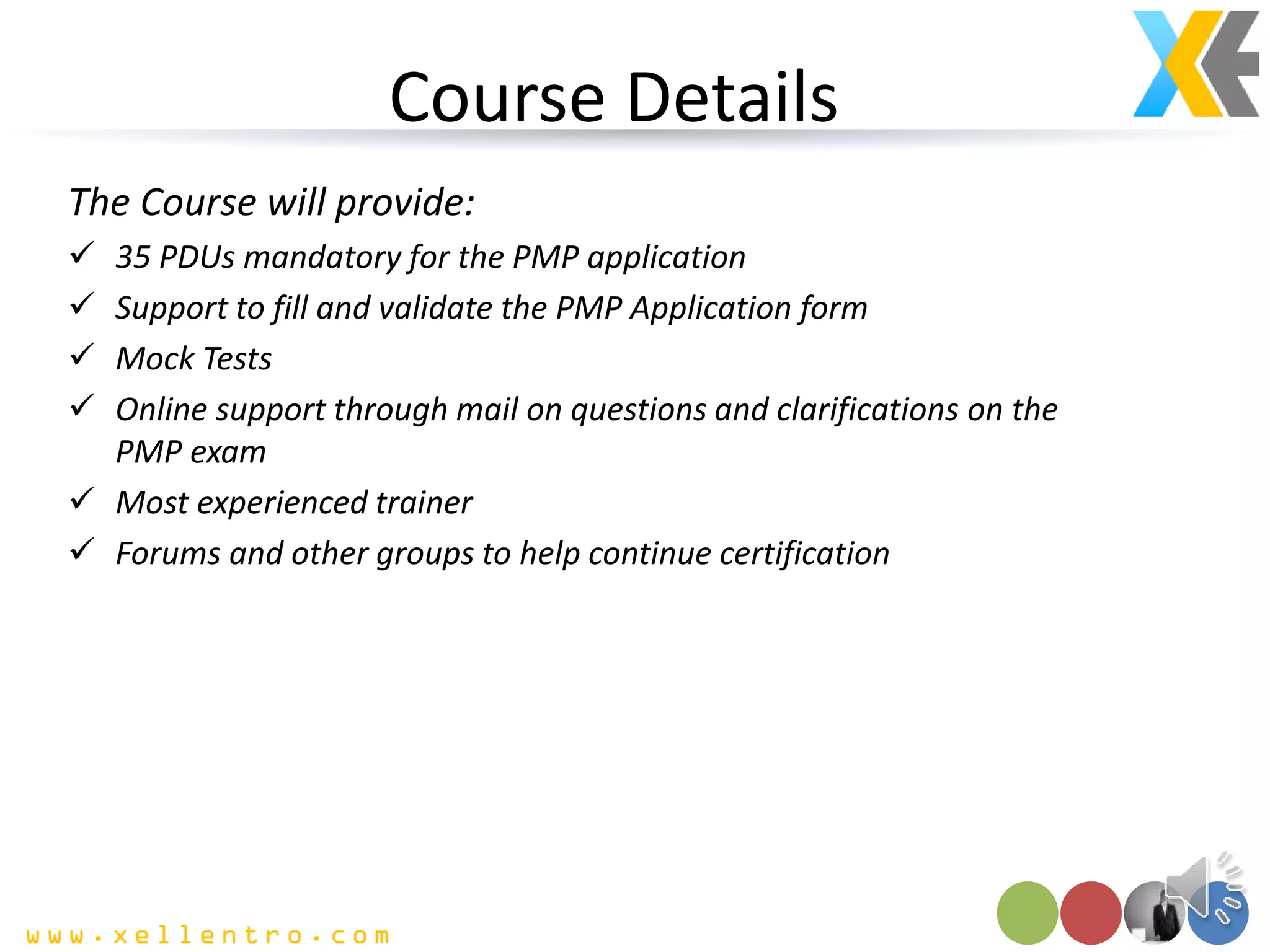
The Course will provide:
 35 PDUs mandatory for the PMP application
 Support to fill and validate the PMP Application form
 Mock Tests
 Online support through mail on questions and clarifications on the
PMP exam
 Most experienced trainer
 Forums and other groups to help continue certification
About PMI®
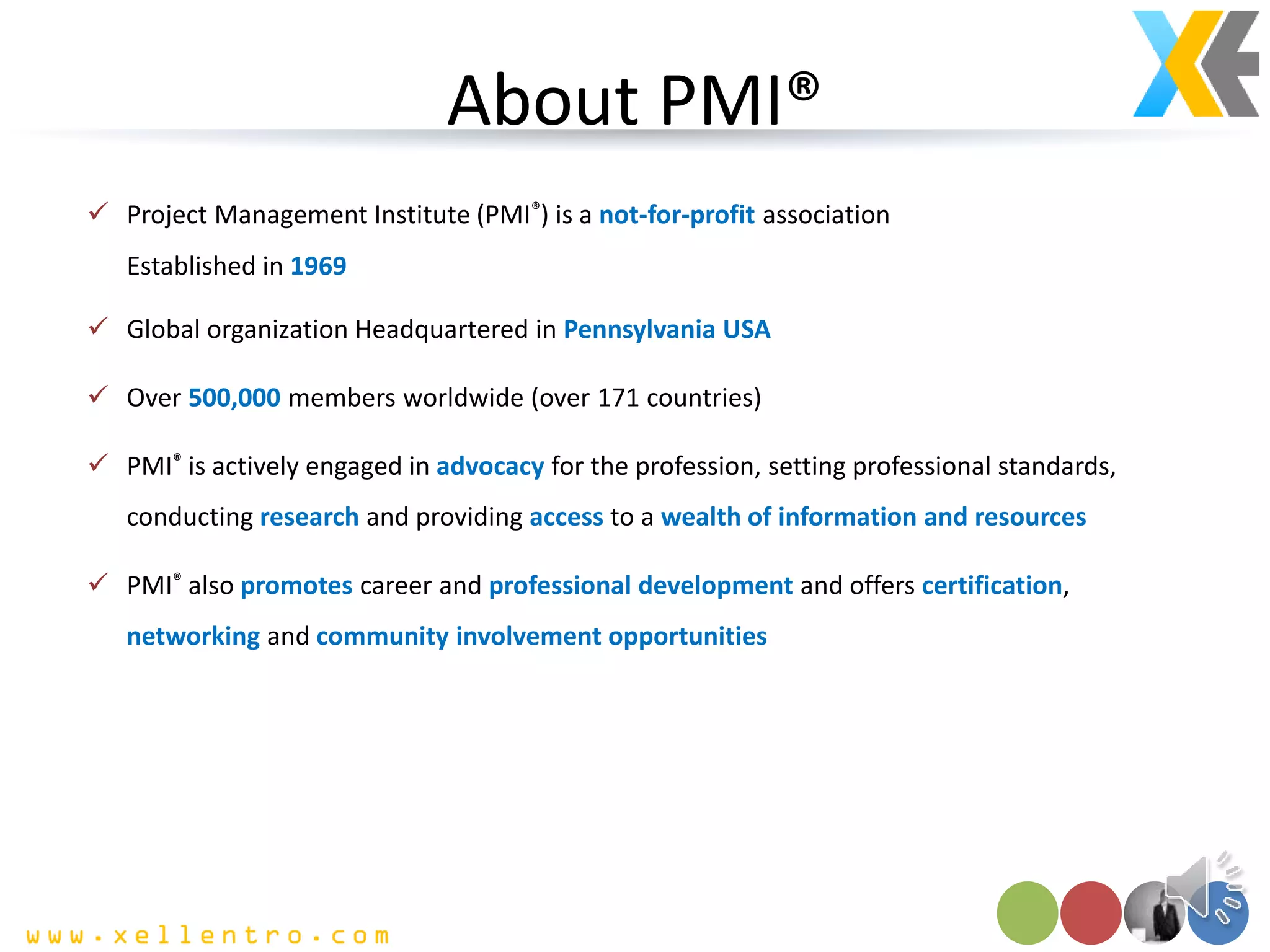
 Project Management Institute (PMI®) is a not-for-profit association
Established in 1969
 Global organization Headquartered in Pennsylvania USA
 Over 500,000 members worldwide (over 171 countries)
 PMI® is actively engaged in advocacy for the profession, setting professional standards,
conducting research and providing access to a wealth of information and resources
 PMI® also promotes career and professional development and offers certification,
networking and community involvement opportunities
Certifications/Credentials from PMI®
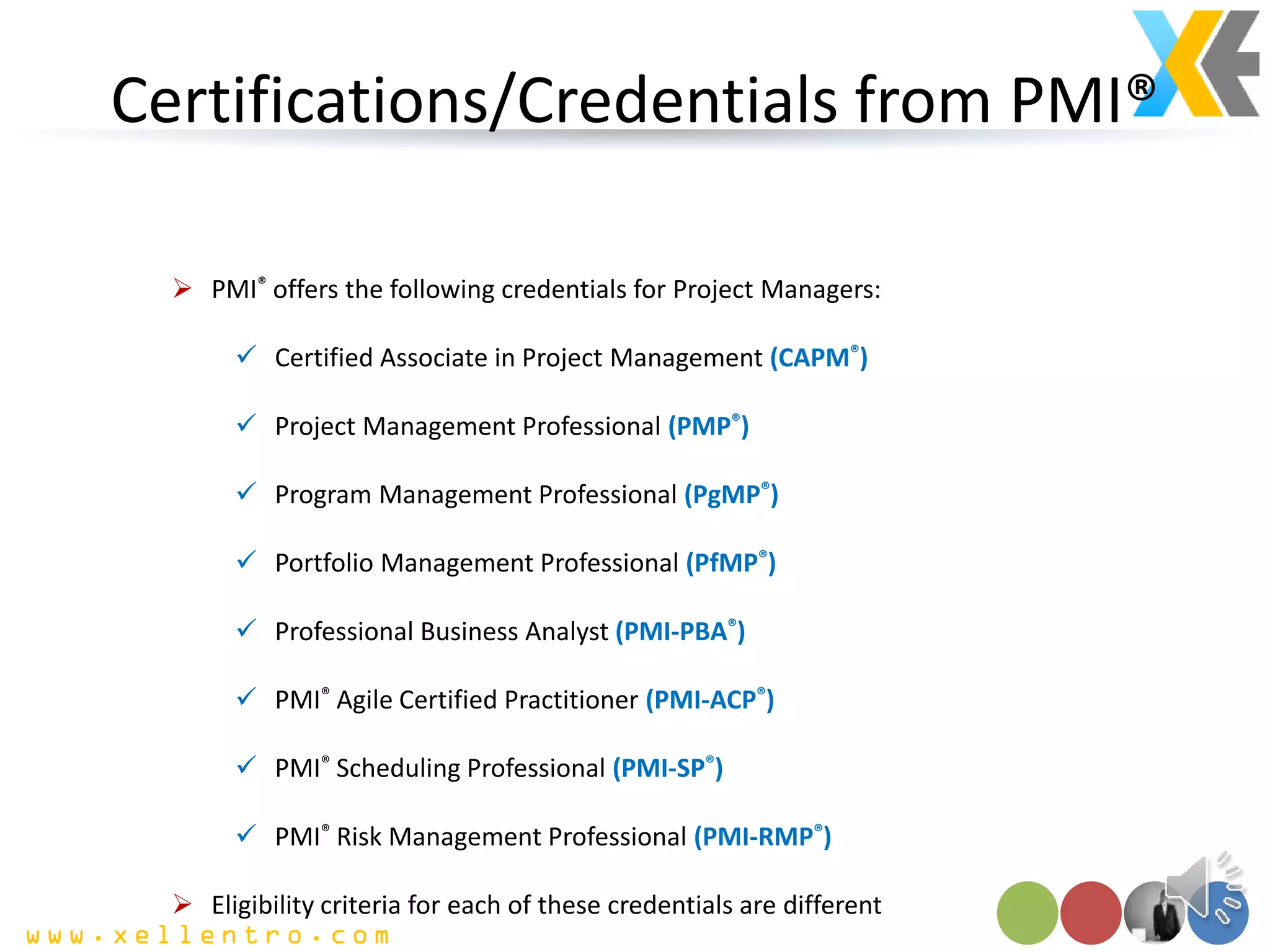
 PMI® offers the following credentials for Project Managers:
 Certified Associate in Project Management (CAPM®)
 Project Management Professional (PMP®)
 Program Management Professional (PgMP®)
 Portfolio Management Professional (PfMP®)
 Professional Business Analyst (PMI-PBA®)
 PMI® Agile Certified Practitioner (PMI-ACP®)
 PMI® Scheduling Professional (PMI-SP®)
 PMI® Risk Management Professional (PMI-RMP®)
 Eligibility criteria for each of these credentials are different
PMP® Examination Pattern
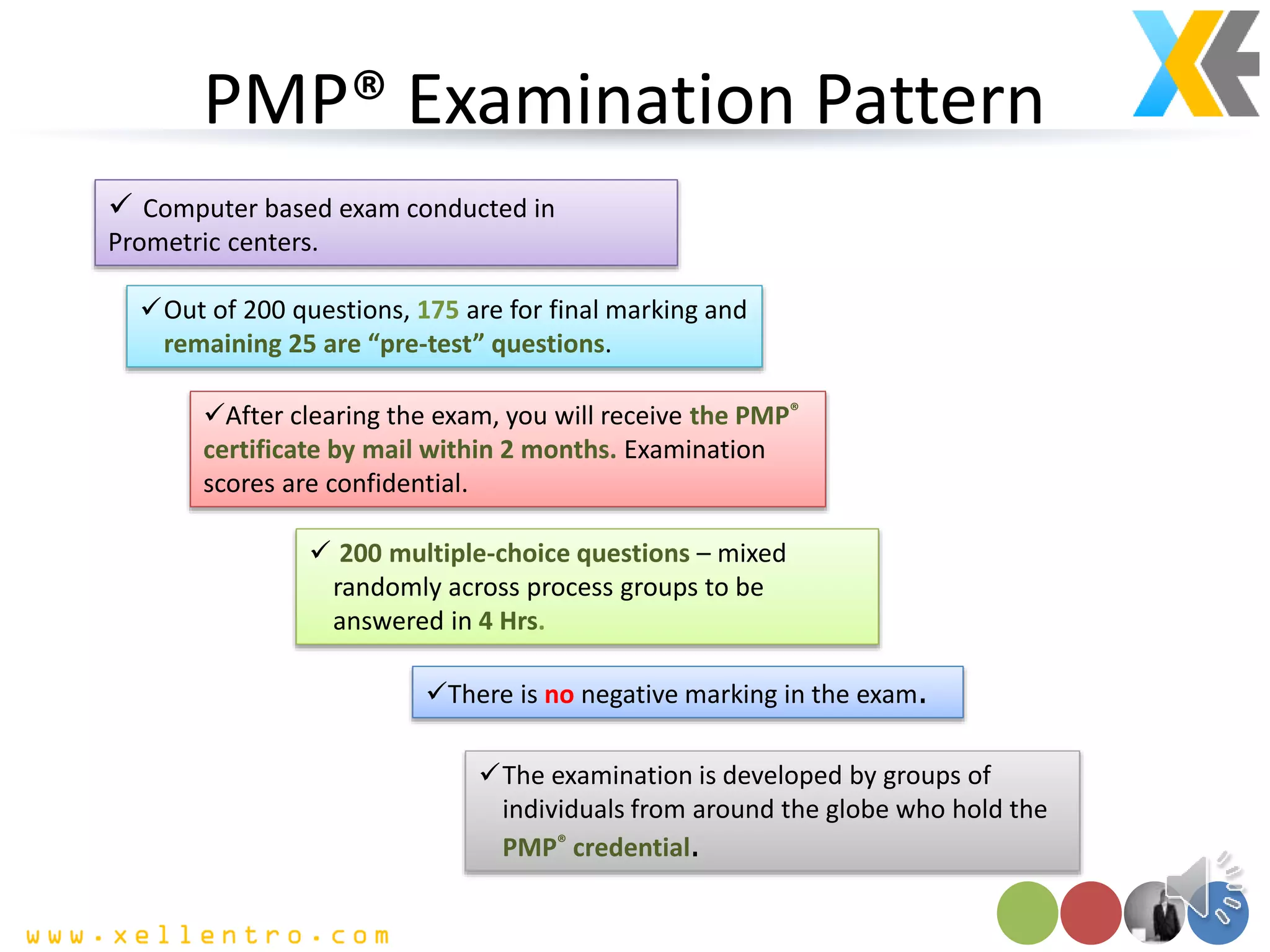
 Computer based exam conducted in
Prometric centers.
 200 multiple-choice questions – mixed
randomly across process groups to be
answered in 4 Hrs.
Out of 200 questions, 175 are for final marking and
remaining 25 are “pre-test” questions.
There is no negative marking in the exam.
The examination is developed by groups of
individuals from around the globe who hold the
PMP® credential.
After clearing the exam, you will receive the PMP®
certificate by mail within 2 months. Examination
scores are confidential.
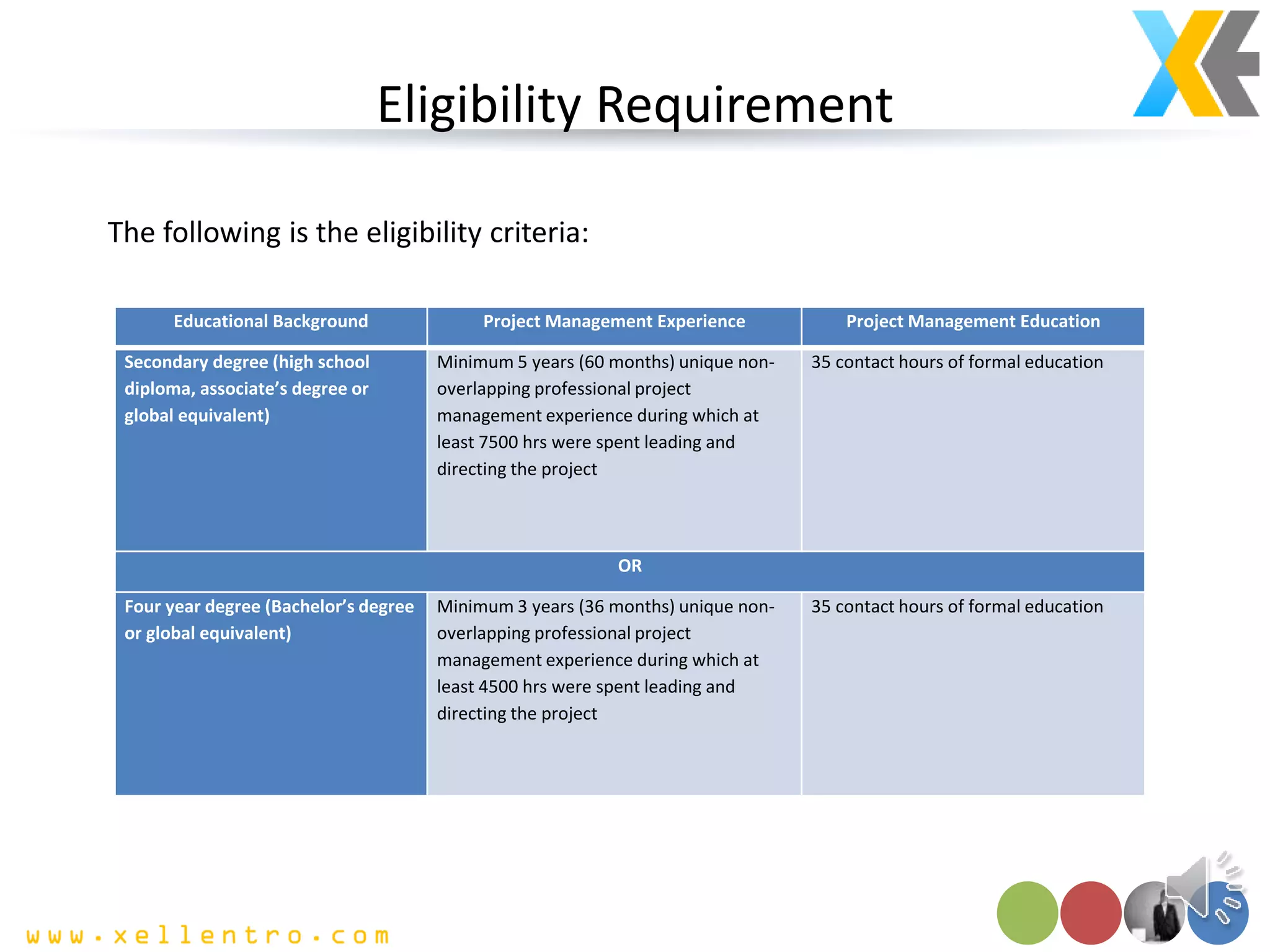
Eligibility Requirement
The following is the eligibility criteria:
Educational Background Project Management Experience Project Management Education
Secondary degree (high school
diploma, associate’s degree or
global equivalent)
Minimum 5 years (60 months) unique non-
overlapping professional project
management experience during which at
least 7500 hrs were spent leading and
directing the project
35 contact hours of formal education
OR
Four year degree (Bachelor’s degree
or global equivalent)
Minimum 3 years (36 months) unique non-
overlapping professional project
management experience during which at
least 4500 hrs were spent leading and
directing the project
35 contact hours of formal education
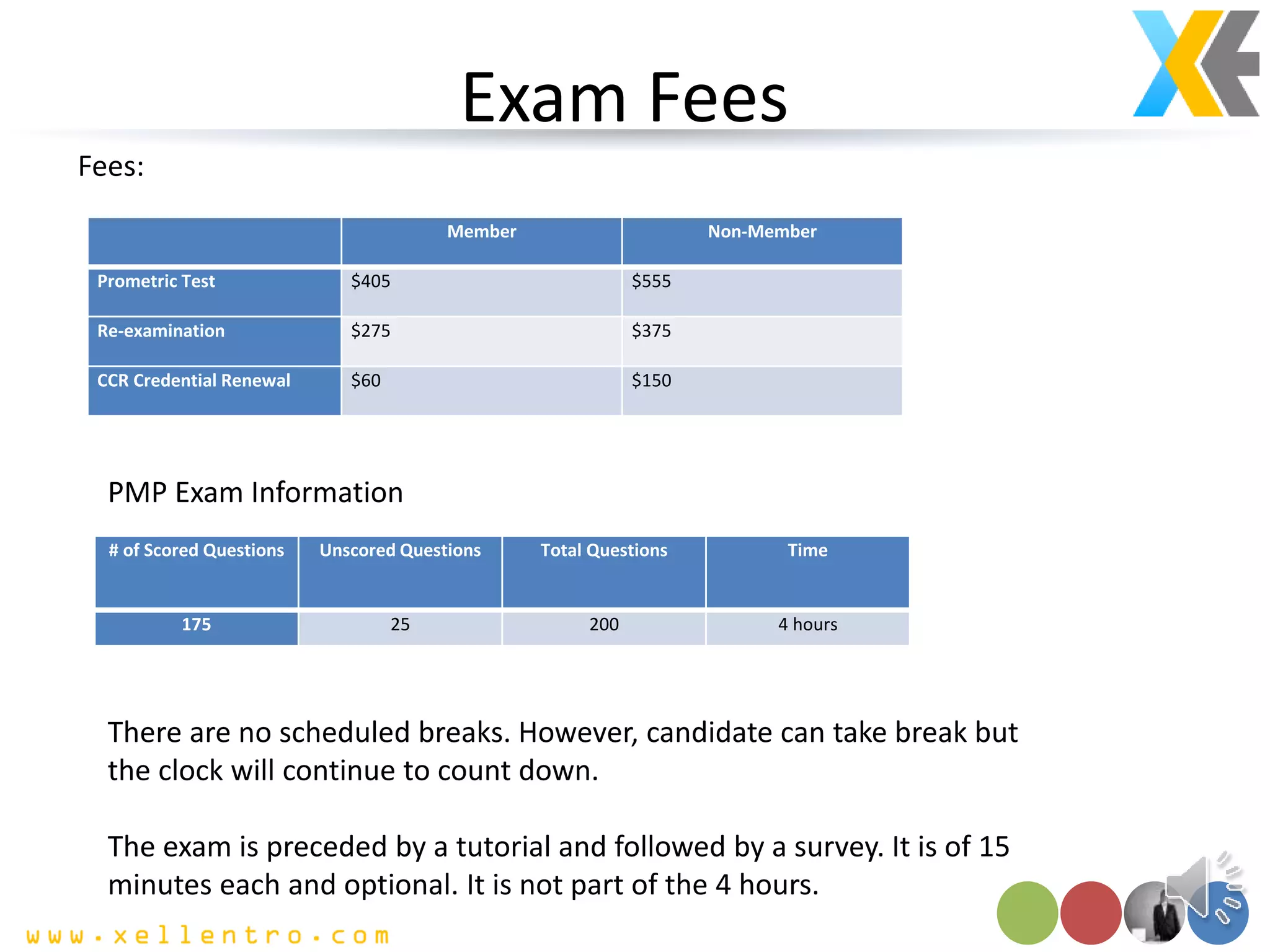
Exam Fees
Fees:
Member Non-Member
Prometric Test $405 $555
Re-examination $275 $375
CCR Credential Renewal $60 $150
PMP Exam Information
# of Scored Questions Unscored Questions Total Questions Time
175 25 200 4 hours
There are no scheduled breaks. However, candidate can take break but
the clock will continue to count down.
The exam is preceded by a tutorial and followed by a survey. It is of 15
minutes each and optional. It is not part of the 4 hours.
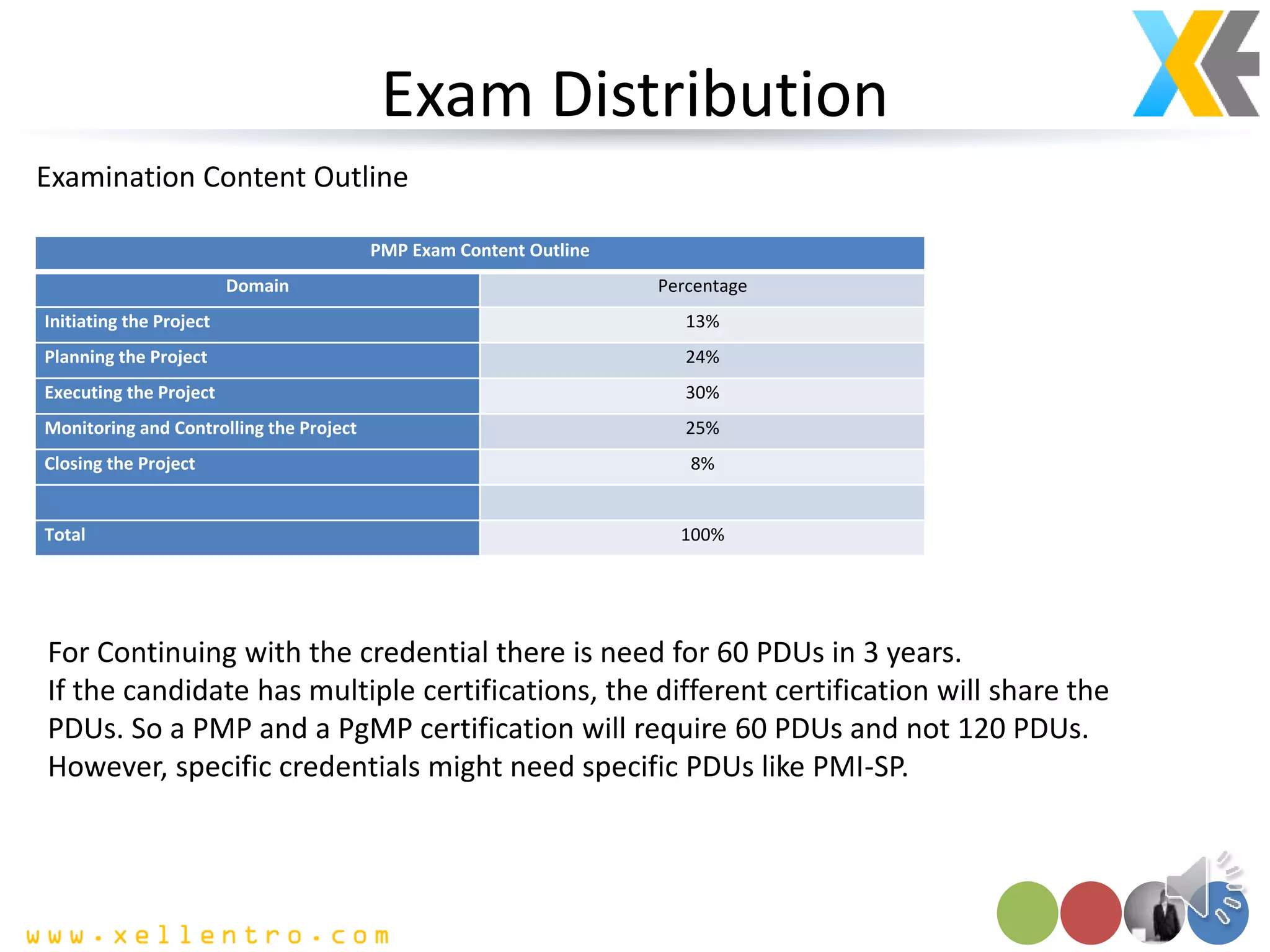
Exam Distribution
Examination Content Outline
PMP Exam Content Outline
Domain Percentage
Initiating the Project 13%
Planning the Project 24%
Executing the Project 30%
Monitoring and Controlling the Project 25%
Closing the Project 8%
Total 100%
For Continuing with the credential there is need for 60 PDUs in 3 years.
If the candidate has multiple certifications, the different certification will share the
PDUs. So a PMP and a PgMP certification will require 60 PDUs and not 120 PDUs.
However, specific credentials might need specific PDUs like PMI-SP.
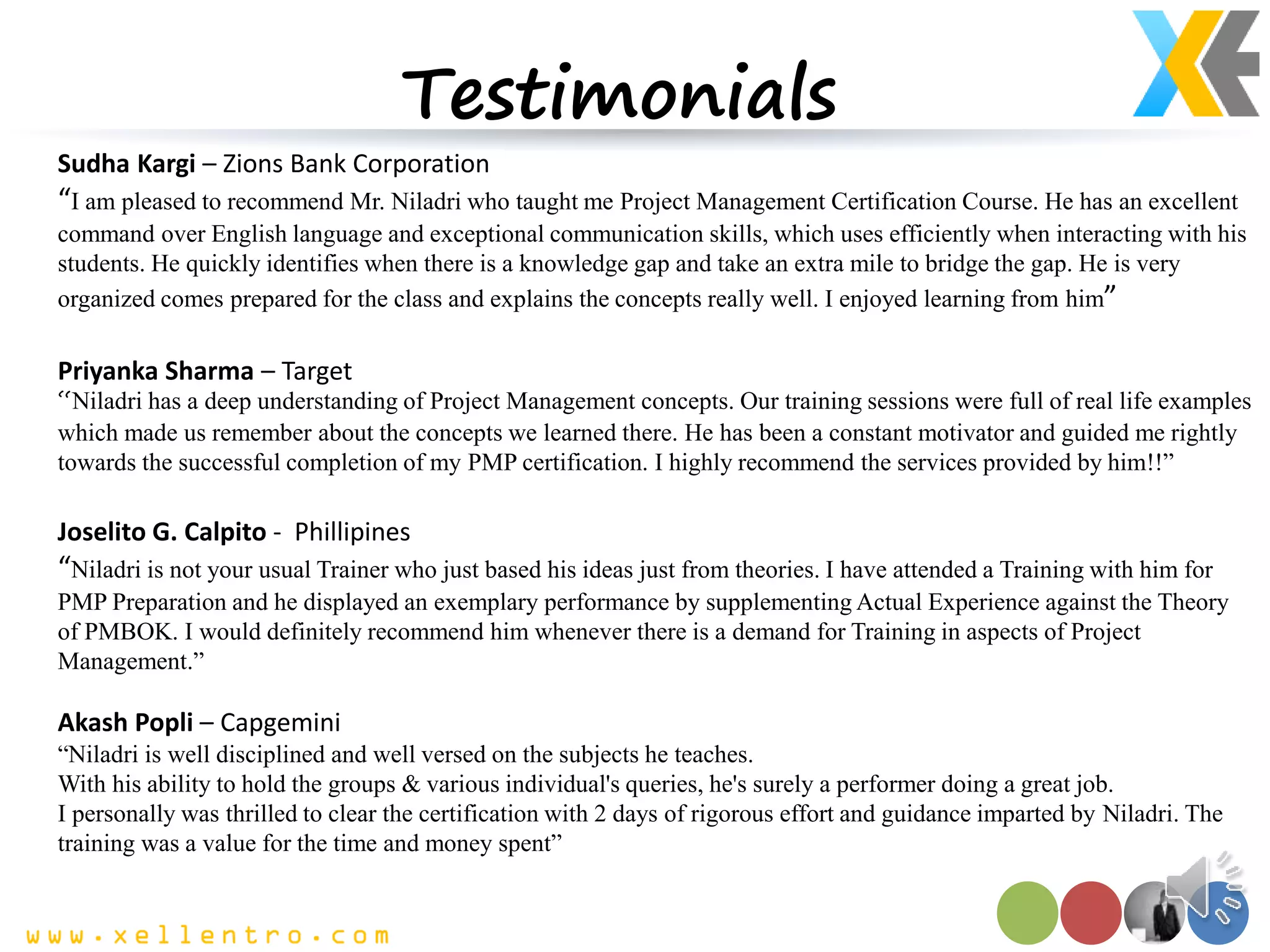
Testimonials
Sudha Kargi – Zions Bank Corporation
“I am pleased to recommend Mr. Niladri who taught me Project Management Certification Course. He has an excellent
command over English language and exceptional communication skills, which uses efficiently when interacting with his
students. He quickly identifies when there is a knowledge gap and take an extra mile to bridge the gap. He is very
organized comes prepared for the class and explains the concepts really well. I enjoyed learning from him”
Priyanka Sharma – Target
“Niladri has a deep understanding of Project Management concepts. Our training sessions were full of real life examples
which made us remember about the concepts we learned there. He has been a constant motivator and guided me rightly
towards the successful completion of my PMP certification. I highly recommend the services provided by him!!”
Joselito G. Calpito - Phillipines
“Niladri is not your usual Trainer who just based his ideas just from theories. I have attended a Training with him for
PMP Preparation and he displayed an exemplary performance by supplementing Actual Experience against the Theory
of PMBOK. I would definitely recommend him whenever there is a demand for Training in aspects of Project
Management.”
Akash Popli – Capgemini
“Niladri is well disciplined and well versed on the subjects he teaches.
With his ability to hold the groups & various individual's queries, he's surely a performer doing a great job.
I personally was thrilled to clear the certification with 2 days of rigorous effort and guidance imparted by Niladri. The
training was a value for the time and money spent”
How to Contact us
Website: www.xellentro.com
Mail: info@xellentro.com
Mobile: +91 8105966200
Xellentro Consulting Services LLP
C 402, Ajmera Infinity, Electronics City Phase 1
Bengaluru, 560100

PMP Preparatory Course Demo

  • 1.
    PROJECT MANAGEMENT PROFESSIONAL PMI®PMPSM CERTIFICATION PMBOK 5TH EDITION Training Demo Xellentro Consulting Services LLP
  • 2.
  • 3.
    Agenda  About Xellentro About Trainer  Subject Matter – First Chapter  Course Details  How to Contact  Clients / Testimonials
  • 4.
    About Xellentro  Anemerging global provider of project, program and portfolio management consulting and training services.  Established in 2012, with Headquarters in Bangalore, India  Working closely with clients to tackle their most difficult organizational development challenges and competency building.  Classroom Training, Virtual classes and Online courses  Trainers with hands-on implementation experience of more than 10 years and with extensive training experience  100% of people pass in first shot
  • 5.
    The Coach Niladri has-  25+ years of experience in consulting and training  Consultant in areas of Project Portfolio Management, Project Management, PMO setup, IT Governance, Business Operations improvement  Certifications- PMP, PRINCE2 Practitioner, Management of Portfolio Practitioner, ITIL Expert, COBIT 5 and Lean Six Sigma Green Belt. Strong knowledge of PMI-ACP Certification  A PhD in Project Management and  MBA in Operations Research
  • 6.
    Project Temporary - adefinitive start and an end. Unique - the product/ service is different in some distinguishing way from all similar products or service. PMBOK defines Project as “A temporary endeavor undertaken to create a unique product, service or result.” Projects are often critical components of the organization’s business strategy.
  • 7.
  • 8.
  • 9.
    Project Management Application ofknowledge, skills, tools and techniques to project activities in order to meet or exceed stakeholder needs and expectations from the project. Stakeholders Product/Outcome
  • 10.
    Project Manager General Management ProjectManager needs have general management skills:  Accounting  Procurement  Sales and Marketing  Contracting abilities  Manufacturing and Distribution principles  Organization and Logistics  Strategic, tactical and operational planning  Leverage of the organizational structure and the organizational behavior  Administration of project team, reasonable compensation, rewards and recognition, and career paths  Health and safety standards and regulations  Using IT to advantage
  • 11.
    Dealing with People Motivate Effective Communication Negotiationskills Influence the Organization Ability to lead Problem solving Emotional Intelligence
  • 12.
    Project Management Needs balancingcompeting demands among: Resource Quality Scope Cost Time Risk
  • 13.
    Related Endeavors Program It isa group of projects managed in a coordinated way to obtain benefits not available from managing them individually. Many programs also include elements of ongoing operations. Subproject Manageable components of a project. It can be: A single phase within a project lifecycle Human Resource skill sets Specialized technology, materials Portfolio Portfolio Management is the selection, management and collection of projects within an organization. Here, the projects may not be directly related, but contribute to the organization’s overall strategic plan
  • 14.
    PMI® PMPSM –Basic Concepts
  • 15.
    Related Endeavors -PMO Project Management Office - Entity related to the centralized and coordinated management of projects under its domain. Primary function of PMO is to support project managers  Managing shared resources across the projects administered  Identifying and developing project management methodology, best practices and standards  Coaching, Mentoring, Training and Oversight  Monitoring compliance with PM Standards, policies, procedures and templates through audits  Developing and managing project policies, procedures, templates and other shared documentation  Coordinating communication across projects
  • 16.
    Role of PMOand Project Manager Project Manager PMO PM focuses on the specific project objectives PMO manages major program scope changes which may be seen as potential opportunities to better achieve business objectives PM controls the assigned project resources PMO optimizes the use of shared organizational resources across all projects PM manages constraints (scope, schedule, cost and quality) of the individual projects PMO manages the methodologies, standards, overall risk/opportunities and interdependence among projects across organization
  • 17.
    Project Management andOperations Management  Operations are organizational function performing the ongoing execution of activities that produce the same product or provide a repetitive service.  Projects require project management while operations require business process management / operations management.  Project can intersect with operations at various points
  • 18.
    Project Lifecycle Projects aregenerally divided into several project phases to provide better management control. Collectively the project phases are known as the project lifecycle. In a Project Lifecycle,  Phases are typically sequential  Costs and staffing requirements are low at the beginning phases, highest in the intermediate phase and low at the end  Likelihood of project success is lowest at the beginning and highest at the end  Stakeholders have highest influences on the project product during the initiating phases Monitoring and control
  • 19.
    Project Lifecycle Feasibility Planningand Design Production Turnover and Startup Project lifecycle phases vary for different kinds of business. For example: Construction- Discovery and screening Preclinical development Registration Workup Post submission activities Requirements Gathering Analysis Design Development Testing Implementation Pharmaceuticals- IT Software Development-
  • 20.
    Product Life Cycle Productlifecycle starts with the start of the project lifecycle. It ends when the product is decided to be stopped (sunset). Sunset
  • 21.
    Course Details Globally recognizedand demanded, the PMP Credential demonstrates to employers, clients and colleagues that a project manager possesses project management knowledge, experience and skills to bring projects to successful completion. As the demand for skilled project managers is at a critically urgent level, practitioners who holds the PMP credential are well positioned to provide professional skills necessary to lead project teams and achieve successful project results. The PMP recognizes the competence of an individual to perform in the role of a project manager, specifically experienced in leading and directing projects. Year after year the PMP credential has garnered global recognition and commanded a higher salary for credentialed individuals over non-credentialed individuals.
  • 22.
    Course Details The Coursewill provide:  35 PDUs mandatory for the PMP application  Support to fill and validate the PMP Application form  Mock Tests  Online support through mail on questions and clarifications on the PMP exam  Most experienced trainer  Forums and other groups to help continue certification
  • 23.
    About PMI®  ProjectManagement Institute (PMI®) is a not-for-profit association Established in 1969  Global organization Headquartered in Pennsylvania USA  Over 500,000 members worldwide (over 171 countries)  PMI® is actively engaged in advocacy for the profession, setting professional standards, conducting research and providing access to a wealth of information and resources  PMI® also promotes career and professional development and offers certification, networking and community involvement opportunities
  • 24.
    Certifications/Credentials from PMI® PMI® offers the following credentials for Project Managers:  Certified Associate in Project Management (CAPM®)  Project Management Professional (PMP®)  Program Management Professional (PgMP®)  Portfolio Management Professional (PfMP®)  Professional Business Analyst (PMI-PBA®)  PMI® Agile Certified Practitioner (PMI-ACP®)  PMI® Scheduling Professional (PMI-SP®)  PMI® Risk Management Professional (PMI-RMP®)  Eligibility criteria for each of these credentials are different
  • 25.
    PMP® Examination Pattern Computer based exam conducted in Prometric centers.  200 multiple-choice questions – mixed randomly across process groups to be answered in 4 Hrs. Out of 200 questions, 175 are for final marking and remaining 25 are “pre-test” questions. There is no negative marking in the exam. The examination is developed by groups of individuals from around the globe who hold the PMP® credential. After clearing the exam, you will receive the PMP® certificate by mail within 2 months. Examination scores are confidential.
  • 26.
    Eligibility Requirement The followingis the eligibility criteria: Educational Background Project Management Experience Project Management Education Secondary degree (high school diploma, associate’s degree or global equivalent) Minimum 5 years (60 months) unique non- overlapping professional project management experience during which at least 7500 hrs were spent leading and directing the project 35 contact hours of formal education OR Four year degree (Bachelor’s degree or global equivalent) Minimum 3 years (36 months) unique non- overlapping professional project management experience during which at least 4500 hrs were spent leading and directing the project 35 contact hours of formal education
  • 27.
    Exam Fees Fees: Member Non-Member PrometricTest $405 $555 Re-examination $275 $375 CCR Credential Renewal $60 $150 PMP Exam Information # of Scored Questions Unscored Questions Total Questions Time 175 25 200 4 hours There are no scheduled breaks. However, candidate can take break but the clock will continue to count down. The exam is preceded by a tutorial and followed by a survey. It is of 15 minutes each and optional. It is not part of the 4 hours.
  • 28.
    Exam Distribution Examination ContentOutline PMP Exam Content Outline Domain Percentage Initiating the Project 13% Planning the Project 24% Executing the Project 30% Monitoring and Controlling the Project 25% Closing the Project 8% Total 100% For Continuing with the credential there is need for 60 PDUs in 3 years. If the candidate has multiple certifications, the different certification will share the PDUs. So a PMP and a PgMP certification will require 60 PDUs and not 120 PDUs. However, specific credentials might need specific PDUs like PMI-SP.
  • 29.
    Testimonials Sudha Kargi –Zions Bank Corporation “I am pleased to recommend Mr. Niladri who taught me Project Management Certification Course. He has an excellent command over English language and exceptional communication skills, which uses efficiently when interacting with his students. He quickly identifies when there is a knowledge gap and take an extra mile to bridge the gap. He is very organized comes prepared for the class and explains the concepts really well. I enjoyed learning from him” Priyanka Sharma – Target “Niladri has a deep understanding of Project Management concepts. Our training sessions were full of real life examples which made us remember about the concepts we learned there. He has been a constant motivator and guided me rightly towards the successful completion of my PMP certification. I highly recommend the services provided by him!!” Joselito G. Calpito - Phillipines “Niladri is not your usual Trainer who just based his ideas just from theories. I have attended a Training with him for PMP Preparation and he displayed an exemplary performance by supplementing Actual Experience against the Theory of PMBOK. I would definitely recommend him whenever there is a demand for Training in aspects of Project Management.” Akash Popli – Capgemini “Niladri is well disciplined and well versed on the subjects he teaches. With his ability to hold the groups & various individual's queries, he's surely a performer doing a great job. I personally was thrilled to clear the certification with 2 days of rigorous effort and guidance imparted by Niladri. The training was a value for the time and money spent”
  • 30.
    How to Contactus Website: www.xellentro.com Mail: info@xellentro.com Mobile: +91 8105966200
  • 31.
    Xellentro Consulting ServicesLLP C 402, Ajmera Infinity, Electronics City Phase 1 Bengaluru, 560100

Editor's Notes

  • #7 Let us now look at some of the basic concepts related to project management. First of all let us understand what is a Project. Don’t we all know what it is? Yes you are right. A birthday party is a project or may be the annual award ceremony of your organization. A project is temporary in nature, which means it has to have a fixed start and end date. It should create a unique product or service or result. A product is like a software application. A service is like a training class or a consulting engagement. A result is like a feasibility study report. Unique means it has to be different from others. Even when a builder is building apartments which has same elevation and facilities and construction quality, it still is different as the land is different and may have separate characteristics. Projects can be of any size like a school project or building a dam.
  • #8 As we saw earlier, due to temporary nature of the project, the project is over as soon as the end objective is met. For example, as soon as the Financial Accounting Software is tested and handed over to the customer or the operations team, the project is over. It is not related to the time of execution. The project team is also temporary and is released as soon as the project is over. We have already looked at the Uniqueness aspect of the project. What we also need to understand is the difference between the project and the product. Project is the execution or how it is to be done where as the Product is the outcome or final result of the project. Product satisfies the requirement of the customer and project is how it is to be done. Hence, the Project Manager needs to satisfy both the requirements of the customer (Functional and non-functional) as well as the need to deliver the project within the competing demands. There are two sponsors – Customer Sponsor who signs the cheque and the Project sponsor who is internal, who is the person who will provide resources for the project to be executed.
  • #10 Project Management is the application of the knowledge, what you are learning, skills which you have acquired with experience and the tools and techniques to the project activities to successfully complete the project within the competing demands. The competing demands are – Scope, Time (Schedule), Cost (Budget), Quality as per Customer’s expectation, Resource, Risk. General management skills like accounting, procurement, sales & marketing, contracting, manufacturing and distribution, organization and logistics, etc., needs to be known to some extent. Master is those is not required.
  • #14 Let us now understand a few other concepts. We have all heard about “Program”. It is a group of projects, which are related in some way, and are managed in a way that it gives benefits which otherwise is not available. For example a project to implement a new HR Application Software and a project to change the existing HR Policy and the banding structure. Both are related and will require the same SMEs. It will be of no use to have the software implemented as per the current policies when it is getting changed. Program management helps in proper utilization of scarce resources. Sub-projects are breaking up a project into smaller manageable modules. For example, the part to be done by a contractor can be made as a subproject and managed which rolls up into the main project plan. Portfolio Management – The organization has its own basket of resources like we have for our income in terms of salaries or other incomes. This is then used to invest on Project and on Business as Usual operations. We as individuals also do the same for our investments in stock, mutual funds, fixed deposits, liquid cash in bank. We all have a objective for doing it like our retirement or a big expense for a vacation or for child’s education, etc. Organization has their business objectives. These objectives changes and the investment has to align to these objectives. Portfolio Management is the process of aligning the project with the business objectives for running projects and decide which to kill or put on hold or expedite. It is also the process of approving the projects which meets the business objectives and then tract the benefits realized, once they are live, and match with the expectation mentioned in the business case of the project. There needs to be a balance between the money spent on new projects and the operations for Business as Usual. Do we need to change the operating system to Windows 8 in the organization or have the HR system upgraded to meet the current change in the government rules.
  • #15 This diagram represents the relationship among Portfolio, Program and Projects. It is not a hierarchy.
  • #21 These are some examples of Project Phases of a Construction Project, Pharma Project and IT Project
  • #22 PMP Credential is a globally recognized certification valued by various organizations both IT and non-IT. It endorses that you have the necessary knowledge, skills to manage projects of any nature. It recognizes the competence of the individual to perform the role of the Project Manager and is experienced in leading and directing projects.
  • #23 PMP Credential is a globally recognized certification valued by various organizations both IT and non-IT. It endorses that you have the necessary knowledge, skills to manage projects of any nature. It recognizes the competence of the individual to perform the role of the Project Manager and is experienced in leading and directing projects.
  • #27 Assuming everyone is graduate, the Eligibility Criteria is Graduation degree with 4500 hours of non-overlapping project management experience. Experience can be in any or some or all the process groups like Initiation to Closure. Non overlapping means that if you are working on multiple projects at one time, you need to give the time for each so that in each day you cannot work for more than 8 hours. 35 Contact hours of education is required. This is what you get after going through this course. You can claim it in Category – B. In case of non graduate, the requirement is 7500 hours of non overlapping project management experience over 5 years. People who are not eligible for this also can go for the CAPM examination.
  • #28 The exam costs are given above. I suggest people to go for the membership as it costs the same (US $ 150 for membership + US$ 405 for exam). It is a prometric test online and has to be done from the prometric center once the approval of your application comes. There are 200 questions of which 25 are not marked and used for survey purpose. As a student, you will not know which are those 25 questions hence need to answer all the 200 in 4 hours. You can go out for bio-breaks or for having water etc., but the clock keeps ticking. Do not use backspace in your exam. You will not be allowed to carry anything even your handkerchief, mobile, pen, pencil, calculator, etc. There is a 15 mins tutorial at the beginning and the exam is followed by a survey. At the end you will get your marksheet mentioning your Pass status and proficiency levels in each area. Once you become a PMP, you have to earn 60 PDUs in 3 years as the certificate is valid for 3 years only. You can do this by attending various courses, attending seminars, etc., by PMI or their chapters or other organizations who specify that you will get PDUs. 5 PDUs can be claimed every year as you are a practicing Project Manager. The other way is to volunteer for activities with PMI, PMI Chapters or PMI Centre of Practice.
  • #29 The breakup of the questions as per the Process Groups are given above. You can see Execution has the highest percentage and then the Monitoring and Control and Planning. If a person has PMP and PMI-ACP or PGMP, they do not need to get 60* 2 = 120 PDUS. Total 60 PDUs are ok for all. The marks are calculated with some special formulas and the questions are weighted. Roughly pass marks is 70%.
  • #30 The breakup of the questions as per the Process Groups are given above. You can see Execution has the highest percentage and then the Monitoring and Control and Planning. If a person has PMP and PMI-ACP or PGMP, they do not need to get 60* 2 = 120 PDUS. Total 60 PDUs are ok for all. The marks are calculated with some special formulas and the questions are weighted. Roughly pass marks is 70%.
  • #31 The breakup of the questions as per the Process Groups are given above. You can see Execution has the highest percentage and then the Monitoring and Control and Planning. If a person has PMP and PMI-ACP or PGMP, they do not need to get 60* 2 = 120 PDUS. Total 60 PDUs are ok for all. The marks are calculated with some special formulas and the questions are weighted. Roughly pass marks is 70%.