316(b)Compliance
Planning and
Implementation
andrew.j.carstens@sargentlundy.com
312-269-3640
Andy Carstens
Director Environmental Services
2 of 6
www.sargentlundy.com
On August 15, 2014 the U.S. Environmental
­Protection Agency (EPA) published a ­final rule
implementing Section 316(b) of the Federal
Clean Water Act for existing power generat­
ing, manufacturing, and industrial facilities
that withdraw more than 2 million gallons
per day (MGD) of cooling water from waters
of the United States. The rule establishes
­national 316(b) standards applicable to cool­
ing ­water intake structures at these facilities
by ­requiring the Best Technology Available
(BTA) to minimize adverse environmental
impacts associated with both impingement
mortality and entrainment.
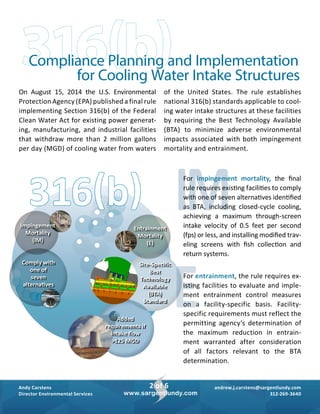
316(b) IMFor impingement mortality, the final
rule requires existing facilities to comply
with one of seven alternatives identified
as BTA, including closed-cycle cooling,
achieving a maximum through-screen
intake velocity of 0.5 feet per second
(fps) or less, and installing modified trav­
eling screens with fish collection and
­return systems.
EFor entrainment, the rule requires ex­
isting facilities to evaluate and imple­
ment entrainment control measures
on a facility-specific basis. Facility-
specific requirements must reflect the
permitting agency’s determination of
the maximum reduction in entrain­
ment warranted after consideration
of all factors relevant to the BTA
­determination.
Impingement
Mortality
(IM)
Comply with
one of
seven
alternatives
Entrainment
Mortality
(E)
Added
requirements if
intake flow
>125 MGD
Site-Specific
Best
Technology
Available
(BTA)
Standard
316(b)Compliance Planning and Implementation
for Cooling Water Intake Structures
andrew.j.carstens@sargentlundy.com
312-269-3640
Andy Carstens
Director Environmental Services
3 of 6
www.sargentlundy.com
316(b)Environmental Services
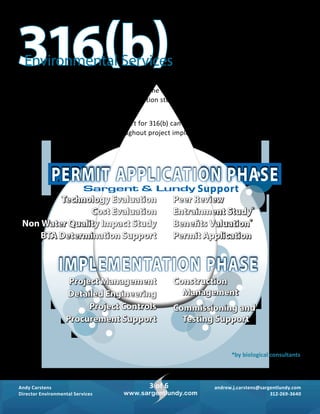
Technology Evaluation
Cost Evaluation
Non Water Quality Impact Study
BTA Determination Support
Peer Review
Entrainment Study*
Benefits Valuation*
Permit Application
Project Management
Detailed Engineering
Project Controls
Procurement Support
Construction
Management
Commissioning and
Testing Support
*by biological consultants
Support
PERMIT APPLICATION PHASE
IMPLEMENTATION PHASE
Sargent & Lundy’s environmental services group supports the preparation of all
required permit application material. In some cases, for example, the entrainment
characterization study and benefits valuation study, the expertise of a biological
consultant is required.
Sargent & Lundy’s full-service support for 316(b) can start with the permit
application phase and extend throughout project implementation.
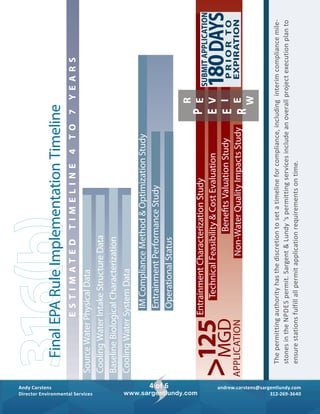
SourceWaterPhysicalData
BaselineBiologicalCharacterization
CoolingWaterIntakeStructureData
CoolingWaterSystemData
316(b)FinalEPARuleImplementationTimeline
IMComplianceMethod&OptimizationStudy
OperationalStatus
EntrainmentPerformanceStudy
Thepermittingauthorityhasthediscretiontosetatimelineforcompliance,includinginterimcompliancemile­
stonesintheNPDESpermit.Sargent&Lundy‘spermittingservicesincludeanoverallprojectexecutionplanto
ensurestationsfulfillallpermitapplication­requirementsontime.
EntrainmentCharacterizationStudy
	TechnicalFeasibility&CostEvaluation
>125
	MGD
APPLICATIONNon-WaterQualityImpactsStudy
BenefitsValuationStudy
SUBMITAPPLICATION
180DAYSPRIORTO
EXPIRATION
R
E
V
I
E
W
P
E
E
R
ESTIMATEDTIMELINE4TO7YEARS
andrew.carstens@sargentlundy.com
312-269-3640
Andy Carstens
Director Environmental Services
4 of 6
www.sargentlundy.com
andrew.j.carstens@sargentlundy.com
312-269-3640
Andy Carstens
Director Environmental Services
5 of 6
www.sargentlundy.com
Client 	 Xcel Energy Services	
Project 	 Riverside Repowering	
Location 	 Minneapolis, MN
Size 	 466 MW
Fuel 	 Coal-to-Gas Conversion	
Configuration 	 2x2x1	
CT Supplier/Type 	 GE 7FA	
Start 	 2006
Commercial Operation 	 2009
In 2003, Xcel Energy initiated implementation of the
Metropolitan Emissions Reduction Project (MERP),
with the twofold goal of significantly reducing flue
gas emissions, while increasing the amount of elec-
tricity produced at three Twin Cities coal-fired pow-
er plants. MERP was a voluntary program pursued
by Xcel Energy to convert two of the coal plants to
­natural gas combined-cycle arrangements (the
­Riverside and High Bridge plants) and to install
emission control equipment on the third coal plant
(the Allen S. King Plant).
Repowering of the Riverside plant required the
project to reduce impingement by limiting the
maximum through-screen design intake velocity
to 0.5 ft/s or less, which could not be met by the
existing traveling screens.
A study was performed to evaluate the technical
acceptability and economics of the available tech-
nologies for intake screening. The number of available
intake screening options was limited by the short
timeframe allowed for actual construction of the
intake. Installation of the new intake could not
­affect the operation of the plant until Unit 7 went
into an extended outage starting in September
of 2008, and had to be completed by the time
the ­repowered plant initiated startup activities in
­January of 2009. Further, special consideration had
to be taken to ensure all river work was completed
before the river froze in November 2008.
Use of underwater wedge-wire screens was deter-
mined to be the best technically acceptable option.
The versatility of the wedge-wire screens enabled
them to be incorporated into the existing intake
structure with relatively minor modifications. Five
wedge-wire screens extend into the Mississippi River
and are connected via an underwater pipe header to
a new steel bulkhead installed at the existing Unit 7
intake screenhouse. A 3-D model view illustrating
the new intake as designed is shown on page 6.
The river area in the vicinity of the Unit 7 intake was
dredged and rip-rap was placed during a planned
outage in the summer prior to installing the new
intake. During the installation of the new intake,
piles were driven into the river bottom to support the
wedge-wire screens and the piping header. The new
bulkhead and all underwater piping were shop-
prefabricated and modularized so that underwater
installation involved only the setting of the pieces
and bolting up the flanges. The intent of the design
was to minimize the need for any underwater weld-
ing. The photo on page 6 shows one of the modular
piping sections being lowered into the river.
Project-Unique Features
Challenges associated with the design of the new
circulating water intake included the shallow river
water depths in the vicinity of the existing intake,
periods of heavy river debris and silting, incorporation
of the wedge-wire screens into the existing intake
structure, and avoiding the circulating water dis-
charge pipe directly below the intake that extends to
the middle of the river. Air burst, silt sluicing, and
river warming systems were designed and installed
to mitigate the varying types of screen fouling and
keep the screens operating at peak performance.
316(b)EXAMPLE
PROJECTRIVERSIDE COMBINED-CYCLE
COOLING WATER INTAKE MODIFICATIONS
andrew.j.carstens@sargentlundy.com
312-269-3640
Andy Carstens
Director Environmental Services
6 of 6
www.sargentlundy.com
Lowering of New Circulating Water Intake Piping into River
Riverside Plant, Minneapolis, MN
New Circulating Water Intake Screens
316(b)EXAMPLE
PROJECTRIVERSIDECOMBINED-CYCLE
COOLINGWATERINTAKEMODIFICATIONS

316b Booklet for S&L

  • 1.
  • 2.
    andrew.j.carstens@sargentlundy.com 312-269-3640 Andy Carstens Director EnvironmentalServices 2 of 6 www.sargentlundy.com On August 15, 2014 the U.S. Environmental ­Protection Agency (EPA) published a ­final rule implementing Section 316(b) of the Federal Clean Water Act for existing power generat­ ing, manufacturing, and industrial facilities that withdraw more than 2 million gallons per day (MGD) of cooling water from waters of the United States. The rule establishes ­national 316(b) standards applicable to cool­ ing ­water intake structures at these facilities by ­requiring the Best Technology Available (BTA) to minimize adverse environmental impacts associated with both impingement mortality and entrainment. 316(b) IMFor impingement mortality, the final rule requires existing facilities to comply with one of seven alternatives identified as BTA, including closed-cycle cooling, achieving a maximum through-screen intake velocity of 0.5 feet per second (fps) or less, and installing modified trav­ eling screens with fish collection and ­return systems. EFor entrainment, the rule requires ex­ isting facilities to evaluate and imple­ ment entrainment control measures on a facility-specific basis. Facility- specific requirements must reflect the permitting agency’s determination of the maximum reduction in entrain­ ment warranted after consideration of all factors relevant to the BTA ­determination. Impingement Mortality (IM) Comply with one of seven alternatives Entrainment Mortality (E) Added requirements if intake flow >125 MGD Site-Specific Best Technology Available (BTA) Standard 316(b)Compliance Planning and Implementation for Cooling Water Intake Structures
  • 3.
    andrew.j.carstens@sargentlundy.com 312-269-3640 Andy Carstens Director EnvironmentalServices 3 of 6 www.sargentlundy.com 316(b)Environmental Services Technology Evaluation Cost Evaluation Non Water Quality Impact Study BTA Determination Support Peer Review Entrainment Study* Benefits Valuation* Permit Application Project Management Detailed Engineering Project Controls Procurement Support Construction Management Commissioning and Testing Support *by biological consultants Support PERMIT APPLICATION PHASE IMPLEMENTATION PHASE Sargent & Lundy’s environmental services group supports the preparation of all required permit application material. In some cases, for example, the entrainment characterization study and benefits valuation study, the expertise of a biological consultant is required. Sargent & Lundy’s full-service support for 316(b) can start with the permit application phase and extend throughout project implementation.
  • 4.
    SourceWaterPhysicalData BaselineBiologicalCharacterization CoolingWaterIntakeStructureData CoolingWaterSystemData 316(b)FinalEPARuleImplementationTimeline IMComplianceMethod&OptimizationStudy OperationalStatus EntrainmentPerformanceStudy Thepermittingauthorityhasthediscretiontosetatimelineforcompliance,includinginterimcompliancemile­ stonesintheNPDESpermit.Sargent&Lundy‘spermittingservicesincludeanoverallprojectexecutionplanto ensurestationsfulfillallpermitapplication­requirementsontime. EntrainmentCharacterizationStudy TechnicalFeasibility&CostEvaluation >125 MGD APPLICATIONNon-WaterQualityImpactsStudy BenefitsValuationStudy SUBMITAPPLICATION 180DAYSPRIORTO EXPIRATION R E V I E W P E E R ESTIMATEDTIMELINE4TO7YEARS andrew.carstens@sargentlundy.com 312-269-3640 Andy Carstens Director EnvironmentalServices 4 of 6 www.sargentlundy.com
  • 5.
    andrew.j.carstens@sargentlundy.com 312-269-3640 Andy Carstens Director EnvironmentalServices 5 of 6 www.sargentlundy.com Client Xcel Energy Services Project Riverside Repowering Location Minneapolis, MN Size 466 MW Fuel Coal-to-Gas Conversion Configuration 2x2x1 CT Supplier/Type GE 7FA Start 2006 Commercial Operation 2009 In 2003, Xcel Energy initiated implementation of the Metropolitan Emissions Reduction Project (MERP), with the twofold goal of significantly reducing flue gas emissions, while increasing the amount of elec- tricity produced at three Twin Cities coal-fired pow- er plants. MERP was a voluntary program pursued by Xcel Energy to convert two of the coal plants to ­natural gas combined-cycle arrangements (the ­Riverside and High Bridge plants) and to install emission control equipment on the third coal plant (the Allen S. King Plant). Repowering of the Riverside plant required the project to reduce impingement by limiting the maximum through-screen design intake velocity to 0.5 ft/s or less, which could not be met by the existing traveling screens. A study was performed to evaluate the technical acceptability and economics of the available tech- nologies for intake screening. The number of available intake screening options was limited by the short timeframe allowed for actual construction of the intake. Installation of the new intake could not ­affect the operation of the plant until Unit 7 went into an extended outage starting in September of 2008, and had to be completed by the time the ­repowered plant initiated startup activities in ­January of 2009. Further, special consideration had to be taken to ensure all river work was completed before the river froze in November 2008. Use of underwater wedge-wire screens was deter- mined to be the best technically acceptable option. The versatility of the wedge-wire screens enabled them to be incorporated into the existing intake structure with relatively minor modifications. Five wedge-wire screens extend into the Mississippi River and are connected via an underwater pipe header to a new steel bulkhead installed at the existing Unit 7 intake screenhouse. A 3-D model view illustrating the new intake as designed is shown on page 6. The river area in the vicinity of the Unit 7 intake was dredged and rip-rap was placed during a planned outage in the summer prior to installing the new intake. During the installation of the new intake, piles were driven into the river bottom to support the wedge-wire screens and the piping header. The new bulkhead and all underwater piping were shop- prefabricated and modularized so that underwater installation involved only the setting of the pieces and bolting up the flanges. The intent of the design was to minimize the need for any underwater weld- ing. The photo on page 6 shows one of the modular piping sections being lowered into the river. Project-Unique Features Challenges associated with the design of the new circulating water intake included the shallow river water depths in the vicinity of the existing intake, periods of heavy river debris and silting, incorporation of the wedge-wire screens into the existing intake structure, and avoiding the circulating water dis- charge pipe directly below the intake that extends to the middle of the river. Air burst, silt sluicing, and river warming systems were designed and installed to mitigate the varying types of screen fouling and keep the screens operating at peak performance. 316(b)EXAMPLE PROJECTRIVERSIDE COMBINED-CYCLE COOLING WATER INTAKE MODIFICATIONS
  • 6.
    andrew.j.carstens@sargentlundy.com 312-269-3640 Andy Carstens Director EnvironmentalServices 6 of 6 www.sargentlundy.com Lowering of New Circulating Water Intake Piping into River Riverside Plant, Minneapolis, MN New Circulating Water Intake Screens 316(b)EXAMPLE PROJECTRIVERSIDECOMBINED-CYCLE COOLINGWATERINTAKEMODIFICATIONS