A Cost-Benefit Analysis of AMD
Recovery and its Implications for
Potential Business Opportunities
Ryan McCampbell
AMR Conference 2015
Background
• Accounting student at Bloomsburg University
• Started as a paper for the Honors Program in
my undergrad at Bloomsburg University –
worked with Dr. Ed Pitingolo
• Pursued the idea of “entering into the
‘business’ of Sustainability”
• Worked closely with the SCRA for cost
information-how the process works
• Applied accounting knowledge to what I
understood of AMD to develop a business plan
Business and Sustainability
• Brundtland Report – 1987
• Called for better resource management and environmental protection
• Coined the phrase “Sustainability” (or sustainable development)
• Industries have shifted to Sustainable Development
• “green” projects
• Limit waste/hazards on environment
• Customer bases concerned with environmental impact
• Triple Bottom Line – Profit, People, Planet
• Companies began looking for ways being “green” could save money
‘Scarlift’ Site 15
• Vertical Flow
• Series of Settlement and treatment cells
• Utilizes compost, limestone, and wetland plants
• Inflow: pH of 4.3, 28.6 mg/l Iron
Feasibility/Assumptions
• Best Case Scenario within reasonable expectations
• Most of the iron oxides removed from the water are accessible/recoverable
• Useful life of limestone/compost is 10 years
• Organizing as Not-for-Profit
• No taxes on income
• Primary source of funding from support of State
• No “service revenue”
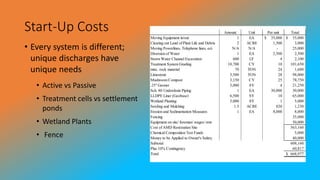
Start-Up Costs
• Every system is different;
unique discharges have
unique needs
• Active vs Passive
• Treatment cells vs settlement
ponds
• Wetland Plants
• Fence
Figure 2-1 Estimated Material Costs
Amount Unit Per unit Total
Moving Equipment in/out 1 EA 35,000$ 35,000$
Clearing out Land of Plant Life and Debris 2 ACRE 1,500 3,000
Moving Powerlines, Telephone lines, ect. N/A N/A - 25,000
Diversion of Water 1 EA 2,500 2,500
Storm Water Channel Excavation 600 LF 4 2,100
Treatment System Grading 10,700 CY 10 101,650
misc. rock material 70 TON 24 1,680
Limestone 3,500 TON 28 98,000
Mushroom Compost 3,150 CY 25 78,750
.25" Geonet 5,000 SY 4 21,250
Sch. 80 Underdrain Piping 1 EA 30,000 30,000
LLDPE Liner (Geobase) 6,500 SY 10 65,000
Wetland Planting 5,000 SY 1 5,000
Seeding and Mulching 1.5 ACRE 820 1,230
Erosion and Sedimentation Measures 1 EA 8,000 8,000
Fencing 35,000
Equipment on site/ foreman/ wages/ rent 50,000
Cost of AMD Restoration Site 563,160
Chemical Composition Test Funds 5,000
Money to be Applied to Owner's Salary 40,000
Subtotal 608,160
Plus 10% Contingency 60,817
Total 668,977$
Continuing Costs, Depreciation
• “Passive” treatment is not really passive, requires upkeep, regular
monitoring, and periodic field tests
• Active treatments often incur material electricity costs as well as costs
for chemicals/materials and wages.
• Depreciation
• Depletion varies by discharge flow rates
• Generally need to be replenished every 10 years
• Depreciation Expense offsets revenue generated
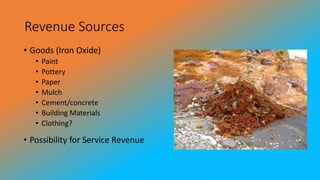
Revenue Sources
• Goods (Iron Oxide)
• Paint
• Pottery
• Paper
• Mulch
• Cement/concrete
• Building Materials
• Clothing?
• Possibility for Service Revenue
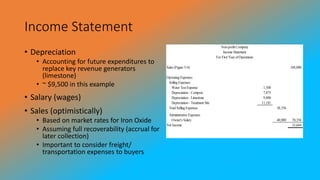
Income Statement
• Depreciation
• Accounting for future expenditures to
replace key revenue generators
(limestone)
• ~ $9,500 in this example
• Salary (wages)
• Sales (optimistically)
• Based on market rates for Iron Oxide
• Assuming full recoverability (accrual for
later collection)
• Important to consider freight/
transportation expenses to buyers
Figure 7-3
Sales (Figure 5-4) 104,000
Operating Expenses:
Selling Expenses
Water Test Expense 1,500
Depreciation - Compost 7,875
Depreciation - Limestone 9,800
Depreciation - Treatment Site 11,181
TotalSelling Expenses 30,356
Administrative Expenses
Owner's Salary 40,000 70,356
Net Income 33,644
Non-profit Company
Income Statement
For First Year ofOperations
Cash vs. Accrual, Revenues vs. Assets
• Revenues and Expenses do not immediately correlate to cash in hand
• Depreciation does not cause an outflow of cash
• Revenues do not always indicate cash received
• Cash flow problems are likely to occur as accumulated assets remain in
treatment cells
• For simplification (and best case scenario), iron oxides are shown as
revenues, even though a good portion of them would not be
recovered/sold until the treatment cells are replenished.
Service/Sales Contracts
• Good way to guarantee demand, get a good rate on iron oxide
• Potential for Service Revenue
• Pay to hire workers/crews to extract iron oxide
• Arrange there own extraction, use of company equipment, ect.
• Viable industries for contracts
• Painting/Pottery
• Bricklaying/Construction
• Clothing, fabrics, ect.
• Fish habitats and harvesting
Closing
• Sustainable Development is slow, but is not going away
• The Iron Oxide is there, but in many cases it is difficult/costly to
extract
• There isn’t a guaranteed source of revenue; need to find demand
• Expenses, while not all out-of-pocket, are continuous year-to-year
• While AMD recovery may not make break-even, recovering costs
reduces the amount of funding needed, and makes ventures that
recover their costs more competitive for grant money.
Thank You
SCRA
EPCAMR
Bloomsburg University
and the Honors Program
Dr. Edward Pitingolo, Advisor

Ryan A. McCampbell, Bloomsburg University, "A Cost-Benefit Analysis of AMD Recovery and its Implications for Potential Business Opportunities"

  • 1.
    A Cost-Benefit Analysisof AMD Recovery and its Implications for Potential Business Opportunities Ryan McCampbell AMR Conference 2015
  • 2.
    Background • Accounting studentat Bloomsburg University • Started as a paper for the Honors Program in my undergrad at Bloomsburg University – worked with Dr. Ed Pitingolo • Pursued the idea of “entering into the ‘business’ of Sustainability” • Worked closely with the SCRA for cost information-how the process works • Applied accounting knowledge to what I understood of AMD to develop a business plan
  • 3.
    Business and Sustainability •Brundtland Report – 1987 • Called for better resource management and environmental protection • Coined the phrase “Sustainability” (or sustainable development) • Industries have shifted to Sustainable Development • “green” projects • Limit waste/hazards on environment • Customer bases concerned with environmental impact • Triple Bottom Line – Profit, People, Planet • Companies began looking for ways being “green” could save money
  • 4.
    ‘Scarlift’ Site 15 •Vertical Flow • Series of Settlement and treatment cells • Utilizes compost, limestone, and wetland plants • Inflow: pH of 4.3, 28.6 mg/l Iron
  • 5.
    Feasibility/Assumptions • Best CaseScenario within reasonable expectations • Most of the iron oxides removed from the water are accessible/recoverable • Useful life of limestone/compost is 10 years • Organizing as Not-for-Profit • No taxes on income • Primary source of funding from support of State • No “service revenue”
  • 6.
    Start-Up Costs • Everysystem is different; unique discharges have unique needs • Active vs Passive • Treatment cells vs settlement ponds • Wetland Plants • Fence Figure 2-1 Estimated Material Costs Amount Unit Per unit Total Moving Equipment in/out 1 EA 35,000$ 35,000$ Clearing out Land of Plant Life and Debris 2 ACRE 1,500 3,000 Moving Powerlines, Telephone lines, ect. N/A N/A - 25,000 Diversion of Water 1 EA 2,500 2,500 Storm Water Channel Excavation 600 LF 4 2,100 Treatment System Grading 10,700 CY 10 101,650 misc. rock material 70 TON 24 1,680 Limestone 3,500 TON 28 98,000 Mushroom Compost 3,150 CY 25 78,750 .25" Geonet 5,000 SY 4 21,250 Sch. 80 Underdrain Piping 1 EA 30,000 30,000 LLDPE Liner (Geobase) 6,500 SY 10 65,000 Wetland Planting 5,000 SY 1 5,000 Seeding and Mulching 1.5 ACRE 820 1,230 Erosion and Sedimentation Measures 1 EA 8,000 8,000 Fencing 35,000 Equipment on site/ foreman/ wages/ rent 50,000 Cost of AMD Restoration Site 563,160 Chemical Composition Test Funds 5,000 Money to be Applied to Owner's Salary 40,000 Subtotal 608,160 Plus 10% Contingency 60,817 Total 668,977$
  • 7.
    Continuing Costs, Depreciation •“Passive” treatment is not really passive, requires upkeep, regular monitoring, and periodic field tests • Active treatments often incur material electricity costs as well as costs for chemicals/materials and wages. • Depreciation • Depletion varies by discharge flow rates • Generally need to be replenished every 10 years • Depreciation Expense offsets revenue generated
  • 8.
    Revenue Sources • Goods(Iron Oxide) • Paint • Pottery • Paper • Mulch • Cement/concrete • Building Materials • Clothing? • Possibility for Service Revenue
  • 9.
    Income Statement • Depreciation •Accounting for future expenditures to replace key revenue generators (limestone) • ~ $9,500 in this example • Salary (wages) • Sales (optimistically) • Based on market rates for Iron Oxide • Assuming full recoverability (accrual for later collection) • Important to consider freight/ transportation expenses to buyers Figure 7-3 Sales (Figure 5-4) 104,000 Operating Expenses: Selling Expenses Water Test Expense 1,500 Depreciation - Compost 7,875 Depreciation - Limestone 9,800 Depreciation - Treatment Site 11,181 TotalSelling Expenses 30,356 Administrative Expenses Owner's Salary 40,000 70,356 Net Income 33,644 Non-profit Company Income Statement For First Year ofOperations
  • 10.
    Cash vs. Accrual,Revenues vs. Assets • Revenues and Expenses do not immediately correlate to cash in hand • Depreciation does not cause an outflow of cash • Revenues do not always indicate cash received • Cash flow problems are likely to occur as accumulated assets remain in treatment cells • For simplification (and best case scenario), iron oxides are shown as revenues, even though a good portion of them would not be recovered/sold until the treatment cells are replenished.
  • 11.
    Service/Sales Contracts • Goodway to guarantee demand, get a good rate on iron oxide • Potential for Service Revenue • Pay to hire workers/crews to extract iron oxide • Arrange there own extraction, use of company equipment, ect. • Viable industries for contracts • Painting/Pottery • Bricklaying/Construction • Clothing, fabrics, ect. • Fish habitats and harvesting
  • 12.
    Closing • Sustainable Developmentis slow, but is not going away • The Iron Oxide is there, but in many cases it is difficult/costly to extract • There isn’t a guaranteed source of revenue; need to find demand • Expenses, while not all out-of-pocket, are continuous year-to-year • While AMD recovery may not make break-even, recovering costs reduces the amount of funding needed, and makes ventures that recover their costs more competitive for grant money.
  • 13.
    Thank You SCRA EPCAMR Bloomsburg University andthe Honors Program Dr. Edward Pitingolo, Advisor