PricewaterhouseCoopers Audit LLC, Central Tower, 6th floor, suit 601
Sukhbaatar square SBD- 8, Ulaanbaatar 14200, Mongolia
Tel: 976 (11)329088, 329089 Fax: 976 (11)322068, www.pwc.com/mn
© 2012 PwC. All rights reserved. Not for further distribution without the permission of PwC. "PwC" refers to the network of member firms of PricewaterhouseCoopers International Limited (PwCIL), or, as the context requires, individual member firms of the PwC network. Each
member firm is a separate legal entity and does not act as agent of PwCIL or any other member firm. PwCIL does not provide any services to clients. PwCIL is not responsible or liable for the acts or omissions of any of its member firms nor can it control the exercise of their
professional judgment or bind them in any way. No member firm is responsible or liable for the acts or omissions of any other member firm nor can it control the exercise of another member firm's professional judgment or bind another member firm or PwCIL in any way.
23 April 2012
Contacts:
Carolyn Clarke
Managing Partner
E-mail: carolyn.x.clarke@mn.pwc.com
Abdulkhamid Muminov
Partner, Tax
E-mail:
abdulkhamid.muminov@mn.pwc.com
Tsendmaa Choijamts
Executive Director, Tax
E-mail:
tsendmaa.choijamts@mn.pwc.com
Leylim Mizamkhan
Consultant, Tax
E-mail:
leylim.x.mizamkhan@mn.pwc.com
www.pwc.com
Tax Alert
Issue 2
© 2012 PwC. All rights reserved. Not for further distribution without the permission of PwC. "PwC" refers to the network of member firms of PricewaterhouseCoopers International Limited (PwCIL), or, as the context requires, individual member firms of the PwC network. Each
member firm is a separate legal entity and does not act as agent of PwCIL or any other member firm. PwCIL does not provide any services to clients. PwCIL is not responsible or liable for the acts or omissions of any of its member firms nor can it control the exercise of their
professional judgment or bind them in any way. No member firm is responsible or liable for the acts or omissions of any other member firm nor can it control the exercise of another member firm's professional judgment or bind another member firm or PwCIL in any way.
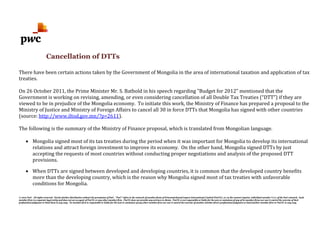
Cancellation of DTTs
There have been certain actions taken by the Government of Mongolia in the area of international taxation and application of tax
treaties.
On 26 October 2011, the Prime Minister Mr. S. Batbold in his speech regarding "Budget for 2012" mentioned that the
Government is working on revising, amending, or even considering cancellation of all Double Tax Treaties (“DTT”) if they are
viewed to be in prejudice of the Mongolia economy. To initiate this work, the Ministry of Finance has prepared a proposal to the
Ministry of Justice and Ministry of Foreign Affairs to cancel all 30 in force DTTs that Mongolia has signed with other countries
(source: http://www.iltod.gov.mn/?p=2611).
The following is the summary of the Ministry of Finance proposal, which is translated from Mongolian language.
• Mongolia signed most of its tax treaties during the period when it was important for Mongolia to develop its international
relations and attract foreign investment to improve its economy. On the other hand, Mongolia signed DTTs by just
accepting the requests of most countries without conducting proper negotiations and analysis of the proposed DTT
provisions.
• When DTTs are signed between developed and developing countries, it is common that the developed country benefits
more than the developing country, which is the reason why Mongolia signed most of tax treaties with unfavorable
conditions for Mongolia.
© 2012 PwC. All rights reserved. Not for further distribution without the permission of PwC. "PwC" refers to the network of member firms of PricewaterhouseCoopers International Limited (PwCIL), or, as the context requires, individual member firms of the PwC network. Each
member firm is a separate legal entity and does not act as agent of PwCIL or any other member firm. PwCIL does not provide any services to clients. PwCIL is not responsible or liable for the acts or omissions of any of its member firms nor can it control the exercise of their
professional judgment or bind them in any way. No member firm is responsible or liable for the acts or omissions of any other member firm nor can it control the exercise of another member firm's professional judgment or bind another member firm or PwCIL in any way.
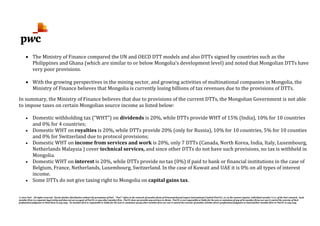
• The Ministry of Finance compared the UN and OECD DTT models and also DTTs signed by countries such as the
Philippines and Ghana (which are similar to or below Mongolia’s development level) and noted that Mongolian DTTs have
very poor provisions.
• With the growing perspectives in the mining sector, and growing activities of multinational companies in Mongolia, the
Ministry of Finance believes that Mongolia is currently losing billions of tax revenues due to the provisions of DTTs.
In summary, the Ministry of Finance believes that due to provisions of the current DTTs, the Mongolian Government is not able
to impose taxes on certain Mongolian source income as listed below:
• Domestic withholding tax (“WHT”) on dividends is 20%, while DTTs provide WHT of 15% (India), 10% for 10 countries
and 0% for 4 countries;
• Domestic WHT on royalties is 20%, while DTTs provide 20% (only for Russia), 10% for 10 countries, 5% for 10 counties
and 0% for Switzerland due to protocol provisions;
• Domestic WHT on income from services and work is 20%, only 7 DTTs (Canada, North Korea, India, Italy, Luxembourg,
Netherlands Malaysia ) cover technical services, and since other DTTs do not have such provisions, no tax is withheld in
Mongolia.
• Domestic WHT on interest is 20%, while DTTs provide no tax (0%) if paid to bank or financial institutions in the case of
Belgium, France, Netherlands, Luxembourg, Switzerland. In the case of Kuwait and UAE it is 0% on all types of interest
income.
• Some DTTs do not give taxing right to Mongolia on capital gains tax.
© 2012 PwC. All rights reserved. Not for further distribution without the permission of PwC. "PwC" refers to the network of member firms of PricewaterhouseCoopers International Limited (PwCIL), or, as the context requires, individual member firms of the PwC network. Each
member firm is a separate legal entity and does not act as agent of PwCIL or any other member firm. PwCIL does not provide any services to clients. PwCIL is not responsible or liable for the acts or omissions of any of its member firms nor can it control the exercise of their
professional judgment or bind them in any way. No member firm is responsible or liable for the acts or omissions of any other member firm nor can it control the exercise of another member firm's professional judgment or bind another member firm or PwCIL in any way.
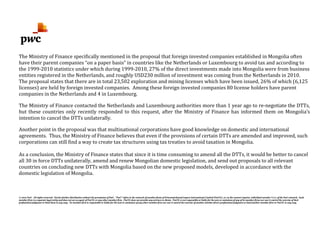
The Ministry of Finance specifically mentioned in the proposal that foreign invested companies established in Mongolia often
have their parent companies “on a paper basis” in countries like the Netherlands or Luxembourg to avoid tax and according to
the 1999-2010 statistics under which during 1999-2010, 27% of the direct investments made into Mongolia were from business
entities registered in the Netherlands, and roughly USD230 million of investment was coming from the Netherlands in 2010.
The proposal states that there are in total 23,502 exploration and mining licenses which have been issued, 26% of which (6,125
licenses) are held by foreign invested companies. Among these foreign invested companies 80 license holders have parent
companies in the Netherlands and 4 in Luxembourg.
The Ministry of Finance contacted the Netherlands and Luxembourg authorities more than 1 year ago to re-negotiate the DTTs,
but these countries only recently responded to this request, after the Ministry of Finance has informed them on Mongolia’s
intention to cancel the DTTs unilaterally.
Another point in the proposal was that multinational corporations have good knowledge on domestic and international
agreements. Thus, the Ministry of Finance believes that even if the provisions of certain DTTs are amended and improved, such
corporations can still find a way to create tax structures using tax treaties to avoid taxation in Mongolia.
As a conclusion, the Ministry of Finance states that since it is time consuming to amend all the DTTs, it would be better to cancel
all 30 in force DTTs unilaterally, amend and renew Mongolian domestic legislation, and send out proposals to all relevant
countries on concluding new DTTs with Mongolia based on the new proposed models, developed in accordance with the
domestic legislation of Mongolia.
© 2012 PwC. All rights reserved. Not for further distribution without the permission of PwC. "PwC" refers to the network of member firms of PricewaterhouseCoopers International Limited (PwCIL), or, as the context requires, individual member firms of the PwC network. Each
member firm is a separate legal entity and does not act as agent of PwCIL or any other member firm. PwCIL does not provide any services to clients. PwCIL is not responsible or liable for the acts or omissions of any of its member firms nor can it control the exercise of their
professional judgment or bind them in any way. No member firm is responsible or liable for the acts or omissions of any other member firm nor can it control the exercise of another member firm's professional judgment or bind another member firm or PwCIL in any way.
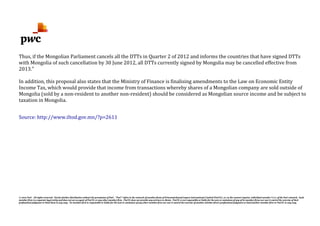
Thus, if the Mongolian Parliament cancels all the DTTs in Quarter 2 of 2012 and informs the countries that have signed DTTs
with Mongolia of such cancellation by 30 June 2012, all DTTs currently signed by Mongolia may be cancelled effective from
2013."
In addition, this proposal also states that the Ministry of Finance is finalising amendments to the Law on Economic Entity
Income Tax, which would provide that income from transactions whereby shares of a Mongolian company are sold outside of
Mongolia (sold by a non-resident to another non-resident) should be considered as Mongolian source income and be subject to
taxation in Mongolia.
Source: http://www.iltod.gov.mn/?p=2611

31.10.2012, Tax Alert 2, PWC Mongolia

  • 1.
    PricewaterhouseCoopers Audit LLC,Central Tower, 6th floor, suit 601 Sukhbaatar square SBD- 8, Ulaanbaatar 14200, Mongolia Tel: 976 (11)329088, 329089 Fax: 976 (11)322068, www.pwc.com/mn © 2012 PwC. All rights reserved. Not for further distribution without the permission of PwC. "PwC" refers to the network of member firms of PricewaterhouseCoopers International Limited (PwCIL), or, as the context requires, individual member firms of the PwC network. Each member firm is a separate legal entity and does not act as agent of PwCIL or any other member firm. PwCIL does not provide any services to clients. PwCIL is not responsible or liable for the acts or omissions of any of its member firms nor can it control the exercise of their professional judgment or bind them in any way. No member firm is responsible or liable for the acts or omissions of any other member firm nor can it control the exercise of another member firm's professional judgment or bind another member firm or PwCIL in any way. 23 April 2012 Contacts: Carolyn Clarke Managing Partner E-mail: carolyn.x.clarke@mn.pwc.com Abdulkhamid Muminov Partner, Tax E-mail: abdulkhamid.muminov@mn.pwc.com Tsendmaa Choijamts Executive Director, Tax E-mail: tsendmaa.choijamts@mn.pwc.com Leylim Mizamkhan Consultant, Tax E-mail: leylim.x.mizamkhan@mn.pwc.com www.pwc.com Tax Alert Issue 2
  • 2.
    © 2012 PwC.All rights reserved. Not for further distribution without the permission of PwC. "PwC" refers to the network of member firms of PricewaterhouseCoopers International Limited (PwCIL), or, as the context requires, individual member firms of the PwC network. Each member firm is a separate legal entity and does not act as agent of PwCIL or any other member firm. PwCIL does not provide any services to clients. PwCIL is not responsible or liable for the acts or omissions of any of its member firms nor can it control the exercise of their professional judgment or bind them in any way. No member firm is responsible or liable for the acts or omissions of any other member firm nor can it control the exercise of another member firm's professional judgment or bind another member firm or PwCIL in any way. Cancellation of DTTs There have been certain actions taken by the Government of Mongolia in the area of international taxation and application of tax treaties. On 26 October 2011, the Prime Minister Mr. S. Batbold in his speech regarding "Budget for 2012" mentioned that the Government is working on revising, amending, or even considering cancellation of all Double Tax Treaties (“DTT”) if they are viewed to be in prejudice of the Mongolia economy. To initiate this work, the Ministry of Finance has prepared a proposal to the Ministry of Justice and Ministry of Foreign Affairs to cancel all 30 in force DTTs that Mongolia has signed with other countries (source: http://www.iltod.gov.mn/?p=2611). The following is the summary of the Ministry of Finance proposal, which is translated from Mongolian language. • Mongolia signed most of its tax treaties during the period when it was important for Mongolia to develop its international relations and attract foreign investment to improve its economy. On the other hand, Mongolia signed DTTs by just accepting the requests of most countries without conducting proper negotiations and analysis of the proposed DTT provisions. • When DTTs are signed between developed and developing countries, it is common that the developed country benefits more than the developing country, which is the reason why Mongolia signed most of tax treaties with unfavorable conditions for Mongolia.
  • 3.
    © 2012 PwC.All rights reserved. Not for further distribution without the permission of PwC. "PwC" refers to the network of member firms of PricewaterhouseCoopers International Limited (PwCIL), or, as the context requires, individual member firms of the PwC network. Each member firm is a separate legal entity and does not act as agent of PwCIL or any other member firm. PwCIL does not provide any services to clients. PwCIL is not responsible or liable for the acts or omissions of any of its member firms nor can it control the exercise of their professional judgment or bind them in any way. No member firm is responsible or liable for the acts or omissions of any other member firm nor can it control the exercise of another member firm's professional judgment or bind another member firm or PwCIL in any way. • The Ministry of Finance compared the UN and OECD DTT models and also DTTs signed by countries such as the Philippines and Ghana (which are similar to or below Mongolia’s development level) and noted that Mongolian DTTs have very poor provisions. • With the growing perspectives in the mining sector, and growing activities of multinational companies in Mongolia, the Ministry of Finance believes that Mongolia is currently losing billions of tax revenues due to the provisions of DTTs. In summary, the Ministry of Finance believes that due to provisions of the current DTTs, the Mongolian Government is not able to impose taxes on certain Mongolian source income as listed below: • Domestic withholding tax (“WHT”) on dividends is 20%, while DTTs provide WHT of 15% (India), 10% for 10 countries and 0% for 4 countries; • Domestic WHT on royalties is 20%, while DTTs provide 20% (only for Russia), 10% for 10 countries, 5% for 10 counties and 0% for Switzerland due to protocol provisions; • Domestic WHT on income from services and work is 20%, only 7 DTTs (Canada, North Korea, India, Italy, Luxembourg, Netherlands Malaysia ) cover technical services, and since other DTTs do not have such provisions, no tax is withheld in Mongolia. • Domestic WHT on interest is 20%, while DTTs provide no tax (0%) if paid to bank or financial institutions in the case of Belgium, France, Netherlands, Luxembourg, Switzerland. In the case of Kuwait and UAE it is 0% on all types of interest income. • Some DTTs do not give taxing right to Mongolia on capital gains tax.
  • 4.
    © 2012 PwC.All rights reserved. Not for further distribution without the permission of PwC. "PwC" refers to the network of member firms of PricewaterhouseCoopers International Limited (PwCIL), or, as the context requires, individual member firms of the PwC network. Each member firm is a separate legal entity and does not act as agent of PwCIL or any other member firm. PwCIL does not provide any services to clients. PwCIL is not responsible or liable for the acts or omissions of any of its member firms nor can it control the exercise of their professional judgment or bind them in any way. No member firm is responsible or liable for the acts or omissions of any other member firm nor can it control the exercise of another member firm's professional judgment or bind another member firm or PwCIL in any way. The Ministry of Finance specifically mentioned in the proposal that foreign invested companies established in Mongolia often have their parent companies “on a paper basis” in countries like the Netherlands or Luxembourg to avoid tax and according to the 1999-2010 statistics under which during 1999-2010, 27% of the direct investments made into Mongolia were from business entities registered in the Netherlands, and roughly USD230 million of investment was coming from the Netherlands in 2010. The proposal states that there are in total 23,502 exploration and mining licenses which have been issued, 26% of which (6,125 licenses) are held by foreign invested companies. Among these foreign invested companies 80 license holders have parent companies in the Netherlands and 4 in Luxembourg. The Ministry of Finance contacted the Netherlands and Luxembourg authorities more than 1 year ago to re-negotiate the DTTs, but these countries only recently responded to this request, after the Ministry of Finance has informed them on Mongolia’s intention to cancel the DTTs unilaterally. Another point in the proposal was that multinational corporations have good knowledge on domestic and international agreements. Thus, the Ministry of Finance believes that even if the provisions of certain DTTs are amended and improved, such corporations can still find a way to create tax structures using tax treaties to avoid taxation in Mongolia. As a conclusion, the Ministry of Finance states that since it is time consuming to amend all the DTTs, it would be better to cancel all 30 in force DTTs unilaterally, amend and renew Mongolian domestic legislation, and send out proposals to all relevant countries on concluding new DTTs with Mongolia based on the new proposed models, developed in accordance with the domestic legislation of Mongolia.
  • 5.
    © 2012 PwC.All rights reserved. Not for further distribution without the permission of PwC. "PwC" refers to the network of member firms of PricewaterhouseCoopers International Limited (PwCIL), or, as the context requires, individual member firms of the PwC network. Each member firm is a separate legal entity and does not act as agent of PwCIL or any other member firm. PwCIL does not provide any services to clients. PwCIL is not responsible or liable for the acts or omissions of any of its member firms nor can it control the exercise of their professional judgment or bind them in any way. No member firm is responsible or liable for the acts or omissions of any other member firm nor can it control the exercise of another member firm's professional judgment or bind another member firm or PwCIL in any way. Thus, if the Mongolian Parliament cancels all the DTTs in Quarter 2 of 2012 and informs the countries that have signed DTTs with Mongolia of such cancellation by 30 June 2012, all DTTs currently signed by Mongolia may be cancelled effective from 2013." In addition, this proposal also states that the Ministry of Finance is finalising amendments to the Law on Economic Entity Income Tax, which would provide that income from transactions whereby shares of a Mongolian company are sold outside of Mongolia (sold by a non-resident to another non-resident) should be considered as Mongolian source income and be subject to taxation in Mongolia. Source: http://www.iltod.gov.mn/?p=2611