Terms of Endearment Lines and Angles:  3.1
Parallel Lines Coplanar lines that do not intersect
Skew Lines Non-Coplanar lines that do not intersect
Parallel Planes Planes that do not intersect
Parallel Postulate If there is a line and a point not on the line, then there is exactly one line through the point parallel to the given line
Perpendicular Postulate If there is a line and a point not on the line, then there is exactly one line through the given point perpendicular to the given line
Transversal A line that intersects two or more coplanar lines at different points Most of what will be referred to as a transversal will deal with parallel lines and the transversal being the line that intersects both of them, but transversals do not have to go through parallel lines only…by definition they simply go through two coplanar lines
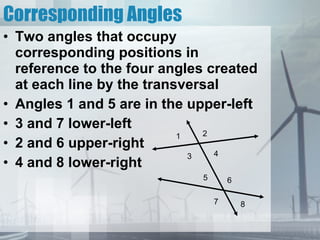
Corresponding Angles Two angles that occupy corresponding positions in reference to the four angles created at each line by the transversal Angles 1 and 5 are in the upper-left 3 and 7 lower-left 2 and 6 upper-right 4 and 8 lower-right 1 2 3 4 5 6 7 8
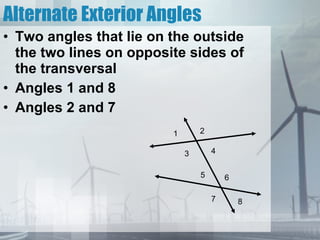
Alternate Exterior Angles Two angles that lie on the outside the two lines on opposite sides of the transversal Angles 1 and 8 Angles 2 and 7 1 2 3 4 5 6 7 8
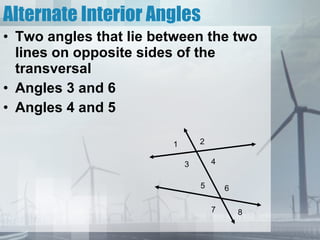
Alternate Interior Angles Two angles that lie between the two lines on opposite sides of the transversal Angles 3 and 6 Angles 4 and 5 1 2 3 4 5 6 7 8
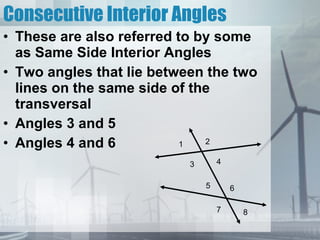
Consecutive Interior Angles These are also referred to by some as Same Side Interior Angles Two angles that lie between the two lines on the same side of the transversal Angles 3 and 5 Angles 4 and 6 1 2 3 4 5 6 7 8

3.1 terms

  • 1.
    Terms of EndearmentLines and Angles: 3.1
  • 2.
    Parallel Lines Coplanarlines that do not intersect
  • 3.
    Skew Lines Non-Coplanarlines that do not intersect
  • 4.
    Parallel Planes Planesthat do not intersect
  • 5.
    Parallel Postulate Ifthere is a line and a point not on the line, then there is exactly one line through the point parallel to the given line
  • 6.
    Perpendicular Postulate Ifthere is a line and a point not on the line, then there is exactly one line through the given point perpendicular to the given line
  • 7.
    Transversal A linethat intersects two or more coplanar lines at different points Most of what will be referred to as a transversal will deal with parallel lines and the transversal being the line that intersects both of them, but transversals do not have to go through parallel lines only…by definition they simply go through two coplanar lines
  • 8.
    Corresponding Angles Twoangles that occupy corresponding positions in reference to the four angles created at each line by the transversal Angles 1 and 5 are in the upper-left 3 and 7 lower-left 2 and 6 upper-right 4 and 8 lower-right 1 2 3 4 5 6 7 8
  • 9.
    Alternate Exterior AnglesTwo angles that lie on the outside the two lines on opposite sides of the transversal Angles 1 and 8 Angles 2 and 7 1 2 3 4 5 6 7 8
  • 10.
    Alternate Interior AnglesTwo angles that lie between the two lines on opposite sides of the transversal Angles 3 and 6 Angles 4 and 5 1 2 3 4 5 6 7 8
  • 11.
    Consecutive Interior AnglesThese are also referred to by some as Same Side Interior Angles Two angles that lie between the two lines on the same side of the transversal Angles 3 and 5 Angles 4 and 6 1 2 3 4 5 6 7 8