EngageSelling.com
3 Opening Phrases
to NEVER USE
Colleen Francis
EngageSelling.com
3 Opening Phrases to NEVER USE
In sales, there's a fine line between persistence and stalking. In
my experience, with the exception of prospects who are already
in the sales cycle, that line is usually drawn at about once every
6 weeks. So given that you only have once every 6 weeks to
make a direct impression on your "B" and "C" list prospects, how
can you make sure those follow-up calls have the greatest
possible impact?
© Engage Selling Solutions Inc. 2
Mistake #1: “How are you today?”
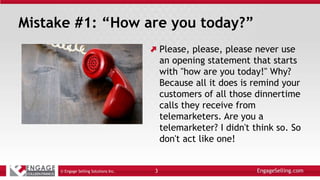
Please, please, please never use
an opening statement that starts
with "how are you today!" Why?
Because all it does is remind your
customers of all those dinnertime
calls they receive from
telemarketers. Are you a
telemarketer? I didn't think so. So
don't act like one!
© Engage Selling Solutions Inc. 3
Mistake #1: “How are you today?”
Please, please, please never use
an opening statement that starts
with "how are you today!" Why?
Because all it does is remind your
customers of all those dinnertime
calls they receive from
telemarketers. Are you a
telemarketer? I didn't think so. So
don't act like one!
© Engage Selling Solutions Inc. 4
Mistake #1: “How are you today?”
Instead, try this rapport-winning
phrase: "Did I catch you at a bad time?"
This works well because it points out
the obvious, and that makes the
customer laugh. Of course it's a bad
time! Any non-scheduled call is an
interruption, and no interruption ever
comes at a "good" time. After all, if all
your customers spent their days just
waiting at their desk for you to call,
then sales would be too easy!
© Engage Selling Solutions Inc. 5
Mistake #2: “I’m just calling to check in…”
Are you their mother, or their sales
rep? Seriously, are you really calling
just to check in or check up? If so,
either you've got a lot more time on
your hands than I do, or else it's time
to seriously consider a career change!
© Engage Selling Solutions Inc. 6
Mistake #2: “I’m just calling to check in…”
First, start by removing the word "just" - it
makes you sound unimportant, and your call
seem like an afterthought. Instead, replace it
with something like: "The last time we spoke,
you…." By taking the customer back to the last
time you spoke, you remind them of your
relationship, and prove that you are carrying
through on what you were asked or promised
to do. Nothing builds rapport better than a
promise kept. And as we know, rapport leads
to trust, and trust leads to loyal customers!
© Engage Selling Solutions Inc. 7
Mistake #3: “…to see if anything has changed
since the last time we spoke”
Our experience in today's market shows
that if a prospect doesn't understand the
purpose of your call within the first 30
seconds, 99 times out of 100, they will
simply lose interest, stop listening and
start looking for a way to get you off the
phone.
© Engage Selling Solutions Inc. 8
Mistake #3: “…to see if anything has changed
since the last time we spoke”
State up front exactly why you are calling, and
your prospects will appreciate your openness.
To complete what we started in the response
to Mistake #2, try tying your opening
statement back to something specific the
client requested on your last interaction, like:
"The last time we spoke, you mentioned that
you wanted me to call before we had a price
increase…" or, "The last time we spoke, you
mentioned you were looking for consultants
with experience in the banking industry."
© Engage Selling Solutions Inc. 9
Final Thoughts
By the way - there are ways you can stay in touch (and click here for 7
ways to stay in contact with clients) with your prospects more often than
once every 6 weeks, and still not be considered a stalker. Just use a
combination of direct contacts (the phone) with indirect contacts (email or
mail).
Mix up a phone call with an email, and then later maybe send them an
individualized hard copy mail piece - not a generic corporate brochure, but
something that's relevant to them, like an article you clipped from a
magazine with a personal note, a celebration card recognizing their
company anniversary or an invitation to your open house.
© Engage Selling Solutions Inc. 10
Final Thoughts
To get you started, try the following schedule:
Week 1: Follow-up call with action items noted for the next direct contact.
Week 3: Company email newsletter, announcement or article. It doesn't
really matter what, provided it is content-rich and NOT an advertisement.
After all, this contact is intended to increase your credibility, not weaken
it.
Week 4-5: Another indirect contact such as a birthday or anniversary card,
a note in the mail with a newspaper clipping they might be interested in,
or an email with a newsworthy article about their industry. This contact is
designed to strengthen your personal relationship, and help you build
rapport.
© Engage Selling Solutions Inc. 11
Final Thoughts
Week 6-7: Follow up again with another direct phone call.
Finally, a last piece of advice: when making a follow-up call, make sure
you're never in a position where you're still thinking about what you're
going to say while the phone is ringing. Even if you're a veteran
salesperson, pick up a pen and script the first 45-second "opener" of your
next call right now. Then, look in a mirror and say it out loud.
© Engage Selling Solutions Inc. 12

3 Opening Phrases to Never Use

  • 1.
    EngageSelling.com 3 Opening Phrases toNEVER USE Colleen Francis EngageSelling.com
  • 2.
    3 Opening Phrasesto NEVER USE In sales, there's a fine line between persistence and stalking. In my experience, with the exception of prospects who are already in the sales cycle, that line is usually drawn at about once every 6 weeks. So given that you only have once every 6 weeks to make a direct impression on your "B" and "C" list prospects, how can you make sure those follow-up calls have the greatest possible impact? © Engage Selling Solutions Inc. 2
  • 3.
    Mistake #1: “Howare you today?” Please, please, please never use an opening statement that starts with "how are you today!" Why? Because all it does is remind your customers of all those dinnertime calls they receive from telemarketers. Are you a telemarketer? I didn't think so. So don't act like one! © Engage Selling Solutions Inc. 3
  • 4.
    Mistake #1: “Howare you today?” Please, please, please never use an opening statement that starts with "how are you today!" Why? Because all it does is remind your customers of all those dinnertime calls they receive from telemarketers. Are you a telemarketer? I didn't think so. So don't act like one! © Engage Selling Solutions Inc. 4
  • 5.
    Mistake #1: “Howare you today?” Instead, try this rapport-winning phrase: "Did I catch you at a bad time?" This works well because it points out the obvious, and that makes the customer laugh. Of course it's a bad time! Any non-scheduled call is an interruption, and no interruption ever comes at a "good" time. After all, if all your customers spent their days just waiting at their desk for you to call, then sales would be too easy! © Engage Selling Solutions Inc. 5
  • 6.
    Mistake #2: “I’mjust calling to check in…” Are you their mother, or their sales rep? Seriously, are you really calling just to check in or check up? If so, either you've got a lot more time on your hands than I do, or else it's time to seriously consider a career change! © Engage Selling Solutions Inc. 6
  • 7.
    Mistake #2: “I’mjust calling to check in…” First, start by removing the word "just" - it makes you sound unimportant, and your call seem like an afterthought. Instead, replace it with something like: "The last time we spoke, you…." By taking the customer back to the last time you spoke, you remind them of your relationship, and prove that you are carrying through on what you were asked or promised to do. Nothing builds rapport better than a promise kept. And as we know, rapport leads to trust, and trust leads to loyal customers! © Engage Selling Solutions Inc. 7
  • 8.
    Mistake #3: “…tosee if anything has changed since the last time we spoke” Our experience in today's market shows that if a prospect doesn't understand the purpose of your call within the first 30 seconds, 99 times out of 100, they will simply lose interest, stop listening and start looking for a way to get you off the phone. © Engage Selling Solutions Inc. 8
  • 9.
    Mistake #3: “…tosee if anything has changed since the last time we spoke” State up front exactly why you are calling, and your prospects will appreciate your openness. To complete what we started in the response to Mistake #2, try tying your opening statement back to something specific the client requested on your last interaction, like: "The last time we spoke, you mentioned that you wanted me to call before we had a price increase…" or, "The last time we spoke, you mentioned you were looking for consultants with experience in the banking industry." © Engage Selling Solutions Inc. 9
  • 10.
    Final Thoughts By theway - there are ways you can stay in touch (and click here for 7 ways to stay in contact with clients) with your prospects more often than once every 6 weeks, and still not be considered a stalker. Just use a combination of direct contacts (the phone) with indirect contacts (email or mail). Mix up a phone call with an email, and then later maybe send them an individualized hard copy mail piece - not a generic corporate brochure, but something that's relevant to them, like an article you clipped from a magazine with a personal note, a celebration card recognizing their company anniversary or an invitation to your open house. © Engage Selling Solutions Inc. 10
  • 11.
    Final Thoughts To getyou started, try the following schedule: Week 1: Follow-up call with action items noted for the next direct contact. Week 3: Company email newsletter, announcement or article. It doesn't really matter what, provided it is content-rich and NOT an advertisement. After all, this contact is intended to increase your credibility, not weaken it. Week 4-5: Another indirect contact such as a birthday or anniversary card, a note in the mail with a newspaper clipping they might be interested in, or an email with a newsworthy article about their industry. This contact is designed to strengthen your personal relationship, and help you build rapport. © Engage Selling Solutions Inc. 11
  • 12.
    Final Thoughts Week 6-7:Follow up again with another direct phone call. Finally, a last piece of advice: when making a follow-up call, make sure you're never in a position where you're still thinking about what you're going to say while the phone is ringing. Even if you're a veteran salesperson, pick up a pen and script the first 45-second "opener" of your next call right now. Then, look in a mirror and say it out loud. © Engage Selling Solutions Inc. 12