Emerging Threats to InfrastructureJorge OrchillesSecurity AnalystNorth Florida ISACA
About Your SpeakerInformation Technology for over 7 years
Security Operations Center Analyst – Terremark Worldwide, Inc (NASDAQ: TMRK)
Consultant by night – Orchilles Consulting
Master of Science in Management Information Systems – Florida International University
Author – Microsoft Windows 7 Administrator’s Reference (Syngress)
Certifications – GCIH, CCDA, CSSDS, MCTS, MCP, Security+
Organizations:
VP of South Florida ISSA
Hack Miami
OWASP
InfraGard
Miami Electronic Crimes Task ForceAbout TerremarkLeading global provider of managed IT servicesColocationNetwork & ConnectivityManaged HostingCloud ComputingInformation SecurityData Services & Disaster RecoveryAccess to more than 160 global network carriersVMware Service Provider of the Year 2009
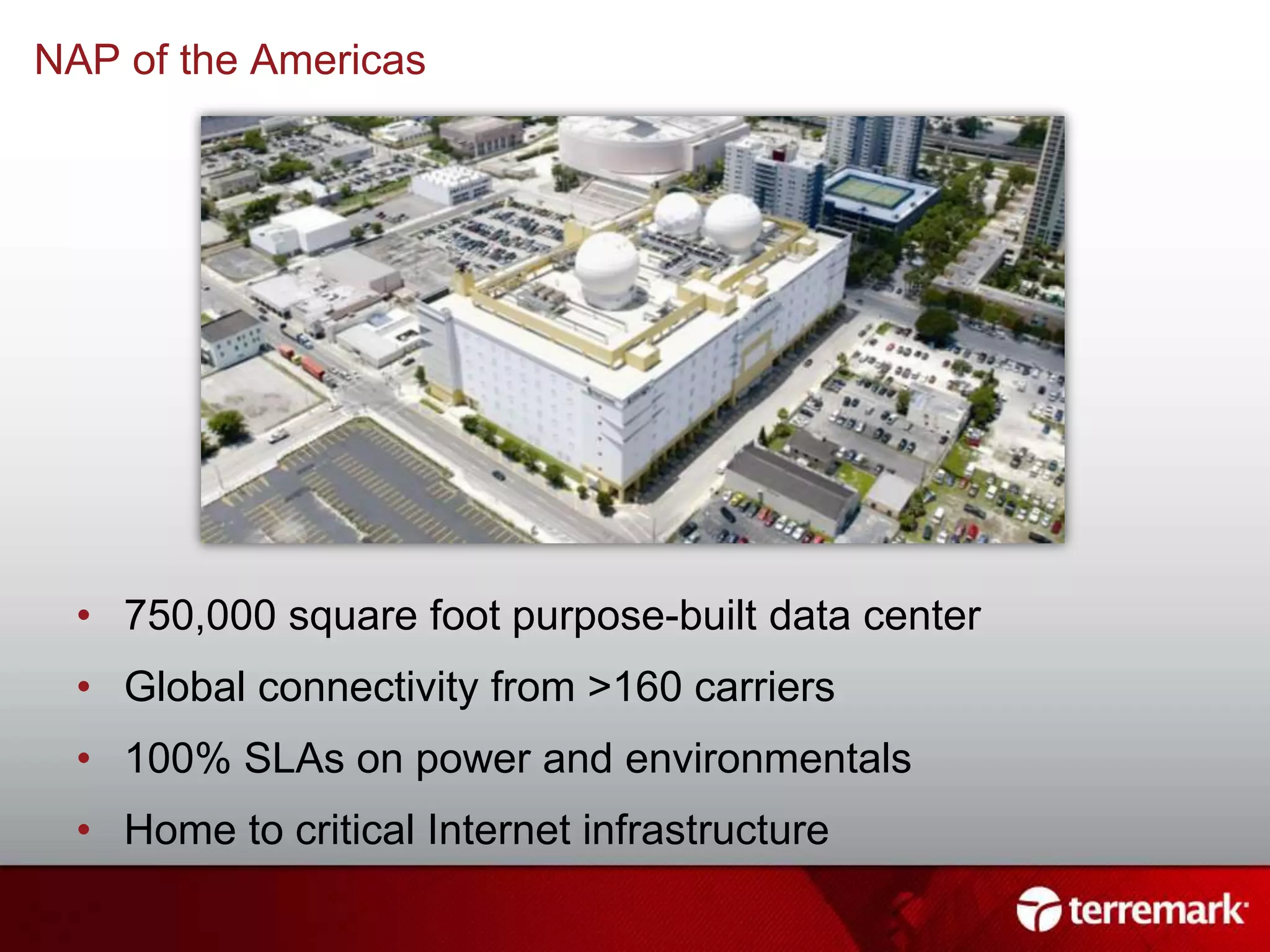
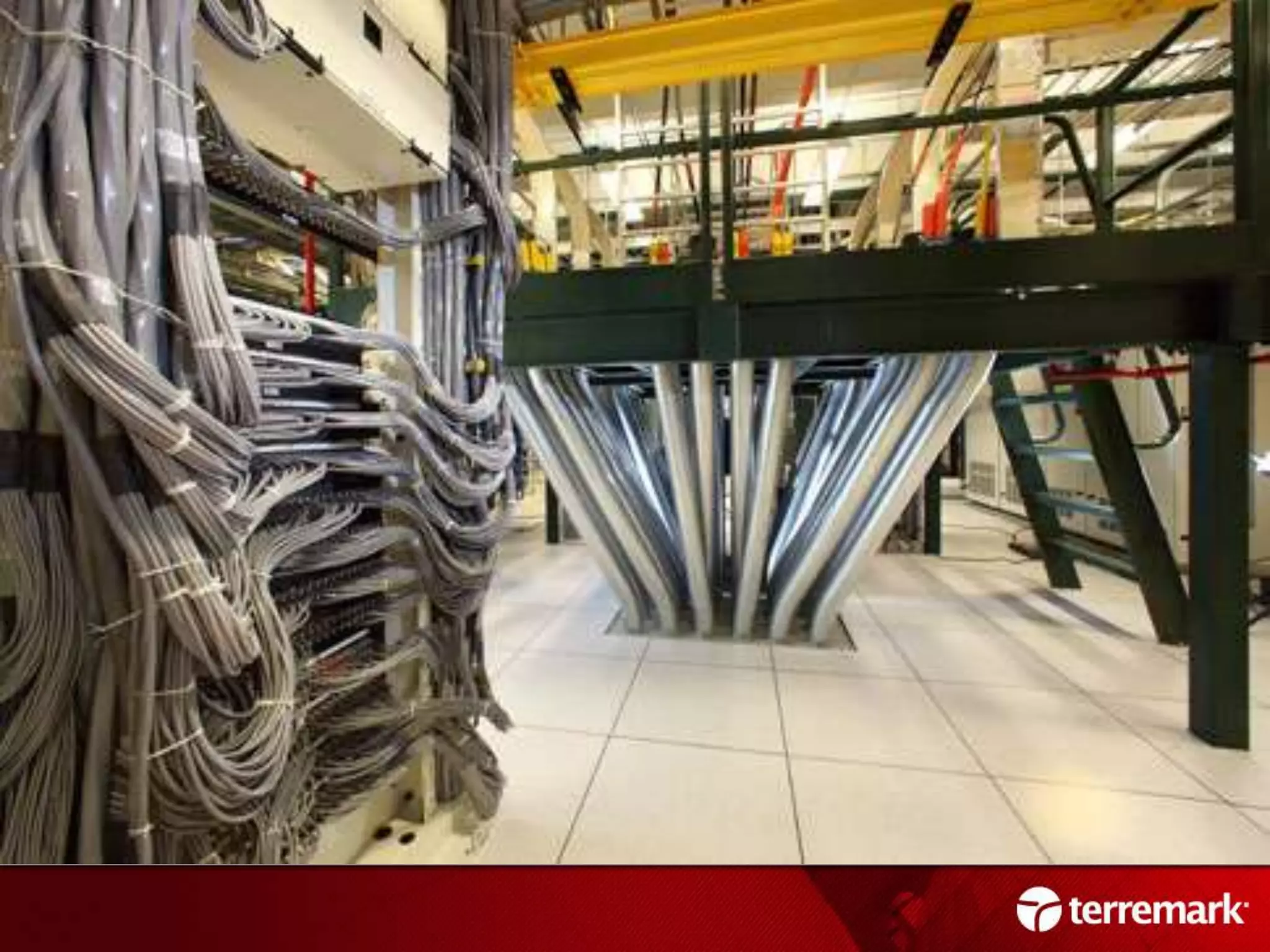
NAP of the Americas750,000 square foot purpose-built data centerGlobal connectivity from >160 carriers100% SLAs on power and environmentalsHome to critical Internet infrastructure
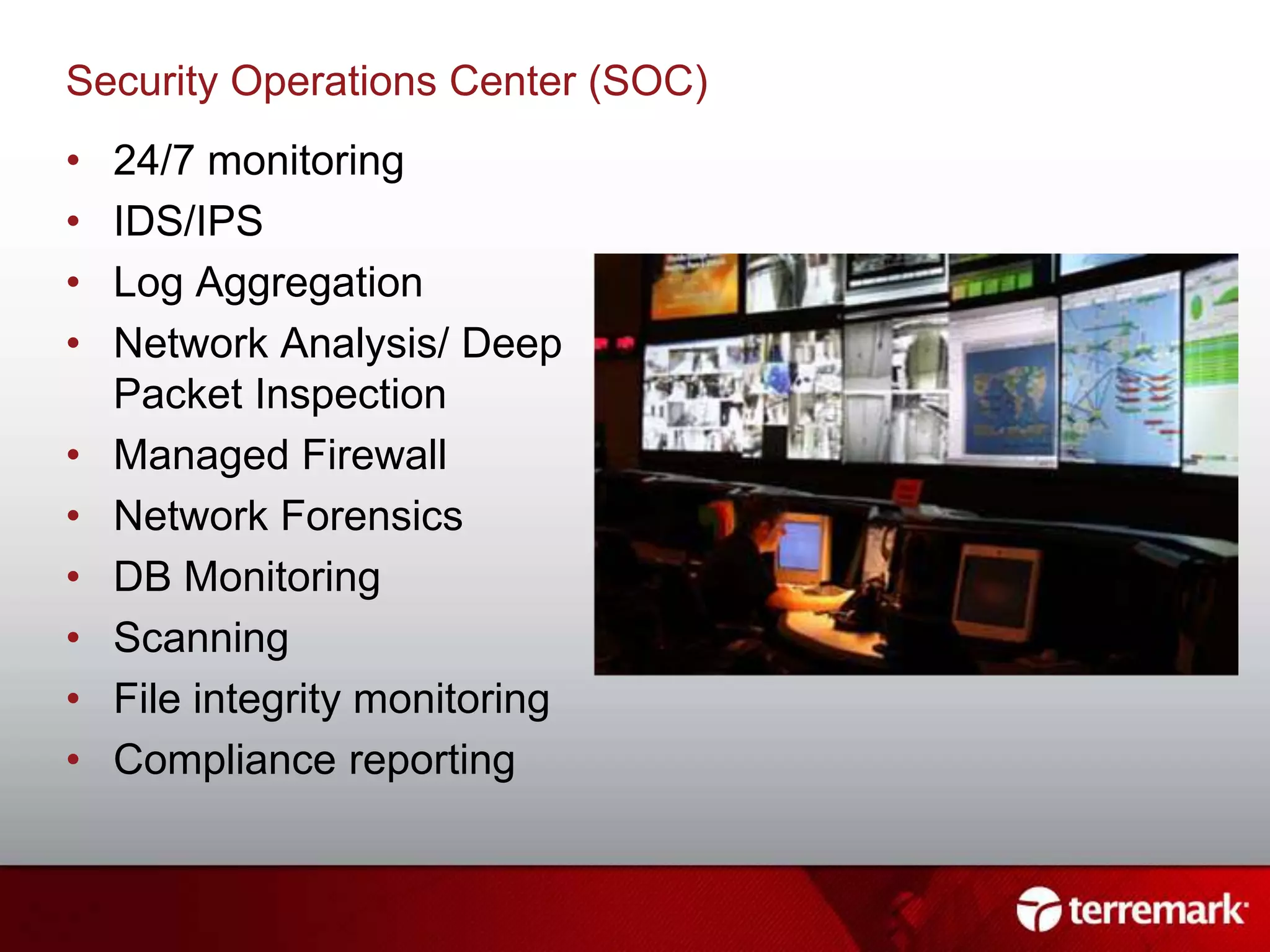
Security Operations Center (SOC)24/7 monitoringIDS/IPSLog AggregationNetwork Analysis/ Deep Packet InspectionManaged FirewallNetwork ForensicsDB MonitoringScanningFile integrity monitoringCompliance reporting
Industry ReportsSANS Top Cyber Security Threats – September 2009Verizon Business 2009 Data Breach Study – April 2009Symantec State of Security Report – 2010US CertSANS Internet Storm Center – http://isc.sans.org/
News and Media	Resources:Data Loss Database - http://datalossdb.org/PrivacyRights.orgSome that were reported:Heartland Payment Systems (130+ million – 1/2009)Oklahoma Dept of Human Service (1 million – 4/2009)University of California (160,000 – 5/2009)Network Solutions (573,000 – 7/2009)U.S. Military Veterans Administration (76 million – 10/2009)BlueCross BlueShield of Tennessee (187,000 – 10/2009)Google (1/2010)Many others?
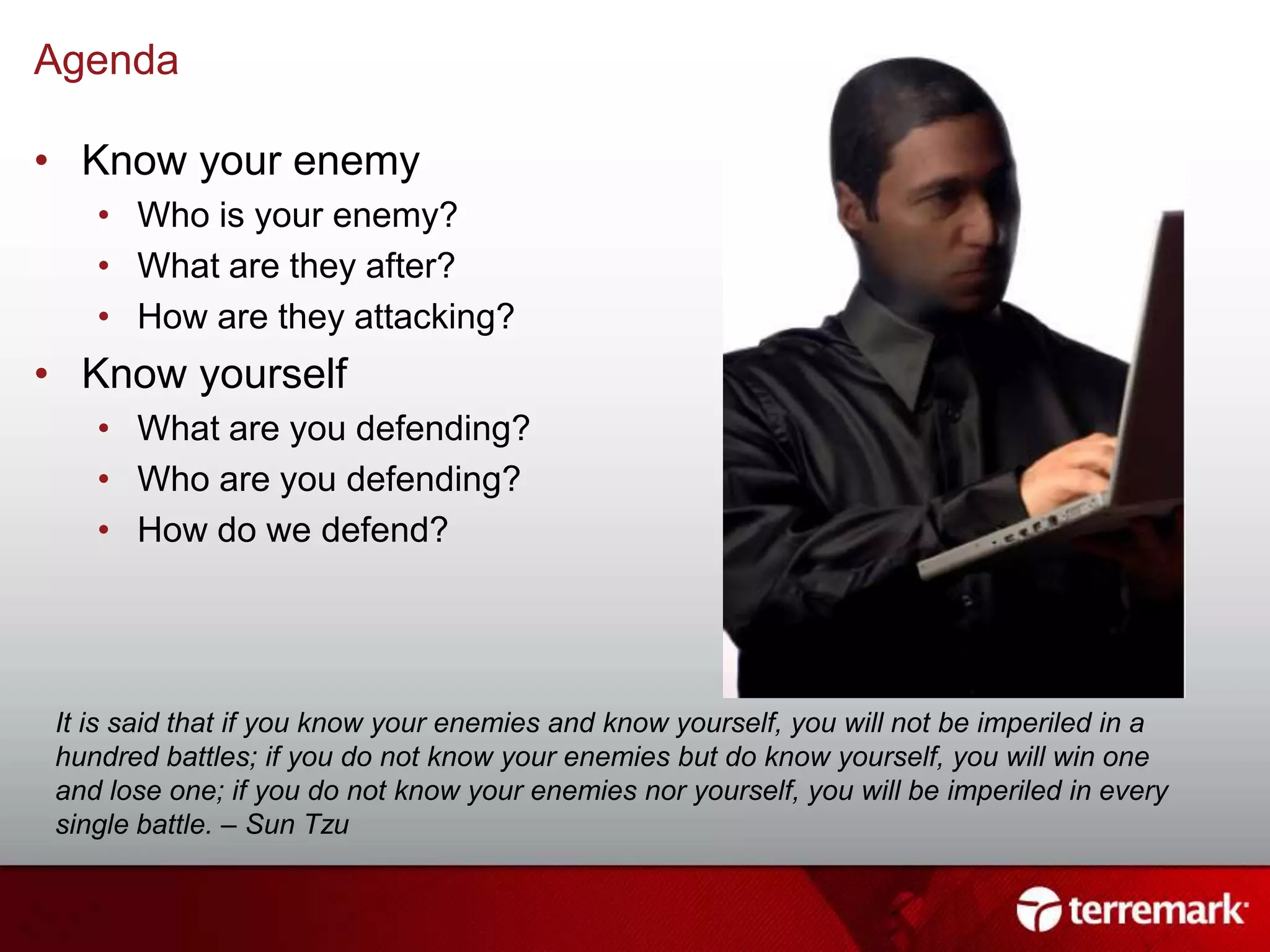
AgendaKnow your enemyWho is your enemy?What are they after?How are they attacking?Know yourselfWhat are you defending?Who are you defending?How do we defend?It is said that if you know your enemies and know yourself, you will not be imperiled in a hundred battles; if you do not know your enemies but do know yourself, you will win one and lose one; if you do not know your enemies nor yourself, you will be imperiled in every single battle. – Sun Tzu
Know your enemy
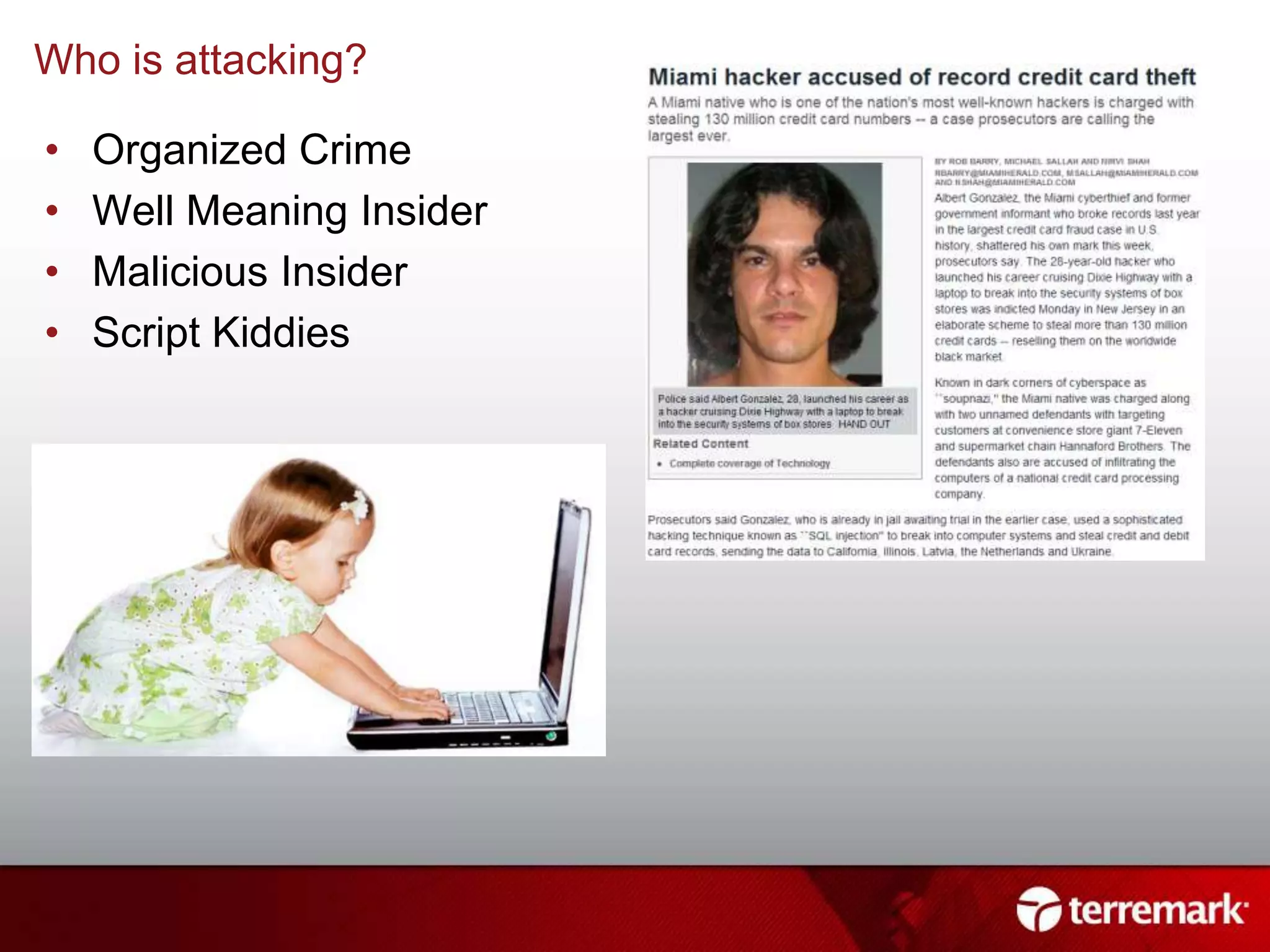
Who is attacking?Organized Crime
Well Meaning Insider
Malicious Insider
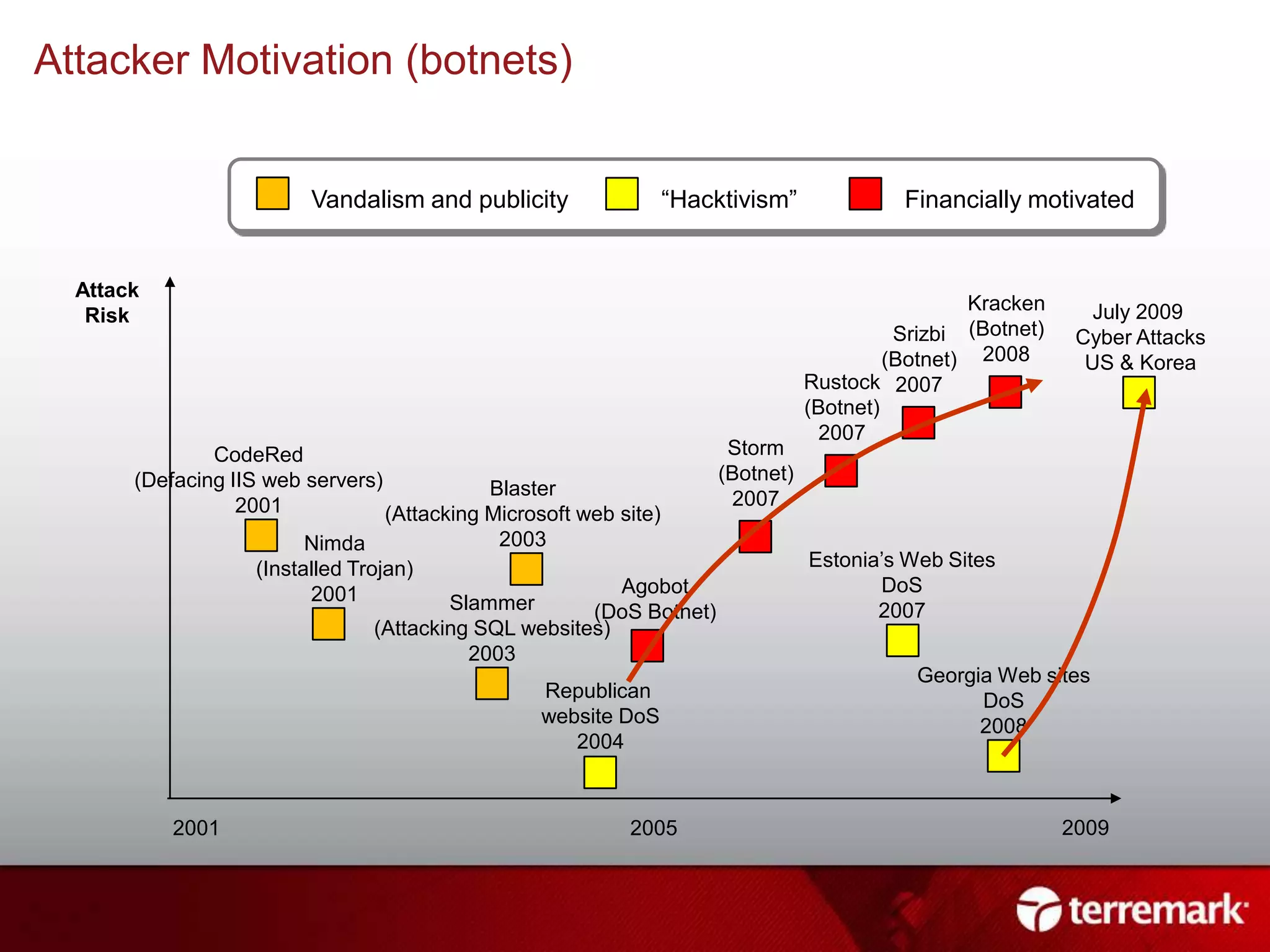
Script KiddiesAttacker Motivation (botnets)Storm(Botnet)2007Srizbi(Botnet)2007Rustock(Botnet)2007Kracken(Botnet)2008Vandalism and publicity“Hacktivism”Attack RiskFinancially motivatedNimda(Installed Trojan)2001CodeRed(Defacing IIS web servers)2001Slammer(Attacking SQL websites)2003Agobot(DoS Botnet)Republican website DoS2004Estonia’s Web SitesDoS2007Georgia Web sitesDoS2008July 2009 Cyber AttacksUS & KoreaBlaster(Attacking Microsoft web site)2003200920012005
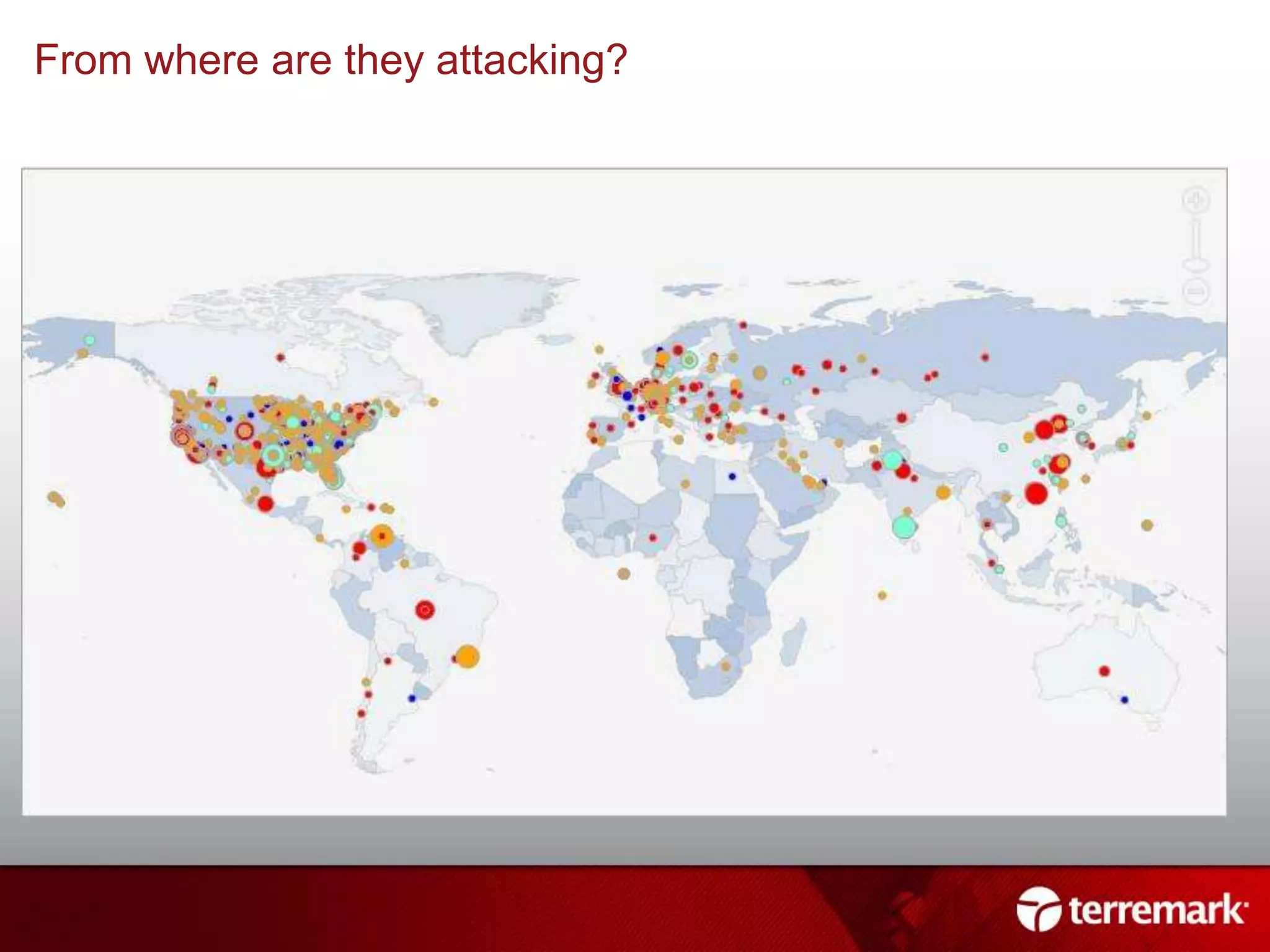
From where are they attacking?
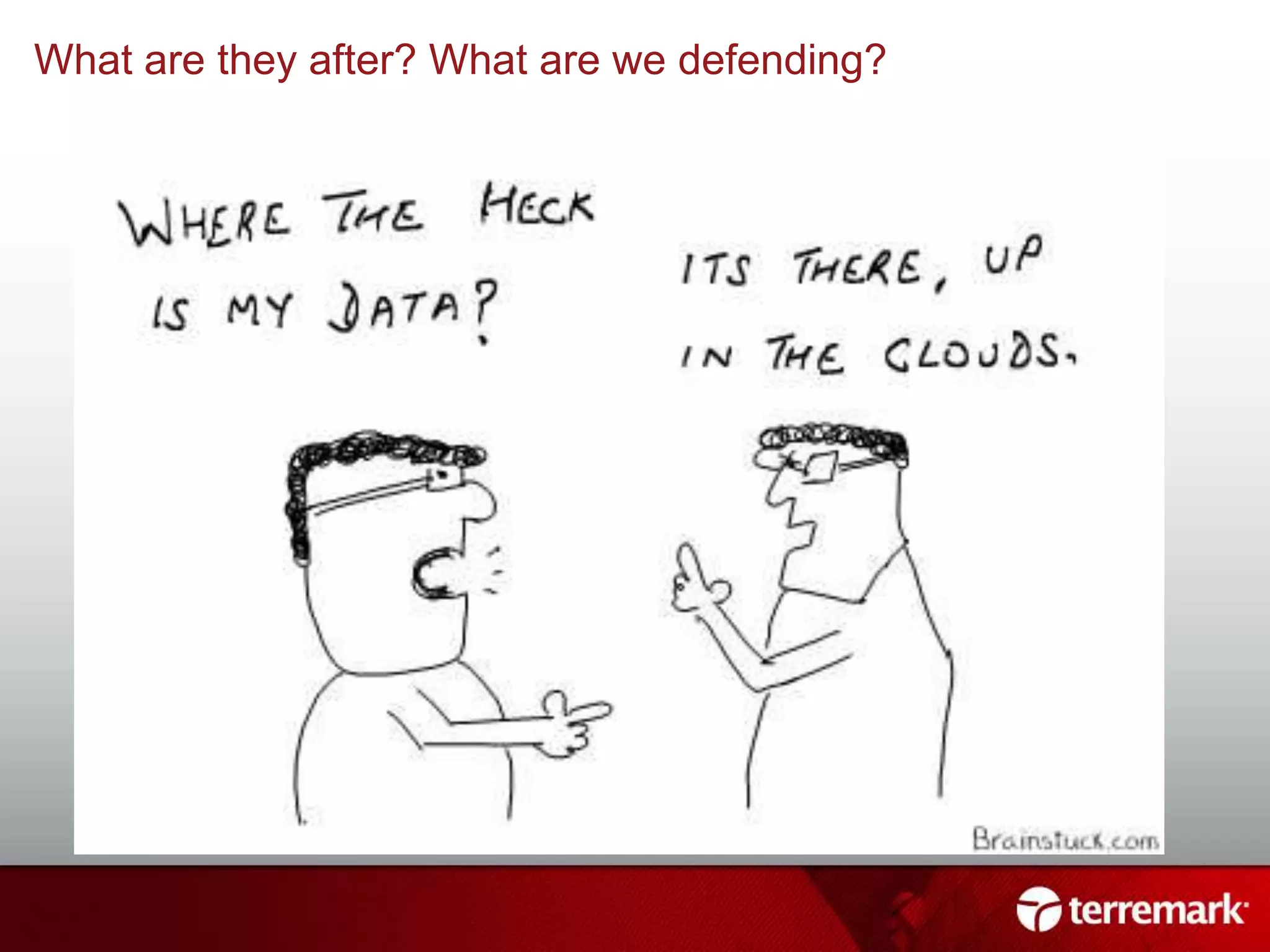
What are they after? What are we defending?
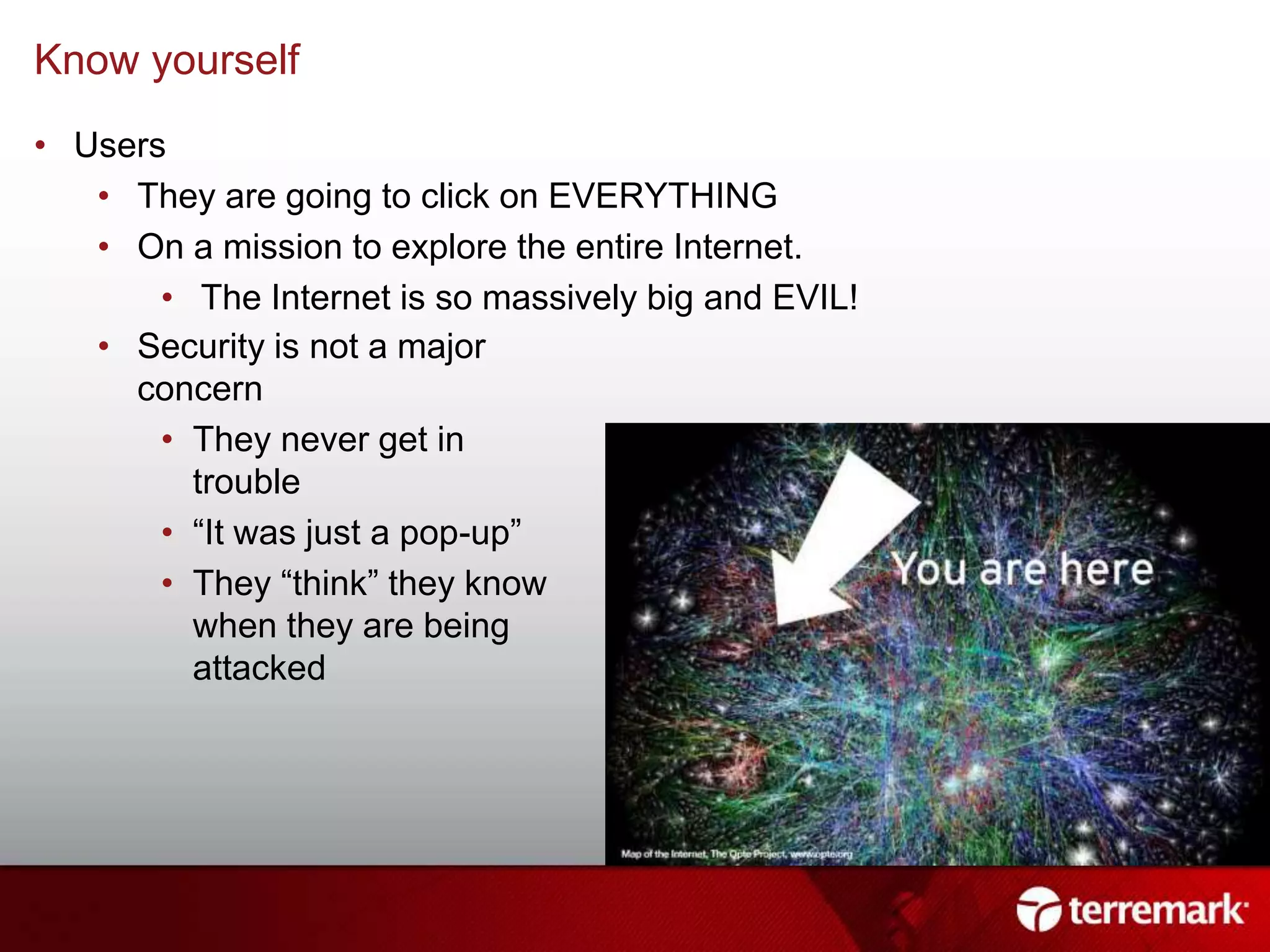
Know yourselfUsers
They are going to click on EVERYTHING
On a mission to explore the entire Internet.
The Internet is so massively big and EVIL!Security is not a major concernThey never get in trouble“It was just a pop-up”They “think” they know when they are being attacked
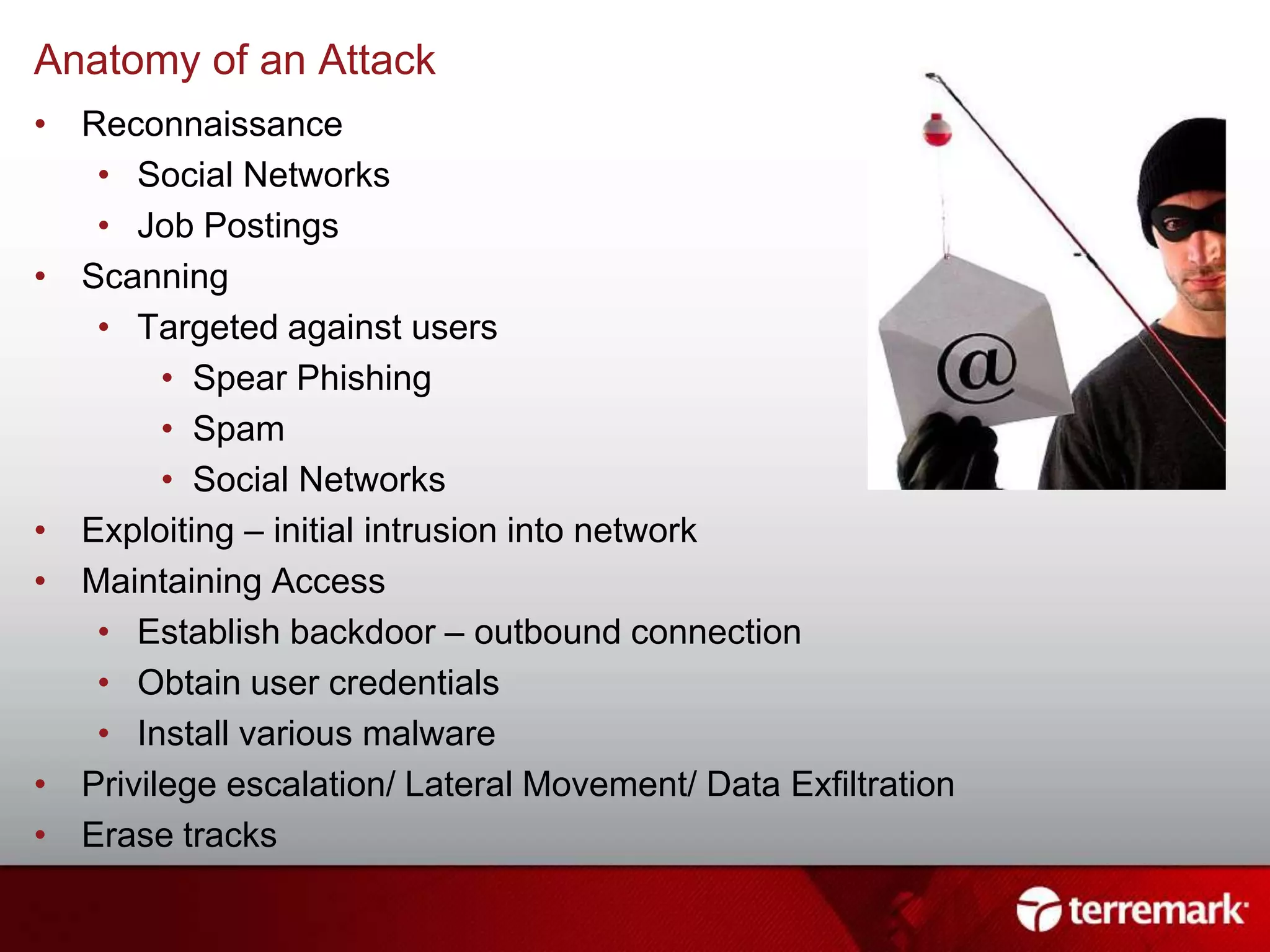
Anatomy of an AttackReconnaissanceSocial NetworksJob PostingsScanningTargeted against usersSpear PhishingSpamSocial NetworksExploiting – initial intrusion into networkMaintaining Access Establish backdoor – outbound connectionObtain user credentialsInstall various malwarePrivilege escalation/ Lateral Movement/ Data ExfiltrationErase tracks

Emerging Threats to Infrastructure

  • 1.
    Emerging Threats toInfrastructureJorge OrchillesSecurity AnalystNorth Florida ISACA
  • 2.
    About Your SpeakerInformationTechnology for over 7 years
  • 3.
    Security Operations CenterAnalyst – Terremark Worldwide, Inc (NASDAQ: TMRK)
  • 4.
    Consultant by night– Orchilles Consulting
  • 5.
    Master of Sciencein Management Information Systems – Florida International University
  • 6.
    Author – MicrosoftWindows 7 Administrator’s Reference (Syngress)
  • 7.
    Certifications – GCIH,CCDA, CSSDS, MCTS, MCP, Security+
  • 8.
  • 9.
    VP of SouthFlorida ISSA
  • 10.
  • 11.
  • 12.
  • 13.
    Miami Electronic CrimesTask ForceAbout TerremarkLeading global provider of managed IT servicesColocationNetwork & ConnectivityManaged HostingCloud ComputingInformation SecurityData Services & Disaster RecoveryAccess to more than 160 global network carriersVMware Service Provider of the Year 2009
  • 14.
    NAP of theAmericas750,000 square foot purpose-built data centerGlobal connectivity from >160 carriers100% SLAs on power and environmentalsHome to critical Internet infrastructure
  • 16.
    Security Operations Center(SOC)24/7 monitoringIDS/IPSLog AggregationNetwork Analysis/ Deep Packet InspectionManaged FirewallNetwork ForensicsDB MonitoringScanningFile integrity monitoringCompliance reporting
  • 17.
    Industry ReportsSANS TopCyber Security Threats – September 2009Verizon Business 2009 Data Breach Study – April 2009Symantec State of Security Report – 2010US CertSANS Internet Storm Center – http://isc.sans.org/
  • 18.
    News and Media Resources:DataLoss Database - http://datalossdb.org/PrivacyRights.orgSome that were reported:Heartland Payment Systems (130+ million – 1/2009)Oklahoma Dept of Human Service (1 million – 4/2009)University of California (160,000 – 5/2009)Network Solutions (573,000 – 7/2009)U.S. Military Veterans Administration (76 million – 10/2009)BlueCross BlueShield of Tennessee (187,000 – 10/2009)Google (1/2010)Many others?
  • 19.
    AgendaKnow your enemyWhois your enemy?What are they after?How are they attacking?Know yourselfWhat are you defending?Who are you defending?How do we defend?It is said that if you know your enemies and know yourself, you will not be imperiled in a hundred battles; if you do not know your enemies but do know yourself, you will win one and lose one; if you do not know your enemies nor yourself, you will be imperiled in every single battle. – Sun Tzu
  • 20.
  • 21.
  • 22.
  • 23.
  • 24.
    Script KiddiesAttacker Motivation(botnets)Storm(Botnet)2007Srizbi(Botnet)2007Rustock(Botnet)2007Kracken(Botnet)2008Vandalism and publicity“Hacktivism”Attack RiskFinancially motivatedNimda(Installed Trojan)2001CodeRed(Defacing IIS web servers)2001Slammer(Attacking SQL websites)2003Agobot(DoS Botnet)Republican website DoS2004Estonia’s Web SitesDoS2007Georgia Web sitesDoS2008July 2009 Cyber AttacksUS & KoreaBlaster(Attacking Microsoft web site)2003200920012005
  • 25.
    From where arethey attacking?
  • 26.
    What are theyafter? What are we defending?
  • 27.
  • 28.
    They are goingto click on EVERYTHING
  • 29.
    On a missionto explore the entire Internet.
  • 30.
    The Internet isso massively big and EVIL!Security is not a major concernThey never get in trouble“It was just a pop-up”They “think” they know when they are being attacked
  • 31.
    Anatomy of anAttackReconnaissanceSocial NetworksJob PostingsScanningTargeted against usersSpear PhishingSpamSocial NetworksExploiting – initial intrusion into networkMaintaining Access Establish backdoor – outbound connectionObtain user credentialsInstall various malwarePrivilege escalation/ Lateral Movement/ Data ExfiltrationErase tracks
  • 32.
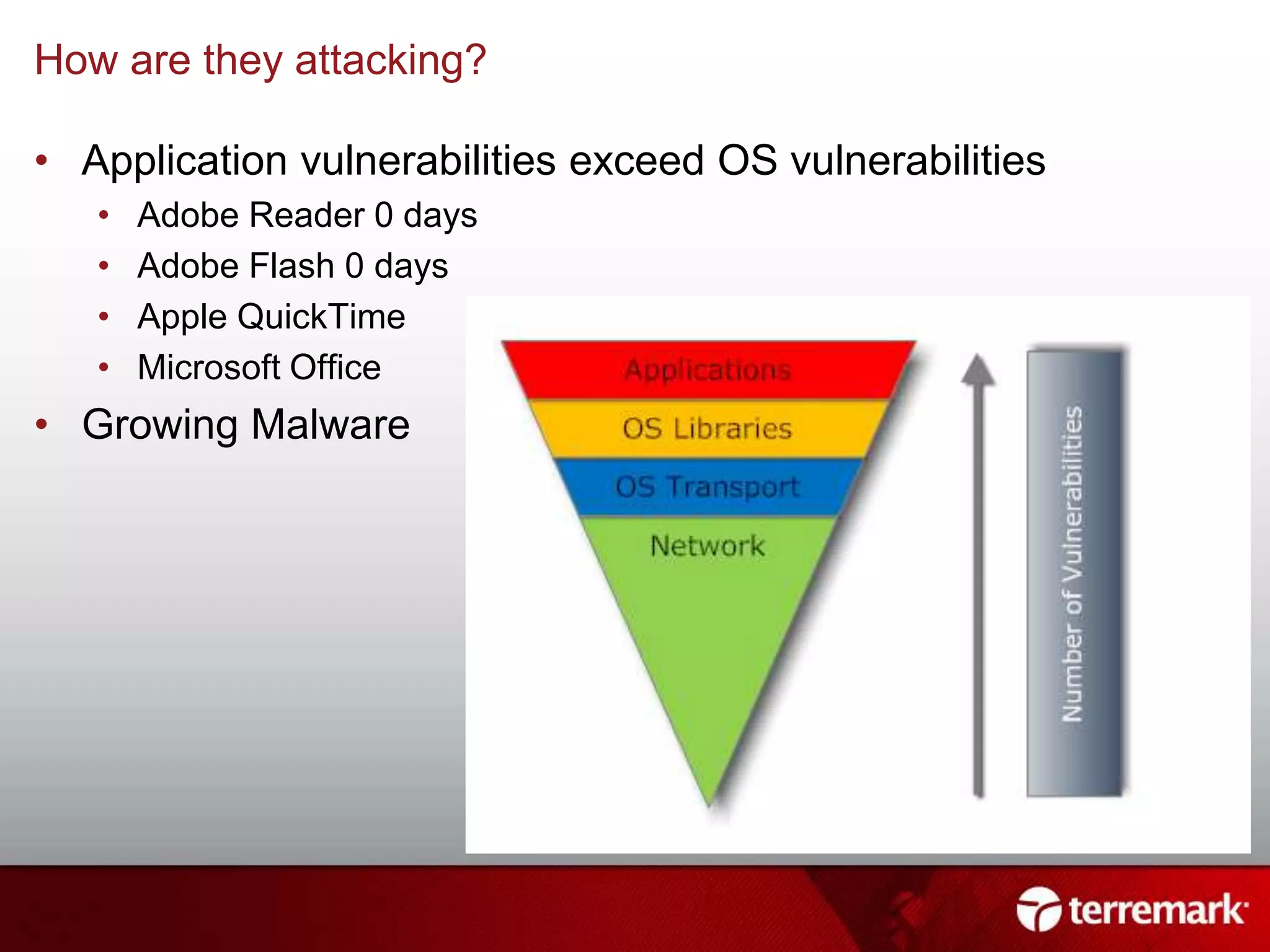
    How are theyattacking?Application vulnerabilities exceed OS vulnerabilitiesAdobe Reader 0 daysAdobe Flash 0 daysApple QuickTimeMicrosoft OfficeGrowing Malware
  • 33.
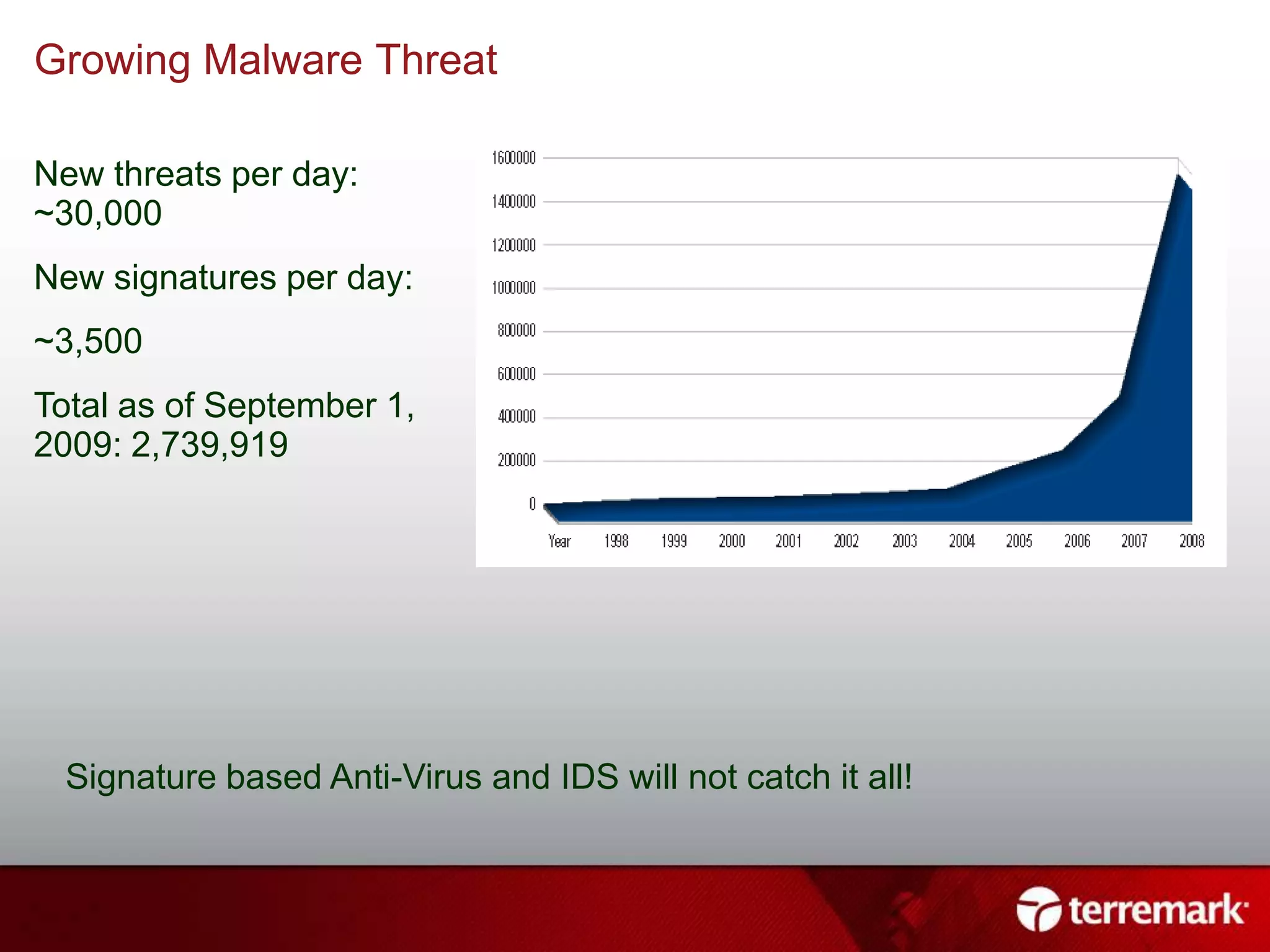
    Growing Malware ThreatNewthreats per day: ~30,000New signatures per day:~3,500Total as of September 1, 2009: 2,739,919Signature based Anti-Virus and IDS will not catch it all!
  • 34.
    How are theyattacking?Professionally targeted to weakest links
  • 35.
  • 36.
  • 37.
  • 38.
    Obfuscated JavaScript codeinserted on hacked Web pages
  • 39.
    Redirects to remoteserver hosting exploits
  • 40.
    Serves custom malwarebased on Windows OS version, browser version, patch level, vulnerable third party apps
  • 41.
    Fires exploits simultaneouslyat IE, WinZip, Java, QuickTime, ActiveX controls, even Firefox … until exploit hits target
  • 42.
    Payload: Backdoor Trojans,password stealers, banker Trojans, spam bots
  • 43.
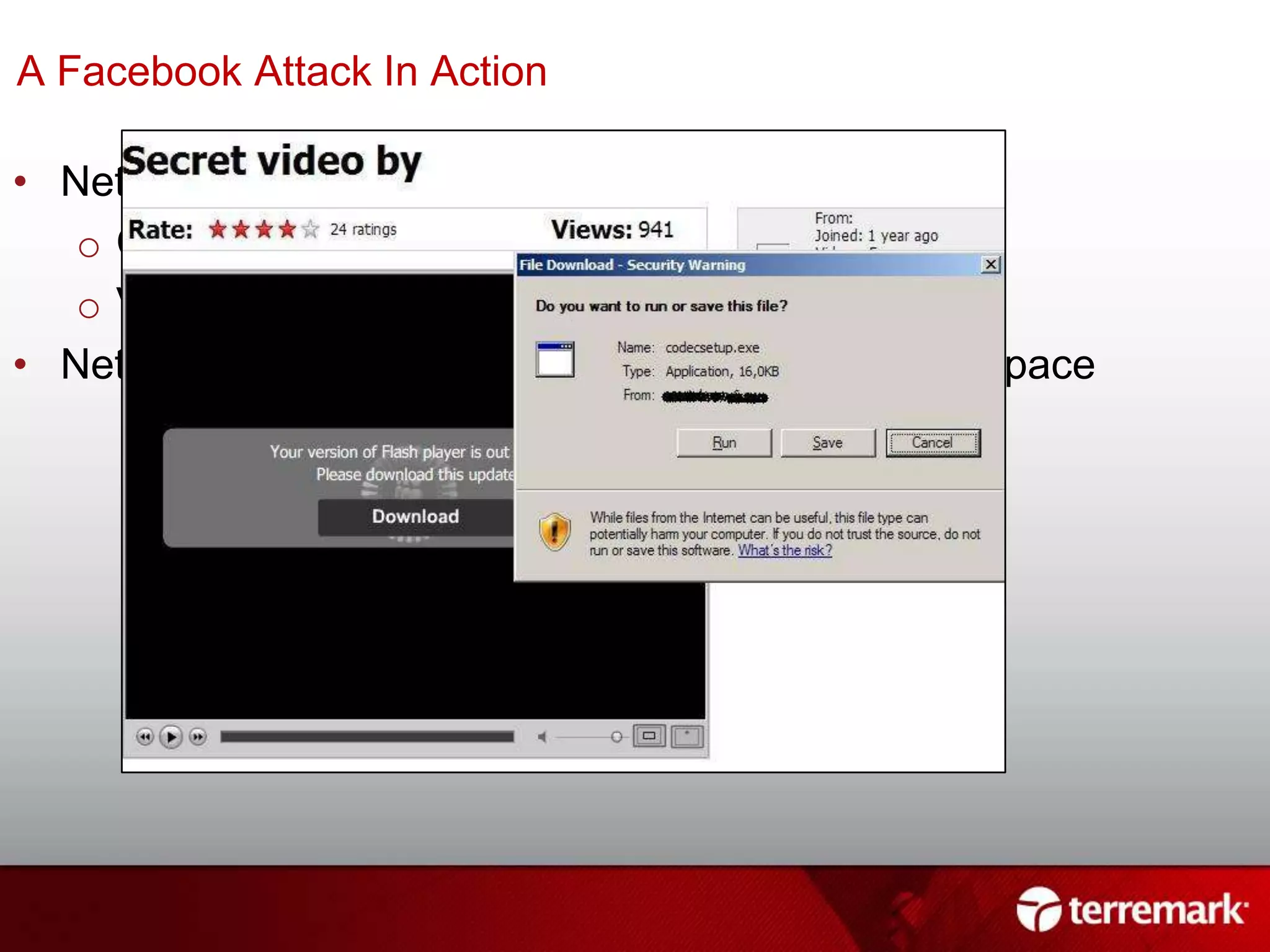
    This is thework of highly skilled, well-organized cyber criminalsA Facebook Attack In ActionNet-Worm.Win32.KoobfaceCreated in July 2008
  • 44.
    Variants still squirmingin 2009Net-worm that exploits trust on Facebook and Myspace
  • 45.
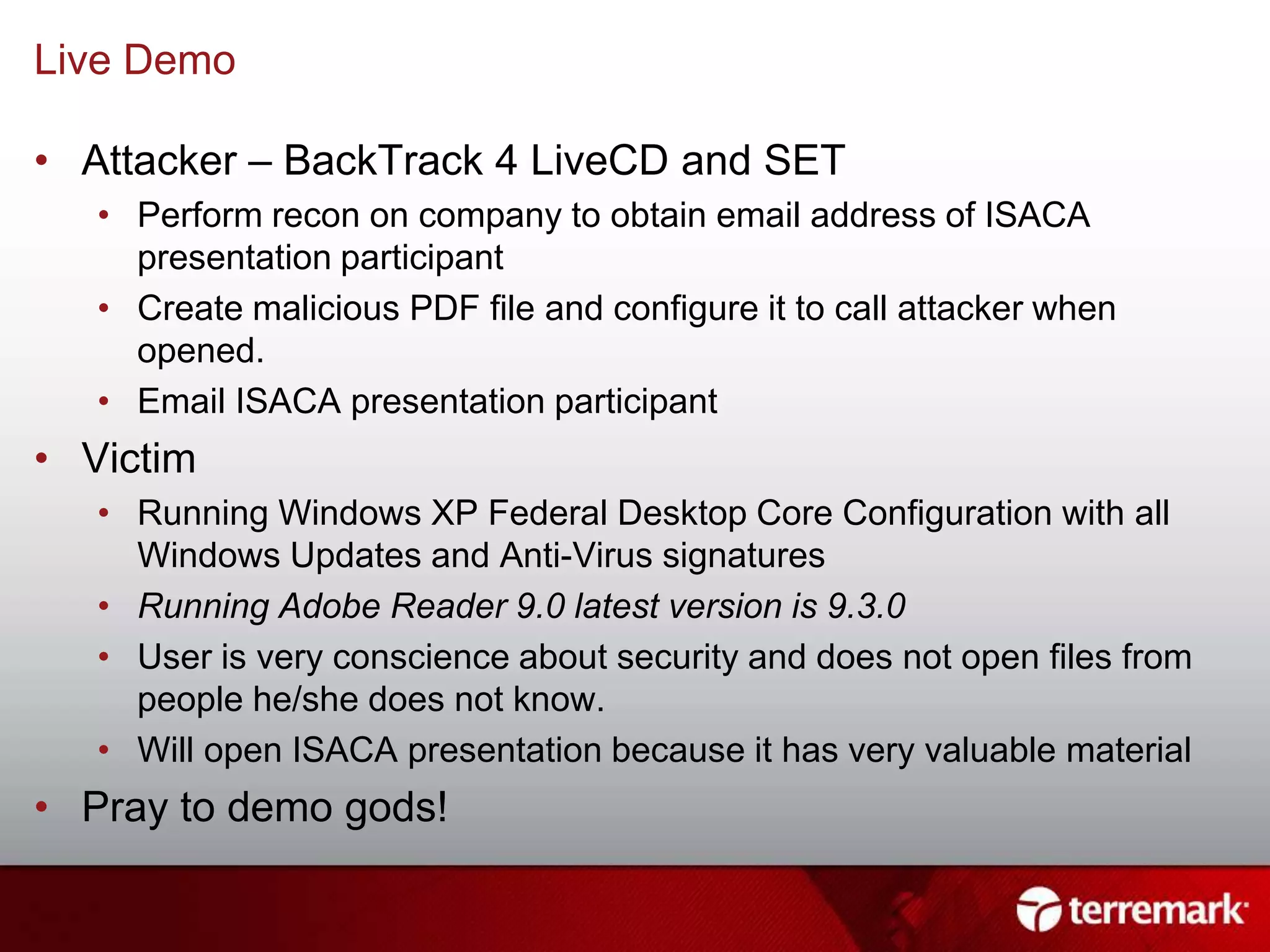
    Live DemoAttacker –BackTrack 4 LiveCD and SETPerform recon on company to obtain email address of ISACA presentation participantCreate malicious PDF file and configure it to call attacker when opened.Email ISACA presentation participantVictimRunning Windows XP Federal Desktop Core Configuration with all Windows Updates and Anti-Virus signaturesRunning Adobe Reader 9.0 latest version is 9.3.0User is very conscience about security and does not open files from people he/she does not know.Will open ISACA presentation because it has very valuable materialPray to demo gods!
  • 46.
    How do welet this happening?Lack of user awarenessPoorly protected infrastructurePatch everything, not just OS but applicationsPoorly protected dataPoorly enforced IT/Security PolicySecurity tools deployed don’t just work
  • 47.
    What is AdvancedPersistent Threat? Term coined by U.S. Air Force for Chinese Related IntrusionsAttacks conducted by well funded and organized groupsProfessionals not script kiddies!MotivationEconomic, Financial, and Political against US government and commercial entitiesTargeted attacksCustom MalwareConstant AggressorNetwork OccupationPersistent Access to networkThis is not new! Over 5 years seeing this activity!
  • 48.
    Why is APTSuccessful? Victims and targets are not aware of these attacksGood that Google disclosed?Information Security Defenses Don’t Work!APT evades:Anti-Virus signaturesIDS signaturesNetwork appliances (firewall, IPS, etc)Security Operations?APT remains undetected once inside the network!
  • 49.
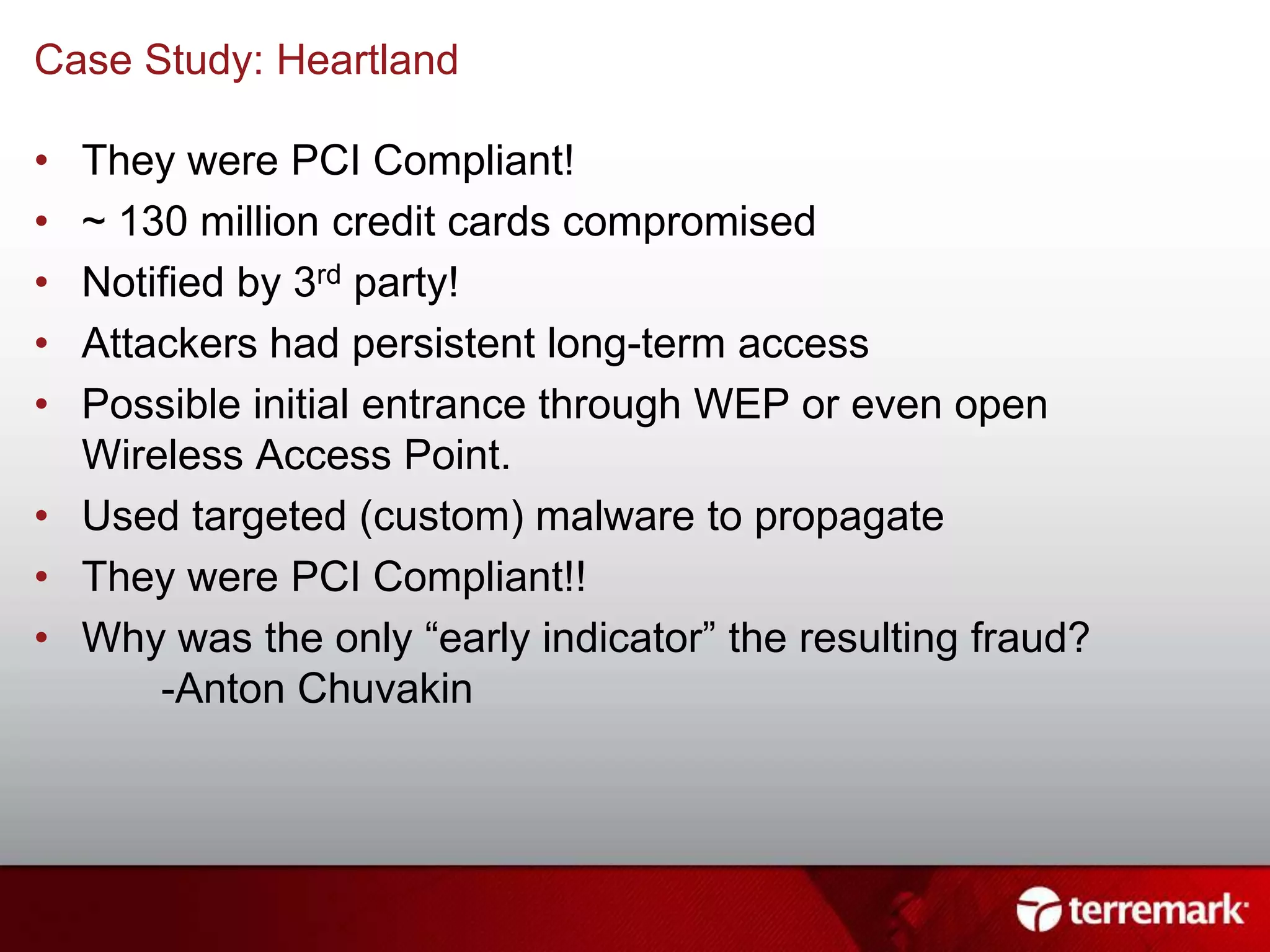
    Case Study: Heartland Theywere PCI Compliant!~ 130 million credit cards compromisedNotified by 3rd party!Attackers had persistent long-term accessPossible initial entrance through WEP or even open Wireless Access Point.Used targeted (custom) malware to propagateThey were PCI Compliant!!Why was the only “early indicator” the resulting fraud? -Anton Chuvakin
  • 50.
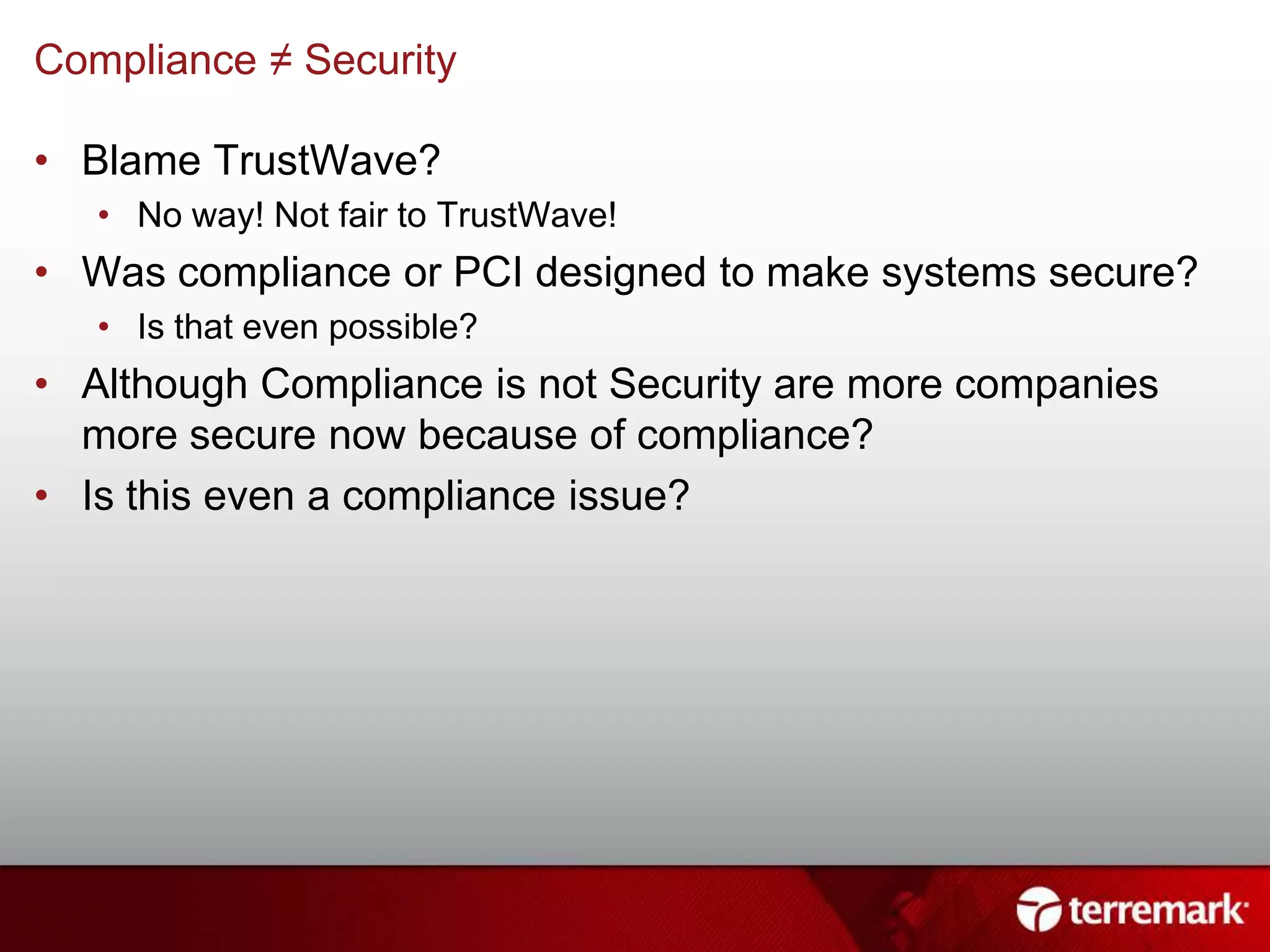
    Compliance ≠ SecurityBlameTrustWave?No way! Not fair to TrustWave!Was compliance or PCI designed to make systems secure?Is that even possible?Although Compliance is not Security are more companies more secure now because of compliance?Is this even a compliance issue?
  • 51.
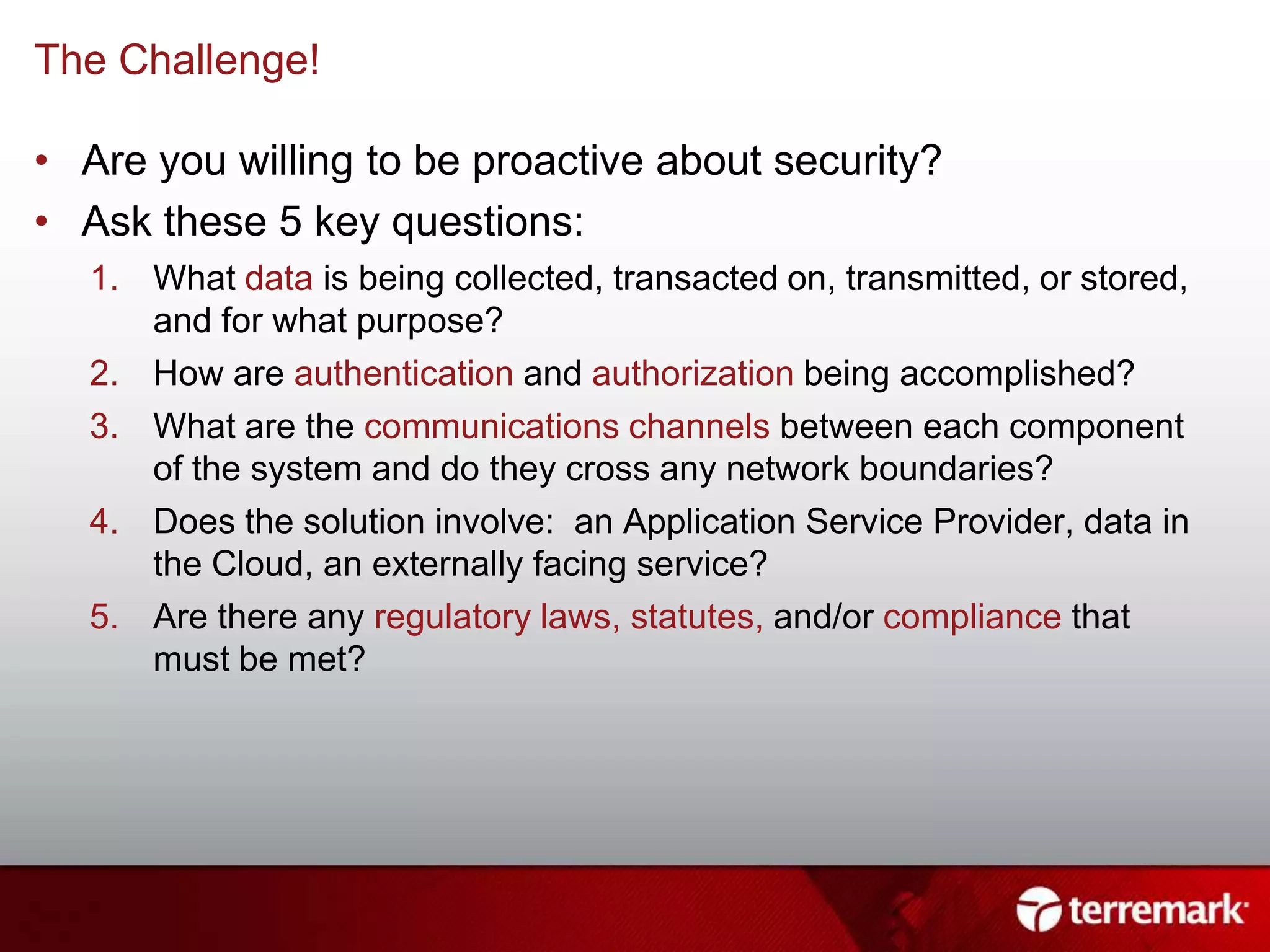
    The Challenge!Are youwilling to be proactive about security?Ask these 5 key questions:What data is being collected, transacted on, transmitted, or stored, and for what purpose?How are authentication and authorization being accomplished?What are the communications channels between each component of the system and do they cross any network boundaries?Does the solution involve: an Application Service Provider, data in the Cloud, an externally facing service?Are there any regulatory laws, statutes, and/or compliance that must be met?
  • 52.
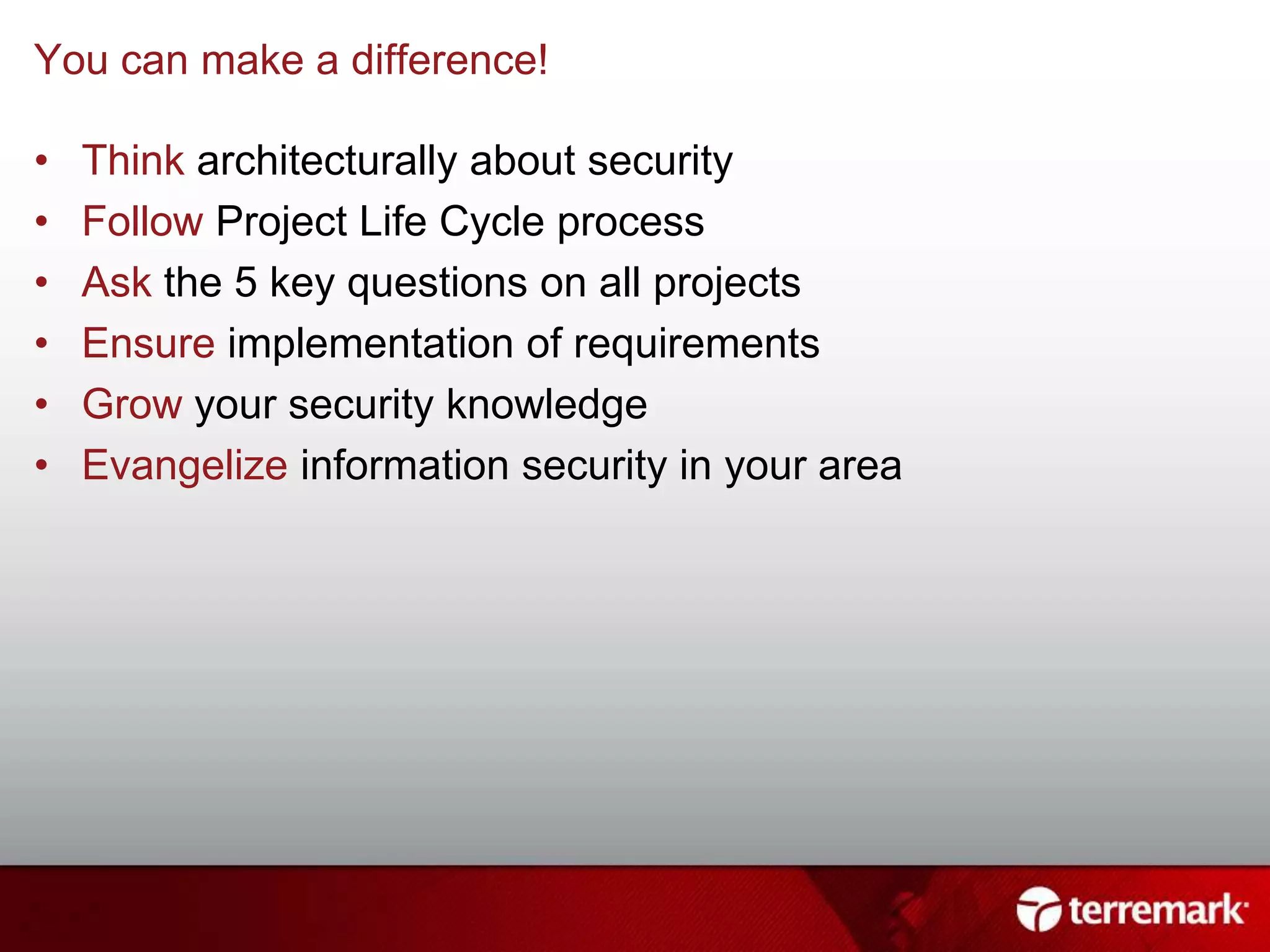
    You can makea difference!Think architecturally about securityFollow Project Life Cycle processAsk the 5 key questions on all projectsEnsure implementation of requirementsGrow your security knowledgeEvangelize information security in your area
  • 53.
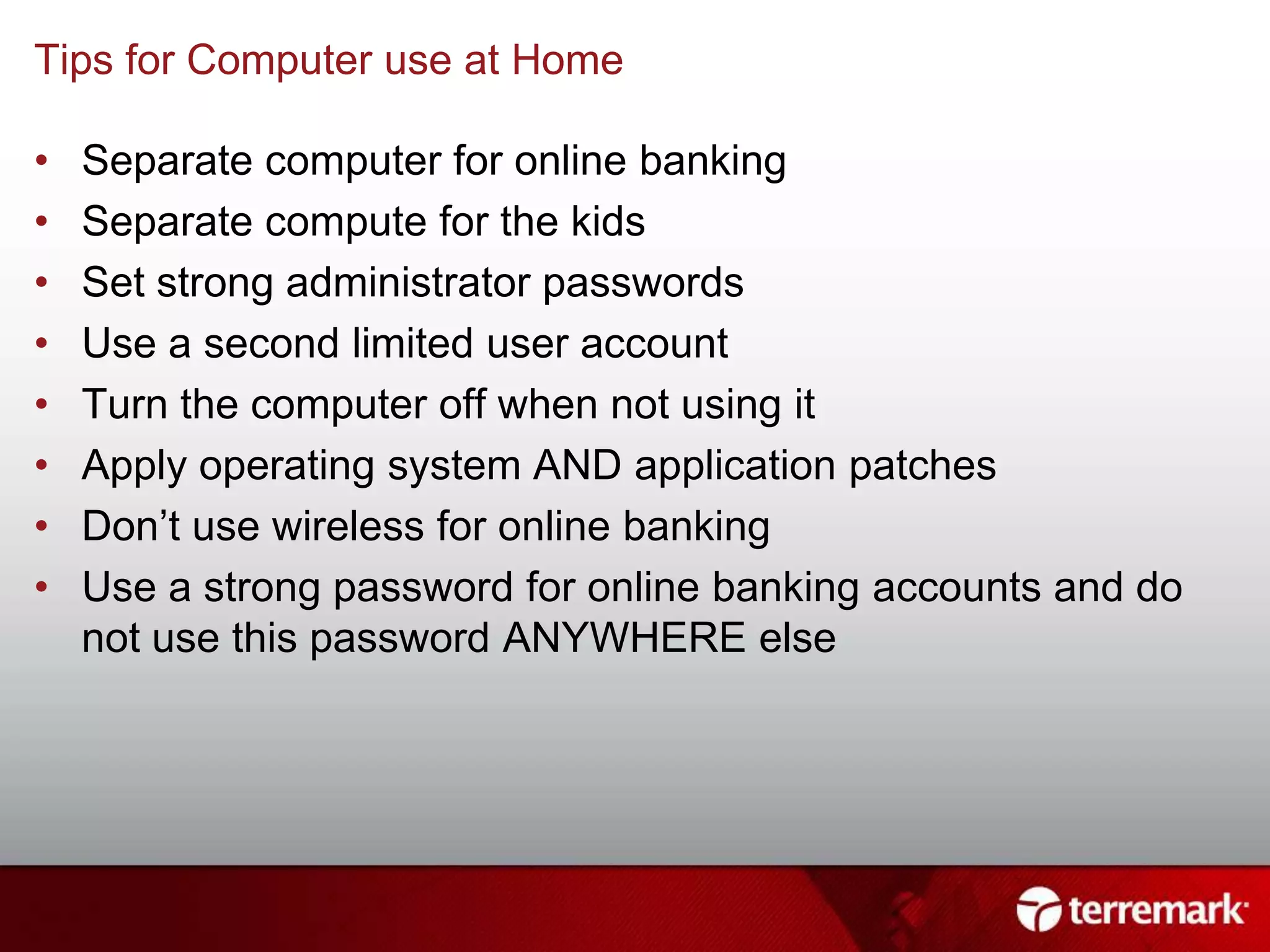
    Tips for Computeruse at HomeSeparate computer for online bankingSeparate compute for the kidsSet strong administrator passwordsUse a second limited user accountTurn the computer off when not using itApply operating system AND application patchesDon’t use wireless for online bankingUse a strong password for online banking accounts and do not use this password ANYWHERE else
  • 54.
    ConclusionYou will getcompromised!Plan accordingly – incident response planningFocus on securing the data and the access to itSecure the user environmentPatch OS and applications User awareness trainingNot just a form to signTest the users!
  • 55.

Editor's Notes

  • #2 Titled Emerging Threats to Infrastructure and NOT Advanced Persistent Threat. APT will be highlighted but by definition only refer to attacks coming from China.Prepared for North Florida ISACA.
  • #6 More than 160 global carriers exchange data at the NAP of the Americas.  Currently, seven Tier 1 service providers provide us with our upstream access to the global Internet. This gives us unparalleled routing table access and multi-homing capabilities. Terremark requires these service providers to have at least OC-48 capacity to maintain connectivity to our network. With such a wide selection of 15 domestic fiber backbones in our facilities, we are then able to provide heightened performance and quickly add virtually any approved carrier required by our downstream clients. Terremark continuously tests each backbone provider for latency performance statistics and compares them to client requirements to ensure SLA compliance.
  • #7 Terremark’s Security Operations Center (SOC) is part of Terremark Operations and located in the Network Operations Center in the NAP of the Americas. Our team of skilled security analysts monitor our customers and internal information security 24/7. The slide points out most of the security solutions we provide.We offer all of these quality services to customers and are considered a Managed Security Service Provider (MSSP).
  • #8 Information Security reports are released at different intervals throughout the year depending on the sponsor. Generally these reports are by vendors and show their results. The favored reports are those by vendor neutral entities such as the SANS, US Cert, and Verizon business which deal with actual data breaches:Verizon: http://newscenter.verizon.com/press-releases/verizon/2009/verizon-business-2009-data.htmlSANS Top Security Risk: http://www.sans.org/top-cyber-security-risks/SANS Internet Storm Center: http://isc.sans.org/Symantec State of Security Report - http://www.symantec.com/about/news/resources/press_kits/detail.jsp?pkid=sesreport2010US Cert - http://www.us-cert.gov/
  • #9 DataLossDB is a research project aimed at documenting known and reported data loss incidents and data breaches world-wide.PrivacyRights.org - A nonprofit consumer education and advocacy project whose purpose is to advocate for consumers' privacy rights in public policy proceedings.
  • #10 Sun Tzu:It is said that if you know your enemies and know yourself, you will not be imperiled in a hundred battles; if you do not know your enemies but do know yourself, you will win one and lose one; if you do not know your enemies nor yourself, you will be imperiled in every single battle.Art of War for Security Managers: http://www.elsevier.com/wps/find/bookdescription.cws_home/712202/description#descriptionTo properly analyze emerging threats we need to answer a few questions:Who is attacking? Know your enemyKnow what your enemy is after.Know how your enemy is attacking.
  • #11 This slide is reserved for a video courtesy of Radware demonstrating hackers in the past and hackers today. In 1988, kids played computer games and figured out how to cheat. It was a lot of fun. Then as they got older they got good grades in school, not because they earned them but because they hacked the school computers. While they were at it they would deface web sites too for bragging rights. Today, today is different. Today hackers want money and they are going after your financial information.
  • #12 Organized Crime - 90% of records lost in 2008 involved organized crime targeting corporate information according to SymantecWell Meaning Insiders – includes laptops and USB flash drives lost with dataMalicious Insiders – Script Kiddies and automated attacks is the majority of the attacks your IDS and Anti-virus will see and stop
  • #13 Botnet attacks show a lot about hacker motivation. Back in the early 2000’s it was more for vandalism, publicity, and hacktivism. In the late 2000’s a trend began to financially motivated attacks. “If my competition is down for 1 day, I get all their business”
  • #14 Where the attacks are coming from? Everywhere! Attackers generally do not attack from home, they proxy and bounce from compromised host to compromised host to hide identity.This is a snapshot of the events in the past 24 hours as of Tuesday March 16, 2010
  • #15 Is anyone evaluating or looking at Cloud Computing? What is one of the main questions when considering this move? Where is my data?Data is what they attackers of after, whether it is PII, credit card numbers, databases, etc they are after the data. Hacktivism might be after infrastructure to take it down but the biggest concern is loosing data.
  • #16 The weakest link in any security assessment is the user. The user can be socially engineered to do things they shouldn’t, click on things they shouldn’t and eventually give an attacker access to data that they should not have.A snapshot of a map of the internet. It is HUGE and many areas are evil!
  • #17 This is how attacks work and have always worked. The methods used within each point is what changes. The SANS SEC504 class that prepares you for the GIAC Certified Incident Handler certification titled Hacker Techniques, Exploits, and Incident Response is based on these main points. The main method stays the same, the ways of doing each aspect is what changes and emerges and what we will focus on in this presentation.
  • #18 Microsoft and other Operating Systems have been diligent about releasing secure code and patches to vulnerabilities in a timely fashion. Users and IT have also been keeping up to date and patching these systems on a regular basis. Therefore, the weakest link becomes the third party applications installed on these systems. Adobe has been extremely bad about patching their vulnerable software and has horrible coding practice with what is speculated to be no concern for security. The same is true for other third party applications and developers.
  • #19 Malware is an increasing threat. Over 30,000 new malware variants are released per day. In this presentation we will create 1 more for the purpose of proving this point. The malware will not leave the sandbox/demo environment. Anti-virus vendors cannot keep up with the growing threat. The growth is incredible.
  • #20 Attackers today are cyber-criminals looking to make money off of your data. Attackers no longer target the OS. They are after applications that contain data that can be used to make money! Threats come from many vectors: physical vectors (floppy disk, USB drives, CD’s), Email vectors (spam, web redirection, phishing), Web vectors (drive-by downloads, malicious sites, liability). And they are targeting WEB sites as the weakest links.The primary web vulnerabilities, SQL Injections and Cross-site Scripting (XSS) make up 80% of the exploited vulnerabilities. Because of these, your web site could be launching malware, serving malicious content to vulnerable client side applications. If it’s poorly configured to keep hackers out, hackers will plant malicious code that proliferates malware to unsuspecting surfers. Not only will your users be hurt but Google will see it and block your website until you clean it, resulting in damage to your business. Vulnerable databases that hold user data can also be hacked. Software that creates a website, like Drupal, WordPress (the most insecure), and others. Your website is vulnerable because of these platforms. Must keep systems updated and patched.Obfuscated (hidden, obscure) Javascript, hidden in a legitimate website, redirects users connections to another server (in Astonia, Russia). This happens in background without your knowledge. You are fingerprinted, shows apps, OS, patch levels, etc., and an exploit is triggered to target a found vulnerability. A backdoor trojan is loaded which gives the hacker access to put other things on your system, i.e., banker Trojans (programed with list of 100 banks – when you go to your bank the Trojan kicks in because it’s on the list and it captures your info and uploads it to a remote server.
  • #21 Koobface. A network worm running on Windows systems. There are 60 new variants today since july 2008.Originally found on facebook but now it’s occurring on twitter and myspace. Exploits this trusted site kind of thing.Here’s what it looks like. Notice the redirector says google to add more trust. You click on the link and it looks like Youtube. Then it tells you that you need to update your flashplayer. If you run it, you get the malware. When you get it, you then start sending the same message to all of your friends and family. Makes you very popular!!
  • #22 Shiatata_ga_nai – Chinese for “you can not do anything about it”