1 
(3) C++ Abstractions 
Nico Ludwig (@ersatzteilchen)
2 
TOC 
● (3) C++ Abstractions 
– Advanced Creation of Instances on the Heap and the Freestore 
● The Operators new/delete, new[]/delete[] and Placement 
– Controlling the Lifetime of an Object 
● Destructors and Resource Acquisition is Initialization (RAII) 
● Copies of Objects and Avoiding Copying Objects 
– Instance- vs. Class Members 
● Sources: 
– Bruce Eckel, Thinking in C++ Vol I 
– Bjarne Stroustrup, The C++ Programming Language
3 
Instances of UDTs are passed by Value 
● As we learned, in C++ objects are getting passed by value to/from functions. 
– This is also true for instances of UDTs. 
● We know that we can pass data by reference with pointers. 
– It was required to do so, e.g. modify values of a variable passed to a function. 
● However, copying instances of a UDT can be costly, as all fields get copied. 
● Avoiding to copy instances of UDTs is another strength of C++. 
● C++ provides means to avoid copies of UDT-instances. 
– We have to revisit dynamic creation of objects.
4 
Creation of UDTs on the Heap 
● It's possible and often needed to create instances of UDTs on the heap like so: 
Date* date = static_cast<Date*>(std::malloc(sizeof(Date))); // No surprise... 
date->day = 17; date->month = 10; date->year = 2012; 
date->Print(); 
// >17.10.2012 
std::free(date); 
● That's boring! It's also cumbersome and dangerous! 
● Minor problems: 
– We have to do the calculation of the size of the memory-block manually. 
● Major and dangerous problems: 
– We can not call ctors during creation, instead we have to initialize explicitly! 
● Dangers w/o ctors: forgetting to initialize, doing it twice or with erroneous values... ouch! 
● Is there a better way? Yes, the C++ freestore. 
● Which fields/functions of Date are public?
5 
Creation and Deletion of UDTs on the Freestore 
● C++' freestore uses the operators new and delete to create/free dynamic objects. 
● Wow! The new-syntax! 
Date* date = new Date(17, 10, 2012); // Create a Date instance on the freestore. 
date->Print(); 
// >17.10.2012 
delete date; // Delete the Date instance from the freestore. 
– It allows creating dynamic instances w/o specifying the size of the memory block explicitly, 
– it allows calling a ctor with the object creation, so we have real initialization back 
– it saves us from forgetting ctor calls or doing "initialization" twice and as a "bonus" 
– it also works, when creating dynamic instances of fundamental type. 
● We have to use delete (not std::free()) to free an object from the freestore. 
● The operator delete can safely deal with 0-pointers. 
● In this course we make a distinction between 
heap and freestore. This distinction is not defined 
by the C++ standard. Instead it is used 
colloquially to separate the memory managed by 
std::malloc()/std::free() and new/delete, because 
they are assumed to be operating in different 
memory locations each. 
● The freestore impl. can be based on the heap 
impl., but not vice versa. This is a hint to the 
awaited performance: a faster impl. can not be 
based on a slower one.
6 
Creation and Deletion of Arrays on the Freestore 
● We can also manage arrays on the freestore with new[] and delete[]: 
int* values = new int[2]; // Creation of an int array with two elements. 
values[0] = 22; // The operator new[] does not allow to initialize the elements, so we 
values[1] = 10; // have to assign them individually. 
delete [] values; // Free the memory occupied by values with delete[]. 
● The operator new[] is a little simplification over std::malloc() for arrays: 
– We're no longer required to specify a size of the block. The count of elements will do. 
– But we can still not use an array initializer with new[], we have to assign explicitly! 
● We have to use delete[] (not delete) to free an array from the freestore. 
– It's more complex than std::free(), which can be used w/ scalar objects and arrays. 
– Arrays created with new[] can not be freed with delete (w/o "[]") or std::free()! 
● The operator delete[] can safely deal with 0-pointers as well. 
C++11 – uniformed initializers for arrays in the freestore 
int* values = new int[2] {22, 10};
7 
What if new or new[] fail? 
● If new or new[] fail, they will throw an std::bad_alloc exception. - Huh? 
● Exceptions are an advanced way to signal and handle run time errors. 
– Exceptions can be caught and handled, or they can be ignored. 
● A fully ignored exception, won't be handled and leads to immediate program exit. 
● => Let's make a contract: 
– We will not handle std::bad_alloc exceptions thrown by new. 
● If new failed, let the program exit immediately. That's the best we can do it for now. 
– We will not check the result of new against 0! 
● (The option new(std::nothrow) returns a 0-pointer on failure instead of throwing.) 
– (We are not going to use the option std::nothrow for now!)
8 
Extra: Placement-new 
● C++ allows creating objects with new on a non-freestore buffer: 
– 1. The operator new together with calling a ctor initializes the object. 
– 2. The passed pointer to a buffer is used as location of the object. 
– => This is called placement. 
● Example: creating an instance of a UDT with new on the heap. 
void* buffer = std::malloc(sizeof(Date)); // Create a blank buffer in the heap. 
// Create a Date instance with a ctor and place it on that blank buffer in the heap: 
Date* date = new (buffer) Date(17, 10, 2012); 
std::free(buffer); // Free date's buffer from the heap. 
– The C++ placement-new syntax is simple to use: 
● 1. Include <new>. 
● 2. Allocate a buffer (from any memory) to place the to-be-created object in. 
● 3. Pass a pointer to the allocated buffer to placement-new. 
● 4. The buffer needs to be freed congruently (std::malloc() → std::free()) with how it was created. 
● Placement-new is often used with special 3rd party buffers.
9 
A Problem: Freeing dynamic Fields in UDT Instances 
class Person { // Another UDT Person 
char* name; 
● Hm... What's the problem with the UDT Person? 
– When we create a Person object, a buffer for name needs to be created dynamically. 
– As we learned we are responsible for freeing dynamically created memory. 
– But who is responsible? The user/creator of a Person-instance? 
– When should the user free name? And how? 
– Freeing could be done explicitly as shown in the example above. 
– ...but then freeing could be forgotten or done twice. Is there a better solution? 
public: 
Person(const char* name) { 
this->name = new char[std::strlen(name) + 1]; 
std::strcpy(this->name, name); 
} 
const char* GetName() { 
return this->name; 
} 
}; 
void Foo() { 
// Create a Person object. 
Person nico("nico"); 
std::cout<<nico.GetName()<<std::endl; 
// >nico 
// But... when to free Person::name from 
// freestore like so?: 
delete[] nico.GetName(); // Really? 
// Freed it twice... oops! 
delete[] nico.GetName(); 
}
10 
… yes, with Destructors 
class Person { // UDT Person with destructor (dtor) 
char* name; // (members hidden) 
Destructor-syntax: ~Person(), think: "the complement to the ctor Person(...)" 
Destructors (dtors) can not have parameters or return types (not even void). 
Idea: A Person-instance is itself responsible for freeing the buffers of fields. 
The one and only dtor is automatically called if an auto object goes out of scope. 
Then the object has the chance to free its resources itself. 
If no dtor is implemented, it'll created by the compiler implicitly. 
The implicitly created dtor just calls the dtors of each of the UDT's fields. 
The implicitly created dtor is public also for classes. 
public: 
Person(const char* name) { 
this->name = new char[std::strlen(name) + 1]; 
std::strcpy(this->name, name); 
} 
~Person() { // The dtor. 
delete[] this->name; 
} 
}; 
void Foo() { 
// Create a Person object. 
Person nico("nico"); 
std::cout<<nico.GetName()<<std::endl; 
// >nico 
} 
// When the scope is left, nico will get destroyed. 
● Dtor syntax in short: 
● The dtor's name must be exactly the name of 
the UDT with the '~'-prefix. 
● We can have only one dtor, i.e. no overloads 
are allowed. 
● The dtor does not return a value and has no 
return type, not even void.
11 
Managing dynamic Memory on the Stack – RAII 
class PersonLitmus { // Shows when an instance is 
public: // created and destroyed. 
PersonLitmus(const char* name) { 
std::cout<<"Person created"<<std::endl; 
} 
~PersonLitmus() { 
std::cout<<"Person destroyed"<<std::endl; 
● What we've shown: dynamic resource management can be bound to scopes. 
– The object (auto variable) manages its resources (freestore, file handles etc.) itself. 
– 1. The ctor of the object "reserves" resources (allocates memory, opens a file etc.). 
– 2. Then we can use the object, call member functions etc. 
– 3. When the object leaves its scope the dtor will automatically free the resources. 
● The implementor of the UDT has to care for proper resource management. 
– Scope-bound resource management is called Resource Acquisition Is Initialization (RAII). 
– UDTs allow binding the lifetime of dynamic memory to auto variables with RAII. 
} 
}; 
void Foo() { // When is the object nico destroyed? 
PersonLitmus nico("nico"); 
// >Person created 
} 
// >Person destroyed 
● Using additional output in functions (e.g. on the 
console or into log files) is called tracing. Tracing is 
an important means to debug code as it is the next 
level of "printf()-debugging". And it is useful to 
understand what our code does... 
● RAII allows us to view auto objects from a different 
perspective: scopes not only control the visibility of 
auto variables, but also the lifetime of objects. 
● In this case the PersonLitmus object is stored in an 
auto variable. So its lifetime is controlled by the 
stack, where scopes control the lifetime of objects in 
C++. On the end of the scope the PersonLitmus 
object will be popped of the stack automatically and 
the dtor will also be called automatically. 
● The lifetime of autos also ends, if their scope is left 
with a return statement or throwing an exception. 
● If we create an auto PersonLitmus-array of n items, 
we'll see n ctor calls and n dtor calls respectively.
12 
RAII is all around 
● RAII does also work, if a function is left early or within nested scopes. 
void Foo() { // left early 
PersonLitmus nico("nico"); 
// >Person created 
return; 
std::cout<<"Beyond return."<<std::endl; 
} 
// >Person destroyed 
● RAII is very important for UDTs in C++! 
– The initialization with the ctor establishes all required resources. 
void Foo(const char* name) { // scoped 
if (name) { // if-scope in Foo()'s scope 
PersonLitmus nico(name); 
// >Person created 
} 
// >Person destroyed 
} 
– Users of a UDT can't forget freeing resources, it's managed automatically w/ the dtor. 
– It's very elegant with auto variables on the stack. 
– It's very clean code for readers as the scopes (braces) control the lifetime of objects. 
● Downsides: 
– The implementor of a UDT needs to program very carefully to get clean RAII. 
– RAII as we implemented it in Person doesn't work w/ copying (e.g. passing by value). 
● An example for a very important C++ type using 
RAII is std::string. All further container types in the 
STL make use of RAII. 
● RAII means that a resource that requires e.g. 
dynamic memory or other operating system 
resources, will be initialized and freed analogously 
to the lifetime of a variable. - Practically it means 
that a resource from the heap can be controlled by 
a variable on the stack! - This can be implemented 
with user defined types.
13 
Dynamic Memory and RAII 
● Again: explicit caring for dynamic memory vs. RAII must be fully understood! 
● Explicitly caring for dynamic memory in the scope of an if-statement: 
if (handleName) { // Explicit - no RAII: 
char* name = new char[5]; 
std::strcpy(name, "nico"); 
//... doing some some stuff with name 
delete [] name; // Here explicit deletion is required! 
} // The dynamic memory "behind" the pointer name needs to be freed explicitly, because the memory 
// to which name points to is not bound to name's lifetime. But name's (i.e. the pointer's) lifetime is 
// controlled by the scope that is controlled by the stack. 
// => The pointer name does not represent the dynamic memory, it is only a pointer to the memory! 
● Automatic caring for dynamic memory with RAII in the scope of an if-statement: 
if (handleName) { // Automatic - with RAII: 
Person nico("nico"); 
//... doing some some stuff with nico 
} // The dynamic memory, encapsulated by the object nico, will be automatically freed, when nico 
// leaves its scope and is popped from the stack. On leaving the scope, Person's dtor will free the 
// dynamic memory automatically. The lifetime of the dynamic memory is now controlled by the stack. 
// => The object nico does itself represent and care for the dynamic memory encapsulated by its type.
14 
Controlling Object Lifetime – Unnecessary Object-Copies 
PersonLitmus GetPersonByName(const char* name) { 
return PersonLitmus(name); // Creates an anonymous object. 
// >Person created (1) (2) 
} // >Person destroyed (3) 
if (handleName) { 
PersonLitmus nico = GetPersonByName("nico"); 
// >Person destroyed (4) (5) 
} // >Person destroyed (6) 
● When we return an object from a function, how often will it be copied? 
● What the heck is going on here? 
● (1) First an anonymous object is created. → ctor call. 
● (2) When we return an object from a function, it will be silently copied! 
● (3) The anonymous object will be destroyed. → dtor call. 
● (4) When the copied object is assigned to nico it will be silently copied again! 
● (5) The copy created in (2) will be destroyed. 
● (6) nico will be destroyed. 
● Some of the copies are really unnecessary, but we can solve the problem... 
● By default most C++ compilers are able to create 
code that suppresses the generation of copies on 
returning object. - This feature is called Return 
Value Optimization (RVO). RVO has been 
disabled in this example to unleash the full story 
of copied objects (gcc-option: -fno-elide-constructors). 
● The shown silent copies are not created with the 
ctor accepting a const char*, and also mind that 
there exists no dctor in PersonLitmus. The copies 
are created by the automatically provided "copy 
constructor". We'll learn about the copy 
constructor in a future lecture.
15 
Controlling Object Lifetime – Automatic Arrays revisited 
● For matters of completeness we'll analyze how arrays work with RAII. 
void Foo() { 
PersonLitmus persons[] = { PersonLitmus("trish"), PersonLitmus("john") }; 
// >Person created 
// >Person created 
} 
// >Person destroyed // anonymous copies. 
// >Person destroyed 
// >Person destroyed // the array elements 
// >Person destroyed 
● On destruction, the dtors of all objects in the array will be called. 
– Mind that dtors for the anonymous copies are called as well. 
● Therefor we call them automatic arrays (in opposite to dynamic arrays): 
– the lifetime of an automatic array's objects is bound to the array's scope.
16 
Controlling Object Lifetime – Avoiding Object-Copies 
● We can get rid of the superfluous copies by using the freestore. 
– The stack manages objects by scope automatically, it also creates the extra copies. 
– But here we as programmers have to reclaim the control of an object's lifetime! 
– So we have to make an objects lifetime independent from the scope of its variable. 
– We learned that we can control the lifetime of objects created in the dynamic memory. 
– => We have to create a PersonLitmus in the freestore with the new operator. 
● We will also call the ctor by using the new operator. 
– If the object's lifetime is independent of its scope, when will it be freed? 
– => Of course with delete! Mind that we are responsible for dynamic memory! 
● Calling delete will also call the dtor. 
PersonLitmus* GetPersonByName(const char* name) { 
return new PersonLitmus(name); // Creates an anonymous object. 
// >Person created 
} 
if (handleName) { 
PersonLitmus* nico = GetPersonByName("nico"); 
delete nico; 
} // >Person destroyed
17 
Extra: Using Resources temporarily 
● Often we have just to allocate a resource, use it and then deallocate it. 
– Let's assume a member function to give a phone call to a PersonLitmus: 
void PersonLitmus::GiveACall() { 
std::cout<<"ring ring"<<std::endl; 
} 
– And we can "use" a PersonLitmus resource like so: 
PersonLitmus* nico = new PersonLitmus("nico"); 
// >Person created 
nico->GiveACall(); 
// >ring ring 
delete nico; 
// >Person destroyed 
● When we create objects on the freestore, we have to free explicitly. 
– And this explicit freeing is very often forgotten leading to memory leaks... 
● C++ provides a special tool to simplify such situations: auto pointers. 
● In this case we say that a resource is unmanaged 
(this is virtually a .Net term). "Unmanaged" means 
that the resource needs to be freed by the 
programmer, because it is not managed by 
hardware or software. Examples of such 
resources are esp. files or file handles.
Extra: Wrapping dynamic Memory Affairs with auto Pointers 
18 
● Auto pointers wrap a pointer to the freestore into a RAII-enabled container. 
– The C++ type std::auto_ptr (in <memory>) provides this functionality: 
{ 
std::auto_ptr<PersonLitmus> nico(new PersonLitmus("nico")); 
// >Person created 
nico->GiveACall(); 
// >ring ring 
} 
// >Person destroyed (std::auto_ptr's RAII is effective here) 
● But std::auto_ptr doesn't work with dynamic arrays and has misleading copy semantics. 
– Therefor std::auto_ptr is deprecated meanwhile! 
– C++11 introduces the type std::unique_ptr, which solves std::auto_ptr's problems: 
C++11 – std::unique_ptr 
{ 
std::unique_ptr<PersonLitmus> nico(new PersonLitmus("nico")); 
// >Person created 
nico->GiveACall(); 
// >ring ring 
} 
// >Person destroyed // std::unique_ptr's RAII is effective here 
● Sometimes auto pointers are called smart 
pointers, but C++' std::auto_ptr is not very smart. 
● std::unique_ptr does also support dynamic arrays 
created in the freestore.
19 
Summary: Controlling Object Lifetime 
● Dealing with objects created on the stack (autos): 
– We've to use "complete" objects on the stack, which will lead to silent copies. 
– We've less control over an object's lifetime, RAII conveniently binds lifetime to scopes. 
● Dealing with dynamically created objects: 
– We have to use pointers; function interfaces need to use pointers as well. 
● The objects will not be copied! - We'll only pass a shortcut the object around. 
– We have full control over an object's lifetime, but also full responsibility for the lifetime. 
– The operators new and delete conveniently work with ctors and the dtor. 
● => C++ programmers decide, whether objects are created on stack or freestore. 
– On many other languages/platforms a type declares, where it is created (e.g. C#/.Net). 
● We can also create objects on the heap (std::malloc()/placement-new/std::free()). 
– But then we have to call construction functions and the dtor explicitly. 
● Having a "complete" object on the stack means 
that all fields of the object will be stored on the 
function's stack. This is typically the situation, 
where PODs are used.
20 
The Lifetime of static/global Objects 
● The ctors of global objects are called on the start of the program. 
– In a translation unit (tu) the initialization order is from top to bottom. 
– Between tus the order is not defined, but often it depends on the link order. 
● Link order: the sequence, in which o-files are being passed to the linker. 
● The ctors of other static objects, e.g. local statics, can be deferred. 
● The dtors of globals and other static objects are called when the programs ends. 
– The dtors of globals are called in the opposite order to initialization in a tu. 
– Between tus the order is not defined, but often it depends on the link order as well.
21 
Instance independent Functionality 
● Sometimes we need UDT-utility-functions that are independent of an instance. 
– Often such functions end in free functions, i.e. not as member functions, e.g. like so: 
Date Today() { // Today() returns the current date in a Date object. 
std::time_t t = std::time(0); // Get the current time (API from <ctime>). 
std::tm* now = std::localtime(&t); 
return Date(now->tm_mday, 1 + now->tm_mon, 1900 + now->tm_year); 
} 
Date now = Today(); 
now.Print(); 
// >20.12.2012 
● Features of the free function Today(): 
– It is independent of a concrete instance of the type Date. 
– But it creates a new Date-instance! 
● The idea of having free utility-functions is not bad, but: 
– the belonging to to a type is not given, but Today() somehow does depend on Date, 
– and we can do better...
22 
Static Member Functions 
● We can bind free functions to a type: static member functions. 
class Date { // (members hidden) 
public: 
static Date Today() { // Today() as static member function. 
std::time_t time = std::time(0); 
std::tm* now = std::localtime(&time); 
return Date(now->tm_mday, 1 + now->tm_mon, 1900 + now->tm_year); 
} 
}; 
Date now = Date::Today(); 
now.Print(); 
// >20.12.2012 
● The static member function Date::Today() has following features: 
– it's independent of a concrete Date instance (no Date object is needed to call Today()), 
– because it is public, it can be called “from outside” the class. 
● Syntactic peculiarities of static member functions: 
– In the definition of a static member function, the keyword static is used 
– and static member functions are called with the :: operator applied on the type name. 
● The static keyword must not be repeated on a 
non-inline definition.
constexpr static double secondsPerGregorianYear = 31556952.2; 
23 
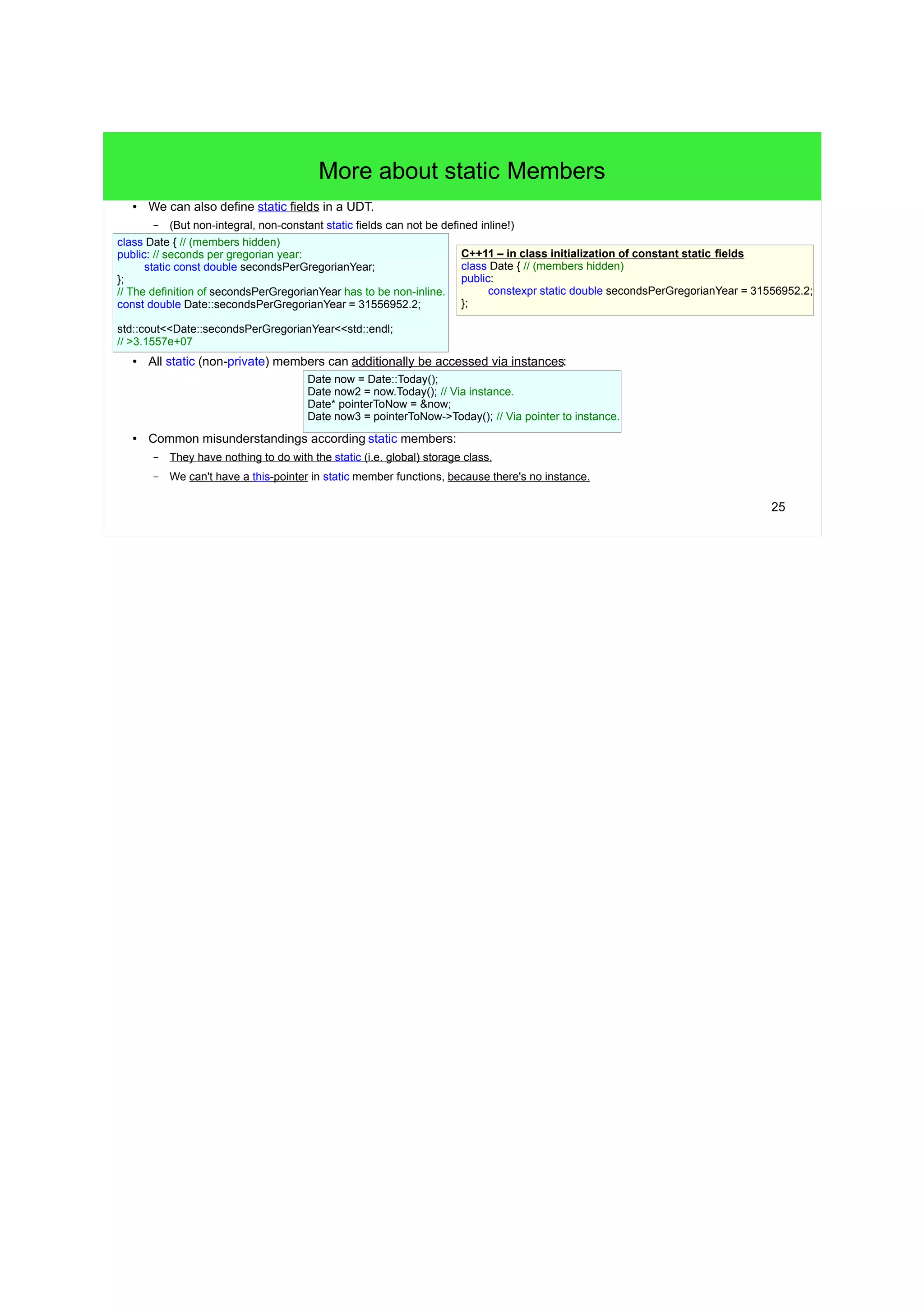
More about static Members 
● We can also define static fields in a UDT. 
– (But non-integral, non-constant static fields can not be defined inline!) 
class Date { // (members hidden) 
public: // seconds per gregorian year: 
static const double secondsPerGregorianYear; 
}; 
// The definition of secondsPerGregorianYear has to be non-inline. 
const double Date::secondsPerGregorianYear = 31556952.2; 
std::cout<<Date::secondsPerGregorianYear<<std::endl; 
// >3.1557e+07 
C++11 – in class initialization of constant static fields 
class Date { // (members hidden) 
public: 
}; 
● All static (non-private) members can additionally be accessed via instances: 
Date now = Date::Today(); 
Date now2 = now.Today(); // Via instance. 
Date* pointerToNow = &now; 
Date now3 = pointerToNow->Today(); // Via pointer to instance. 
● Common misunderstandings according static members: 
– They have nothing to do with the static (i.e. global) storage class. 
– We can't have a this-pointer in static member functions, because there's no instance.
24 
Class-Members vs. Instance-Members 
● static functions and fields are not used very often in C++, but they are handy! 
● Interesting facts: 
– static member functions have access to private fields of the defining UDT! 
– static member functions do not overload non-static member functions! 
● static members are often called class- or type-members. 
– static members are shared among all instances. 
● Non-static members (i.e. "normal" members) are often called instance-members. 
– Each instance has its own copy of, e.g., a non-static field. 
● The idea of type- vs. instance-members is in fact required for useful abstractions. 
– We can find these concepts in all programming languages allowing to define abstractions. 
● A static member function can access the private 
members (esp. the fields) of a passed object that 
has the same UDT, in which this static member 
function has been defined. Nevertheless, a static 
member function has no this-pointer!
25 
Thank you!

(3) cpp abstractions more_on_user_defined_types

  • 1.
    1 (3) C++Abstractions Nico Ludwig (@ersatzteilchen)
  • 2.
    2 TOC ●(3) C++ Abstractions – Advanced Creation of Instances on the Heap and the Freestore ● The Operators new/delete, new[]/delete[] and Placement – Controlling the Lifetime of an Object ● Destructors and Resource Acquisition is Initialization (RAII) ● Copies of Objects and Avoiding Copying Objects – Instance- vs. Class Members ● Sources: – Bruce Eckel, Thinking in C++ Vol I – Bjarne Stroustrup, The C++ Programming Language
  • 3.
    3 Instances ofUDTs are passed by Value ● As we learned, in C++ objects are getting passed by value to/from functions. – This is also true for instances of UDTs. ● We know that we can pass data by reference with pointers. – It was required to do so, e.g. modify values of a variable passed to a function. ● However, copying instances of a UDT can be costly, as all fields get copied. ● Avoiding to copy instances of UDTs is another strength of C++. ● C++ provides means to avoid copies of UDT-instances. – We have to revisit dynamic creation of objects.
  • 4.
    4 Creation ofUDTs on the Heap ● It's possible and often needed to create instances of UDTs on the heap like so: Date* date = static_cast<Date*>(std::malloc(sizeof(Date))); // No surprise... date->day = 17; date->month = 10; date->year = 2012; date->Print(); // >17.10.2012 std::free(date); ● That's boring! It's also cumbersome and dangerous! ● Minor problems: – We have to do the calculation of the size of the memory-block manually. ● Major and dangerous problems: – We can not call ctors during creation, instead we have to initialize explicitly! ● Dangers w/o ctors: forgetting to initialize, doing it twice or with erroneous values... ouch! ● Is there a better way? Yes, the C++ freestore. ● Which fields/functions of Date are public?
  • 5.
    5 Creation andDeletion of UDTs on the Freestore ● C++' freestore uses the operators new and delete to create/free dynamic objects. ● Wow! The new-syntax! Date* date = new Date(17, 10, 2012); // Create a Date instance on the freestore. date->Print(); // >17.10.2012 delete date; // Delete the Date instance from the freestore. – It allows creating dynamic instances w/o specifying the size of the memory block explicitly, – it allows calling a ctor with the object creation, so we have real initialization back – it saves us from forgetting ctor calls or doing "initialization" twice and as a "bonus" – it also works, when creating dynamic instances of fundamental type. ● We have to use delete (not std::free()) to free an object from the freestore. ● The operator delete can safely deal with 0-pointers. ● In this course we make a distinction between heap and freestore. This distinction is not defined by the C++ standard. Instead it is used colloquially to separate the memory managed by std::malloc()/std::free() and new/delete, because they are assumed to be operating in different memory locations each. ● The freestore impl. can be based on the heap impl., but not vice versa. This is a hint to the awaited performance: a faster impl. can not be based on a slower one.
  • 6.
    6 Creation andDeletion of Arrays on the Freestore ● We can also manage arrays on the freestore with new[] and delete[]: int* values = new int[2]; // Creation of an int array with two elements. values[0] = 22; // The operator new[] does not allow to initialize the elements, so we values[1] = 10; // have to assign them individually. delete [] values; // Free the memory occupied by values with delete[]. ● The operator new[] is a little simplification over std::malloc() for arrays: – We're no longer required to specify a size of the block. The count of elements will do. – But we can still not use an array initializer with new[], we have to assign explicitly! ● We have to use delete[] (not delete) to free an array from the freestore. – It's more complex than std::free(), which can be used w/ scalar objects and arrays. – Arrays created with new[] can not be freed with delete (w/o "[]") or std::free()! ● The operator delete[] can safely deal with 0-pointers as well. C++11 – uniformed initializers for arrays in the freestore int* values = new int[2] {22, 10};
  • 7.
    7 What ifnew or new[] fail? ● If new or new[] fail, they will throw an std::bad_alloc exception. - Huh? ● Exceptions are an advanced way to signal and handle run time errors. – Exceptions can be caught and handled, or they can be ignored. ● A fully ignored exception, won't be handled and leads to immediate program exit. ● => Let's make a contract: – We will not handle std::bad_alloc exceptions thrown by new. ● If new failed, let the program exit immediately. That's the best we can do it for now. – We will not check the result of new against 0! ● (The option new(std::nothrow) returns a 0-pointer on failure instead of throwing.) – (We are not going to use the option std::nothrow for now!)
  • 8.
    8 Extra: Placement-new ● C++ allows creating objects with new on a non-freestore buffer: – 1. The operator new together with calling a ctor initializes the object. – 2. The passed pointer to a buffer is used as location of the object. – => This is called placement. ● Example: creating an instance of a UDT with new on the heap. void* buffer = std::malloc(sizeof(Date)); // Create a blank buffer in the heap. // Create a Date instance with a ctor and place it on that blank buffer in the heap: Date* date = new (buffer) Date(17, 10, 2012); std::free(buffer); // Free date's buffer from the heap. – The C++ placement-new syntax is simple to use: ● 1. Include <new>. ● 2. Allocate a buffer (from any memory) to place the to-be-created object in. ● 3. Pass a pointer to the allocated buffer to placement-new. ● 4. The buffer needs to be freed congruently (std::malloc() → std::free()) with how it was created. ● Placement-new is often used with special 3rd party buffers.
  • 9.
    9 A Problem:Freeing dynamic Fields in UDT Instances class Person { // Another UDT Person char* name; ● Hm... What's the problem with the UDT Person? – When we create a Person object, a buffer for name needs to be created dynamically. – As we learned we are responsible for freeing dynamically created memory. – But who is responsible? The user/creator of a Person-instance? – When should the user free name? And how? – Freeing could be done explicitly as shown in the example above. – ...but then freeing could be forgotten or done twice. Is there a better solution? public: Person(const char* name) { this->name = new char[std::strlen(name) + 1]; std::strcpy(this->name, name); } const char* GetName() { return this->name; } }; void Foo() { // Create a Person object. Person nico("nico"); std::cout<<nico.GetName()<<std::endl; // >nico // But... when to free Person::name from // freestore like so?: delete[] nico.GetName(); // Really? // Freed it twice... oops! delete[] nico.GetName(); }
  • 10.
    10 … yes,with Destructors class Person { // UDT Person with destructor (dtor) char* name; // (members hidden) Destructor-syntax: ~Person(), think: "the complement to the ctor Person(...)" Destructors (dtors) can not have parameters or return types (not even void). Idea: A Person-instance is itself responsible for freeing the buffers of fields. The one and only dtor is automatically called if an auto object goes out of scope. Then the object has the chance to free its resources itself. If no dtor is implemented, it'll created by the compiler implicitly. The implicitly created dtor just calls the dtors of each of the UDT's fields. The implicitly created dtor is public also for classes. public: Person(const char* name) { this->name = new char[std::strlen(name) + 1]; std::strcpy(this->name, name); } ~Person() { // The dtor. delete[] this->name; } }; void Foo() { // Create a Person object. Person nico("nico"); std::cout<<nico.GetName()<<std::endl; // >nico } // When the scope is left, nico will get destroyed. ● Dtor syntax in short: ● The dtor's name must be exactly the name of the UDT with the '~'-prefix. ● We can have only one dtor, i.e. no overloads are allowed. ● The dtor does not return a value and has no return type, not even void.
  • 11.
    11 Managing dynamicMemory on the Stack – RAII class PersonLitmus { // Shows when an instance is public: // created and destroyed. PersonLitmus(const char* name) { std::cout<<"Person created"<<std::endl; } ~PersonLitmus() { std::cout<<"Person destroyed"<<std::endl; ● What we've shown: dynamic resource management can be bound to scopes. – The object (auto variable) manages its resources (freestore, file handles etc.) itself. – 1. The ctor of the object "reserves" resources (allocates memory, opens a file etc.). – 2. Then we can use the object, call member functions etc. – 3. When the object leaves its scope the dtor will automatically free the resources. ● The implementor of the UDT has to care for proper resource management. – Scope-bound resource management is called Resource Acquisition Is Initialization (RAII). – UDTs allow binding the lifetime of dynamic memory to auto variables with RAII. } }; void Foo() { // When is the object nico destroyed? PersonLitmus nico("nico"); // >Person created } // >Person destroyed ● Using additional output in functions (e.g. on the console or into log files) is called tracing. Tracing is an important means to debug code as it is the next level of "printf()-debugging". And it is useful to understand what our code does... ● RAII allows us to view auto objects from a different perspective: scopes not only control the visibility of auto variables, but also the lifetime of objects. ● In this case the PersonLitmus object is stored in an auto variable. So its lifetime is controlled by the stack, where scopes control the lifetime of objects in C++. On the end of the scope the PersonLitmus object will be popped of the stack automatically and the dtor will also be called automatically. ● The lifetime of autos also ends, if their scope is left with a return statement or throwing an exception. ● If we create an auto PersonLitmus-array of n items, we'll see n ctor calls and n dtor calls respectively.
  • 12.
    12 RAII isall around ● RAII does also work, if a function is left early or within nested scopes. void Foo() { // left early PersonLitmus nico("nico"); // >Person created return; std::cout<<"Beyond return."<<std::endl; } // >Person destroyed ● RAII is very important for UDTs in C++! – The initialization with the ctor establishes all required resources. void Foo(const char* name) { // scoped if (name) { // if-scope in Foo()'s scope PersonLitmus nico(name); // >Person created } // >Person destroyed } – Users of a UDT can't forget freeing resources, it's managed automatically w/ the dtor. – It's very elegant with auto variables on the stack. – It's very clean code for readers as the scopes (braces) control the lifetime of objects. ● Downsides: – The implementor of a UDT needs to program very carefully to get clean RAII. – RAII as we implemented it in Person doesn't work w/ copying (e.g. passing by value). ● An example for a very important C++ type using RAII is std::string. All further container types in the STL make use of RAII. ● RAII means that a resource that requires e.g. dynamic memory or other operating system resources, will be initialized and freed analogously to the lifetime of a variable. - Practically it means that a resource from the heap can be controlled by a variable on the stack! - This can be implemented with user defined types.
  • 13.
    13 Dynamic Memoryand RAII ● Again: explicit caring for dynamic memory vs. RAII must be fully understood! ● Explicitly caring for dynamic memory in the scope of an if-statement: if (handleName) { // Explicit - no RAII: char* name = new char[5]; std::strcpy(name, "nico"); //... doing some some stuff with name delete [] name; // Here explicit deletion is required! } // The dynamic memory "behind" the pointer name needs to be freed explicitly, because the memory // to which name points to is not bound to name's lifetime. But name's (i.e. the pointer's) lifetime is // controlled by the scope that is controlled by the stack. // => The pointer name does not represent the dynamic memory, it is only a pointer to the memory! ● Automatic caring for dynamic memory with RAII in the scope of an if-statement: if (handleName) { // Automatic - with RAII: Person nico("nico"); //... doing some some stuff with nico } // The dynamic memory, encapsulated by the object nico, will be automatically freed, when nico // leaves its scope and is popped from the stack. On leaving the scope, Person's dtor will free the // dynamic memory automatically. The lifetime of the dynamic memory is now controlled by the stack. // => The object nico does itself represent and care for the dynamic memory encapsulated by its type.
  • 14.
    14 Controlling ObjectLifetime – Unnecessary Object-Copies PersonLitmus GetPersonByName(const char* name) { return PersonLitmus(name); // Creates an anonymous object. // >Person created (1) (2) } // >Person destroyed (3) if (handleName) { PersonLitmus nico = GetPersonByName("nico"); // >Person destroyed (4) (5) } // >Person destroyed (6) ● When we return an object from a function, how often will it be copied? ● What the heck is going on here? ● (1) First an anonymous object is created. → ctor call. ● (2) When we return an object from a function, it will be silently copied! ● (3) The anonymous object will be destroyed. → dtor call. ● (4) When the copied object is assigned to nico it will be silently copied again! ● (5) The copy created in (2) will be destroyed. ● (6) nico will be destroyed. ● Some of the copies are really unnecessary, but we can solve the problem... ● By default most C++ compilers are able to create code that suppresses the generation of copies on returning object. - This feature is called Return Value Optimization (RVO). RVO has been disabled in this example to unleash the full story of copied objects (gcc-option: -fno-elide-constructors). ● The shown silent copies are not created with the ctor accepting a const char*, and also mind that there exists no dctor in PersonLitmus. The copies are created by the automatically provided "copy constructor". We'll learn about the copy constructor in a future lecture.
  • 15.
    15 Controlling ObjectLifetime – Automatic Arrays revisited ● For matters of completeness we'll analyze how arrays work with RAII. void Foo() { PersonLitmus persons[] = { PersonLitmus("trish"), PersonLitmus("john") }; // >Person created // >Person created } // >Person destroyed // anonymous copies. // >Person destroyed // >Person destroyed // the array elements // >Person destroyed ● On destruction, the dtors of all objects in the array will be called. – Mind that dtors for the anonymous copies are called as well. ● Therefor we call them automatic arrays (in opposite to dynamic arrays): – the lifetime of an automatic array's objects is bound to the array's scope.
  • 16.
    16 Controlling ObjectLifetime – Avoiding Object-Copies ● We can get rid of the superfluous copies by using the freestore. – The stack manages objects by scope automatically, it also creates the extra copies. – But here we as programmers have to reclaim the control of an object's lifetime! – So we have to make an objects lifetime independent from the scope of its variable. – We learned that we can control the lifetime of objects created in the dynamic memory. – => We have to create a PersonLitmus in the freestore with the new operator. ● We will also call the ctor by using the new operator. – If the object's lifetime is independent of its scope, when will it be freed? – => Of course with delete! Mind that we are responsible for dynamic memory! ● Calling delete will also call the dtor. PersonLitmus* GetPersonByName(const char* name) { return new PersonLitmus(name); // Creates an anonymous object. // >Person created } if (handleName) { PersonLitmus* nico = GetPersonByName("nico"); delete nico; } // >Person destroyed
  • 17.
    17 Extra: UsingResources temporarily ● Often we have just to allocate a resource, use it and then deallocate it. – Let's assume a member function to give a phone call to a PersonLitmus: void PersonLitmus::GiveACall() { std::cout<<"ring ring"<<std::endl; } – And we can "use" a PersonLitmus resource like so: PersonLitmus* nico = new PersonLitmus("nico"); // >Person created nico->GiveACall(); // >ring ring delete nico; // >Person destroyed ● When we create objects on the freestore, we have to free explicitly. – And this explicit freeing is very often forgotten leading to memory leaks... ● C++ provides a special tool to simplify such situations: auto pointers. ● In this case we say that a resource is unmanaged (this is virtually a .Net term). "Unmanaged" means that the resource needs to be freed by the programmer, because it is not managed by hardware or software. Examples of such resources are esp. files or file handles.
  • 18.
    Extra: Wrapping dynamicMemory Affairs with auto Pointers 18 ● Auto pointers wrap a pointer to the freestore into a RAII-enabled container. – The C++ type std::auto_ptr (in <memory>) provides this functionality: { std::auto_ptr<PersonLitmus> nico(new PersonLitmus("nico")); // >Person created nico->GiveACall(); // >ring ring } // >Person destroyed (std::auto_ptr's RAII is effective here) ● But std::auto_ptr doesn't work with dynamic arrays and has misleading copy semantics. – Therefor std::auto_ptr is deprecated meanwhile! – C++11 introduces the type std::unique_ptr, which solves std::auto_ptr's problems: C++11 – std::unique_ptr { std::unique_ptr<PersonLitmus> nico(new PersonLitmus("nico")); // >Person created nico->GiveACall(); // >ring ring } // >Person destroyed // std::unique_ptr's RAII is effective here ● Sometimes auto pointers are called smart pointers, but C++' std::auto_ptr is not very smart. ● std::unique_ptr does also support dynamic arrays created in the freestore.
  • 19.
    19 Summary: ControllingObject Lifetime ● Dealing with objects created on the stack (autos): – We've to use "complete" objects on the stack, which will lead to silent copies. – We've less control over an object's lifetime, RAII conveniently binds lifetime to scopes. ● Dealing with dynamically created objects: – We have to use pointers; function interfaces need to use pointers as well. ● The objects will not be copied! - We'll only pass a shortcut the object around. – We have full control over an object's lifetime, but also full responsibility for the lifetime. – The operators new and delete conveniently work with ctors and the dtor. ● => C++ programmers decide, whether objects are created on stack or freestore. – On many other languages/platforms a type declares, where it is created (e.g. C#/.Net). ● We can also create objects on the heap (std::malloc()/placement-new/std::free()). – But then we have to call construction functions and the dtor explicitly. ● Having a "complete" object on the stack means that all fields of the object will be stored on the function's stack. This is typically the situation, where PODs are used.
  • 20.
    20 The Lifetimeof static/global Objects ● The ctors of global objects are called on the start of the program. – In a translation unit (tu) the initialization order is from top to bottom. – Between tus the order is not defined, but often it depends on the link order. ● Link order: the sequence, in which o-files are being passed to the linker. ● The ctors of other static objects, e.g. local statics, can be deferred. ● The dtors of globals and other static objects are called when the programs ends. – The dtors of globals are called in the opposite order to initialization in a tu. – Between tus the order is not defined, but often it depends on the link order as well.
  • 21.
    21 Instance independentFunctionality ● Sometimes we need UDT-utility-functions that are independent of an instance. – Often such functions end in free functions, i.e. not as member functions, e.g. like so: Date Today() { // Today() returns the current date in a Date object. std::time_t t = std::time(0); // Get the current time (API from <ctime>). std::tm* now = std::localtime(&t); return Date(now->tm_mday, 1 + now->tm_mon, 1900 + now->tm_year); } Date now = Today(); now.Print(); // >20.12.2012 ● Features of the free function Today(): – It is independent of a concrete instance of the type Date. – But it creates a new Date-instance! ● The idea of having free utility-functions is not bad, but: – the belonging to to a type is not given, but Today() somehow does depend on Date, – and we can do better...
  • 22.
    22 Static MemberFunctions ● We can bind free functions to a type: static member functions. class Date { // (members hidden) public: static Date Today() { // Today() as static member function. std::time_t time = std::time(0); std::tm* now = std::localtime(&time); return Date(now->tm_mday, 1 + now->tm_mon, 1900 + now->tm_year); } }; Date now = Date::Today(); now.Print(); // >20.12.2012 ● The static member function Date::Today() has following features: – it's independent of a concrete Date instance (no Date object is needed to call Today()), – because it is public, it can be called “from outside” the class. ● Syntactic peculiarities of static member functions: – In the definition of a static member function, the keyword static is used – and static member functions are called with the :: operator applied on the type name. ● The static keyword must not be repeated on a non-inline definition.
  • 23.
    constexpr static doublesecondsPerGregorianYear = 31556952.2; 23 More about static Members ● We can also define static fields in a UDT. – (But non-integral, non-constant static fields can not be defined inline!) class Date { // (members hidden) public: // seconds per gregorian year: static const double secondsPerGregorianYear; }; // The definition of secondsPerGregorianYear has to be non-inline. const double Date::secondsPerGregorianYear = 31556952.2; std::cout<<Date::secondsPerGregorianYear<<std::endl; // >3.1557e+07 C++11 – in class initialization of constant static fields class Date { // (members hidden) public: }; ● All static (non-private) members can additionally be accessed via instances: Date now = Date::Today(); Date now2 = now.Today(); // Via instance. Date* pointerToNow = &now; Date now3 = pointerToNow->Today(); // Via pointer to instance. ● Common misunderstandings according static members: – They have nothing to do with the static (i.e. global) storage class. – We can't have a this-pointer in static member functions, because there's no instance.
  • 24.
    24 Class-Members vs.Instance-Members ● static functions and fields are not used very often in C++, but they are handy! ● Interesting facts: – static member functions have access to private fields of the defining UDT! – static member functions do not overload non-static member functions! ● static members are often called class- or type-members. – static members are shared among all instances. ● Non-static members (i.e. "normal" members) are often called instance-members. – Each instance has its own copy of, e.g., a non-static field. ● The idea of type- vs. instance-members is in fact required for useful abstractions. – We can find these concepts in all programming languages allowing to define abstractions. ● A static member function can access the private members (esp. the fields) of a passed object that has the same UDT, in which this static member function has been defined. Nevertheless, a static member function has no this-pointer!
  • 25.