New C#4 Features – Part III 
Nico Ludwig (@ersatzteilchen)
2 
TOC 
● New C#4 Features – Part III 
– Why dynamic Programming 
– Dynamic Programming in VB 
– Dynamic Programming in C#4 
● Sources: 
– Jon Skeet, C# in Depth 
– Chaur Wu, Pro DLR in .NET 4 
– Programming Microsoft® LINQ in Microsoft .NET Framework 4 
– MSDN Magazine 05/10, 06/10, 0710, 02/11 
– Software Engineering Radio; Episode 28: Type Systems, <http://www.se-radio.net/2006/09/episode-28-type-systems/> 
– Software Engineering Radio; Episode 49: Dynamic Languages for Static Minds, 
<http://www.se-radio.net/2007/03/episode-49-dynamic-languages-for-static-minds/>
3 
Dynamic Typing as major new Feature in .Net 4/C#4 
● A big topic in .Net 4 is interoperability. 
● Interoperability with other technologies is often a pain. 
– COM interop. 
– Explorative APIs that sit upon a dynamic object model (e.g. DOM). 
– Remoting technologies with loosely coupling, like SOA and cloud computing do rise. 
● Services (read: operations or methods) may be available or not. 
– Domain Specific Languages (DSLs). 
– New scripting languages came into play, (some even base on the CLR). 
● They're especially employing dynamic typing. 
– => As developers we encounter more and more things having a dynamic interface. 
● Besides interoperability, dynamic typing enables other features. 
– Scripting .Net and with .Net. opens your application's object model to be scripted. 
– Mighty data-driven patterns (expando objects and dynamic Expression Trees).
4 
Leering at VB: Dynamic Programming 
<DynamicProgrammingVB> 
Shows dynamic typing, late binding, duck typing and COM 
automation with VB. 
Key aspects of dynamic programming: 
1. Dynamic Typing 
2. Late Binding 
3. Duck Typing 
(4. Dynamic Objects)
5 
Static Typing vs. dynamic Typing – Part I 
● Programming languages can be divided into statically and dynamically typed ones, whereby basically: 
– Statically typed languages make type checks at compile time. 
● Expressions are of a known type at compile time, variables are fixed to one type at compile time. 
– Dynamically typed languages make type identification and checks at run time. 
● Dynamically typed languages claim "convention over configuration/static check". 
– The believe is that discipline is more important than technical guidance. 
– The conventions work, because duck typing allows consistency at run time. 
– Conventions must be checked with unit-tests, a compiler can just check the syntax. 
– (Unit tests are required: they make dynamic code safe, because the compiler can't .) 
● In dynamic typing the objects' types you're dealing with could be unknown. 
– The types are checked at run time and may even change at run time! 
– In static typing the objects' types are known and checked at compile time.
6 
Static Typing vs. dynamic Typing – Part II 
● Incompatible interfaces (e.g. missing methods) are handled differently. 
– Static typing uses methods that must be bound at compile time successfully. 
– Dynamic typing rather uses messages being dispatched at run time. 
● In static typing we have typing before run time, but 
● in dynamic typing an object decides, whether it accepts a message. 
– In dynamic typing messages that are not "understood" can be handled at run time. 
● Methods and fields could be added or removed during run time. 
● Possible perception: Not: "Are you of this type?", rather: "Can you respond to this message?" 
● Static type-checks, rely on explicit conversions; dynamic type-checks are deferred to run time and explicit conversions are required. 
– This is called late binding. 
– Late binding resolves textual symbols at run time (e.g. property names). 
– Early binding means to resolve all textual symbols early at compile time. 
– Static polymorphism is class-based polymorphism with static interfaces and dynamic dispatch. 
– Dynamic polymorphism means that objects don't need a common static interface like classes as we need no dynamic dispatch.
7 
So eventually: Dynamic Programming in .Net 4 and C#4 
● The .Net framework and C# are based on static typing, nothing changed here. 
– I.e. types and their interfaces are resolved/bound at compile time. 
● C#4 allows dynamic typing in a statically typed language. 
– C# stays a statically typed language primarily, but it has new dynamic features now. 
● Dynamic type analysis can be done via reflection, but it's difficult to read. 
– Dynamic typing makes the syntax much more appealing, even natural. 
● The .Net 4 framework introduces the Dynamic Language Runtime (DLR). 
– The DLR is a library that enables dynamic dispatching within a CLR language. 
● The new C#4 keyword dynamic is the syntactical entrance into the DLR. 
– If you apply dynamic you tell the compiler to turn off type-checks.
8 
Syntactical Basics of dynamic Coding in C#4 
<BasicSyntax, Dispatching> 
Shows the syntax basics of dynamics, dynamic expressions in C# and 
dynamic dispatching.
9 
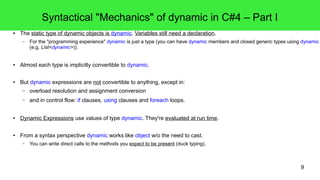
Syntactical "Mechanics" of dynamic in C#4 – Part I 
● The static type of dynamic objects is dynamic. Variables still need a declaration. 
– For the "programming experience" dynamic is just a type (you can have dynamic members and closed generic types using dynamic 
(e.g. List<dynamic>)). 
● Almost each type is implicitly convertible to dynamic. 
● But dynamic expressions are not convertible to anything, except in: 
– overload resolution and assignment conversion 
– and in control flow: if clauses, using clauses and foreach loops. 
● Dynamic Expressions use values of type dynamic. They're evaluated at run time. 
● From a syntax perspective dynamic works like object w/o the need to cast. 
– You can write direct calls to the methods you expect to be present (duck typing).
10 
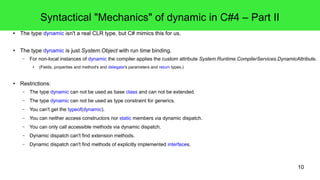
Syntactical "Mechanics" of dynamic in C#4 – Part II 
● The type dynamic isn't a real CLR type, but C# mimics this for us. 
● The type dynamic is just System.Object with run time binding. 
– For non-local instances of dynamic the compiler applies the custom attribute System.Runtime.CompilerServices.DynamicAttribute. 
● (Fields, properties and method's and delegate's parameters and return types.) 
● Restrictions: 
– The type dynamic can not be used as base class and can not be extended. 
– The type dynamic can not be used as type constraint for generics. 
– You can't get the typeof(dynamic). 
– You can neither access constructors nor static members via dynamic dispatch. 
– You can only call accessible methods via dynamic dispatch. 
– Dynamic dispatch can't find extension methods. 
– Dynamic dispatch can't find methods of explicitly implemented interfaces.
11 
Thank you!

New c sharp4_features_part_iii

  • 1.
    New C#4 Features– Part III Nico Ludwig (@ersatzteilchen)
  • 2.
    2 TOC ●New C#4 Features – Part III – Why dynamic Programming – Dynamic Programming in VB – Dynamic Programming in C#4 ● Sources: – Jon Skeet, C# in Depth – Chaur Wu, Pro DLR in .NET 4 – Programming Microsoft® LINQ in Microsoft .NET Framework 4 – MSDN Magazine 05/10, 06/10, 0710, 02/11 – Software Engineering Radio; Episode 28: Type Systems, <http://www.se-radio.net/2006/09/episode-28-type-systems/> – Software Engineering Radio; Episode 49: Dynamic Languages for Static Minds, <http://www.se-radio.net/2007/03/episode-49-dynamic-languages-for-static-minds/>
  • 3.
    3 Dynamic Typingas major new Feature in .Net 4/C#4 ● A big topic in .Net 4 is interoperability. ● Interoperability with other technologies is often a pain. – COM interop. – Explorative APIs that sit upon a dynamic object model (e.g. DOM). – Remoting technologies with loosely coupling, like SOA and cloud computing do rise. ● Services (read: operations or methods) may be available or not. – Domain Specific Languages (DSLs). – New scripting languages came into play, (some even base on the CLR). ● They're especially employing dynamic typing. – => As developers we encounter more and more things having a dynamic interface. ● Besides interoperability, dynamic typing enables other features. – Scripting .Net and with .Net. opens your application's object model to be scripted. – Mighty data-driven patterns (expando objects and dynamic Expression Trees).
  • 4.
    4 Leering atVB: Dynamic Programming <DynamicProgrammingVB> Shows dynamic typing, late binding, duck typing and COM automation with VB. Key aspects of dynamic programming: 1. Dynamic Typing 2. Late Binding 3. Duck Typing (4. Dynamic Objects)
  • 5.
    5 Static Typingvs. dynamic Typing – Part I ● Programming languages can be divided into statically and dynamically typed ones, whereby basically: – Statically typed languages make type checks at compile time. ● Expressions are of a known type at compile time, variables are fixed to one type at compile time. – Dynamically typed languages make type identification and checks at run time. ● Dynamically typed languages claim "convention over configuration/static check". – The believe is that discipline is more important than technical guidance. – The conventions work, because duck typing allows consistency at run time. – Conventions must be checked with unit-tests, a compiler can just check the syntax. – (Unit tests are required: they make dynamic code safe, because the compiler can't .) ● In dynamic typing the objects' types you're dealing with could be unknown. – The types are checked at run time and may even change at run time! – In static typing the objects' types are known and checked at compile time.
  • 6.
    6 Static Typingvs. dynamic Typing – Part II ● Incompatible interfaces (e.g. missing methods) are handled differently. – Static typing uses methods that must be bound at compile time successfully. – Dynamic typing rather uses messages being dispatched at run time. ● In static typing we have typing before run time, but ● in dynamic typing an object decides, whether it accepts a message. – In dynamic typing messages that are not "understood" can be handled at run time. ● Methods and fields could be added or removed during run time. ● Possible perception: Not: "Are you of this type?", rather: "Can you respond to this message?" ● Static type-checks, rely on explicit conversions; dynamic type-checks are deferred to run time and explicit conversions are required. – This is called late binding. – Late binding resolves textual symbols at run time (e.g. property names). – Early binding means to resolve all textual symbols early at compile time. – Static polymorphism is class-based polymorphism with static interfaces and dynamic dispatch. – Dynamic polymorphism means that objects don't need a common static interface like classes as we need no dynamic dispatch.
  • 7.
    7 So eventually:Dynamic Programming in .Net 4 and C#4 ● The .Net framework and C# are based on static typing, nothing changed here. – I.e. types and their interfaces are resolved/bound at compile time. ● C#4 allows dynamic typing in a statically typed language. – C# stays a statically typed language primarily, but it has new dynamic features now. ● Dynamic type analysis can be done via reflection, but it's difficult to read. – Dynamic typing makes the syntax much more appealing, even natural. ● The .Net 4 framework introduces the Dynamic Language Runtime (DLR). – The DLR is a library that enables dynamic dispatching within a CLR language. ● The new C#4 keyword dynamic is the syntactical entrance into the DLR. – If you apply dynamic you tell the compiler to turn off type-checks.
  • 8.
    8 Syntactical Basicsof dynamic Coding in C#4 <BasicSyntax, Dispatching> Shows the syntax basics of dynamics, dynamic expressions in C# and dynamic dispatching.
  • 9.
    9 Syntactical "Mechanics"of dynamic in C#4 – Part I ● The static type of dynamic objects is dynamic. Variables still need a declaration. – For the "programming experience" dynamic is just a type (you can have dynamic members and closed generic types using dynamic (e.g. List<dynamic>)). ● Almost each type is implicitly convertible to dynamic. ● But dynamic expressions are not convertible to anything, except in: – overload resolution and assignment conversion – and in control flow: if clauses, using clauses and foreach loops. ● Dynamic Expressions use values of type dynamic. They're evaluated at run time. ● From a syntax perspective dynamic works like object w/o the need to cast. – You can write direct calls to the methods you expect to be present (duck typing).
  • 10.
    10 Syntactical "Mechanics"of dynamic in C#4 – Part II ● The type dynamic isn't a real CLR type, but C# mimics this for us. ● The type dynamic is just System.Object with run time binding. – For non-local instances of dynamic the compiler applies the custom attribute System.Runtime.CompilerServices.DynamicAttribute. ● (Fields, properties and method's and delegate's parameters and return types.) ● Restrictions: – The type dynamic can not be used as base class and can not be extended. – The type dynamic can not be used as type constraint for generics. – You can't get the typeof(dynamic). – You can neither access constructors nor static members via dynamic dispatch. – You can only call accessible methods via dynamic dispatch. – Dynamic dispatch can't find extension methods. – Dynamic dispatch can't find methods of explicitly implemented interfaces.
  • 11.

Editor's Notes

  • #3 &amp;quot;Programming Microsoft® LINQ in Microsoft .NET Framework 4&amp;quot; provides a good overview of programming with Expression Trees.
  • #4 Interop often meant to use Object and casting all over. It makes sense to base scripting languages on the CLR, because it already offers some features: type loader, resolver, memory manager, garbage collector etc. In Java we found this development some years ago (JSR 292 and JSR 223). - Some new scripting languages have been built on top of the JRE (Groovy, Clojure and Scala) and others have been migrated (JRuby and Jython).
  • #5 The feature, which we discuss here as dynamic typing, is also known as loosely typing. - The main idea is that a dynamically typed variable is just a named placeholder for a value.
  • #6 Esp. do dynamically typed languages not require to declare a type at compile time. Example conventions: (esp. naming conventions) Ruby on Rails&amp;apos; scaffolding pattern and also ASP.Net MVC. Dynamic typing and unknown types are typically found in JavaScript (also called loosely typing in JavaScript) programming. The type-changes at run time are not expressed by polymorphism in dynamic typing! - The needed consistency is solely expressed by duck typing!
  • #7 Missing methods: Mind the problem of unavailable Services in a SOA. In Ruby and Python methods can be removed during run time. If a method wasn&amp;apos;t found in Obj-C, the method invocation can be forwarded and handled at run time. If the case of unknown methods was not handled by the programmer doesNotRecognizeSelector: will be called, which will eventually throw NSInvalidArgumentException (&amp;quot;unrecognized selector sent to instance &amp;lt;address&amp;gt;&amp;quot;). In Smalltalk doesNotUnderstand: will be called, which, if not handled by the programmer, will be handled by the runtime (or the debugger).
  • #8 In Obj-C you can use the static type id to enable dynamic typing on objects. The COM type IDispatch is indeed also an enabler for dynamic dispatching/late binding, when scripting and COM automation come into play. For a long time VB was the only language, in which you can switch between early bound (static) and lately bound (dynamic) typing (Option Explicit On/Off, Option Strict On/Off). In past versions of VB, e.g. in VB 6 this ability was based on the VB- and COM-type VARIANT. But VARIANT is best explained to be an example of weak typing rather than of dynamic typing.
  • #10 The keyword dynamic can be understood as &amp;quot;System.Object with run time binding&amp;quot;. At compile time, dynamic variables have only those methods defined in System.Object, at run time possibly more. But dynamic can be used as type argument for a generic type as base class (not a generic interface).
  • #11 If you need to do more with a dynamic object than, say, assigning values to it, e.g. calling methods, the DLR starts its work to dispatch the resulting dynamic expressions. In C#, the C# language binder will come into play in that situation, and if you apply dynamic dispatch in your code, you will need to add a reference to the assembly Microsoft.CSharp.dll in VS 2010. - The good news is that this assembly will be referenced by default, when you setup a new C# project in VS2010. Ctors and static members can&amp;apos;t be dynamically dispatched! You have to stick to instance methods or you have to use polymorphic static typing and factories.