1 
New C#4 Features – Part V 
Nico Ludwig (@ersatzteilchen)
2 
TOC 
● New C#4 Features – Part V 
– Dynamic COM Automation with C# 
– Dynamic Objects in JavaScript 
– Expando Objects in C# 
● Sources: 
– Jon Skeet, CSharp in Depth
3 
Dynamic Coding – A better Experience with COM 
● You no longer need interop types: 
– Just don't use them: 
● if you want lazy dispatching and you don't bother finding method signatures yourself... 
● or if you simply don't want to or can't use type infos (w/o type library)! - You just use dynamic. 
– (Use them if you want to exploit early dispatching, e.g. if you want to use IntelliSense.) 
– To have no need to create code as an extra step is a key benefit of dynamic coding. 
● But if you use interop types w/o PIAs, the DLR still makes your life easier: 
– No-PIA deployed types provide the type dynamic instead of object in their APIs. 
– E.g. IDispatch and VARIANTs are exposed as dynamics, reducing cast operations. 
● With dynamic typing and COM you now have a "natural" coding experience: 
– "Plain old CLR objects" (POCOs) and COM objects can be programmed like peers. 
– During debugging the new "Dynamic View" assists you watching COM objects. 
● COM as "peer objects" is one advantage of VB and 
PowerShell programming.
4 
Example with COM Automation 
<DynamicComInteropCSharp> 
aThis example shows the application of C# dynamic coding to allow 
simple COM automation.
5 
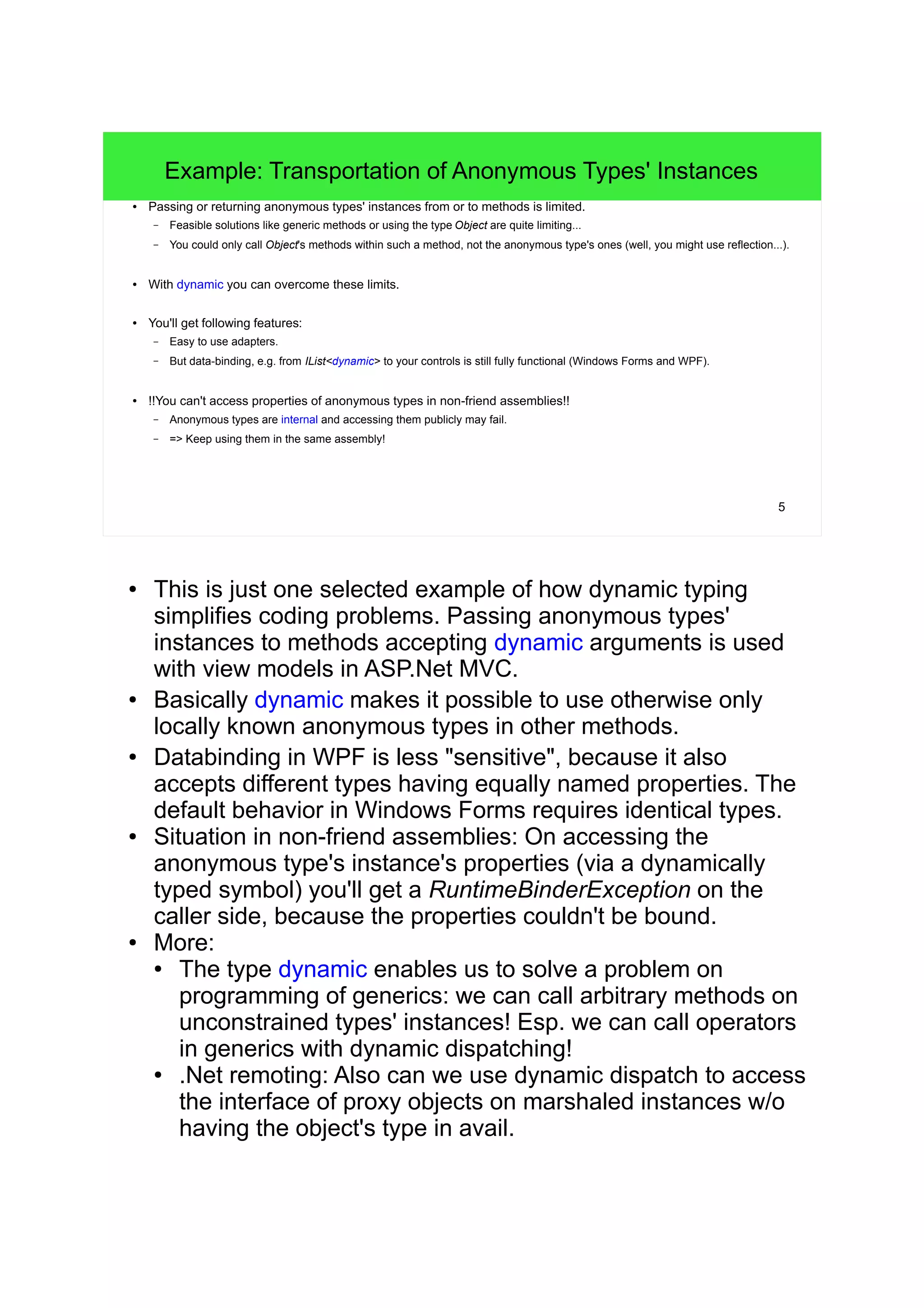
Example: Transportation of Anonymous Types' Instances 
● Passing or returning anonymous types' instances from or to methods is limited. 
– Feasible solutions like generic methods or using the type Object are quite limiting... 
– You could only call Object's methods within such a method, not the anonymous type's ones (well, you might use reflection...). 
● With dynamic you can overcome these limits. 
● You'll get following features: 
– Easy to use adapters. 
– But data-binding, e.g. from IList<dynamic> to your controls is still fully functional (Windows Forms and WPF). 
● !!You can't access properties of anonymous types in non-friend assemblies!! 
– Anonymous types are internal and accessing them publicly may fail. 
– => Keep using them in the same assembly! 
● This is just one selected example of how dynamic typing 
simplifies coding problems. Passing anonymous types' 
instances to methods accepting dynamic arguments is used 
with view models in ASP.Net MVC. 
● Basically dynamic makes it possible to use otherwise only 
locally known anonymous types in other methods. 
● Databinding in WPF is less "sensitive", because it also 
accepts different types having equally named properties. The 
default behavior in Windows Forms requires identical types. 
● Situation in non-friend assemblies: On accessing the 
anonymous type's instance's properties (via a dynamically 
typed symbol) you'll get a RuntimeBinderException on the 
caller side, because the properties couldn't be bound. 
● More: 
● The type dynamic enables us to solve a problem on 
programming of generics: we can call arbitrary methods on 
unconstrained types' instances! Esp. we can call operators 
in generics with dynamic dispatching! 
● .Net remoting: Also can we use dynamic dispatch to access 
the interface of proxy objects on marshaled instances w/o 
having the object's type in avail.
6 
Leering at JavaScript: Dynamic Objects 
<Safari Web Inspector as REPL> 
Shows how we can exploit dynamic objects with dynamic 
properties in JavaScript. 
Key aspects of dynamic programming: 
(1. Dynamic Typing) 
(2. Late Binding) 
(3. Duck Typing) 
4. Dynamic Objects 
● The ability to modify objects during run time is 
another aspect of dynamic programming that is 
shown here. -> Dynamic objects.
7 
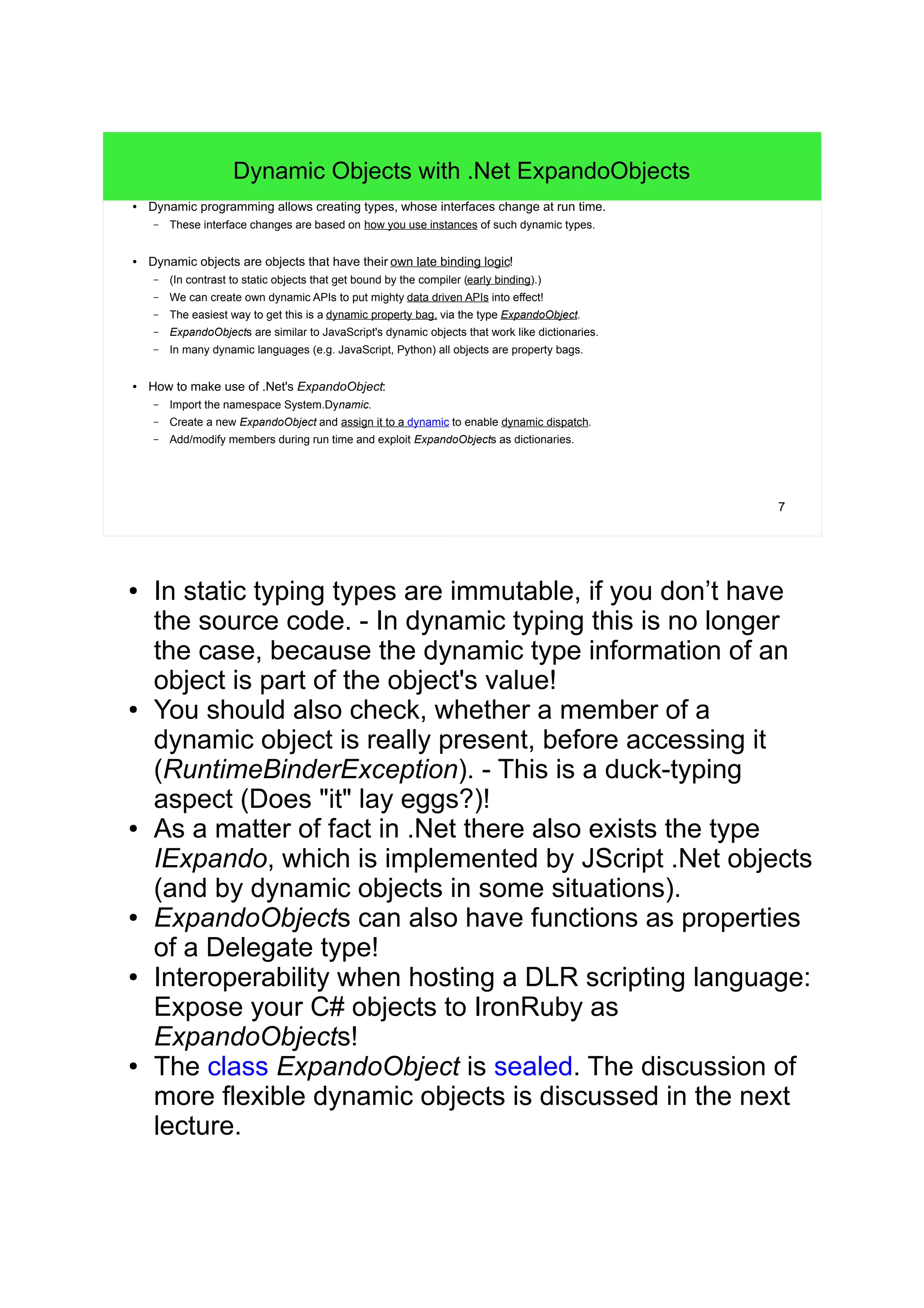
Dynamic Objects with .Net ExpandoObjects 
● Dynamic programming allows creating types, whose interfaces change at run time. 
– These interface changes are based on how you use instances of such dynamic types. 
● Dynamic objects are objects that have their own late binding logic! 
– (In contrast to static objects that get bound by the compiler (early binding).) 
– We can create own dynamic APIs to put mighty data driven APIs into effect! 
– The easiest way to get this is a dynamic property bag, via the type ExpandoObject. 
– ExpandoObjects are similar to JavaScript's dynamic objects that work like dictionaries. 
– In many dynamic languages (e.g. JavaScript, Python) all objects are property bags. 
● How to make use of .Net's ExpandoObject: 
– Import the namespace System.Dynamic. 
– Create a new ExpandoObject and assign it to a dynamic to enable dynamic dispatch. 
– Add/modify members during run time and exploit ExpandoObjects as dictionaries. 
● In static typing types are immutable, if you don’t have 
the source code. - In dynamic typing this is no longer 
the case, because the dynamic type information of an 
object is part of the object's value! 
● You should also check, whether a member of a 
dynamic object is really present, before accessing it 
(RuntimeBinderException). - This is a duck-typing 
aspect (Does "it" lay eggs?)! 
● As a matter of fact in .Net there also exists the type 
IExpando, which is implemented by JScript .Net objects 
(and by dynamic objects in some situations). 
● ExpandoObjects can also have functions as properties 
of a Delegate type! 
● Interoperability when hosting a DLR scripting language: 
Expose your C# objects to IronRuby as 
ExpandoObjects! 
● The class ExpandoObject is sealed. The discussion of 
more flexible dynamic objects is discussed in the next 
lecture.
8 
ExpandoObjects in Action 
<DynamicObjects> 
Shows the basic usage of ExpandoObjects. 
Key aspects of dynamic programming: 
(1. Dynamic Typing) 
(2. Late Binding) 
(3. Duck Typing) 
4. Dynamic Objects
9 
Thank you!

New c sharp4_features_part_v

  • 1.
    1 New C#4Features – Part V Nico Ludwig (@ersatzteilchen)
  • 2.
    2 TOC ●New C#4 Features – Part V – Dynamic COM Automation with C# – Dynamic Objects in JavaScript – Expando Objects in C# ● Sources: – Jon Skeet, CSharp in Depth
  • 3.
    3 Dynamic Coding– A better Experience with COM ● You no longer need interop types: – Just don't use them: ● if you want lazy dispatching and you don't bother finding method signatures yourself... ● or if you simply don't want to or can't use type infos (w/o type library)! - You just use dynamic. – (Use them if you want to exploit early dispatching, e.g. if you want to use IntelliSense.) – To have no need to create code as an extra step is a key benefit of dynamic coding. ● But if you use interop types w/o PIAs, the DLR still makes your life easier: – No-PIA deployed types provide the type dynamic instead of object in their APIs. – E.g. IDispatch and VARIANTs are exposed as dynamics, reducing cast operations. ● With dynamic typing and COM you now have a "natural" coding experience: – "Plain old CLR objects" (POCOs) and COM objects can be programmed like peers. – During debugging the new "Dynamic View" assists you watching COM objects. ● COM as "peer objects" is one advantage of VB and PowerShell programming.
  • 4.
    4 Example withCOM Automation <DynamicComInteropCSharp> aThis example shows the application of C# dynamic coding to allow simple COM automation.
  • 5.
    5 Example: Transportationof Anonymous Types' Instances ● Passing or returning anonymous types' instances from or to methods is limited. – Feasible solutions like generic methods or using the type Object are quite limiting... – You could only call Object's methods within such a method, not the anonymous type's ones (well, you might use reflection...). ● With dynamic you can overcome these limits. ● You'll get following features: – Easy to use adapters. – But data-binding, e.g. from IList<dynamic> to your controls is still fully functional (Windows Forms and WPF). ● !!You can't access properties of anonymous types in non-friend assemblies!! – Anonymous types are internal and accessing them publicly may fail. – => Keep using them in the same assembly! ● This is just one selected example of how dynamic typing simplifies coding problems. Passing anonymous types' instances to methods accepting dynamic arguments is used with view models in ASP.Net MVC. ● Basically dynamic makes it possible to use otherwise only locally known anonymous types in other methods. ● Databinding in WPF is less "sensitive", because it also accepts different types having equally named properties. The default behavior in Windows Forms requires identical types. ● Situation in non-friend assemblies: On accessing the anonymous type's instance's properties (via a dynamically typed symbol) you'll get a RuntimeBinderException on the caller side, because the properties couldn't be bound. ● More: ● The type dynamic enables us to solve a problem on programming of generics: we can call arbitrary methods on unconstrained types' instances! Esp. we can call operators in generics with dynamic dispatching! ● .Net remoting: Also can we use dynamic dispatch to access the interface of proxy objects on marshaled instances w/o having the object's type in avail.
  • 6.
    6 Leering atJavaScript: Dynamic Objects <Safari Web Inspector as REPL> Shows how we can exploit dynamic objects with dynamic properties in JavaScript. Key aspects of dynamic programming: (1. Dynamic Typing) (2. Late Binding) (3. Duck Typing) 4. Dynamic Objects ● The ability to modify objects during run time is another aspect of dynamic programming that is shown here. -> Dynamic objects.
  • 7.
    7 Dynamic Objectswith .Net ExpandoObjects ● Dynamic programming allows creating types, whose interfaces change at run time. – These interface changes are based on how you use instances of such dynamic types. ● Dynamic objects are objects that have their own late binding logic! – (In contrast to static objects that get bound by the compiler (early binding).) – We can create own dynamic APIs to put mighty data driven APIs into effect! – The easiest way to get this is a dynamic property bag, via the type ExpandoObject. – ExpandoObjects are similar to JavaScript's dynamic objects that work like dictionaries. – In many dynamic languages (e.g. JavaScript, Python) all objects are property bags. ● How to make use of .Net's ExpandoObject: – Import the namespace System.Dynamic. – Create a new ExpandoObject and assign it to a dynamic to enable dynamic dispatch. – Add/modify members during run time and exploit ExpandoObjects as dictionaries. ● In static typing types are immutable, if you don’t have the source code. - In dynamic typing this is no longer the case, because the dynamic type information of an object is part of the object's value! ● You should also check, whether a member of a dynamic object is really present, before accessing it (RuntimeBinderException). - This is a duck-typing aspect (Does "it" lay eggs?)! ● As a matter of fact in .Net there also exists the type IExpando, which is implemented by JScript .Net objects (and by dynamic objects in some situations). ● ExpandoObjects can also have functions as properties of a Delegate type! ● Interoperability when hosting a DLR scripting language: Expose your C# objects to IronRuby as ExpandoObjects! ● The class ExpandoObject is sealed. The discussion of more flexible dynamic objects is discussed in the next lecture.
  • 8.
    8 ExpandoObjects inAction <DynamicObjects> Shows the basic usage of ExpandoObjects. Key aspects of dynamic programming: (1. Dynamic Typing) (2. Late Binding) (3. Duck Typing) 4. Dynamic Objects
  • 9.