Copyright © 2007 Ramez Elmasr and Shamkant B. Navathei Slide 3- 1
Chapter 3
Data Modeling Using the Entity-Data Modeling Using the Entity-
Relationship (ER) Model
Copyright © 2007 Ramez Elmasri and Shamkant B. Navathe
Chapter OutlineChapter Outline
Overview of Database Design Processg
Example Database Application (COMPANY)
ER Model Concepts
Entities and Attrib tesEntities and Attributes
Entity Types, Value Sets, and Key Attributes
Relationships and Relationship Types
Weak Entity Types
Roles and Attributes in Relationship Types
ER Diagrams - NotationER Diagrams Notation
ER Diagram for COMPANY Schema
Alternative Notations – UML class diagrams, others
Copyright © 2007 Ramez Elmasr and Shamkant B. Navathei Slide 3- 3
Overview of Database Design ProcessOverview of Database Design Process
Two main activities:Two main activities:
Database design
Applications designApplications design
Focus in this chapter on database design
To design the conceptual schema for a databaseTo design the conceptual schema for a database
application
Applications design focuses on the programs andpp g p g
interfaces that access the database
Generally considered part of software engineering
Copyright © 2007 Ramez Elmasr and Shamkant B. Navathei Slide 3- 4
Overview of Database Design ProcessOverview of Database Design Process
Copyright © 2007 Ramez Elmasr and Shamkant B. Navathei Slide 3- 5
Example COMPANY DatabaseExample COMPANY Database
We need to create a database schema designg
based on the following (simplified) requirements
of the COMPANY Database:
Th i i d i t DEPARTMENTThe company is organized into DEPARTMENTs.
Each department has a name, number and an
employee who manages the department. We keepp y g p p
track of the start date of the department manager.
A department may have several locations.
Each department controls a number ofEach department controls a number of
PROJECTs. Each project has a unique name,
unique number and is located at a single location.
Copyright © 2007 Ramez Elmasr and Shamkant B. Navathei Slide 3- 6
Example COMPANY Database (Contd )Example COMPANY Database (Contd.)
We store each EMPLOYEE’s social securityy
number, address, salary, sex, and birthdate.
Each employee works for one department but may
work on several projectswork on several projects.
We keep track of the number of hours per week that
an employee currently works on each project.
We also keep track of the direct supervisor of each
employee.
Each employee may have a number ofEach employee may have a number of
DEPENDENTs.
For each dependent, we keep track of their name,
sex birthdate and relationship to the employee
Copyright © 2007 Ramez Elmasr and Shamkant B. Navathei Slide 3- 7
sex, birthdate, and relationship to the employee.
ER Model ConceptsER Model Concepts
Entities and Attributes
Entities are specific objects or things in the mini-world that
are represented in the database.
For example the EMPLOYEE John Smith, the Research
DEPARTMENT the ProductX PROJECTDEPARTMENT, the ProductX PROJECT
Attributes are properties used to describe an entity.
For example an EMPLOYEE entity may have the attributes
Name, SSN, Address, Sex, BirthDatea e, SS , dd ess, Se , t ate
A specific entity will have a value for each of its attributes.
For example a specific employee entity may have Name='John
Smith', SSN='123456789', Address ='731, Fondren, Houston,
TX' S 'M' Bi thD t '09 JAN 55‘TX', Sex='M', BirthDate='09-JAN-55‘
Each attribute has a value set (or data type) associated with
it – e.g. integer, string, subrange, enumerated type, …
Copyright © 2007 Ramez Elmasr and Shamkant B. Navathei Slide 3- 8
Types of Attributes (1)Types of Attributes (1)
Simple
Each entity has a single atomic value for the attribute. For
example, SSN or Sex.
Composite
The attribute may be composed of several components. For
example:
Address(Apt#, House#, Street, City, State, ZipCode, Country), or
Name(FirstName MiddleName LastName)Name(FirstName, MiddleName, LastName).
Composition may form a hierarchy where some components
are themselves composite.
Multi-valued
An entity may have multiple values for that attribute. For
example, Color of a CAR or PreviousDegrees of a STUDENT.
Denoted as {Color} or {PreviousDegrees}.
Copyright © 2007 Ramez Elmasr and Shamkant B. Navathei Slide 3- 9
Types of Attributes (2)Types of Attributes (2)
In general, composite and multi-valued attributesIn general, composite and multi valued attributes
may be nested arbitrarily to any number of levels,
although this is rare.
For example, PreviousDegrees of a STUDENT is a
composite multi-valued attribute denoted by
{P i D (C ll Y D Fi ld)}{PreviousDegrees (College, Year, Degree, Field)}
Multiple PreviousDegrees values can exist
Each has fo r s bcomponent attrib tesEach has four subcomponent attributes:
College, Year, Degree, Field
Copyright © 2007 Ramez Elmasr and Shamkant B. Navathei Slide 3- 10
Example of a composite attributeExample of a composite attribute
Copyright © 2007 Ramez Elmasr and Shamkant B. Navathei Slide 3- 11
Entity Types and Key Attributes (1)Entity Types and Key Attributes (1)
Entities with the same basic attributes areEntities with the same basic attributes are
grouped or typed into an entity type.
For example the entity type EMPLOYEEFor example, the entity type EMPLOYEE
and PROJECT.
An attribute of an entity type for which eachAn attribute of an entity type for which each
entity must have a unique value is called a
key attribute of the entity typekey attribute of the entity type.
For example, SSN of EMPLOYEE.
Copyright © 2007 Ramez Elmasr and Shamkant B. Navathei Slide 3- 12
Entity Types and Key Attributes (2)Entity Types and Key Attributes (2)
A key attribute may be composite.A key attribute may be composite.
VehicleTagNumber is a key of the CAR entity
type with components (Number, State).yp p ( , )
An entity type may have more than one key.
The CAR entity type may have two keys:The CAR entity type may have two keys:
VehicleIdentificationNumber (popularly called VIN)
VehicleTagNumber (Number, State), aka licenseg ( )
plate number.
Each key is underlined
Copyright © 2007 Ramez Elmasr and Shamkant B. Navathei Slide 3- 13
Displaying an Entity typeDisplaying an Entity type
In ER diagrams, an entity type is displayed in ag , y yp p y
rectangular box
Attributes are displayed in ovals
Each attribute is connected to its entity type
Components of a composite attribute are
connected to the oval representing the compositeconnected to the oval representing the composite
attribute
Each key attribute is underlinedy
Multivalued attributes displayed in double ovals
See CAR example on next slide
Copyright © 2007 Ramez Elmasr and Shamkant B. Navathei Slide 3- 14
Entity Type CAR with two keys and a
corresponding Entity Setcorresponding Entity Set
Copyright © 2007 Ramez Elmasr and Shamkant B. Navathei Slide 3- 15
Entity SetEntity Set
Each entity type will have a collection of entitiesEach entity type will have a collection of entities
stored in the database
Called the entity sety
Previous slide shows three CAR entity instances
in the entity set for CAR
Same name (CAR) used to refer to both the entity
type and the entity set
Entity set is the current state of the entities of that
type that are stored in the database
Copyright © 2007 Ramez Elmasr and Shamkant B. Navathei Slide 3- 16
Initial Design of Entity Types for the
COMPANY Database SchemaCOMPANY Database Schema
Based on the requirements, we can identify fourBased on the requirements, we can identify four
initial entity types in the COMPANY database:
DEPARTMENT
PROJECT
EMPLOYEE
DEPENDENT
Their initial design is shown on the following slideg g
The initial attributes shown are derived from the
requirements description
Copyright © 2007 Ramez Elmasr and Shamkant B. Navathei Slide 3- 17
Initial Design of Entity Types:
EMPLOYEE DEPARTMENT PROJECT DEPENDENTEMPLOYEE, DEPARTMENT, PROJECT, DEPENDENT
Copyright © 2007 Ramez Elmasr and Shamkant B. Navathei Slide 3- 18
Refining the initial design by introducing
relationshipsrelationships
The initial design is typically not completeThe initial design is typically not complete
Some aspects in the requirements will be
represented as relationshipsp p
ER model has three main concepts:
Entities (and their entity types and entity sets)Entities (and their entity types and entity sets)
Attributes (simple, composite, multivalued)
Relationships (and their relationship types andp ( p yp
relationship sets)
We introduce relationship concepts next
Copyright © 2007 Ramez Elmasr and Shamkant B. Navathei Slide 3- 19
Relationships and Relationship Types (1)Relationships and Relationship Types (1)
A relationship relates two or more distinct entities with a
ifi ispecific meaning.
For example, EMPLOYEE John Smith works on the ProductX
PROJECT, or EMPLOYEE Franklin Wong manages the
Research DEPARTMENTResearch DEPARTMENT.
Relationships of the same type are grouped or typed into
a relationship type.
For example the WORKS ON relationship type in whichFor example, the WORKS_ON relationship type in which
EMPLOYEEs and PROJECTs participate, or the MANAGES
relationship type in which EMPLOYEEs and DEPARTMENTs
participate.
Th d f l ti hi t i th b fThe degree of a relationship type is the number of
participating entity types.
Both MANAGES and WORKS_ON are binary relationships.
Copyright © 2007 Ramez Elmasr and Shamkant B. Navathei Slide 3- 20
Relationship instances of the WORKS_FOR N:1
relationship between EMPLOYEE and DEPARTMENTp
Copyright © 2007 Ramez Elmasr and Shamkant B. Navathei Slide 3- 21
Relationship instances of the M:N WORKS_ON
relationship between EMPLOYEE and PROJECTrelationship between EMPLOYEE and PROJECT
Copyright © 2007 Ramez Elmasr and Shamkant B. Navathei Slide 3- 22
Relationship type vs relationship set (1)Relationship type vs. relationship set (1)
Relationship Type:Relationship Type:
Is the schema description of a relationship
Identifies the relationship name and theIdentifies the relationship name and the
participating entity types
Also identifies certain relationship constraints
Relationship Set:
The current set of relationship instances
represented in the database
The current state of a relationship type
Copyright © 2007 Ramez Elmasr and Shamkant B. Navathei Slide 3- 23
Relationship type vs relationship set (2)Relationship type vs. relationship set (2)
Previous figures displayed the relationship setsPrevious figures displayed the relationship sets
Each instance in the set relates individual
participating entities – one from each participatingp p g p p g
entity type
In ER diagrams, we represent the relationshipg , p p
type as follows:
Diamond-shaped box is used to display a
relationship type
Connected to the participating entity types via
straight lines
Copyright © 2007 Ramez Elmasr and Shamkant B. Navathei Slide 3- 24
straight lines
Refining the COMPANY database
schema by introducing relationshipsschema by introducing relationships
By examining the requirements, six relationship types arey g q , p yp
identified
All are binary relationships( degree 2)
Listed below with their participating entity types:
WORKS_FOR (between EMPLOYEE, DEPARTMENT)
MANAGES (also between EMPLOYEE DEPARTMENT)MANAGES (also between EMPLOYEE, DEPARTMENT)
CONTROLS (between DEPARTMENT, PROJECT)
WORKS_ON (between EMPLOYEE, PROJECT)
SUPERVISION (between EMPLOYEE (as subordinate),
EMPLOYEE (as supervisor))
DEPENDENTS OF (between EMPLOYEE DEPENDENT)
Copyright © 2007 Ramez Elmasr and Shamkant B. Navathei Slide 3- 25
DEPENDENTS_OF (between EMPLOYEE, DEPENDENT)
ER DIAGRAM – Relationship Types are:
WORKS_FOR, MANAGES, WORKS_ON, CONTROLS, SUPERVISION, DEPENDENTS_OF
Copyright © 2007 Ramez Elmasr and Shamkant B. Navathei Slide 3- 26
Discussion on Relationship TypesDiscussion on Relationship Types
In the refined design, some attributes from the initial entityg , y
types are refined into relationships:
Manager of DEPARTMENT -> MANAGES
W k f EMPLOYEE WORKS ONWorks_on of EMPLOYEE -> WORKS_ON
Department of EMPLOYEE -> WORKS_FOR
etcetc
In general, more than one relationship type can exist
between the same participating entity types
MANAGES and WORKS_FOR are distinct relationship
types between EMPLOYEE and DEPARTMENT
Different meanings and different relationship instances.
Copyright © 2007 Ramez Elmasr and Shamkant B. Navathei Slide 3- 27
g p
Recursive Relationship TypeRecursive Relationship Type
A relationship type with the same participating entity typep yp p p g y yp
in distinct roles
Example: the SUPERVISION relationship
EMPLOYEE participates twice in two distinct roles:
supervisor (or boss) role
supervisee (or subordinate) rolesupervisee (or subordinate) role
Each relationship instance relates two distinct
EMPLOYEE entities:
One employee in supervisor role
One employee in supervisee role
Copyright © 2007 Ramez Elmasr and Shamkant B. Navathei Slide 3- 28
Displaying a recursive relationshipDisplaying a recursive relationship
In a recursive relationship type.p yp
Both participations are same entity type in
different roles.
For example SUPERVISION relationshipsFor example, SUPERVISION relationships
between EMPLOYEE (in role of supervisor or
boss) and (another) EMPLOYEE (in role of
b di t k )subordinate or worker).
In following figure, first role participation labeled
with 1 and second role participation labeled witht a d seco d o e pa t c pat o abe ed t
2.
In ER diagram, need to display role names to
distinguish participations
Copyright © 2007 Ramez Elmasr and Shamkant B. Navathei Slide 3- 29
distinguish participations.
A Recursive Relationship Supervision`
Copyright © 2007 Ramez Elmasr and Shamkant B. Navathei Slide 3- 30
Weak Entity TypesWeak Entity Types
An entity that does not have a key attribute
A weak entity must participate in an identifying relationship type with
an owner or identifying entity type
Weak entities are identified by the combination of:
A partial key of the weak entity type
The particular entity they are related to in the identifying entity
type
E lExample:
A DEPENDENT entity is identified by the dependent’s first name,
and the specific EMPLOYEE with whom the dependent is related
N f DEPENDENT i th ti l kName of DEPENDENT is the partial key
DEPENDENT is a weak entity type
EMPLOYEE is its identifying entity type via the identifying
relationship type DEPENDENT OF
Copyright © 2007 Ramez Elmasr and Shamkant B. Navathei Slide 3- 31
relationship type DEPENDENT_OF
Constraints on RelationshipsConstraints on Relationships
Constraints on Relationship Typesp yp
Cardinality Ratio (specifies maximum participation)
Shown by placing appropriate numbers on the relationship
edges.g
One-to-one (1:1)
One-to-many (1:N) or Many-to-one (N:1)
Many-to-many (M:N)
Existence Dependency Constraint (specifies minimum
participation) (also called participation constraint)
zero (optional participation, not existence-dependent)
shown by single line
one or more (mandatory participation, existence-dependent)
shown by double line
Copyright © 2007 Ramez Elmasr and Shamkant B. Navathei Slide 3- 32
Attributes of Relationship typesAttributes of Relationship types
A relationship type can have attributes:p yp
For example, HoursPerWeek of WORKS_ON
Its value for each relationship instance describes
the number of hours per week that an EMPLOYEE
works on a PROJECT.
A value of HoursPerWeek depends on a particularA value of HoursPerWeek depends on a particular
(employee, project) combination
Most relationship attributes are used with M:N
relationshipsrelationships
In 1:N relationships, they can be transferred to the
entity type on the N-side of the relationship
Copyright © 2007 Ramez Elmasr and Shamkant B. Navathei Slide 3- 33
Summary of notation for ER diagramsSummary of notation for ER diagrams
Copyright © 2007 Ramez Elmasr and Shamkant B. Navathei Slide 3- 34
Alternative (min, max) notation for
relationship structural constraints:relationship structural constraints:
Specified on each participation of an entity type E in a relationship
type Rtype R
Specifies that each entity e in E participates in at least min and at
most max relationship instances in R
Default(no constraint): min=0, max=n (signifying no limit)( ) , ( g y g )
Must have min≤max, min≥0, max ≥1
Derived from the knowledge of mini-world constraints
Examples:
A department has exactly one manager and an employee can
manage at most one department.
Specify (0,1) for participation of EMPLOYEE in MANAGES
Specify (1 1) for participation of DEPARTMENT in MANAGESSpecify (1,1) for participation of DEPARTMENT in MANAGES
An employee can work for exactly one department but a
department can have any number of employees.
Specify (1,1) for participation of EMPLOYEE in WORKS_FOR
Copyright © 2007 Ramez Elmasr and Shamkant B. Navathei Slide 3- 35
Specify (0,n) for participation of DEPARTMENT in WORKS_FOR
The (min,max) notation for
relationship constraintsrelationship constraints
Read the min,max numbers next to the entity
Copyright © 2007 Ramez Elmasr and Shamkant B. Navathei Slide 3- 36
type and looking away from the entity type
COMPANY ER Schema Diagram using (min,
max) notationmax) notation
Copyright © 2007 Ramez Elmasr and Shamkant B. Navathei Slide 3- 37
Alternative diagrammatic notationAlternative diagrammatic notation
ER diagrams is one popular example forER diagrams is one popular example for
displaying database schemas
Many other notations exist in the literature and iny
various database design and modeling tools
Appendix A illustrates some of the alternativepp
notations that have been used
UML class diagrams is representative of another
way of displaying ER concepts that is used in
several commercial design tools
Copyright © 2007 Ramez Elmasr and Shamkant B. Navathei Slide 3- 38
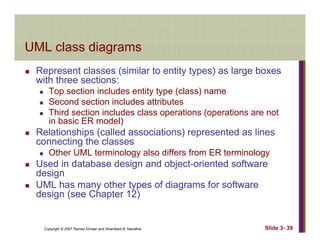
UML class diagramsUML class diagrams
Represent classes (similar to entity types) as large boxes
ith th tiwith three sections:
Top section includes entity type (class) name
Second section includes attributes
Third section includes class operations (operations are not
in basic ER model)
Relationships (called associations) represented as lines
ti th lconnecting the classes
Other UML terminology also differs from ER terminology
Used in database design and object-oriented software
d idesign
UML has many other types of diagrams for software
design (see Chapter 12)
Copyright © 2007 Ramez Elmasr and Shamkant B. Navathei Slide 3- 39
UML class diagram for COMPANY
database schemadatabase schema
Copyright © 2007 Ramez Elmasr and Shamkant B. Navathei Slide 3- 40
Relationships of Higher DegreeRelationships of Higher Degree
Relationship types of degree 2 are called binaryRelationship types of degree 2 are called binary
Relationship types of degree 3 are called ternary
and of degree n are called n-aryg y
In general, an n-ary relationship is not equivalent
to n binary relationshipsy p
Constraints are harder to specify for higher-
degree relationships (n > 2) than for binary
relationships
Copyright © 2007 Ramez Elmasr and Shamkant B. Navathei Slide 3- 41
Discussion of n ary relationships (n > 2)Discussion of n-ary relationships (n > 2)
In general, 3 binary relationships can representIn general, 3 binary relationships can represent
different information than a single ternary
relationship (see Figure 3.17a and b on next
slide)
If needed, the binary and n-ary relationships can
all be included in the schema design (see Figure
3.17a and b, where all relationships convey
different meanings)different meanings)
Copyright © 2007 Ramez Elmasr and Shamkant B. Navathei Slide 3- 42
Example of a ternary relationshipExample of a ternary relationship
Copyright © 2007 Ramez Elmasr and Shamkant B. Navathei Slide 3- 43
Discussion of n ary relationships (n > 2)Discussion of n-ary relationships (n > 2)
If a particular binary relationship can be derivedIf a particular binary relationship can be derived
from a higher-degree relationship at all times,
then it is redundant
For example, the TAUGHT_DURING binary
relationship in Figure 3.18 (see next slide) can be
derived from the ternary relationship OFFERS
(based on the meaning of the relationships)
Copyright © 2007 Ramez Elmasr and Shamkant B. Navathei Slide 3- 44
Another example of a ternary relationshipAnother example of a ternary relationship
Copyright © 2007 Ramez Elmasr and Shamkant B. Navathei Slide 3- 45
Some of the Currently Available
Automated Database Design ToolsAutomated Database Design Tools
COMPANY TOOL FUNCTIONALITY
Embarcadero ER Studio Database Modeling in ER and IDEF1XEmbarcadero
Technologies
ER Studio Database Modeling in ER and IDEF1X
DB Artisan Database administration, space and security
management
Oracle Developer 2000/Designer 2000 Database modeling application developmentOracle Developer 2000/Designer 2000 Database modeling, application development
Popkin
Software
System Architect 2001 Data modeling, object modeling, process modeling,
structured analysis/design
Platinum Enterprise Modeling Suite: Data, process, and business component modeling
(Computer
Associates)
p g
Erwin, BPWin, Paradigm Plus
, p , p g
Persistence
Inc
Pwertier Mapping from O-O to relational model
Inc.
Rational (IBM) Rational Rose UML Modeling & application generation in C++/JAVA
Resolution Ltd. Xcase Conceptual modeling up to code maintenance
Copyright © 2007 Ramez Elmasr and Shamkant B. Navathei Slide 3- 46
Sybase Enterprise Application Suite Data modeling, business logic modeling
Visio Visio Enterprise Data modeling, design/reengineering Visual Basic/C++

Data Modeling Using the EntityRelationship (ER) Model

  • 1.
    Copyright © 2007Ramez Elmasr and Shamkant B. Navathei Slide 3- 1
  • 2.
    Chapter 3 Data ModelingUsing the Entity-Data Modeling Using the Entity- Relationship (ER) Model Copyright © 2007 Ramez Elmasri and Shamkant B. Navathe
  • 3.
    Chapter OutlineChapter Outline Overviewof Database Design Processg Example Database Application (COMPANY) ER Model Concepts Entities and Attrib tesEntities and Attributes Entity Types, Value Sets, and Key Attributes Relationships and Relationship Types Weak Entity Types Roles and Attributes in Relationship Types ER Diagrams - NotationER Diagrams Notation ER Diagram for COMPANY Schema Alternative Notations – UML class diagrams, others Copyright © 2007 Ramez Elmasr and Shamkant B. Navathei Slide 3- 3
  • 4.
    Overview of DatabaseDesign ProcessOverview of Database Design Process Two main activities:Two main activities: Database design Applications designApplications design Focus in this chapter on database design To design the conceptual schema for a databaseTo design the conceptual schema for a database application Applications design focuses on the programs andpp g p g interfaces that access the database Generally considered part of software engineering Copyright © 2007 Ramez Elmasr and Shamkant B. Navathei Slide 3- 4
  • 5.
    Overview of DatabaseDesign ProcessOverview of Database Design Process Copyright © 2007 Ramez Elmasr and Shamkant B. Navathei Slide 3- 5
  • 6.
    Example COMPANY DatabaseExampleCOMPANY Database We need to create a database schema designg based on the following (simplified) requirements of the COMPANY Database: Th i i d i t DEPARTMENTThe company is organized into DEPARTMENTs. Each department has a name, number and an employee who manages the department. We keepp y g p p track of the start date of the department manager. A department may have several locations. Each department controls a number ofEach department controls a number of PROJECTs. Each project has a unique name, unique number and is located at a single location. Copyright © 2007 Ramez Elmasr and Shamkant B. Navathei Slide 3- 6
  • 7.
    Example COMPANY Database(Contd )Example COMPANY Database (Contd.) We store each EMPLOYEE’s social securityy number, address, salary, sex, and birthdate. Each employee works for one department but may work on several projectswork on several projects. We keep track of the number of hours per week that an employee currently works on each project. We also keep track of the direct supervisor of each employee. Each employee may have a number ofEach employee may have a number of DEPENDENTs. For each dependent, we keep track of their name, sex birthdate and relationship to the employee Copyright © 2007 Ramez Elmasr and Shamkant B. Navathei Slide 3- 7 sex, birthdate, and relationship to the employee.
  • 8.
    ER Model ConceptsERModel Concepts Entities and Attributes Entities are specific objects or things in the mini-world that are represented in the database. For example the EMPLOYEE John Smith, the Research DEPARTMENT the ProductX PROJECTDEPARTMENT, the ProductX PROJECT Attributes are properties used to describe an entity. For example an EMPLOYEE entity may have the attributes Name, SSN, Address, Sex, BirthDatea e, SS , dd ess, Se , t ate A specific entity will have a value for each of its attributes. For example a specific employee entity may have Name='John Smith', SSN='123456789', Address ='731, Fondren, Houston, TX' S 'M' Bi thD t '09 JAN 55‘TX', Sex='M', BirthDate='09-JAN-55‘ Each attribute has a value set (or data type) associated with it – e.g. integer, string, subrange, enumerated type, … Copyright © 2007 Ramez Elmasr and Shamkant B. Navathei Slide 3- 8
  • 9.
    Types of Attributes(1)Types of Attributes (1) Simple Each entity has a single atomic value for the attribute. For example, SSN or Sex. Composite The attribute may be composed of several components. For example: Address(Apt#, House#, Street, City, State, ZipCode, Country), or Name(FirstName MiddleName LastName)Name(FirstName, MiddleName, LastName). Composition may form a hierarchy where some components are themselves composite. Multi-valued An entity may have multiple values for that attribute. For example, Color of a CAR or PreviousDegrees of a STUDENT. Denoted as {Color} or {PreviousDegrees}. Copyright © 2007 Ramez Elmasr and Shamkant B. Navathei Slide 3- 9
  • 10.
    Types of Attributes(2)Types of Attributes (2) In general, composite and multi-valued attributesIn general, composite and multi valued attributes may be nested arbitrarily to any number of levels, although this is rare. For example, PreviousDegrees of a STUDENT is a composite multi-valued attribute denoted by {P i D (C ll Y D Fi ld)}{PreviousDegrees (College, Year, Degree, Field)} Multiple PreviousDegrees values can exist Each has fo r s bcomponent attrib tesEach has four subcomponent attributes: College, Year, Degree, Field Copyright © 2007 Ramez Elmasr and Shamkant B. Navathei Slide 3- 10
  • 11.
    Example of acomposite attributeExample of a composite attribute Copyright © 2007 Ramez Elmasr and Shamkant B. Navathei Slide 3- 11
  • 12.
    Entity Types andKey Attributes (1)Entity Types and Key Attributes (1) Entities with the same basic attributes areEntities with the same basic attributes are grouped or typed into an entity type. For example the entity type EMPLOYEEFor example, the entity type EMPLOYEE and PROJECT. An attribute of an entity type for which eachAn attribute of an entity type for which each entity must have a unique value is called a key attribute of the entity typekey attribute of the entity type. For example, SSN of EMPLOYEE. Copyright © 2007 Ramez Elmasr and Shamkant B. Navathei Slide 3- 12
  • 13.
    Entity Types andKey Attributes (2)Entity Types and Key Attributes (2) A key attribute may be composite.A key attribute may be composite. VehicleTagNumber is a key of the CAR entity type with components (Number, State).yp p ( , ) An entity type may have more than one key. The CAR entity type may have two keys:The CAR entity type may have two keys: VehicleIdentificationNumber (popularly called VIN) VehicleTagNumber (Number, State), aka licenseg ( ) plate number. Each key is underlined Copyright © 2007 Ramez Elmasr and Shamkant B. Navathei Slide 3- 13
  • 14.
    Displaying an EntitytypeDisplaying an Entity type In ER diagrams, an entity type is displayed in ag , y yp p y rectangular box Attributes are displayed in ovals Each attribute is connected to its entity type Components of a composite attribute are connected to the oval representing the compositeconnected to the oval representing the composite attribute Each key attribute is underlinedy Multivalued attributes displayed in double ovals See CAR example on next slide Copyright © 2007 Ramez Elmasr and Shamkant B. Navathei Slide 3- 14
  • 15.
    Entity Type CARwith two keys and a corresponding Entity Setcorresponding Entity Set Copyright © 2007 Ramez Elmasr and Shamkant B. Navathei Slide 3- 15
  • 16.
    Entity SetEntity Set Eachentity type will have a collection of entitiesEach entity type will have a collection of entities stored in the database Called the entity sety Previous slide shows three CAR entity instances in the entity set for CAR Same name (CAR) used to refer to both the entity type and the entity set Entity set is the current state of the entities of that type that are stored in the database Copyright © 2007 Ramez Elmasr and Shamkant B. Navathei Slide 3- 16
  • 17.
    Initial Design ofEntity Types for the COMPANY Database SchemaCOMPANY Database Schema Based on the requirements, we can identify fourBased on the requirements, we can identify four initial entity types in the COMPANY database: DEPARTMENT PROJECT EMPLOYEE DEPENDENT Their initial design is shown on the following slideg g The initial attributes shown are derived from the requirements description Copyright © 2007 Ramez Elmasr and Shamkant B. Navathei Slide 3- 17
  • 18.
    Initial Design ofEntity Types: EMPLOYEE DEPARTMENT PROJECT DEPENDENTEMPLOYEE, DEPARTMENT, PROJECT, DEPENDENT Copyright © 2007 Ramez Elmasr and Shamkant B. Navathei Slide 3- 18
  • 19.
    Refining the initialdesign by introducing relationshipsrelationships The initial design is typically not completeThe initial design is typically not complete Some aspects in the requirements will be represented as relationshipsp p ER model has three main concepts: Entities (and their entity types and entity sets)Entities (and their entity types and entity sets) Attributes (simple, composite, multivalued) Relationships (and their relationship types andp ( p yp relationship sets) We introduce relationship concepts next Copyright © 2007 Ramez Elmasr and Shamkant B. Navathei Slide 3- 19
  • 20.
    Relationships and RelationshipTypes (1)Relationships and Relationship Types (1) A relationship relates two or more distinct entities with a ifi ispecific meaning. For example, EMPLOYEE John Smith works on the ProductX PROJECT, or EMPLOYEE Franklin Wong manages the Research DEPARTMENTResearch DEPARTMENT. Relationships of the same type are grouped or typed into a relationship type. For example the WORKS ON relationship type in whichFor example, the WORKS_ON relationship type in which EMPLOYEEs and PROJECTs participate, or the MANAGES relationship type in which EMPLOYEEs and DEPARTMENTs participate. Th d f l ti hi t i th b fThe degree of a relationship type is the number of participating entity types. Both MANAGES and WORKS_ON are binary relationships. Copyright © 2007 Ramez Elmasr and Shamkant B. Navathei Slide 3- 20
  • 21.
    Relationship instances ofthe WORKS_FOR N:1 relationship between EMPLOYEE and DEPARTMENTp Copyright © 2007 Ramez Elmasr and Shamkant B. Navathei Slide 3- 21
  • 22.
    Relationship instances ofthe M:N WORKS_ON relationship between EMPLOYEE and PROJECTrelationship between EMPLOYEE and PROJECT Copyright © 2007 Ramez Elmasr and Shamkant B. Navathei Slide 3- 22
  • 23.
    Relationship type vsrelationship set (1)Relationship type vs. relationship set (1) Relationship Type:Relationship Type: Is the schema description of a relationship Identifies the relationship name and theIdentifies the relationship name and the participating entity types Also identifies certain relationship constraints Relationship Set: The current set of relationship instances represented in the database The current state of a relationship type Copyright © 2007 Ramez Elmasr and Shamkant B. Navathei Slide 3- 23
  • 24.
    Relationship type vsrelationship set (2)Relationship type vs. relationship set (2) Previous figures displayed the relationship setsPrevious figures displayed the relationship sets Each instance in the set relates individual participating entities – one from each participatingp p g p p g entity type In ER diagrams, we represent the relationshipg , p p type as follows: Diamond-shaped box is used to display a relationship type Connected to the participating entity types via straight lines Copyright © 2007 Ramez Elmasr and Shamkant B. Navathei Slide 3- 24 straight lines
  • 25.
    Refining the COMPANYdatabase schema by introducing relationshipsschema by introducing relationships By examining the requirements, six relationship types arey g q , p yp identified All are binary relationships( degree 2) Listed below with their participating entity types: WORKS_FOR (between EMPLOYEE, DEPARTMENT) MANAGES (also between EMPLOYEE DEPARTMENT)MANAGES (also between EMPLOYEE, DEPARTMENT) CONTROLS (between DEPARTMENT, PROJECT) WORKS_ON (between EMPLOYEE, PROJECT) SUPERVISION (between EMPLOYEE (as subordinate), EMPLOYEE (as supervisor)) DEPENDENTS OF (between EMPLOYEE DEPENDENT) Copyright © 2007 Ramez Elmasr and Shamkant B. Navathei Slide 3- 25 DEPENDENTS_OF (between EMPLOYEE, DEPENDENT)
  • 26.
    ER DIAGRAM –Relationship Types are: WORKS_FOR, MANAGES, WORKS_ON, CONTROLS, SUPERVISION, DEPENDENTS_OF Copyright © 2007 Ramez Elmasr and Shamkant B. Navathei Slide 3- 26
  • 27.
    Discussion on RelationshipTypesDiscussion on Relationship Types In the refined design, some attributes from the initial entityg , y types are refined into relationships: Manager of DEPARTMENT -> MANAGES W k f EMPLOYEE WORKS ONWorks_on of EMPLOYEE -> WORKS_ON Department of EMPLOYEE -> WORKS_FOR etcetc In general, more than one relationship type can exist between the same participating entity types MANAGES and WORKS_FOR are distinct relationship types between EMPLOYEE and DEPARTMENT Different meanings and different relationship instances. Copyright © 2007 Ramez Elmasr and Shamkant B. Navathei Slide 3- 27 g p
  • 28.
    Recursive Relationship TypeRecursiveRelationship Type A relationship type with the same participating entity typep yp p p g y yp in distinct roles Example: the SUPERVISION relationship EMPLOYEE participates twice in two distinct roles: supervisor (or boss) role supervisee (or subordinate) rolesupervisee (or subordinate) role Each relationship instance relates two distinct EMPLOYEE entities: One employee in supervisor role One employee in supervisee role Copyright © 2007 Ramez Elmasr and Shamkant B. Navathei Slide 3- 28
  • 29.
    Displaying a recursiverelationshipDisplaying a recursive relationship In a recursive relationship type.p yp Both participations are same entity type in different roles. For example SUPERVISION relationshipsFor example, SUPERVISION relationships between EMPLOYEE (in role of supervisor or boss) and (another) EMPLOYEE (in role of b di t k )subordinate or worker). In following figure, first role participation labeled with 1 and second role participation labeled witht a d seco d o e pa t c pat o abe ed t 2. In ER diagram, need to display role names to distinguish participations Copyright © 2007 Ramez Elmasr and Shamkant B. Navathei Slide 3- 29 distinguish participations.
  • 30.
    A Recursive RelationshipSupervision` Copyright © 2007 Ramez Elmasr and Shamkant B. Navathei Slide 3- 30
  • 31.
    Weak Entity TypesWeakEntity Types An entity that does not have a key attribute A weak entity must participate in an identifying relationship type with an owner or identifying entity type Weak entities are identified by the combination of: A partial key of the weak entity type The particular entity they are related to in the identifying entity type E lExample: A DEPENDENT entity is identified by the dependent’s first name, and the specific EMPLOYEE with whom the dependent is related N f DEPENDENT i th ti l kName of DEPENDENT is the partial key DEPENDENT is a weak entity type EMPLOYEE is its identifying entity type via the identifying relationship type DEPENDENT OF Copyright © 2007 Ramez Elmasr and Shamkant B. Navathei Slide 3- 31 relationship type DEPENDENT_OF
  • 32.
    Constraints on RelationshipsConstraintson Relationships Constraints on Relationship Typesp yp Cardinality Ratio (specifies maximum participation) Shown by placing appropriate numbers on the relationship edges.g One-to-one (1:1) One-to-many (1:N) or Many-to-one (N:1) Many-to-many (M:N) Existence Dependency Constraint (specifies minimum participation) (also called participation constraint) zero (optional participation, not existence-dependent) shown by single line one or more (mandatory participation, existence-dependent) shown by double line Copyright © 2007 Ramez Elmasr and Shamkant B. Navathei Slide 3- 32
  • 33.
    Attributes of RelationshiptypesAttributes of Relationship types A relationship type can have attributes:p yp For example, HoursPerWeek of WORKS_ON Its value for each relationship instance describes the number of hours per week that an EMPLOYEE works on a PROJECT. A value of HoursPerWeek depends on a particularA value of HoursPerWeek depends on a particular (employee, project) combination Most relationship attributes are used with M:N relationshipsrelationships In 1:N relationships, they can be transferred to the entity type on the N-side of the relationship Copyright © 2007 Ramez Elmasr and Shamkant B. Navathei Slide 3- 33
  • 34.
    Summary of notationfor ER diagramsSummary of notation for ER diagrams Copyright © 2007 Ramez Elmasr and Shamkant B. Navathei Slide 3- 34
  • 35.
    Alternative (min, max)notation for relationship structural constraints:relationship structural constraints: Specified on each participation of an entity type E in a relationship type Rtype R Specifies that each entity e in E participates in at least min and at most max relationship instances in R Default(no constraint): min=0, max=n (signifying no limit)( ) , ( g y g ) Must have min≤max, min≥0, max ≥1 Derived from the knowledge of mini-world constraints Examples: A department has exactly one manager and an employee can manage at most one department. Specify (0,1) for participation of EMPLOYEE in MANAGES Specify (1 1) for participation of DEPARTMENT in MANAGESSpecify (1,1) for participation of DEPARTMENT in MANAGES An employee can work for exactly one department but a department can have any number of employees. Specify (1,1) for participation of EMPLOYEE in WORKS_FOR Copyright © 2007 Ramez Elmasr and Shamkant B. Navathei Slide 3- 35 Specify (0,n) for participation of DEPARTMENT in WORKS_FOR
  • 36.
    The (min,max) notationfor relationship constraintsrelationship constraints Read the min,max numbers next to the entity Copyright © 2007 Ramez Elmasr and Shamkant B. Navathei Slide 3- 36 type and looking away from the entity type
  • 37.
    COMPANY ER SchemaDiagram using (min, max) notationmax) notation Copyright © 2007 Ramez Elmasr and Shamkant B. Navathei Slide 3- 37
  • 38.
    Alternative diagrammatic notationAlternativediagrammatic notation ER diagrams is one popular example forER diagrams is one popular example for displaying database schemas Many other notations exist in the literature and iny various database design and modeling tools Appendix A illustrates some of the alternativepp notations that have been used UML class diagrams is representative of another way of displaying ER concepts that is used in several commercial design tools Copyright © 2007 Ramez Elmasr and Shamkant B. Navathei Slide 3- 38
  • 39.
    UML class diagramsUMLclass diagrams Represent classes (similar to entity types) as large boxes ith th tiwith three sections: Top section includes entity type (class) name Second section includes attributes Third section includes class operations (operations are not in basic ER model) Relationships (called associations) represented as lines ti th lconnecting the classes Other UML terminology also differs from ER terminology Used in database design and object-oriented software d idesign UML has many other types of diagrams for software design (see Chapter 12) Copyright © 2007 Ramez Elmasr and Shamkant B. Navathei Slide 3- 39
  • 40.
    UML class diagramfor COMPANY database schemadatabase schema Copyright © 2007 Ramez Elmasr and Shamkant B. Navathei Slide 3- 40
  • 41.
    Relationships of HigherDegreeRelationships of Higher Degree Relationship types of degree 2 are called binaryRelationship types of degree 2 are called binary Relationship types of degree 3 are called ternary and of degree n are called n-aryg y In general, an n-ary relationship is not equivalent to n binary relationshipsy p Constraints are harder to specify for higher- degree relationships (n > 2) than for binary relationships Copyright © 2007 Ramez Elmasr and Shamkant B. Navathei Slide 3- 41
  • 42.
    Discussion of nary relationships (n > 2)Discussion of n-ary relationships (n > 2) In general, 3 binary relationships can representIn general, 3 binary relationships can represent different information than a single ternary relationship (see Figure 3.17a and b on next slide) If needed, the binary and n-ary relationships can all be included in the schema design (see Figure 3.17a and b, where all relationships convey different meanings)different meanings) Copyright © 2007 Ramez Elmasr and Shamkant B. Navathei Slide 3- 42
  • 43.
    Example of aternary relationshipExample of a ternary relationship Copyright © 2007 Ramez Elmasr and Shamkant B. Navathei Slide 3- 43
  • 44.
    Discussion of nary relationships (n > 2)Discussion of n-ary relationships (n > 2) If a particular binary relationship can be derivedIf a particular binary relationship can be derived from a higher-degree relationship at all times, then it is redundant For example, the TAUGHT_DURING binary relationship in Figure 3.18 (see next slide) can be derived from the ternary relationship OFFERS (based on the meaning of the relationships) Copyright © 2007 Ramez Elmasr and Shamkant B. Navathei Slide 3- 44
  • 45.
    Another example ofa ternary relationshipAnother example of a ternary relationship Copyright © 2007 Ramez Elmasr and Shamkant B. Navathei Slide 3- 45
  • 46.
    Some of theCurrently Available Automated Database Design ToolsAutomated Database Design Tools COMPANY TOOL FUNCTIONALITY Embarcadero ER Studio Database Modeling in ER and IDEF1XEmbarcadero Technologies ER Studio Database Modeling in ER and IDEF1X DB Artisan Database administration, space and security management Oracle Developer 2000/Designer 2000 Database modeling application developmentOracle Developer 2000/Designer 2000 Database modeling, application development Popkin Software System Architect 2001 Data modeling, object modeling, process modeling, structured analysis/design Platinum Enterprise Modeling Suite: Data, process, and business component modeling (Computer Associates) p g Erwin, BPWin, Paradigm Plus , p , p g Persistence Inc Pwertier Mapping from O-O to relational model Inc. Rational (IBM) Rational Rose UML Modeling & application generation in C++/JAVA Resolution Ltd. Xcase Conceptual modeling up to code maintenance Copyright © 2007 Ramez Elmasr and Shamkant B. Navathei Slide 3- 46 Sybase Enterprise Application Suite Data modeling, business logic modeling Visio Visio Enterprise Data modeling, design/reengineering Visual Basic/C++