Boolean Algebra
Outline
Boolean Algebra:
Laws of boolean algebra, De Morgan’s Theorem,
Minimization of boolean expression, Boolean
expression and logic diagram, Converting
AND/OR/Invert Logic to NAND/NOR logic.
3
Boolean Algebra
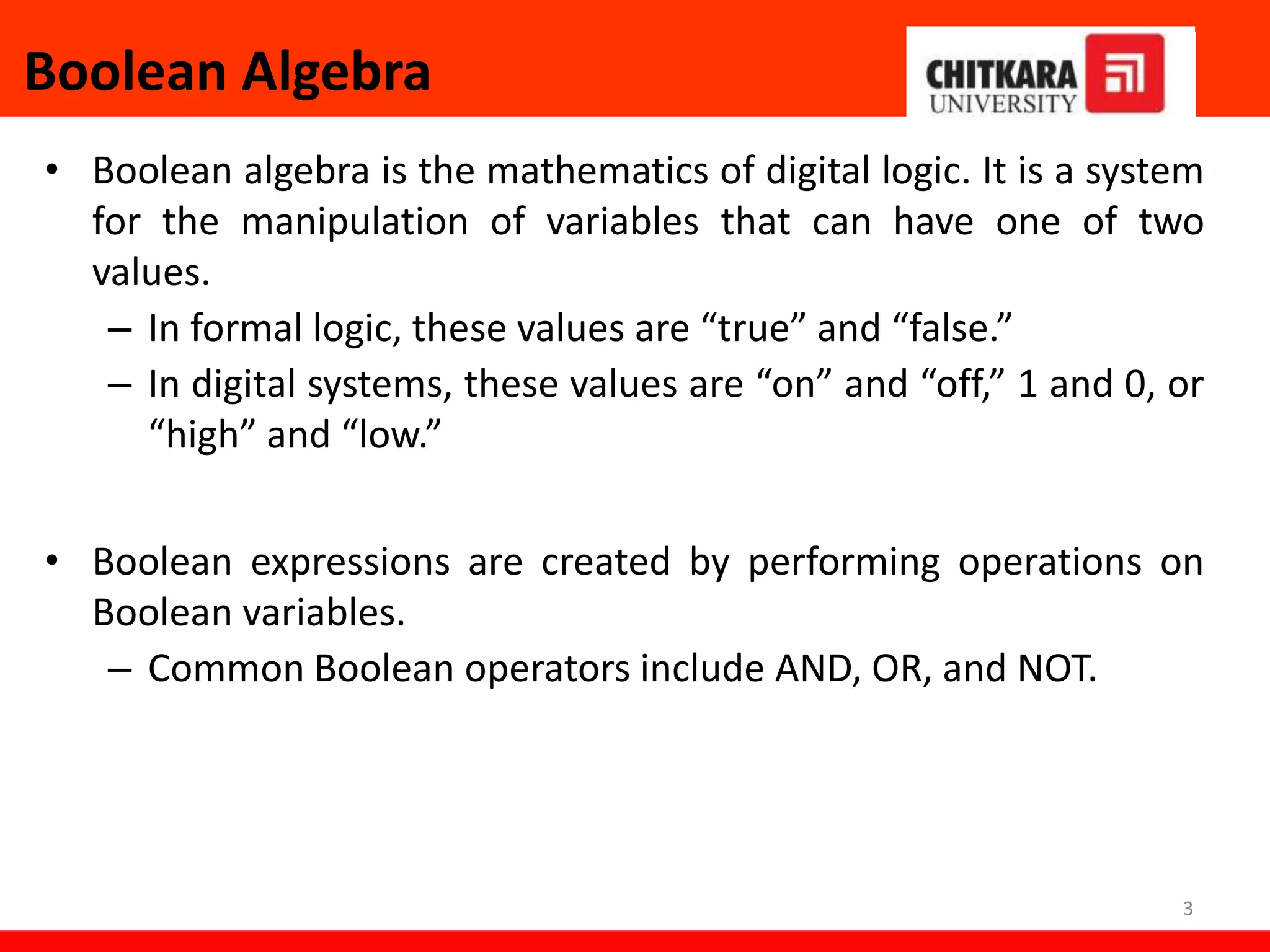
• Boolean algebra is the mathematics of digital logic. It is a system
for the manipulation of variables that can have one of two
values.
– In formal logic, these values are “true” and “false.”
– In digital systems, these values are “on” and “off,” 1 and 0, or
“high” and “low.”
• Boolean expressions are created by performing operations on
Boolean variables.
– Common Boolean operators include AND, OR, and NOT.
Rules of Boolean Algebra
De Morgan’s Theorems
 Theorem 1: A.B = A+B
 Theorem 2: A+B = A.B
 De Morgan’s Theorem is very useful in digital circuit design
 It allows ANDs to be exchanged with ORs by using invertors
 De Morgan’s Theorem can be extended to any number of variables
Remember: “Break the
bar, change the
operator”
5
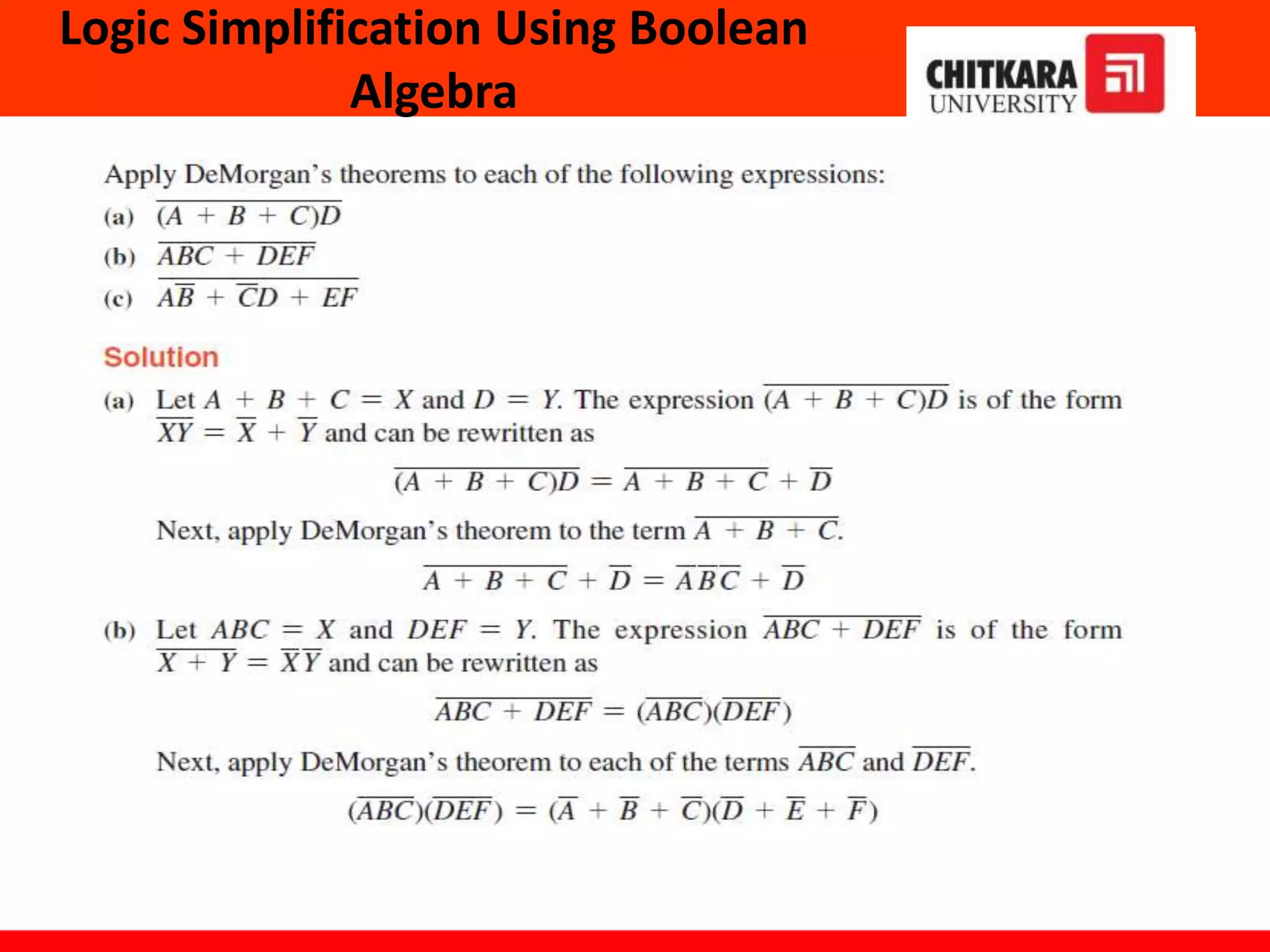
Logic Simplification Using Boolean
Algebra
Contd.
(c)
Activity 1
Apply De Morgan’s theorem to reduce the following
expressions:
1. F = AB + A + AB
2. F = (A+B) (C+D)
Contd.
Example1: Using Boolean algebra techniques, simplify this expression:
AB + A(B + C) + B(B + C)
Step 1: Apply the distributive law to the second and third terms in the
expression, as follows:
AB + AB + AC + BB + BC
Step 2: Apply rule 7 (BB = B) to the fourth term.
AB + AB + AC + B + BC
Step 3: Apply rule 5 (AB + AB = AB) to the first two terms.
AB + AC + B + BC
Step 4: Apply rule 10 (B + BC = B) to the last two terms.
AB + AC + B
Step 5: Apply rule 10 (AB + B = B) to the first and third terms.
B + AC
Contd.
Example 2: Simplify the following Boolean expression: [A B (C + B D) + A B] C
Apply the distributive law to the terms within the brackets.
Step 1: (ABC + ABBD + A B)C
Step 2: Apply rule 8 (BB = 0) to the second term within the parentheses.
(ABC + A . 0 . D + A B) C
Step 3: Apply rule 3 (A . 0 . D = 0) to the second term within the parentheses.
(ABC + 0 + A B) C
Step 4: Apply rule 1 (drop the 0) within the parentheses.
(ABC + A B) C
Contd.
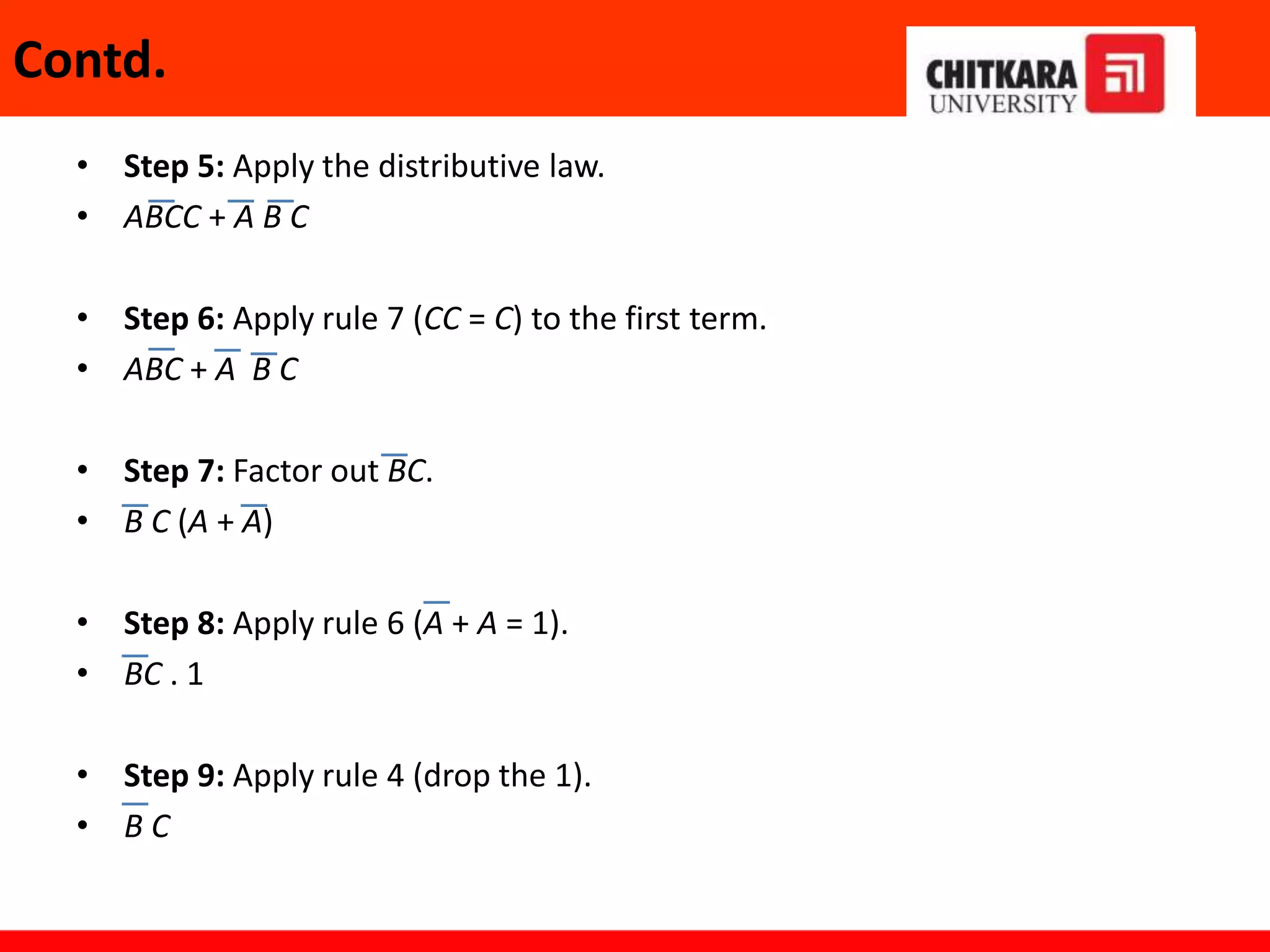
• Step 5: Apply the distributive law.
• ABCC + A B C
• Step 6: Apply rule 7 (CC = C) to the first term.
• ABC + A B C
• Step 7: Factor out BC.
• B C (A + A)
• Step 8: Apply rule 6 (A + A = 1).
• BC . 1
• Step 9: Apply rule 4 (drop the 1).
• B C
Activity 2
Reduce the following expressions:
1. F= A+B [AC+(B+C)D]
2. F= (B+BC) (B+BC)(B+D)
3. Show that ABC+B+BD+ABD+AC = B+C
Conversion of AOI Logic to
NAND/NOR Logic
Conversion of AOI Logic to NAND/NOR
Logic
Any AOI logic can be converted into NAND/NOR logic following
some steps which are listed below.
• Step 1: Draw the circuit in AOI logic.
• Step 2: If the circuit is to be drawn only using NOR Gates, add a
circle at the output of each OR Gate and the input of each AND
Gate.
• Step 3: If the circuit is to be drawn only using NAND Gates, add a
circle at the output of each NAND Gate and the input of each OR
Gate.
• Step 4: Now, add or subtract an inverter on each line where a
circle has been drawn in steps 2 or 3 so that the polarity of signals
on those lines remains unchanged from those of the original
diagram.
Example
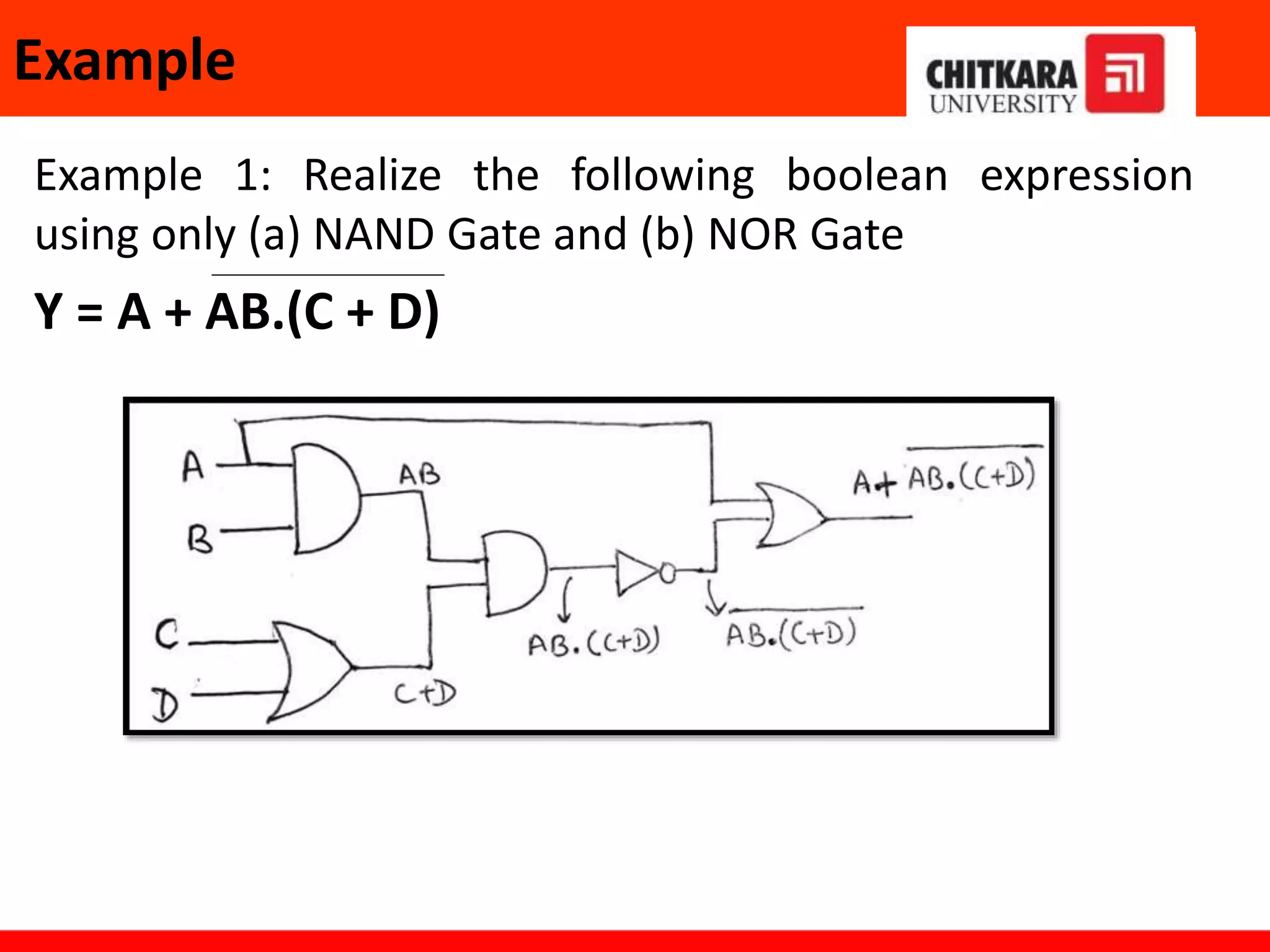
Example 1: Realize the following boolean expression
using only (a) NAND Gate and (b) NOR Gate
Y = A + AB.(C + D)
NAND Logic
(a) For realization using NAND logic, we will follow step 3, and add a circle to the
output of each AND gate and also at the inputs of each OR gate which can be shown
as,
Now, moving on to step 4, we have to add or remove an inverter on every line where
we have drawn a circle in the previous step which can be shown as:
Inverters at line x, y, z, and p has been added as a circle was drawn here, also in the
line r addition of an inverter is not required since two circles were drawn and adding
two inverters will cancel out each other.
Contd.
Therefore, the final circuit using only NAND can be
represented as:
NOR Logic
(b) For realization using NOR logic, we will follow step 2, and add a circle to the output of
each OR gate and also at the inputs of each AND gate which can be shown as:
Now, moving on to step 4, we have to add or remove an inverter on every line where we
have drawn a circle in the previous step which can be shown as:
Inverters at line a, b, c and d has been added as a circle was drawn here, also in the line e
addition of an inverter is not required since two circles were drawn and adding two inverters
will cancel out each other.
Contd.
The final circuit using only NOR can be represented as:
Activity 3
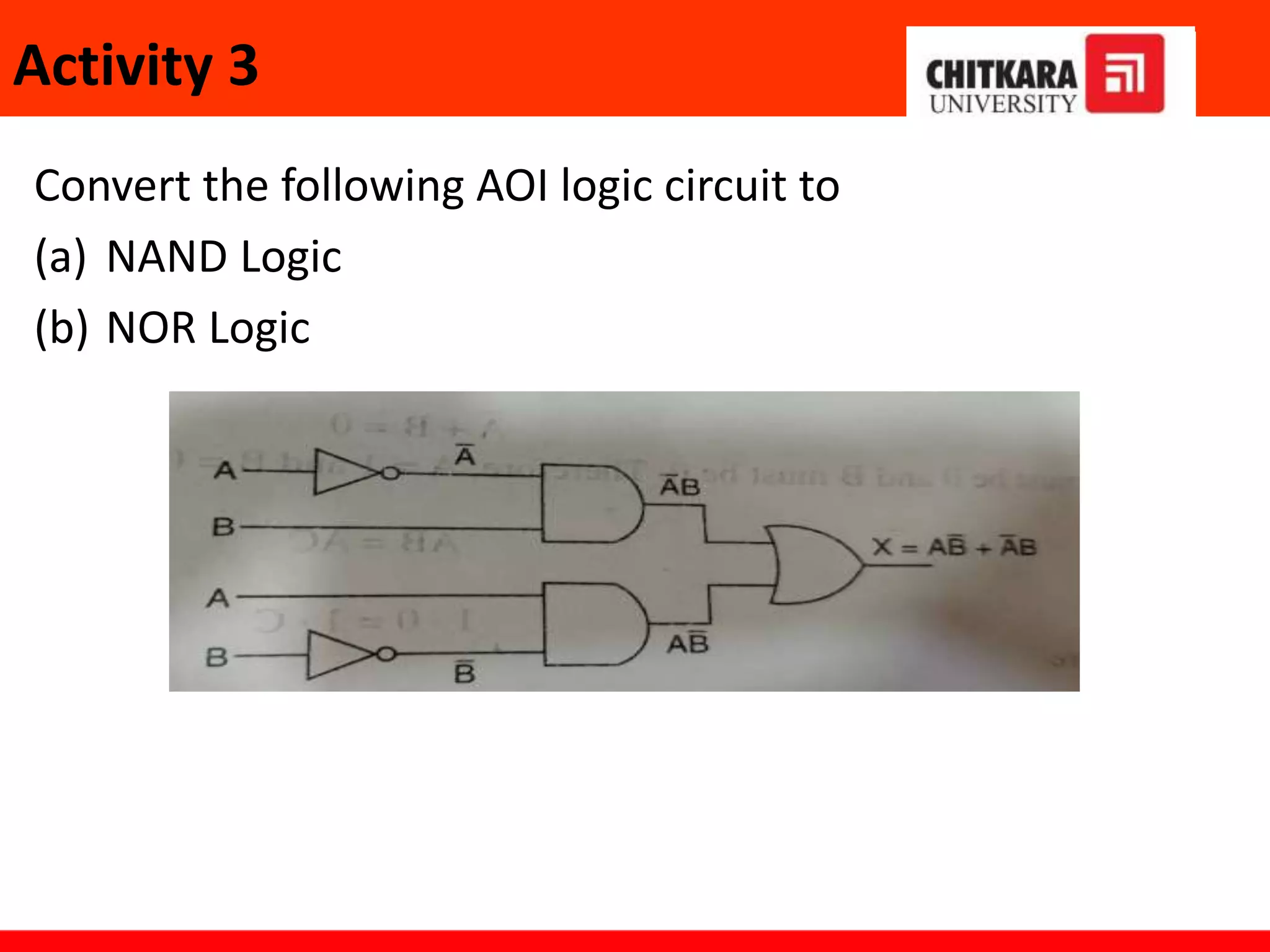
Convert the following AOI logic circuit to
(a) NAND Logic
(b) NOR Logic
Thank You!!

3. Boolean Algebra.pptx

  • 1.
  • 2.
    Outline Boolean Algebra: Laws ofboolean algebra, De Morgan’s Theorem, Minimization of boolean expression, Boolean expression and logic diagram, Converting AND/OR/Invert Logic to NAND/NOR logic.
  • 3.
    3 Boolean Algebra • Booleanalgebra is the mathematics of digital logic. It is a system for the manipulation of variables that can have one of two values. – In formal logic, these values are “true” and “false.” – In digital systems, these values are “on” and “off,” 1 and 0, or “high” and “low.” • Boolean expressions are created by performing operations on Boolean variables. – Common Boolean operators include AND, OR, and NOT.
  • 4.
  • 5.
    De Morgan’s Theorems Theorem 1: A.B = A+B  Theorem 2: A+B = A.B  De Morgan’s Theorem is very useful in digital circuit design  It allows ANDs to be exchanged with ORs by using invertors  De Morgan’s Theorem can be extended to any number of variables Remember: “Break the bar, change the operator” 5
  • 6.
  • 7.
  • 8.
    Activity 1 Apply DeMorgan’s theorem to reduce the following expressions: 1. F = AB + A + AB 2. F = (A+B) (C+D)
  • 9.
    Contd. Example1: Using Booleanalgebra techniques, simplify this expression: AB + A(B + C) + B(B + C) Step 1: Apply the distributive law to the second and third terms in the expression, as follows: AB + AB + AC + BB + BC Step 2: Apply rule 7 (BB = B) to the fourth term. AB + AB + AC + B + BC Step 3: Apply rule 5 (AB + AB = AB) to the first two terms. AB + AC + B + BC Step 4: Apply rule 10 (B + BC = B) to the last two terms. AB + AC + B Step 5: Apply rule 10 (AB + B = B) to the first and third terms. B + AC
  • 10.
    Contd. Example 2: Simplifythe following Boolean expression: [A B (C + B D) + A B] C Apply the distributive law to the terms within the brackets. Step 1: (ABC + ABBD + A B)C Step 2: Apply rule 8 (BB = 0) to the second term within the parentheses. (ABC + A . 0 . D + A B) C Step 3: Apply rule 3 (A . 0 . D = 0) to the second term within the parentheses. (ABC + 0 + A B) C Step 4: Apply rule 1 (drop the 0) within the parentheses. (ABC + A B) C
  • 11.
    Contd. • Step 5:Apply the distributive law. • ABCC + A B C • Step 6: Apply rule 7 (CC = C) to the first term. • ABC + A B C • Step 7: Factor out BC. • B C (A + A) • Step 8: Apply rule 6 (A + A = 1). • BC . 1 • Step 9: Apply rule 4 (drop the 1). • B C
  • 12.
    Activity 2 Reduce thefollowing expressions: 1. F= A+B [AC+(B+C)D] 2. F= (B+BC) (B+BC)(B+D) 3. Show that ABC+B+BD+ABD+AC = B+C
  • 13.
    Conversion of AOILogic to NAND/NOR Logic
  • 14.
    Conversion of AOILogic to NAND/NOR Logic Any AOI logic can be converted into NAND/NOR logic following some steps which are listed below. • Step 1: Draw the circuit in AOI logic. • Step 2: If the circuit is to be drawn only using NOR Gates, add a circle at the output of each OR Gate and the input of each AND Gate. • Step 3: If the circuit is to be drawn only using NAND Gates, add a circle at the output of each NAND Gate and the input of each OR Gate. • Step 4: Now, add or subtract an inverter on each line where a circle has been drawn in steps 2 or 3 so that the polarity of signals on those lines remains unchanged from those of the original diagram.
  • 15.
    Example Example 1: Realizethe following boolean expression using only (a) NAND Gate and (b) NOR Gate Y = A + AB.(C + D)
  • 16.
    NAND Logic (a) Forrealization using NAND logic, we will follow step 3, and add a circle to the output of each AND gate and also at the inputs of each OR gate which can be shown as, Now, moving on to step 4, we have to add or remove an inverter on every line where we have drawn a circle in the previous step which can be shown as: Inverters at line x, y, z, and p has been added as a circle was drawn here, also in the line r addition of an inverter is not required since two circles were drawn and adding two inverters will cancel out each other.
  • 17.
    Contd. Therefore, the finalcircuit using only NAND can be represented as:
  • 18.
    NOR Logic (b) Forrealization using NOR logic, we will follow step 2, and add a circle to the output of each OR gate and also at the inputs of each AND gate which can be shown as: Now, moving on to step 4, we have to add or remove an inverter on every line where we have drawn a circle in the previous step which can be shown as: Inverters at line a, b, c and d has been added as a circle was drawn here, also in the line e addition of an inverter is not required since two circles were drawn and adding two inverters will cancel out each other.
  • 19.
    Contd. The final circuitusing only NOR can be represented as:
  • 20.
    Activity 3 Convert thefollowing AOI logic circuit to (a) NAND Logic (b) NOR Logic
  • 21.