When does competition end? A staged
approach to procurement modifications
Dr Albert Sanchez-Graells
Reader in Economic Law
Contract Changes in a European Perspective,
Dansk Forening for Udbudsret
Copenhagen, 19 September 2017
19 September 2017
1Dansk Forening for Udbudsret
Agenda
• Explore the relevance of controlling procurement
modifications from a competition perspective,
with a concentration on contract modifications
• Critically assess the logic(s) behind the rules in
Directive 2014/24/EU (Art 72)
• Critically reflect on the need for a more
commercial approach in recent CJEU case law
Dansk Forening for Udbudsret 2
19 September 2017
Object of the contract, market and competition
– logic and limits
• Tender documentation establishes the object
and limits of competition for a public contract
• Modifications are thus problematic if they either
nullify or distort competition
• But ‘open-ended’ modification possibilities not
seen to alter the competition if they are
transparent and ensure equal treatment
Dansk Forening for Udbudsret 3
19 September 2017
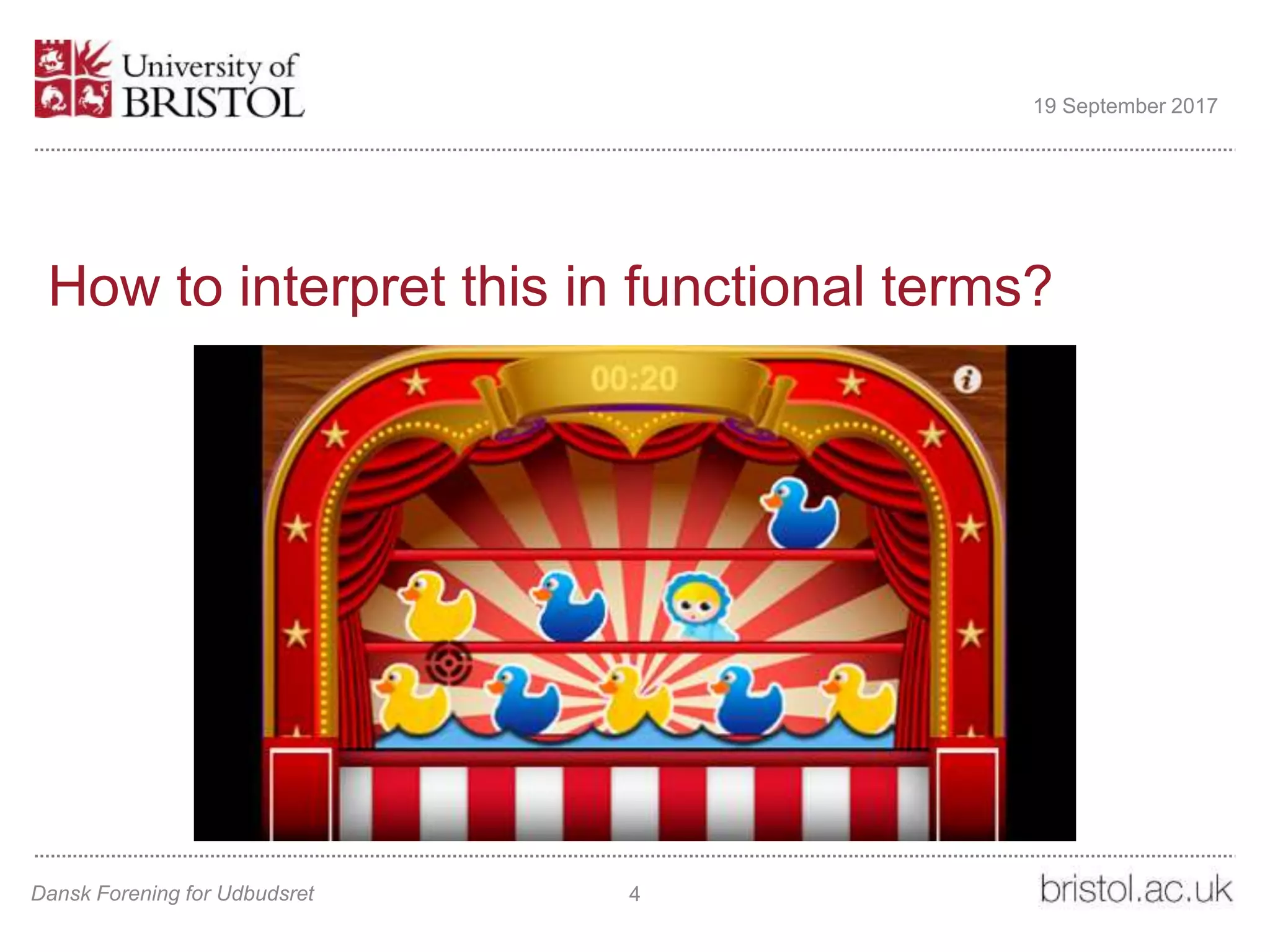
How to interpret this in functional terms?
Dansk Forening for Udbudsret 4
19 September 2017
Commission v CAS Succhi di Frutta,
C-496/99 P, EU:C:2004:236
• ‘No change of rules of the game’ logic
• prohibition of changes that, ‘had [they] been included in the
notice of invitation to tender, would have made it possible for
tenderers to submit a substantially different tender’ (116)
• ‘Flexibility in the rules of the game’ trump
• ability of the contracting authority to introduce modifications
if (and only if) it reserves the possibility and ‘defines the
framework within which the [modification] procedure must
be carried out’ (118)
Dansk Forening for Udbudsret 5
19 September 2017
pressetext Nachrichtenagentur,
C-454/06, EU:C:2008:351
• Material change + ‘No-negotiation’ rule?
• ‘In order to ensure transparency of procedures and equal
treatment of tenderers, amendments to … a public contract …
constitute a new award … when they are materially different
in character from the original contract and, therefore, such as
to demonstrate the intention of the parties to renegotiate
the essential terms of that contract’ (34)
• What if there was a contractual provision on renegotiation?
(is Succhi di Frutta only applicable to unilateral modifications?)
Dansk Forening for Udbudsret 6
19 September 2017
pressetext Nachrichtenagentur,
C-454/06, EU:C:2008:351
• No rebalancing – unless foreseen?
• ‘… changes the economic balance of the contract in favour of
the contractor in a manner which was not provided for in the
terms of the initial contract’ (37)
• Does this mean initial contract, or procurement documents?
(ie is there an obligation for all potential tenderers to have
been informed of this possibility, or would it have sufficed to
insert this clause in the contract with the awardee? Any
intermediate solutions concerning multi-stage procedures?)
Dansk Forening for Udbudsret 7
19 September 2017
What are the consequences of this logic?
• When the game changes, new game
• Most of the remedies that can be obtained in
case of illegal modifications assume a continued
interest in the (revised) object of the contract +
the (reasonably foreseeable) possibility that
there will be interest in supplying it from
undertakings other than the incumbent
Dansk Forening for Udbudsret 8
19 September 2017
Pre-award modifications and impact on
competition (equal treatment, transparency)
• The same logic (broadly) applies to pre-contract
modifications of the procurement documents /
requirements—e.g. qualitative selection
• MT Højgaard and Züblin, C-396/14, EU:C:2016:347
• Double criterion of (a) no modification of procurement
documents (selection criteria) and (b) no distortion of
competition by advantaging ‘modification beneficiary’–
see para 44) [what of broader competition consideration?]
Dansk Forening for Udbudsret 9
19 September 2017
Post-award contract modifications
• Therefore, the logic controlling the (incipient)
regulation of contract modifications rested on
the need to ensure that (a) competition is not
distorted (change of ‘playing field’), (b) the
results of competition are not nullified (change
of economic balance), unless (c) there was a
prior, transparent procedure for such changes
Dansk Forening for Udbudsret 10
19 September 2017
Post-award modifications and
(theoretical) competition for the contract
• The problem with this logic is that it does not
make sense (or is difficult to apply) in
• situations involving long-term contracts
(competition issues fade away with time)
• situations involving very complex contracts
(competition involves a degree of uncertainty)
• situations unforeseen / unforeseeable / unwanted by the
parties (driver for modifications is ‘beyond control’)
Dansk Forening for Udbudsret 11
19 September 2017
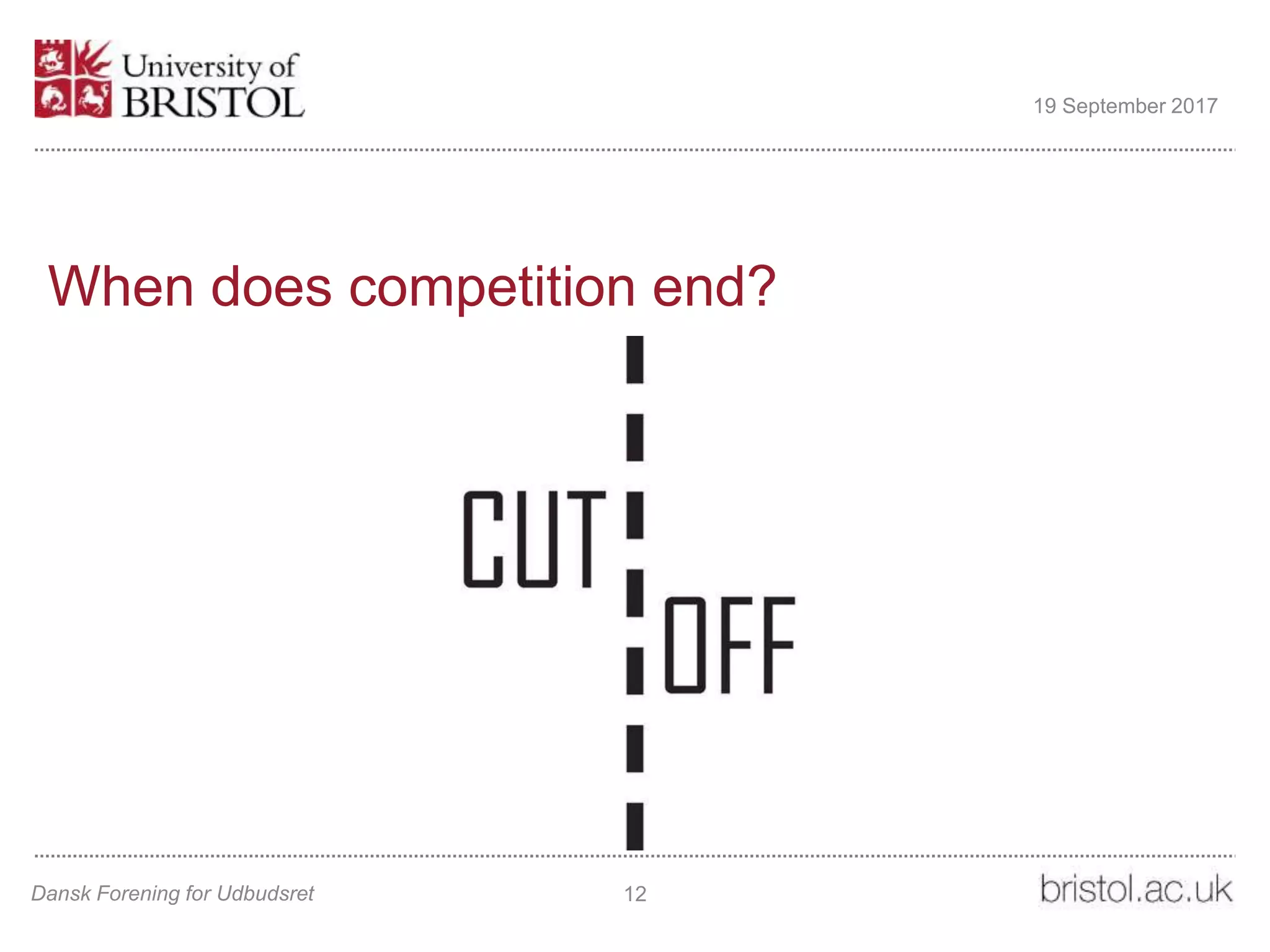
When does competition end?
Dansk Forening for Udbudsret 12
19 September 2017
Termination involving modifications –
competition perspective
• The limitations of the logic have become
particularly obvious in situations of unwanted
modification of the contract due to a break up of
the commercial relationship (cfr Finn Frogne)
• Same issues would (potentially) arise in other
situations, such as termination for convenience,
which can introduce significant rigidity
Dansk Forening for Udbudsret 13
19 September 2017
Finn Frogne, C-549/14, EU:C:2016:634
• Unsustainable situation
• disagreement ‘as to which party was responsible for making it
impossible to perform the contract as stipulated’ (10)
• Contract modification implicit in effort to minimise the
damages / losses resulting from the break up of the
commercial relationship and contract
• Public interest? / Urgency? / Sole source?
• All would have been well if ‘contractualised’ (37/40)
Dansk Forening for Udbudsret 14
19 September 2017
Review clauses – competition perspective
• The second part of the underlying logic that hits
the (practical) wall rather quickly concerns the
pre-establishment of clear and ‘automatic’ rules
foreseeing ‘equal for all’ modifications
• Is it really competition-neutral?
• Information asymmetries
• Moral hazard / winners’ curse
Dansk Forening for Udbudsret 15
19 September 2017
Review clauses – contract law perspective
• The standard set in Art 72 Directive 2014/24/EU
may be simply impossible (or too costly)
• where the modifications, irrespective of their monetary value, have
been provided for in the initial procurement documents in clear,
precise and unequivocal review clauses, which may include price
revision clauses ... Such clauses shall state the scope and nature of
possible modifications … as well as the conditions under which
they may be used. They shall not provide for modifications … that
would alter the overall nature of the contract or framework agmnt
Dansk Forening for Udbudsret 16
19 September 2017
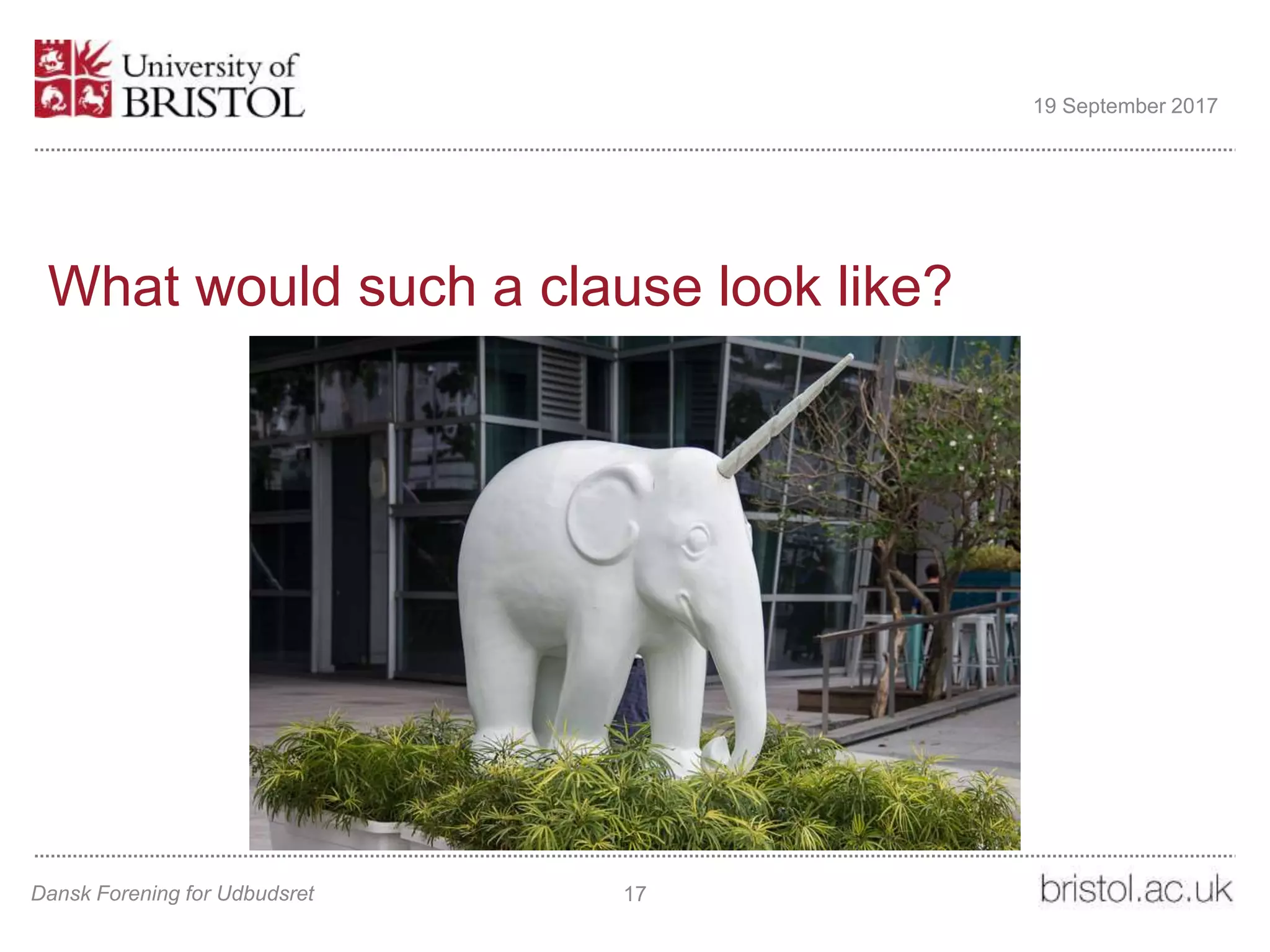
What would such a clause look like?
Dansk Forening for Udbudsret 17
19 September 2017
Conclusions
• Competition-preservation remains regulatory goal
• But: need for a more sophisticated approach,
based on a commercially-informed assessment of
justification and proportionality of modifications
• Specially where they are ancillary to other problems
• Revised approach to (or hope for) general contract
modification clauses
Dansk Forening for Udbudsret 18
19 September 2017
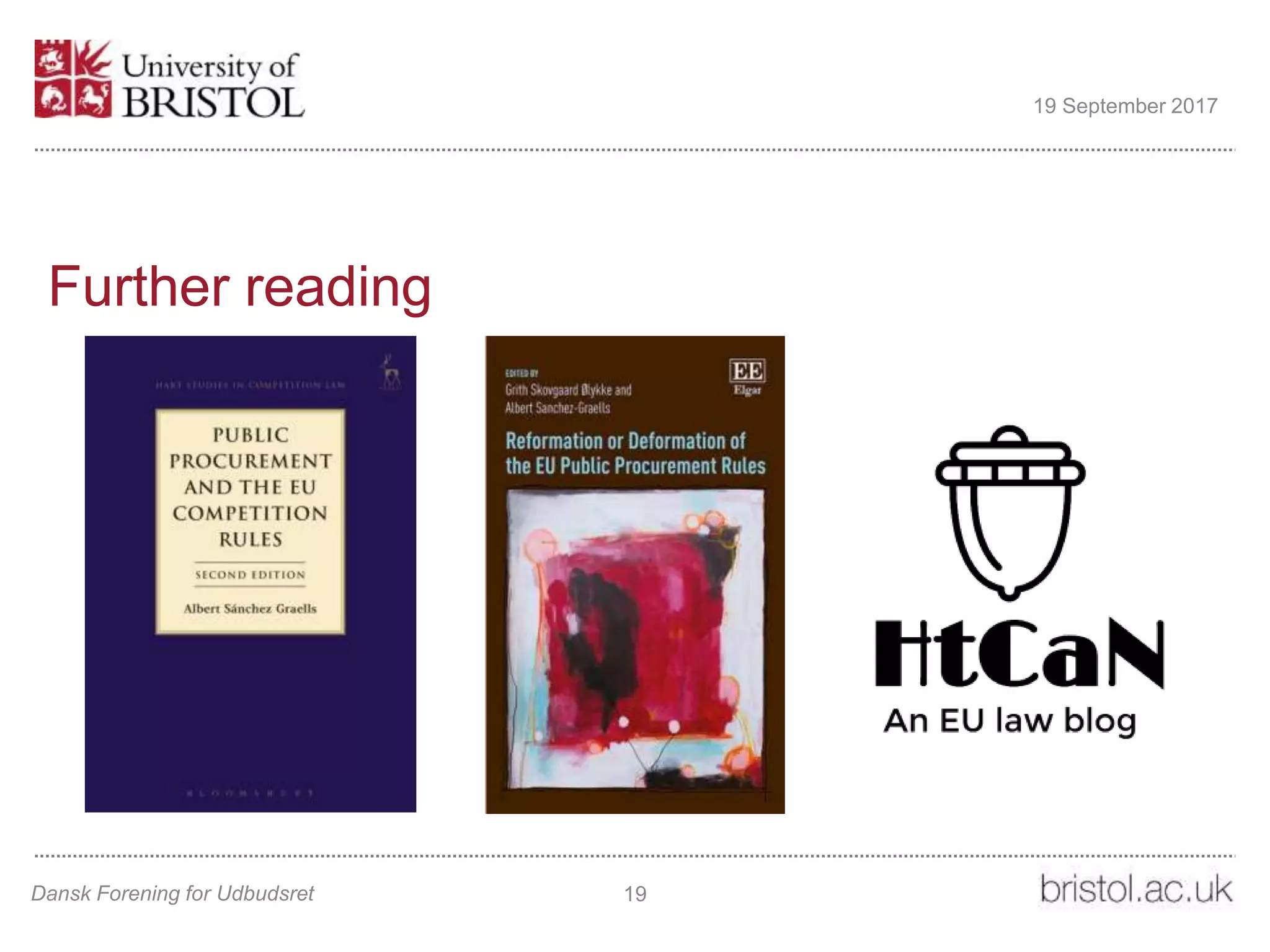
Further reading
Dansk Forening for Udbudsret 19
19 September 2017
Thank you for your attention
Be in touch
a.sanchez-graells@bristol.ac.uk
www.howtocrackanut.com
@asanchezgraells
Dansk Forening for Udbudsret 20
19 September 2017

When does competition end? A staged approach to procurement modifications

  • 1.
    When does competitionend? A staged approach to procurement modifications Dr Albert Sanchez-Graells Reader in Economic Law Contract Changes in a European Perspective, Dansk Forening for Udbudsret Copenhagen, 19 September 2017 19 September 2017 1Dansk Forening for Udbudsret
  • 2.
    Agenda • Explore therelevance of controlling procurement modifications from a competition perspective, with a concentration on contract modifications • Critically assess the logic(s) behind the rules in Directive 2014/24/EU (Art 72) • Critically reflect on the need for a more commercial approach in recent CJEU case law Dansk Forening for Udbudsret 2 19 September 2017
  • 3.
    Object of thecontract, market and competition – logic and limits • Tender documentation establishes the object and limits of competition for a public contract • Modifications are thus problematic if they either nullify or distort competition • But ‘open-ended’ modification possibilities not seen to alter the competition if they are transparent and ensure equal treatment Dansk Forening for Udbudsret 3 19 September 2017
  • 4.
    How to interpretthis in functional terms? Dansk Forening for Udbudsret 4 19 September 2017
  • 5.
    Commission v CASSucchi di Frutta, C-496/99 P, EU:C:2004:236 • ‘No change of rules of the game’ logic • prohibition of changes that, ‘had [they] been included in the notice of invitation to tender, would have made it possible for tenderers to submit a substantially different tender’ (116) • ‘Flexibility in the rules of the game’ trump • ability of the contracting authority to introduce modifications if (and only if) it reserves the possibility and ‘defines the framework within which the [modification] procedure must be carried out’ (118) Dansk Forening for Udbudsret 5 19 September 2017
  • 6.
    pressetext Nachrichtenagentur, C-454/06, EU:C:2008:351 •Material change + ‘No-negotiation’ rule? • ‘In order to ensure transparency of procedures and equal treatment of tenderers, amendments to … a public contract … constitute a new award … when they are materially different in character from the original contract and, therefore, such as to demonstrate the intention of the parties to renegotiate the essential terms of that contract’ (34) • What if there was a contractual provision on renegotiation? (is Succhi di Frutta only applicable to unilateral modifications?) Dansk Forening for Udbudsret 6 19 September 2017
  • 7.
    pressetext Nachrichtenagentur, C-454/06, EU:C:2008:351 •No rebalancing – unless foreseen? • ‘… changes the economic balance of the contract in favour of the contractor in a manner which was not provided for in the terms of the initial contract’ (37) • Does this mean initial contract, or procurement documents? (ie is there an obligation for all potential tenderers to have been informed of this possibility, or would it have sufficed to insert this clause in the contract with the awardee? Any intermediate solutions concerning multi-stage procedures?) Dansk Forening for Udbudsret 7 19 September 2017
  • 8.
    What are theconsequences of this logic? • When the game changes, new game • Most of the remedies that can be obtained in case of illegal modifications assume a continued interest in the (revised) object of the contract + the (reasonably foreseeable) possibility that there will be interest in supplying it from undertakings other than the incumbent Dansk Forening for Udbudsret 8 19 September 2017
  • 9.
    Pre-award modifications andimpact on competition (equal treatment, transparency) • The same logic (broadly) applies to pre-contract modifications of the procurement documents / requirements—e.g. qualitative selection • MT Højgaard and Züblin, C-396/14, EU:C:2016:347 • Double criterion of (a) no modification of procurement documents (selection criteria) and (b) no distortion of competition by advantaging ‘modification beneficiary’– see para 44) [what of broader competition consideration?] Dansk Forening for Udbudsret 9 19 September 2017
  • 10.
    Post-award contract modifications •Therefore, the logic controlling the (incipient) regulation of contract modifications rested on the need to ensure that (a) competition is not distorted (change of ‘playing field’), (b) the results of competition are not nullified (change of economic balance), unless (c) there was a prior, transparent procedure for such changes Dansk Forening for Udbudsret 10 19 September 2017
  • 11.
    Post-award modifications and (theoretical)competition for the contract • The problem with this logic is that it does not make sense (or is difficult to apply) in • situations involving long-term contracts (competition issues fade away with time) • situations involving very complex contracts (competition involves a degree of uncertainty) • situations unforeseen / unforeseeable / unwanted by the parties (driver for modifications is ‘beyond control’) Dansk Forening for Udbudsret 11 19 September 2017
  • 12.
    When does competitionend? Dansk Forening for Udbudsret 12 19 September 2017
  • 13.
    Termination involving modifications– competition perspective • The limitations of the logic have become particularly obvious in situations of unwanted modification of the contract due to a break up of the commercial relationship (cfr Finn Frogne) • Same issues would (potentially) arise in other situations, such as termination for convenience, which can introduce significant rigidity Dansk Forening for Udbudsret 13 19 September 2017
  • 14.
    Finn Frogne, C-549/14,EU:C:2016:634 • Unsustainable situation • disagreement ‘as to which party was responsible for making it impossible to perform the contract as stipulated’ (10) • Contract modification implicit in effort to minimise the damages / losses resulting from the break up of the commercial relationship and contract • Public interest? / Urgency? / Sole source? • All would have been well if ‘contractualised’ (37/40) Dansk Forening for Udbudsret 14 19 September 2017
  • 15.
    Review clauses –competition perspective • The second part of the underlying logic that hits the (practical) wall rather quickly concerns the pre-establishment of clear and ‘automatic’ rules foreseeing ‘equal for all’ modifications • Is it really competition-neutral? • Information asymmetries • Moral hazard / winners’ curse Dansk Forening for Udbudsret 15 19 September 2017
  • 16.
    Review clauses –contract law perspective • The standard set in Art 72 Directive 2014/24/EU may be simply impossible (or too costly) • where the modifications, irrespective of their monetary value, have been provided for in the initial procurement documents in clear, precise and unequivocal review clauses, which may include price revision clauses ... Such clauses shall state the scope and nature of possible modifications … as well as the conditions under which they may be used. They shall not provide for modifications … that would alter the overall nature of the contract or framework agmnt Dansk Forening for Udbudsret 16 19 September 2017
  • 17.
    What would sucha clause look like? Dansk Forening for Udbudsret 17 19 September 2017
  • 18.
    Conclusions • Competition-preservation remainsregulatory goal • But: need for a more sophisticated approach, based on a commercially-informed assessment of justification and proportionality of modifications • Specially where they are ancillary to other problems • Revised approach to (or hope for) general contract modification clauses Dansk Forening for Udbudsret 18 19 September 2017
  • 19.
    Further reading Dansk Foreningfor Udbudsret 19 19 September 2017
  • 20.
    Thank you foryour attention Be in touch a.sanchez-graells@bristol.ac.uk www.howtocrackanut.com @asanchezgraells Dansk Forening for Udbudsret 20 19 September 2017