Оксана Карпюк
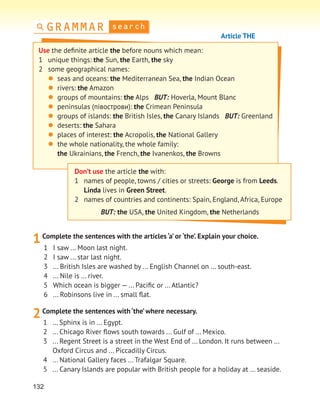
Крістіна Карпюк
АНГЛІЙСЬКА
МОВА
(5-й рік навчання)
Підручник для 5 класу закладів загальної середньої освіти
(з аудіосупроводом)
Видавництво Астон
Рекомендовано Міністерством освіти і науки України
English is fun!
And today we all came
To meet everyone.
So, what is your name?
And today we all came
To meet everyone.
English is fun!
And today we all came
K i d s - O n l i n
e
. n
e
t
VOCABULARY GRAMMAR
pp. 6-8
Instructions
Headings and logos in
the book
Imperatives
to be (Present Simple)
to have (Present Simple)
SCHOOL
IS COOL
pp. 9-24
School subjects
Activities
Daily routine
Present Simple
Prepositions of time
Adverbs of frequency
Adjective: degrees of comparison
Numbers (cardinal and ordinal)
WHAT ABOUT
YOUR FAMILY?
pp. 25-40
Family members
Relatives
Jobs
Actions
Qualities
Present Continuous
Would like
Wh-questions
IT’S TASTY!
pp. 41-56
Food
Drinks
Dishes
Countables & Uncountables
some, any; much/many
Present Perfect
Modals: must/mustn’t
The verb ‘to need’
IT’S TIME
TO CELEBRATE!
pp. 57-72
Holidays
Celebrations
Customs
Traditions
Festive activities
Past Simple
Regular & Irregular verbs
Time expressions with ‘last’,
‘yesterday’,‘ago’
WHAT’S THE WEATHER
LIKE TODAY?
pp. 73-88
Weather
Clothes
be going to
Future Simple
Time expressions with ‘next’,
‘tomorrow’
Zero Conditional
LET’S HAVE FUN!
pp. 89-106
Free-time activities
Hobbies
Collections
The ‘-ing’ form of the verb with
likes & dislikes
Present Continuous for
future fixed plans
THIS IS THE PLACE
I LIVE IN
pp. 107-122
Symbols of Ukraine
Ukrainian towns and
cities
Places in a town/city
Past Simple vs Present Perfect
WHERE
TO TRAVEL?
pp. 123-141
Countries
Languages
Ways of travelling
Linking words: and, but, so,
because
The article ‘the’ with proper
names
Vocabulary pp. 142-145
Irregular Verbs pp. 146-147
Audio Scripts pp. 148-155
CONTENTS
UNIT
UNIT
UNIT 1
UNIT
WHAT’S THE WEATHER
UNIT
UNIT 5
UNIT
UNIT
UNIT 2
UNIT
UNIT
UNIT 6
UNIT
UNIT
UNIT 3
UNIT
UNIT
UNIT 7
UNIT
UNIT
UNIT 4
UNIT
UNIT
UNIT 8
STARTER
4
READING & LISTENING SPEAKING WRITING
Greetings
Introducing yourself
Asking for personal information
Internet Safety; School website
School subjects and activities
Listening: a dialogue about new
teachers, new timetable
Describing a favourite subject
Asking about timetable
Talking about school life
A short report about school life
A diary page about a typical day
What do you know about twins?
My kid brother
Listening: a dialogue
What would you like to be?
Describing family photos
Asking about jobs
Playing a guessing game
A paragraph about mum’s job
A paragraph about a dream job
Favourite cuisine; Healthy food
Listening: Сooking adventure
Talking about eating habits
Buying food
Ordering a meal
A recipe
A paragraph about national
cuisine
A poster about healthy food
Reading dates; What are
holidays? Christmas quiz
Celebrating a holiday: customs
& traditions; The history of the
1st day of the year
Talking about a party
Making suggestions
Making invitations
An e-mail about your last holiday
A letter to Santa Claus
An invitation to a party
Reading weather maps
A weather report
Listening: dialogues
A weather forecast
Talking about the weather and clothes;
Giving advice; Giving predictions;
Talking about intentions, plans;
Informing about on-the-spot decisions
A comment on the weather
An e-mail describing a climate
‘What are you like?’ quiz
Wonderland is a theme park
Mobile phones and messages
Listening: Hobbies and interests
Expressing likes & dislikes;
An interview: asking and answering
questions about favourite activities and
hobbies
A comment on somebody’s
hobbies
An e-mail about a theme park and
its attractions
A letter about interests and
feelings
Facts about Ukraine
In a village; My native town
Listening: Kyiv is the capital of
Ukraine
Asking about a city / town; Sharing
impressions about a city/town; Talking
about Ukraine; Talking about popular
tourist places in Ukraine
A paragraph about a town/city
An e-mail telling about Ukraine
The joy of travelling
English-speaking countries
Listening: Virtual travelling
Asking and answering questions in quiz
shows; Describing tours; Expressing an
opinion on different ways of travelling;
Talking about summer plans
A paragraph with information
about a country/city
An e-mail sharing impressions on
visiting places
An e-mail about summer plans
5
6
Mike
Linda
Pete
1Read and say if all of the children are neighbours.
LET’S GET STARTED!
1 Michael’s parents call him ...
2 Cathy’s surname is ...
2Listen to the text and read it again. Complete the sentences.
Cathy
3 Linda is Cathy’s ...
4 Pete’s nickname is ...
Hi! My name is Michael or Mike for
short. My parents call me Mikey, but
I am not a baby. I am 11 years old
and I am in the fifth form this year.
Hi! I am Linda. I am Cathy’s best
friend. We are in the same class.
But we aren’t neighbours.
Hello! I am Cathy. My surname is Roberts.
I’m 10, but my birthday is in November.
So you may say I’m almost 11.
Hi! My name is Peter, but all my
friends call me Pete. I have got a
nickname too. It is 007 because I am
crazy about detective and spy stories.
My favourite spy is James Bond.
7
3Complete the sentences
about yourself.
4Ask and answer in pairs.
5Find these headings / logos in your book. Guess what they mean.
Hi! My name is … or … for short.
My parents call me …
My surname is … I am … years old.
My birthday is in …
I am in the … form this year.
I have / haven’t got a nickname.
My friends call me …
What is your name?
What is your surname?
How old are you?
When is your birthday?
What form are you in this year?
Have you got a nickname?
Self-Check
L k Back
L k Back
Kids Online
TIP
Keep
in Mind!
Grammar
Corner
WORDS YOU
FOR
search
LISTENING
search
GRAMMAR
search
VOCABULARY
search
SPEAKING
search
WRITING
search
READING
8
1 A: ...
B: It’s okay. But please don’t be late next time.
2 A: What do we need to do?
B: ...
3 A: ...?
B: Exercises 4 and 5 on page 6 in your Activity Book.
4 A: ...!
B: Yes, Miss Smith!
5 A: ...!
B: Sorry, Miss Smith.
6 A: ...!
B: So fast?
7 A: ...
B: Okay.
8 A: What’s the matter?
B: ...?
6Group up these phrases into two columns. Column ‘T’ is for a teacher,
column ‘S’ is for a student. Write your answers down into the notebook.
Add any other phrases that you remember.
I finished the task!
Stand up, everyone!
What does this word mean?
Copy this into your notebooks.
What’s for homework?
Sorry, I am late.
Open your books on page 3.
Be quiet, please!
T S
7Listen to the dialogues and complete them with the phrases from task 6.
Then read them in class.
7
Lead-in:
 What’s your new timetable like?
 What is your typical day like?
 What is your favourite day of the week? Why?
SCHOOL
IS COOL
UNIT
LANGUAGE
 school subjects and activities
 ordinal and cardinal numbers
 subject pronouns and possessive
adjectives
 Present Simple and daily routine
 prepositions of time
 adverbs of frequency
 adjective: degrees of comparison
SKILLS
 introducing yourself
 talking about different
subjects and teachers
 describing your favourite
subject
 talking about your abilities
 presenting a website
 writing an e-mail
WHAT’S IN THIS UNIT?
UNIT
UNIT 1
SCHOOL
IS COOL
IS COOL
SCHOOL
IS COOL
IS COOL
IS COOL
IS COOL
IS COOL
IS COOL
IS COOL
IS COOL
IS COOL
presenting a website
10
10
1Read the messages above and answer the questions.
2Name other websites that you know.
Work in pairs.Tell your partner what
you do on the Internet.
1 What is Kids Online?
2 What can you do there?
3 What does Anna want to do
on kids-online.net?
4 What does Tim do on kids-online.net?
HOME NEWS BLOGS VIDEOS MUSIC
Hey! Welcome to our website Kids Online!
This is a place where you can find lots of interesting
information, contact kids and teens from all around the
world and post different blogs about yourself, too. And,
of course, you can learn and practise your English here!
Hey! Welcome to our website Kids Online!
This is a place where you can find lots of interesting
information, contact kids and teens from all around the
world and post different blogs about yourself, too. And,
of course, you can learn and practise your English here!
HOME NEWS BLOGS VIDEOS MUSIC
www.kids-online.net
TIM, 11, England
I always watch films online and never on TV. You can find
anything on the Internet but on TV you always watch what
they show you. I really like your website because there are
lists of new films every week!
I sometimes listen to your music too!
ANNA, 10, Ukraine
I usually watch videos on YouTube and I often chat with my
friends on Viber. But now I want to try something different!
I want to make friends from different countries and practise
my English. Your website gives me a chance! I am also
happy that there are videos about kids like me here!
message [9mesidz]
website [9websait]
careful [9ke3fl]
personal [9pE:s3nl]
safe [seif]
to chat [t12t]
to contact [9kAnt2kt]
 all around the world
[wE:ld]
WORDS YOU
FOR
11
11
1 Use the websites that you know / don’t know.
2 Make an easy / a difficult password.
3 Use / Don’t use unsafe websites.
4 Share a little / a lot of personal information.
5 Sign out / Don’t sign out of your account when
you are finished.
4Use your
(or any other)
school website.
Say what
information
you have got
there.
3Read the text above and choose the right
words in the sentences below.
1
safety [9seiftI] безпека
2
data [9deit3] дані
3
fake [feik] підроблений
4
an account [39kaUnt] акаунт
5
a password [9p4:swE:d] пароль
CHAT MORE
INTERNET
search
I SEARCH
SAFETY
The Internet is a large
sphere where you can
find a lot of
information and
contact people from
different parts of the
world. However, there
are some websites
where the data2
is
fake3
or where there
are viruses that can
break your computer,
smartphone or tablet.
Another problem is
when someone gets
your personal
information and uses it.
That is why you always
have to be careful.
Here are some tips.
Use those websites that you
know. If the website is new,
ask and check if it is safe.
Do not use
a website where
it says ‘Not safe’.
Create a strong
password5
and
keep it secret.
Sign out of
your account4
before you
switch offyour
computer.
Kids Online
1
Do not share too much personal
information and always think
before posting anything.
12
2Name the subjects you have got.
3Match the subjects with the examples.
4Guess the subjects (1-10). Say what you do in these lessons.
5Name your favourite subject. Explain why you like it.
1 History
2 Maths
3 Geography
4 English
5 Physical Education (PE)
6 Science
7 Religion
8 Music
9 Foreign Language
10 Art
a the Present Continuous
b Ready, steady, go!
c World War One
d Our Father who art in heaven...
e The Dnipro is a river.
f My favourite composer is Mozart.
g Ich liebe dich.
h The tiger can swim.
i Draw this vase with flowers.
j Ten plus seventeen is twenty-seven.
MATHS GERMAN MUSIC
GEOGRAPHY
PE (PHYSICAL EDUCATION)
FRENCH
HISTORY
SCIENCE ART
IT (INFORMATION TECHNOLOGY)
ENGLISH
1 learn how to use the computer
2 read about countries all over the world
3 draw and paint
4 discuss how people lived in the past
5 study English words, phrases and grammar
6 use numbers and calculations
7 learn about animals, plants and the human body
8 play different sports
9 learn about composers, styles of music
10 make different things and cook
Example: In IT we learn how to use the computer. In … we learn … .
1Listen and repeat.
1
search
VOCABULARY
13
1Read and guess the missing words.
battle [9b2tl]
calculation [0k2lkju9lei1n]
creature [9krI:t13]
subject [9sybdzikt]
timetable [9taimteibl]
fascinating [9f2sineitiN]
to divide [di9vaid]
to multiply [9myltiplai]
to subtract [s3b9tr2kt]
In ... you really have
fun because you
play different
sports. During the
class you are not in
the classroom but
in the gym or in the
school playground.
You need sneakers
and special clothes.
In … you learn about our planet,
about other planets and stars. You
also learn about rivers, lakes,
mountains, continents, countries and
cities from all over the world. Of
course, you need a map and a globe.
In ... you work with
numbers. You do all
sorts of mathematical
calculations. You add
numbers (two plus two
is four), subtract
numbers (four minus
three is one), multiply
numbers (two times six
is twelve) or divide
numbers. But that’s
not all. There are many
more things you can
do with numbers.
In … you learn
everything
about computers
and how to use
computers. It is
fun because you
sometimes play
games. But you
can also chat
with your friends
or find many
interesting
things on the
Internet.
WORDS YOU
FOR
search
READING
14
1 In PE you learn about our planet,
about other planets and stars.
2 In Maths you learn everything
about computers.
3 In Geography you learn about
the things and people from
the past.
4 In IT you learn about nature.
5 In History you work with
numbers.
6 In Science you play different
sports.
3Correct these wrong statements.
4Name all the subjects you have got
this year.Tell the class about your
favourite subject and the activities
you usually do in it.
In … you learn about nature: all living
creatures on our planet — plants,
animals, people. You learn what they
eat, where they live, how they grow.
You can even do some experiments.
In … you learn about the things and people
from the past. You can hear fascinating
stories about what life was like before. You
read about heroes and battles. But you must
learn some years, too.
2Listen and check.
2
15
Affirmative Prepositions of Time
I
You
We
They
learn.
teach.
do.
fly.
He
She
It
learns.
teaches.
does.
flies.
at
the time (at 5 o’clock),
at midday/noon/midnight/night
in
in the morning/afternoon/evening,
months (in April), seasons (in spring)
on
days (on Friday), dates (on 3rd September),
parts of the day (on Monday afternoon)
We use the Present Simple when we talk about routines and habits.
We also use it for general facts.
1Put the verbs in brackets into the Present Simple.
2Complete the phrases with ‘on’,‘in’ or ‘at’. Make your sentences with them.
3Complete the questions using ‘do’ or ‘does’. Give short answers too.
1 Summer … (start) in June.
2 Fruit and vegetables … (give) you vitamins.
3 My dad … (go) to work at 8 o’clock in the morning.
4 We … (watch) cartoons at weekends.
5 His brother ... (study) at school № 10.
1 … 3 o’clock
2 … the evening
1 … you ride your bike? — …
2 … your father play games? — …
3 … your parents work online? — …
Negative Questions Short Answers
I/You don’t (do not)
swim.
Do I/you swim? Yes, I/you do. No, I/you don’t.
He/She/It doesn’t
(does not) swim.
Does he/she/it
swim?
Yes, he/she/it
does.
No, he/she/it
doesn’t.
We/You/They don’t
(do not) swim.
Do we/you/they
swim?
Yes, we/you/
they do.
No, we/you/
they don’t.
3 … winter
4 … midday
5 … the afternoon
6 … Monday
Example: I do my homework at 3 o’clock.
PRESENT SIMPLE
BUT
4 … your mum like football? — …
5 … my friend and I have lessons? — …
6 … your computer work well? — …
Always
Usually
Often
Sometimes
Never
search
GRAMMAR
16
curious [9kjU3rI3s] The story was very interesting! I was so curious to know what hap-
pened next! Liza was very curious about your holidays! Tell me everything!
horrible [9hAr3bl] She doesn’t look beautiful in that dress. It’s horrible! I am really ill
— my sore throat is horrible.
strict [strikt] I always must be on time for work because my boss is strict. Our new
teacher is very strict — she has so many rules!
unusual [yn9ju:zu3l] Alice has got an unusual colour of her hair, it’s blue!
wrong [rAN] That answer is not right, it’s wrong.
Mike’s teacher Form teacher Maths PE History
Mr Finch
Miss Jones
Mrs Pitt
1 Mike’s first week at school is fine.
2 Mike’s timetable is OK.
3 Mike is bad at Maths.
4 Mr Finch is strict.
5 Mike’s favourite subject is History.
6 Miss Jones is old.
7 Mrs Pitt is a nice teacher.
8 There are three new pupils.
1 Mike and Cathy are in the…
a) classroom b) corridor c) garden
2 The first lesson on Thursday is…
a) PE b) Maths c) History
3 The new pupils in Mike’s class are from…
a) the USA b) New Zealand c) Australia
4 Their father is…
a) a police officer b) a writer c) a doctor
1Read and guess the meanings of the words in bold.
4Say if the statements are true or false.
5In pairs, talk about your first week at school. Did you like it? Why/Why not?
3Listen again and choose the correct answer.
3
3
2Copy the table into your notebook.Then listen and tick the correct box.
2
search
LISTENING
17
1 one
2 two
3 three
4 four
5 five
6 six
7 seven
8 eight
9 nine
10 ten
11 eleven
12 twelve
13 thirteen
14 fourteen
15 fifteen
16 sixteen
17 seventeen
18 eighteen
19 nineteen
20 twenty
30 thirty
40 forty
50 fifty
60 sixty
70 seventy
80 eighty
90 ninety
Mind the stress!
14 [0fc:9tI:n] але
40 [9fc:tI]
16 [0siks9tI:n] але
60 [9sikstI] і т. п.
Odd numbers: 1, 3, 5, 7, 9, 11, 13, 15, 17…
Even numbers: 2, 4, 6, 8, 10, 12, 14, 16, 18…
1Copy the correct pairs in your notebook.
Example: 0 — zero 21 — ...
1 — ... 19 — ...
2 — ... 50 — ...
2Continue the chain.
Even numbers: two, four, …
Odd numbers: one, three, …
3Match.
1 five hundred
and twenty-six
2 ninety-four
3 seventeen
4 one thousand
5 eleven
a 11
b 1000
c 526
d 94
e 17
Keep
in Mind!
42 forty-two
300 three hundred
652 six hundred
and fifty-two
1000 a thousand
[98aUxnd]
2000 two thousand
4Look at your timetable.Ask and answer in pairs.
Example: — What is your second lesson on Tuesday?
— It’s Craft.
— What is your fifth lesson on Friday?
— ...
CARDINAL NUMBERS
Numbers can be tricky: -teen and -ty are easily mixed up!
ORDINAL NUMBERS
1st (the) first [fE:st]
2nd second [9sekCnd]
3rd third [8E:d]
4th fourth
5th fifth
6th sixth
10th tenth
21st twenty-first
53rd fifty-third
Telephone Numbers
6220558
six-double two-o-double five-eight
330357
double three-o-three-five-seven
Years
1909 nineteen o nine
1992 nineteen ninety-two
2013 two thousand and thirteen
search
VOCABULARY
18
PE is the most popular and History is
the least popular. Craft is less popular
than Art but more popular than Music.
1Complete the sentences as in the example.
2Fill in the correct forms of the adjectives from the box.
3Read the lists of the most popular and least popular
subjects at one of the schools in England.
Example: Tom is tall but Ben is taller. Ben is taller than Tom.
1 Stella is short but Rita is … . Rita is…
2 Tom’s kitten is small but Ben’s puppy is … . Ben’s puppy is …
3 My bag is big but your bag is … . Your bag is …
4 I am good at English but you are … . You are …
5 Pete has got a nice car but Sam has got a ... car. Sam’s car is ...
interesting, popular, normal, difficult, boring
1 I don’t like this book. This book is more boring than that one.
2 I liked his story. His story is … than my story.
3 I am not good at Maths. Maths is … for me than English.
4 Students love their English teacher. She is … than the History teacher.
5 It is … to say ‘goodbye’ and go home than to go home without saying it.
Make up six sentences
as in the example.
The most popular school subjects: PE, English, IT, Art, Craft, Music
The least popular school subjects: History, German, Science, Maths
Base Form Comparative Superlative
cold
tall
colder
taller
the coldest
the tallest
interesting
beautiful
more
less
interesting
beautiful
the most
the least
interesting
beautiful
good
bad
little
better
worse
less
the best
the worst
the least
ADJECTIVE
DEGREES
OF COMPARISON
BUT
History, German, Science, Maths
search
GRAMMAR
19
1a) Read what Tania says about her Spanish lessons
and find out about her problem.
2Read the dialogue, then look at your timetable.Ask and answer in pairs.
3Use the questions and talk in groups of three.
4Interview your classmate about his/her favourite subjects.
My Spanish lessons are fun. I’ve got them on Mondays and Thursdays.
We play games and sing songs in Spanish.
My new Spanish book is interesting. The pictures are bright.
Spanish grammar is not easy, but my teacher is very helpful. She is really nice.
But there is a problem. It’s difficult for me to say ‘rrr’ in Spanish!
A: How often do we have English?
B: Three times a week.
A: When do we have it?
B: English is on Monday, Wednesday and Thursday.
A: When do we have Science on Tuesday?
B: Science is the third lesson on Tuesday. We have it at 11 o’clock.
b) Tell Tania about your English lessons, your new English book and your teacher.
How many subjects have you got?
Is your timetable OK? Why / Why not?
Who is your Maths teacher?
What is he or she like?
Who is your form teacher?
Who is your favourite teacher?
What is he or she like?
What are you good at?
What are you bad at?
Have you got any unusual teachers?
Why is he or she unusual?
How many students are there in your class?
How many new students are there in your
class? Who are they?
1 Think and make a list of questions.
2 Ask clearly. Be polite.
3 Write down answers.
4 Say ‘thank you’ at the end.
search
SPEAKING
20
my
your
her
their
our
3Read a page from Cathy’s diary.Then say why she is bored
and what she would like to do one day.
b) Write an e-mail to Cathy about your typical day.
4a) Talk in pairs.
— Have you got a diary?
— Do you sometimes feel like Cathy?
Grammar
Corner
Subject
Pronouns
Possessive
Adjectives
I
you
he/she/it
we
you
they
my
your
his/her/its
our
your
their
2Write a short report about your school life. Start like this.
1 … timetable is horrible.
2 … first lesson is Maths on
Monday, Tuesday, etc.
3 Who is … Maths teacher?
4 … hair is a bit unusual.
5 … father is a writer.
I have got …subjects.
My timetable is …because …
I am good at …but I am bad at ….
My form teacher is …
He/She is also my …teacher.
My favourite teacher is …
DAN, 11, United States
Wednesday, 14 November
Dear Diary,
I’m so bored. Every day is the same. My mum wakes
me up at seven. I quickly get ready and have breakfast.
At school it’s always the same story. Students make a
lot of noise and teachers get angry.
Boring… In the evening nothing interesting happens. On
weekdays I go to bed at 9:30. Just for one day I would
like to travel around the world in a hot-air balloon!
P.S. Oh, yes, I forgot. There is something different after
all. I’ve got an A in Maths today! Hooray!
1Listen to the dialogue between Mike and Cathy
again (page 16 task 2) and write the missing words.
1
search
WRITING
21
2Talk about Mike’s first week at school.
3Complete the sentences with the correct possessive adjectives.
4Read and number the ways to learn English from 1 (the best way) to 6.
Then compare your list with your partner’s.
5Say why you learn English. Use the ideas below.
L k Back
L k Back
L k Back
1 How many subjects has Mike got?
2 Why isn’t his timetable OK?
3 What isn’t he good at?
4 Why is he afraid of Mr Finch?
5 What is Mike’s favourite subject?
6 Who is his form teacher?
7 Who is his favourite teacher?
8 What is she like?
9 Who is his History teacher?
10 Why is she unusual?
11 How many new pupils are
there in his class?
12 Who are they?
 on the Internet
 at school with a teacher
 talking to people in English
 at home using a book
 watching English films
 listening to stories in English
 write comments in English
 be good at English
 contact kids all around the world
 travel to other countries
 make presentations in English
 watch films in English
 read English books
 sing English songs
 work and play with a computer
I learn English
because I want
to have friends
from other
countries.
1 Mr Finch is a strict teacher. … tests are difficult.
2 Mrs Pitt is unusual. … clothes are funny.
3 Mike and Cathy like Miss Jones. She is … favourite teacher.
4 Who are you? What is … name?
5 We are good at sport. … favourite subject is PE.
6 Look at that bird! … wing is broken.
7 I am in class 5B. … form teacher is Mrs Jason.
1Listen to the talk between Mike and Cathy (page 16 task 2),
then answer the questions. Work in pairs.
L k Back
1
22
6a) Look and guess the meanings of the phrases below.
7Read the extracts from Ann’s diary and say how she feels on the first day at school
and after two months at school.
b) Ask and answer in pairs. Use the phrases above.
1 Do you keep a diary? What do children usually write in their diaries?
2 What is the first day at school usually like for students?
3 How do you think new students feel when they come to a new school?
4 How can teachers and students help new students in class?
Tuesday, 23 September
(the second week at school)
I am still worried. Teachers don’t
know me well, and I don’t speak
English like other children. The
Geography teacher is helpful and I
really like the PE teacher. She runs
up and down the school stairs
during the break to keep fit. I met
Paul. Everybody calls him Bully
because he teases girls and bullies
little kids from the first form.
Saturday, 15 November
I can’t believe it’s November. The first
two months are behind me! I am not
worried about my English any more.
Teachers are helpful and they say I
am hard-working. Even the Maths
teacher is OK (but he still gives us a
lot of homework). The students don’t
tease me about my English. I think
I’m going to like it here after all!
Wednesday, 15 October
The headteacher wants to talk to me. He
always talks to new students after the
first month and he is not strict at all.
The History teacher doesn’t write much
on the whiteboard, so it’s really difficult
to understand her! My classmates are
nice. Especially Ella. She likes travelling so
maybe I can invite her to Italy in
summer. I miss my old friends!
Ann is
in a good mood.
Ann is
in a bad mood.
Tuesday, 23 September
Monday, 15 September
(the first day at school)
Mum says that the first day at
school is always difficult. But
here, I’m really nervous. No
one speaks Italian and I’m
worried about my English! The
Science teacher seems strict.
L k Back
L k Back
L k Back
8Choose the correct question for the given answer.
9Fill in ‘in’ or ‘on’.
1 No, he doesn’t.
a) What does the Maths teacher
give students?
b) Does the Maths teacher give
them a lot of homework?
2 She is nervous and worried.
a) How does Ann feel on the first
day at school?
b) Does Ann feel nervous on the
first day at school?
3 Because she wants to keep fit.
a) Does the PE teacher keep fit?
b) Why does the PE teacher run
up the stairs?
4 No, he doesn’t.
a) Why does the History teacher write
on the whiteboard?
b) Does the History teacher write
on the whiteboard?
5 Yes, he does.
a) Does the Geography teacher
help Ann?
b) How does the Geography teacher
help Ann?
6 She seems strict.
a) What does the Science teacher
seem like?
b) Does the Science teacher seem strict?
23
10Role-play.Ask and answer in pairs.
One student is Ann’s mum and the other student is Ann.
1 How do you feel after the first week at school, Ann?
2 Do teachers help you?
3 Which teachers do you like best?
4 What does Paul usually do at school?
5 What does Ella like doing?
6 So, tell me about your classmates.
Are they nice?
1 … September Ann feels worried.
2 … November she feels OK.
3 Students feel tired ... Friday.
4 Ann has six classes ... Tuesday.
5 ... 15th October the headteacher
wants to talk to her.
6 ... September children feel nervous
because school starts.
11Choose any website for kids
to learn English. Write your
comments on what you can
do there. Say if you like it.
Why? (Why not?)
Score: / 6
24
1Complete the sentences with
the correct words from the box.
2Write the numbers.
3Put the words in
brackets into the correct form.
5Match.
battles, calculation, subject, IT, to divide,
to multiply, to subtract, fascinating, chat
present my timetable
talk about my subjects,
teachers and abilities
present a website
compare things
1 … is a very popular subject today.
2 In History we learn a lot about the …
that happened a long time ago.
3 My favourite … is Maths because
I like …, …, … and to add!
4 This story is so …! Tell me more!
5 I need to … with Ted to find out what’s
for homework.
6 This … is very difficult.
Can you help me, please?
Score: / 9 Score: / 6
Score: / 6
TOTAL SCORE: / 35
Score: / 8
1st …
2nd …
3rd …
28th …
337th …
29th …
106th …
82nd …
1 Sam is … (fat) than Bill.
2 My house is … (small) one
in the street.
3 Helen is … (beautiful)
woman I know!
4 This film is … (interesting)
than that one.
5 That dress is … (horrible)
one in the shop.
6 Your look is … (good) than
it was yesterday.
1 … 7 pm
2 … October
3 … the 7th of November
4 … midnight
5 … Tuesday
6 … 1906
1 Do you know this website?
2 Does Kate study a lot?
3 Do we need this book?
4 Do Sam amd Jack go to school?
5 Does this laptop work well?
6 Does Ben swim?
a No, he doesn’t.
b Yes, we do.
c Yes, she does.
d No, I don’t.
e Yes, they do.
f No, it doesn’t.
use the Present Simple
use possessive adjectives
use cardinal and ordinal numbers
write about my typical day and feelings
write comments
Grammar
Communication
NOW I CAN
Vocabulary
4Fill in ‘at’,‘in’ or ‘on’.
Self-Check
Lead-in:
 Have you got a brother or a sister?
 Where do your cousins live?
UNIT
LANGUAGE
 family members
 relatives
 jobs
 qualities
 Present Continuous
 would like
 wh-questions
SKILLS
 introducing members of your family
 describing a family member
 identifying jobs
 talking about your parents’ jobs
 discussing your dream job
 writing a paragraph about your family
member’s job / your dream job
WHAT’S IN THIS UNIT?
UNIT
UNIT 2
WHAT ABOUT
YOUR FAM LY?
family members
WHAT ABOUT
WHAT ABOUT
WHAT ABOUT
YOUR FAM LY?
YOUR FAM LY?
YOUR FAM LY?
YOUR FAM LY?
YOUR FAM LY?
YOUR FAM LY?
YOUR FAM LY?
26
26
1Read the comments above. What do you think about twins? Discuss in pairs.
2Read, guess and match the words with their meanings.
HOME NEWS BLOGS VIDEOS MUSIC CHAT
What Do You Know About TWINS?
1 to compete
2 an only child
3 a twin
4 to look alike
5 similar
a a child who has got no brothers
b somebody who was born at the same time as his
or her brother or sister
c to look like somebody else
d to try to do everything better than somebody else
e almost the same
Have you got a twin brother or a twin sister?
Do you think it is fun to be twins or it is a problem?
Take a look at these comments.
SUE, 6
Twins always compete
with each other.
AHMET, 10
Twins have special
powers.
SANTIAGO, 11
Twins are always
best friends.
IRA, 9
Twins should always be in different
classes so they can learn to live
without each other.
Twins have special
TARAS, 12
Twins look alike and no one
can say who is who.
www.kids-online.net
27
27
3a) Read the article above. Compare the kids’ answers with Dr Green’s words.
4Find sentences or pairs of sentences in the text above which show that …
MORE
b) Match Dr Green’s answers with the kids’ comments.
a it is not a good idea to put twins in different classes at school.
b twins are not best friends just because they are twins.
c twins do not compete with each other when they grow up.
d twins are never completely1
the same.
e some twins have special powers.
Dr GREEN SAYS
pain [pein]
power [9paUC]
twin [twin]
to compete [kCm9pI:t]
to enjoy [in9dzci]
to grow up [grCU yp]
together [tC9geqC]
 each other [0I:tS 9yqC]
WORDS YOU
FOR
Dr Green: Some twins really look alike
but some don’t. When you know twins
well, you can say who is who. Their
parents can always say who is who.
Kid’s Name
Dr Green: Twins compete with each
other just like any children. As they
grow up, they no longer feel the
need to compare themselves with
their twin brother or sister.
Kid’s Name
Dr Green: Not always. Sometimes it is better for
young twins to be together in class, but they can
work in different groups of children. Some twins
are really sad when they are in different classes.
Kid’s Name
Dr Green: Twins are close to each other,
but that doesn’t mean they are always
best friends. They enjoy playing with
other kids just like any other children.
Kid’s Name
1
completely [k3m9plI:tlI] цілковито
search
I SEARCH
Kids Online
1Read and guess the meanings of the words in bold.
a relative [9rel3tiv] I have got many relatives: four uncles and aunts and six
cousins. Ben often calls uncle John, his relative from the USA.
an only child [03UnlI 9t1aild] Sally hasn’t got any brothers or sisters — she is an
only child in her family.
сuddly [9kydlI] My cat is so cuddly! I love hugging him very much. Jane has
got many soft and cuddly toy animals.
to be a real pain in the neck My little sister always asks me silly questions
and often takes my things out of my room — she is a real pain in the neck.
My little brother is a …
We have got a lot of … around the world.
My … and … from Australia are the best.
We have got a parrot … Lilly.
I am not an …
My … is not bad at singing.
I have got a lot of … animals
and they all have got …
I share a room
with my …
We have got …
3Ask and answer in pairs.
1 Are you an only child in the family?
2 Have you/Has your friend got a little
brother/sister? If yes, is he/she a real
pain in the neck?
3 In what cities/towns do your relatives
live?
4 Do you often call your cousins?
5 Are there twins in your family/among
your relatives?
6 Have you got any cuddly pet at home?
2Listen to what Mike, Cathy, Linda and Pete tell us about their families
and relatives and complete the sentences.
2
28
I have got … in America. They are …
They live near … I would like to go
to this amusement …
search
VOCABULARY
29
1Talk to your partner.
2Read Mike’s homework about his little brother
Ted and find out if Mike loves him.
My kid brother Ted is a real nuisance. He follows me all the time. He
doesn’t play in his room, but he comes to my room and makes a mess.
“Please tidy the room now,” I tell him, but he doesn’t. He just says, “I’m
too small.” In fact, he doesn’t do any chores. I help our mum with the
dishes, I take out the rubbish, I wash dad’s car...
Ted always takes my things without asking and doesn’t give them back.
I still don’t know where my skateboard is.
When I phone my friends he always repeats everything I say. “Luckily,
we don’t have anything for homework today.” “Luckily, we don’t have
anything for homework today,” he says. “I think Jessica doesn’t like me.”
“I think Jessica doesn’t like me,” he repeats.
“Shut up!” I scream. “Shut up!” he screams too. I don’t understand
what’s so funny about repeating what other people say.
“He’s too small,” my parents just explain. “He doesn’t understand.”
Ted eats sweets before dinner and then he doesn’t
eat his food. Sometimes he hides dad’s car key and
doesn’t want to say where it is. So mum and dad
sometimes really get angry, but Ted just says, “I’m
too small.”
Sometimes I would like to be “too small”
, especially
when Ms Jones tells my dad that I don’t do my
homework regularly.
So, that’s Ted. He really annoys me, but he is my
kid brother and I love him.
nuisance [9nju:sns]
to annoy [39nci]
to follow [9fAl3U]
to scream [skrI:m]
luckily [9lykilI]
 to do chores [t1c:]
 to get angry
 to make a mess
WORDS YOU
FOR
 Have you got a brother / a sister?
 Do you get along with your brother / sister?
 Does he / she sometimes annoy you? How?
 Would you like to be an only child?
 Is it better to have a brother / a sister or to
be an only child?
search
READING & LISTENING
30
4Read Mike’s homework again. Choose the correct sentence.
5Talk to your partner.
1 a) Mike’s brother Ted is a nuisance.
b) Mike’s brother Ted is an angel.
2 a) Ted doesn’t make a mess in Mike’s room.
b) Ted makes a mess in Mike’s room.
3 a) Ted does a lot of chores.
b) Ted doesn’t do any chores.
4 a) Ted never takes Mike’s things without
asking.
b) Ted always takes Mike’s things without
asking.
5 a) Mike repeats everything Ted says.
b) Ted repeats everything Mike says.
Is Ted a good brother?
Is Mike a good brother?
Would you like to have a brother like Ted?
Why or why not?
6 a) Ted eats sweets before
dinner.
b) Ted eats sweets before
breakfast.
7 a) Mike does his
homework regularly.
b) Mike doesn’t do his
homework regularly.
8 a) Mike loves his brother.
b) Mike doesn’t love his
brother.
 I’ve got a little brother,
 His hobby’s asking questions,
 He makes me really mad.
 His name is Ted.
 And snails are not?
 Why are the stars in the sky?
 Why is the Sun so hot?
 Why are lions so fast?
 How old is that tree?
 Why are the clouds white?
 And where’s the Sun at night?
 What is the name of this street?
 His name is Ted.
 His hobby’s asking questions,
 I’ve got a little brother,
 He makes me really mad.
NOSY
TED
6Listen and put the lines in the correct order in your notebook.
6
7Sing along.
7
3Listen to Mike’s teacher who is reading Mike’s homework in class.
The teacher makes mistakes on purpose. Find out how many mistakes he makes.
3
31
1Read the message. Copy it in your notebook, but make the words in bold shorter.
2Write a message about what you and the members of your family are doing.
1 The children … … about the
Present Continuous now.
2 My father … … … .
3 My mother … … … .
4 My sister … … … .
5 One grandmother … … now,
the other grandma … … ... .
6 My grandpa … … in the garden.
1 Where is Taras?
2 What is he doing?
3 What is his father’s job?
4 Is his mother a teacher?
5 Who is his sister?
6 Where is his grandfather?
Example: I am sitting in my room. I’m sitting in my room.
Affirmative Negative
I am/’m
reading.
I am not/’m not
reading.
You/We/They are/’re You/We/They are not/aren’t
He/She/It is/’s He/She/It is not/isn’t
We use the Present Continuous to talk about something that is happening
at the moment of speaking. Boys are doing their homework at the moment.
Questions Short Answers
Am I
reading? Yes,
I am.
No,
I’m not.
Are you/we/they you/we/they are. you/we/they aren’t.
Is he/she/it he/she/it is. he/she/it isn’t.
PRESENT CONTINUOUS
MARK, 11
Hi, Rita. I am sitting in my room. My dad is reading a newspaper. It
is cold outside. We are listening to music. My sister and her friends
are watching a film in the living room. Say hello to your family!
b) Ask and answer in pairs.
3a) Listen to the dialogue and say what the boy’s grandparents are doing now.
3
4Listen again and complete the sentences.
4
search
GRAMMAR
32
journalist [9dzE:n3list]
mystery [9mistrI]
quality [9kwAl3tI]
dangerous [9deindz3r3s]
hard-working
[0h4:d 9wE:kiN]
patient [9pei1nt]
to solve [sAlv]
definitely [9defin3tlI]
WORDS YOU
FOR
1 Would Mike like to be a pilot?
2 Would he like to be a teacher?
3 Would he like to be a computer programmer?
4 Why wouldn’t Pete like to be a doctor?
5 Would Pete like to be a journalist?
6 What would Pete like to be?
7 What qualities should you have to become a detective?
3Work in a group of three. Discuss.
Wouldn’t like to be… Why Would like to be… Why
Mike
Pete
 What would you like to be? Why?
 What wouldn’t you like to be? Why not?
1Listen to Mike and Pete and answer
the questions.
1
2Copy the table into your notebook.
Listen to the dialogue again to complete the table.
2
Grammar
Corner
 We use would like to say what
we want in a polite way.
I would like some cheese, please.
 We also use it when we talk
about our dreams and wishes.
I would like to become a doctor.
search
LISTENING
33
hairdresser
hairdresser
burglar [9bE:glC]
to babysit [9beibIsit]
to repair [ri9peC]
WORDS YOU
FOR
3Make up true sentences.
5Read and say who says what.
1Name as many jobs
as you can.
A cook
An actor
A vet
A clerk
in a theatre.
in a bank.
in a restaurant.
in a zoo.
works
b) Listen again and say who does it.
1 Who is absent today?
2 Open wide!
3 Say ‘Aaaah’!
4 Yummy, this cake will be very good!
1 Who brings letters?
2 Who helps a doctor?
3 Who repairs teeth?
4 Who works in an office?
5 Who teaches at school?
6 Who catches burglars?
5 How many rooms would you like?
6 That is 20 pounds, sir.
7 I must put on my costume.
8 Hands up, burglar!
Name as many jobs
engineer
musician
astronaut
mechanic
2Listen
and
repeat.
2
4a) Listen and name all the jobs which you can hear.
4
search
VOCABULARY
34
1Change these sentences from the Present Simple into the Present Continuous.
3Choose the correct question word.
Example: I often play football. I’m playing football now.
1 Jane visits her grandparents.
2 They usually run in the park.
3 Ted and Bob sing.
4 Carly dances disco.
5 I sometimes cook dinner.
WH-QUESTIONS
 We use wh-questions
to find out more
information about
someone or
something.
1 Who/What do you do on Saturday? — I go to the club.
2 When/Where is Sally studying? — Right now.
3 Why/When are they smiling? — Because they are happy.
4 What/Where does he work? — At the office.
5 When/Who is cleaning the kitchen? — Ted is.
Present Simple Present Continuous
What do you have?
Where does he live?
When do they work?
Why does she dance?
What are you doing?
Where is he going?
When are they singing?
Why is she crying?
Who plays the piano? Who is speaking?
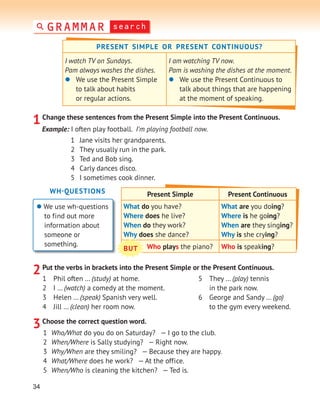
BUT
2Put the verbs in brackets into the Present Simple or the Present Continuous.
1 Phil often … (study) at home.
2 I … (watch) a comedy at the moment.
3 Helen … (speak) Spanish very well.
4 Jill … (clean) her room now.
5 They … (play) tennis
in the park now.
6 George and Sandy … (go)
to the gym every weekend.
PRESENT SIMPLE OR PRESENT CONTINUOUS?
I watch TV on Sundays.
Pam always washes the dishes.
 We use the Present Simple
to talk about habits
or regular actions.
I am watching TV now.
Pam is washing the dishes at the moment.
 We use the Present Continuous to
talk about things that are happening
at the moment of speaking.
search
GRAMMAR
35
1Describe your family photo.
2Ask and answer in pairs.
What does do?
a mechanic
a musician
a hairdresser
a nurse
an architect
…
b) Play this game in your class.
Always write who you are in your notebook.
1 Bring family pictures to school.
2 Prepare a one-minute talk about
the photo.
3 Say who they are and
what they are doing.
Prepare a one-minute talk about
Tim
Example:
N
u
r
s
e
No, I’m not a housewife.
No, I’m not a journalist.
No, I don’t work in an office.
4Listen to the dialogue between Mike and Pete (page 32 task 1) again.
Have a talk in pairs.Ask your partner what he/she would like to be.
Answer his/her questions.
4
3a) Listen to find out what game
Pam’s class is playing.
3
This is Tim.
He is my cousin.
He is playing football.
He is running for the ball ...
search
SPEAKING
36
1Read the children’s homework‘My Mum’s Job’ and guess the job.
2Write a paragraph about your mum’s / family member’s job.
3Write a short
paragraph about
what you would
like to be.
Explain why.
I’d like to be ………. because it is a ……….. job.
It is also ……….
I am patient / strong / talented ………. and ……….
I like cars / films / music ………. and ……….
I’D LIKE TO BE ...
My mum starts work very late
because she has to read articles
for tomorrow’s Internet paper.
She often talks to journalists
and reporters about interesting
stories. She knows a lot about
the news around town.
a She is an architect.
b She is an editor.
c She is a reporter.
… and sometimes she gives them
medicine. Patients love her
because she often talks to them.
Sometimes she has to call the
doctor when patients don’t feel
well. The only problem with her
job is that sometimes she must
work at night.
a She is a vet.
b She is a doctor.
c She is a nurse.
I would like to have the same
job as my mum when I grow up.
She works in the circus and
children are surprised when I
tell them what she does. They
think this is not a job for a
woman, but when they see her
with a funny hat and big shoes,
they laugh and say she is great.
a She is a teacher.
b She is a clown.
c She is an actress.
Most children are afraid of my
mum because they say it always
hurts when she fixes their teeth,
but it is important to have
healthy teeth. She doesn’t like it
when I eat chocolate and sweets
because it’s bad for my teeth.
So, she makes fruit salad
instead.
a She is a cook.
b She is a dentist.
c She is a nurse.
search
WRITING
37
1Change these sentences from the Present Simple into the Present Continuous.
2Look at the pictures and say what everyone would like to do.
3Make wh-questions to the answers.
4Ask and answer in pairs.
L k Back
1 We play hockey.
2 Sarah sings in the club.
3 Sam and Jack dance well.
4 I clean my bedroom.
5 Does Kim study Italian?
6 Do you run in the park?
 What would you like to do right now?
1 ... ? — Kate is going to the park.
2 ... ? — I dance because it’s fun.
3 ... ? — She is reading a book.
Student A:
1 Who grows plants?
2 Who writes documents?
3 Who cuts people’s hair?
4 Who repairs cars?
5 Who helps a doctor?
6 Who teaches children?
7 Who acts in films?
8 Who brings letters?
Student B:
1 Who helps sick animals?
2 Who drives a taxi?
3 Who cooks in a restaurant?
4 Who flies into space?
5 Who catches burglars?
6 Who sells things in a shop?
7 Who plays an instrument?
8 Who draws plans for houses?
Bella
Tim
Clare
Ben
4 ... ? — Charlie and George
go to the beach in summer.
5 ... ? — Rick is talking.
+/- +/-
Bella
Clare
38
5Read the text and say if the sentences below are true or false.
Many young boys and girls would like to be detectives.
Do you remember Inspector J?
Oh yes, he can solve any crime1
— just name it! But he has
a very busy life. His phone rings all day long because there
are a lot of people who need his help. He tries hard to help
everybody and he never says no.
He always gets up before 5 am because he has a lot of
work to do. He usually jogs for an hour to keep fit. The rest
of the day he is so busy that he often skips lunch or dinner.
In the morning, he usually talks to suspects2
, he
examines things, and he catches criminals3
.
The rest of the day he works undercover4
. Sometimes
he acts as a kindergarten teacher and teaches little
children. Sometimes he is a pilot and he flies a plane, or he is a waiter and serves
meals in a restaurant.
And he never goes to bed before 12.30. Sometimes he
even works all night. Only on Sunday he has got some
rest.Then he sits in front of his TV and he always watches
detective films to learn new detective tricks. You see, he
is busy even when he relaxes at home.
So, if you want to be a detective too, you must be brave,
hard-working, clever and a good actor. Are you?
1 Many girls would like to be
teachers.
2 Inspector J can solve any crime.
3 His telephone rings the whole
morning.
4 Inspector J often skips breakfast.
5 In the morning he works undercover.
6 He often wears special clothes.
7 Inspector J works from Monday to
Friday.
8 If you want to be a detective, you
must be a good actor.
WOULD YOU LIKE TO BE A DETECTIVE?
L k Back
1
a crime [kraim] злочин
2
a suspect [9syspekt] підозрюваний
3
a criminal [9kriminl] злочинець
4
undercover [0yndC9kyvC] під прикриттям
39
6Speak on the following question. Work in pairs.
b) Tell your class
everything
you remember
about Alan,Tom,
Melody and Ana.
9Work in groups and name as many jobs as you can from each kind.
10Discuss in a group of three.
12Complete the sentences and discuss them in a group.
 Would you like to be a detective? Why?
1 Alan is a) an orchestra director. b) a dentist.
2 Tom is a) a pilot. b) a janitor.
3 Melody is a) a singer. b) a detective.
4 Ana is a) a Formula 1 driver. b) a teacher.
 an orchestra director
 a detective
 a janitor
 a Formula 1 driver
 Outdoor jobs
 Indoor jobs
 Dangerous jobs
 Well-paid jobs
 Interesting jobs
 Difficult jobs
a Which job of those mentioned in task 7 is the most dangerous/interesting/
difficult? Would you like to be an orchestra director/a Formula 1 driver/a
detective/a janitor? Say why.
b Make a list of your group’s top five jobs. Say why you like them.
1 It is good to be an only child because…
2 It is good to have a younger brother or sister because…
3 It is fun to have a twin brother / sister because…
4 It is good to have an older brother or sister because…
a detective
7Listen to the interviews
with some people with
unusual jobs and choose
the correct answer.
7
8a) Listen again and say where these people work.
8
11Search for information about another unusual
job and present it to the class.
 in trouble
40
40
40
40
Self-Check
40
1Complete the sentences with the words from the box.
2Make wh-questions to the answers.
3Complete the dialogue with the sentences a-f.
1 They need some time to … this crime.
2 I want to be a mechanic when I …
3 … is a very interesting job.
4 My cat is very soft and … .
5 Jack is an … , but he wants to have a
brother one day.
1 … ? — I am writing a story.
2 … ? — She learns English at school.
3 …?—They go to work at 8 am.
4 … ? — Ben is singing.
Score: / 8
TOTAL SCORE: / 20
A: …
B: Really? What does he do?
A: He is a police officer.
B: Oh, is he brave?
A: … He is hard-working, too.
B: … ?
A: Well, he is clever, strong and careful.
B: My dad’s a doctor. …
A: … ?
B: Of course, I want to be like him.
A: Well, I want to be a singer when I grow up.
B: … . So, come on!
a So, he has to be careful too.
b My dad’s job is very
dangerous.
c Definitely.
d Does he have to be patient?
e What other qualities does he
have?
f You are very talented.
Grammar
Communication
Vocabulary
mystery, grow up, solve, only child, twins, journalist, cuddly, relatives
6 People often mix up Sam and
Pam because they are …
7 Bella does not have very
many …— only one uncle.
8 Life can be … . There is always
something you don’t know.
Score: / 6
Score: / 6
5 … ? — We are sitting here
because we are bored.
6 … ? — Charlie and Ted
play volleyball.
NOW I CAN
present my family and relatives
identify jobs
discuss my parents’ jobs
talk about my dream job
ask and answer about qualities
use the Present Continuous
use ‘would like’
make ‘wh-questions’
write a paragraph about my family
member’s job/my dream job
Lead-in:
 Do you always have breakfast in the morning?
 What do you usually have for dinner?
 What is your favourite food?
UNIT
LANGUAGE
 food & drinks
 dishes
 modals: must / mustn’t
 the verb ‘to need’
 Present Perfect
 countable and
uncountable nouns
 some, any
 much / many
SKILLS
 talking about different food and drinks
 identifying food and drinks as “healthy”
and “unhealthy”
 asking and answering about cooking
 talking about having meals
 presenting your national dishes
 writing a recipe
 writing a paragraph about
your favourite cuisine
WHAT’S IN THIS UNIT?
UNIT
UNIT 3
presenting your national dishes
It’s T a sty!
It’s T a sty!
It’s T a sty!
It’s T a sty!
42
42
HOME NEWS BLOGS VIDEOS MUSIC CHAT
cuisine, pasta, baguettes, seafood,
macaroons, dessert, tiramisu,
croissants, raw, champagne, snails,
probably, noodles, Japanese, Asians
1Listen and repeat the words in the box.
1 2Listen to the kids in the Kids
Online videos.Then read the
texts above and guess the
meanings of the words in bold or
look them up in your Vocabulary
at the end of the book.
2
macaroons
spaghetti
sushi
Salut! What do you have for breakfast? Baguettes, croissants,
cheese? They all come from France. France is a country of
food lovers. The French love eating cheese and seafood, and
drinking wine and champagne. The most famous French
dessert is macaroons. French people are famous in the rest
of the world for eating frogs and snails. Bon appetit!
Nei Ho! You probably know Asian noodles with
vegetables and chicken. Rice is typical of Asian
cuisine. A lot of people also know Japanese sushi.
The Asians like to eat fish. They also eat raw fish.
sushi
sushi
Julien
Ai
Ciao! Do you like pizza and spaghetti? They come
from Italy. The Italians like to eat light food. They
often cook pasta with tomatoes and seafood. One
of the most popular desserts in Italy is tiramisu.
Italy is also a country of good coffee.
www.kids-online.net
Paula
National Cuisines
a baguette
tiramisu
raw fish tiramisu
a baguette
a baguette
43
43
4Look for photos of some popular
Ukrainian dishes on the Internet.
Make your short presentation on
national dishes. Use the kids’
presentations on page 42 as
examples.
MORE
1
to produce [prC9dju:s] виготовляти
What is your favourite cuisine and why?
How many foreign dishes do you know?
3Listen to the online
interview. Read the
kids’ answers above.
Then give your own
answer.
3
What is your favourite cuisine and why?
How many foreign dishes do you know?
I think Asian cuisine is very
healthy. People there eat rice
and noodles, chicken and fish.
My favourite cuisine is Asian
cuisine, but I don’t eat raw fish.
I love cheese. They
produce1
a lot of
cheese in France.
I would like to
travel there.
F
R
E
N
C
H M
ENU
I
T
A
L
I
A
N
M
E
NU JA
P
A
N
E
S
E
M
E
N
U
I spend my
holidays by the sea
every year. I love
Italian cuisine. You
can get pizza every
day there.
search
I SEARCH search
I SEARCH search
I SEARCH search
I SEARCH
Kids Online
44
2Look at the picture for two minutes. Shut the book and name all the things
you remember.
3Say what fruit and vegetables you like.
1Look at the pictures. Listen and name the food you hear and see.
1
spaghetti /
rice
fish /
meat
cocoa /
tea
boiled eggs /
fried eggs
soup /
chips
bread /
doughnuts
butter /
crisps
jam /
honey
cheese /
ham
a sandwich /
sausages
salad /
yoghurt
popcorn /
biscuits
pancakes /
a fruit cake
chocolate /
ice cream
juice /
mineral water
cheese
bacon and eggs
cornflakes
tea
jam
milk
sugar
honey butter
ENGLISH BREAKFAST
search
VOCABULARY
45
1a) Answer the question.
2Complete the sentences.
bone [bCUn]
health [hel8]
skin [skin]
(un)healthy [(yn)9hel8I]
 to be rich in
 to skip a meal [mI:l]
WORDS YOU
FOR
 Do you eat healthy food?
EAT WELL — FEEL WELL
The children are having
Science. A doctor is talking
about healthy food.
Doctor: What food is rich in
vitamins?
Class: Lemons, oranges, apples,
pears…
Doctor: Yes, there are vitamins
in fruit, vegetables, brown
bread and in other food as
well.
Class: Why do we need
vitamins?
Doctor: They are important for
your eyes, your skin and…
your health. Who can tell me
where we can find
minerals?
Class: In milk, cheese, eggs and
in vegetables.
Doctor: Yes, minerals are
important for your teeth and
your bones. And… don’t skip
your breakfast. It is the most
important meal. Don’t eat
crisps and peanuts between
your meals. And remember:
you must drink at least five
glasses of water every day.
1 …, …, … are rich in vitamins.
2 There are vitamins in …, … and … .
3 Vitamins are important for our …, … and … .
4 We can find minerals in …, …, … and … .
5 Minerals are important for our … and … .
6 Breakfast is … … … .
7 Don’t … … …!
8 You must … … … .
b) Listen and read to find out if
crisps and peanuts are healthy.
b) Listen and read to find out if
crisps [krisps] peanuts [9pI:nyts]
search
READING
46
c) Listen and check your answers in b).
 A BIG MEAL OF A DAY  BRITISH BREAKFASTS
 BRITISH FOOD BELIEFS  PLACES TO EAT OUT
1 People in other countries often believe that British food is bad and not tasty.
2 The traditional breakfast is fried eggs, bacon, sausages, fried tomatoes and fried
bread. But most British people have a toast with marmalade or cereals such as
cornflakes. A late breakfast and an early lunch is called ‘brunch’.
3 Many British people eat very little for lunch and then have a big meal when
they come home around six in the evening. It’s called dinner. It’s a cooked meal.
4 Fish and Chips shops are their traditional fast-food restaurants. There are also a
lot of burger and pizza places as well as Indian and Chinese takeaways.
5Read the text again and choose a), b) or c).
1 People in other countries
believe that British food is very
good and tasty.
2 The British eat a traditional
English breakfast every morning.
3 The British have a big meal
only for brunch.
4 There are many places to eat
out in Britain.
3a) Read the sentences and guess the
meanings of the words in bold.
a I like this food — it’s very tasty.
b I like fried eggs better than boiled eggs.
c Cornflakes are cereals.
d A toast with marmalade is my usual
breakfast.
e — My mum drives cars.
— Can she drive?!! I can’t believe you!
b) Agree or disagree. Work in pairs.
1 The most famous meal in Britain is …
a) brunch b) breakfast c) dinner
2 Most British people have … for
breakfast.
a) a toast with marmalade or cornflakes
b) fried eggs, bacon, sausages,
tomatoes and bread
c) cornflakes or fried eggs
3 Brunch is …
a) a late dinner and an early supper
b) a late breakfast and an early lunch
c) a late lunch and an early dinner
4 The British have a big meal
around …
a) 7 pm b) 5 pm c) 6 pm
5 Traditional fast-food
restaurants in Britain are …
a) McDonald’s b) McBurger
c) Fish and Chips shops
6 In Britain there are many …
takeaways.
a) Indian and Chinese
b) Indian and Italian
c) Japanese and Chinese
4Read the headings and match them with the paragraphs (1-4).
47
1Write the past participles of the verbs below.
Check the Irregular Verbs List at the end of the book.
Affirmative Negative
I/You have
cooked dinner
(already).
I/You haven’t
mixed salad (yet).
He/She/It has He/She/It hasn’t
We/You/They have We/You/They haven’t
We use the Present Perfect for actions that happened in the past and we can
see their results in the present.
I have tried this fruit salad. It’s yummy! Bob has drunk some mineral water
already. He isn’t thirsty.
Time expressions with the Present Perfect: already, just, never, ever, yet, etc.
PRESENT PERFECT
Form: have/has + Past Participle
1 be …
2 buy …
3 cut …
4 do …
5 drink …
6 eat …
7 have …
8 learn …
9 make …
10 put …
2Use the verbs in task 1 to complete the sentences.
1 She hasn’t eaten her breakfast. ( )
2 Linda … some lemonade. ()
3 I … some sandwiches. ()
4 He … milk. ( )
5 We … the shopping yet. ( )
Questions Short Answers
Have I/you (ever)
tried
sushi?
Yes,
I/you have.
No,
I/you haven’t.
Has he/she/it he/she/it has. he/she/it hasn’t.
Have we/you/they we/you/they have. we/you/they haven’t.
6 I … 3 eggs on the plate. ()
7 I … how to cook tomato soup yet. ( )
8 Peter … to a nice restaurant. ()
9 They … dinner yet. ( )
10 Mum … the cake for us. ()
3Write questions.Then answer them.
1 you/ever/try/Italian pizza ?
Have you ever tried Italian pizza?
— Yes, I have./No, I haven’t.
2 your mum/buy/the ingredients
for the cake?
3 you/ever/have/a picnic?
4 they/drink/the lemonade/already?
5 she/make/a cheesecake?
6 Sam and Mary/ever/eat/frog legs?
search
GRAMMAR
48
1 …
4 cups ...
½ cup …
2 squares …
6 cups …
Bake for …
minutes at 200 0C
BROWNIES
1Name the items you can use when you make a cake.
In the TV show for children “Do It Yourself”,
chef Le Pierre is giving instructions to kids
on how to make a cake on their own.
2Read, then listen to the talk between Mike and Ted.
Complete the recipe below with the missing words.
2
4Listen again to answer
the questions.
4
3Talk to your partner.
 Can you make a cake?
 What’s it called?
 What do you need to
make it?
WORDS YOU
FOR
pan [p2n]
recipe [9res3pI]
square [skwe3]
delicious [di9li13s]
delighted [di9laitid]
tasty [9teistI]
to bake [beik]
to mix [miks]
to smell [smel]
 on my/his/their own
 What are Mike and
Ted doing? Why?
 Is their mother
surprised? Why?
Grammar
Corner
1 It is dad’s birthday today.
2 Mike and Ted are making soup
to surprise their mum.
3 They are making Whities.
4 They mix 1 cup of butter, 6 cups
of flour, 6 squares of chocolate,
4 eggs and 2 cups of sugar.
5 They bake the cake for 40 minutes.
6 Their cake looks like an old boot.
7 Mum thinks this is a horrible surprise.
8 Mike and Ted must clean the bathroom before the guests arrive.
5Correct these wrong sentences.
Must / Mustn’t
I/You/He/She/It/We/You/They
must mix sugar and eggs first.
I/You/He/She/It/We/You/They
mustn’t put in salt.
forget-forgot-forgotten
search
LISTENING
49
1Match the words from the box with the sentences (1-5).
1 It is the biggest meal of the day. We eat it in the afternoon or in the evening.
2 It is a meal that we eat first thing in the morning.
3 It is the last meal of the day.
4 It is a meal that we have in the middle of the day. It is not a big meal.
5 It is a meal that is like a late breakfast or an early lunch.
breakfast, brunch, lunch, dinner, supper
SNACK
salad
butter
cornflakes
mashed
potatoes
BREAKFAST
an apple
fish
roast chicken
cereals
DINNER /
LUNCH
fruit yoghurt
popcorn
jam
crisps
Name at least three things you can eat for supper.
crisps SUPPER
................... ?
................... ?
................... ?
................... ?
3What about you? Complete the sentences.
 For breakfast I usually have …
 For lunch / dinner I usually …
 For a snack I usually …
 For supper I usually …
2What’s wrong? Rewrite the menus.
search
VOCABULARY
50
COUNTABLES AND UNCOUNTABLES
We can count:
apples, sandwiches, tomatoes …
We can’t count:
milk, fish, tea, ice cream, meat …
We use there are with countables:
There are some eggs on the plate.
We use there is with uncountables:
There is some coffee in the cup.
There are some apples on the table.
There are some oranges on the table.
There are some eggs on the table.
There are some bananas on the table.
There are some lemons on the table.
There are some onions on the table. Grammar
Corner
+ There are some tomatoes.
? Are there any tomatoes?
– There aren’t any tomatoes.
+ There is some water.
? Is there any water?
– There isn’t any water.
b) Say if these
nouns are
countables or
uncountables.
2Listen, compare and practise.
2
3Listen and practise.
3
There isn’t any butter.
There isn’t any cheese.
There aren’t any tomatoes.
There aren’t any mushrooms.
There aren’t any eggs.
— Is there any cheese in the fridge?
— Yes, there is.
— Is there any butter in the fridge?
— No, there isn’t.
— Are there any eggs in the fridge?
— Yes, there are.
1a) Listen, find and repeat.
1 There’s some rice in the jar.
There’s some milk in the bottle.
There’s some sugar in the jar.
There’s some oil in the bottle.
There’s some water in the jug.
A: There’s some butter in the freezer.
B: How much is there?
A: There is a lot.There are some hamburgers in the freezer.
B: How many are there?
A: There are a lot.
search
GRAMMAR
2Complete the dialogue with the phrases a-c.
3Role-play the situation in pairs.
1a) Listen to the dialogue and
say where it takes place.
1
A: Can I help you?
B: Yes. Can I have a hot dog and fries, please?
A: Here you are. Anything to drink?
B: Yes, a milkshake, please.
A: So, a hot dog and fries, and a milkshake.
B: Thank you. How much is that?
A: 3.90 pounds altogether, please.
B: Here you are.
A: Here’s the change.
b) Act out the dialogue in pairs.
Keep
in Mind!
How much is the cake?
It’s 210 hryvnias.
A: What do you eat every day?
B: ...
A: How about breakfast?
B: ...
A: We’re studying food at the moment.
I’m asking my friends about eating
habits. What else do you eat?
B: ...
a It’s hard to remember!
I sometimes eat lots of sweets!
b I eat some breakfast cereal —
you know, cornflakes. I usually
drink some tea. Why do you ask?
c Well, at school I sometimes eat
an apple or a banana at break
time, and I drink some milk.
I have lunch at school.
Jane goes to a food shop. Look at the lists below and act out the dialogue.
So, a hot dog and fries, and a milkshake.
eggs
crisps
tomatoes
bananas
apples
biscuits
oranges
Shop assistant



51
eggs
crisps
tomatoes
bananas
apples
biscuits
oranges
Shopping List
search
SPEAKING
52
b) Copy the recipe above into your notebook using
the correct words instead of pictures.
2Ask your mum or your granny
to give you a recipe for an easy
cake to make. Now write the
recipe in English.
... name ...
You need: ......................................................
......................................................
......................................................
Procedure: First ...........................................
Then ...........................................
Finally ........................................
Corner
Grammar
The verb TO NEED
He needs some money.
She doesn’t need any bread.
Do you need any plate?
1a) Look, listen and read.
1
1a) Look, listen and read.
1 1 ¾ cups flour
1 tsp baking soda
1 cup sugar
100 grams butter
1 egg
1 cup yoghurt
½ cup milk
¼-½ cup chocolate chips
200
o
C 10’-12’
tsp = teaspoon
MUFFINS
Try to write the recipe: For muffins you need some...
Prepare . Combine the and .
Add . Mix .
Put... and... into the bowl.
Add .
WORDS YOU
FOR
to combine [k3m9bain]
to cool [ku:l]
to prepare [pri9pe3]
to stir [st#E:]
completely [k3m9plI:tlI]
A: What do we need?
B: We need some eggs, some milk … But we haven’t got any milk.
A: Have we got any oil?
search
WRITING
53
L k Back
L k Back
L k Back
2Complete the sentences with ‘must’ or ‘mustn’t’. Explain your choice.
1 Mike and Ted have made a
cake for their mum.
2 Mike and Ted haven’t cleaned
up the kitchen.
3 Chef Le Pierre has prepared
some very unusual brownies.
4 Chef Le Pierre hasn’t put any
sugar in the brownies.
 That’s why their mum is
surprised but happy.
 That’s why the brownies
are not sweet at all.
 That’s why their mum is
a little bit angry.
 That’s why everybody
wants to eat them today.
1Listen to the talk between Mike and Ted again (page 48 task 2)
and match the sentences in both columns.
1
3Listen to find out what Pam and Mia have got for their meals.
3
1 You … eat and speak at the same time.
2 You … wash your hands before eating.
3 You … lick your knife and put it in your
mouth.
4 You … eat with your fingers.
5 You … eat loudly.
6 You … use a napkin to clean your
mouth.
TABLE MANNERS
TIME for DINNER
7 You … leave the table while
the others are still eating.
8 You … let an older person
take food first.
9 You … sing or whistle while
you are eating.
10 You … try not to make a
mess around your plate.
TIME for BREAKFAST
TIME for LUNCH
54
L k Back
L k Back
L k Back
4Answer the questions.
1 What does Pam usually have for breakfast?
2 Who skips breakfast?
3 What else is there on Pam’s table?
4 Does Mia get up early?
5 What is there in Pam’s lunch box?
6 What is there in Mia’s lunch box?
7 What do Pam and her mum often have
for dinner?
8 Where does Mia’s family often go?
 Which food is good for health?  Which is bad for health?
6Discuss in a group.
 What about your meals?
 What time is your main meal?
7Choose the correct word
to complete the dialogue.
A: I would like to make some/any muffins.
B: OK. We have some/any time.
A: How many/much muffins do you want to bake?
B: Hmmm... What about 20?
A: I haven’t got some/any oil. But I’ve got some/any butter.
B: And how many/much butter have you got?
A: I’ve got enough. Oh! I’ve got just two eggs. How many/much eggs do we need?
B: It is OK. We just need one egg.
A: Here is the sugar. How many/much do we need?
B: Look at the recipe.
A: And have you got some/any milk? We need some/any.
B: Go to the fridge.
5Draw two columns in your notebook. Listen again and fill in the columns
with Pam’s and Mia’s food. Compare the food both girls have and say:
5
8a) Listen and check your answers in task 7.
b) Listen again and act out the dialogue in pairs.
8
mia
pam
Grammar
Corner
We use many with countables.
There are many apples.
We use much with uncountables.
There is much water.
9Have a talk in pairs.
 Do you cook with your
mum or with your dad?
 What is your favourite
food?
10Make a class cookbook
with the recipes for
your favourite cakes.
Work in groups.
12Make a poster about food.
1 Find pictures of food in old magazines.
2 Cut out the food and drinks you can name.
3 Paste them on two big pieces of paper.
4 Write the titles: GOOD FOR HEALTH
and NOT VERY HEALTHY.
5 Write the captions1
under
each picture.
6 Present it in class.
1
a caption [9k2pSn] підпис (під ілюстрацією)
11Write a short paragraph about your national
cuisine to send it to kids-online.net
NOT VERY HEALTHY
sweets
hamburgers
cakes
chocolate
hamburgers
chocolate
55
Self-Check
1Choose the correct word from the box.
2Use some/any to
complete the sentences.
4Complete the dialogue with the words from the box.
3Put the verbs in brackets
into the Present Perfect.
1 I like sandwiches with jam for a … .
2 Do not use so much … for the bread.
3 Sue enjoys … with milk for breakfast.
4 Ben likes … more than fried eggs.
1 We need … tomatoes for the salad.
2 There isn’t … meat in the fridge.
Let’s go to the shop.
3 I haven’t got … crisps.
4 Frank has … eggs to bake brownies.
5 They want …popcorn to watch the
film.
6 Do you need … carrots for your pie?
Score: / 6
TOTAL SCORE: / 26
A: It’s lunch soon. Let’s have some … .
B: No, let’s have something else. Fish
has many … .
A: Okay. What about some rice with
meat and some tea with …?
B: Sounds …! We can … our …
biscuits too!
Grammar
Communication
Vocabulary
yoghurt, butter, boiled eggs, brunch, cornflakes, snack
tasty, bones, honey, smell, bake, own, delighted, fish and chips
5 What do you usually have for …?
6 This … is too sweet.
Give me another one, please.
Score: / 6
Score: / 8
Score: / 6
NOW I CAN
talk about having meals
talk about healthy and
unhealthy food and drinks
present popular Ukrainian
and foreign dishes
write a recipe
write a paragraph about
my favourite cuisine
use must/mustn’t and to need
use some/any and
much/many
use the Present Perfect
56
1 I … (learn) this recipe already.
2 Sam … (not make) a cake yet.
3 Bill and John … (be) to this
restaurant.
4 We … (not clean up) the kitchen,
sorry.
5 You … (not buy) any eggs.
6 Jane … (eat) some fish.
A: I’d be … , but there’s not enough time.
B: Alright. Hey! What’s that …?
A: Oh no! The rice!
B: Go get it!
57
Lead-in:
 When is your birthday?
 How do you usually celebrate it?
 Have you got a favourite holiday?
UNIT
LANGUAGE
 holidays
 celebrations
 customs and traditions
 festive activities
 Past Simple (regular verbs)
 Past Simple (irregular verbs)
 time expressions with ‘last’,
‘yesterday’,‘ago’
SKILLS
 identifying dates
 talking about celebrations
 describing festive activities
 presenting your favourite holiday
 talking about parties
 writing an invitation
 writing an e-mail
 writing a mini-report
WHAT’S IN THIS UNIT?
UNIT
UNIT 4
customs and traditions
IT’S T ME TO
CELEBRATE.
How do you usually celebrate it?
58
1Read Bohdan’s blog and complete
the sentences.
2Ask and answer in pairs.
Take turns.
HOME NEWS BLOGS VIDEOS MUSIC CHAT
www.kids-online.net
1
independence [0indi9pend3ns] незалежність 2
Thanksgiving [0O2Nks9giviN] День подяки
Many holidays are days when you don’t have to go to
school and grown-ups don’t have to go to work. These
are often fun-filled days
when your family gets to-
gether for a big dinner or a
picnic. Sometimes there are
parades or fireworks.
On some holidays people go
to church.The very word ‘holiday’ means a ‘holy day’— a day
on which people thank and honour God. We celebrate all
kinds of holidays. Many, such as Christmas and Easter, are
religious holidays. Some holidays are the birthdays of fa-
mous people, like Taras Shevchenko in Ukraine or George
Washington in the USA. Others, such as Independence1
Day,
are the birthdays of the countries. And there are a number
of special days like Thanksgiving2
in the USA and Canada.
And there is your very own holiday — your birthday.
Ways of celebration depend on the date, the country, its
national traditions and customs.
1 Holidays are often ...
2 On some holidays people go ...
3 Christmas and Easter are ...
4 Some holidays are the birthdays ...
5 Independence Day is ...
6 Your birthday is ...
7 The way people celebrate a holiday ...
1 What are holidays for?
2 How do they change our life?
3 What holidays do we have?
4 What English holidays do
you know?
5 To whom do people give
presents?
roast turkey
fireworks
What Are Holidays? custom [9kyst3m]
firework [9fai3w#E:k]
parade [p39reid]
famous [9feim3s]
festive [9festiv]
holy [9h3UlI]
religious [ri9lidz3s]
to depend (on) [di9pend]
to honour [9An3]
 in honour of
WORDS YOU
FOR
Hi guys! Today I want to talk about holidays.
Many holidays are days when you don’t have to go to
school and grown-ups don’t have to go to work. These
gether for a big dinner or a
picnic. Sometimes there are
parades or fireworks.
What Are Holidays?
Hi guys! Today I want to talk about holidays.
BOHDAN, 11, Ukraine
STEFAN, 11, Germany EASTER
This is a religious holiday in hon-
our of Jesus Christ and his sacri-
fice1
.We celebrate it in spring. Egg
Hunt2
is the most popular Easter
game. One day before Easter peo-
ple paint eggs and hide them in
their homes.At Easter children try
to find the eggs and put them into
their baskets called ‘Osterkranz’.
On Easter morning people go to
the church, then they have brunch
with their families.They begin the
festive meal by knocking the eggs
with each other and then they eat
them. Kids get sweets for their
good job.
STEFAN, 11, Germany EASTER
JANE, 12, USA THANKSGIVING DAY
Every year in November Ameri-
cans celebrate Thanksgiving Day.
It is a celebration of the arrival
of the first Pilgrims to America.
People celebrate this day with
their families and friends. Some-
times they give presents, for ex-
ample flowers or chocolate. The
traditional meal is roast turkey,
corn and potatoes.
59
MORE
1 Americans celebrate Thanksgiving in October.
2 People paint eggs and hide them before Easter.
3 Kids have brunch with their friends on Easter Day.
4 White and blue are the colours of St Valentine’s Day.
5 People give or send presents on St Valentine’s Day.
1
a sacrifice [9s2krifais] жертва 2
a hunt [hynt] пошуки 3
a shape [1eip] форма 4
a couple [9kypl] пара
4Find information about another holiday on the Internet.
Write a short paragraph about it for the kids-online.net website.
Use the texts above as examples.
LIZ, 10, Canada SAINT VALENTINE’S DAY
This day is a celebration of love. It
is on 14th February.It is a tradition
to give or send presents, flowers,
sweets and postcards to people
you like. These presents are usu-
ally in the shape3
of a heart as a
symbol of love. A lot of couples4
also go for dinner or to the cinema.
The most popular colours on this
day are pink and red.
3Listen and read the comments above. Say if the sentences below are true or false.
3
search
I SEARCH
Kids Online
60
1Say the names of the
months.Then open
the Vocabulary at the
end of the book and
check yourself.
2Match the holidays
with their dates and
say as in the example.
1 New Year’s Day
2 Christmas Day
3 St Valentine’s Day
4 Easter
5 Victory Day
6 Independence Day
7 St Nicholas Day
a 14 February
b 1 January
c 19 December
d 9 May
e 24 August
f 7 January (or 25 December)
g a Sunday in April (or May)
Example:
New Year’s Day is on
the first of January.
3Read and choose the right word.
 St Valentine is a wizard / a captain / a saint who protects and helps
people in love / mothers / teachers / the Easter Bunny.
 St Valentine’s Day is on 13th February / 14th February / 24th December.
 On that day people usually make paper planes / paper hearts / coloured eggs /
exchange presents / put a pumpkin lantern in a window / write love cards / eat pudding.
6Search for the other words from task 4 to understand their meanings.
Name the holidays they are connected with.
4Choose the words which are connected with Easter.
5Look at the pictures and guess
what the most popular Easter
games are. Find the names of
the games in task 4.
search
VOCABULARY
We write
16 May
We write
My birthday is
on 21st February.
Keep in Mind!
We say
the sixteenth of May
We say
My birthday is on the
twenty-first of February.
EGG-RollING BASKETS
TRICK-OR-TREATING
EGG HUNT
A CHRISTMAS TREE
SCARY COSTUMES
CHOCOLATE BUNNIES
BOBBING FOR APPLES
PAPER HEARTS
61
3Find out how to play bobbing for apples.
Put the sentences in the correct order.
2Match.
1 jack-o’-lantern
2 pumpkin
3 monster
4 treat
5 autumn
6 Halloween
7 All Saints’ Day
8 adult
 the season which comes after summer and before winter
 a person who is grown-up
 a religious holiday that people celebrate on 1st November
 a large, round, orange vegetable
 a pumpkin with a face cut into it
 an unusual, scary creature
 a gift, such as money or sweets
 an autumn holiday for children
 Try to take the apples out without using your hands.
 Put some apples into the tub of water.
 Fill a tub with water.
search
READING
1 Read to answer the questions.
1 What does ‘Halloween’ mean?
2 What kind of holiday is Halloween?
3 What do children cut out faces into?
4 What do they put inside a pumpkin?
5 What do children dress up in every Halloween?
6 What do children say when they come to a new house?
7 What is one of the most popular Halloween games?
Halloween is a holiday for children in America,Canada and Britain.
It means “holy evening”, and it takes place every 31 October, the
evening before All Saints’ Day. But it is not really a church holiday.
Every autumn children cut faces into pumpkins and put
candles inside.These pumpkins are called jack-o’-lanterns.
Children also put on strange masks and scary costumes every Halloween.
Some children paint their faces to look like monsters. They go from
house to house. Every time they come to a new house they say,“Trick or
treat! Money or eat!” Adults put a treat, money or sweets, in their bags.
One of the most popular Halloween games is called bobbing
for apples. You can get really, really wet when you play it.
62
Sleep in heavenly peace
Round yon Virgin Mother and Child
Silent night, holy night
Holy Infant so tender and mild
All is calm, all is bright
Sleep in heavenly peace
4Answer these questions about Christmas traditions.
1 Father Christmas and Santa Claus are two
names for the man who brings children
presents at Christmas.
2 Most people have a Christmas tree
at Christmastime. It’s a small pine tree
with baubles and tinsel.
3 The day before Christmas is called Boxing Day.
4 Father Christmas brings children their presents
in the night. In the morning, on Christmas Day,
they wake up and see the presents in a stocking
at the bottom of their bed.
5 At midday, most families have a big Christmas
dinner. This is usually roast turkey, with
vegetables and sauces. For dessert they
have Christmas pudding.
6 Christmas pudding is a very dark, wet and heavy
fruit cake. You eat it hot with cream.
7 Some people put a coin in the pudding.
The person who finds it has bad luck.
8 In Britain, after their Christmas dinner, families sit
down in front of the television for the traditional
Christmas speech of the British Monarch.
9 The usual Christmas greeting
is “Happy Christmas!”
10 Silent Night is a popular Christmas carol.
Christmas Quiz
True False
True False
True False
True False
True False
True False
True False
True False
True False
True False
5Listen and put the lines in the right order.Then sing along.
5
63
2Listen and read.
2
3a) Listen and say the rhyme.
3
PAST SIMPLE OF THE VERB ‘TO BE’
Affirmative Negative
I/He/She/It was
at home.
I/He/She/It was not
at home.
We/You/They were We/You/They were not
Affirmative Negative
I/You/He/She/It/We/They
played games yesterday.
I/You/He/She/It/We/They
didn’t play games.
[t] [d] [id]
watched
cooked
helped
listened
played
showed
visited
invited
painted
Questions Short Answers
Was I/he/she/it
at home? Yes,
I/he/she/it was.
No,
I/he/she/it wasn’t.
Were we/you/they we/you/they were. we/you/they weren’t.
1Fill in the gaps with ‘was’,‘were’,‘wasn’t’,‘weren’t’.
1 We … in the history museum
at our weekend.
2 Bob … in the swimming pool
on Saturday.
3 … you at school on Sunday?
4 Jane and Liz … in a circus at their
weekend, they … in the library.
5 I … at home on my winter holidays.
6 Donna … at the camp in the mountains.
7 The weather … fine at the weekend.
PAST SIMPLE (REGULAR VERBS)
We use the Past Simple for
actions that happened at a
specific time in the past.
Time expressions with the
Past Simple: last evening,
last year/month, last
Monday, yesterday etc.
I visited my granny yesterday.
Bob didn’t play football last
Sunday.
On Sunday I played with my friend,
On Monday I started my school.
On Tuesday I watched the play to the end,
And helped my mum to cook.
b) Find the verbs in Past Simple.
On Wednesday I washed the dishes,
On Thursday I watched TV.
On Friday I visited my dear cousins,
On Saturday they phoned me.
search
GRAMMAR
DAY BY DAY
1Before listening answer the questions.
5Listen to the popular song and put the lines
in the right order.Then sing along.
5
5
2Listen and check your answers in task 1.
2
 What is the 1st day of the year?
 Do all of the countries start the year on that date?
 Have you heard about the Chinese calendar?
Grammar
Corner
China [9t1ain3]
Greek [grI:k]
moon [mu:n]
Roman [9r3Um3n]
ancient [9ein13nt]
Chinese [0t1ai9nI:x]
Jewish [9dzu:i1]
to begin [bi9gin]
to divide [di9vaid]
WORDS YOU
FOR
Mind the past
simple forms of
some irregular
verbs:
begin — began
make — made
have — had
3Listen again and match.
3 1 ancient Greeks
2 ancient Romans
3 a French king
4 Jewish New Year
5 Iranian New Year
6 Chinese New Year
a Easter
b between 21 January
and 19 February
c 21 or 22 December
d 1 March
e between 5 September
and 5 October
f 21 March
4Tell the history of the 1st day of the year to your partner.
search
LISTENING
Bells are ringing,
All is merry and bright.
And say your prayers
Children are singing,
Hang your stockings
‘Cause Santa Claus
is coming tonight.
Santa Claus is coming to town.
And he is making a list,
Who is naughty and nice.
Checking it twice.
Gonna find out
64
2
65
Cathy
Cathy
2Fill in the text with the missing words from the box.
decorate, celebrates, Chinese, traditions, fireworks, January, look forward, good luck
Every country has its own ... for New Year’s Day. Scotland ... it with its traditional
music. At New Year people look back and ... to a good future. The Chinese New Year
comes between 21 ... and 19 February. There are ... and parades in the streets. Some
people dress up as traditional ... dragons and dance in the streets, while others ...
their homes. The Chinese people believe that decorations bring ... for the New Year.
1Remember as many Christmas/New Year words as you can.
3a) Read and guess the meaning of the words in bold.
When I have a birthday party, I usually prepare invitations
for my guests. It is a special invitation — a card with a tied1
balloon. I write a name of a guest on a card.
1
tied [taid] прив’язаний
b) Look them up in the Vocabulary and check yourself.
4Think of a party you enjoyed.Tell the class about it. Use the following word map.
5Think about surprises. Build a word map of the word ‘surprise’ like the one in task 4.
music fun
dances
search
VOCABULARY
PARTY
presents
games Joy
shows
contests
winners
prizes
surprises
songs
I like to make surprises for my guests. For example,
I write jokes on paper and put them with sweets.
Yesterday I joined a party at my school.
We played games. There were different contests.
The winners received special prizes. I enjoyed it.
66
PAST SIMPLE (IRREGULAR VERBS)
Affirmative Negative
I/You/He/She/It/We/They
made a cake last Friday.
I/You/He/She/It/We/They
didn’t make a cake yesterday.
(See a List of Irregular Verbs at the end of the book.)
1Write the Past Simple of these verbs.
go — went
come — ...
begin — ...
have — ...
give — ...
bring — ...
drink — ...
eat — ...
put — ...
send — ...
see — ...
make — ...
2Read the sentences and choose the correct item.
1 Max ... to Africa last month.
a) saw b) went c) sent
2 He ... lots of people there.
a) made b) saw c) met
3 They ... to Linda’s birthday party.
a) spent b) came c) got
4 There ... wild animals all around them.
a) were b) brought c) ate
5 Max ... some apple pie.
a) drank b) began c) ate
6 When he got back home, he ... a letter
to his new friend.
a) sent b) had c) brought
3Ask and answer in pairs.
4Use the time expressions to write 4 sentences about yourself.
Example: go to the cinema / yesterday? A: Did you go to the cinema yesterday?
B: Yes, I did./No, I didn’t.
1 your teacher / go to a party / last weekend?
2 your friend / send you a letter / last week?
3 your dad / go to bed early / last Sunday?
4 you / drink a glass of juice / yesterday?
5 your mum / make a cake / last night?
Example: I went to the zoo two days ago.
 yesterday afternoon  last weekend  ago  last night
Questions Short Answers
Did I/you/he/she/
it/we/they play?
Yes, I/you/he/she/
it/we/they did.
No, I/you/he/she/
it/we/they didn’t.
search
GRAMMAR
67
costume [9kAstju:m]
spooky [9spuLL:kI]
to trick or treat
[0trik c: 9trI:t]
 to be excited [ik9saitid]
WORDS YOU
FOR
2Match.
3Discuss in a group.
1a) Look, read and guess.
It’s the morning of 31 October. The kids meet in
front of the school building. What are they talking
about? Make a guess!
b) Read the conversation quickly and see if you were
right. Say how many correct guesses you have got.
Mike: Hi, Linda! Have you got any plans for the evening?
Linda: No, I haven’t. Why?
Mike: It’s Halloween. We can all go trick-or-
treating. You can meet a lot of spooky
creatures in the street.
Linda: I must ask my mum first. And I haven’t got
a costume or a mask to wear.
Cathy: Take one of mine. I’ve got a lot of spooky
costumes at home.
Linda: OK. Thanks.
Cathy: Come to my Halloween party after that.
We can dance and play bobbing for apples.
Linda: Bobbing for apples? What kind of game is it?
Cathy: Come and see. We’ll have good fun!
Mike: And Linda, don’t forget to put a pumpkin
lantern in your window!
Linda: I won’t. I’m so excited. It’s my first
Halloween in England!
(Thinks to herself: But first I must do well in my Geography test today.)
1 spooky
2 bob
3 wear
4 go
5 a pumpkin
6 go to
 for apples
 creatures
 a costume
 a Halloween party
 trick-or-treating
 lantern
Is there a similar tradition in our country? When do you and your friends go from
door to door dressed up in funny costumes? What do you usually wear? What do
you get from your neighbours? What do you usually eat on that day? Would you like
to join Linda and her friends on Halloween? Why?
search
SPEAKING
68
1Write a letter to Santa.
2a) Look at the invitations and say
which one is better. Why?
b) Write your own invitation to your birthday party. Use the phrases.
join a party; have a picnic/fireworks; wear costumes; have contests/surprises;
decorate a house; make a cake/sandwiches; invite clowns/friends; win prizes
3Write an e-mail to a friend in Ukraine describing the imaginary3
situation:
Christmas you had with an English family in London.
1
to deserve [di9xE:v] заслуговувати 2
a chimney [9t1imnI] димохід 3
imaginary [i9m2dzin3rI] уявний
search
WRITING
b) Write your own invitation to your birthday party. Use the phrases.
Write a letter to Santa.
Dear Santa Claus,
Christmas is coming and I am looking forward to your
visit. This year, I would like many things for Christmas:
First of all, … Then … . Finally, … .
I have been a good … this year, so I think I deserve1
these
presents. Three good things about me: I’m … , … and … .
When you come down the chimney2
, please look in the
kitchen. I am going to leave … and … on the table for you.
Thank you, Santa, I am very excited.
Your name
A good invitation:
 has a title
 is short but
clear
 gives a reason
 gives a date
and time
 gives a place
 (sometimes)
asks people
to bring things
 gives contact
details
Writing
Invitations TIP
69
L k Back
L k Back
L k Back
1Fill in the words to complete the text.
invited, Thanksgiving, special, celebrate, each other, helped, festival, holiday, join
1
a harvest [9h4:vist] урожай 2
a settler [9setl3] поселенець 3
a spectator [spek9teit3] глядач
2Put the verbs in brackets into the correct forms.
3Say if it is true or false.
1 The 1st day of the New Year is 1 January for all countries.
2 New Year’s Day is a more important holiday than Christmas in Britain!
3 Stonehenge was kind of a calendar.
BETSY, 10, Canada
My name is Betsy. I am from Canada. My favourite holiday is … Day.
We … it on the fourth Thursday in November.
Thanksgiving is really a harvest1
… .
But the history of this … comes back to 1621 when the Pilgrims,
the first settlers2
of America, after the difficult winter had a good
harvest the next year. The Indians … them.
In Massachusetts the Pilgrims … their Indian friends to … their
festival. These days Americans and Canadians thank God and … for
the good on this day. I think it’s a … holiday for our people.
ALVARO, 10, Brazil
Yesterday we … (to have) a Playday Party. The students of our school
(to do) a real show. School actors and actresses … (to act) out plays.
The other students … (to watch) them and … (to play) games! The
students … (to be) not only spectators3
of the plays, but also they
had to vote for the best actor, the best actress and the best play!
The schoolchildren … (to applaud) them. The winners … (to get) their
prizes. Some of the prizes … (to be) very tasty: milk chocolates and a
very delicious apple pie. There were many surprises, interesting
games and different contests at the party. The winners … (to get)
special badges and hats. The special prize … (to be) for the most
active spectator — it … (to be) ‘A Wonderful Book of Fairy Tales’! Every
child … (to have) a good time and … (to enjoy) the party greatly!
70
L k Back
L k Back
L k Back
4Say how you celebrate some of the holidays. You may use the phrases below.
5Discuss in a group.
Mother’s Day: to make the day special; to please; to help; to give flowers
(presents, greetings cards); to send greetings cards to granny, sister or aunt.
Easter: to paint Easter eggs; to go to church; to have family dinner; to bake an
Easter cake.
Christmas: a Christmas tree (decorations); Santa Claus; to have a party; to invite
guests; to roast a goose; to make New Year’s wishes; to make a fancy dress
(party mask); to sing (dance).
What is Thanksgiving? Do you like the idea of the holiday?
Would you like to introduce the holiday of Thanksgiving in Ukraine? Why?
b) Write a short paragraph
to present Independence
Day in Ukraine.
1
freedom [9frI:d3m] свобода 2
Statue of Liberty [0st2t1u: 3v 9lib3tI] Статуя Свободи
4 They celebrate Thanksgiving both in the US and Canada.
5 Independence Day is a religious holiday.
6 Every country has its own traditions for New Year celebrations.
7 Midsummer Day is on 22nd June.
Would you like to introduce the holiday of Thanksgiving in Ukraine? Why?
In July, Americans
celebrate Independence
Day. It is a day of
political freedom1
. A lot
of people put the
American flag in front of
their houses. People are
with their families. They
have a picnic or
barbecue and play sports
games. There are a lot of
parades, shows and
fireworks in the streets.
The symbol of this day is
the Statue of Liberty2
.
6a) Think about Independence Day. Listen to the American girl and read
her presentation.
6
71
7a) Read
the ads1
.
b) In pairs, ask
and answer
about the
celebrations
in the ads.
8Think of a celebration that takes place in your school every year.
Make an ad for it for your school website. Write its name, date,
place and activities. Illustrate your ad with pictures.
9Write an e-mail about a special celebration you enjoyed.Tell your friend about the time,
the activities, the people you joined and your favourite moments.
10a) Interview your classmates, friends or relatives.Add questions you’d like to ask.
Ukrainian Holidays and Celebrations
b) Complete the sentences with the results of your interviews.
Give a report to the class.
I interviewed ... people.
Most (many, some, ...) people think that the greatest holiday is ... .
Most (many, some, ...) people celebrate ... .
... % want to celebrate ... .
... were not named as favourites.
...
 What is your favourite holiday?
 What new celebrations would you like to have?
 What is the greatest holiday in Ukraine?
 In honour of what person would you like to introduce a holiday?
 Which is more important to you (on a holiday): a day off or a celebration?
 Do you celebrate any holidays?
 What traditions do you know?
 How do you celebrate your favourite holidays?
1
an ad [2d] реклама
72
72
72
72
Self-Check
1Complete the sentences with the words from the list.
2Put the verbs into the Past Simple.
3Put the sentences into the correct order to make up a dialogue.
1 I’m so …! My birthday’s tomorrow.
2 It’s Halloween! Let’s go …, everyone!
3 Ah! You look so … in this costume!
4 We always have a … dinner on
Thanksgiving Day.
5 There are many …holidays like Easter.
1 Tina … (help) me with the cake yesterday.
2 There … (be) many fireworks on Independence Day last year.
3 John … (not play) any music at the party.
4 Sam and Paul … (bring) me some presents.
5 We … (go) to the parade last Sunday.
Score: / 8
TOTAL SCORE: / 23
Grammar
Communication
Vocabulary
religious, festive, famous, ancient, moon, trick-or-treating, spooky, excited
6 Christmas is a very … holiday
around the world.
7 The … Romans had their own
celebrations.
8 Oh, look at the …! It’s so beautiful
tonight on Christmas Eve!
NOW I CAN
name holidays
talk about dates and the calendar
talk about festive activities
describe a tradition/custom
talk about past events
write a report
write a birthday invitation
write an e-mail about a
celebration
use the Past Simple
72
 B: Try it next time.
 A: What did you do?
 B: Of course! Rob brought a lot of pizza and juice.
There was also ice cream in the end.
 A: Did you enjoy the party last weekend?
 B: Well, Bill played some music and everyone danced.
 A: Did Bella sing?
 B: Oh, yes! It was amazing!
 A: Did you eat or drink anything?
 B: No, she didn’t. But Kelly did. She was great!
 A: Oh, it’s a pity I didn’t come.
Score: / 5
Score: / 10
Lead-in:
 What do you usually do when it’s snowy?
 What is your favourite season? Why?
UNIT
LANGUAGE
 weather
 clothes
 be going to
 Future Simple
 Zero Conditional
SKILLS
 describing the weather
 talking about clothes
 informing about general facts
 making suggestions/offers
 giving advice
 talking about future plans
 talking about intentions
 giving predictions
 writing a weather report
WHAT’S IN THIS UNIT?
UNIT
UNIT 5
WHAT’S THE WEATHER
LIKE T DAY?
HOME NEWS BLOGS VIDEOS MUSIC CHAT
www.kids-online.net
74
1Match the symbols with the weather.
DIFFERENT
WORDS YOU
FOR
climate [9klaim3t]
rainforest [9reinfArist]
chilly [9t1ilI]
freezing [9frI:xiN]
however [haU9ev3]
It’s cloudy.
It’s windy.
It’s snowy.
It’s sunny.
It’s rainy.
It’s foggy.
Match the symbols with the weather.
1Match the symbols with the weather.
Match the symbols with the weather.
4
1
5
2
6
3
Polar zone
Cold zone
Moderate zone
Subtropical zone
Tropical zone
BEN, 10, Canada
It’s so freezing and windy here.
It often snows too. That’s why I
always wear my hat. I often ski
and skate here.
MARJORE, 11, Brazil
It often rains here, but it’s sunny too.
That’s why it is called a ‘rainforest’. It is
very warm and the nature is very
beautiful. I enjoy going for a walk here
and always have my umbrella with me.
Brazil
Canada
MORE
75
3Read the kids’ blogs about the climate in their countries. Find the places on the map.
Say what the climate is like in different parts of the world.
4Say what you usually do when it is: sunny and hot / cold and snowy / wet and chilly.
5Write about the climate in Ukraine. Use the texts above as examples.
2Find the opposites.
CLIMATES
search
I SEARCH
Kids Online
 cold  dry  freezing  wet  warm  hot
MARIA, 10, Poland
The climate is fine here. It is chilly
in winter and it sometimes snows.
However, summer is quite warm
and sunny and I often ride my bike.
ARHAAN, 11, India
It is very hot and sunny here. It doesn’t rain very
much. That is why the weather is quite dry. I usually
wear my sunglasses and I often go to the sea.
ARHAAN
India
Poland
Ukraine
Ukraine
76
1Listen to the sounds. Say what images come to your mind.
Describe what the weather is like.
1
search
VOCABULARY
Example: A: What is the weather like in picture 1?
B: It is chilly and foggy.
2Ask and answer in pairs. Use the pictures.
cloudy [9klaUdI]
foggy [9fAgI]
stormy [9stc:mI]
wet [wet]
WORDS YOU
FOR
Grammar
Corner
cloud — cloudy
fog — foggy
rain — rainy
storm — stormy
wind — windy
3Read and guess what the weather is like.
1 I can’t see anything. It’s foggy.
2 Hurray! Everything is white! It’s ...
3 We can go swimming in the sea. ...
4 Look! The sky is grey. There is no sun. ...
5 Oh, I haven’t got my umbrella. I’ll get wet. ...
6 Look! The papers and leaves are flying like birds. ...
4Describe the weather in different seasons.
What is it like in your village / town / city?
1
4
2
5
3
6
77
Keep in Mind!
2 o
C = 2 degrees centigrade
[di9grI:x 9sentigreid]
This is the weather report for our continent — dear old Europe. Yesterday
was not different from the rest of the week. In the north it was cold as usual.
In the south it was warm as can be expected for this time of the year.
London was foggy with a temperature of 12 degrees centigrade.
search
READING
1a) Copy the boxes into your notebooks.
Look at the symbols and use the words from
the list to fill in the first gaps about the weather.
a snowstorm, foggy, cloudy and windy,
rainy and wet, sunny and warm
b) Listen and read the weather report. Fill in the gaps above (a)
with the temperature and the name of each city mentioned.
centigrade [9sentigreid]
degree [di9grI:]
forecast [9fc:k4:st]
to expect [ik9spekt]
to report [ri9pc:t]
WORDS YOU
FOR
1
Weather _____________
Temperature ______ o
C
Town ________________
foggy
2
Weather _____________
Temperature ______ o
C
Town ________________
3
Weather _____________
Temperature ______ o
C
Town ________________
4
Weather _____________
Temperature ______ o
C
Town ________________
5
Weather _____________
Temperature ______ o
C
Town ________________
It was windy and cloudy in
Berlin. And the temperature
was 9 degrees centigrade.
In Madrid it was rainy again.
Usually wet for this time of the
year. And the temperature was
15 degrees centigrade.
78
2Read the text again and choose
the right answer.
1 The weather report is for …
a) Africa b) Europe c) Asia
2 In London the temperature was …
a) 12 o
C b) 15 o
C c) 22 o
C
3 In Madrid it was …
a) snowy b) rainy c) sunny
4 The weather in Rome was …
a) cold and wet b) chilly and windy
c) warm and sunny
5 The coldest part was …
a) the north b) the south c) the west
6 In the north there was …
a) rain b) fog c) a snowstorm
3Ask and answer in pairs.
 What is the difference between a weather report and a weather forecast?
 What is the weather like today?
 What was the weather like yesterday / last Sunday / two days ago?
Let’s see what the weather was
like farther south. So, in Rome the
weather was really beautiful.
It was sunny and warm and the
temperature was wonderful —
22 degrees centigrade.
Oslo
Kyiv
Berlin
London
Madrid
Rome
The north of our continent was
the coldest. Actually, it was even
colder than usual. In Oslo the
temperature was only 0 degrees
and there was even a snowstorm.
the North
[nc:O]
the South
[saUO]
the West
[west]
the East
[I:st]
79
search
GRAMMAR
1Complete the sentences with the words from the list. Use the ‘be going to’ form.
BE GOING TO
 We use ‘be going to’ to talk about intentions (наміри) and
predictions (передбачення) that are based on what we know or see.
They are going to play snowballs. (There is much snow outside.)
I am not going to play games. Is it going to rain? Yes, it is. / No, it isn’t.
buy, swim,
walk, go,
snow, play
1 It … soon.
2 I … basketball with Tom.
3 We … to the beach on Sunday.
2Make questions to the answers. Use the ‘be going to’ form and words in brackets.
1 … (Tim, sing)? — Yes, he is.
2 … (you, dance)? — No, I’m not.
AFFIRMATIVE NEGATIVE
I/You/He/She/It/We/They
will (’ll) go there.
I/You/He/She/It/We/They will not (won’t) go there.
QUESTIONS SHORT ANSWERS
Will I/you/he/she/it/we/they
go there?
Yes, I/you/he/she/it/we/
they will.
No, I/you/he/she/it/we/they
won’t.
We use the Future Simple to talk about on-the-spot decisions (раптові рішення)
and predictions (передбачення) that are based on what we think or believe.
FUTURE SIMPLE
4 Kate … in the park.
5 Pam and Sam … in the sea.
6 Jack … a new coat.
3 … (Clare, skate)? — No, she isn’t.
4 … (Bill and Sue, work)? — Yes, they are.
3Complete the sentences with the words in brackets. Use ‘will’ or ‘won’t’.
1 I … (go) to the cinema with you.
2 He thinks Ann … (not ski) with
him.
4Make questions to the answers. Use the words in brackets in the Future Simple.
1 ... (you, wear a hat)? — Yes, I will.
2 … (it, snow) tomorrow? — No, it won’t.
3 … (Helen, do homework)? — Yes, she will.
4 … (Ben and Jim, go to the club)? — No, they won’t.
3 Sue and George … (not learn)
Maths next year.
4 We … (visit) Spain this year.
80
search
LISTENING
4Think and say what you usually wear when it’s rainy/snowy/hot/windy.
1Listen to three dialogues and describe the weather.
1
2Listen again and say if the sentences are true or false.
2
3Look at the photos.Then listen and guess the names of the people in them.
3
1 Ted is going to put his warm
clothes on and go skiing with his
friends tomorrow.
2 Ted isn’t going to get frozen.
3 Ted isn’t going to stay at home
tomorrow.
4 Ted is going to play computer
games tomorrow.
5 There will be a pyjama party at
Mary’s next week.
6 Liz’ sister isn’t going to join it.
 Who is Nick, James, Kyle or Veronica?
slippers
7 Liz’ sister is going to put her jeans and
jumper on.
8 It is going to be rainy weather next
week.
9 Liz’ sister won’t put her dress on.
10 She will put her raincoat on.
11 Greg isn’t going to change his clothes.
12 The weather forecast says it’s going to
be sunny and warm soon.
13 Greg’s mum thinks it isn’t going to rain.
14 Greg will take his umbrella.
tie shirt
suit
jersey bathrobe
top
shorts
trainers
flip-flops
leggings
underwear
81
search
VOCABULARY
1Match the words to the pictures.
T-shirt
cap
trousers
scarf
dress
socks
sandals
raincoat
skirt
shorts
jeans
leggings
gloves
shirt
coat
hat
boots
trainers
pyjamas
jacket
jumper
blouse
shoes
swimsuit
slippers
2Solve the riddles. More than one answer is possible.
1 You wear them on your feet in winter.
2 You put it on your head.
3 You wear them when you sleep.
4 Girls wear it on the beach.
5 You put it around your neck.
6 You wear them on your feet at home.
3Make your own riddle.Test your friend.
22 23 24 25
7
14
20
21
10 11
13
5
19
12
6
18
15
1 4
3
16
17
2
9
8
82
search
GRAMMAR
ZERO CONDITIONAL
Form: If + Present Simple + Present Simple
 We use the Zero Conditional to
a) talk about general facts
If it rains, I take my umbrella.
b) make suggestions and offers (рекомендувати і пропонувати)
If you are free, come to the club. If you need help, call Bill.
c) give advice (давати пораду)
If you go to Egypt, visit the Pyramids.
1Match to make sentences.
1 If it rains,
2 If you call Pete,
3 If Stella gets sick,
4 If it becomes dark,
5 If the temperature is 100 o
C,
6 If Jack goes on holiday,
7 If you have a big dog,
8 If Sam and Bill are hungry,
a it boils.
b I get scared.
c tell him I’m fine.
d take your umbrella.
e Tom calls a doctor.
f tell them there is some pasta.
g feed it well.
h he visits his parents.
2Finish the sentences.
1 If I am hot, …
2 If the weather is wet, …
3 If it is frosty, …
4 If I am cold, …
3Make your own six sentences with the Zero Conditional.
5 If it snows, …
6 If it is stormy, …
7 If the weather is sunny, …
8 If it is windy, …
83
search
SPEAKING
1 a cold winter day
2 a birthday party
1Listen, read and act out the talk in a group of three.
1
2a) Look at the picture
and say what
everyone is wearing.
b) Say what one of your
classmates is wearing
and let the others
guess who it is.
Example:
Olenka is wearing …
If it is cool, I usually put my jumper on.
3Look and match each
picture to the weather
(1-4).Then say as in
the example.
1 It is cool.
2 It is cold and
snowing.
3 It is sunny
and hot.
4 It is raining.
4Say what the right clothes are and what are not for the following.
careful [9keCfl]
slippery [9slip3rI]
WORDS YOU
FOR
Jane: Shsh! Let’s listen about the weather.
Speaker: It is going to be snowy tomorrow. The weather is going to be cold and
frosty in London. Be careful! It’s going to be slippery in the city.
Mother: What do they say about the weather, Jane?
Jane: They say we must put our warm clothes on.
Mother: Really?
Jane: Yes,it is going to be frosty and slippery tomorrow.
3 a PE lesson
4 a rainy summer (autumn) day
1
84
search
WRITING
1Check the weather in your capital city and in
your home town/city on the Internet and write
a weather forecast. Use the example below.
In London on 15th January it will be 5 o
C.
It is going to be cloudy and wet.
2a) Read the e-mail from Ann.
b) Write an e-mail back to Ann and tell her about the climate in your home place
and what people usually wear in each season.
Date: 15 January
Place: London
Temperature: 5 o
C
Weather: cloudy and wet
To
From Ann
Subject Weather in Australia
New Message
Hi! My name is Ann and I am from Australia. The climate here is very hot and quite
dry. In summer the temperature can get to 40 o
C in some places! But I live near the
sea, so it is usually 25-30 o
C. The days are often sunny and there’s not very much
rain, so people here wear T-shirts, skirts, shorts, dresses and, of course, sunglasses!
In winter,however,it is sometimes cloudy and windy.The temperature can get down
to 20 o
C, so we often put on a light jacket and jeans. What about your home place?
Write me back! 
Yours, Ann
Send
L k Back
L k Back
L k Back
1Complete the sentences with the words in brackets.
Use the Future Simple or ‘be going to’ form.
1 I am thirsty. I … (have) a drink.
2 Bob and Jill … (go) to Italy next week.
3 Sam … (meet) me tomorrow.
4 We … (not study) history next semester.
5 My brothers … (not play) tennis today.
2Make your own 6 sentences with the Zero Conditional.
Use the words in brackets.
1 … (feel happy).
If my granny smiles, I feel happy.
2 … (learn English).
3 … (be bored).
3Look at the chart, then work in pairs.
Ask and answer as in the example.
A: What’s the weather like in Kyiv today?
B: It’s snowy and frosty with a temperature of -5 o
C.
4Look and say as in the example.
Example: It’s going to be foggy in France tomorrow.
Kyiv
London
Paris
Rome
Cairo
-5 o
C
10 o
C
8 o
C
18 o
C
30 o
C
6 … Phill … (come back) home
tonight?
7 …Kim and Jim …(swim) in the sea?
8 Everybody … (celebrate) Holly’s
birthday this Sunday.
4 … (wear a jumper).
5 … (rain).
6 … (put on a shirt).
rainy
sunny
snowy
foggy
frosty
hot
slippery
windy
85
86
L k Back
L k Back
L k Back
6Choose the right word to do a correct commentary on a fashion show.
1 With jeans you can wear a skirt / a shirt / trousers.
2 Over a dress you can put on slippers / gloves / a coat.
3 When it’s cold you wear a jacket / a swimsuit / sandals.
4 When it’s warm you wear a T-shirt / a scarf / boots.
5 Boys often wear a dress / a swimsuit / a tracksuit.
6 Only girls wear trainers / skirts / jeans.
7 You can put a cap / a belt / socks on your head.
8 On the beach you wear pyjamas / a jumper / swimming
trunks.
7Read and name.
1 two things you wear in hot (cold) weather
2 three things that only women wear
3 four things you wear on your feet
4 five things that keep you warm
5 six things that men and women can both wear
1 It is hot and sunny. I am going to
go out to play with my friends.
2 It is cool. I am going to go to the
shop.
3 It is a dancing party today.
4 It is raining. I am going to go to
school.
5 It is snowing. Let’s go to the park!
8Read and match.
a I will put my beautiful new
pink dress and shoes on.
b I will put my yellow raincoat
and green boots on.
c I will put my old white
T-shirt and blue shorts on.
d I will put my coat, red cap,
scarf and mittens on.
e I will put my blue jumper
and grey trousers on.
5Make up a dialogue in pairs. Use the phrases below.
There will be …
I’m going to … / I’m not going to …
I saw a weather forecast. It says it is going to…
I will … / I won’t …
Let’s see what the weather is
like around the world today.
b) Listen again and answer the questions.
1 What are people in England doing?
2 What’s the weather like in Argentina today?
3 In which country are people swimming today?
4 What’s the weather like in Canada today?
10Write an e-mail
to your friend
from another
country.
Describe the
weather in
Ukraine today.
9a) Listen and say why the weather is different in various places.
9
87
88
1Fill in the sentences with
the words from the box.
2Group up the words
from the list into three columns.
5Match to make sentences.
1 It can get really … here in winter —
25 o
C below zero.
2 I’ll put on my jumper because it’s ...
3 Oh, it’s so … today! Let’s go for a walk!
4 It’s … outside! Take an umbrella with
you.
5 Tom can’t see anything because
there is …
6 I don’t like it when the sky is …
Score: / 6 Score: / 12
Score: / 6
Score: / 6
Score: / 6
TOTAL SCORE: / 36
1 What will you wear to the party?
2 Is Robert going to the gym?
3 If it’s hot,
4 Will it rain?
5 If Polly is hungry,
6 Are Kate and Kim going to play with us?
a she goes to the fridge.
b Yes, they are.
c I’ll wear my pink dress.
d I put my T-shirt on.
e No, he isn’t.
f No, it won’t.
Grammar
Communication
identify clothes
describe the weather
inform about general facts
make suggestions/offers
give advice
talk about plans and intentions
give predictions
write a weather report
NOW I CAN
Vocabulary
Self-Check
4Write 6 sentences about what you wear in each weather:
hot, cold, wet, windy, snowy, sunny. Use the Zero Conditional.
3Put the verbs in brackets into the Future Simple or ‘be going to’ form.
1 Liz … (work) late tonight.
2 I … (get) you a drink.
3 We … (not go) to school
tomorrow — it’s Easter!
4 Clare … (not call) you because she’s
busy.
5 … you … (visit) Spain this year?
6 … Bill … (help) me with homework?
jumper, trousers, shorts, jacket,
T-shirt, scarf, cap, shirt, hat,
gloves, dress, coat
chilly, cloudy, sunny, freezing, raining, fog
Light
clothes
Warm
clothes
Acces-
sories
... ... ...
Lead-in:
 Have you got a friend?
 How do you spend your free time?
UNIT
LANGUAGE
 free-time activities
 hobbies
 likes / dislikes
 ‘-ing’ form of the verb with
likes / dislikes
 Present Continuous
for future actions
SKILLS
 identifying free-time activities
 informing about likes / dislikes
 talking about free time
 talking about a hobby
 talking about fixed plans
 describing a theme park
 writing an e-mail
WHAT’S IN THIS UNIT?
UNIT
UNIT 6
LET’S HAVE FUN!
LET’S HAVE FUN!
90
90
1Do the quiz above to find out what kind of person you are.
HOME NEWS BLOGS VIDEOS MUSIC CHAT
What are you Really Like?
www.kids-online.net
2Name some popular activities with Ukrainian children.
3Read the comments on page 91 and answer the questions:
 Who is crazy about
sport?
 Who doesn’t like PE?
 Who plays table tennis?
 Who collects
something?
Physical activities are more popular with children than creative
activities. Computer classes and ICT are becoming more and more
popular. What activities are more popular in your country? Why?
Physical activities are more popular with children than creative
activities. Computer classes and ICT are becoming more and more
popular. What activities are more popular in your country? Why?
 Are you more a physical kind of person
or are you more a creative one? Or are you both?
 Put these activities into two groups.
Write the headings: I LIKE and I DON’T LIKE.
 If you like more ‘pink’ activities — you are more physical.
 If you like more ‘blue’ activities — you are more creative.
TENNIS
BASKETBALL
VOLLEYBALL
GYMNASTICS
FOOTBALL
SWIMMING
DISCUSSION
MUSIC
DRAMA
SINGING IN A CHOIR
READING
CREATIVE WRITING
DRAWING
FOREIGN LANGUAGES
KARATE
AEROBICS
WORDS YOU
FOR
activity [2k9tiv3tI]
ballet [9b2lei]
choir [9kwai3]
fan [f2n]
violin [0vai39lin]
creative [krI9eitiv]
physical [9fixikl]
both [b3UO]
91
91
4Ask and answer in pairs.
MORE
search
I SEARCH
Kids Online
1 How often does Sandra play
table tennis?
2 What does she do in winter?
3 What happens if she plays
computer games too much?
5Write a comment about your attitude to sport and your favourite activities.
4 What does Judy sometimes do?
5 What does she like?
6 What instrument does she play?
7 Is Henry bad at sports or is he lazy?
8 What sports does Joe play?
SANDRA, 11, Sweden
I play table tennis twice a week and every January
I go skiing. I play “Home You Go” with my little
brother. I sometimes play computer games, but if I
play too much, my father gets angry. He thinks it’s
better if I play outdoors with my friends.
HENRY, 10,Australia
I don’t like PE. I don’t
think I’m very good at
sports. I can’t run very
fast. Or maybe I’m just
lazy. I don’t care.
JUDY, 11, Israel
I still collect little teddy
bears. I keep them in a
big box under my bed.
I sometimes go cycling.
When we have PE at
school, I like it when we
are in the gym and we do
exercises. I go to music
school and I play the
violin, but I’m not sure I
like it very much. I want
to do ballet.
JOE, 12, England
I’m crazy about sport. I’m the
happiest boy at school when we have
PE. I’m in the school football team.
I also play tennis and I swim all July
when I am at the seaside. I want to
do judo but my parents think I need
some time to do homework. I’m also
a great Manchester United fan.
92
1Look at the columns.Talk about different groups of hobbies. Which one is
your favourite? What hobbies will you have in the future? Work in groups.
2Put the verbs into the correct lines.
search
VOCABULARY
LEARNING
THINGS
reading,
going to the
theatre,
museums,
art galleries,
cinema, etc.
DOING
THINGS
gardening,
cycling,
travelling,
playing chess,
playing computer
games, etc.
MAKING
THINGS
drawing,
painting,
handicrafts,
cooking,
etc.
COLLECTING
THINGS
stamps, coins,
badges, stones,
board games,
books, cards,
video games,
toys, watches,
paintings, etc.
play, write, go, collect, do, watch, make
1 … teddy bears, comic books, posters
2 … a snowman, a birdhouse, a model boat
3 … chess, the piano, football
4 … yoga, puzzles, experiments
5 … birds, stars, action films
6 … a diary, poems, text messages
7 … dancing, fishing, climbing
3Think and say who in your class is keen on:
 watching short videos
 playing computer games
 doing Maths / PE / History
 writing text messages to friends
4Match and use the right prepositions to make up sentences.
Match and use the right prepositions to make up sentences.
Keep
in Mind!
to play the piano
the guitar
to play football
tennis
hockey
chess
to go running
skiing
skating
swimming
We are good
He is keen
They are fond
She is interested
in
at
of
on
music.
speaking English.
reading books.
sport.
H O B B I E S
1 2 3 4
adventure [3d9vent13]
attraction [39tr2k1n]
experience [ik9spi3rI3ns]
maze [meix]
roundabout [9raUnd3baUt]
theme park [9OI:m p4:k]
amazing [39meixiN]
awesome [9c:s3m]
to explore [ik9splc:]
to relax [ri9l2ks]
WORDS YOU
FOR
1Listen and read to find out what
Cathy and Mike are reading.
1
2Say if the statements are true or false.
1 They are looking at a brochure of the Crazyland
theme park.
2 There is a fascinating dance show.
3 You can travel into the future.
4 Cathy doesn’t want a birthday present this year.
5 You can take your pets to the park.
6 Cathy’s dad thinks it’s a bad idea to go to the park.
search
READING
Mike: Wow…
Cathy: This is awesome!
Mike: Amazing!
Dad: You two, what have you got there?
Cathy: It’s a Wonderland brochure.
Dad: Wonderland? What’s Wonderland?
Mike: It’s a theme park. There are a lot of great rides
and attractions. It looks so exciting.
Dad: That sounds like boys’ fun.
Mike: Oh no. There is something for the whole family. Even grandpa.
Dad: Is there anything for little kids?
Cathy: Of course, there is. There are two roundabouts.
Mike: There is also a fascinating dolphin show.
Cathy: I’d really like to go there. Can we, dad?
Dad: Hmmm... I don’t know.
Mike: You can also learn a lot because you can travel into the past.
Dad: Is there also something that can help you two with your Maths homework?
Cathy: Oh dad, stop it! I’ve got an idea. This can be my birthday present this year.
We can all spend a whole day there.
Mike: They say here that pets are welcome.
Dad: It sounds like real fun for the whole family. Let me see the brochure.
3Read again and answer the questions.
1 What is there in the theme park?
2 Who can go to the theme park?
93
94
search
READING
4Read the brochure and match each picture with its description.
Take an amazing
trip into the past
where you will
see real dragons
and knights1
!
Jump 20 metres
high.
Explore the
jungles.
Experience life
on board a pirate
ship. Don’t be
scared when the
adventure takes
you through a
battle on the sea.
Put on your 3D
glasses and enjoy
a new
experience!
Take an amazing
water ride. Try
not to get wet!
Find your way out
of the maze.
There is only one
way out!
WONDERLAND
A LIFETIME
OF ADVENTURE
IN ONE DAY
There is something
for everyone. Just relax
and enjoy your stay!
1
2
4
6
3
5
7 1
a knight [nait] лицар
95
1 On the trip into the past you will see ...
a) knights and dragons b) pirates
2 You go through the jungle ...
a) on foot b) by boat
3 In the theme park cinema you must put on ...
a) a special hat b) 3D glasses
4 When you go on a water ride,
you must be careful not to get ...
a) wet b) scared
5 You should find the way out in the ...
a) maze b) jungle
6 In the theme park you can buy ...
a) toys b) souvenirs
7 The park is open ...
a) almost every day b) every weekend
8 Children under ... don’t need to pay
for a ticket.
a) 100 cm b) 110 cm
9 You can get to the park ...
a) by underground b) by bus
10 If you’re 11 years old, you pay …
a) EUR 35 b) EUR 25
5Read the brochure again and choose the correct words.
TICKETS: Adult — EUR 35
Child (4-11) — EUR 25
Child under 1 metre — free
Family ticket (2 adults + 2 children aged 4-11) — EUR 100
OPENING HOURS: Open 356 days a year,
from 10.00 am to 6.30 pm daily.
HOW TO GET TO THE PARK: by car / by bus / by train
from 10.00 am to 6.30 pm daily.
by car / by bus / by train
TICKETS:
Child (4-11) — EUR 25
Child under 1 metre — free
Family ticket (2 adults + 2 children aged 4-11) — EUR 100
DON’T
FORGET TO BUY
A SOUVENIR!
PETS ARE
WELCOME.
WONDERLAND
In the theme park cinema you must put on ...
Read the brochure again and choose the correct words.
95
96
To Kids’ Net Magazine
From ...
Subject Likes and Dislikes
New Message
In English I sit next to …
He / She likes / doesn’t like …
He / She is good at … He / She likes going …
Send
Kids’ Net Magazine
search
GRAMMAR
Do you like playing in the snow?
Yes, I do. It’s fantastic! /
No, I don’t like it. It’s boring.
THE ‘
-ING’ FORM OF THE VERB
1Finish the sentences.
I love...
I like... I’m good at... I hate...
I don’t like...
3Ask and answer in pairs as in the example.
 reading in bed
 writing text messages
 going shopping
 helping in the house
 playing computer games
Talk about likes and dislikes with the ‘-ing’ form.
I
love
like
don’t like
hate
enjoy
playing football.
reading.
dancing.
doing tests.
swimming.
I’m good at drawing.
I’m keen on singing.
I don’t like going sledging.
2Complete the e-mail about your
partner for the “Kids’ Net Magazine”.
search
LISTENING
1Have a talk in pairs. Use the ideas below.
I use it ...
My parents use it ...
... to talk to my / their friends
... to send text messages
... to play games
... to listen to music
2Read these text messages and
put them in the correct order.
 Have you got a smartphone?
 How do you use it?
 What about your family?
 How many text messages do you
send every day?
 Is it necessary for 10-year-old kids
to have a smartphone? Why?
97
OK. See you.
Linda
Of course.
When?
Linda
Today at 5. My place.
Cathy
I’m doing a music project for
school with Monica and Hannah.
Can you help us, please?
Cathy
98
search
LISTENING
4Listen again and say the word that means:
4  a game in which you try to hit the players
in the other team with a ball
 a group of people who sing together
 a chair with large wheels for people who can’t walk
 a musical instrument with black and white keys
5Correct these wrong sentences.
The girls are working on an art project.
Monica is a member of a swimming club.
Most people think Monica can’t do things because she is too young.
6Talk about Monica. Say as many true sentences as you can.
7Write down 4 true sentences about yourself.
3Listen and answer the questions.
3
1 Where are the girls?
2 How is Monica different from her friends?
3 Who likes Greg?
4 Why can Linda help a lot with their music project?
a game in which you try to hit the players
a chair with large wheels for people who can’t walk
a musical instrument with black and white keys
How is Monica different from her friends?
Why can Linda help a lot with their music project?
99
We’re looking for a GUITARIST.
If you are interested, contact Jim.
School band
1
search
VOCABULARY
1Speak about collections. Say:
 what things people collect
 why they collect these things
 what different collections can teach us
 what you / your friends / family collect
2Say what games children play at sports grounds and what musical instruments
some of them play after classes.
Example: Mary and Tom (table tennis)
Mary and Tom play table tennis.
1 The children (volleyball)
2 Mary (piano)
3 Nelly and Victor (badminton)
3Read and guess the activities. Match them with the correct names from the box.
Cooking club, School newspaper, Spanish lessons,
School choir, Drama group, School band
4 My elder sister (guitar)
5 Caroline (basketball)
6 The boys (violin)
ATTENTION, JOURNALISTS! We’ll
help you become great writers.
2
WANT TO BECOME AN ACTOR? This is
the right activity for you. Join us.
3
A chance to learn a WONDERFUL
LANGUAGE and get to know the
culture of Spain.
5
Have you got an EAR FOR MUSIC?
Join us when we sing different
melodies, pop songs and even opera.
6
Want to learn how to bake bread,
make pancakes or a fruit salad?
4
search
GRAMMAR
PRESENT CONTINUOUS FOR FUTURE ACTIONS
1Read the sentences, then say which refer to
the present and which refer to the future.
Max is watching TV at the moment.
Jason is playing tennis on Saturday.
Julie and her friends are having a party tomorrow.
We are doing our homework now.
Jeff is helping his mum at the moment.
They are visiting the zoo on Sunday.
2Ask and answer questions as in the example. Use the prompts below.
Example: Billy / this afternoon / aquarium / to see the dolphins
What is Billy doing this afternoon?
He is going to the aquarium to see the dolphins.
1 Ron / tomorrow / museum / to learn some history
2 Mary / this afternoon / dinner
3 You / next weekend / Kyiv / to visit the theatre
4 I / next Saturday / my friend’s birthday party
5 They / next summer / Italy / to spend their holidays
3Look at Jane’s diary, then ask and
answer questions as in the example.
Example: — What is Jane doing on Monday?
— She’s visiting her grandparents.
We can use the Present Continuous to talk about fixed arrangements (заплановані
дії) in the future: She’s flying to Paris tomorrow morning. (a fixed arrangement)
— What are you doing this weekend,Ann?
— I am going to the cinema with Pam tonight.
JULY
Mon visit my grandparents
Tue play computer games
with Ben
Wed have a picnic with Jack
Thu visit a museum
Fri play tennis
Sat act out in the play
Sun decorate my room
100
101
search
SPEAKING
1Listen, then put the interview from Helen’s school magazine “Super J”
in the right order.
1
Super J: Hello, Helen. So, you are the winner! Congratulations!
Helen: Oh, I don’t know what dance. My own creation.
Super J: It was cool! What form are you in?
Helen: Thank you.
Super J: What kind of music do you like?
Helen: The fifth.
Super J: You are a real dancer. What dance was it?
Helen: Of course, I am. Love gives me the energy
to dance.
Super J: Are you in love, Helen?
Helen: Latino music. And I play the piano,
so I love classical music as well.
Super J: Is your prince from our school?
Helen: Yes, he is. But it’s a secret. Hush, hush.
He doesn’t know it yet.
2Act out the interview in pairs.
4Discuss in a group.
3Remember the Wonderland theme park. How many questions can you answer without
looking back at the brochure? Work with a partner. Choose 5 questions for him/her.
1 Who is the Wonderland theme
park for?
2 Name at least 3 things you can
do there.
3 How can you get to the park?
4 On which attraction can you get wet?
5 On which attraction should you find
the way out?
 Would you like to go to a theme park? Why?
 Which attraction from the Wonderland theme park brochure would you choose?
Why?
6 What can you explore?
7 From how high do you jump?
8 What must you put on in the cinema?
9 How much are the tickets for a child?
10 How much are the tickets for an adult?
11 How many days a year is the theme
park open?
12 What can you buy in the theme park?
To ...
From ...
Subject ...
New Message
Dear …
I’m at the … theme park. There are many … attractions
here, so I’m not bored at all.
My favourite attraction is … because you can …
I also like … It is …
It’s really … here.
I’m sorry you are not here with me.
Bye, …
Send
2Read, then write a short letter to Dora. Answer her questions.
Say something about yourself.
Dear, …
My name is Dora. I’m 11. I’m in the 5th form. My school is not big.
I have got no brothers or sisters and I often feel lonely. I found your
letter in our school magazine. I see you are lonely too. It is sad. I feel
I am different. I don’t watch dull films. I don’t often go out. I like
reading. And I like writing real letters, not e-mails. When a postman
brings me a letter — wow, I am the happiest girl in the
world. Oh, yes, I play the piano and collect tiny little
things. I keep them on a shelf. What about you?
Do you play any musical instrument? Do you
play any sport? Do you collect anything?
Write to me.
Yours, Dora
102
1Imagine you are spending a day
at a theme park with your family.
Write an e-mail to your friend.
Imagine you are spending a day
at a theme park with your family.
Write an e-mail to your friend.
search
WRITING
interesting
exciting
wonderful
fun
lovely
nice
dangerous
103
PASTIME
making
new friends
collecting
things
visiting places
of interest
travelling
making
things
doing
sports
learning
things
L k Back
3Make your timetable for the next week, then tell the class
what you are doing each day of the week. Use the Present
Continuous for your fixed arrangements.
2Speak on spending free time by different people.
Use the word map and the scheme below.Add some other activities.
1Do a survey! Ask your classmates and fill in the table.
1 Copy the table.
2 Choose five hobbies and sports. Write them in the second column.
3 Work in a group. Ask the members of your group what they think about each
sport or hobby.
4 Put a tick () for each person in the correct column.
5 Compare the results with your classmates.
What do you think of collecting coins? I think it’s dull.
Name Hobby/Sport Exciting Fun Interesting Dull
HOBBY SURVEY
103
People spend their pastimes in different ways. Some
are fond of ... Others like ... I am interested in ... My
friend is keen on ... At weekends my family usually ...
104
L k Back
4Do the quiz.
1 Who has got the same hobby?
2 Who is the member of a karate club?
3 Who has got a big piano in his/her room?
4 Whose favourite colour is blue?
5 Who spends 3 hours a day in front of his/her computer?
6 Whose favourite free-time activity is skateboarding?
7 Who is good at dancing?
8 Who are both interested in sports?
ARE YOU A GOOD FRIEND?
 Do your friends tell you their secrets?
 Do you keep your friends’ secrets?
 Do you often talk about your problems with your friends?
 Do your friends help you when you are in trouble?
 Do you trust your friends?
 Do you invite all your friends to your birthday party?
 Do you often get angry with your friends?
 Do you lie to your friends?
Yes No
QUIZ
Computer games are …
Actually, I am in front of my
computer … My parents …
My best friend has got …
We are both interested in …
and we are …
Cathy
Mike
5Listen to what Mike, Cathy, Linda and Pete
say about their hobbies and answer the questions.
5
6Listen again and complete the sentences.
6
My best friend hasn’t got a …,
so we are like … We have got
the same hobby … I’ve got …
But that’s not all. I am a
member of … and I’m good at …
too. Dancing is my favourite …
105
8‘Hobbies’ is a usual topic between friends.
Write a short paragraph about your hobbies.
7Speak on your days off in a group.
1 Where do you like to go on your days off and why?
2 How did you spend your last Sunday?
3 Did you have a good time? Why?
4 What do you usually do at home on your day off?
5 What did you do at home last Sunday?
6 How do you usually spend your days off?
7 What’s your idea of having a good time?
8 Do you often have free time?
9 Do your parents often have free time?
10 Do your parents always spend their free time with you? Why?
My favourite spy is … I also
like … My … is ‘Inspector J.’
Like a real detective, I am a
member of … too. I have
got … But my favourite
free-time activity is …
I play the … and my … classes
are three times a week. I
have got a … My favourite
colour is … I am interested in
…, but I haven’t got much
time for it. I’m really bad at …
Pete
Linda
I collect things. At the
moment, I’m collecting
perfume bottles. I’ve got
about 40. I’ve got 90
match boxes, hundreds
of stamps and about 80
coins. In summer I am
going to start collecting
toy cars.
Self-Check
1Choose a) or b).
2Put ‘in’,‘at’,‘of’, ‘on’.
Use the ‘
-ing’ form
of the verbs in brackets.
4Match the sentences to make dialogues.
Score: / 5
TOTAL SCORE: / 19
Grammar
Communication
Vocabulary
Score: / 4 Score: / 4
Score: / 6
NOW I CAN
name hobbies
express my likes and dislikes
talk about free time and activities
talk about my fixed plans
describe a theme park
write an e-mail about hobbies
106
a I know.She is more keen on painting.
b That sounds awesome!
c Let’s stay at home and have some
tea then.
d Collecting coins and playing chess.
e Because there are many amazing
attractions there.
f He is visiting his grandparents.
1 I enjoy playing the … a) violin b) football
2 Henry is very … He can draw anything! a) physical b) creative
3 Diane likes ballet but this year she wants to sing in the … instead.
a) school team b) school choir
4 We do both …— singing and dancing. a) activities b) subjects
5 Ron’s favourite singer is Michael Jackson.He is his big … a) friend b) fan
1 Sue is keen ... ... (draw).
2 I am interested ... ...
(play) hockey.
3 We are fond ... ... (dance).
4 Bill and Jane are good
... ... (cook).
3Write what everyone
is doing tomorrow. Use the Present
Continuous and the words below.
1 I want to relax this weekend.
2 Why is that theme park so
popular?
3 Let’s do something exciting!
Like explore a new city!
4 What is Albert doing this
Friday?
5 What are you fond of?
6 Zoe is not really interested
in sports.
1 George / visit / a museum
2 Stella and Liz / go / London
3 Isabella / learn / Spanish
4 Rick and Fiona / skate / with
their friends
Lead-in:
 Where are you from?
 Where do you live?
 What is your address?
UNIT
LANGUAGE
 names of towns and
cities in Ukraine
 symbols of Ukraine
 places in a town / city
 Past Simple vs Present
Perfect
SKILLS
 presenting Ukraine and its symbols
 talking about a place where you live
 asking for / giving directions
 writing about a city / town / village
 making a programme and a leaflet
about Ukraine for tourists
WHAT’S IN THIS UNIT?
UNIT
UNIT 7
THIS IS THE PLACE
I LIVE IN
1Match.
HOME NEWS BLOGS VIDEOS MUSIC CHAT
www.kids-online.net
108
ancient 
talented 
independent 
national 
 country
 flag
 people
 city
1
a square [skwe3] km квадратний кілометр
2
powerful [9paU3fl] могутній
3
golden [9g3Uld3n] золотий
4
grain [grein] (тут) пшениця
2Complete the sentences according
to Bohdan’s blog.
1 Ukraine is in the ...
2 Its territory is …
3 Kyiv is …
4 Today Ukraine is …
5 The Ukrainians have their own ...
6 The two colours of the Ukrainian
flag symbolise ...
BOHDAN, 11, Ukraine
Ukraine is in the centre of Europe.
It is a large country. Its territory is 603,7 thousand square1
kilometres.
Ukraine has got a long history. Its territory was part of Kyivan Rus —
a powerful2
state hundreds of years ago. Today Ukraine is an
independent country. 24 August is Independence Day in Ukraine.
Kyiv is the capital of our country. It is very ancient and beautiful.
The Ukrainians live in small towns and big cities.
A lot of them live in villages. Ukrainian people are talented, hard-working
and friendly. They have their own language, culture, customs and traditions.
The two colours of our national flag — yellow and blue — symbolise
Ukraine’s golden3
fields of grain4
under blue skies.
I am from Ukraine. Lots of children around the
world don’t know much about my country.
Let me introduce Ukraine to you.
BOHDAN’S BLOG
MORE
search
I SEARCH
Kids Online
109
3Read the comments above and answer the questions.
 How did Ukrainian cities and towns get their names?
 Who was the founder of Lviv?
 What about the name of your village/town/city?
 What are the Ukrainians like?
4Search for information about one of the
Ukrainian towns and write a short comment.
Where is it? What thing or person did it take
its name after? What are people like in there?
OKSANA, 11, Ukraine
There are many big cities and beautiful
towns in Ukraine. Each of them has its
own ancient name. Some of the towns
took their names after their founders or
national heroes.
Danylo of Halych gave his son’s
name Leo (Lev — in Ukrainian)
to the town of Lviv.
Other towns took their names
after the names of their regions.
Kharkiv, Uzhhorod, Luhansk,
Poltava grew on the rivers with
the similar names.
Coat of arms of Lviv
YANEK, 11, Poland
The Ukrainians are not different from the
other Europeans. They also like to travel,
meet other people, enjoy life’s pleasures
and give their love to sports.
WORDS YOU
FOR
capital [9k2pitl]
centre [9sent3]
country [9kyntrI]
culture [9kylt13]
founder [9faUnd3]
state [steit]
independent
[0indi9pend3nt]
to symbolise
[9simb3laix]
 to take a name after
110
search
VOCABULARY
bus stop, bus station, city, town
1Read the short dialogues and fill in the gaps with the words from the box.
2a) Ask and answer in pairs.
1 Is there a cafe in your street?
2 Is there a post office not far from your house?
3 Is there a church in your town / village?
4 Are there any family houses in your street?
5 Are there a lot of shops in your town / village?
b) Add some more questions.Ask your partner.
3Guess and name the place.
1 You can eat there.
2 You can buy things there.
3 You can watch films there.
4Say what there is in your street.
4 You can see very old things there.
5 You can keep your money there.
6 You clap your hands there when you like a show.
a
b
A: I like living in a (1) … It’s small but it’s
got everything you need: a few shops,
a post office, a pharmacy, a food
market, a restaurant and even a hotel.
B: For me it would be too boring. I’d miss
the big supermarkets, museums,
galleries, all the people in the street.
I just have to live in a big (2) …
A: I go to work by bus. There’s a
(3) … at the end of our street,
so I don’t go very far to catch
the bus.
B: I go to work by bus too. But I
work in a different town, so I
have to catch the bus at the
(4) … in the centre of the town.
111
111
111
Keep
in Mind!
1 000 000
one million
[9milj3n]
5 000 000
five million
search
READING
1Read and say what the village club looks like.
IN THE VILLAGE
My uncle lives in the countryside. The name of the
village where he lives is Krasne. The village is not small,
more than six thousand people live there. There is a train
station in the village.
In the centre of the village there is a large square with
shops and a cafe near it. The club is on the other side,
opposite the hotel. The club has got a big hall where
people watch films and concerts. There is a library in the
club. In the evening people of the
village go to the club and have a
good time there. Sometimes they
gather there to talk, sing and dance.
There are two schools in the village.
The houses in Krasne are clean
and nice. Some of them have got two
or three floors. There is gas, cold and
hot water in many houses.
There are a lot of trees in the
gardens and lots of flowerbeds along
the streets. The traffic is not heavy.
There are some crossings and traffic
lights opposite the train station.
I like to visit my uncle and stay in
the village for several days.
crossroads
[9krAsr3Udx]
region [9rI:dz3n]
traffic [9tr2fik]
traffic light
[9tr2fik lait]
modern [9mAdn]
native [9neitiv]
 to be famous for
 to be proud of
WORDS YOU
FOR
2Say if it is true or false.
1 More than five thousand people live in Krasne.
2 There is a train station in the centre of the village.
3 Some shops and a cafe are on one side of the square.
4 The club is opposite the hotel.
5 People can watch films and concerts in the theatre.
6 The village library is in the club.
7 There are trees along the streets.
8 There are some crossings and traffic lights in the village.
112
search
READING
3a) Read the information from the two Ukrainian children
that they have sent to Kids Online.
b) Ask and answer in pairs.
Hi! I am Iryna. I’m from Skala-Podilska. It’s a big village in Ternopil
region. Skala-Podilska is famous for its large park.There are more
than 100 kinds of trees in it. My favourite trees are oak trees.They
are strong and can be very old. One of them is over 400 years old.
They say that Bohdan Khmelnytsky had a nap under it.
There are many birds in our park too.
You should visit our beautiful village.
I am sure you’ll love it.
Hello, my name is Danylo. I’d like to tell
you about my native town Nizhyn. It is in
Chernihiv region. It stands on the Oster
River. Nizhyn is 870 years old. 67 000 people live here. Nizhyn was a
famous centre of culture and arts. Poets Taras Shevchenko, Oleksandr
Pushkin and many other well-known people visited Nizhyn. Writer
Mykola Hohol studied in Nizhyn.There are many monuments, churches
and museums in my town.There is the Art Gallery and Drama Theatre in
Nizhyn. We are proud of our town. Come and see true historical places!
1 What region is Nizhyn in?
2 Is Nizhyn a city or a town?
3 What was it famous for?
4 Who visited the town?
5 Who studied there?
6 What does Nizhyn look like?
7 Is there a circus in the town?
1 Is Skala-Podilska a town?
2 What region is it in?
3 What is Iryna proud of?
4 How does the park look like?
5 How many kinds of trees are there
in the park?
6 What tree is the most famous one there?
a b
NIZHYN UNIVERSITY
SKALA-PODILSKA CASTLE
113
search
GRAMMAR
1Read and compare.
2Make up questions.
did
What
Where
Why
When
How
I
you
we
they
she
do?
do it?
see it?
eat it?
buy it?
done it?
seen it?
eaten it?
bought it?
Have ever
you
we
they
3Read the sentences choosing the correct tense form of the verb in brackets.
1 My brother (finished / has finished) school last year.
2 His sister (didn’t finish / hasn’t finished) school yet.
3 I (haven’t seen / didn’t see) Tom today.
4 (Have you met / Did you meet) before?
Yes, we (have met / met) once. It (was / has been) in Spain.
4Put yes/no and wh-questions to the following sentences.
Use the correct tense forms of the verbs.
Example: I’ve been to the United States.
Have you ever been to the United States? Where have you been?
1 I went there in 1995.
2 I tried Indian food there.
3 I lived in Kyiv.
4 I’ve lived there all my life.
French
German
Spanish
Ukrainian
at evening classes
at home
at university
5 My granny has written a letter.
6 She wrote a letter last night.
7 I did my work this morning.
8 I have done lots of work.
5Practise the dialogue in pairs. Use the words from
the boxes to change the underlined words.
A: Have you ever studied English before?
B: Yes, I have.
A: Where did you study it?
B: I studied it at school.
PAST SIMPLE PRESENT PERFECT
I went to Paris in 1987.
I saw the President last summer.
I have been to Paris already.
(And I can tell about the city.)
I have never seen the Pyramids.
(And I would like to see them.)
search
LISTENING
chestnut [9t1esnyt]
hero [9hi3r3U]
Motherland [9myq3l2nd]
main [mein]
WORDS YOU
FOR
2Answer the questions.
1 Is Kyiv a new city?
2 How many people live in the capital?
3 What is the biggest river of Ukraine?
4 What is the name of the main street?
 The ink is black,
the page is white.
 Together we learn
to read and write,
 To read and write.
 Ukraine is our
Motherland.
 And now a child can
understand,
 So clear and bright.
 And now at last we clearly see
 Ukrainian people are Family.
 The board is black, the chalk
is white,
 The words stand out so clear
and bright.
 This is the way our friendship grows.
 The child is black, the child is white,
 The whole world looks upon the sight,
 For very well the whole world knows,
 A beautiful sight. adapted from the ‘Black&White’
song by Three Dog Night
1Listen about the capital of Ukraine.Try to note
the names of the places of interest in Kyiv.
1
1
3Listen to the song and put the lines in the correct order.
3
114
5 What is there in the centre of
Kyiv?
6 Are there any places of interest?
7 What is the symbol of the city?
115
search
VOCABULARY
turn right at the crossroads; cross the road and go straight
ahead; it is opposite the...; go straight ahead; turn right at
the corner; it is not very far...; take a bus (tram) number...
2a) Match to make up sentences.
 the science museum?
 straight.
 the traffic lights.
 from here.
 next to the bank.
 on foot.
 miss it.
 to help us.
We can go by bus or 
Let’s ask somebody 
Excuse me, where is 
You can’t 
Turn left at 
Go 
The museum is 
It’s not far 
Student A, you are a stranger. Ask:
 where ... is
 how to get to ...
 what the shortest way to get to ... is
 how far ... is
 which bus you should take to get to ...
Student B, you are a passer-by. Answer the stranger’s questions.
3Use the words from the box and role-play the situation.
b) Work in a group of three.Think of a situation to use three phrases from task (a).
Role-play your situation.
1Look, listen and repeat.
1
go down the street turn left turn right go straight
116
search
GRAMMAR
1Complete the dialogues as in the example.
A: Has she ... been to Kyiv?
B: Yes, she ...
A: When was she there?
B: She ... there last summer.
2Choose the correct word to read the story below.
He usually (got / gets) home from school (at / in) 4.30, but once he (was /
were) very late. At 7 o’clock (her I his) mother (phoned / has phoned) the school.
“Steve (is / was) not here,” a teacher said.
“He (has gone / went) home. He (left / has left) here at 4.30.”“Where can he
be?” his mother (said / has said) to his father.“(Do I Will) we tell the police?”
“No,” said (Steve’s I Steves’) father.
He (is pointing I pointed) through the window. There was Steve.
“Where have you (been I was)?” asked his mother.“The bus turned (up I over),”
explained Steve.“Some people were hurt and I (had to I must) help them.”
Example:
A: Have you ever seen chestnuts?
B: Yes, I have.
A: Where did you see them?
B: I saw chestnuts in Kyiv.
A: Have they ever met a
famous person?
B: Yes, they have.
A: Who did they ...?
B: They ... the President.
A: ... you ever ... in hospital?
B: Yes, I have.
A: Why ... you in hospital?
B: Because I ... very ill.
Steve (wants / would like) to
be a pilot when he leaves
school but he (can / has to) work
hard. Steve (is getting / gets) up
every morning at 7 o’clock
and (catches / caught) a bus
at 7.30.
School (starts / start) at 8
o’clock.
a
c
1
3
2
b
Steve lives in a small town called
Newtown. He (has lived / is living)
there for many years.
Newtown is small now but it
(is growing / has grown) quickly.
Steve (go / goes) to school
near his house. He (is liking /
likes) his school (now / because)
he has many friends there.
117
search
SPEAKING
1Read and act out in pairs.
2a) Read the dialogue and say if Greg likes the town and why.
Ann: So, how do you like our town?
Greg: It’s small but nice. There is a beautiful park in your town. I’ve seen some
places of interest and I have bought some souvenirs.
Ann: Really? And what are you going to do tomorrow?
Greg: We can go to the museum or to the zoo...
b) Act out the talk in a group of three.
4Role-play the situation in a group of four.
You are on a visit to one of the English-speaking countries.
A is a student from Ukraine. He/She answers questions.
B, C, D are schoolchildren from a foreign country.
They ask questions about Ukraine and its people.
3Role-play the situation. Work in a group of three.
Some American children are visiting your town / village.
Student A. You are going to show your town / village.
Students B, C. You are asking questions about:
1 the name of the town / village
2 the founder of the town / village
3 history or legends
4 places of interest
Jim: What a sight! What a beautiful river!
Oksana: This is the Dnipro, the biggest river in Ukraine.
Jim: Can you tell me how Kyiv got its name?
Oksana: There is a legend about three brothers and their
sister Lybid. The brothers’ names were: Kyi, Shchek and
Khoryv. They built the city and gave it a name after their
eldest brother Kyi. That’s why the city is called Kyiv.
Jim: That’s really interesting...
search
WRITING
2Imagine your class got an
e-mail from your Canadian
e-mail friends who want
to know more about
Ukraine and its lifestyle.
Give answers to them.
1Use the Internet. Choose one of the
Ukrainian towns and write about:
 the region it is in;
 the thing or the person it
took its name after;
 well-known people who
lived there or visited the
town;
 the things it is famous for;
 the places of interest.
118
To Ukrainian Kids
From The Winni Peggies
Subject Ukraine
New Message
 Can you tell us about your country?
 What kind of place is it where you live?
What is life like there?
 How is life in your place different from
life in other parts of Ukraine?
 What places are popular for having
holidays in your country?
Send
Odesa
Lviv
Chernihiv
Kharkiv
Dnipro
L k Back
L k Back
L k Back
1Complete the text with
the words from the box.
Ukrainian schoolchildren are making
a special ... of the newspaper today.
They are telling us about their ..., its ...
people, their traditions and ... Ukraine
has got a long ... Kyiv is the ... of the
country. It is an ... and beautiful city.
Many ... people live and work here.
Ukraine is in the centre of ... Its
territory is 603,7 thousand square ...
Ukrainian is the ... language of the
country. The ... flag is blue and yellow.
On 24th August Ukrainian people
celebrate ... Day.
national (×2), issue, ancient,
customs, Europe, country, history,
hard-working, Independence,
capital, kilometres, talented
national, ancient, part of Kyivan Rus,
talented, centre of Europe, customs
and traditions, language and culture,
square kilometres, to symbolise
2Introduce your country.
Use the words from the box.
 What is Ukraine?
 Where is it?
 Is it large?
 What do you know about its history?
 Is it an independent country now?
 When do we celebrate Independence Day?
 What is the capital of Ukraine?
 What are the Ukrainians like?
 What are the national symbols of Ukraine?
talented, centre of Europe, customs
and traditions, language and culture,
square kilometres, to symbolise
3Think of a place which is not very far from your house.
Draw a plan to get there. Write down the quickest way
to get there from your place.
119
120
4Read the information for travellers
to Ukraine. Use Present Perfect and
make sentences about Bill as in
the example.
L k Back
L k Back
L k Back
A trip to Ukraine should be
well-planned. Travellers can take
personal things and souvenirs
with them.
Travel agencies can help you
with transport, train tickets, hotel
and meals. Travel agents can give you advice on shopping,
health and bank service. They can help with an interesting cultural
programme like visiting galleries, museums and theatres,
historical places or art festivals. You may take
short trips around the country by bus or train.
Be prepared for other kind of meal. You
can enjoy some of the finest dishes in
Eastern Europe and try Ukrainian borsch
and varenyky, chicken a-la-Kyiv, rolled-and-
filled pancakes or delicious Ukrainian brown
bread.
Good luck and enjoy your time in Ukraine!
Continue.
Example: Bill has planned his trip to Ukraine. He has taken his
personal things already and souvenirs for friends.
5Ask and answer in pairs.
and meals. Travel agents can give you advice on shopping,
 What things can travellers take with them?
 How can travel agencies help?
 What cultural programme can a travel
agent help you with?
 How can you take short trips around
Ukraine?
 What national dishes can a traveller taste
in Ukraine?


health and bank service. They can help with an interesting cultural
programme like visiting galleries, museums and theatres,
121
6a) Look through the leaflet1
and find out about some popular places and
tours for foreigners in Ukraine.
b) Think and discuss:
Where can they
buy some great souvenirs?
go boating on a river?
take part in a festival?
7Choose one of the tours above.
Convince5
your friend to join you.
8Do your project.
1
a leaflet [9lI:fl3t] буклет
2
folk crafts — народні ремесла
3
applied [39plaid] декоративний
4
embroidered [im9brcidCd] вишитий
5
to convince [k3n9vins]
переконувати
1 Work in a group and discuss:
 ways of travelling around Ukraine;
 holiday activities in Ukraine;
 places of interest;
 some useful tips on meals, shops,
money, weather, etc.;
 things that are necessary to take with you.
2 Work out a programme of the tour/excursion.
3 Design your leaflet. Don’t forget about some drawings or photos.
4 Present it to the class.
b) Think and discuss:
Where can they
buy some great souvenirs?
go boating on a river?
POLTAVA!
It is famous for its
Ukrainian writers,
folk craſts2
people,
folk concer�s. RAINBOW TOUR
Get to know the applied3
ar�s and folklore of
Ukraine! Visitors can buy
original souvenirs like
embroidered4
towels or
Ukrainian Easter eggs.
DNIPRO CRUISE
Visitors can ex�erience
an exciting 1000 km
jour�ey from Kyiv to
Odesa on the Dnipro,
the four�h longest river
in Europe, on a
comfor�able ship.
Self-Check
1Choose a), b) or c).
2Put the verbs in brackets into the Past Simple or Present Perfect.
3Match the questions to the answers.
1 The ... of Kyiv were Kyi, Shchek
and Khoryv.
a) people b) symbols c) founders
2 The picture of the lion ... the city
of Lviv.
a) presents b) symbolises
c) describes
3 Ukraine is a very beautiful ... .
a) country b) capital c) city
Score: / 6
TOTAL SCORE: / 20
Grammar
Communication
Vocabulary
Score: / 6
Score: / 8
NOW I CAN
introduce Ukraine and its symbols
talk about the history
and culture of Ukraine
ask for and give directions
write about a city / town / village
make a tourist programme
and a leaflet about Ukraine
use different tense forms correctly
122
1 Sarah ... (be) in Odesa last year.
2 I ... (visit) this museum yesterday.
3 Tom and Sue ... (see) this castle already.
4 We ... (go) on a tour to Mukachevo two months ago.
5 Luke ... (just finish) his tourist visit to Chernivtsi.
6 Bella ... (never be) to Ukraine.
1 Did you go to Ukraine in July?
2 Where has your father been to?
3 What did you do in Kyiv?
4 When did your sister go to Lviv?
5 How long have you been
in the city of Dnipro?
6 Where is the museum?
7 Has your family gone with you?
8 Who did you go with?
 I went there with my brother.
 No, they haven’t.
 I’ve been there for a week.
 He has been to Kyiv,Odesa and Yaremche.
 Go down the street, then turn left.
 I went sightseeing there.
 She went there last spring.
 Yes, I did.
4 Our ... is very interesting — there
are many original traditions and
symbols.
a) history b) culture c) language
5 There are many places for tourists
in our ... city.
a) main b) important c) popular
6 The symbol of Kyiv is the ... .
a) chestnut leaf b) lion c) star
Lead-in:
 Do you like travelling?
 What is your favourite means of transport?
 Where did you travel last time?
UNIT
LANGUAGE
 ways of travelling
 activities and feelings
 countries
 languages
 linking words ‘and,
‘but’,‘so’,‘because’
 the article ‘the’ with
proper names
SKILLS
 expressing an opinion on different
ways of travelling
 talking about tours
 informing about a country or a place
 describing a favourite holiday
 preparing quiz questions
 writing about places / countries /
summer plans
WHAT’S IN THIS UNIT?
UNIT
UNIT 8
WHERE T TRAVEL?
WHERE T TRAVEL?
WHERE T TRAVEL?
WHERE T TRAVEL?
124
1Read the text above and answer
the questions.
2Read the comments on the text
and say if the statements are true
or false. Explain why some of the
statements are false.
HOME NEWS BLOGS VIDEOS MUSIC CHAT
www.kids-online.net
1 Why do people travel?
2 Is each way of travelling perfect?
3 Where do some people like going?
4 What do travel agencies do?
5 What are travel websites about?
6 What do people usually do after
they come back?
article [94:tikl]
choice [t1cis]
journey [9dzE:nI]
leaflet [9lI:fl3t]
to discover [di9skyv3]
to display [di9splei]
 to go camping
WORDS YOU
FOR
People who like travelling usually like change. They want to see other cities and
towns, other countries and continents. It is always interesting to discover new things.
There are different ways of travelling. People choose the way they like.
Some of them like going camping and watching the nature around. Others go to
different countries and experience exciting journeys.
You should plan your trip. Travel agencies give leaflets with their programmes of the
trips. There are websites for travellers with interesting and useful information.
We can learn about the place, its history and lifestyle of its
people from the articles. They give us the idea of the
places of interest, food, traditions and many other things.
Everyone can make his or her own choice and enjoy the
tour. When the tour is over, people
come back home and meet friends.
They usually show photos, display
souvenirs and tell them interesting
stories.
THE JOY OF TRAVELLING
1 Nick likes Italy the most.
2 He likes Italy because it has
delicious cuisine.
3 Olenka is not fond of travelling
around her country.
trips. There are websites for travellers with interesting and useful information.
We can learn about the place, its history and lifestyle of its
tour. When the tour is over, people
come back home and meet friends.
They usually show photos, display
souvenirs and tell them interesting
stories.
stories.
stories.
125
3Ask and answer in pairs.
MORE
search
I SEARCH
Kids Online
1 Do you like travelling? Why?
2 Where have you been?
3 When did you go there?
4 How did you go there?
5 What did you do there?
4Write your comment on travelling.
4 She likes her country because there
are many things to see there.
5 Bao’s favourite means of transport
is the plane.
6 He also enjoys travelling by train.
7 Amara likes all ways of travelling.
8 She went camping with her friends
by car.
BAO, 10, China
There are many ways to
travel but I like going by
plane the most. It’s
comfortable and fast,
especially if you want to
go somewhere far away.
Trains are fine, but I’m
not very fond of them — I
sometimes get sick on
them.
NICK, 11, Ireland
I’m really keen on travelling.
I’ve been to many places
but my favourite one is Italy.
I like it because the nature
there is very beautiful and
there are many things to
see and to do.
OLENKA, 10, Ukraine
I like travelling around my
own country. It is big and
there are very many
interesting places and
exciting things to see here
— the mountains, the sea,
museums, castles and so on.
AMARA, 11, Congo
I think all means of
transport are good. It only
depends on where you are
going. If it is far away, then
travelling by plane is
comfortable. If it is close,
going by car is fine. However,
last year I went camping to
the woods with my friends
and we travelled on foot!
126
search
VOCABULARY
a country b continent c river d sea e mountains f desert
1Work in groups. Name as many countries as you can think of.
 Ukrainian
 Portuguese
 German
 Greek
 Italian
 Spanish
 Japanese
 Chinese
 French
1 France
2 China
3 Japan
4 Germany
5 Spain
6 Portugal
7 Ukraine
8 Italy
9 Greece
COUNTRY LANGUAGE
3Find it out.
 What language do people speak in Austria / Mexico / Brazil / New Zealand?
4Match the words to the pictures.
2Listen and match.
2
Portuguese
Spanish
Japanese
search
READING
3Read the following websites about some English-speaking countries.
1Name the countries where people speak
English as their first language.
2Read and check.
People speak English all around the world.
It is the first language in many countries: the USA, the United Kingdom, Australia,
New Zealand, partly in Canada... Over 350 million people use English as their first
language. But that’s not all. There are also more than 1 billion people who speak
English as a foreign language. And, of course, you are among them. English is also
the main language used on the Internet.
 How many people in the world altogether can speak English?
 Who can speak English in your family?
The United Kingdom is in Europe.
It includes 4 countries: England, Scotland, Wales and Northern Ireland.
Big cities: London, Edinburgh, Manchester, Cardiff, Belfast, Liverpool.
Capital: London.
The flag is called the Union Jack.
Popular sports: football (soccer) and cricket.
Children wear uniforms at school. The British drink
a lot of tea. They drink tea with milk.
The money is called the British pound (£).
People speak English all around the world.
www.kids-online-more-learnnow-geography/uk
www.kids-online-more-learnnow-geography/usa
The United States of America is on the continent called North
America. There are 50 states in the USA: Alaska, Texas, California,
Florida, Alabama, Ohio... There are six time zones. For example,
when it is 12 o’clock in Los Angeles, it is 3 o’clock in New York.
The US flag: the stars and stripes.
In the USA you pay in American dollars ($).
Big cities: New York, Los Angeles, Chicago, Houston,
Philadelphia, Phoenix, Las Vegas. Capital: Washington, D.C.
Popular sports: American football, baseball, basketball.
127
128
search
READING
4Say if the sentences are true or false.
1 The capital of the USA is New York.
2 Koalas live in Australia.
3 A popular sport in the USA is rugby.
4 In the UK you pay in pounds.
5 Sydney is in the UK.
5Read again and complete the sentences.
6 An Aussie is a person from the USA.
7 The UK includes 5 countries.
8 There are stars on the Australian flag.
9 Philadelphia is in the UK.
10 People also call Australia “Down
Under”.
www.kids-online-more-learnnow-geography/australia
Australia is a country, but it is also a continent.
People also call it Down Under.
A person from Australia is called an Australian
or an Aussie. The weather is warm. When it is
winter in Europe, in Australia it is summer.
Capital: Canberra. The national flag includes
the Union Jack and six white stars.
Big cities: Sydney, Melbourne.
Animals that live only in Australia:
kangaroos, koalas, dingoes.
Popular sports: rugby, cricket.
In Australia you pay in Australian dollars.
includes
In Australia you pay in Australian dollars.
6Choose one of the countries
and say at least 3 things you
remember about it.
www.kids-online-more-learnnow-geography/australia
www.kids-online-more-learnnow-geography/uk
www.kids-online-more-learnnow-geography/usa
1 The Union Jack is the British ...
2 In the USA you pay in American …
3 Canberra is the … of Australia.
4 In the USA there are … time zones.
5 Australia is a country, but it is also a …
6 Cricket is a popular … and … sport.
7 When it is summer in Europe, it is winter in …
8 In the UK children wear … at school.
9 There are 50 … in the USA.
10 The … is in Europe.
When it is summer in Europe, it is winter in …
In the UK children wear … at school.
129
search
GRAMMAR
AND, BUT, SO, BECAUSE
1Read and guess the meanings of the linking words in bold.
I am not interested in karate and I can’t ride a horse.
You are good at eating, but it isn’t a hobby.
I’m not good at playing tennis, so I never win.
I don’t want to go on a trip because I’m not feeling well.
2Read and match.
We can link two parts of the sentence with
AND
BUT
BECAUSE
SO
to say why
to say the result
to add ideas
to express contrast
3Fill in the sentences with ‘and’,‘but’,‘so’ or ‘because’.
1 My friend is fond of football ... he is going to become a famous football
player in the future.
2 Kate can’t buy this dress ... it is too expensive.
3 I can read English, ... I can’t speak English.
4 The first week we spent at the seaside ... then we went to the mountains.
5 We haven’t got any apples, ... we can’t make an apple pie today.
6 Julia is very happy ... her mother has bought her a fantastic dress
for a New Year party.
7 We can speak to her, ... we are not sure it will help.
8 I haven’t got any brother or sister, ... I have got a wonderful friend.
9 The weather was terrible yesterday, ... they haven’t cleaned the yard yet.
10 He is a good student at school ... he is a good sportsman too.
11 The footballers are happy ... they have won the match today.
12 Nobody knew about John’s plan, ... everybody was surprised
to hear the news.
13 Mark has finished his work ... can have a rest now.
I am interested in … because …
4Speak about yourself. Use ‘and’,‘but’,‘so’ and ‘because’.
LINKING WORDS
129
I haven’t got any brother or sister, ... I have got a wonderful friend.
The weather was terrible yesterday, ... they haven’t cleaned the yard yet.
130
search
LISTENING
1Write down the names of some cities and the monuments that make them famous.
Work in pairs. Share your information with the class.
2Listen and name the places which Nano showed the girl.
2
3Listen again and answer the questions.
31 What would Pam like to visit?
2 What is the most famous square in London?
3 What river can you see in London?
4 What building in New York has got a hundred and two floors?
5 Where is the most interesting opera house in the world?
6 Who is a real friend?
4See how much you know about our planet. Match to answer the questions.
1 What is the name of the largest ocean? _____ Asia.
2 What is the highest mountain in the world? _____ Niagara Falls.
3 What is the longest river in the world? _____ The Pacific.
4 What is the name of the biggest desert? _____ The Statue of Liberty.
5 What is the largest continent? _____ The Nile.
6 What is the name of the most famous waterfall? _____ Toronto.
7 What is the most famous sight in New York? _____ The Sahara.
8 What is the most popular animal in Australia? _____ The Eiffel Tower.
9 What is the largest city in Canada? _____ Everest.
10 What is the name of the famous tower in France? _____ The kangaroo.
Write down the names of some cities and the monuments that make them famous.
Work in pairs. Share your information with the class.
Listen and name the places which Nano showed the girl.
1
3
2
4
131
search
VOCABULARY
1Look at the capitals on the world map. Which continent is each city on?
 London  Canberra  Washington, D.C.  New Delhi  Ottawa
Example: London is in Europe.
2Name
the capitals
of the
countries
below.
 the UK
 Australia
 Canada
 the USA
 New Zealand
 India
3Match the words to make phrases.
1 to have
2 to go
3 to enjoy
4 to explore
5 to buy
6 to share
a on an excursion
b an exciting journey
c souvenirs
d holidays
e a new country
f information
4Make up at least 4 sentences with the phrases from task 3.
5Complete the texts with the words from the list.
1
a skyscraper [9skaiskreip3] хмарочос
I live in Madrid. It is the ... of
Spain. It is in the ... of the
country. It is a big city with 3
million people in it. Madrid
is very... in summer, but it is
cold in winter.There are lots
of things to do and ... to go.
I live in New York. It is one of
the most ... cities in the USA. It
is also the city of … .
... want to see the skyscrapers1
.
People come to see one of the
most ... statues in the ...— the
Statue of Liberty.
sunny
centre
places
capital
famous
business
tourists
important
world
Finding places on
a map helps you
remember them. TIP
London
Europe
Asia
Africa
South
America
New Delhi
Ottawa
Canberra
Washington, D.C.
Wellington
Australia
North
America
132
search
GRAMMAR
Article THE
Don’t use the article the with:
1 names of people, towns / cities or streets: George is from Leeds.
Linda lives in Green Street.
2 names of countries and continents: Spain, England, Africa, Europe
BUT: the USA, the United Kingdom, the Netherlands
1Complete the sentences with the articles ‘a’ or ‘the’. Explain your choice.
1 I saw ... Moon last night.
2 I saw ... star last night.
3 ... British Isles are washed by ... English Channel on ... south-east.
4 ... Nile is ... river.
5 Which ocean is bigger — ... Pacific or ... Atlantic?
6 ... Robinsons live in ... small flat.
2Complete the sentences with ‘the’where necessary.
1 … Sphinx is in ... Egypt.
2 ... Chicago River flows south towards ... Gulf of ... Mexico.
3 ... Regent Street is a street in the West End of ... London. It runs between ...
Oxford Circus and ... Piccadilly Circus.
4 ... National Gallery faces ... Trafalgar Square.
5 ... Canary Islands are popular with British people for a holiday at ... seaside.
Use the definite article the before nouns which mean:
1 unique things: the Sun, the Earth, the sky
2 some geographical names:
 seas and oceans: the Mediterranean Sea, the Indian Ocean
 rivers: the Amazon
 groups of mountains: the Alps BUT: Hoverla, Mount Blanc
 peninsulas (півострови): the Crimean Peninsula
 groups of islands: the British Isles, the Canary Islands BUT: Greenland
 deserts: the Sahara
 places of interest: the Acropolis, the National Gallery
 the whole nationality, the whole family:
the Ukrainians, the French, the Ivanenkos, the Browns
1 ... Statue of Liberty was a gift from ... France to ... United States.
2 ... Donald and ... Sarah went to school yesterday.
3 On our trip to ... USA we crossed ... Atlantic Ocean.
4 ... Nickolas is the youngest son of ... Browns.
5 He lived in ... south-east, then he moved to ... north.
6 Some seas have names of colours: ... Black Sea, ... Red Sea, ... Yellow Sea.
7 ... Fleet Street in London took its name from ... Fleet River, which till 1765 ran
into ... Thames.
8 His ship nearly sank in ... Pacific.
9 The article tells us about the events in ... Asia and in ... Africa.
10 My uncle has been to ... Latin America.
11 ... Asia is between ... Black Sea and ... Mediterranean Sea.
12 In one of the cities of ... China there lived ... Mustapha.
13 ... Mount Blanc is the highest peak of ... Alps.
14 ... Aladdin was a lazy boy.
3Use the article ‘the’where necessary.
4Rewrite the sentences, correcting the mistakes.
6 Where are ... British Isles?
7 ... Margaret lives in ... Vienna. It is in ... Austria.
8 We get tea mostly from ... China and … Sri Lanka.
1 The Canberra is a capital of the Australia.
...
2 Is Amazon a longest river in the Latin America?
...
3 The San Diego is in the California.
...
4 The Jamaica is island in Caribbean Sea.
...
5 Dnister River is in the Ukraine.
...
6 Statue of Liberty was made in the France.
...
7 The Gobi Desert is in the Asia.
...
... Mount Blanc is the highest peak of ... Alps.
Rewrite the sentences, correcting the mistakes.
The Canberra is a capital of the Australia.
Is Amazon a longest river in the Latin America?
133
134
search
SPEAKING
John: Can you say what the smallest
country in the world is?
Lilly: The clues are: a) Luxembourg
b) the Vatican City c) Andorra.
Jack: Luxembourg.
Lilly: Not correct.
Sally: The Vatican City.
John: Yes, it is! It’s the Vatican City —
the smallest country in the world!
Lilly: Question number two: what is
the biggest city in the world?
John: The clues are: a) New York
b) Mexico City c) Tokyo.
Tom: Is it New York?
John: No, it isn’t.
Sally: Is it Mexico City?
Lilly: Yes, you are right! Mexico City is the largest city in the world.
John: And now ...
2Read the dialogue, then make your dialogue about any city you like. Work in pairs.
Mike: What do tourists do in New York?
Cathy: They go sightseeing. They visit all the sights — you know,
the Statue of Liberty, the Empire State Building. Lots of places.
Mike: And what do they do in the evening?
Cathy: They go to restaurants, clubs and discos.
3Discuss in a group of three.
1 Do you like to imagine that you are travelling to some places?
2 What imaginary places do you travel to?
3 Who do you travel with?
4 How do you travel? Do you take a map and a compass or do you just imagine things?
5 Is it more interesting to travel when you have a map and a compass?
6 What can you learn when you imagine that you are travelling?
1Listen, read and act out. Work in a group of 5.
1
Good afternoon, boys and girls! Welcome to
our quiz “Who Knows Our World the Best?”
Lilly:
135
search
WRITING
1a) Read Paul’s e-mail and name the country
where he is having his holidays.
b) Imagine you’ve been to one of the English-speaking countries.
Write 7-8 sentences about:
 where you have been to
 what you have seen
 what you have bought
 whom you have met
 how many photos you have taken
 what you have learnt
 what you have heard
 what you have understood
2You’ve read some information about the UK, the USA and Australia. Search
for the information about other English-speaking countries: Canada and
New Zealand. Use the texts from task 3 on pages 127-128 as examples
and write an information file about each country.
To The Robinsons
From Paul
Subject Holiday
New Message
Send
Dear Mum and Dad,
I am having a fantastic holiday. Windsor is a nice town. I have
visited a beautiful castle here. I have got a lot of friends now.
We visit museums and cafes. I have been to London already.
It is wonderful! I have seen many places of interest there:
the Houses of Parliament, St Paul’s Cathedral, the London
Eye and many others. I have taken a lot of pictures. I have
bought many souvenirs. See you soon.
Love, Paul
Windsor Castle
St Paul’s Cathedral
L k Back
L k Back
L k Back
1Complete the sentences with the linking words ‘and’,‘but’ or ‘because’.
1 Tara likes horror films ... I don’t.
2 I don’t like horror films ... they are too scary.
3 I play basketball with my friends ... tennis with my dad.
4 I think doing sport is good for me ... I sit all day.
5 I like winning ... I sometimes lose too.
6 She plays the piano ... she isn’t very good at it.
7 I don’t like watching football ... it is boring.
2Complete the sentences with the definite article ‘the’where necessary.
1 ... Danube rises in ... Germany and flows through ...Vienna in ...Austria, ... Budapest
in ... Hungary, and through ... Romania and ... Moldova, and finally into ... Black Sea.
2 They brought the potato to ... Europe from ... America.
3 ... Mary speaks ... English very well.
4 ... British are a conservative nation.
5 Have you written a letter to ... Johnsons?
6 This man is ... English.
7 What is the capital of ... Canada?
8 ... Carpathian Mountains are in the western part of Ukraine.
1 Who is going to the Bournemouth [9bc:nm3*O©]?
2 Who isn’t going to go to the beach?
3 Who will fly to Brazil?
4 Who is going to live in a small house?
5 Who is going to rent a boat and water-ski?
6 Who is going to travel around a country?
7 Who is going to hang around with his friends?
8 Who won’t stay in a hotel?
3a) Listen to the girls talk about their plans for holidays and find out where they
are going to spend them.
3
b) Listen again and answer the questions.
136
Bournemouth
Seaside Luna Park
137
137
explore india!
AN ... HOLIDAY THAT TAKES YOU FROM THE BUSY STREETS OF DELHI
TO THE ... BEAUTY! ON YOUR ‘EXPLORE INDIA’ TOUR, YOU WILL SEE
AND DO LOTS OF ... THINGS. HERE IS YOUR 7-DAY …
You will have these days to have ...
and see the ... of old Delhi.
You can do some ...
You will travel to see the ...
Taj Mahal. Don’t forget your ...
You will go to Jaipur and ...
the colourful palaces there.
You’ll come back to Delhi,
ready for your ... back home.
Days 1
and 2
Day 3
Day 4
Day 7
You will spend these days at Corbett
National Park. You can ... an elephant
and see tigers and other animals.
Days 5
and 6
4Read the leaflet and complete the text with the words from the box.
natural, exciting, interesting, a rest, camera, sights,
ride, programme, shopping, beautiful, flight, enjoy
138
L k Back
L k Back
L k Back
6Work in groups. Match the pictures with the facts about the UK.
a The United Kingdom of Great
Britain and Northern Ireland is
situated on islands to the
north-west of Europe.
b Great Britain includes England,
Scotland and Wales.
c The capital of the UK is London.
It stands on the Thames River
— the longest river in Great
Britain.
d The flag of the UK is made up
of three crosses. It is red, white
and blue. The English call their
flag “the Union Jack” because it
unites the flags of all parts of
the UK.
e The highest mountain of the UK
is Ben Nevis. It is in Scotland.
f British money is called pounds
and their coins are pence.
g People of the UK keep their
traditions. There is still the
Queen in the country. She is the
head of the United Kingdom.
5Ask and answer in pairs.
1 When do you usually travel?
2 Where do you go?
3 Do you collect information about the places you’d like to visit?
4 When do you start preparing for your trip?
5 Do you like taking photos of different places?
6 Do you think travelling teaches you a lot of new things?
7 What places would you like to visit?
8 Which do you like better: to travel alone or in a group? Why?
1
3
4
6
7
5
Scotland
N. Ireland
Wales
England
2
139
7Work in two groups. Choose one group of questions.Answer them.
 What is the full name of the UK?
 Where is it situated?
 How many parts does the
Kingdom consist of?
 What are the names of the parts
of the UK?
 What is the capital of the country?
 What river is the longest
in Great Britain?
 What does the flag of the UK
look like? Why is the flag
of the UK called the Union Jack?
 What is the highest mountain
in the UK? Where is the highest
mountain situated?
 What is British money called?
Who is the head of the United
Kingdom?
Which group is the quickest?
8Work in small groups. Use the Internet and prepare several
quiz questions to organise a quiz show in your class.
9Discuss in a group.
 What places would you like to visit in summer? Why?
 Where are you going to spend your holidays?
 How long are you going to stay there?
 What are you going to do there?
 Which summer month
will you spend with
your parents?
 What plans have
your friends got?
 What places would
they like to see?
10Imagine you have just
arrived in a place to
spend two weeks of
your summer holidays.
Write an e-mail to your
friend about what you
are planning to do.
To ...
From ...
Subject ...
New Message
Dear...,
Hi! How are you? We arrived ... and we’re really ...
We’re going to...
My parents... I’m ...
That’s all for now.
See you in ...
Love, …
Send
a
b
Self-Check
1Say the names of the languages.
3Fill in the sentences with ‘and’,‘but’,‘because’ or ‘so’.
4Put ‘the’where necessary.
Score: / 6
Score: / 8
Grammar
Vocabulary
river, desert, article, photos, choice, continent, discovered, displays
140
Score: / 8
Score: / 6
1 I’m from Greece. I speak …
2 Klaus is from Germany. He speaks …
3 Paulo is from Portugal. He speaks …
4 Ai and Lani are from Japan. They speak …
5 Maria is from Spain. She speaks …
6 We are from Ukraine. We speak …
2Fill in the sentences with the words from the box.
1 South America is a big ... .
2 The Thames is a famous ... in England.
3 Sam read an interesting ... about Egypt.
4 The Sahara is a big ... .
5 Sasha ... a new restaurant in our city.
6 This art gallery ... many beautiful paintings.
7 We had a lot of great ... after the tour.
8 Our best ... was to go to Hawaii.
1 George doesn’t want to go to the sea ... he can’t swim.
2 Lilly and Pam were bored, … they went to the cinema.
3 Wendy went to Israel … Turkey last winter.
4 We can go to a museum … we can’t talk there.
5 There are mountains … seas in Ukraine.
6 We are all tired … our journey was very long.
7 Sam hasn’t been to Brazil, … Carl has.
8 Tania was cold, … she came back to the café.
1 … Sophia speaks …Chinese very well.
2 I met … Johnsons in … Australia.
3 … Great Britain is a country where I want to go.
4 William is not from … USA.
5 I like … Black Sea — it’s so big and beautiful.
6 We live in … Austria.
Self-Check
5Put the sentences into the correct order to make a dialogue.
TOTAL SCORE: / 38
Communication
NOW I CAN
express my opinion about ways of travelling
talk about a tour; share impressions
inform about a country; describe a place of interest
prepare a quiz show
write a paragraph about a country
write an e-mail about places I visit
write a letter about my summer plans
Score: / 10
— Well, I went there with Kate, so we started with the museums.
— Did you see the Houses of Parliament and Big Ben?
— Lucky you!
— Hi, Rick! How was your trip to London?
— Don’t worry. You’ll visit London someday too.
— Hey, Bella! It was awesome!
— Oh, yes. Kate is fond of history.
— What did you do?
— Of course! We also went to Trafalgar Square.
— Then we went sightseeing on a bus tour.
Have a wonderful summer!
141
142
A
activity [2k9tiv3tI] діяльність
add [2d] додавати
adventure [3d9vent13] пригода
alike [39laik] схожий
amazing [39meixiN] чудовий
ancient [9ein13nt] давній
angry [92NgrI] сердитий
annoy [39nci] дратувати
April [9eipr3l] квітень
article [94:tikl] стаття (у газеті, журналі)
Asian [9ei1n] азіат; азійський
astronaut [92str3nc:t] астронавт
attraction [39tr2k1n] атракціон
August [9c:g3st] серпень
awesome [9c:s3m] прекрасний
B
babysit [9beibIsit] доглядати дитину
baguette [b29get] багет (хліб)
bake [beik] пекти
ballet [9b2lei] балет
battle [9b2tl] битва
bauble [9bc:bl] ялинкова кулька
begin [bi9gin] починати
believe [bi9lI:v] вірити
boiled [bcild] варений
bone [bCUn] кістка
both [b3UO] обоє
brunch [brynt1] пізній сніданок
burglar [9bE:gl3] грабіжник
C
calculation [0k2lkju9lei1n] обчислення
capital [9k2pitl] столиця
careful [9ke3fl] обачний
centigrade [9sentigreid] шкала Цельсія
centre [9sent3] центр
champagne [12m9pein] шампанське (напій)
chat [t12t] невимушено розмовляти
chestnut [9t1esnyt] каштан
chilly [9t1ilI] холодний, вологий
(про погоду)
China [9t1ain3] Китай
Chinese [0t1ai9nI:x] китайський
choice [t1cis] вибір
choir [9kwai3] хор
chore [t1c:] робота по дому
climate [9klaim3t] клімат
cloudy [9klaUdI] хмарний
coat of arms [0k3Ut 3v 94:mx] герб
combine [k3m9bain] змішувати
compete [k3m9pI:t] змагатися
completely [k3m9plI:tlI] цілковито
contact [9kAnt2kt] зв’язуватися з кимось
contest [9kAntest] конкурс
cool [ku:l] охолоджувати
cornflakes [9kc:nfleiks] пластівці
costume [9kAstju:m] костюм
country [9kyntrI] країна
countryside [9kyntrIsaid] сільська місцевість
cream [krI:m] вершки
creative [krI9eitiv] творчий
creature [9krI:t13] створіння
crisp [krisp] хрустка картопля
croissant [kw4:9s4:nt] круасан
crossroads [9krAsr3Udx] перехрестя
сuddly [9kydlI] якого хочеться обіймати
cuisine [kwi9xI:n] кухня (набір страв)
culture [9kylt13] культура
curious [9kjU3rI3s] допитливий
custom [9kyst3m] звичай
VOCABULARY
143
D
dangerous [9deindz3r3s] небезпечний
December [di9semb3] грудень
definitely [9defin3tlI] безсумнівно
degree [di9grI:] градус
delicious [di9li13s] дуже смачний
delighted [di9laitid] задоволений
depend (on) [di9pend] залежати (від)
dessert [di9xE:t] десерт
detective [di9tektiv] детектив
director [dai9rekt3] диригент
discover [di9skyv3] робити відкриття
display [di9splei] показувати
divide [di9vaid] ділити
doughnut [9d3Unyt] пончик
E
each other [0I:tS 9yqC] один одного
editor [9edit3] редактор
engineer [0endzi9ni3] інженер
enjoy [in9dzci] насолоджуватися
excited [ik9saitid] збуджений
expect [ik9spekt] очікувати
experience [ik9spi3rI3ns] досвід;
переживати
explore [ik9splc:] досліджувати
F
famous [9feim3s] відомий
fan [f2n] фанат, уболівальник
fascinating [9f2sineitiN] чарівний
February [9febru3rI] лютий
festive [9festiv] святковий
firework [9fai3w#E:k] феєрверк
foggy [9fAgI] туманний
follow [9fAl3U] іти слідом
forecast [9fc:k4:st] прогноз
foreign [9fAr3n] іноземний
foreigner [9fAr3n3] іноземець
founder [9faUnd3] засновник
freezing [9frI:xiN] морозяний
fried [fraid] смажений
G
Greek [grI:k] грек
grow up [grCU yp] рости
H
hairdresser [9he3dres3] перукар
hard-working [0h4:d 9wE:kiN] старанний,
працьовитий
health [hel8] здоров’я
healthy [9hel8I] здоровий
hero [9hi3r3U] герой
holy [9h3UlI] святий
honour [9An3] ушановувати
horrible [9hAr3bl] жахливий
however [haU9ev3] проте
I
important [im9pc:tnt] важливий
include [in9klu:d] містити
independent [0indi9pend3nt] незалежний
invitation [0invi9tei1n] запрошення
issue [9i1u:] номер газети
J
janitor [9dz2nit3] доглядач за будинком
January [9dz2nju3rI] січень
Japanese [0dz2p39nI:x] японський
Jewish [9dzu:i1] єврейський
join [dzcin] приєднатися
journalist [9dzE:n3list] журналіст
journey [9dzE:nI] подорож
July [dzu9lai] липень
June [dzu:n] червень
VOCABULARY
144
L
leaflet [9lI:fl3t] буклет
luckily [9lykilI] на щастя
M
macaroon [0m2k39ru:n] макарон
(тістечко)
main [mein] основний
March [m4:t1] березень
May [mei] травень
maze [meix] лабіринт
meal [mI:l] прийом їжі
mechanic [m39k2nik] механік
mess [mes] безлад
message [9mesidz] повідомлення
mix [miks] змішувати
modern [9mAdn] сучасний
mood [mu:d] настрій
moon [mu:n] місяць
Motherland [9myq3l2nd] Батьківщина
multiply [9myltiplai] множити
musician [mju9xi1n] музикант
must [myst] повинен (щось робити)
mystery [9mistrI] таємниця
N
nap [n!@2p] короткий сон удень
native [9neitiv] рідний
need [nI:d] мати потребу (у чомусь)
noodle [9nu:dl] локшина
November [n3U9vemb3] листопад (місяць)
nuisance [9nju:sns] прикрість
O
oak [3Uk] дуб
October [Ak9t3Ub3] жовтень
only child [03UnlI 9t1aild] одна дитина в
сім’ї
orchestra [9c:kistr3] оркестр
own [3Un] свій, власний
on your own самотужки
P
pain [9pein] біль
be a real pain in the neck дратувати
pan [p2n] каструля
parade [p39reid] парад
part [p4:t] частина
passer-by [0p4:s3 9bai] перехожий
pasta [9p2st3] паста (страва)
patient [9pei1nt] пацієнт; терпеливий
peanut [9pI:nyt] арахіс
personal [9pE:s3nl] особистий
physical [9fixikl] фізичний
pie [pai] пиріг
pine [pain] сосна
popular [9pApj3l3] популярний
prepare [pri9pe3] готувати
prize [praix] приз
probably [9prAb3blI] імовірно
proud [praUd] який пишається чимось
Q
quality [9kwAl3tI] риса характеру
R
rainforest [9reinfArist] тропічний ліс
raw [rc:] сирий
recipe [9res3pI] рецепт
region [9rI:dz3n] область
relative [9rel3tiv] родич
relax [ri9l2ks] розслаблятися
religious [ri9lidz3s] релігійний
repair [ri9pe3] ремонтувати
report [ri9pc:t] звіт; доповідати
rest [rest] решта
VOCABULARY
145
rich (in) [rit1] багатий (на)
roast [r3Ust] печений; запікати
Roman [9r3Um3n] римлянин
roundabout [9raUnd3baUt] карусель
S
safe [seif] безпечний
sauce [sc:s] соус
scream [skrI:m] кричати
seafood [9sI:fu:d] морепродукти
September [sep9temb3] вересень
sightseeing [9saitsI:iN] огляд визначних
місць
similar [9sim3l3] подібний
skin [skin] шкіра
skip [skip] пропускати
slippery [9slip3rI] слизький
smell [smel] пахнути
snack [sn2k] легка закуска
snail [sneil] равлик
solve [sAlv] вирішувати
spaghetti [sp39getI] спагеті
spooky [9spuLL:kI] моторошний
square [skwe3] квадрат
state [steit] держава; штат (у США)
stir [st#E:] помішувати
stormy [9stc:mI] грозовий
stranger [9streindz3] незнайомець
strict [strikt] строгий
subject [9sybdzikt] предмет
subtract [s3b9tr2kt] віднімати
surprise [s39praix] сюрприз
sushi [9su:1I] суші
symbolise [9simb3laix] символізувати
T
tasty [9teistI] смачний
theme park [9OI:m p4:k] парк розваг
timetable [9taimteibl] розклад
tinsel [9tinsl] гірлянда з мішури
tiramisu [0tir3m39su:] тірамісу
toast [t3Ust] грінка
together [tC9geqC] разом
traffic [9tr2fik] дорожній рух
traffic light [9tr2fik lait] світлофор
trick or treat [0trik c: 9trI:t] гра «гаманець
або життя»
trouble [9trybl] біда
twin [twin] близнюк
U
unhealthy [yn9hel8I] шкідливий
unusual [yn9ju:zu3l] незвичний
V
violin [0vai39lin] скрипка
W
website [9websait] сайт (в інтернеті)
wet [wet] мокрий, вологий
world [w#E:ld] світ
wrong [rAN] неправильний
VOCABULARY
146
I II III
be [bI:] was [wAx] /
were [wE:]
been [bI:n] бути
become [bi9kym] became [bi9keim] become [bi9kym] ставати
begin [bi9gin] began [bi9g2n] begun [bi9gyn] починати(ся)
blow [bl3U] blew [blu:] blown [bl3Un] дути
break [breik] broke [br3Uk] broken [9br3Uk3n] розбивати(ся)
bring [briN] brought [brc:t] brought [brc:t] приносити
build [bild] built [bilt] built [bilt] будувати
buy [bai] bought [bc:t] bought [bc:t] купувати
catch [k2tS] caught [kc:t] caught [kc:t] ловити
come [kym] came [keim] come [kym] приходити
cost [kAst] cost [kAst] cost [kAst] коштувати
cut [kyt] cut [kyt] cut [kyt] різати
do [du:] did [did] done [dyn] робити, виконувати
dream [drI:m] dreamt [dremt] dreamt [dremt] мріяти
drink [driNk] drank [dr2Nk] drunk [dryNk] пити
eat [I:t] ate [eit] eaten [9I:tn] їсти
fall [fc:l] fell [fel] fallen [9fc:l3n] падати
feel [fI:l] felt [felt] felt [felt] відчувати
find [faind] found [faUnd] found [faUnd] знаходити
fly [flai] flew [flu:] flown [fl3Un] літати
forget [f39get] forgot [f39gAt] forgotten [fC9gAtn] забувати
get [get] got [gAt] got [gAt] отримувати
give [giv] gave [geiv] given [9givn] давати
go [g3U] went [went] gone [gAn] іти, ходити
grow [gr3U] grew [gru:] grown [gr3Un] рости
hang [h2N] hung [hyN] hung [hyN] вішати, висіти
have [h2v] had [h2d] had [h2d] мати
hear [hi3] heard [hE:d] heard [hE:d] чути
hide [haid] hid [hid] hidden [9hidn] ховати(ся)
hurt [hE:t] hurt [hE:t] hurt [hE:t] вдаряти, боліти
keep [kI:p] kept [kept] kept [kept] тримати, зберігати
IRREGULAR VERBS
147
I II III
lead [lI:d] led [led] led [led] вести, прямувати
learn [lE:n] learnt [lE:nt] learnt [lE:nt] вивчати
leave [lI:v] left [left] left [left] залишати,виїжджати
make [meik] made [meid] made [meid] робити, виготовляти
meet [mI:t] met [met] met [met] зустрічати(ся)
put [pUt] put [pUt] put [pUt] класти, ставити
read [rI:d] read [red] read [red] читати
rise [raix] rose [r3Ux] risen [9rixn] підніматися
run [ryn] ran [r2n] run [ryn] бігати
see [sI:] saw [sc:] seen [sI:n] бачити
sell [sel] sold [s3Uld] sold [s3Uld] продавати
send [send] sent [sent] sent [sent] надсилати
shine [Sain] shone [SAn] shone [SAn] світити, сяяти
shut [Syt] shut [Syt] shut [Syt] закривати
sing [siN] sang [s2N] sung [syN] співати
sit [sit] sat [s2t] sat [s2t] сидіти
sleep [slI:p] slept [slept] slept [slept] спати
speak [spI:k] spoke [sp3Uk] spoken [9sp3Uk3n] розмовляти
spend [spend] spent [spent] spent [spent] витрачати
stand [st2nd] stood [stUd] stood [stUd] стояти
swim [swim] swam [sw2m] swum [swym] плавати
take [teik] took [tUk] taken [9teik3n] брати, взяти
tell [tel] told [t3Uld] told [t3Uld] розповідати
think [8iNk] thought [8c:t] thought [8c:t] думати
throw [8r3U] threw [8ru:] thrown [8r3Un] кидати
understand
[0ynd39st2nd]
understood
[0ynd39stUd]
understood
[0ynd39stUd]
розуміти
wake up
[weik yp]
woke up
[w3Uk yp]
woken up
[9w3Uk3n yp]
прокидатися
wear [we3] wore [wc:] worn [wc:n] одягати, носити
win [win] won [wyn] won [wyn] перемагати
write [rait] wrote [r3Ut] written [9ritn] писати
IRREGULAR VERBS
148
STARTER
p. 8 task 7
1 A: Sorry, I am late.
B: It’s okay. But please don’t be late next
time.
2 A: What do we need to do?
B: Copy this into your notebooks.
3 A: What’s for homework?
B: Exercises 4 and 5 on page 6 in your
Activity Book.
4 A: Stand up, everyone!
B: Yes, Miss Smith!
5 A: Be quiet, please!
B: Sorry, Miss Smith.
6 A: I finished the task!
B: So fast?
7 A: Open your books on page 3.
B: Okay.
8 A: What’s the matter?
B: What does this word mean?
UNIT 1
Listening
p. 16 task 2
It is the first week of school. Mike and
Cathy are now at school. It’s break so they
are in the school corridor. They are a bit
excited. Everything is new for them. They
have got a lot of new teachers and some
new subjects. They are not in the same class,
so Cathy is curious.
Cathy: Hi Mike. How’s your first week at
school?
Mike: Everything’s fine. But my timetable is
horrible.
Cathy: Why? What’s wrong with it?
Mike: Our first lesson is Maths on Monday,
Maths on Tuesday, Maths on Wednesday
and Maths on Friday.
Cathy: And who is your Maths teacher?
Mike: Mr Finch. He is really strict and I’m not
good at Maths. I’m really scared.
Cathy: Oh no! Poor you. Maths on Monday,
Tuesday, Wednesday and Friday. So, what’s
your first lesson on Thursday?
Mike: Let me see. The first lesson on
Thursday is PE.
Cathy: Your favourite subject! Is Miss Jones
your teacher?
Mike: Yes, she is. She is great. She is my form
teacher, too.
Cathy: Lucky you. I think she’s wonderful.
Very pretty and young, too. And who is
your History teacher?
Mike: Mrs Pitt. She is very nice. But her hair
is a bit unusual, don’t you think?
Cathy: Well... maybe the colour. What do you
think about History?
Mike: I’m not sure, but I think it’s pretty
interesting.
Cathy: Are there any new pupils in your
class?
Mike: Yes, there are two new pupils. The
twins. They are from Australia and their
father is a writer. He writes detective
stories.
Cathy: Wicked! Oh, the bell’s ringing. I must
go back to my classroom.
Mike: Me too. I don’t want to be late.
Cathy: Good luck with Mr Finch!
Mike: I think I’ll need it.
Cathy: Bye Mike. See you after school.
Mike: Bye, and keep your fingers crossed!
UNIT 2
Vocabulary
p. 28 task 2
Mike: I have got a big family. I live with my
AUDIO SCRIPTS
149
mum, my dad, a big sister and a little
brother. My brother is a real pain in the
neck. He never leaves me alone. We have
got a lot of relatives around the world,
but my aunt and uncle from Australia are
the best. We have also got a pet - a parrot
called Lilly.
Cathy: My family is not so big, but I am not
an only child. I’ve got a big sister. Amy
always sings. She isn’t bad at singing at
all. We haven’t got a pet because our flat
is not very big. I have got a lot of cuddly
animals instead, and all my cuddly
animals have got names.
Linda: I share my room with my brother. We
have got bunk beds. I am on the top bed
and he has got the bottom bed. Jack is
older.
Pete: I have got two cousins in America. They
are twins. They haven’t got any other
brothers or sisters. They are from Los
Angeles. Disneyland is near Los Angeles.
It is an amusement park and I would like
to go there.
Reading & Listening
p. 30 task 3
My kid brother Ted is a real nuisance. He
sings to me all the time. He doesn’t play in
his room, but he comes to my room and
makes a noise.
“Please, tidy the room now,” I tell him, but
he doesn’t. He just says: “I’m too small.” In
fact, he doesn’t do any chores. I help our
mum with the dishes, I take out the chairs, I
wash dad’s car....
Ted always takes my things without
asking and doesn’t give them back. I still
don’t know where my tennis racket is.
When I phone my friends he always
repeats everything I say.“Luckily we don’t
have anything for dinner today.”
“Luckily we don’t have anything for
homework today,” he says.“I think Jessica
doesn’t like me.”“I think Jessica doesn’t like
me,” he repeats.
“Shut up!” I scream.“Get out!” he screams,
too. I don’t understand what’s so funny
about repeating what other people say.
“He’s too small,” my parents just explain.
“He doesn’t understand.”
Ted eats ice cream before dinner and
then he doesn’t eat his food. Sometimes he
hides dad’s umbrella and doesn’t want to
say where it is. So, mum and dad sometimes
really get angry, but Ted just says: “I’m too
small.”
Sometimes I would like to be “too small”,
especially when Ms Jones tells my dad that I
don’t do my homework regularly.
So, that’s Ted. He really annoys me, but he
is my kid dinosaur and I love him.
Grammar
p. 31 task 3
It is morning. The children are in the
classroom. They are learning about the
Present Continuous now.
Teacher: It’s ten o’clock. What’s your family
doing now?
Taras: I don’t know. I think father is playing
basketball.
Teacher: Is he a basketball player?
Taras: No, he’s a PE teacher. My mother is
probably talking to a patient.
Teacher: Is she a doctor?
Taras: Yes, she is. My sister is doing a test.
She is a student.
AUDIO SCRIPTS
150
Teacher: What about your grandparents?
Taras: I’ve got two grandmothers and a
grandfather. One grandma is cooking now,
the other grandma is probably watching
TV and, I guess, grandpa is working in the
garden.
Teacher: What about your friends?
Taras: Ihor is here. He is listening to me.
Listening
p. 32 task 1
Pete: Mike, what would you like to be when
you grow up?
Mike: I don’t know, maybe a pilot. No, no.
That’s dangerous.
Pete: A teacher?
Mike: No, school is boring and there are too
many kids. I know! I’d like to be a
computer programmer.
Pete: Why?
Mike: Isn’t it clear? Then I could play
computer games all day long with
nobody around to say,“Don’t you think it’s
time to stop playing?”
Pete: That sounds great!
Mike: What about you?
Pete: I’d like to be.... Let me see. Not a doctor,
it’s yucky and you often work at night.
Mike: A journalist maybe?
Pete: Definitely not. You know I’m bad at
writing. I would like to be a detective.
Mike: You mean like Inspector J?
Pete: Look,it says here that I have all the right
qualities to be a detective.I’m patient,I’m
brave,I’m hard-working and I’m clever.
Mike: OK, Mr Perfect. Let’s solve one mystery!
How come you got an F in the History
test if you are so clever and hard-
working?
Pete: Yes, that’s a real mystery that even the
best detective in the world couldn’t solve.
Vocabulary
p. 33 task 4
Adam is babysitting for his little brother.
They are reading a book about jobs.‘What
does a teacher do? What does a vet do?” the
little boy wants to know.
An architect draws plans for houses. A
teacher teaches children.
A secretary works in an office. A dentist
repairs your teeth.
A doctor helps sick people. A nurse helps
the doctor.
A postman brings letters. A vet helps
sick animals.
And a policeman catches burglars.
‘I’d like to be a policeman,’ says little Billy.
Speaking
p. 35 task 3
Pam’s class is playing a game. Pam is
standing in front of the blackboard. She has
got a notebook in her hand.
Pam: I am not a schoolgirl now. I am
somebody else. (She writes NURSE in her
notebook.) Guess my job?
Class: Do you work in the street?
Pam: No, I don’t.
Class: Do you work in an office?
Pam: No, I don’t.
Class: Do you repair something?
Pam: No, I don’t.
Class: Do you catch anybody?
Pam: No, I don’t.
Class: Do you help sick animals?
Pam: No, I don’t.
Class: Do you help the doctor?
Pam: Yes, I do.
AUDIO SCRIPTS
151
Class: Are you a nurse?
Pam: Yes, I am. (She shows them the word
NURSE in the notebook.)
Look Back
p. 39 task 7
My name is Alan Bowinski, and I’m an
orchestra director. I work in theatres or
concert halls. I move my arms and hands. In
this way I help musicians with the music. I
like my job, but it’s not easy. Sometimes I
lose 2 kilos at a concert.
My name is Tom Rowling, and I’m a
janitor. I work at a school. I open and close
the classrooms, clean the board or fix CD
players or computers. I like my job and the
kids. Sometimes, I help them with their
homework or help them prepare for a test.
My name is Melody Braze, and I’m a
detective. Some people say it’s a dangerous
job and that it’s not for a woman, but this is
not true. I usually work in the office or in the
street. I help people in trouble or look for lost
people and sometimes for lost pets. Do I
carry a gun? No, I don’t need one. For me, the
computer and a camera are more important.
My name is Ana Laponen, and I drive
Formula 1 racing cars. I’m the only woman
in my team, but the boys are great. They’re
very kind and help me when I’ve a problem
on the road. I like fast racing cars, but when
I’m not racing. I’m a very careful driver and
never drive too fast.
UNIT 3
Vocabulary
p. 44 task 1
spaghetti, pancakes, sausages, boiled eggs,
crisps, meat, chocolate, salad, soup, honey,
cocoa, mineral water, biscuits, doughnut, ham
Listening
p. 48 task 2
Mike and his little brother Ted are alone
at home.
Ted: It’s mum’s birthday today.
Mike: Oh yes. We must do something to
surprise her.
Ted: But what?
Mike: Let’s make a cake for her. Chef Le
Pierre’s Brownies.
Ted: But we can’t cook.
Mike: Chef Le Pierre says it’s easy.
Ted: OK. Let’s do it. Do you remember the
recipe?
Mike: Of course. First we must mix 1 egg, 4
cups of butter, half a cup of sugar, 2
squares of chocolate and 6 cups of flour.
Perfect Brownies.
Ted: Haven’t you forgotten something?
Mike: What?
Ted: Some salt.
Mike: No, no. We mustn’t put in any salt. We
are making a cake, not soup.
Ted: I guess you’re right.
Mike: Now we must put this into the pan
and we must bake it for 40 minutes.
Ted: No, not 40. It’s definitely 60 minutes. I
remember.
Mike: Good. Mum will be delighted.
Later...
Mother: Boys, I’m home!
Ted and Mike: Happy birthday mum!
Mother: What’s that smell?
Ted and Mike: Brownies!
In the kitchen…
Ted: We’ve got a surprise for you, mum.
Mother: You mean, this mess that I must
clean up?
AUDIO SCRIPTS
152
Mike: Of course, not. We’ve made a cake for
your birthday. Look!
Ted: But our cake looks more like an old
shoe than tasty brownies.
Mother: Never mind! This is a really nice
surprise. I love it! Thank you, boys. I’m
sure your brownies are delicious. But now
we must clean the kitchen together
before the guests arrive.
Look Back
p. 53 task 3
Time for breakfast
In the morning Pam eats cornflakes with
milk and honey. There are two boxes of
cereal on the table. And some fruit.
Mia usually skips her breakfast.She gets up
late,washes her face,takes her school things
and runs to school.No time for breakfast.
Time for lunch
During break Pam opens her lunch box.
There is a cheese sandwich with brown
bread, a carton of yoghurt and an apple in it.
In Mia’s lunch box there is a big sandwich
with a lot of butter and ham, there is a piece
of pie, a carton of cocoa and a candy bar.
Time for dinner
Pam and her mum usually have dinner at
six o’clock. They often have cooked fish,
some vegetables and a big bowl of salad.
Mia and her family often go to a fast food
restaurant. They eat hamburgers and chips.
They drink coke. Mia always takes an ice
cream too.
UNIT 4
Listening
p. 64 task 2
The 1st day of winter for ancient Greeks
was 21 or 22 December.
The Romans began their year first on 1
March, then changed the calendar to 1
January.
In France in ancient times a king made
Easter the first day of a year. Even today,
many people celebrate the 1st day of the
year on different dates. The Jewish New Year
is between 5 September and 5 October. In
Iran, the New Year begins on 21 March. The
Chinese living outside China celebrate the
old Chinese New Year between 21 January
and 19 February.
Long ago the only “calendar” people had
was the moon, the sun, the stars and the
seasons. The calendar we use today isn’t the
only kind of calendar. Do you know about
the Chinese calendar, for example? It divides
the years into groups of 12. Each year has
got a name of an animal.
UNIT 5
Listening
p. 80 task 2
1
A: Hello, Ted! Don’t you think it’s so beautiful
outside? Will you go skiing with us
tomorrow?
B: No, I won’t. I am not going to get frozen.
A: Oh, come on! You can put your warm
clothes on and you will be OK.
B: No, I won’t. I’m going to stay at home and
play computer games.
2
A: Look, Liz, there will be a balloon party at
Mary’s next week. I’m going to put this
dress on. How do you like it?
B: Well, it’s not bad. But they say it is going
to be a rainy weather next week. You’d
better put your jeans and jumper on.
AUDIO SCRIPTS
153
A: No, I won’t put any jeans on. I’d like to
wear a dress. I will put my raincoat on it.
3
A: Oh, Greg! What are you wearing? Don’t
you see it’s wet and windy today?
B: Don’t worry. I saw the weather forecast in
the morning. It’s going to be sunny and
warm soon.
A: I don’t think so. Look at the sky – it’s grey.
There are many clouds in it. I think it is
going to rain.
B: OK, I’ll take my umbrella.
Listening
p. 80 task 4
1 Football is my favourite sport. That’s why
I always wear a Manchester United jersey,
shorts and trainers. My mum often says:
“Kyle, you can’t go to school like this!” But
I pretend I can’t hear her.
2 Oops! I’ve just got up. That is why I’m
wearing only my underwear. Do you like
my slippers? Look, I’ve got my name on
the bathrobe: Nick. Nice, isn’t it?
3 I’m Veronica. I think colours are very
important. Look, today I’m wearing pink
leggings and a green top. Of course, my
flip-flops are also pink. Cool!
4 I’m a spy, so I must be elegant. I always
wear a suit and a shirt with a tie. Don’t
you recognise me? I’m Bond — James
Bond.
Look Back
p. 87 task 9
There are different kinds of weather all
around the world. This is because different
places have different climates. Let’s see
what the weather is like around the world
today.
England. It is very wet and rainy here in
London. The temperature is 8 °C. There are
only a few people outside. They are all
holding umbrellas. Most people are
watching TV or playing board games at
home. Rainy days are so boring!
Argentina. It’s cloudy and windy here in
Buenos-Aires. The temperature is 18 °C so
it’s not very cold. People are walking in the
park. A few are having picnics or flying kites.
Canada. It’s snowing heavily here in
Ottawa. The temperature is around -15 °C.
It’s freezing cold. Some kids are building a
big snowman in the street. Others are
playing in the snow. It’s great fun!
Australia. It’s hot and sunny in Adelaide
today. The temperature is 26 °C. Everyone is
at the beach. Most people are swimming
and sunbathing. Some are fishing! It is a
lovely day.
UNIT 6
Listening
p. 98 task 3
It’s 5 o’clock and the girls are in Cathy’s
room. They are ready to start their work on
the music project for school.
Linda: Girls, can we start?
Hannah: No, we can’t. Monica isn’t here yet.
Cathy: She isn’t coming. She has basketball
training.
Hannah: Basketball training? But Monica is
in a wheelchair.
Cathy: Yes, yes... She can’t walk or run but
she can play basketball. She is a member
of a team together with other kids like
her.
Linda: That’s interesting!
Cathy: You know, most people think she can’t
AUDIO SCRIPTS
154
do things because she is in a wheelchair
and that’s not true. She can sing in the
school choir, she can write stories for the
school magazine. You know how good she
is at writing.
Hannah: But she can’t go to school alone
and at school she can’t do PE. She can
only sit and watch.
Linda: Sometimes I wish I could just sit and
watch, especially when we play dodge
ball with boys.
Hannah: I think boys are horrible.
Cathy: Hannah, not all boys! What about
Greg?
Hannah: Stop it! He’s only a friend.
Cathy: Yeah, yeah...
Linda: Let’s get down to work, girls! Our
project is waiting.
Cathy: Linda, can you name 10 musical
instruments?
Linda: Why me?
Cathy: Because you go to music school and
you can play the piano. So, you certainly
know more than we do.
Look Back
p. 104 task 5
Mike: Computer games are my hobby.
Actually, I am in front of my computer
about 3 hours a day. My parents are angry.
I don’t see why! Like every other kid, I
have got a lot of friends. My best friend,
Pete, is in my class. He has got a lot of
computer games. We are very similar. We
are both interested in sports, and we are
not crazy about school.
Cathy: My best friend is Linda. Linda hasn’t
got a sister so we are like sisters. We have
got the same hobby – we collect stickers.
I’ve got 3 full albums. But that’s not all. I
am a member of a karate club and I’m
good at dancing too. Dancing is my
favourite free-time activity.
Linda: I play the piano and my piano classes
are three times a week. I have got a big
piano in my room. My favourite colour is
blue. I am interested in dancing, but I
haven’t got much time for it. I’m really
bad at sport. So what!
Pete: My favourite spy is James Bond. I also
like reading comics. My favourite comic is
‘Inspector J.’ Like a real detective, I am a
member of a karate club, too. I have got a
green belt already. But my favourite
free-time activity is skateboarding.
UNIT 7
Listening
p. 114 task 1
The capital of Ukraine is Kyiv, a
beautiful and ancient city. More than 3
million people live here. Kyiv stands on
the Dnipro — the biggest Ukrainian river.
There are several bridges over it.
Khreshchatyk is the main street of the
capital. People like to walk along the
street. Maidan Nezalezhnosti (it means
Independence Square) is in the centre of
the city. It is a very beautiful place with
lots of people walking around. There are
many places of interest in Kyiv: St. Sophia
Cathedral, Kyiv-Pechersk Lavra,
monuments to Prince Volodymyr and to
hetman Bohdan Khmelnytsky, the Golden
Gate and many others. The symbol of the
city is the chestnut leaf. Chestnut trees
make Kyiv very beautiful, especially in
springtime.
AUDIO SCRIPTS
155
UNIT 8
Listening
p. 130 task 2
Nano is a computer hero. He knows
everything about our world. He can show
you all the continents, oceans, seas,
mountains, lakes and rivers.
Nano: What’s your wish, little girl?
Pam: Can you take me to three big cities
today, Nano?
Nano: Your wish is my command. Just press
this button.
Pam: Wow, what’s this?
Nano: This is London and that is Trafalgar
Square. It is the most famous square in
London. There are four black lions there,
Nelson’s Column and two fountains.
Pam: I’d like to see Tower Bridge, the River
Thames and the Houses of Parliament.
Pam: Fantastic! I love London. And now take
me to New York, please.
Nano: This is New York. And that’s the
Empire State Building. It’s got a hundred
and two floors.
Nano: This is Sydney. And that big white
sailing boat is their Opera House.
Pam: It’s the most unusual building I have
ever seen.
Nano: And now, young lady, it’s time to go
home.
Pam: Thank you, Nano. You’re a real friend.
Look Back
p. 136 task 3
Lisa: Summer holidays are near, I’m so happy.
Pam: Yes, they are. What are you going to do
on holidays?
Lisa: My parents, my brother and I will go to
the seaside. We often go to Bournemouth.
So I think we will go there this summer.
Pam: Oh, Bournemouth is nice. Where are
you going to stay? In a hotel?
Lisa: No, we usually stay in a house near the
sea because my mum doesn’t like staying
in a hotel.
Pam: Have you got your own room in that
house?
Lisa: Yes, I have. It’s not very big, but it’s OK.
Pam: What is your brother going to do on
holidays?
Lisa: Oh, he is going to go fishing and find
some friends to play football with. He
doesn’t stand at home much; he, for sure,
will hang around with his friends all day
and won’t go with us to the beach.
Pam: Does your father usually go with you
to the beach?
Lisa: Sometimes he does, but he often rides
a bicycle. I think he will rent a boat and
we’ll ski on the water. It will be fantastic.
Where are you going for your holidays?
Pam: My dad is going to take me to Brazil
where my aunt lives. It’s winter in Brazil
at that time so I’ll swim in the swimming
pool. We are going to travel around Brazil
too. I think it will be interesting.
AUDIO SCRIPTS

Англійська мова.pdf

  • 2.
    Оксана Карпюк Крістіна Карпюк АНГЛІЙСЬКА МОВА (5-йрік навчання) Підручник для 5 класу закладів загальної середньої освіти (з аудіосупроводом) Видавництво Астон Рекомендовано Міністерством освіти і науки України
  • 3.
    English is fun! Andtoday we all came To meet everyone. So, what is your name? And today we all came To meet everyone. English is fun! And today we all came K i d s - O n l i n e . n e t
  • 4.
    VOCABULARY GRAMMAR pp. 6-8 Instructions Headingsand logos in the book Imperatives to be (Present Simple) to have (Present Simple) SCHOOL IS COOL pp. 9-24 School subjects Activities Daily routine Present Simple Prepositions of time Adverbs of frequency Adjective: degrees of comparison Numbers (cardinal and ordinal) WHAT ABOUT YOUR FAMILY? pp. 25-40 Family members Relatives Jobs Actions Qualities Present Continuous Would like Wh-questions IT’S TASTY! pp. 41-56 Food Drinks Dishes Countables & Uncountables some, any; much/many Present Perfect Modals: must/mustn’t The verb ‘to need’ IT’S TIME TO CELEBRATE! pp. 57-72 Holidays Celebrations Customs Traditions Festive activities Past Simple Regular & Irregular verbs Time expressions with ‘last’, ‘yesterday’,‘ago’ WHAT’S THE WEATHER LIKE TODAY? pp. 73-88 Weather Clothes be going to Future Simple Time expressions with ‘next’, ‘tomorrow’ Zero Conditional LET’S HAVE FUN! pp. 89-106 Free-time activities Hobbies Collections The ‘-ing’ form of the verb with likes & dislikes Present Continuous for future fixed plans THIS IS THE PLACE I LIVE IN pp. 107-122 Symbols of Ukraine Ukrainian towns and cities Places in a town/city Past Simple vs Present Perfect WHERE TO TRAVEL? pp. 123-141 Countries Languages Ways of travelling Linking words: and, but, so, because The article ‘the’ with proper names Vocabulary pp. 142-145 Irregular Verbs pp. 146-147 Audio Scripts pp. 148-155 CONTENTS UNIT UNIT UNIT 1 UNIT WHAT’S THE WEATHER UNIT UNIT 5 UNIT UNIT UNIT 2 UNIT UNIT UNIT 6 UNIT UNIT UNIT 3 UNIT UNIT UNIT 7 UNIT UNIT UNIT 4 UNIT UNIT UNIT 8 STARTER 4
  • 5.
    READING & LISTENINGSPEAKING WRITING Greetings Introducing yourself Asking for personal information Internet Safety; School website School subjects and activities Listening: a dialogue about new teachers, new timetable Describing a favourite subject Asking about timetable Talking about school life A short report about school life A diary page about a typical day What do you know about twins? My kid brother Listening: a dialogue What would you like to be? Describing family photos Asking about jobs Playing a guessing game A paragraph about mum’s job A paragraph about a dream job Favourite cuisine; Healthy food Listening: Сooking adventure Talking about eating habits Buying food Ordering a meal A recipe A paragraph about national cuisine A poster about healthy food Reading dates; What are holidays? Christmas quiz Celebrating a holiday: customs & traditions; The history of the 1st day of the year Talking about a party Making suggestions Making invitations An e-mail about your last holiday A letter to Santa Claus An invitation to a party Reading weather maps A weather report Listening: dialogues A weather forecast Talking about the weather and clothes; Giving advice; Giving predictions; Talking about intentions, plans; Informing about on-the-spot decisions A comment on the weather An e-mail describing a climate ‘What are you like?’ quiz Wonderland is a theme park Mobile phones and messages Listening: Hobbies and interests Expressing likes & dislikes; An interview: asking and answering questions about favourite activities and hobbies A comment on somebody’s hobbies An e-mail about a theme park and its attractions A letter about interests and feelings Facts about Ukraine In a village; My native town Listening: Kyiv is the capital of Ukraine Asking about a city / town; Sharing impressions about a city/town; Talking about Ukraine; Talking about popular tourist places in Ukraine A paragraph about a town/city An e-mail telling about Ukraine The joy of travelling English-speaking countries Listening: Virtual travelling Asking and answering questions in quiz shows; Describing tours; Expressing an opinion on different ways of travelling; Talking about summer plans A paragraph with information about a country/city An e-mail sharing impressions on visiting places An e-mail about summer plans 5
  • 6.
    6 Mike Linda Pete 1Read and sayif all of the children are neighbours. LET’S GET STARTED! 1 Michael’s parents call him ... 2 Cathy’s surname is ... 2Listen to the text and read it again. Complete the sentences. Cathy 3 Linda is Cathy’s ... 4 Pete’s nickname is ... Hi! My name is Michael or Mike for short. My parents call me Mikey, but I am not a baby. I am 11 years old and I am in the fifth form this year. Hi! I am Linda. I am Cathy’s best friend. We are in the same class. But we aren’t neighbours. Hello! I am Cathy. My surname is Roberts. I’m 10, but my birthday is in November. So you may say I’m almost 11. Hi! My name is Peter, but all my friends call me Pete. I have got a nickname too. It is 007 because I am crazy about detective and spy stories. My favourite spy is James Bond.
  • 7.
    7 3Complete the sentences aboutyourself. 4Ask and answer in pairs. 5Find these headings / logos in your book. Guess what they mean. Hi! My name is … or … for short. My parents call me … My surname is … I am … years old. My birthday is in … I am in the … form this year. I have / haven’t got a nickname. My friends call me … What is your name? What is your surname? How old are you? When is your birthday? What form are you in this year? Have you got a nickname? Self-Check L k Back L k Back Kids Online TIP Keep in Mind! Grammar Corner WORDS YOU FOR search LISTENING search GRAMMAR search VOCABULARY search SPEAKING search WRITING search READING
  • 8.
    8 1 A: ... B:It’s okay. But please don’t be late next time. 2 A: What do we need to do? B: ... 3 A: ...? B: Exercises 4 and 5 on page 6 in your Activity Book. 4 A: ...! B: Yes, Miss Smith! 5 A: ...! B: Sorry, Miss Smith. 6 A: ...! B: So fast? 7 A: ... B: Okay. 8 A: What’s the matter? B: ...? 6Group up these phrases into two columns. Column ‘T’ is for a teacher, column ‘S’ is for a student. Write your answers down into the notebook. Add any other phrases that you remember. I finished the task! Stand up, everyone! What does this word mean? Copy this into your notebooks. What’s for homework? Sorry, I am late. Open your books on page 3. Be quiet, please! T S 7Listen to the dialogues and complete them with the phrases from task 6. Then read them in class. 7
  • 9.
    Lead-in:  What’s yournew timetable like?  What is your typical day like?  What is your favourite day of the week? Why? SCHOOL IS COOL UNIT LANGUAGE  school subjects and activities  ordinal and cardinal numbers  subject pronouns and possessive adjectives  Present Simple and daily routine  prepositions of time  adverbs of frequency  adjective: degrees of comparison SKILLS  introducing yourself  talking about different subjects and teachers  describing your favourite subject  talking about your abilities  presenting a website  writing an e-mail WHAT’S IN THIS UNIT? UNIT UNIT 1 SCHOOL IS COOL IS COOL SCHOOL IS COOL IS COOL IS COOL IS COOL IS COOL IS COOL IS COOL IS COOL IS COOL presenting a website
  • 10.
    10 10 1Read the messagesabove and answer the questions. 2Name other websites that you know. Work in pairs.Tell your partner what you do on the Internet. 1 What is Kids Online? 2 What can you do there? 3 What does Anna want to do on kids-online.net? 4 What does Tim do on kids-online.net? HOME NEWS BLOGS VIDEOS MUSIC Hey! Welcome to our website Kids Online! This is a place where you can find lots of interesting information, contact kids and teens from all around the world and post different blogs about yourself, too. And, of course, you can learn and practise your English here! Hey! Welcome to our website Kids Online! This is a place where you can find lots of interesting information, contact kids and teens from all around the world and post different blogs about yourself, too. And, of course, you can learn and practise your English here! HOME NEWS BLOGS VIDEOS MUSIC HOME NEWS BLOGS VIDEOS MUSIC www.kids-online.net TIM, 11, England I always watch films online and never on TV. You can find anything on the Internet but on TV you always watch what they show you. I really like your website because there are lists of new films every week! I sometimes listen to your music too! ANNA, 10, Ukraine I usually watch videos on YouTube and I often chat with my friends on Viber. But now I want to try something different! I want to make friends from different countries and practise my English. Your website gives me a chance! I am also happy that there are videos about kids like me here! message [9mesidz] website [9websait] careful [9ke3fl] personal [9pE:s3nl] safe [seif] to chat [t12t] to contact [9kAnt2kt]  all around the world [wE:ld] WORDS YOU FOR
  • 11.
    11 11 1 Use thewebsites that you know / don’t know. 2 Make an easy / a difficult password. 3 Use / Don’t use unsafe websites. 4 Share a little / a lot of personal information. 5 Sign out / Don’t sign out of your account when you are finished. 4Use your (or any other) school website. Say what information you have got there. 3Read the text above and choose the right words in the sentences below. 1 safety [9seiftI] безпека 2 data [9deit3] дані 3 fake [feik] підроблений 4 an account [39kaUnt] акаунт 5 a password [9p4:swE:d] пароль CHAT MORE INTERNET search I SEARCH SAFETY The Internet is a large sphere where you can find a lot of information and contact people from different parts of the world. However, there are some websites where the data2 is fake3 or where there are viruses that can break your computer, smartphone or tablet. Another problem is when someone gets your personal information and uses it. That is why you always have to be careful. Here are some tips. Use those websites that you know. If the website is new, ask and check if it is safe. Do not use a website where it says ‘Not safe’. Create a strong password5 and keep it secret. Sign out of your account4 before you switch offyour computer. Kids Online 1 Do not share too much personal information and always think before posting anything.
  • 12.
    12 2Name the subjectsyou have got. 3Match the subjects with the examples. 4Guess the subjects (1-10). Say what you do in these lessons. 5Name your favourite subject. Explain why you like it. 1 History 2 Maths 3 Geography 4 English 5 Physical Education (PE) 6 Science 7 Religion 8 Music 9 Foreign Language 10 Art a the Present Continuous b Ready, steady, go! c World War One d Our Father who art in heaven... e The Dnipro is a river. f My favourite composer is Mozart. g Ich liebe dich. h The tiger can swim. i Draw this vase with flowers. j Ten plus seventeen is twenty-seven. MATHS GERMAN MUSIC GEOGRAPHY PE (PHYSICAL EDUCATION) FRENCH HISTORY SCIENCE ART IT (INFORMATION TECHNOLOGY) ENGLISH 1 learn how to use the computer 2 read about countries all over the world 3 draw and paint 4 discuss how people lived in the past 5 study English words, phrases and grammar 6 use numbers and calculations 7 learn about animals, plants and the human body 8 play different sports 9 learn about composers, styles of music 10 make different things and cook Example: In IT we learn how to use the computer. In … we learn … . 1Listen and repeat. 1 search VOCABULARY
  • 13.
    13 1Read and guessthe missing words. battle [9b2tl] calculation [0k2lkju9lei1n] creature [9krI:t13] subject [9sybdzikt] timetable [9taimteibl] fascinating [9f2sineitiN] to divide [di9vaid] to multiply [9myltiplai] to subtract [s3b9tr2kt] In ... you really have fun because you play different sports. During the class you are not in the classroom but in the gym or in the school playground. You need sneakers and special clothes. In … you learn about our planet, about other planets and stars. You also learn about rivers, lakes, mountains, continents, countries and cities from all over the world. Of course, you need a map and a globe. In ... you work with numbers. You do all sorts of mathematical calculations. You add numbers (two plus two is four), subtract numbers (four minus three is one), multiply numbers (two times six is twelve) or divide numbers. But that’s not all. There are many more things you can do with numbers. In … you learn everything about computers and how to use computers. It is fun because you sometimes play games. But you can also chat with your friends or find many interesting things on the Internet. WORDS YOU FOR search READING
  • 14.
    14 1 In PEyou learn about our planet, about other planets and stars. 2 In Maths you learn everything about computers. 3 In Geography you learn about the things and people from the past. 4 In IT you learn about nature. 5 In History you work with numbers. 6 In Science you play different sports. 3Correct these wrong statements. 4Name all the subjects you have got this year.Tell the class about your favourite subject and the activities you usually do in it. In … you learn about nature: all living creatures on our planet — plants, animals, people. You learn what they eat, where they live, how they grow. You can even do some experiments. In … you learn about the things and people from the past. You can hear fascinating stories about what life was like before. You read about heroes and battles. But you must learn some years, too. 2Listen and check. 2
  • 15.
    15 Affirmative Prepositions ofTime I You We They learn. teach. do. fly. He She It learns. teaches. does. flies. at the time (at 5 o’clock), at midday/noon/midnight/night in in the morning/afternoon/evening, months (in April), seasons (in spring) on days (on Friday), dates (on 3rd September), parts of the day (on Monday afternoon) We use the Present Simple when we talk about routines and habits. We also use it for general facts. 1Put the verbs in brackets into the Present Simple. 2Complete the phrases with ‘on’,‘in’ or ‘at’. Make your sentences with them. 3Complete the questions using ‘do’ or ‘does’. Give short answers too. 1 Summer … (start) in June. 2 Fruit and vegetables … (give) you vitamins. 3 My dad … (go) to work at 8 o’clock in the morning. 4 We … (watch) cartoons at weekends. 5 His brother ... (study) at school № 10. 1 … 3 o’clock 2 … the evening 1 … you ride your bike? — … 2 … your father play games? — … 3 … your parents work online? — … Negative Questions Short Answers I/You don’t (do not) swim. Do I/you swim? Yes, I/you do. No, I/you don’t. He/She/It doesn’t (does not) swim. Does he/she/it swim? Yes, he/she/it does. No, he/she/it doesn’t. We/You/They don’t (do not) swim. Do we/you/they swim? Yes, we/you/ they do. No, we/you/ they don’t. 3 … winter 4 … midday 5 … the afternoon 6 … Monday Example: I do my homework at 3 o’clock. PRESENT SIMPLE BUT 4 … your mum like football? — … 5 … my friend and I have lessons? — … 6 … your computer work well? — … Always Usually Often Sometimes Never search GRAMMAR
  • 16.
    16 curious [9kjU3rI3s] Thestory was very interesting! I was so curious to know what hap- pened next! Liza was very curious about your holidays! Tell me everything! horrible [9hAr3bl] She doesn’t look beautiful in that dress. It’s horrible! I am really ill — my sore throat is horrible. strict [strikt] I always must be on time for work because my boss is strict. Our new teacher is very strict — she has so many rules! unusual [yn9ju:zu3l] Alice has got an unusual colour of her hair, it’s blue! wrong [rAN] That answer is not right, it’s wrong. Mike’s teacher Form teacher Maths PE History Mr Finch Miss Jones Mrs Pitt 1 Mike’s first week at school is fine. 2 Mike’s timetable is OK. 3 Mike is bad at Maths. 4 Mr Finch is strict. 5 Mike’s favourite subject is History. 6 Miss Jones is old. 7 Mrs Pitt is a nice teacher. 8 There are three new pupils. 1 Mike and Cathy are in the… a) classroom b) corridor c) garden 2 The first lesson on Thursday is… a) PE b) Maths c) History 3 The new pupils in Mike’s class are from… a) the USA b) New Zealand c) Australia 4 Their father is… a) a police officer b) a writer c) a doctor 1Read and guess the meanings of the words in bold. 4Say if the statements are true or false. 5In pairs, talk about your first week at school. Did you like it? Why/Why not? 3Listen again and choose the correct answer. 3 3 2Copy the table into your notebook.Then listen and tick the correct box. 2 search LISTENING
  • 17.
    17 1 one 2 two 3three 4 four 5 five 6 six 7 seven 8 eight 9 nine 10 ten 11 eleven 12 twelve 13 thirteen 14 fourteen 15 fifteen 16 sixteen 17 seventeen 18 eighteen 19 nineteen 20 twenty 30 thirty 40 forty 50 fifty 60 sixty 70 seventy 80 eighty 90 ninety Mind the stress! 14 [0fc:9tI:n] але 40 [9fc:tI] 16 [0siks9tI:n] але 60 [9sikstI] і т. п. Odd numbers: 1, 3, 5, 7, 9, 11, 13, 15, 17… Even numbers: 2, 4, 6, 8, 10, 12, 14, 16, 18… 1Copy the correct pairs in your notebook. Example: 0 — zero 21 — ... 1 — ... 19 — ... 2 — ... 50 — ... 2Continue the chain. Even numbers: two, four, … Odd numbers: one, three, … 3Match. 1 five hundred and twenty-six 2 ninety-four 3 seventeen 4 one thousand 5 eleven a 11 b 1000 c 526 d 94 e 17 Keep in Mind! 42 forty-two 300 three hundred 652 six hundred and fifty-two 1000 a thousand [98aUxnd] 2000 two thousand 4Look at your timetable.Ask and answer in pairs. Example: — What is your second lesson on Tuesday? — It’s Craft. — What is your fifth lesson on Friday? — ... CARDINAL NUMBERS Numbers can be tricky: -teen and -ty are easily mixed up! ORDINAL NUMBERS 1st (the) first [fE:st] 2nd second [9sekCnd] 3rd third [8E:d] 4th fourth 5th fifth 6th sixth 10th tenth 21st twenty-first 53rd fifty-third Telephone Numbers 6220558 six-double two-o-double five-eight 330357 double three-o-three-five-seven Years 1909 nineteen o nine 1992 nineteen ninety-two 2013 two thousand and thirteen search VOCABULARY
  • 18.
    18 PE is themost popular and History is the least popular. Craft is less popular than Art but more popular than Music. 1Complete the sentences as in the example. 2Fill in the correct forms of the adjectives from the box. 3Read the lists of the most popular and least popular subjects at one of the schools in England. Example: Tom is tall but Ben is taller. Ben is taller than Tom. 1 Stella is short but Rita is … . Rita is… 2 Tom’s kitten is small but Ben’s puppy is … . Ben’s puppy is … 3 My bag is big but your bag is … . Your bag is … 4 I am good at English but you are … . You are … 5 Pete has got a nice car but Sam has got a ... car. Sam’s car is ... interesting, popular, normal, difficult, boring 1 I don’t like this book. This book is more boring than that one. 2 I liked his story. His story is … than my story. 3 I am not good at Maths. Maths is … for me than English. 4 Students love their English teacher. She is … than the History teacher. 5 It is … to say ‘goodbye’ and go home than to go home without saying it. Make up six sentences as in the example. The most popular school subjects: PE, English, IT, Art, Craft, Music The least popular school subjects: History, German, Science, Maths Base Form Comparative Superlative cold tall colder taller the coldest the tallest interesting beautiful more less interesting beautiful the most the least interesting beautiful good bad little better worse less the best the worst the least ADJECTIVE DEGREES OF COMPARISON BUT History, German, Science, Maths search GRAMMAR
  • 19.
    19 1a) Read whatTania says about her Spanish lessons and find out about her problem. 2Read the dialogue, then look at your timetable.Ask and answer in pairs. 3Use the questions and talk in groups of three. 4Interview your classmate about his/her favourite subjects. My Spanish lessons are fun. I’ve got them on Mondays and Thursdays. We play games and sing songs in Spanish. My new Spanish book is interesting. The pictures are bright. Spanish grammar is not easy, but my teacher is very helpful. She is really nice. But there is a problem. It’s difficult for me to say ‘rrr’ in Spanish! A: How often do we have English? B: Three times a week. A: When do we have it? B: English is on Monday, Wednesday and Thursday. A: When do we have Science on Tuesday? B: Science is the third lesson on Tuesday. We have it at 11 o’clock. b) Tell Tania about your English lessons, your new English book and your teacher. How many subjects have you got? Is your timetable OK? Why / Why not? Who is your Maths teacher? What is he or she like? Who is your form teacher? Who is your favourite teacher? What is he or she like? What are you good at? What are you bad at? Have you got any unusual teachers? Why is he or she unusual? How many students are there in your class? How many new students are there in your class? Who are they? 1 Think and make a list of questions. 2 Ask clearly. Be polite. 3 Write down answers. 4 Say ‘thank you’ at the end. search SPEAKING
  • 20.
    20 my your her their our 3Read a pagefrom Cathy’s diary.Then say why she is bored and what she would like to do one day. b) Write an e-mail to Cathy about your typical day. 4a) Talk in pairs. — Have you got a diary? — Do you sometimes feel like Cathy? Grammar Corner Subject Pronouns Possessive Adjectives I you he/she/it we you they my your his/her/its our your their 2Write a short report about your school life. Start like this. 1 … timetable is horrible. 2 … first lesson is Maths on Monday, Tuesday, etc. 3 Who is … Maths teacher? 4 … hair is a bit unusual. 5 … father is a writer. I have got …subjects. My timetable is …because … I am good at …but I am bad at …. My form teacher is … He/She is also my …teacher. My favourite teacher is … DAN, 11, United States Wednesday, 14 November Dear Diary, I’m so bored. Every day is the same. My mum wakes me up at seven. I quickly get ready and have breakfast. At school it’s always the same story. Students make a lot of noise and teachers get angry. Boring… In the evening nothing interesting happens. On weekdays I go to bed at 9:30. Just for one day I would like to travel around the world in a hot-air balloon! P.S. Oh, yes, I forgot. There is something different after all. I’ve got an A in Maths today! Hooray! 1Listen to the dialogue between Mike and Cathy again (page 16 task 2) and write the missing words. 1 search WRITING
  • 21.
    21 2Talk about Mike’sfirst week at school. 3Complete the sentences with the correct possessive adjectives. 4Read and number the ways to learn English from 1 (the best way) to 6. Then compare your list with your partner’s. 5Say why you learn English. Use the ideas below. L k Back L k Back L k Back 1 How many subjects has Mike got? 2 Why isn’t his timetable OK? 3 What isn’t he good at? 4 Why is he afraid of Mr Finch? 5 What is Mike’s favourite subject? 6 Who is his form teacher? 7 Who is his favourite teacher? 8 What is she like? 9 Who is his History teacher? 10 Why is she unusual? 11 How many new pupils are there in his class? 12 Who are they?  on the Internet  at school with a teacher  talking to people in English  at home using a book  watching English films  listening to stories in English  write comments in English  be good at English  contact kids all around the world  travel to other countries  make presentations in English  watch films in English  read English books  sing English songs  work and play with a computer I learn English because I want to have friends from other countries. 1 Mr Finch is a strict teacher. … tests are difficult. 2 Mrs Pitt is unusual. … clothes are funny. 3 Mike and Cathy like Miss Jones. She is … favourite teacher. 4 Who are you? What is … name? 5 We are good at sport. … favourite subject is PE. 6 Look at that bird! … wing is broken. 7 I am in class 5B. … form teacher is Mrs Jason. 1Listen to the talk between Mike and Cathy (page 16 task 2), then answer the questions. Work in pairs. L k Back 1
  • 22.
    22 6a) Look andguess the meanings of the phrases below. 7Read the extracts from Ann’s diary and say how she feels on the first day at school and after two months at school. b) Ask and answer in pairs. Use the phrases above. 1 Do you keep a diary? What do children usually write in their diaries? 2 What is the first day at school usually like for students? 3 How do you think new students feel when they come to a new school? 4 How can teachers and students help new students in class? Tuesday, 23 September (the second week at school) I am still worried. Teachers don’t know me well, and I don’t speak English like other children. The Geography teacher is helpful and I really like the PE teacher. She runs up and down the school stairs during the break to keep fit. I met Paul. Everybody calls him Bully because he teases girls and bullies little kids from the first form. Saturday, 15 November I can’t believe it’s November. The first two months are behind me! I am not worried about my English any more. Teachers are helpful and they say I am hard-working. Even the Maths teacher is OK (but he still gives us a lot of homework). The students don’t tease me about my English. I think I’m going to like it here after all! Wednesday, 15 October The headteacher wants to talk to me. He always talks to new students after the first month and he is not strict at all. The History teacher doesn’t write much on the whiteboard, so it’s really difficult to understand her! My classmates are nice. Especially Ella. She likes travelling so maybe I can invite her to Italy in summer. I miss my old friends! Ann is in a good mood. Ann is in a bad mood. Tuesday, 23 September Monday, 15 September (the first day at school) Mum says that the first day at school is always difficult. But here, I’m really nervous. No one speaks Italian and I’m worried about my English! The Science teacher seems strict. L k Back L k Back L k Back
  • 23.
    8Choose the correctquestion for the given answer. 9Fill in ‘in’ or ‘on’. 1 No, he doesn’t. a) What does the Maths teacher give students? b) Does the Maths teacher give them a lot of homework? 2 She is nervous and worried. a) How does Ann feel on the first day at school? b) Does Ann feel nervous on the first day at school? 3 Because she wants to keep fit. a) Does the PE teacher keep fit? b) Why does the PE teacher run up the stairs? 4 No, he doesn’t. a) Why does the History teacher write on the whiteboard? b) Does the History teacher write on the whiteboard? 5 Yes, he does. a) Does the Geography teacher help Ann? b) How does the Geography teacher help Ann? 6 She seems strict. a) What does the Science teacher seem like? b) Does the Science teacher seem strict? 23 10Role-play.Ask and answer in pairs. One student is Ann’s mum and the other student is Ann. 1 How do you feel after the first week at school, Ann? 2 Do teachers help you? 3 Which teachers do you like best? 4 What does Paul usually do at school? 5 What does Ella like doing? 6 So, tell me about your classmates. Are they nice? 1 … September Ann feels worried. 2 … November she feels OK. 3 Students feel tired ... Friday. 4 Ann has six classes ... Tuesday. 5 ... 15th October the headteacher wants to talk to her. 6 ... September children feel nervous because school starts. 11Choose any website for kids to learn English. Write your comments on what you can do there. Say if you like it. Why? (Why not?)
  • 24.
    Score: / 6 24 1Completethe sentences with the correct words from the box. 2Write the numbers. 3Put the words in brackets into the correct form. 5Match. battles, calculation, subject, IT, to divide, to multiply, to subtract, fascinating, chat present my timetable talk about my subjects, teachers and abilities present a website compare things 1 … is a very popular subject today. 2 In History we learn a lot about the … that happened a long time ago. 3 My favourite … is Maths because I like …, …, … and to add! 4 This story is so …! Tell me more! 5 I need to … with Ted to find out what’s for homework. 6 This … is very difficult. Can you help me, please? Score: / 9 Score: / 6 Score: / 6 TOTAL SCORE: / 35 Score: / 8 1st … 2nd … 3rd … 28th … 337th … 29th … 106th … 82nd … 1 Sam is … (fat) than Bill. 2 My house is … (small) one in the street. 3 Helen is … (beautiful) woman I know! 4 This film is … (interesting) than that one. 5 That dress is … (horrible) one in the shop. 6 Your look is … (good) than it was yesterday. 1 … 7 pm 2 … October 3 … the 7th of November 4 … midnight 5 … Tuesday 6 … 1906 1 Do you know this website? 2 Does Kate study a lot? 3 Do we need this book? 4 Do Sam amd Jack go to school? 5 Does this laptop work well? 6 Does Ben swim? a No, he doesn’t. b Yes, we do. c Yes, she does. d No, I don’t. e Yes, they do. f No, it doesn’t. use the Present Simple use possessive adjectives use cardinal and ordinal numbers write about my typical day and feelings write comments Grammar Communication NOW I CAN Vocabulary 4Fill in ‘at’,‘in’ or ‘on’. Self-Check
  • 25.
    Lead-in:  Have yougot a brother or a sister?  Where do your cousins live? UNIT LANGUAGE  family members  relatives  jobs  qualities  Present Continuous  would like  wh-questions SKILLS  introducing members of your family  describing a family member  identifying jobs  talking about your parents’ jobs  discussing your dream job  writing a paragraph about your family member’s job / your dream job WHAT’S IN THIS UNIT? UNIT UNIT 2 WHAT ABOUT YOUR FAM LY? family members WHAT ABOUT WHAT ABOUT WHAT ABOUT YOUR FAM LY? YOUR FAM LY? YOUR FAM LY? YOUR FAM LY? YOUR FAM LY? YOUR FAM LY? YOUR FAM LY?
  • 26.
    26 26 1Read the commentsabove. What do you think about twins? Discuss in pairs. 2Read, guess and match the words with their meanings. HOME NEWS BLOGS VIDEOS MUSIC CHAT What Do You Know About TWINS? 1 to compete 2 an only child 3 a twin 4 to look alike 5 similar a a child who has got no brothers b somebody who was born at the same time as his or her brother or sister c to look like somebody else d to try to do everything better than somebody else e almost the same Have you got a twin brother or a twin sister? Do you think it is fun to be twins or it is a problem? Take a look at these comments. SUE, 6 Twins always compete with each other. AHMET, 10 Twins have special powers. SANTIAGO, 11 Twins are always best friends. IRA, 9 Twins should always be in different classes so they can learn to live without each other. Twins have special TARAS, 12 Twins look alike and no one can say who is who. www.kids-online.net
  • 27.
    27 27 3a) Read thearticle above. Compare the kids’ answers with Dr Green’s words. 4Find sentences or pairs of sentences in the text above which show that … MORE b) Match Dr Green’s answers with the kids’ comments. a it is not a good idea to put twins in different classes at school. b twins are not best friends just because they are twins. c twins do not compete with each other when they grow up. d twins are never completely1 the same. e some twins have special powers. Dr GREEN SAYS pain [pein] power [9paUC] twin [twin] to compete [kCm9pI:t] to enjoy [in9dzci] to grow up [grCU yp] together [tC9geqC]  each other [0I:tS 9yqC] WORDS YOU FOR Dr Green: Some twins really look alike but some don’t. When you know twins well, you can say who is who. Their parents can always say who is who. Kid’s Name Dr Green: Twins compete with each other just like any children. As they grow up, they no longer feel the need to compare themselves with their twin brother or sister. Kid’s Name Dr Green: Not always. Sometimes it is better for young twins to be together in class, but they can work in different groups of children. Some twins are really sad when they are in different classes. Kid’s Name Dr Green: Twins are close to each other, but that doesn’t mean they are always best friends. They enjoy playing with other kids just like any other children. Kid’s Name 1 completely [k3m9plI:tlI] цілковито search I SEARCH Kids Online
  • 28.
    1Read and guessthe meanings of the words in bold. a relative [9rel3tiv] I have got many relatives: four uncles and aunts and six cousins. Ben often calls uncle John, his relative from the USA. an only child [03UnlI 9t1aild] Sally hasn’t got any brothers or sisters — she is an only child in her family. сuddly [9kydlI] My cat is so cuddly! I love hugging him very much. Jane has got many soft and cuddly toy animals. to be a real pain in the neck My little sister always asks me silly questions and often takes my things out of my room — she is a real pain in the neck. My little brother is a … We have got a lot of … around the world. My … and … from Australia are the best. We have got a parrot … Lilly. I am not an … My … is not bad at singing. I have got a lot of … animals and they all have got … I share a room with my … We have got … 3Ask and answer in pairs. 1 Are you an only child in the family? 2 Have you/Has your friend got a little brother/sister? If yes, is he/she a real pain in the neck? 3 In what cities/towns do your relatives live? 4 Do you often call your cousins? 5 Are there twins in your family/among your relatives? 6 Have you got any cuddly pet at home? 2Listen to what Mike, Cathy, Linda and Pete tell us about their families and relatives and complete the sentences. 2 28 I have got … in America. They are … They live near … I would like to go to this amusement … search VOCABULARY
  • 29.
    29 1Talk to yourpartner. 2Read Mike’s homework about his little brother Ted and find out if Mike loves him. My kid brother Ted is a real nuisance. He follows me all the time. He doesn’t play in his room, but he comes to my room and makes a mess. “Please tidy the room now,” I tell him, but he doesn’t. He just says, “I’m too small.” In fact, he doesn’t do any chores. I help our mum with the dishes, I take out the rubbish, I wash dad’s car... Ted always takes my things without asking and doesn’t give them back. I still don’t know where my skateboard is. When I phone my friends he always repeats everything I say. “Luckily, we don’t have anything for homework today.” “Luckily, we don’t have anything for homework today,” he says. “I think Jessica doesn’t like me.” “I think Jessica doesn’t like me,” he repeats. “Shut up!” I scream. “Shut up!” he screams too. I don’t understand what’s so funny about repeating what other people say. “He’s too small,” my parents just explain. “He doesn’t understand.” Ted eats sweets before dinner and then he doesn’t eat his food. Sometimes he hides dad’s car key and doesn’t want to say where it is. So mum and dad sometimes really get angry, but Ted just says, “I’m too small.” Sometimes I would like to be “too small” , especially when Ms Jones tells my dad that I don’t do my homework regularly. So, that’s Ted. He really annoys me, but he is my kid brother and I love him. nuisance [9nju:sns] to annoy [39nci] to follow [9fAl3U] to scream [skrI:m] luckily [9lykilI]  to do chores [t1c:]  to get angry  to make a mess WORDS YOU FOR  Have you got a brother / a sister?  Do you get along with your brother / sister?  Does he / she sometimes annoy you? How?  Would you like to be an only child?  Is it better to have a brother / a sister or to be an only child? search READING & LISTENING
  • 30.
    30 4Read Mike’s homeworkagain. Choose the correct sentence. 5Talk to your partner. 1 a) Mike’s brother Ted is a nuisance. b) Mike’s brother Ted is an angel. 2 a) Ted doesn’t make a mess in Mike’s room. b) Ted makes a mess in Mike’s room. 3 a) Ted does a lot of chores. b) Ted doesn’t do any chores. 4 a) Ted never takes Mike’s things without asking. b) Ted always takes Mike’s things without asking. 5 a) Mike repeats everything Ted says. b) Ted repeats everything Mike says. Is Ted a good brother? Is Mike a good brother? Would you like to have a brother like Ted? Why or why not? 6 a) Ted eats sweets before dinner. b) Ted eats sweets before breakfast. 7 a) Mike does his homework regularly. b) Mike doesn’t do his homework regularly. 8 a) Mike loves his brother. b) Mike doesn’t love his brother.  I’ve got a little brother,  His hobby’s asking questions,  He makes me really mad.  His name is Ted.  And snails are not?  Why are the stars in the sky?  Why is the Sun so hot?  Why are lions so fast?  How old is that tree?  Why are the clouds white?  And where’s the Sun at night?  What is the name of this street?  His name is Ted.  His hobby’s asking questions,  I’ve got a little brother,  He makes me really mad. NOSY TED 6Listen and put the lines in the correct order in your notebook. 6 7Sing along. 7 3Listen to Mike’s teacher who is reading Mike’s homework in class. The teacher makes mistakes on purpose. Find out how many mistakes he makes. 3
  • 31.
    31 1Read the message.Copy it in your notebook, but make the words in bold shorter. 2Write a message about what you and the members of your family are doing. 1 The children … … about the Present Continuous now. 2 My father … … … . 3 My mother … … … . 4 My sister … … … . 5 One grandmother … … now, the other grandma … … ... . 6 My grandpa … … in the garden. 1 Where is Taras? 2 What is he doing? 3 What is his father’s job? 4 Is his mother a teacher? 5 Who is his sister? 6 Where is his grandfather? Example: I am sitting in my room. I’m sitting in my room. Affirmative Negative I am/’m reading. I am not/’m not reading. You/We/They are/’re You/We/They are not/aren’t He/She/It is/’s He/She/It is not/isn’t We use the Present Continuous to talk about something that is happening at the moment of speaking. Boys are doing their homework at the moment. Questions Short Answers Am I reading? Yes, I am. No, I’m not. Are you/we/they you/we/they are. you/we/they aren’t. Is he/she/it he/she/it is. he/she/it isn’t. PRESENT CONTINUOUS MARK, 11 Hi, Rita. I am sitting in my room. My dad is reading a newspaper. It is cold outside. We are listening to music. My sister and her friends are watching a film in the living room. Say hello to your family! b) Ask and answer in pairs. 3a) Listen to the dialogue and say what the boy’s grandparents are doing now. 3 4Listen again and complete the sentences. 4 search GRAMMAR
  • 32.
    32 journalist [9dzE:n3list] mystery [9mistrI] quality[9kwAl3tI] dangerous [9deindz3r3s] hard-working [0h4:d 9wE:kiN] patient [9pei1nt] to solve [sAlv] definitely [9defin3tlI] WORDS YOU FOR 1 Would Mike like to be a pilot? 2 Would he like to be a teacher? 3 Would he like to be a computer programmer? 4 Why wouldn’t Pete like to be a doctor? 5 Would Pete like to be a journalist? 6 What would Pete like to be? 7 What qualities should you have to become a detective? 3Work in a group of three. Discuss. Wouldn’t like to be… Why Would like to be… Why Mike Pete  What would you like to be? Why?  What wouldn’t you like to be? Why not? 1Listen to Mike and Pete and answer the questions. 1 2Copy the table into your notebook. Listen to the dialogue again to complete the table. 2 Grammar Corner  We use would like to say what we want in a polite way. I would like some cheese, please.  We also use it when we talk about our dreams and wishes. I would like to become a doctor. search LISTENING
  • 33.
    33 hairdresser hairdresser burglar [9bE:glC] to babysit[9beibIsit] to repair [ri9peC] WORDS YOU FOR 3Make up true sentences. 5Read and say who says what. 1Name as many jobs as you can. A cook An actor A vet A clerk in a theatre. in a bank. in a restaurant. in a zoo. works b) Listen again and say who does it. 1 Who is absent today? 2 Open wide! 3 Say ‘Aaaah’! 4 Yummy, this cake will be very good! 1 Who brings letters? 2 Who helps a doctor? 3 Who repairs teeth? 4 Who works in an office? 5 Who teaches at school? 6 Who catches burglars? 5 How many rooms would you like? 6 That is 20 pounds, sir. 7 I must put on my costume. 8 Hands up, burglar! Name as many jobs engineer musician astronaut mechanic 2Listen and repeat. 2 4a) Listen and name all the jobs which you can hear. 4 search VOCABULARY
  • 34.
    34 1Change these sentencesfrom the Present Simple into the Present Continuous. 3Choose the correct question word. Example: I often play football. I’m playing football now. 1 Jane visits her grandparents. 2 They usually run in the park. 3 Ted and Bob sing. 4 Carly dances disco. 5 I sometimes cook dinner. WH-QUESTIONS  We use wh-questions to find out more information about someone or something. 1 Who/What do you do on Saturday? — I go to the club. 2 When/Where is Sally studying? — Right now. 3 Why/When are they smiling? — Because they are happy. 4 What/Where does he work? — At the office. 5 When/Who is cleaning the kitchen? — Ted is. Present Simple Present Continuous What do you have? Where does he live? When do they work? Why does she dance? What are you doing? Where is he going? When are they singing? Why is she crying? Who plays the piano? Who is speaking? BUT 2Put the verbs in brackets into the Present Simple or the Present Continuous. 1 Phil often … (study) at home. 2 I … (watch) a comedy at the moment. 3 Helen … (speak) Spanish very well. 4 Jill … (clean) her room now. 5 They … (play) tennis in the park now. 6 George and Sandy … (go) to the gym every weekend. PRESENT SIMPLE OR PRESENT CONTINUOUS? I watch TV on Sundays. Pam always washes the dishes.  We use the Present Simple to talk about habits or regular actions. I am watching TV now. Pam is washing the dishes at the moment.  We use the Present Continuous to talk about things that are happening at the moment of speaking. search GRAMMAR
  • 35.
    35 1Describe your familyphoto. 2Ask and answer in pairs. What does do? a mechanic a musician a hairdresser a nurse an architect … b) Play this game in your class. Always write who you are in your notebook. 1 Bring family pictures to school. 2 Prepare a one-minute talk about the photo. 3 Say who they are and what they are doing. Prepare a one-minute talk about Tim Example: N u r s e No, I’m not a housewife. No, I’m not a journalist. No, I don’t work in an office. 4Listen to the dialogue between Mike and Pete (page 32 task 1) again. Have a talk in pairs.Ask your partner what he/she would like to be. Answer his/her questions. 4 3a) Listen to find out what game Pam’s class is playing. 3 This is Tim. He is my cousin. He is playing football. He is running for the ball ... search SPEAKING
  • 36.
    36 1Read the children’shomework‘My Mum’s Job’ and guess the job. 2Write a paragraph about your mum’s / family member’s job. 3Write a short paragraph about what you would like to be. Explain why. I’d like to be ………. because it is a ……….. job. It is also ………. I am patient / strong / talented ………. and ………. I like cars / films / music ………. and ………. I’D LIKE TO BE ... My mum starts work very late because she has to read articles for tomorrow’s Internet paper. She often talks to journalists and reporters about interesting stories. She knows a lot about the news around town. a She is an architect. b She is an editor. c She is a reporter. … and sometimes she gives them medicine. Patients love her because she often talks to them. Sometimes she has to call the doctor when patients don’t feel well. The only problem with her job is that sometimes she must work at night. a She is a vet. b She is a doctor. c She is a nurse. I would like to have the same job as my mum when I grow up. She works in the circus and children are surprised when I tell them what she does. They think this is not a job for a woman, but when they see her with a funny hat and big shoes, they laugh and say she is great. a She is a teacher. b She is a clown. c She is an actress. Most children are afraid of my mum because they say it always hurts when she fixes their teeth, but it is important to have healthy teeth. She doesn’t like it when I eat chocolate and sweets because it’s bad for my teeth. So, she makes fruit salad instead. a She is a cook. b She is a dentist. c She is a nurse. search WRITING
  • 37.
    37 1Change these sentencesfrom the Present Simple into the Present Continuous. 2Look at the pictures and say what everyone would like to do. 3Make wh-questions to the answers. 4Ask and answer in pairs. L k Back 1 We play hockey. 2 Sarah sings in the club. 3 Sam and Jack dance well. 4 I clean my bedroom. 5 Does Kim study Italian? 6 Do you run in the park?  What would you like to do right now? 1 ... ? — Kate is going to the park. 2 ... ? — I dance because it’s fun. 3 ... ? — She is reading a book. Student A: 1 Who grows plants? 2 Who writes documents? 3 Who cuts people’s hair? 4 Who repairs cars? 5 Who helps a doctor? 6 Who teaches children? 7 Who acts in films? 8 Who brings letters? Student B: 1 Who helps sick animals? 2 Who drives a taxi? 3 Who cooks in a restaurant? 4 Who flies into space? 5 Who catches burglars? 6 Who sells things in a shop? 7 Who plays an instrument? 8 Who draws plans for houses? Bella Tim Clare Ben 4 ... ? — Charlie and George go to the beach in summer. 5 ... ? — Rick is talking. +/- +/- Bella Clare
  • 38.
    38 5Read the textand say if the sentences below are true or false. Many young boys and girls would like to be detectives. Do you remember Inspector J? Oh yes, he can solve any crime1 — just name it! But he has a very busy life. His phone rings all day long because there are a lot of people who need his help. He tries hard to help everybody and he never says no. He always gets up before 5 am because he has a lot of work to do. He usually jogs for an hour to keep fit. The rest of the day he is so busy that he often skips lunch or dinner. In the morning, he usually talks to suspects2 , he examines things, and he catches criminals3 . The rest of the day he works undercover4 . Sometimes he acts as a kindergarten teacher and teaches little children. Sometimes he is a pilot and he flies a plane, or he is a waiter and serves meals in a restaurant. And he never goes to bed before 12.30. Sometimes he even works all night. Only on Sunday he has got some rest.Then he sits in front of his TV and he always watches detective films to learn new detective tricks. You see, he is busy even when he relaxes at home. So, if you want to be a detective too, you must be brave, hard-working, clever and a good actor. Are you? 1 Many girls would like to be teachers. 2 Inspector J can solve any crime. 3 His telephone rings the whole morning. 4 Inspector J often skips breakfast. 5 In the morning he works undercover. 6 He often wears special clothes. 7 Inspector J works from Monday to Friday. 8 If you want to be a detective, you must be a good actor. WOULD YOU LIKE TO BE A DETECTIVE? L k Back 1 a crime [kraim] злочин 2 a suspect [9syspekt] підозрюваний 3 a criminal [9kriminl] злочинець 4 undercover [0yndC9kyvC] під прикриттям
  • 39.
    39 6Speak on thefollowing question. Work in pairs. b) Tell your class everything you remember about Alan,Tom, Melody and Ana. 9Work in groups and name as many jobs as you can from each kind. 10Discuss in a group of three. 12Complete the sentences and discuss them in a group.  Would you like to be a detective? Why? 1 Alan is a) an orchestra director. b) a dentist. 2 Tom is a) a pilot. b) a janitor. 3 Melody is a) a singer. b) a detective. 4 Ana is a) a Formula 1 driver. b) a teacher.  an orchestra director  a detective  a janitor  a Formula 1 driver  Outdoor jobs  Indoor jobs  Dangerous jobs  Well-paid jobs  Interesting jobs  Difficult jobs a Which job of those mentioned in task 7 is the most dangerous/interesting/ difficult? Would you like to be an orchestra director/a Formula 1 driver/a detective/a janitor? Say why. b Make a list of your group’s top five jobs. Say why you like them. 1 It is good to be an only child because… 2 It is good to have a younger brother or sister because… 3 It is fun to have a twin brother / sister because… 4 It is good to have an older brother or sister because… a detective 7Listen to the interviews with some people with unusual jobs and choose the correct answer. 7 8a) Listen again and say where these people work. 8 11Search for information about another unusual job and present it to the class.  in trouble
  • 40.
    40 40 40 40 Self-Check 40 1Complete the sentenceswith the words from the box. 2Make wh-questions to the answers. 3Complete the dialogue with the sentences a-f. 1 They need some time to … this crime. 2 I want to be a mechanic when I … 3 … is a very interesting job. 4 My cat is very soft and … . 5 Jack is an … , but he wants to have a brother one day. 1 … ? — I am writing a story. 2 … ? — She learns English at school. 3 …?—They go to work at 8 am. 4 … ? — Ben is singing. Score: / 8 TOTAL SCORE: / 20 A: … B: Really? What does he do? A: He is a police officer. B: Oh, is he brave? A: … He is hard-working, too. B: … ? A: Well, he is clever, strong and careful. B: My dad’s a doctor. … A: … ? B: Of course, I want to be like him. A: Well, I want to be a singer when I grow up. B: … . So, come on! a So, he has to be careful too. b My dad’s job is very dangerous. c Definitely. d Does he have to be patient? e What other qualities does he have? f You are very talented. Grammar Communication Vocabulary mystery, grow up, solve, only child, twins, journalist, cuddly, relatives 6 People often mix up Sam and Pam because they are … 7 Bella does not have very many …— only one uncle. 8 Life can be … . There is always something you don’t know. Score: / 6 Score: / 6 5 … ? — We are sitting here because we are bored. 6 … ? — Charlie and Ted play volleyball. NOW I CAN present my family and relatives identify jobs discuss my parents’ jobs talk about my dream job ask and answer about qualities use the Present Continuous use ‘would like’ make ‘wh-questions’ write a paragraph about my family member’s job/my dream job
  • 41.
    Lead-in:  Do youalways have breakfast in the morning?  What do you usually have for dinner?  What is your favourite food? UNIT LANGUAGE  food & drinks  dishes  modals: must / mustn’t  the verb ‘to need’  Present Perfect  countable and uncountable nouns  some, any  much / many SKILLS  talking about different food and drinks  identifying food and drinks as “healthy” and “unhealthy”  asking and answering about cooking  talking about having meals  presenting your national dishes  writing a recipe  writing a paragraph about your favourite cuisine WHAT’S IN THIS UNIT? UNIT UNIT 3 presenting your national dishes presenting your national dishes presenting your national dishes It’s T a sty! It’s T a sty! It’s T a sty! It’s T a sty!
  • 42.
    42 42 HOME NEWS BLOGSVIDEOS MUSIC CHAT cuisine, pasta, baguettes, seafood, macaroons, dessert, tiramisu, croissants, raw, champagne, snails, probably, noodles, Japanese, Asians 1Listen and repeat the words in the box. 1 2Listen to the kids in the Kids Online videos.Then read the texts above and guess the meanings of the words in bold or look them up in your Vocabulary at the end of the book. 2 macaroons spaghetti sushi Salut! What do you have for breakfast? Baguettes, croissants, cheese? They all come from France. France is a country of food lovers. The French love eating cheese and seafood, and drinking wine and champagne. The most famous French dessert is macaroons. French people are famous in the rest of the world for eating frogs and snails. Bon appetit! Nei Ho! You probably know Asian noodles with vegetables and chicken. Rice is typical of Asian cuisine. A lot of people also know Japanese sushi. The Asians like to eat fish. They also eat raw fish. sushi sushi Julien Ai Ciao! Do you like pizza and spaghetti? They come from Italy. The Italians like to eat light food. They often cook pasta with tomatoes and seafood. One of the most popular desserts in Italy is tiramisu. Italy is also a country of good coffee. www.kids-online.net Paula National Cuisines a baguette tiramisu raw fish tiramisu a baguette a baguette
  • 43.
    43 43 4Look for photosof some popular Ukrainian dishes on the Internet. Make your short presentation on national dishes. Use the kids’ presentations on page 42 as examples. MORE 1 to produce [prC9dju:s] виготовляти What is your favourite cuisine and why? How many foreign dishes do you know? 3Listen to the online interview. Read the kids’ answers above. Then give your own answer. 3 What is your favourite cuisine and why? How many foreign dishes do you know? I think Asian cuisine is very healthy. People there eat rice and noodles, chicken and fish. My favourite cuisine is Asian cuisine, but I don’t eat raw fish. I love cheese. They produce1 a lot of cheese in France. I would like to travel there. F R E N C H M ENU I T A L I A N M E NU JA P A N E S E M E N U I spend my holidays by the sea every year. I love Italian cuisine. You can get pizza every day there. search I SEARCH search I SEARCH search I SEARCH search I SEARCH Kids Online
  • 44.
    44 2Look at thepicture for two minutes. Shut the book and name all the things you remember. 3Say what fruit and vegetables you like. 1Look at the pictures. Listen and name the food you hear and see. 1 spaghetti / rice fish / meat cocoa / tea boiled eggs / fried eggs soup / chips bread / doughnuts butter / crisps jam / honey cheese / ham a sandwich / sausages salad / yoghurt popcorn / biscuits pancakes / a fruit cake chocolate / ice cream juice / mineral water cheese bacon and eggs cornflakes tea jam milk sugar honey butter ENGLISH BREAKFAST search VOCABULARY
  • 45.
    45 1a) Answer thequestion. 2Complete the sentences. bone [bCUn] health [hel8] skin [skin] (un)healthy [(yn)9hel8I]  to be rich in  to skip a meal [mI:l] WORDS YOU FOR  Do you eat healthy food? EAT WELL — FEEL WELL The children are having Science. A doctor is talking about healthy food. Doctor: What food is rich in vitamins? Class: Lemons, oranges, apples, pears… Doctor: Yes, there are vitamins in fruit, vegetables, brown bread and in other food as well. Class: Why do we need vitamins? Doctor: They are important for your eyes, your skin and… your health. Who can tell me where we can find minerals? Class: In milk, cheese, eggs and in vegetables. Doctor: Yes, minerals are important for your teeth and your bones. And… don’t skip your breakfast. It is the most important meal. Don’t eat crisps and peanuts between your meals. And remember: you must drink at least five glasses of water every day. 1 …, …, … are rich in vitamins. 2 There are vitamins in …, … and … . 3 Vitamins are important for our …, … and … . 4 We can find minerals in …, …, … and … . 5 Minerals are important for our … and … . 6 Breakfast is … … … . 7 Don’t … … …! 8 You must … … … . b) Listen and read to find out if crisps and peanuts are healthy. b) Listen and read to find out if crisps [krisps] peanuts [9pI:nyts] search READING
  • 46.
    46 c) Listen andcheck your answers in b). c) Listen and check your answers in b).  A BIG MEAL OF A DAY  BRITISH BREAKFASTS  BRITISH FOOD BELIEFS  PLACES TO EAT OUT 1 People in other countries often believe that British food is bad and not tasty. 2 The traditional breakfast is fried eggs, bacon, sausages, fried tomatoes and fried bread. But most British people have a toast with marmalade or cereals such as cornflakes. A late breakfast and an early lunch is called ‘brunch’. 3 Many British people eat very little for lunch and then have a big meal when they come home around six in the evening. It’s called dinner. It’s a cooked meal. 4 Fish and Chips shops are their traditional fast-food restaurants. There are also a lot of burger and pizza places as well as Indian and Chinese takeaways. 5Read the text again and choose a), b) or c). 1 People in other countries believe that British food is very good and tasty. 2 The British eat a traditional English breakfast every morning. 3 The British have a big meal only for brunch. 4 There are many places to eat out in Britain. 3a) Read the sentences and guess the meanings of the words in bold. a I like this food — it’s very tasty. b I like fried eggs better than boiled eggs. c Cornflakes are cereals. d A toast with marmalade is my usual breakfast. e — My mum drives cars. — Can she drive?!! I can’t believe you! b) Agree or disagree. Work in pairs. 1 The most famous meal in Britain is … a) brunch b) breakfast c) dinner 2 Most British people have … for breakfast. a) a toast with marmalade or cornflakes b) fried eggs, bacon, sausages, tomatoes and bread c) cornflakes or fried eggs 3 Brunch is … a) a late dinner and an early supper b) a late breakfast and an early lunch c) a late lunch and an early dinner 4 The British have a big meal around … a) 7 pm b) 5 pm c) 6 pm 5 Traditional fast-food restaurants in Britain are … a) McDonald’s b) McBurger c) Fish and Chips shops 6 In Britain there are many … takeaways. a) Indian and Chinese b) Indian and Italian c) Japanese and Chinese 4Read the headings and match them with the paragraphs (1-4).
  • 47.
    47 1Write the pastparticiples of the verbs below. Check the Irregular Verbs List at the end of the book. Affirmative Negative I/You have cooked dinner (already). I/You haven’t mixed salad (yet). He/She/It has He/She/It hasn’t We/You/They have We/You/They haven’t We use the Present Perfect for actions that happened in the past and we can see their results in the present. I have tried this fruit salad. It’s yummy! Bob has drunk some mineral water already. He isn’t thirsty. Time expressions with the Present Perfect: already, just, never, ever, yet, etc. PRESENT PERFECT Form: have/has + Past Participle 1 be … 2 buy … 3 cut … 4 do … 5 drink … 6 eat … 7 have … 8 learn … 9 make … 10 put … 2Use the verbs in task 1 to complete the sentences. 1 She hasn’t eaten her breakfast. ( ) 2 Linda … some lemonade. () 3 I … some sandwiches. () 4 He … milk. ( ) 5 We … the shopping yet. ( ) Questions Short Answers Have I/you (ever) tried sushi? Yes, I/you have. No, I/you haven’t. Has he/she/it he/she/it has. he/she/it hasn’t. Have we/you/they we/you/they have. we/you/they haven’t. 6 I … 3 eggs on the plate. () 7 I … how to cook tomato soup yet. ( ) 8 Peter … to a nice restaurant. () 9 They … dinner yet. ( ) 10 Mum … the cake for us. () 3Write questions.Then answer them. 1 you/ever/try/Italian pizza ? Have you ever tried Italian pizza? — Yes, I have./No, I haven’t. 2 your mum/buy/the ingredients for the cake? 3 you/ever/have/a picnic? 4 they/drink/the lemonade/already? 5 she/make/a cheesecake? 6 Sam and Mary/ever/eat/frog legs? search GRAMMAR
  • 48.
    48 1 … 4 cups... ½ cup … 2 squares … 6 cups … Bake for … minutes at 200 0C BROWNIES 1Name the items you can use when you make a cake. In the TV show for children “Do It Yourself”, chef Le Pierre is giving instructions to kids on how to make a cake on their own. 2Read, then listen to the talk between Mike and Ted. Complete the recipe below with the missing words. 2 4Listen again to answer the questions. 4 3Talk to your partner.  Can you make a cake?  What’s it called?  What do you need to make it? WORDS YOU FOR pan [p2n] recipe [9res3pI] square [skwe3] delicious [di9li13s] delighted [di9laitid] tasty [9teistI] to bake [beik] to mix [miks] to smell [smel]  on my/his/their own  What are Mike and Ted doing? Why?  Is their mother surprised? Why? Grammar Corner 1 It is dad’s birthday today. 2 Mike and Ted are making soup to surprise their mum. 3 They are making Whities. 4 They mix 1 cup of butter, 6 cups of flour, 6 squares of chocolate, 4 eggs and 2 cups of sugar. 5 They bake the cake for 40 minutes. 6 Their cake looks like an old boot. 7 Mum thinks this is a horrible surprise. 8 Mike and Ted must clean the bathroom before the guests arrive. 5Correct these wrong sentences. Must / Mustn’t I/You/He/She/It/We/You/They must mix sugar and eggs first. I/You/He/She/It/We/You/They mustn’t put in salt. forget-forgot-forgotten search LISTENING
  • 49.
    49 1Match the wordsfrom the box with the sentences (1-5). 1 It is the biggest meal of the day. We eat it in the afternoon or in the evening. 2 It is a meal that we eat first thing in the morning. 3 It is the last meal of the day. 4 It is a meal that we have in the middle of the day. It is not a big meal. 5 It is a meal that is like a late breakfast or an early lunch. breakfast, brunch, lunch, dinner, supper SNACK salad butter cornflakes mashed potatoes BREAKFAST an apple fish roast chicken cereals DINNER / LUNCH fruit yoghurt popcorn jam crisps Name at least three things you can eat for supper. crisps SUPPER ................... ? ................... ? ................... ? ................... ? 3What about you? Complete the sentences.  For breakfast I usually have …  For lunch / dinner I usually …  For a snack I usually …  For supper I usually … 2What’s wrong? Rewrite the menus. search VOCABULARY
  • 50.
    50 COUNTABLES AND UNCOUNTABLES Wecan count: apples, sandwiches, tomatoes … We can’t count: milk, fish, tea, ice cream, meat … We use there are with countables: There are some eggs on the plate. We use there is with uncountables: There is some coffee in the cup. There are some apples on the table. There are some oranges on the table. There are some eggs on the table. There are some bananas on the table. There are some lemons on the table. There are some onions on the table. Grammar Corner + There are some tomatoes. ? Are there any tomatoes? – There aren’t any tomatoes. + There is some water. ? Is there any water? – There isn’t any water. b) Say if these nouns are countables or uncountables. 2Listen, compare and practise. 2 3Listen and practise. 3 There isn’t any butter. There isn’t any cheese. There aren’t any tomatoes. There aren’t any mushrooms. There aren’t any eggs. — Is there any cheese in the fridge? — Yes, there is. — Is there any butter in the fridge? — No, there isn’t. — Are there any eggs in the fridge? — Yes, there are. 1a) Listen, find and repeat. 1 There’s some rice in the jar. There’s some milk in the bottle. There’s some sugar in the jar. There’s some oil in the bottle. There’s some water in the jug. A: There’s some butter in the freezer. B: How much is there? A: There is a lot.There are some hamburgers in the freezer. B: How many are there? A: There are a lot. search GRAMMAR
  • 51.
    2Complete the dialoguewith the phrases a-c. 3Role-play the situation in pairs. 1a) Listen to the dialogue and say where it takes place. 1 A: Can I help you? B: Yes. Can I have a hot dog and fries, please? A: Here you are. Anything to drink? B: Yes, a milkshake, please. A: So, a hot dog and fries, and a milkshake. B: Thank you. How much is that? A: 3.90 pounds altogether, please. B: Here you are. A: Here’s the change. b) Act out the dialogue in pairs. Keep in Mind! How much is the cake? It’s 210 hryvnias. A: What do you eat every day? B: ... A: How about breakfast? B: ... A: We’re studying food at the moment. I’m asking my friends about eating habits. What else do you eat? B: ... a It’s hard to remember! I sometimes eat lots of sweets! b I eat some breakfast cereal — you know, cornflakes. I usually drink some tea. Why do you ask? c Well, at school I sometimes eat an apple or a banana at break time, and I drink some milk. I have lunch at school. Jane goes to a food shop. Look at the lists below and act out the dialogue. So, a hot dog and fries, and a milkshake. eggs crisps tomatoes bananas apples biscuits oranges Shop assistant    51 eggs crisps tomatoes bananas apples biscuits oranges Shopping List search SPEAKING
  • 52.
    52 b) Copy therecipe above into your notebook using the correct words instead of pictures. 2Ask your mum or your granny to give you a recipe for an easy cake to make. Now write the recipe in English. ... name ... You need: ...................................................... ...................................................... ...................................................... Procedure: First ........................................... Then ........................................... Finally ........................................ Corner Grammar The verb TO NEED He needs some money. She doesn’t need any bread. Do you need any plate? 1a) Look, listen and read. 1 1a) Look, listen and read. 1 1 ¾ cups flour 1 tsp baking soda 1 cup sugar 100 grams butter 1 egg 1 cup yoghurt ½ cup milk ¼-½ cup chocolate chips 200 o C 10’-12’ tsp = teaspoon MUFFINS Try to write the recipe: For muffins you need some... Prepare . Combine the and . Add . Mix . Put... and... into the bowl. Add . WORDS YOU FOR to combine [k3m9bain] to cool [ku:l] to prepare [pri9pe3] to stir [st#E:] completely [k3m9plI:tlI] A: What do we need? B: We need some eggs, some milk … But we haven’t got any milk. A: Have we got any oil? search WRITING
  • 53.
    53 L k Back Lk Back L k Back 2Complete the sentences with ‘must’ or ‘mustn’t’. Explain your choice. 1 Mike and Ted have made a cake for their mum. 2 Mike and Ted haven’t cleaned up the kitchen. 3 Chef Le Pierre has prepared some very unusual brownies. 4 Chef Le Pierre hasn’t put any sugar in the brownies.  That’s why their mum is surprised but happy.  That’s why the brownies are not sweet at all.  That’s why their mum is a little bit angry.  That’s why everybody wants to eat them today. 1Listen to the talk between Mike and Ted again (page 48 task 2) and match the sentences in both columns. 1 3Listen to find out what Pam and Mia have got for their meals. 3 1 You … eat and speak at the same time. 2 You … wash your hands before eating. 3 You … lick your knife and put it in your mouth. 4 You … eat with your fingers. 5 You … eat loudly. 6 You … use a napkin to clean your mouth. TABLE MANNERS TIME for DINNER 7 You … leave the table while the others are still eating. 8 You … let an older person take food first. 9 You … sing or whistle while you are eating. 10 You … try not to make a mess around your plate. TIME for BREAKFAST TIME for LUNCH
  • 54.
    54 L k Back Lk Back L k Back 4Answer the questions. 1 What does Pam usually have for breakfast? 2 Who skips breakfast? 3 What else is there on Pam’s table? 4 Does Mia get up early? 5 What is there in Pam’s lunch box? 6 What is there in Mia’s lunch box? 7 What do Pam and her mum often have for dinner? 8 Where does Mia’s family often go?  Which food is good for health?  Which is bad for health? 6Discuss in a group.  What about your meals?  What time is your main meal? 7Choose the correct word to complete the dialogue. A: I would like to make some/any muffins. B: OK. We have some/any time. A: How many/much muffins do you want to bake? B: Hmmm... What about 20? A: I haven’t got some/any oil. But I’ve got some/any butter. B: And how many/much butter have you got? A: I’ve got enough. Oh! I’ve got just two eggs. How many/much eggs do we need? B: It is OK. We just need one egg. A: Here is the sugar. How many/much do we need? B: Look at the recipe. A: And have you got some/any milk? We need some/any. B: Go to the fridge. 5Draw two columns in your notebook. Listen again and fill in the columns with Pam’s and Mia’s food. Compare the food both girls have and say: 5 8a) Listen and check your answers in task 7. b) Listen again and act out the dialogue in pairs. 8 mia pam Grammar Corner We use many with countables. There are many apples. We use much with uncountables. There is much water.
  • 55.
    9Have a talkin pairs.  Do you cook with your mum or with your dad?  What is your favourite food? 10Make a class cookbook with the recipes for your favourite cakes. Work in groups. 12Make a poster about food. 1 Find pictures of food in old magazines. 2 Cut out the food and drinks you can name. 3 Paste them on two big pieces of paper. 4 Write the titles: GOOD FOR HEALTH and NOT VERY HEALTHY. 5 Write the captions1 under each picture. 6 Present it in class. 1 a caption [9k2pSn] підпис (під ілюстрацією) 11Write a short paragraph about your national cuisine to send it to kids-online.net NOT VERY HEALTHY sweets hamburgers cakes chocolate hamburgers chocolate 55
  • 56.
    Self-Check 1Choose the correctword from the box. 2Use some/any to complete the sentences. 4Complete the dialogue with the words from the box. 3Put the verbs in brackets into the Present Perfect. 1 I like sandwiches with jam for a … . 2 Do not use so much … for the bread. 3 Sue enjoys … with milk for breakfast. 4 Ben likes … more than fried eggs. 1 We need … tomatoes for the salad. 2 There isn’t … meat in the fridge. Let’s go to the shop. 3 I haven’t got … crisps. 4 Frank has … eggs to bake brownies. 5 They want …popcorn to watch the film. 6 Do you need … carrots for your pie? Score: / 6 TOTAL SCORE: / 26 A: It’s lunch soon. Let’s have some … . B: No, let’s have something else. Fish has many … . A: Okay. What about some rice with meat and some tea with …? B: Sounds …! We can … our … biscuits too! Grammar Communication Vocabulary yoghurt, butter, boiled eggs, brunch, cornflakes, snack tasty, bones, honey, smell, bake, own, delighted, fish and chips 5 What do you usually have for …? 6 This … is too sweet. Give me another one, please. Score: / 6 Score: / 8 Score: / 6 NOW I CAN talk about having meals talk about healthy and unhealthy food and drinks present popular Ukrainian and foreign dishes write a recipe write a paragraph about my favourite cuisine use must/mustn’t and to need use some/any and much/many use the Present Perfect 56 1 I … (learn) this recipe already. 2 Sam … (not make) a cake yet. 3 Bill and John … (be) to this restaurant. 4 We … (not clean up) the kitchen, sorry. 5 You … (not buy) any eggs. 6 Jane … (eat) some fish. A: I’d be … , but there’s not enough time. B: Alright. Hey! What’s that …? A: Oh no! The rice! B: Go get it!
  • 57.
    57 Lead-in:  When isyour birthday?  How do you usually celebrate it?  Have you got a favourite holiday? UNIT LANGUAGE  holidays  celebrations  customs and traditions  festive activities  Past Simple (regular verbs)  Past Simple (irregular verbs)  time expressions with ‘last’, ‘yesterday’,‘ago’ SKILLS  identifying dates  talking about celebrations  describing festive activities  presenting your favourite holiday  talking about parties  writing an invitation  writing an e-mail  writing a mini-report WHAT’S IN THIS UNIT? UNIT UNIT 4 customs and traditions IT’S T ME TO CELEBRATE. How do you usually celebrate it?
  • 58.
    58 1Read Bohdan’s blogand complete the sentences. 2Ask and answer in pairs. Take turns. HOME NEWS BLOGS VIDEOS MUSIC CHAT www.kids-online.net 1 independence [0indi9pend3ns] незалежність 2 Thanksgiving [0O2Nks9giviN] День подяки Many holidays are days when you don’t have to go to school and grown-ups don’t have to go to work. These are often fun-filled days when your family gets to- gether for a big dinner or a picnic. Sometimes there are parades or fireworks. On some holidays people go to church.The very word ‘holiday’ means a ‘holy day’— a day on which people thank and honour God. We celebrate all kinds of holidays. Many, such as Christmas and Easter, are religious holidays. Some holidays are the birthdays of fa- mous people, like Taras Shevchenko in Ukraine or George Washington in the USA. Others, such as Independence1 Day, are the birthdays of the countries. And there are a number of special days like Thanksgiving2 in the USA and Canada. And there is your very own holiday — your birthday. Ways of celebration depend on the date, the country, its national traditions and customs. 1 Holidays are often ... 2 On some holidays people go ... 3 Christmas and Easter are ... 4 Some holidays are the birthdays ... 5 Independence Day is ... 6 Your birthday is ... 7 The way people celebrate a holiday ... 1 What are holidays for? 2 How do they change our life? 3 What holidays do we have? 4 What English holidays do you know? 5 To whom do people give presents? roast turkey fireworks What Are Holidays? custom [9kyst3m] firework [9fai3w#E:k] parade [p39reid] famous [9feim3s] festive [9festiv] holy [9h3UlI] religious [ri9lidz3s] to depend (on) [di9pend] to honour [9An3]  in honour of WORDS YOU FOR Hi guys! Today I want to talk about holidays. Many holidays are days when you don’t have to go to school and grown-ups don’t have to go to work. These gether for a big dinner or a picnic. Sometimes there are parades or fireworks. What Are Holidays? Hi guys! Today I want to talk about holidays. BOHDAN, 11, Ukraine
  • 59.
    STEFAN, 11, GermanyEASTER This is a religious holiday in hon- our of Jesus Christ and his sacri- fice1 .We celebrate it in spring. Egg Hunt2 is the most popular Easter game. One day before Easter peo- ple paint eggs and hide them in their homes.At Easter children try to find the eggs and put them into their baskets called ‘Osterkranz’. On Easter morning people go to the church, then they have brunch with their families.They begin the festive meal by knocking the eggs with each other and then they eat them. Kids get sweets for their good job. STEFAN, 11, Germany EASTER JANE, 12, USA THANKSGIVING DAY Every year in November Ameri- cans celebrate Thanksgiving Day. It is a celebration of the arrival of the first Pilgrims to America. People celebrate this day with their families and friends. Some- times they give presents, for ex- ample flowers or chocolate. The traditional meal is roast turkey, corn and potatoes. 59 MORE 1 Americans celebrate Thanksgiving in October. 2 People paint eggs and hide them before Easter. 3 Kids have brunch with their friends on Easter Day. 4 White and blue are the colours of St Valentine’s Day. 5 People give or send presents on St Valentine’s Day. 1 a sacrifice [9s2krifais] жертва 2 a hunt [hynt] пошуки 3 a shape [1eip] форма 4 a couple [9kypl] пара 4Find information about another holiday on the Internet. Write a short paragraph about it for the kids-online.net website. Use the texts above as examples. LIZ, 10, Canada SAINT VALENTINE’S DAY This day is a celebration of love. It is on 14th February.It is a tradition to give or send presents, flowers, sweets and postcards to people you like. These presents are usu- ally in the shape3 of a heart as a symbol of love. A lot of couples4 also go for dinner or to the cinema. The most popular colours on this day are pink and red. 3Listen and read the comments above. Say if the sentences below are true or false. 3 search I SEARCH Kids Online
  • 60.
    60 1Say the namesof the months.Then open the Vocabulary at the end of the book and check yourself. 2Match the holidays with their dates and say as in the example. 1 New Year’s Day 2 Christmas Day 3 St Valentine’s Day 4 Easter 5 Victory Day 6 Independence Day 7 St Nicholas Day a 14 February b 1 January c 19 December d 9 May e 24 August f 7 January (or 25 December) g a Sunday in April (or May) Example: New Year’s Day is on the first of January. 3Read and choose the right word.  St Valentine is a wizard / a captain / a saint who protects and helps people in love / mothers / teachers / the Easter Bunny.  St Valentine’s Day is on 13th February / 14th February / 24th December.  On that day people usually make paper planes / paper hearts / coloured eggs / exchange presents / put a pumpkin lantern in a window / write love cards / eat pudding. 6Search for the other words from task 4 to understand their meanings. Name the holidays they are connected with. 4Choose the words which are connected with Easter. 5Look at the pictures and guess what the most popular Easter games are. Find the names of the games in task 4. search VOCABULARY We write 16 May We write My birthday is on 21st February. Keep in Mind! We say the sixteenth of May We say My birthday is on the twenty-first of February. EGG-RollING BASKETS TRICK-OR-TREATING EGG HUNT A CHRISTMAS TREE SCARY COSTUMES CHOCOLATE BUNNIES BOBBING FOR APPLES PAPER HEARTS
  • 61.
    61 3Find out howto play bobbing for apples. Put the sentences in the correct order. 2Match. 1 jack-o’-lantern 2 pumpkin 3 monster 4 treat 5 autumn 6 Halloween 7 All Saints’ Day 8 adult  the season which comes after summer and before winter  a person who is grown-up  a religious holiday that people celebrate on 1st November  a large, round, orange vegetable  a pumpkin with a face cut into it  an unusual, scary creature  a gift, such as money or sweets  an autumn holiday for children  Try to take the apples out without using your hands.  Put some apples into the tub of water.  Fill a tub with water. search READING 1 Read to answer the questions. 1 What does ‘Halloween’ mean? 2 What kind of holiday is Halloween? 3 What do children cut out faces into? 4 What do they put inside a pumpkin? 5 What do children dress up in every Halloween? 6 What do children say when they come to a new house? 7 What is one of the most popular Halloween games? 7 What is one of the most popular Halloween games? Halloween is a holiday for children in America,Canada and Britain. It means “holy evening”, and it takes place every 31 October, the evening before All Saints’ Day. But it is not really a church holiday. Every autumn children cut faces into pumpkins and put candles inside.These pumpkins are called jack-o’-lanterns. Children also put on strange masks and scary costumes every Halloween. Some children paint their faces to look like monsters. They go from house to house. Every time they come to a new house they say,“Trick or treat! Money or eat!” Adults put a treat, money or sweets, in their bags. One of the most popular Halloween games is called bobbing for apples. You can get really, really wet when you play it.
  • 62.
    62 Sleep in heavenlypeace Round yon Virgin Mother and Child Silent night, holy night Holy Infant so tender and mild All is calm, all is bright Sleep in heavenly peace 4Answer these questions about Christmas traditions. 1 Father Christmas and Santa Claus are two names for the man who brings children presents at Christmas. 2 Most people have a Christmas tree at Christmastime. It’s a small pine tree with baubles and tinsel. 3 The day before Christmas is called Boxing Day. 4 Father Christmas brings children their presents in the night. In the morning, on Christmas Day, they wake up and see the presents in a stocking at the bottom of their bed. 5 At midday, most families have a big Christmas dinner. This is usually roast turkey, with vegetables and sauces. For dessert they have Christmas pudding. 6 Christmas pudding is a very dark, wet and heavy fruit cake. You eat it hot with cream. 7 Some people put a coin in the pudding. The person who finds it has bad luck. 8 In Britain, after their Christmas dinner, families sit down in front of the television for the traditional Christmas speech of the British Monarch. 9 The usual Christmas greeting is “Happy Christmas!” 10 Silent Night is a popular Christmas carol. Christmas Quiz True False True False True False True False True False True False True False True False True False True False 5Listen and put the lines in the right order.Then sing along. 5
  • 63.
    63 2Listen and read. 2 3a)Listen and say the rhyme. 3 PAST SIMPLE OF THE VERB ‘TO BE’ Affirmative Negative I/He/She/It was at home. I/He/She/It was not at home. We/You/They were We/You/They were not Affirmative Negative I/You/He/She/It/We/They played games yesterday. I/You/He/She/It/We/They didn’t play games. [t] [d] [id] watched cooked helped listened played showed visited invited painted Questions Short Answers Was I/he/she/it at home? Yes, I/he/she/it was. No, I/he/she/it wasn’t. Were we/you/they we/you/they were. we/you/they weren’t. 1Fill in the gaps with ‘was’,‘were’,‘wasn’t’,‘weren’t’. 1 We … in the history museum at our weekend. 2 Bob … in the swimming pool on Saturday. 3 … you at school on Sunday? 4 Jane and Liz … in a circus at their weekend, they … in the library. 5 I … at home on my winter holidays. 6 Donna … at the camp in the mountains. 7 The weather … fine at the weekend. PAST SIMPLE (REGULAR VERBS) We use the Past Simple for actions that happened at a specific time in the past. Time expressions with the Past Simple: last evening, last year/month, last Monday, yesterday etc. I visited my granny yesterday. Bob didn’t play football last Sunday. On Sunday I played with my friend, On Monday I started my school. On Tuesday I watched the play to the end, And helped my mum to cook. b) Find the verbs in Past Simple. On Wednesday I washed the dishes, On Thursday I watched TV. On Friday I visited my dear cousins, On Saturday they phoned me. search GRAMMAR DAY BY DAY
  • 64.
    1Before listening answerthe questions. 5Listen to the popular song and put the lines in the right order.Then sing along. 5 5 2Listen and check your answers in task 1. 2  What is the 1st day of the year?  Do all of the countries start the year on that date?  Have you heard about the Chinese calendar? Grammar Corner China [9t1ain3] Greek [grI:k] moon [mu:n] Roman [9r3Um3n] ancient [9ein13nt] Chinese [0t1ai9nI:x] Jewish [9dzu:i1] to begin [bi9gin] to divide [di9vaid] WORDS YOU FOR Mind the past simple forms of some irregular verbs: begin — began make — made have — had 3Listen again and match. 3 1 ancient Greeks 2 ancient Romans 3 a French king 4 Jewish New Year 5 Iranian New Year 6 Chinese New Year a Easter b between 21 January and 19 February c 21 or 22 December d 1 March e between 5 September and 5 October f 21 March 4Tell the history of the 1st day of the year to your partner. search LISTENING Bells are ringing, All is merry and bright. And say your prayers Children are singing, Hang your stockings ‘Cause Santa Claus is coming tonight. Santa Claus is coming to town. And he is making a list, Who is naughty and nice. Checking it twice. Gonna find out 64 2
  • 65.
    65 Cathy Cathy 2Fill in thetext with the missing words from the box. decorate, celebrates, Chinese, traditions, fireworks, January, look forward, good luck Every country has its own ... for New Year’s Day. Scotland ... it with its traditional music. At New Year people look back and ... to a good future. The Chinese New Year comes between 21 ... and 19 February. There are ... and parades in the streets. Some people dress up as traditional ... dragons and dance in the streets, while others ... their homes. The Chinese people believe that decorations bring ... for the New Year. 1Remember as many Christmas/New Year words as you can. 3a) Read and guess the meaning of the words in bold. When I have a birthday party, I usually prepare invitations for my guests. It is a special invitation — a card with a tied1 balloon. I write a name of a guest on a card. 1 tied [taid] прив’язаний b) Look them up in the Vocabulary and check yourself. 4Think of a party you enjoyed.Tell the class about it. Use the following word map. 5Think about surprises. Build a word map of the word ‘surprise’ like the one in task 4. music fun dances search VOCABULARY PARTY presents games Joy shows contests winners prizes surprises songs I like to make surprises for my guests. For example, I write jokes on paper and put them with sweets. Yesterday I joined a party at my school. We played games. There were different contests. The winners received special prizes. I enjoyed it.
  • 66.
    66 PAST SIMPLE (IRREGULARVERBS) Affirmative Negative I/You/He/She/It/We/They made a cake last Friday. I/You/He/She/It/We/They didn’t make a cake yesterday. (See a List of Irregular Verbs at the end of the book.) 1Write the Past Simple of these verbs. go — went come — ... begin — ... have — ... give — ... bring — ... drink — ... eat — ... put — ... send — ... see — ... make — ... 2Read the sentences and choose the correct item. 1 Max ... to Africa last month. a) saw b) went c) sent 2 He ... lots of people there. a) made b) saw c) met 3 They ... to Linda’s birthday party. a) spent b) came c) got 4 There ... wild animals all around them. a) were b) brought c) ate 5 Max ... some apple pie. a) drank b) began c) ate 6 When he got back home, he ... a letter to his new friend. a) sent b) had c) brought 3Ask and answer in pairs. 4Use the time expressions to write 4 sentences about yourself. Example: go to the cinema / yesterday? A: Did you go to the cinema yesterday? B: Yes, I did./No, I didn’t. 1 your teacher / go to a party / last weekend? 2 your friend / send you a letter / last week? 3 your dad / go to bed early / last Sunday? 4 you / drink a glass of juice / yesterday? 5 your mum / make a cake / last night? Example: I went to the zoo two days ago.  yesterday afternoon  last weekend  ago  last night Questions Short Answers Did I/you/he/she/ it/we/they play? Yes, I/you/he/she/ it/we/they did. No, I/you/he/she/ it/we/they didn’t. search GRAMMAR
  • 67.
    67 costume [9kAstju:m] spooky [9spuLL:kI] totrick or treat [0trik c: 9trI:t]  to be excited [ik9saitid] WORDS YOU FOR 2Match. 3Discuss in a group. 1a) Look, read and guess. It’s the morning of 31 October. The kids meet in front of the school building. What are they talking about? Make a guess! b) Read the conversation quickly and see if you were right. Say how many correct guesses you have got. Mike: Hi, Linda! Have you got any plans for the evening? Linda: No, I haven’t. Why? Mike: It’s Halloween. We can all go trick-or- treating. You can meet a lot of spooky creatures in the street. Linda: I must ask my mum first. And I haven’t got a costume or a mask to wear. Cathy: Take one of mine. I’ve got a lot of spooky costumes at home. Linda: OK. Thanks. Cathy: Come to my Halloween party after that. We can dance and play bobbing for apples. Linda: Bobbing for apples? What kind of game is it? Cathy: Come and see. We’ll have good fun! Mike: And Linda, don’t forget to put a pumpkin lantern in your window! Linda: I won’t. I’m so excited. It’s my first Halloween in England! (Thinks to herself: But first I must do well in my Geography test today.) 1 spooky 2 bob 3 wear 4 go 5 a pumpkin 6 go to  for apples  creatures  a costume  a Halloween party  trick-or-treating  lantern Is there a similar tradition in our country? When do you and your friends go from door to door dressed up in funny costumes? What do you usually wear? What do you get from your neighbours? What do you usually eat on that day? Would you like to join Linda and her friends on Halloween? Why? search SPEAKING
  • 68.
    68 1Write a letterto Santa. 2a) Look at the invitations and say which one is better. Why? b) Write your own invitation to your birthday party. Use the phrases. join a party; have a picnic/fireworks; wear costumes; have contests/surprises; decorate a house; make a cake/sandwiches; invite clowns/friends; win prizes 3Write an e-mail to a friend in Ukraine describing the imaginary3 situation: Christmas you had with an English family in London. 1 to deserve [di9xE:v] заслуговувати 2 a chimney [9t1imnI] димохід 3 imaginary [i9m2dzin3rI] уявний search WRITING b) Write your own invitation to your birthday party. Use the phrases. Write a letter to Santa. Dear Santa Claus, Christmas is coming and I am looking forward to your visit. This year, I would like many things for Christmas: First of all, … Then … . Finally, … . I have been a good … this year, so I think I deserve1 these presents. Three good things about me: I’m … , … and … . When you come down the chimney2 , please look in the kitchen. I am going to leave … and … on the table for you. Thank you, Santa, I am very excited. Your name A good invitation:  has a title  is short but clear  gives a reason  gives a date and time  gives a place  (sometimes) asks people to bring things  gives contact details Writing Invitations TIP
  • 69.
    69 L k Back Lk Back L k Back 1Fill in the words to complete the text. invited, Thanksgiving, special, celebrate, each other, helped, festival, holiday, join 1 a harvest [9h4:vist] урожай 2 a settler [9setl3] поселенець 3 a spectator [spek9teit3] глядач 2Put the verbs in brackets into the correct forms. 3Say if it is true or false. 1 The 1st day of the New Year is 1 January for all countries. 2 New Year’s Day is a more important holiday than Christmas in Britain! 3 Stonehenge was kind of a calendar. BETSY, 10, Canada My name is Betsy. I am from Canada. My favourite holiday is … Day. We … it on the fourth Thursday in November. Thanksgiving is really a harvest1 … . But the history of this … comes back to 1621 when the Pilgrims, the first settlers2 of America, after the difficult winter had a good harvest the next year. The Indians … them. In Massachusetts the Pilgrims … their Indian friends to … their festival. These days Americans and Canadians thank God and … for the good on this day. I think it’s a … holiday for our people. ALVARO, 10, Brazil Yesterday we … (to have) a Playday Party. The students of our school (to do) a real show. School actors and actresses … (to act) out plays. The other students … (to watch) them and … (to play) games! The students … (to be) not only spectators3 of the plays, but also they had to vote for the best actor, the best actress and the best play! The schoolchildren … (to applaud) them. The winners … (to get) their prizes. Some of the prizes … (to be) very tasty: milk chocolates and a very delicious apple pie. There were many surprises, interesting games and different contests at the party. The winners … (to get) special badges and hats. The special prize … (to be) for the most active spectator — it … (to be) ‘A Wonderful Book of Fairy Tales’! Every child … (to have) a good time and … (to enjoy) the party greatly!
  • 70.
    70 L k Back Lk Back L k Back 4Say how you celebrate some of the holidays. You may use the phrases below. 5Discuss in a group. Mother’s Day: to make the day special; to please; to help; to give flowers (presents, greetings cards); to send greetings cards to granny, sister or aunt. Easter: to paint Easter eggs; to go to church; to have family dinner; to bake an Easter cake. Christmas: a Christmas tree (decorations); Santa Claus; to have a party; to invite guests; to roast a goose; to make New Year’s wishes; to make a fancy dress (party mask); to sing (dance). What is Thanksgiving? Do you like the idea of the holiday? Would you like to introduce the holiday of Thanksgiving in Ukraine? Why? b) Write a short paragraph to present Independence Day in Ukraine. 1 freedom [9frI:d3m] свобода 2 Statue of Liberty [0st2t1u: 3v 9lib3tI] Статуя Свободи 4 They celebrate Thanksgiving both in the US and Canada. 5 Independence Day is a religious holiday. 6 Every country has its own traditions for New Year celebrations. 7 Midsummer Day is on 22nd June. Would you like to introduce the holiday of Thanksgiving in Ukraine? Why? In July, Americans celebrate Independence Day. It is a day of political freedom1 . A lot of people put the American flag in front of their houses. People are with their families. They have a picnic or barbecue and play sports games. There are a lot of parades, shows and fireworks in the streets. The symbol of this day is the Statue of Liberty2 . 6a) Think about Independence Day. Listen to the American girl and read her presentation. 6
  • 71.
    71 7a) Read the ads1 . b)In pairs, ask and answer about the celebrations in the ads. 8Think of a celebration that takes place in your school every year. Make an ad for it for your school website. Write its name, date, place and activities. Illustrate your ad with pictures. 9Write an e-mail about a special celebration you enjoyed.Tell your friend about the time, the activities, the people you joined and your favourite moments. 10a) Interview your classmates, friends or relatives.Add questions you’d like to ask. Ukrainian Holidays and Celebrations b) Complete the sentences with the results of your interviews. Give a report to the class. I interviewed ... people. Most (many, some, ...) people think that the greatest holiday is ... . Most (many, some, ...) people celebrate ... . ... % want to celebrate ... . ... were not named as favourites. ...  What is your favourite holiday?  What new celebrations would you like to have?  What is the greatest holiday in Ukraine?  In honour of what person would you like to introduce a holiday?  Which is more important to you (on a holiday): a day off or a celebration?  Do you celebrate any holidays?  What traditions do you know?  How do you celebrate your favourite holidays? 1 an ad [2d] реклама
  • 72.
    72 72 72 72 Self-Check 1Complete the sentenceswith the words from the list. 2Put the verbs into the Past Simple. 3Put the sentences into the correct order to make up a dialogue. 1 I’m so …! My birthday’s tomorrow. 2 It’s Halloween! Let’s go …, everyone! 3 Ah! You look so … in this costume! 4 We always have a … dinner on Thanksgiving Day. 5 There are many …holidays like Easter. 1 Tina … (help) me with the cake yesterday. 2 There … (be) many fireworks on Independence Day last year. 3 John … (not play) any music at the party. 4 Sam and Paul … (bring) me some presents. 5 We … (go) to the parade last Sunday. Score: / 8 TOTAL SCORE: / 23 Grammar Communication Vocabulary religious, festive, famous, ancient, moon, trick-or-treating, spooky, excited 6 Christmas is a very … holiday around the world. 7 The … Romans had their own celebrations. 8 Oh, look at the …! It’s so beautiful tonight on Christmas Eve! NOW I CAN name holidays talk about dates and the calendar talk about festive activities describe a tradition/custom talk about past events write a report write a birthday invitation write an e-mail about a celebration use the Past Simple 72  B: Try it next time.  A: What did you do?  B: Of course! Rob brought a lot of pizza and juice. There was also ice cream in the end.  A: Did you enjoy the party last weekend?  B: Well, Bill played some music and everyone danced.  A: Did Bella sing?  B: Oh, yes! It was amazing!  A: Did you eat or drink anything?  B: No, she didn’t. But Kelly did. She was great!  A: Oh, it’s a pity I didn’t come. Score: / 5 Score: / 10
  • 73.
    Lead-in:  What doyou usually do when it’s snowy?  What is your favourite season? Why? UNIT LANGUAGE  weather  clothes  be going to  Future Simple  Zero Conditional SKILLS  describing the weather  talking about clothes  informing about general facts  making suggestions/offers  giving advice  talking about future plans  talking about intentions  giving predictions  writing a weather report WHAT’S IN THIS UNIT? UNIT UNIT 5 WHAT’S THE WEATHER LIKE T DAY?
  • 74.
    HOME NEWS BLOGSVIDEOS MUSIC CHAT www.kids-online.net 74 1Match the symbols with the weather. DIFFERENT WORDS YOU FOR climate [9klaim3t] rainforest [9reinfArist] chilly [9t1ilI] freezing [9frI:xiN] however [haU9ev3] It’s cloudy. It’s windy. It’s snowy. It’s sunny. It’s rainy. It’s foggy. Match the symbols with the weather. Match the symbols with the weather. Match the symbols with the weather. 1Match the symbols with the weather. Match the symbols with the weather. 4 1 5 2 6 3 Polar zone Cold zone Moderate zone Subtropical zone Tropical zone BEN, 10, Canada It’s so freezing and windy here. It often snows too. That’s why I always wear my hat. I often ski and skate here. MARJORE, 11, Brazil It often rains here, but it’s sunny too. That’s why it is called a ‘rainforest’. It is very warm and the nature is very beautiful. I enjoy going for a walk here and always have my umbrella with me. Brazil Canada
  • 75.
    MORE 75 3Read the kids’blogs about the climate in their countries. Find the places on the map. Say what the climate is like in different parts of the world. 4Say what you usually do when it is: sunny and hot / cold and snowy / wet and chilly. 5Write about the climate in Ukraine. Use the texts above as examples. 2Find the opposites. CLIMATES search I SEARCH Kids Online  cold  dry  freezing  wet  warm  hot MARIA, 10, Poland The climate is fine here. It is chilly in winter and it sometimes snows. However, summer is quite warm and sunny and I often ride my bike. ARHAAN, 11, India It is very hot and sunny here. It doesn’t rain very much. That is why the weather is quite dry. I usually wear my sunglasses and I often go to the sea. ARHAAN India Poland Ukraine Ukraine
  • 76.
    76 1Listen to thesounds. Say what images come to your mind. Describe what the weather is like. 1 search VOCABULARY Example: A: What is the weather like in picture 1? B: It is chilly and foggy. 2Ask and answer in pairs. Use the pictures. cloudy [9klaUdI] foggy [9fAgI] stormy [9stc:mI] wet [wet] WORDS YOU FOR Grammar Corner cloud — cloudy fog — foggy rain — rainy storm — stormy wind — windy 3Read and guess what the weather is like. 1 I can’t see anything. It’s foggy. 2 Hurray! Everything is white! It’s ... 3 We can go swimming in the sea. ... 4 Look! The sky is grey. There is no sun. ... 5 Oh, I haven’t got my umbrella. I’ll get wet. ... 6 Look! The papers and leaves are flying like birds. ... 4Describe the weather in different seasons. What is it like in your village / town / city? 1 4 2 5 3 6
  • 77.
    77 Keep in Mind! 2o C = 2 degrees centigrade [di9grI:x 9sentigreid] This is the weather report for our continent — dear old Europe. Yesterday was not different from the rest of the week. In the north it was cold as usual. In the south it was warm as can be expected for this time of the year. London was foggy with a temperature of 12 degrees centigrade. search READING 1a) Copy the boxes into your notebooks. Look at the symbols and use the words from the list to fill in the first gaps about the weather. a snowstorm, foggy, cloudy and windy, rainy and wet, sunny and warm b) Listen and read the weather report. Fill in the gaps above (a) with the temperature and the name of each city mentioned. centigrade [9sentigreid] degree [di9grI:] forecast [9fc:k4:st] to expect [ik9spekt] to report [ri9pc:t] WORDS YOU FOR 1 Weather _____________ Temperature ______ o C Town ________________ foggy 2 Weather _____________ Temperature ______ o C Town ________________ 3 Weather _____________ Temperature ______ o C Town ________________ 4 Weather _____________ Temperature ______ o C Town ________________ 5 Weather _____________ Temperature ______ o C Town ________________ It was windy and cloudy in Berlin. And the temperature was 9 degrees centigrade. In Madrid it was rainy again. Usually wet for this time of the year. And the temperature was 15 degrees centigrade.
  • 78.
    78 2Read the textagain and choose the right answer. 1 The weather report is for … a) Africa b) Europe c) Asia 2 In London the temperature was … a) 12 o C b) 15 o C c) 22 o C 3 In Madrid it was … a) snowy b) rainy c) sunny 4 The weather in Rome was … a) cold and wet b) chilly and windy c) warm and sunny 5 The coldest part was … a) the north b) the south c) the west 6 In the north there was … a) rain b) fog c) a snowstorm 3Ask and answer in pairs.  What is the difference between a weather report and a weather forecast?  What is the weather like today?  What was the weather like yesterday / last Sunday / two days ago? Let’s see what the weather was like farther south. So, in Rome the weather was really beautiful. It was sunny and warm and the temperature was wonderful — 22 degrees centigrade. Oslo Kyiv Berlin London Madrid Rome The north of our continent was the coldest. Actually, it was even colder than usual. In Oslo the temperature was only 0 degrees and there was even a snowstorm. the North [nc:O] the South [saUO] the West [west] the East [I:st]
  • 79.
    79 search GRAMMAR 1Complete the sentenceswith the words from the list. Use the ‘be going to’ form. BE GOING TO  We use ‘be going to’ to talk about intentions (наміри) and predictions (передбачення) that are based on what we know or see. They are going to play snowballs. (There is much snow outside.) I am not going to play games. Is it going to rain? Yes, it is. / No, it isn’t. buy, swim, walk, go, snow, play 1 It … soon. 2 I … basketball with Tom. 3 We … to the beach on Sunday. 2Make questions to the answers. Use the ‘be going to’ form and words in brackets. 1 … (Tim, sing)? — Yes, he is. 2 … (you, dance)? — No, I’m not. AFFIRMATIVE NEGATIVE I/You/He/She/It/We/They will (’ll) go there. I/You/He/She/It/We/They will not (won’t) go there. QUESTIONS SHORT ANSWERS Will I/you/he/she/it/we/they go there? Yes, I/you/he/she/it/we/ they will. No, I/you/he/she/it/we/they won’t. We use the Future Simple to talk about on-the-spot decisions (раптові рішення) and predictions (передбачення) that are based on what we think or believe. FUTURE SIMPLE 4 Kate … in the park. 5 Pam and Sam … in the sea. 6 Jack … a new coat. 3 … (Clare, skate)? — No, she isn’t. 4 … (Bill and Sue, work)? — Yes, they are. 3Complete the sentences with the words in brackets. Use ‘will’ or ‘won’t’. 1 I … (go) to the cinema with you. 2 He thinks Ann … (not ski) with him. 4Make questions to the answers. Use the words in brackets in the Future Simple. 1 ... (you, wear a hat)? — Yes, I will. 2 … (it, snow) tomorrow? — No, it won’t. 3 … (Helen, do homework)? — Yes, she will. 4 … (Ben and Jim, go to the club)? — No, they won’t. 3 Sue and George … (not learn) Maths next year. 4 We … (visit) Spain this year.
  • 80.
    80 search LISTENING 4Think and saywhat you usually wear when it’s rainy/snowy/hot/windy. 1Listen to three dialogues and describe the weather. 1 2Listen again and say if the sentences are true or false. 2 3Look at the photos.Then listen and guess the names of the people in them. 3 1 Ted is going to put his warm clothes on and go skiing with his friends tomorrow. 2 Ted isn’t going to get frozen. 3 Ted isn’t going to stay at home tomorrow. 4 Ted is going to play computer games tomorrow. 5 There will be a pyjama party at Mary’s next week. 6 Liz’ sister isn’t going to join it.  Who is Nick, James, Kyle or Veronica? slippers 7 Liz’ sister is going to put her jeans and jumper on. 8 It is going to be rainy weather next week. 9 Liz’ sister won’t put her dress on. 10 She will put her raincoat on. 11 Greg isn’t going to change his clothes. 12 The weather forecast says it’s going to be sunny and warm soon. 13 Greg’s mum thinks it isn’t going to rain. 14 Greg will take his umbrella. tie shirt suit jersey bathrobe top shorts trainers flip-flops leggings underwear
  • 81.
    81 search VOCABULARY 1Match the wordsto the pictures. T-shirt cap trousers scarf dress socks sandals raincoat skirt shorts jeans leggings gloves shirt coat hat boots trainers pyjamas jacket jumper blouse shoes swimsuit slippers 2Solve the riddles. More than one answer is possible. 1 You wear them on your feet in winter. 2 You put it on your head. 3 You wear them when you sleep. 4 Girls wear it on the beach. 5 You put it around your neck. 6 You wear them on your feet at home. 3Make your own riddle.Test your friend. 22 23 24 25 7 14 20 21 10 11 13 5 19 12 6 18 15 1 4 3 16 17 2 9 8
  • 82.
    82 search GRAMMAR ZERO CONDITIONAL Form: If+ Present Simple + Present Simple  We use the Zero Conditional to a) talk about general facts If it rains, I take my umbrella. b) make suggestions and offers (рекомендувати і пропонувати) If you are free, come to the club. If you need help, call Bill. c) give advice (давати пораду) If you go to Egypt, visit the Pyramids. 1Match to make sentences. 1 If it rains, 2 If you call Pete, 3 If Stella gets sick, 4 If it becomes dark, 5 If the temperature is 100 o C, 6 If Jack goes on holiday, 7 If you have a big dog, 8 If Sam and Bill are hungry, a it boils. b I get scared. c tell him I’m fine. d take your umbrella. e Tom calls a doctor. f tell them there is some pasta. g feed it well. h he visits his parents. 2Finish the sentences. 1 If I am hot, … 2 If the weather is wet, … 3 If it is frosty, … 4 If I am cold, … 3Make your own six sentences with the Zero Conditional. 5 If it snows, … 6 If it is stormy, … 7 If the weather is sunny, … 8 If it is windy, …
  • 83.
    83 search SPEAKING 1 a coldwinter day 2 a birthday party 1Listen, read and act out the talk in a group of three. 1 2a) Look at the picture and say what everyone is wearing. b) Say what one of your classmates is wearing and let the others guess who it is. Example: Olenka is wearing … If it is cool, I usually put my jumper on. 3Look and match each picture to the weather (1-4).Then say as in the example. 1 It is cool. 2 It is cold and snowing. 3 It is sunny and hot. 4 It is raining. 4Say what the right clothes are and what are not for the following. careful [9keCfl] slippery [9slip3rI] WORDS YOU FOR Jane: Shsh! Let’s listen about the weather. Speaker: It is going to be snowy tomorrow. The weather is going to be cold and frosty in London. Be careful! It’s going to be slippery in the city. Mother: What do they say about the weather, Jane? Jane: They say we must put our warm clothes on. Mother: Really? Jane: Yes,it is going to be frosty and slippery tomorrow. 3 a PE lesson 4 a rainy summer (autumn) day 1
  • 84.
    84 search WRITING 1Check the weatherin your capital city and in your home town/city on the Internet and write a weather forecast. Use the example below. In London on 15th January it will be 5 o C. It is going to be cloudy and wet. 2a) Read the e-mail from Ann. b) Write an e-mail back to Ann and tell her about the climate in your home place and what people usually wear in each season. Date: 15 January Place: London Temperature: 5 o C Weather: cloudy and wet To From Ann Subject Weather in Australia New Message Hi! My name is Ann and I am from Australia. The climate here is very hot and quite dry. In summer the temperature can get to 40 o C in some places! But I live near the sea, so it is usually 25-30 o C. The days are often sunny and there’s not very much rain, so people here wear T-shirts, skirts, shorts, dresses and, of course, sunglasses! In winter,however,it is sometimes cloudy and windy.The temperature can get down to 20 o C, so we often put on a light jacket and jeans. What about your home place? Write me back!  Yours, Ann Send
  • 85.
    L k Back Lk Back L k Back 1Complete the sentences with the words in brackets. Use the Future Simple or ‘be going to’ form. 1 I am thirsty. I … (have) a drink. 2 Bob and Jill … (go) to Italy next week. 3 Sam … (meet) me tomorrow. 4 We … (not study) history next semester. 5 My brothers … (not play) tennis today. 2Make your own 6 sentences with the Zero Conditional. Use the words in brackets. 1 … (feel happy). If my granny smiles, I feel happy. 2 … (learn English). 3 … (be bored). 3Look at the chart, then work in pairs. Ask and answer as in the example. A: What’s the weather like in Kyiv today? B: It’s snowy and frosty with a temperature of -5 o C. 4Look and say as in the example. Example: It’s going to be foggy in France tomorrow. Kyiv London Paris Rome Cairo -5 o C 10 o C 8 o C 18 o C 30 o C 6 … Phill … (come back) home tonight? 7 …Kim and Jim …(swim) in the sea? 8 Everybody … (celebrate) Holly’s birthday this Sunday. 4 … (wear a jumper). 5 … (rain). 6 … (put on a shirt). rainy sunny snowy foggy frosty hot slippery windy 85
  • 86.
    86 L k Back Lk Back L k Back 6Choose the right word to do a correct commentary on a fashion show. 1 With jeans you can wear a skirt / a shirt / trousers. 2 Over a dress you can put on slippers / gloves / a coat. 3 When it’s cold you wear a jacket / a swimsuit / sandals. 4 When it’s warm you wear a T-shirt / a scarf / boots. 5 Boys often wear a dress / a swimsuit / a tracksuit. 6 Only girls wear trainers / skirts / jeans. 7 You can put a cap / a belt / socks on your head. 8 On the beach you wear pyjamas / a jumper / swimming trunks. 7Read and name. 1 two things you wear in hot (cold) weather 2 three things that only women wear 3 four things you wear on your feet 4 five things that keep you warm 5 six things that men and women can both wear 1 It is hot and sunny. I am going to go out to play with my friends. 2 It is cool. I am going to go to the shop. 3 It is a dancing party today. 4 It is raining. I am going to go to school. 5 It is snowing. Let’s go to the park! 8Read and match. a I will put my beautiful new pink dress and shoes on. b I will put my yellow raincoat and green boots on. c I will put my old white T-shirt and blue shorts on. d I will put my coat, red cap, scarf and mittens on. e I will put my blue jumper and grey trousers on. 5Make up a dialogue in pairs. Use the phrases below. There will be … I’m going to … / I’m not going to … I saw a weather forecast. It says it is going to… I will … / I won’t …
  • 87.
    Let’s see whatthe weather is like around the world today. b) Listen again and answer the questions. 1 What are people in England doing? 2 What’s the weather like in Argentina today? 3 In which country are people swimming today? 4 What’s the weather like in Canada today? 10Write an e-mail to your friend from another country. Describe the weather in Ukraine today. 9a) Listen and say why the weather is different in various places. 9 87
  • 88.
    88 1Fill in thesentences with the words from the box. 2Group up the words from the list into three columns. 5Match to make sentences. 1 It can get really … here in winter — 25 o C below zero. 2 I’ll put on my jumper because it’s ... 3 Oh, it’s so … today! Let’s go for a walk! 4 It’s … outside! Take an umbrella with you. 5 Tom can’t see anything because there is … 6 I don’t like it when the sky is … Score: / 6 Score: / 12 Score: / 6 Score: / 6 Score: / 6 TOTAL SCORE: / 36 1 What will you wear to the party? 2 Is Robert going to the gym? 3 If it’s hot, 4 Will it rain? 5 If Polly is hungry, 6 Are Kate and Kim going to play with us? a she goes to the fridge. b Yes, they are. c I’ll wear my pink dress. d I put my T-shirt on. e No, he isn’t. f No, it won’t. Grammar Communication identify clothes describe the weather inform about general facts make suggestions/offers give advice talk about plans and intentions give predictions write a weather report NOW I CAN Vocabulary Self-Check 4Write 6 sentences about what you wear in each weather: hot, cold, wet, windy, snowy, sunny. Use the Zero Conditional. 3Put the verbs in brackets into the Future Simple or ‘be going to’ form. 1 Liz … (work) late tonight. 2 I … (get) you a drink. 3 We … (not go) to school tomorrow — it’s Easter! 4 Clare … (not call) you because she’s busy. 5 … you … (visit) Spain this year? 6 … Bill … (help) me with homework? jumper, trousers, shorts, jacket, T-shirt, scarf, cap, shirt, hat, gloves, dress, coat chilly, cloudy, sunny, freezing, raining, fog Light clothes Warm clothes Acces- sories ... ... ...
  • 89.
    Lead-in:  Have yougot a friend?  How do you spend your free time? UNIT LANGUAGE  free-time activities  hobbies  likes / dislikes  ‘-ing’ form of the verb with likes / dislikes  Present Continuous for future actions SKILLS  identifying free-time activities  informing about likes / dislikes  talking about free time  talking about a hobby  talking about fixed plans  describing a theme park  writing an e-mail WHAT’S IN THIS UNIT? UNIT UNIT 6 LET’S HAVE FUN! LET’S HAVE FUN!
  • 90.
    90 90 1Do the quizabove to find out what kind of person you are. HOME NEWS BLOGS VIDEOS MUSIC CHAT What are you Really Like? www.kids-online.net 2Name some popular activities with Ukrainian children. 3Read the comments on page 91 and answer the questions:  Who is crazy about sport?  Who doesn’t like PE?  Who plays table tennis?  Who collects something? Physical activities are more popular with children than creative activities. Computer classes and ICT are becoming more and more popular. What activities are more popular in your country? Why? Physical activities are more popular with children than creative activities. Computer classes and ICT are becoming more and more popular. What activities are more popular in your country? Why?  Are you more a physical kind of person or are you more a creative one? Or are you both?  Put these activities into two groups. Write the headings: I LIKE and I DON’T LIKE.  If you like more ‘pink’ activities — you are more physical.  If you like more ‘blue’ activities — you are more creative. TENNIS BASKETBALL VOLLEYBALL GYMNASTICS FOOTBALL SWIMMING DISCUSSION MUSIC DRAMA SINGING IN A CHOIR READING CREATIVE WRITING DRAWING FOREIGN LANGUAGES KARATE AEROBICS WORDS YOU FOR activity [2k9tiv3tI] ballet [9b2lei] choir [9kwai3] fan [f2n] violin [0vai39lin] creative [krI9eitiv] physical [9fixikl] both [b3UO]
  • 91.
    91 91 4Ask and answerin pairs. MORE search I SEARCH Kids Online 1 How often does Sandra play table tennis? 2 What does she do in winter? 3 What happens if she plays computer games too much? 5Write a comment about your attitude to sport and your favourite activities. 4 What does Judy sometimes do? 5 What does she like? 6 What instrument does she play? 7 Is Henry bad at sports or is he lazy? 8 What sports does Joe play? SANDRA, 11, Sweden I play table tennis twice a week and every January I go skiing. I play “Home You Go” with my little brother. I sometimes play computer games, but if I play too much, my father gets angry. He thinks it’s better if I play outdoors with my friends. HENRY, 10,Australia I don’t like PE. I don’t think I’m very good at sports. I can’t run very fast. Or maybe I’m just lazy. I don’t care. JUDY, 11, Israel I still collect little teddy bears. I keep them in a big box under my bed. I sometimes go cycling. When we have PE at school, I like it when we are in the gym and we do exercises. I go to music school and I play the violin, but I’m not sure I like it very much. I want to do ballet. JOE, 12, England I’m crazy about sport. I’m the happiest boy at school when we have PE. I’m in the school football team. I also play tennis and I swim all July when I am at the seaside. I want to do judo but my parents think I need some time to do homework. I’m also a great Manchester United fan.
  • 92.
    92 1Look at thecolumns.Talk about different groups of hobbies. Which one is your favourite? What hobbies will you have in the future? Work in groups. 2Put the verbs into the correct lines. search VOCABULARY LEARNING THINGS reading, going to the theatre, museums, art galleries, cinema, etc. DOING THINGS gardening, cycling, travelling, playing chess, playing computer games, etc. MAKING THINGS drawing, painting, handicrafts, cooking, etc. COLLECTING THINGS stamps, coins, badges, stones, board games, books, cards, video games, toys, watches, paintings, etc. play, write, go, collect, do, watch, make 1 … teddy bears, comic books, posters 2 … a snowman, a birdhouse, a model boat 3 … chess, the piano, football 4 … yoga, puzzles, experiments 5 … birds, stars, action films 6 … a diary, poems, text messages 7 … dancing, fishing, climbing 3Think and say who in your class is keen on:  watching short videos  playing computer games  doing Maths / PE / History  writing text messages to friends 4Match and use the right prepositions to make up sentences. Match and use the right prepositions to make up sentences. Match and use the right prepositions to make up sentences. Keep in Mind! to play the piano the guitar to play football tennis hockey chess to go running skiing skating swimming We are good He is keen They are fond She is interested in at of on music. speaking English. reading books. sport. H O B B I E S 1 2 3 4
  • 93.
    adventure [3d9vent13] attraction [39tr2k1n] experience[ik9spi3rI3ns] maze [meix] roundabout [9raUnd3baUt] theme park [9OI:m p4:k] amazing [39meixiN] awesome [9c:s3m] to explore [ik9splc:] to relax [ri9l2ks] WORDS YOU FOR 1Listen and read to find out what Cathy and Mike are reading. 1 2Say if the statements are true or false. 1 They are looking at a brochure of the Crazyland theme park. 2 There is a fascinating dance show. 3 You can travel into the future. 4 Cathy doesn’t want a birthday present this year. 5 You can take your pets to the park. 6 Cathy’s dad thinks it’s a bad idea to go to the park. search READING Mike: Wow… Cathy: This is awesome! Mike: Amazing! Dad: You two, what have you got there? Cathy: It’s a Wonderland brochure. Dad: Wonderland? What’s Wonderland? Mike: It’s a theme park. There are a lot of great rides and attractions. It looks so exciting. Dad: That sounds like boys’ fun. Mike: Oh no. There is something for the whole family. Even grandpa. Dad: Is there anything for little kids? Cathy: Of course, there is. There are two roundabouts. Mike: There is also a fascinating dolphin show. Cathy: I’d really like to go there. Can we, dad? Dad: Hmmm... I don’t know. Mike: You can also learn a lot because you can travel into the past. Dad: Is there also something that can help you two with your Maths homework? Cathy: Oh dad, stop it! I’ve got an idea. This can be my birthday present this year. We can all spend a whole day there. Mike: They say here that pets are welcome. Dad: It sounds like real fun for the whole family. Let me see the brochure. 3Read again and answer the questions. 1 What is there in the theme park? 2 Who can go to the theme park? 93
  • 94.
    94 search READING 4Read the brochureand match each picture with its description. Take an amazing trip into the past where you will see real dragons and knights1 ! Jump 20 metres high. Explore the jungles. Experience life on board a pirate ship. Don’t be scared when the adventure takes you through a battle on the sea. Put on your 3D glasses and enjoy a new experience! Take an amazing water ride. Try not to get wet! Find your way out of the maze. There is only one way out! WONDERLAND A LIFETIME OF ADVENTURE IN ONE DAY There is something for everyone. Just relax and enjoy your stay! 1 2 4 6 3 5 7 1 a knight [nait] лицар
  • 95.
    95 1 On thetrip into the past you will see ... a) knights and dragons b) pirates 2 You go through the jungle ... a) on foot b) by boat 3 In the theme park cinema you must put on ... a) a special hat b) 3D glasses 4 When you go on a water ride, you must be careful not to get ... a) wet b) scared 5 You should find the way out in the ... a) maze b) jungle 6 In the theme park you can buy ... a) toys b) souvenirs 7 The park is open ... a) almost every day b) every weekend 8 Children under ... don’t need to pay for a ticket. a) 100 cm b) 110 cm 9 You can get to the park ... a) by underground b) by bus 10 If you’re 11 years old, you pay … a) EUR 35 b) EUR 25 5Read the brochure again and choose the correct words. TICKETS: Adult — EUR 35 Child (4-11) — EUR 25 Child under 1 metre — free Family ticket (2 adults + 2 children aged 4-11) — EUR 100 OPENING HOURS: Open 356 days a year, from 10.00 am to 6.30 pm daily. HOW TO GET TO THE PARK: by car / by bus / by train from 10.00 am to 6.30 pm daily. by car / by bus / by train TICKETS: Child (4-11) — EUR 25 Child under 1 metre — free Family ticket (2 adults + 2 children aged 4-11) — EUR 100 DON’T FORGET TO BUY A SOUVENIR! PETS ARE WELCOME. WONDERLAND In the theme park cinema you must put on ... Read the brochure again and choose the correct words. 95
  • 96.
    96 To Kids’ NetMagazine From ... Subject Likes and Dislikes New Message In English I sit next to … He / She likes / doesn’t like … He / She is good at … He / She likes going … Send Kids’ Net Magazine search GRAMMAR Do you like playing in the snow? Yes, I do. It’s fantastic! / No, I don’t like it. It’s boring. THE ‘ -ING’ FORM OF THE VERB 1Finish the sentences. I love... I like... I’m good at... I hate... I don’t like... 3Ask and answer in pairs as in the example.  reading in bed  writing text messages  going shopping  helping in the house  playing computer games Talk about likes and dislikes with the ‘-ing’ form. I love like don’t like hate enjoy playing football. reading. dancing. doing tests. swimming. I’m good at drawing. I’m keen on singing. I don’t like going sledging. 2Complete the e-mail about your partner for the “Kids’ Net Magazine”.
  • 97.
    search LISTENING 1Have a talkin pairs. Use the ideas below. I use it ... My parents use it ... ... to talk to my / their friends ... to send text messages ... to play games ... to listen to music 2Read these text messages and put them in the correct order.  Have you got a smartphone?  How do you use it?  What about your family?  How many text messages do you send every day?  Is it necessary for 10-year-old kids to have a smartphone? Why? 97 OK. See you. Linda Of course. When? Linda Today at 5. My place. Cathy I’m doing a music project for school with Monica and Hannah. Can you help us, please? Cathy
  • 98.
    98 search LISTENING 4Listen again andsay the word that means: 4  a game in which you try to hit the players in the other team with a ball  a group of people who sing together  a chair with large wheels for people who can’t walk  a musical instrument with black and white keys 5Correct these wrong sentences. The girls are working on an art project. Monica is a member of a swimming club. Most people think Monica can’t do things because she is too young. 6Talk about Monica. Say as many true sentences as you can. 7Write down 4 true sentences about yourself. 3Listen and answer the questions. 3 1 Where are the girls? 2 How is Monica different from her friends? 3 Who likes Greg? 4 Why can Linda help a lot with their music project? a game in which you try to hit the players a chair with large wheels for people who can’t walk a musical instrument with black and white keys How is Monica different from her friends? Why can Linda help a lot with their music project?
  • 99.
    99 We’re looking fora GUITARIST. If you are interested, contact Jim. School band 1 search VOCABULARY 1Speak about collections. Say:  what things people collect  why they collect these things  what different collections can teach us  what you / your friends / family collect 2Say what games children play at sports grounds and what musical instruments some of them play after classes. Example: Mary and Tom (table tennis) Mary and Tom play table tennis. 1 The children (volleyball) 2 Mary (piano) 3 Nelly and Victor (badminton) 3Read and guess the activities. Match them with the correct names from the box. Cooking club, School newspaper, Spanish lessons, School choir, Drama group, School band 4 My elder sister (guitar) 5 Caroline (basketball) 6 The boys (violin) ATTENTION, JOURNALISTS! We’ll help you become great writers. 2 WANT TO BECOME AN ACTOR? This is the right activity for you. Join us. 3 A chance to learn a WONDERFUL LANGUAGE and get to know the culture of Spain. 5 Have you got an EAR FOR MUSIC? Join us when we sing different melodies, pop songs and even opera. 6 Want to learn how to bake bread, make pancakes or a fruit salad? 4
  • 100.
    search GRAMMAR PRESENT CONTINUOUS FORFUTURE ACTIONS 1Read the sentences, then say which refer to the present and which refer to the future. Max is watching TV at the moment. Jason is playing tennis on Saturday. Julie and her friends are having a party tomorrow. We are doing our homework now. Jeff is helping his mum at the moment. They are visiting the zoo on Sunday. 2Ask and answer questions as in the example. Use the prompts below. Example: Billy / this afternoon / aquarium / to see the dolphins What is Billy doing this afternoon? He is going to the aquarium to see the dolphins. 1 Ron / tomorrow / museum / to learn some history 2 Mary / this afternoon / dinner 3 You / next weekend / Kyiv / to visit the theatre 4 I / next Saturday / my friend’s birthday party 5 They / next summer / Italy / to spend their holidays 3Look at Jane’s diary, then ask and answer questions as in the example. Example: — What is Jane doing on Monday? — She’s visiting her grandparents. We can use the Present Continuous to talk about fixed arrangements (заплановані дії) in the future: She’s flying to Paris tomorrow morning. (a fixed arrangement) — What are you doing this weekend,Ann? — I am going to the cinema with Pam tonight. JULY Mon visit my grandparents Tue play computer games with Ben Wed have a picnic with Jack Thu visit a museum Fri play tennis Sat act out in the play Sun decorate my room 100
  • 101.
    101 search SPEAKING 1Listen, then putthe interview from Helen’s school magazine “Super J” in the right order. 1 Super J: Hello, Helen. So, you are the winner! Congratulations! Helen: Oh, I don’t know what dance. My own creation. Super J: It was cool! What form are you in? Helen: Thank you. Super J: What kind of music do you like? Helen: The fifth. Super J: You are a real dancer. What dance was it? Helen: Of course, I am. Love gives me the energy to dance. Super J: Are you in love, Helen? Helen: Latino music. And I play the piano, so I love classical music as well. Super J: Is your prince from our school? Helen: Yes, he is. But it’s a secret. Hush, hush. He doesn’t know it yet. 2Act out the interview in pairs. 4Discuss in a group. 3Remember the Wonderland theme park. How many questions can you answer without looking back at the brochure? Work with a partner. Choose 5 questions for him/her. 1 Who is the Wonderland theme park for? 2 Name at least 3 things you can do there. 3 How can you get to the park? 4 On which attraction can you get wet? 5 On which attraction should you find the way out?  Would you like to go to a theme park? Why?  Which attraction from the Wonderland theme park brochure would you choose? Why? 6 What can you explore? 7 From how high do you jump? 8 What must you put on in the cinema? 9 How much are the tickets for a child? 10 How much are the tickets for an adult? 11 How many days a year is the theme park open? 12 What can you buy in the theme park?
  • 102.
    To ... From ... Subject... New Message Dear … I’m at the … theme park. There are many … attractions here, so I’m not bored at all. My favourite attraction is … because you can … I also like … It is … It’s really … here. I’m sorry you are not here with me. Bye, … Send 2Read, then write a short letter to Dora. Answer her questions. Say something about yourself. Dear, … My name is Dora. I’m 11. I’m in the 5th form. My school is not big. I have got no brothers or sisters and I often feel lonely. I found your letter in our school magazine. I see you are lonely too. It is sad. I feel I am different. I don’t watch dull films. I don’t often go out. I like reading. And I like writing real letters, not e-mails. When a postman brings me a letter — wow, I am the happiest girl in the world. Oh, yes, I play the piano and collect tiny little things. I keep them on a shelf. What about you? Do you play any musical instrument? Do you play any sport? Do you collect anything? Write to me. Yours, Dora 102 1Imagine you are spending a day at a theme park with your family. Write an e-mail to your friend. Imagine you are spending a day at a theme park with your family. Write an e-mail to your friend. search WRITING interesting exciting wonderful fun lovely nice dangerous
  • 103.
    103 PASTIME making new friends collecting things visiting places ofinterest travelling making things doing sports learning things L k Back 3Make your timetable for the next week, then tell the class what you are doing each day of the week. Use the Present Continuous for your fixed arrangements. 2Speak on spending free time by different people. Use the word map and the scheme below.Add some other activities. 1Do a survey! Ask your classmates and fill in the table. 1 Copy the table. 2 Choose five hobbies and sports. Write them in the second column. 3 Work in a group. Ask the members of your group what they think about each sport or hobby. 4 Put a tick () for each person in the correct column. 5 Compare the results with your classmates. What do you think of collecting coins? I think it’s dull. Name Hobby/Sport Exciting Fun Interesting Dull HOBBY SURVEY 103 People spend their pastimes in different ways. Some are fond of ... Others like ... I am interested in ... My friend is keen on ... At weekends my family usually ...
  • 104.
    104 L k Back 4Dothe quiz. 1 Who has got the same hobby? 2 Who is the member of a karate club? 3 Who has got a big piano in his/her room? 4 Whose favourite colour is blue? 5 Who spends 3 hours a day in front of his/her computer? 6 Whose favourite free-time activity is skateboarding? 7 Who is good at dancing? 8 Who are both interested in sports? ARE YOU A GOOD FRIEND?  Do your friends tell you their secrets?  Do you keep your friends’ secrets?  Do you often talk about your problems with your friends?  Do your friends help you when you are in trouble?  Do you trust your friends?  Do you invite all your friends to your birthday party?  Do you often get angry with your friends?  Do you lie to your friends? Yes No QUIZ Computer games are … Actually, I am in front of my computer … My parents … My best friend has got … We are both interested in … and we are … Cathy Mike 5Listen to what Mike, Cathy, Linda and Pete say about their hobbies and answer the questions. 5 6Listen again and complete the sentences. 6 My best friend hasn’t got a …, so we are like … We have got the same hobby … I’ve got … But that’s not all. I am a member of … and I’m good at … too. Dancing is my favourite …
  • 105.
    105 8‘Hobbies’ is ausual topic between friends. Write a short paragraph about your hobbies. 7Speak on your days off in a group. 1 Where do you like to go on your days off and why? 2 How did you spend your last Sunday? 3 Did you have a good time? Why? 4 What do you usually do at home on your day off? 5 What did you do at home last Sunday? 6 How do you usually spend your days off? 7 What’s your idea of having a good time? 8 Do you often have free time? 9 Do your parents often have free time? 10 Do your parents always spend their free time with you? Why? My favourite spy is … I also like … My … is ‘Inspector J.’ Like a real detective, I am a member of … too. I have got … But my favourite free-time activity is … I play the … and my … classes are three times a week. I have got a … My favourite colour is … I am interested in …, but I haven’t got much time for it. I’m really bad at … Pete Linda I collect things. At the moment, I’m collecting perfume bottles. I’ve got about 40. I’ve got 90 match boxes, hundreds of stamps and about 80 coins. In summer I am going to start collecting toy cars.
  • 106.
    Self-Check 1Choose a) orb). 2Put ‘in’,‘at’,‘of’, ‘on’. Use the ‘ -ing’ form of the verbs in brackets. 4Match the sentences to make dialogues. Score: / 5 TOTAL SCORE: / 19 Grammar Communication Vocabulary Score: / 4 Score: / 4 Score: / 6 NOW I CAN name hobbies express my likes and dislikes talk about free time and activities talk about my fixed plans describe a theme park write an e-mail about hobbies 106 a I know.She is more keen on painting. b That sounds awesome! c Let’s stay at home and have some tea then. d Collecting coins and playing chess. e Because there are many amazing attractions there. f He is visiting his grandparents. 1 I enjoy playing the … a) violin b) football 2 Henry is very … He can draw anything! a) physical b) creative 3 Diane likes ballet but this year she wants to sing in the … instead. a) school team b) school choir 4 We do both …— singing and dancing. a) activities b) subjects 5 Ron’s favourite singer is Michael Jackson.He is his big … a) friend b) fan 1 Sue is keen ... ... (draw). 2 I am interested ... ... (play) hockey. 3 We are fond ... ... (dance). 4 Bill and Jane are good ... ... (cook). 3Write what everyone is doing tomorrow. Use the Present Continuous and the words below. 1 I want to relax this weekend. 2 Why is that theme park so popular? 3 Let’s do something exciting! Like explore a new city! 4 What is Albert doing this Friday? 5 What are you fond of? 6 Zoe is not really interested in sports. 1 George / visit / a museum 2 Stella and Liz / go / London 3 Isabella / learn / Spanish 4 Rick and Fiona / skate / with their friends
  • 107.
    Lead-in:  Where areyou from?  Where do you live?  What is your address? UNIT LANGUAGE  names of towns and cities in Ukraine  symbols of Ukraine  places in a town / city  Past Simple vs Present Perfect SKILLS  presenting Ukraine and its symbols  talking about a place where you live  asking for / giving directions  writing about a city / town / village  making a programme and a leaflet about Ukraine for tourists WHAT’S IN THIS UNIT? UNIT UNIT 7 THIS IS THE PLACE I LIVE IN
  • 108.
    1Match. HOME NEWS BLOGSVIDEOS MUSIC CHAT www.kids-online.net 108 ancient  talented  independent  national   country  flag  people  city 1 a square [skwe3] km квадратний кілометр 2 powerful [9paU3fl] могутній 3 golden [9g3Uld3n] золотий 4 grain [grein] (тут) пшениця 2Complete the sentences according to Bohdan’s blog. 1 Ukraine is in the ... 2 Its territory is … 3 Kyiv is … 4 Today Ukraine is … 5 The Ukrainians have their own ... 6 The two colours of the Ukrainian flag symbolise ... BOHDAN, 11, Ukraine Ukraine is in the centre of Europe. It is a large country. Its territory is 603,7 thousand square1 kilometres. Ukraine has got a long history. Its territory was part of Kyivan Rus — a powerful2 state hundreds of years ago. Today Ukraine is an independent country. 24 August is Independence Day in Ukraine. Kyiv is the capital of our country. It is very ancient and beautiful. The Ukrainians live in small towns and big cities. A lot of them live in villages. Ukrainian people are talented, hard-working and friendly. They have their own language, culture, customs and traditions. The two colours of our national flag — yellow and blue — symbolise Ukraine’s golden3 fields of grain4 under blue skies. I am from Ukraine. Lots of children around the world don’t know much about my country. Let me introduce Ukraine to you. BOHDAN’S BLOG
  • 109.
    MORE search I SEARCH Kids Online 109 3Readthe comments above and answer the questions.  How did Ukrainian cities and towns get their names?  Who was the founder of Lviv?  What about the name of your village/town/city?  What are the Ukrainians like? 4Search for information about one of the Ukrainian towns and write a short comment. Where is it? What thing or person did it take its name after? What are people like in there? OKSANA, 11, Ukraine There are many big cities and beautiful towns in Ukraine. Each of them has its own ancient name. Some of the towns took their names after their founders or national heroes. Danylo of Halych gave his son’s name Leo (Lev — in Ukrainian) to the town of Lviv. Other towns took their names after the names of their regions. Kharkiv, Uzhhorod, Luhansk, Poltava grew on the rivers with the similar names. Coat of arms of Lviv YANEK, 11, Poland The Ukrainians are not different from the other Europeans. They also like to travel, meet other people, enjoy life’s pleasures and give their love to sports. WORDS YOU FOR capital [9k2pitl] centre [9sent3] country [9kyntrI] culture [9kylt13] founder [9faUnd3] state [steit] independent [0indi9pend3nt] to symbolise [9simb3laix]  to take a name after
  • 110.
    110 search VOCABULARY bus stop, busstation, city, town 1Read the short dialogues and fill in the gaps with the words from the box. 2a) Ask and answer in pairs. 1 Is there a cafe in your street? 2 Is there a post office not far from your house? 3 Is there a church in your town / village? 4 Are there any family houses in your street? 5 Are there a lot of shops in your town / village? b) Add some more questions.Ask your partner. 3Guess and name the place. 1 You can eat there. 2 You can buy things there. 3 You can watch films there. 4Say what there is in your street. 4 You can see very old things there. 5 You can keep your money there. 6 You clap your hands there when you like a show. a b A: I like living in a (1) … It’s small but it’s got everything you need: a few shops, a post office, a pharmacy, a food market, a restaurant and even a hotel. B: For me it would be too boring. I’d miss the big supermarkets, museums, galleries, all the people in the street. I just have to live in a big (2) … A: I go to work by bus. There’s a (3) … at the end of our street, so I don’t go very far to catch the bus. B: I go to work by bus too. But I work in a different town, so I have to catch the bus at the (4) … in the centre of the town.
  • 111.
    111 111 111 Keep in Mind! 1 000000 one million [9milj3n] 5 000 000 five million search READING 1Read and say what the village club looks like. IN THE VILLAGE My uncle lives in the countryside. The name of the village where he lives is Krasne. The village is not small, more than six thousand people live there. There is a train station in the village. In the centre of the village there is a large square with shops and a cafe near it. The club is on the other side, opposite the hotel. The club has got a big hall where people watch films and concerts. There is a library in the club. In the evening people of the village go to the club and have a good time there. Sometimes they gather there to talk, sing and dance. There are two schools in the village. The houses in Krasne are clean and nice. Some of them have got two or three floors. There is gas, cold and hot water in many houses. There are a lot of trees in the gardens and lots of flowerbeds along the streets. The traffic is not heavy. There are some crossings and traffic lights opposite the train station. I like to visit my uncle and stay in the village for several days. crossroads [9krAsr3Udx] region [9rI:dz3n] traffic [9tr2fik] traffic light [9tr2fik lait] modern [9mAdn] native [9neitiv]  to be famous for  to be proud of WORDS YOU FOR 2Say if it is true or false. 1 More than five thousand people live in Krasne. 2 There is a train station in the centre of the village. 3 Some shops and a cafe are on one side of the square. 4 The club is opposite the hotel. 5 People can watch films and concerts in the theatre. 6 The village library is in the club. 7 There are trees along the streets. 8 There are some crossings and traffic lights in the village.
  • 112.
    112 search READING 3a) Read theinformation from the two Ukrainian children that they have sent to Kids Online. b) Ask and answer in pairs. Hi! I am Iryna. I’m from Skala-Podilska. It’s a big village in Ternopil region. Skala-Podilska is famous for its large park.There are more than 100 kinds of trees in it. My favourite trees are oak trees.They are strong and can be very old. One of them is over 400 years old. They say that Bohdan Khmelnytsky had a nap under it. There are many birds in our park too. You should visit our beautiful village. I am sure you’ll love it. Hello, my name is Danylo. I’d like to tell you about my native town Nizhyn. It is in Chernihiv region. It stands on the Oster River. Nizhyn is 870 years old. 67 000 people live here. Nizhyn was a famous centre of culture and arts. Poets Taras Shevchenko, Oleksandr Pushkin and many other well-known people visited Nizhyn. Writer Mykola Hohol studied in Nizhyn.There are many monuments, churches and museums in my town.There is the Art Gallery and Drama Theatre in Nizhyn. We are proud of our town. Come and see true historical places! 1 What region is Nizhyn in? 2 Is Nizhyn a city or a town? 3 What was it famous for? 4 Who visited the town? 5 Who studied there? 6 What does Nizhyn look like? 7 Is there a circus in the town? 1 Is Skala-Podilska a town? 2 What region is it in? 3 What is Iryna proud of? 4 How does the park look like? 5 How many kinds of trees are there in the park? 6 What tree is the most famous one there? a b NIZHYN UNIVERSITY SKALA-PODILSKA CASTLE
  • 113.
    113 search GRAMMAR 1Read and compare. 2Makeup questions. did What Where Why When How I you we they she do? do it? see it? eat it? buy it? done it? seen it? eaten it? bought it? Have ever you we they 3Read the sentences choosing the correct tense form of the verb in brackets. 1 My brother (finished / has finished) school last year. 2 His sister (didn’t finish / hasn’t finished) school yet. 3 I (haven’t seen / didn’t see) Tom today. 4 (Have you met / Did you meet) before? Yes, we (have met / met) once. It (was / has been) in Spain. 4Put yes/no and wh-questions to the following sentences. Use the correct tense forms of the verbs. Example: I’ve been to the United States. Have you ever been to the United States? Where have you been? 1 I went there in 1995. 2 I tried Indian food there. 3 I lived in Kyiv. 4 I’ve lived there all my life. French German Spanish Ukrainian at evening classes at home at university 5 My granny has written a letter. 6 She wrote a letter last night. 7 I did my work this morning. 8 I have done lots of work. 5Practise the dialogue in pairs. Use the words from the boxes to change the underlined words. A: Have you ever studied English before? B: Yes, I have. A: Where did you study it? B: I studied it at school. PAST SIMPLE PRESENT PERFECT I went to Paris in 1987. I saw the President last summer. I have been to Paris already. (And I can tell about the city.) I have never seen the Pyramids. (And I would like to see them.)
  • 114.
    search LISTENING chestnut [9t1esnyt] hero [9hi3r3U] Motherland[9myq3l2nd] main [mein] WORDS YOU FOR 2Answer the questions. 1 Is Kyiv a new city? 2 How many people live in the capital? 3 What is the biggest river of Ukraine? 4 What is the name of the main street?  The ink is black, the page is white.  Together we learn to read and write,  To read and write.  Ukraine is our Motherland.  And now a child can understand,  So clear and bright.  And now at last we clearly see  Ukrainian people are Family.  The board is black, the chalk is white,  The words stand out so clear and bright.  This is the way our friendship grows.  The child is black, the child is white,  The whole world looks upon the sight,  For very well the whole world knows,  A beautiful sight. adapted from the ‘Black&White’ song by Three Dog Night 1Listen about the capital of Ukraine.Try to note the names of the places of interest in Kyiv. 1 1 3Listen to the song and put the lines in the correct order. 3 114 5 What is there in the centre of Kyiv? 6 Are there any places of interest? 7 What is the symbol of the city?
  • 115.
    115 search VOCABULARY turn right atthe crossroads; cross the road and go straight ahead; it is opposite the...; go straight ahead; turn right at the corner; it is not very far...; take a bus (tram) number... 2a) Match to make up sentences.  the science museum?  straight.  the traffic lights.  from here.  next to the bank.  on foot.  miss it.  to help us. We can go by bus or  Let’s ask somebody  Excuse me, where is  You can’t  Turn left at  Go  The museum is  It’s not far  Student A, you are a stranger. Ask:  where ... is  how to get to ...  what the shortest way to get to ... is  how far ... is  which bus you should take to get to ... Student B, you are a passer-by. Answer the stranger’s questions. 3Use the words from the box and role-play the situation. b) Work in a group of three.Think of a situation to use three phrases from task (a). Role-play your situation. 1Look, listen and repeat. 1 go down the street turn left turn right go straight
  • 116.
    116 search GRAMMAR 1Complete the dialoguesas in the example. A: Has she ... been to Kyiv? B: Yes, she ... A: When was she there? B: She ... there last summer. 2Choose the correct word to read the story below. He usually (got / gets) home from school (at / in) 4.30, but once he (was / were) very late. At 7 o’clock (her I his) mother (phoned / has phoned) the school. “Steve (is / was) not here,” a teacher said. “He (has gone / went) home. He (left / has left) here at 4.30.”“Where can he be?” his mother (said / has said) to his father.“(Do I Will) we tell the police?” “No,” said (Steve’s I Steves’) father. He (is pointing I pointed) through the window. There was Steve. “Where have you (been I was)?” asked his mother.“The bus turned (up I over),” explained Steve.“Some people were hurt and I (had to I must) help them.” Example: A: Have you ever seen chestnuts? B: Yes, I have. A: Where did you see them? B: I saw chestnuts in Kyiv. A: Have they ever met a famous person? B: Yes, they have. A: Who did they ...? B: They ... the President. A: ... you ever ... in hospital? B: Yes, I have. A: Why ... you in hospital? B: Because I ... very ill. Steve (wants / would like) to be a pilot when he leaves school but he (can / has to) work hard. Steve (is getting / gets) up every morning at 7 o’clock and (catches / caught) a bus at 7.30. School (starts / start) at 8 o’clock. a c 1 3 2 b Steve lives in a small town called Newtown. He (has lived / is living) there for many years. Newtown is small now but it (is growing / has grown) quickly. Steve (go / goes) to school near his house. He (is liking / likes) his school (now / because) he has many friends there.
  • 117.
    117 search SPEAKING 1Read and actout in pairs. 2a) Read the dialogue and say if Greg likes the town and why. Ann: So, how do you like our town? Greg: It’s small but nice. There is a beautiful park in your town. I’ve seen some places of interest and I have bought some souvenirs. Ann: Really? And what are you going to do tomorrow? Greg: We can go to the museum or to the zoo... b) Act out the talk in a group of three. 4Role-play the situation in a group of four. You are on a visit to one of the English-speaking countries. A is a student from Ukraine. He/She answers questions. B, C, D are schoolchildren from a foreign country. They ask questions about Ukraine and its people. 3Role-play the situation. Work in a group of three. Some American children are visiting your town / village. Student A. You are going to show your town / village. Students B, C. You are asking questions about: 1 the name of the town / village 2 the founder of the town / village 3 history or legends 4 places of interest Jim: What a sight! What a beautiful river! Oksana: This is the Dnipro, the biggest river in Ukraine. Jim: Can you tell me how Kyiv got its name? Oksana: There is a legend about three brothers and their sister Lybid. The brothers’ names were: Kyi, Shchek and Khoryv. They built the city and gave it a name after their eldest brother Kyi. That’s why the city is called Kyiv. Jim: That’s really interesting...
  • 118.
    search WRITING 2Imagine your classgot an e-mail from your Canadian e-mail friends who want to know more about Ukraine and its lifestyle. Give answers to them. 1Use the Internet. Choose one of the Ukrainian towns and write about:  the region it is in;  the thing or the person it took its name after;  well-known people who lived there or visited the town;  the things it is famous for;  the places of interest. 118 To Ukrainian Kids From The Winni Peggies Subject Ukraine New Message  Can you tell us about your country?  What kind of place is it where you live? What is life like there?  How is life in your place different from life in other parts of Ukraine?  What places are popular for having holidays in your country? Send Odesa Lviv Chernihiv Kharkiv Dnipro
  • 119.
    L k Back Lk Back L k Back 1Complete the text with the words from the box. Ukrainian schoolchildren are making a special ... of the newspaper today. They are telling us about their ..., its ... people, their traditions and ... Ukraine has got a long ... Kyiv is the ... of the country. It is an ... and beautiful city. Many ... people live and work here. Ukraine is in the centre of ... Its territory is 603,7 thousand square ... Ukrainian is the ... language of the country. The ... flag is blue and yellow. On 24th August Ukrainian people celebrate ... Day. national (×2), issue, ancient, customs, Europe, country, history, hard-working, Independence, capital, kilometres, talented national, ancient, part of Kyivan Rus, talented, centre of Europe, customs and traditions, language and culture, square kilometres, to symbolise 2Introduce your country. Use the words from the box.  What is Ukraine?  Where is it?  Is it large?  What do you know about its history?  Is it an independent country now?  When do we celebrate Independence Day?  What is the capital of Ukraine?  What are the Ukrainians like?  What are the national symbols of Ukraine? talented, centre of Europe, customs and traditions, language and culture, square kilometres, to symbolise 3Think of a place which is not very far from your house. Draw a plan to get there. Write down the quickest way to get there from your place. 119
  • 120.
    120 4Read the informationfor travellers to Ukraine. Use Present Perfect and make sentences about Bill as in the example. L k Back L k Back L k Back A trip to Ukraine should be well-planned. Travellers can take personal things and souvenirs with them. Travel agencies can help you with transport, train tickets, hotel and meals. Travel agents can give you advice on shopping, health and bank service. They can help with an interesting cultural programme like visiting galleries, museums and theatres, historical places or art festivals. You may take short trips around the country by bus or train. Be prepared for other kind of meal. You can enjoy some of the finest dishes in Eastern Europe and try Ukrainian borsch and varenyky, chicken a-la-Kyiv, rolled-and- filled pancakes or delicious Ukrainian brown bread. Good luck and enjoy your time in Ukraine! Continue. Example: Bill has planned his trip to Ukraine. He has taken his personal things already and souvenirs for friends. 5Ask and answer in pairs. and meals. Travel agents can give you advice on shopping,  What things can travellers take with them?  How can travel agencies help?  What cultural programme can a travel agent help you with?  How can you take short trips around Ukraine?  What national dishes can a traveller taste in Ukraine?   health and bank service. They can help with an interesting cultural health and bank service. They can help with an interesting cultural programme like visiting galleries, museums and theatres, programme like visiting galleries, museums and theatres,
  • 121.
    121 6a) Look throughthe leaflet1 and find out about some popular places and tours for foreigners in Ukraine. b) Think and discuss: Where can they buy some great souvenirs? go boating on a river? take part in a festival? 7Choose one of the tours above. Convince5 your friend to join you. 8Do your project. 1 a leaflet [9lI:fl3t] буклет 2 folk crafts — народні ремесла 3 applied [39plaid] декоративний 4 embroidered [im9brcidCd] вишитий 5 to convince [k3n9vins] переконувати 1 Work in a group and discuss:  ways of travelling around Ukraine;  holiday activities in Ukraine;  places of interest;  some useful tips on meals, shops, money, weather, etc.;  things that are necessary to take with you. 2 Work out a programme of the tour/excursion. 3 Design your leaflet. Don’t forget about some drawings or photos. 4 Present it to the class. b) Think and discuss: Where can they buy some great souvenirs? go boating on a river? POLTAVA! It is famous for its Ukrainian writers, folk craſts2 people, folk concer�s. RAINBOW TOUR Get to know the applied3 ar�s and folklore of Ukraine! Visitors can buy original souvenirs like embroidered4 towels or Ukrainian Easter eggs. DNIPRO CRUISE Visitors can ex�erience an exciting 1000 km jour�ey from Kyiv to Odesa on the Dnipro, the four�h longest river in Europe, on a comfor�able ship.
  • 122.
    Self-Check 1Choose a), b)or c). 2Put the verbs in brackets into the Past Simple or Present Perfect. 3Match the questions to the answers. 1 The ... of Kyiv were Kyi, Shchek and Khoryv. a) people b) symbols c) founders 2 The picture of the lion ... the city of Lviv. a) presents b) symbolises c) describes 3 Ukraine is a very beautiful ... . a) country b) capital c) city Score: / 6 TOTAL SCORE: / 20 Grammar Communication Vocabulary Score: / 6 Score: / 8 NOW I CAN introduce Ukraine and its symbols talk about the history and culture of Ukraine ask for and give directions write about a city / town / village make a tourist programme and a leaflet about Ukraine use different tense forms correctly 122 1 Sarah ... (be) in Odesa last year. 2 I ... (visit) this museum yesterday. 3 Tom and Sue ... (see) this castle already. 4 We ... (go) on a tour to Mukachevo two months ago. 5 Luke ... (just finish) his tourist visit to Chernivtsi. 6 Bella ... (never be) to Ukraine. 1 Did you go to Ukraine in July? 2 Where has your father been to? 3 What did you do in Kyiv? 4 When did your sister go to Lviv? 5 How long have you been in the city of Dnipro? 6 Where is the museum? 7 Has your family gone with you? 8 Who did you go with?  I went there with my brother.  No, they haven’t.  I’ve been there for a week.  He has been to Kyiv,Odesa and Yaremche.  Go down the street, then turn left.  I went sightseeing there.  She went there last spring.  Yes, I did. 4 Our ... is very interesting — there are many original traditions and symbols. a) history b) culture c) language 5 There are many places for tourists in our ... city. a) main b) important c) popular 6 The symbol of Kyiv is the ... . a) chestnut leaf b) lion c) star
  • 123.
    Lead-in:  Do youlike travelling?  What is your favourite means of transport?  Where did you travel last time? UNIT LANGUAGE  ways of travelling  activities and feelings  countries  languages  linking words ‘and, ‘but’,‘so’,‘because’  the article ‘the’ with proper names SKILLS  expressing an opinion on different ways of travelling  talking about tours  informing about a country or a place  describing a favourite holiday  preparing quiz questions  writing about places / countries / summer plans WHAT’S IN THIS UNIT? UNIT UNIT 8 WHERE T TRAVEL? WHERE T TRAVEL? WHERE T TRAVEL? WHERE T TRAVEL?
  • 124.
    124 1Read the textabove and answer the questions. 2Read the comments on the text and say if the statements are true or false. Explain why some of the statements are false. HOME NEWS BLOGS VIDEOS MUSIC CHAT www.kids-online.net 1 Why do people travel? 2 Is each way of travelling perfect? 3 Where do some people like going? 4 What do travel agencies do? 5 What are travel websites about? 6 What do people usually do after they come back? article [94:tikl] choice [t1cis] journey [9dzE:nI] leaflet [9lI:fl3t] to discover [di9skyv3] to display [di9splei]  to go camping WORDS YOU FOR People who like travelling usually like change. They want to see other cities and towns, other countries and continents. It is always interesting to discover new things. There are different ways of travelling. People choose the way they like. Some of them like going camping and watching the nature around. Others go to different countries and experience exciting journeys. You should plan your trip. Travel agencies give leaflets with their programmes of the trips. There are websites for travellers with interesting and useful information. We can learn about the place, its history and lifestyle of its people from the articles. They give us the idea of the places of interest, food, traditions and many other things. Everyone can make his or her own choice and enjoy the tour. When the tour is over, people come back home and meet friends. They usually show photos, display souvenirs and tell them interesting stories. THE JOY OF TRAVELLING 1 Nick likes Italy the most. 2 He likes Italy because it has delicious cuisine. 3 Olenka is not fond of travelling around her country. trips. There are websites for travellers with interesting and useful information. We can learn about the place, its history and lifestyle of its tour. When the tour is over, people tour. When the tour is over, people come back home and meet friends. They usually show photos, display souvenirs and tell them interesting stories. stories. stories.
  • 125.
    125 3Ask and answerin pairs. MORE search I SEARCH Kids Online 1 Do you like travelling? Why? 2 Where have you been? 3 When did you go there? 4 How did you go there? 5 What did you do there? 4Write your comment on travelling. 4 She likes her country because there are many things to see there. 5 Bao’s favourite means of transport is the plane. 6 He also enjoys travelling by train. 7 Amara likes all ways of travelling. 8 She went camping with her friends by car. BAO, 10, China There are many ways to travel but I like going by plane the most. It’s comfortable and fast, especially if you want to go somewhere far away. Trains are fine, but I’m not very fond of them — I sometimes get sick on them. NICK, 11, Ireland I’m really keen on travelling. I’ve been to many places but my favourite one is Italy. I like it because the nature there is very beautiful and there are many things to see and to do. OLENKA, 10, Ukraine I like travelling around my own country. It is big and there are very many interesting places and exciting things to see here — the mountains, the sea, museums, castles and so on. AMARA, 11, Congo I think all means of transport are good. It only depends on where you are going. If it is far away, then travelling by plane is comfortable. If it is close, going by car is fine. However, last year I went camping to the woods with my friends and we travelled on foot!
  • 126.
    126 search VOCABULARY a country bcontinent c river d sea e mountains f desert 1Work in groups. Name as many countries as you can think of.  Ukrainian  Portuguese  German  Greek  Italian  Spanish  Japanese  Chinese  French 1 France 2 China 3 Japan 4 Germany 5 Spain 6 Portugal 7 Ukraine 8 Italy 9 Greece COUNTRY LANGUAGE 3Find it out.  What language do people speak in Austria / Mexico / Brazil / New Zealand? 4Match the words to the pictures. 2Listen and match. 2 Portuguese Spanish Japanese
  • 127.
    search READING 3Read the followingwebsites about some English-speaking countries. 1Name the countries where people speak English as their first language. 2Read and check. People speak English all around the world. It is the first language in many countries: the USA, the United Kingdom, Australia, New Zealand, partly in Canada... Over 350 million people use English as their first language. But that’s not all. There are also more than 1 billion people who speak English as a foreign language. And, of course, you are among them. English is also the main language used on the Internet.  How many people in the world altogether can speak English?  Who can speak English in your family? The United Kingdom is in Europe. It includes 4 countries: England, Scotland, Wales and Northern Ireland. Big cities: London, Edinburgh, Manchester, Cardiff, Belfast, Liverpool. Capital: London. The flag is called the Union Jack. Popular sports: football (soccer) and cricket. Children wear uniforms at school. The British drink a lot of tea. They drink tea with milk. The money is called the British pound (£). People speak English all around the world. www.kids-online-more-learnnow-geography/uk www.kids-online-more-learnnow-geography/usa The United States of America is on the continent called North America. There are 50 states in the USA: Alaska, Texas, California, Florida, Alabama, Ohio... There are six time zones. For example, when it is 12 o’clock in Los Angeles, it is 3 o’clock in New York. The US flag: the stars and stripes. In the USA you pay in American dollars ($). Big cities: New York, Los Angeles, Chicago, Houston, Philadelphia, Phoenix, Las Vegas. Capital: Washington, D.C. Popular sports: American football, baseball, basketball. 127
  • 128.
    128 search READING 4Say if thesentences are true or false. 1 The capital of the USA is New York. 2 Koalas live in Australia. 3 A popular sport in the USA is rugby. 4 In the UK you pay in pounds. 5 Sydney is in the UK. 5Read again and complete the sentences. 6 An Aussie is a person from the USA. 7 The UK includes 5 countries. 8 There are stars on the Australian flag. 9 Philadelphia is in the UK. 10 People also call Australia “Down Under”. www.kids-online-more-learnnow-geography/australia Australia is a country, but it is also a continent. People also call it Down Under. A person from Australia is called an Australian or an Aussie. The weather is warm. When it is winter in Europe, in Australia it is summer. Capital: Canberra. The national flag includes the Union Jack and six white stars. Big cities: Sydney, Melbourne. Animals that live only in Australia: kangaroos, koalas, dingoes. Popular sports: rugby, cricket. In Australia you pay in Australian dollars. includes In Australia you pay in Australian dollars. 6Choose one of the countries and say at least 3 things you remember about it. www.kids-online-more-learnnow-geography/australia www.kids-online-more-learnnow-geography/uk www.kids-online-more-learnnow-geography/usa 1 The Union Jack is the British ... 2 In the USA you pay in American … 3 Canberra is the … of Australia. 4 In the USA there are … time zones. 5 Australia is a country, but it is also a … 6 Cricket is a popular … and … sport. 7 When it is summer in Europe, it is winter in … 8 In the UK children wear … at school. 9 There are 50 … in the USA. 10 The … is in Europe. When it is summer in Europe, it is winter in … In the UK children wear … at school.
  • 129.
    129 search GRAMMAR AND, BUT, SO,BECAUSE 1Read and guess the meanings of the linking words in bold. I am not interested in karate and I can’t ride a horse. You are good at eating, but it isn’t a hobby. I’m not good at playing tennis, so I never win. I don’t want to go on a trip because I’m not feeling well. 2Read and match. We can link two parts of the sentence with AND BUT BECAUSE SO to say why to say the result to add ideas to express contrast 3Fill in the sentences with ‘and’,‘but’,‘so’ or ‘because’. 1 My friend is fond of football ... he is going to become a famous football player in the future. 2 Kate can’t buy this dress ... it is too expensive. 3 I can read English, ... I can’t speak English. 4 The first week we spent at the seaside ... then we went to the mountains. 5 We haven’t got any apples, ... we can’t make an apple pie today. 6 Julia is very happy ... her mother has bought her a fantastic dress for a New Year party. 7 We can speak to her, ... we are not sure it will help. 8 I haven’t got any brother or sister, ... I have got a wonderful friend. 9 The weather was terrible yesterday, ... they haven’t cleaned the yard yet. 10 He is a good student at school ... he is a good sportsman too. 11 The footballers are happy ... they have won the match today. 12 Nobody knew about John’s plan, ... everybody was surprised to hear the news. 13 Mark has finished his work ... can have a rest now. I am interested in … because … 4Speak about yourself. Use ‘and’,‘but’,‘so’ and ‘because’. LINKING WORDS 129 I haven’t got any brother or sister, ... I have got a wonderful friend. The weather was terrible yesterday, ... they haven’t cleaned the yard yet.
  • 130.
    130 search LISTENING 1Write down thenames of some cities and the monuments that make them famous. Work in pairs. Share your information with the class. 2Listen and name the places which Nano showed the girl. 2 3Listen again and answer the questions. 3Listen again and answer the questions. 31 What would Pam like to visit? 2 What is the most famous square in London? 3 What river can you see in London? 4 What building in New York has got a hundred and two floors? 5 Where is the most interesting opera house in the world? 6 Who is a real friend? 4See how much you know about our planet. Match to answer the questions. 1 What is the name of the largest ocean? _____ Asia. 2 What is the highest mountain in the world? _____ Niagara Falls. 3 What is the longest river in the world? _____ The Pacific. 4 What is the name of the biggest desert? _____ The Statue of Liberty. 5 What is the largest continent? _____ The Nile. 6 What is the name of the most famous waterfall? _____ Toronto. 7 What is the most famous sight in New York? _____ The Sahara. 8 What is the most popular animal in Australia? _____ The Eiffel Tower. 9 What is the largest city in Canada? _____ Everest. 10 What is the name of the famous tower in France? _____ The kangaroo. Write down the names of some cities and the monuments that make them famous. Work in pairs. Share your information with the class. Listen and name the places which Nano showed the girl. 1 3 2 4
  • 131.
    131 search VOCABULARY 1Look at thecapitals on the world map. Which continent is each city on?  London  Canberra  Washington, D.C.  New Delhi  Ottawa Example: London is in Europe. 2Name the capitals of the countries below.  the UK  Australia  Canada  the USA  New Zealand  India 3Match the words to make phrases. 1 to have 2 to go 3 to enjoy 4 to explore 5 to buy 6 to share a on an excursion b an exciting journey c souvenirs d holidays e a new country f information 4Make up at least 4 sentences with the phrases from task 3. 5Complete the texts with the words from the list. 1 a skyscraper [9skaiskreip3] хмарочос I live in Madrid. It is the ... of Spain. It is in the ... of the country. It is a big city with 3 million people in it. Madrid is very... in summer, but it is cold in winter.There are lots of things to do and ... to go. I live in New York. It is one of the most ... cities in the USA. It is also the city of … . ... want to see the skyscrapers1 . People come to see one of the most ... statues in the ...— the Statue of Liberty. sunny centre places capital famous business tourists important world Finding places on a map helps you remember them. TIP London Europe Asia Africa South America New Delhi Ottawa Canberra Washington, D.C. Wellington Australia North America
  • 132.
    132 search GRAMMAR Article THE Don’t usethe article the with: 1 names of people, towns / cities or streets: George is from Leeds. Linda lives in Green Street. 2 names of countries and continents: Spain, England, Africa, Europe BUT: the USA, the United Kingdom, the Netherlands 1Complete the sentences with the articles ‘a’ or ‘the’. Explain your choice. 1 I saw ... Moon last night. 2 I saw ... star last night. 3 ... British Isles are washed by ... English Channel on ... south-east. 4 ... Nile is ... river. 5 Which ocean is bigger — ... Pacific or ... Atlantic? 6 ... Robinsons live in ... small flat. 2Complete the sentences with ‘the’where necessary. 1 … Sphinx is in ... Egypt. 2 ... Chicago River flows south towards ... Gulf of ... Mexico. 3 ... Regent Street is a street in the West End of ... London. It runs between ... Oxford Circus and ... Piccadilly Circus. 4 ... National Gallery faces ... Trafalgar Square. 5 ... Canary Islands are popular with British people for a holiday at ... seaside. Use the definite article the before nouns which mean: 1 unique things: the Sun, the Earth, the sky 2 some geographical names:  seas and oceans: the Mediterranean Sea, the Indian Ocean  rivers: the Amazon  groups of mountains: the Alps BUT: Hoverla, Mount Blanc  peninsulas (півострови): the Crimean Peninsula  groups of islands: the British Isles, the Canary Islands BUT: Greenland  deserts: the Sahara  places of interest: the Acropolis, the National Gallery  the whole nationality, the whole family: the Ukrainians, the French, the Ivanenkos, the Browns
  • 133.
    1 ... Statueof Liberty was a gift from ... France to ... United States. 2 ... Donald and ... Sarah went to school yesterday. 3 On our trip to ... USA we crossed ... Atlantic Ocean. 4 ... Nickolas is the youngest son of ... Browns. 5 He lived in ... south-east, then he moved to ... north. 6 Some seas have names of colours: ... Black Sea, ... Red Sea, ... Yellow Sea. 7 ... Fleet Street in London took its name from ... Fleet River, which till 1765 ran into ... Thames. 8 His ship nearly sank in ... Pacific. 9 The article tells us about the events in ... Asia and in ... Africa. 10 My uncle has been to ... Latin America. 11 ... Asia is between ... Black Sea and ... Mediterranean Sea. 12 In one of the cities of ... China there lived ... Mustapha. 13 ... Mount Blanc is the highest peak of ... Alps. 14 ... Aladdin was a lazy boy. 3Use the article ‘the’where necessary. 4Rewrite the sentences, correcting the mistakes. 6 Where are ... British Isles? 7 ... Margaret lives in ... Vienna. It is in ... Austria. 8 We get tea mostly from ... China and … Sri Lanka. 1 The Canberra is a capital of the Australia. ... 2 Is Amazon a longest river in the Latin America? ... 3 The San Diego is in the California. ... 4 The Jamaica is island in Caribbean Sea. ... 5 Dnister River is in the Ukraine. ... 6 Statue of Liberty was made in the France. ... 7 The Gobi Desert is in the Asia. ... ... Mount Blanc is the highest peak of ... Alps. Rewrite the sentences, correcting the mistakes. The Canberra is a capital of the Australia. Is Amazon a longest river in the Latin America? 133
  • 134.
    134 search SPEAKING John: Can yousay what the smallest country in the world is? Lilly: The clues are: a) Luxembourg b) the Vatican City c) Andorra. Jack: Luxembourg. Lilly: Not correct. Sally: The Vatican City. John: Yes, it is! It’s the Vatican City — the smallest country in the world! Lilly: Question number two: what is the biggest city in the world? John: The clues are: a) New York b) Mexico City c) Tokyo. Tom: Is it New York? John: No, it isn’t. Sally: Is it Mexico City? Lilly: Yes, you are right! Mexico City is the largest city in the world. John: And now ... 2Read the dialogue, then make your dialogue about any city you like. Work in pairs. Mike: What do tourists do in New York? Cathy: They go sightseeing. They visit all the sights — you know, the Statue of Liberty, the Empire State Building. Lots of places. Mike: And what do they do in the evening? Cathy: They go to restaurants, clubs and discos. 3Discuss in a group of three. 1 Do you like to imagine that you are travelling to some places? 2 What imaginary places do you travel to? 3 Who do you travel with? 4 How do you travel? Do you take a map and a compass or do you just imagine things? 5 Is it more interesting to travel when you have a map and a compass? 6 What can you learn when you imagine that you are travelling? 1Listen, read and act out. Work in a group of 5. 1 Good afternoon, boys and girls! Welcome to our quiz “Who Knows Our World the Best?” Lilly:
  • 135.
    135 search WRITING 1a) Read Paul’se-mail and name the country where he is having his holidays. b) Imagine you’ve been to one of the English-speaking countries. Write 7-8 sentences about:  where you have been to  what you have seen  what you have bought  whom you have met  how many photos you have taken  what you have learnt  what you have heard  what you have understood 2You’ve read some information about the UK, the USA and Australia. Search for the information about other English-speaking countries: Canada and New Zealand. Use the texts from task 3 on pages 127-128 as examples and write an information file about each country. To The Robinsons From Paul Subject Holiday New Message Send Dear Mum and Dad, I am having a fantastic holiday. Windsor is a nice town. I have visited a beautiful castle here. I have got a lot of friends now. We visit museums and cafes. I have been to London already. It is wonderful! I have seen many places of interest there: the Houses of Parliament, St Paul’s Cathedral, the London Eye and many others. I have taken a lot of pictures. I have bought many souvenirs. See you soon. Love, Paul Windsor Castle St Paul’s Cathedral
  • 136.
    L k Back Lk Back L k Back 1Complete the sentences with the linking words ‘and’,‘but’ or ‘because’. 1 Tara likes horror films ... I don’t. 2 I don’t like horror films ... they are too scary. 3 I play basketball with my friends ... tennis with my dad. 4 I think doing sport is good for me ... I sit all day. 5 I like winning ... I sometimes lose too. 6 She plays the piano ... she isn’t very good at it. 7 I don’t like watching football ... it is boring. 2Complete the sentences with the definite article ‘the’where necessary. 1 ... Danube rises in ... Germany and flows through ...Vienna in ...Austria, ... Budapest in ... Hungary, and through ... Romania and ... Moldova, and finally into ... Black Sea. 2 They brought the potato to ... Europe from ... America. 3 ... Mary speaks ... English very well. 4 ... British are a conservative nation. 5 Have you written a letter to ... Johnsons? 6 This man is ... English. 7 What is the capital of ... Canada? 8 ... Carpathian Mountains are in the western part of Ukraine. 1 Who is going to the Bournemouth [9bc:nm3*O©]? 2 Who isn’t going to go to the beach? 3 Who will fly to Brazil? 4 Who is going to live in a small house? 5 Who is going to rent a boat and water-ski? 6 Who is going to travel around a country? 7 Who is going to hang around with his friends? 8 Who won’t stay in a hotel? 3a) Listen to the girls talk about their plans for holidays and find out where they are going to spend them. 3 b) Listen again and answer the questions. 136 Bournemouth Seaside Luna Park
  • 137.
    137 137 explore india! AN ...HOLIDAY THAT TAKES YOU FROM THE BUSY STREETS OF DELHI TO THE ... BEAUTY! ON YOUR ‘EXPLORE INDIA’ TOUR, YOU WILL SEE AND DO LOTS OF ... THINGS. HERE IS YOUR 7-DAY … You will have these days to have ... and see the ... of old Delhi. You can do some ... You will travel to see the ... Taj Mahal. Don’t forget your ... You will go to Jaipur and ... the colourful palaces there. You’ll come back to Delhi, ready for your ... back home. Days 1 and 2 Day 3 Day 4 Day 7 You will spend these days at Corbett National Park. You can ... an elephant and see tigers and other animals. Days 5 and 6 4Read the leaflet and complete the text with the words from the box. natural, exciting, interesting, a rest, camera, sights, ride, programme, shopping, beautiful, flight, enjoy
  • 138.
    138 L k Back Lk Back L k Back 6Work in groups. Match the pictures with the facts about the UK. a The United Kingdom of Great Britain and Northern Ireland is situated on islands to the north-west of Europe. b Great Britain includes England, Scotland and Wales. c The capital of the UK is London. It stands on the Thames River — the longest river in Great Britain. d The flag of the UK is made up of three crosses. It is red, white and blue. The English call their flag “the Union Jack” because it unites the flags of all parts of the UK. e The highest mountain of the UK is Ben Nevis. It is in Scotland. f British money is called pounds and their coins are pence. g People of the UK keep their traditions. There is still the Queen in the country. She is the head of the United Kingdom. 5Ask and answer in pairs. 1 When do you usually travel? 2 Where do you go? 3 Do you collect information about the places you’d like to visit? 4 When do you start preparing for your trip? 5 Do you like taking photos of different places? 6 Do you think travelling teaches you a lot of new things? 7 What places would you like to visit? 8 Which do you like better: to travel alone or in a group? Why? 1 3 4 6 7 5 Scotland N. Ireland Wales England 2
  • 139.
    139 7Work in twogroups. Choose one group of questions.Answer them.  What is the full name of the UK?  Where is it situated?  How many parts does the Kingdom consist of?  What are the names of the parts of the UK?  What is the capital of the country?  What river is the longest in Great Britain?  What does the flag of the UK look like? Why is the flag of the UK called the Union Jack?  What is the highest mountain in the UK? Where is the highest mountain situated?  What is British money called? Who is the head of the United Kingdom? Which group is the quickest? 8Work in small groups. Use the Internet and prepare several quiz questions to organise a quiz show in your class. 9Discuss in a group.  What places would you like to visit in summer? Why?  Where are you going to spend your holidays?  How long are you going to stay there?  What are you going to do there?  Which summer month will you spend with your parents?  What plans have your friends got?  What places would they like to see? 10Imagine you have just arrived in a place to spend two weeks of your summer holidays. Write an e-mail to your friend about what you are planning to do. To ... From ... Subject ... New Message Dear..., Hi! How are you? We arrived ... and we’re really ... We’re going to... My parents... I’m ... That’s all for now. See you in ... Love, … Send a b
  • 140.
    Self-Check 1Say the namesof the languages. 3Fill in the sentences with ‘and’,‘but’,‘because’ or ‘so’. 4Put ‘the’where necessary. Score: / 6 Score: / 8 Grammar Vocabulary river, desert, article, photos, choice, continent, discovered, displays 140 Score: / 8 Score: / 6 1 I’m from Greece. I speak … 2 Klaus is from Germany. He speaks … 3 Paulo is from Portugal. He speaks … 4 Ai and Lani are from Japan. They speak … 5 Maria is from Spain. She speaks … 6 We are from Ukraine. We speak … 2Fill in the sentences with the words from the box. 1 South America is a big ... . 2 The Thames is a famous ... in England. 3 Sam read an interesting ... about Egypt. 4 The Sahara is a big ... . 5 Sasha ... a new restaurant in our city. 6 This art gallery ... many beautiful paintings. 7 We had a lot of great ... after the tour. 8 Our best ... was to go to Hawaii. 1 George doesn’t want to go to the sea ... he can’t swim. 2 Lilly and Pam were bored, … they went to the cinema. 3 Wendy went to Israel … Turkey last winter. 4 We can go to a museum … we can’t talk there. 5 There are mountains … seas in Ukraine. 6 We are all tired … our journey was very long. 7 Sam hasn’t been to Brazil, … Carl has. 8 Tania was cold, … she came back to the café. 1 … Sophia speaks …Chinese very well. 2 I met … Johnsons in … Australia. 3 … Great Britain is a country where I want to go. 4 William is not from … USA. 5 I like … Black Sea — it’s so big and beautiful. 6 We live in … Austria.
  • 141.
    Self-Check 5Put the sentencesinto the correct order to make a dialogue. TOTAL SCORE: / 38 Communication NOW I CAN express my opinion about ways of travelling talk about a tour; share impressions inform about a country; describe a place of interest prepare a quiz show write a paragraph about a country write an e-mail about places I visit write a letter about my summer plans Score: / 10 — Well, I went there with Kate, so we started with the museums. — Did you see the Houses of Parliament and Big Ben? — Lucky you! — Hi, Rick! How was your trip to London? — Don’t worry. You’ll visit London someday too. — Hey, Bella! It was awesome! — Oh, yes. Kate is fond of history. — What did you do? — Of course! We also went to Trafalgar Square. — Then we went sightseeing on a bus tour. Have a wonderful summer! 141
  • 142.
    142 A activity [2k9tiv3tI] діяльність add[2d] додавати adventure [3d9vent13] пригода alike [39laik] схожий amazing [39meixiN] чудовий ancient [9ein13nt] давній angry [92NgrI] сердитий annoy [39nci] дратувати April [9eipr3l] квітень article [94:tikl] стаття (у газеті, журналі) Asian [9ei1n] азіат; азійський astronaut [92str3nc:t] астронавт attraction [39tr2k1n] атракціон August [9c:g3st] серпень awesome [9c:s3m] прекрасний B babysit [9beibIsit] доглядати дитину baguette [b29get] багет (хліб) bake [beik] пекти ballet [9b2lei] балет battle [9b2tl] битва bauble [9bc:bl] ялинкова кулька begin [bi9gin] починати believe [bi9lI:v] вірити boiled [bcild] варений bone [bCUn] кістка both [b3UO] обоє brunch [brynt1] пізній сніданок burglar [9bE:gl3] грабіжник C calculation [0k2lkju9lei1n] обчислення capital [9k2pitl] столиця careful [9ke3fl] обачний centigrade [9sentigreid] шкала Цельсія centre [9sent3] центр champagne [12m9pein] шампанське (напій) chat [t12t] невимушено розмовляти chestnut [9t1esnyt] каштан chilly [9t1ilI] холодний, вологий (про погоду) China [9t1ain3] Китай Chinese [0t1ai9nI:x] китайський choice [t1cis] вибір choir [9kwai3] хор chore [t1c:] робота по дому climate [9klaim3t] клімат cloudy [9klaUdI] хмарний coat of arms [0k3Ut 3v 94:mx] герб combine [k3m9bain] змішувати compete [k3m9pI:t] змагатися completely [k3m9plI:tlI] цілковито contact [9kAnt2kt] зв’язуватися з кимось contest [9kAntest] конкурс cool [ku:l] охолоджувати cornflakes [9kc:nfleiks] пластівці costume [9kAstju:m] костюм country [9kyntrI] країна countryside [9kyntrIsaid] сільська місцевість cream [krI:m] вершки creative [krI9eitiv] творчий creature [9krI:t13] створіння crisp [krisp] хрустка картопля croissant [kw4:9s4:nt] круасан crossroads [9krAsr3Udx] перехрестя сuddly [9kydlI] якого хочеться обіймати cuisine [kwi9xI:n] кухня (набір страв) culture [9kylt13] культура curious [9kjU3rI3s] допитливий custom [9kyst3m] звичай VOCABULARY
  • 143.
    143 D dangerous [9deindz3r3s] небезпечний December[di9semb3] грудень definitely [9defin3tlI] безсумнівно degree [di9grI:] градус delicious [di9li13s] дуже смачний delighted [di9laitid] задоволений depend (on) [di9pend] залежати (від) dessert [di9xE:t] десерт detective [di9tektiv] детектив director [dai9rekt3] диригент discover [di9skyv3] робити відкриття display [di9splei] показувати divide [di9vaid] ділити doughnut [9d3Unyt] пончик E each other [0I:tS 9yqC] один одного editor [9edit3] редактор engineer [0endzi9ni3] інженер enjoy [in9dzci] насолоджуватися excited [ik9saitid] збуджений expect [ik9spekt] очікувати experience [ik9spi3rI3ns] досвід; переживати explore [ik9splc:] досліджувати F famous [9feim3s] відомий fan [f2n] фанат, уболівальник fascinating [9f2sineitiN] чарівний February [9febru3rI] лютий festive [9festiv] святковий firework [9fai3w#E:k] феєрверк foggy [9fAgI] туманний follow [9fAl3U] іти слідом forecast [9fc:k4:st] прогноз foreign [9fAr3n] іноземний foreigner [9fAr3n3] іноземець founder [9faUnd3] засновник freezing [9frI:xiN] морозяний fried [fraid] смажений G Greek [grI:k] грек grow up [grCU yp] рости H hairdresser [9he3dres3] перукар hard-working [0h4:d 9wE:kiN] старанний, працьовитий health [hel8] здоров’я healthy [9hel8I] здоровий hero [9hi3r3U] герой holy [9h3UlI] святий honour [9An3] ушановувати horrible [9hAr3bl] жахливий however [haU9ev3] проте I important [im9pc:tnt] важливий include [in9klu:d] містити independent [0indi9pend3nt] незалежний invitation [0invi9tei1n] запрошення issue [9i1u:] номер газети J janitor [9dz2nit3] доглядач за будинком January [9dz2nju3rI] січень Japanese [0dz2p39nI:x] японський Jewish [9dzu:i1] єврейський join [dzcin] приєднатися journalist [9dzE:n3list] журналіст journey [9dzE:nI] подорож July [dzu9lai] липень June [dzu:n] червень VOCABULARY
  • 144.
    144 L leaflet [9lI:fl3t] буклет luckily[9lykilI] на щастя M macaroon [0m2k39ru:n] макарон (тістечко) main [mein] основний March [m4:t1] березень May [mei] травень maze [meix] лабіринт meal [mI:l] прийом їжі mechanic [m39k2nik] механік mess [mes] безлад message [9mesidz] повідомлення mix [miks] змішувати modern [9mAdn] сучасний mood [mu:d] настрій moon [mu:n] місяць Motherland [9myq3l2nd] Батьківщина multiply [9myltiplai] множити musician [mju9xi1n] музикант must [myst] повинен (щось робити) mystery [9mistrI] таємниця N nap [n!@2p] короткий сон удень native [9neitiv] рідний need [nI:d] мати потребу (у чомусь) noodle [9nu:dl] локшина November [n3U9vemb3] листопад (місяць) nuisance [9nju:sns] прикрість O oak [3Uk] дуб October [Ak9t3Ub3] жовтень only child [03UnlI 9t1aild] одна дитина в сім’ї orchestra [9c:kistr3] оркестр own [3Un] свій, власний on your own самотужки P pain [9pein] біль be a real pain in the neck дратувати pan [p2n] каструля parade [p39reid] парад part [p4:t] частина passer-by [0p4:s3 9bai] перехожий pasta [9p2st3] паста (страва) patient [9pei1nt] пацієнт; терпеливий peanut [9pI:nyt] арахіс personal [9pE:s3nl] особистий physical [9fixikl] фізичний pie [pai] пиріг pine [pain] сосна popular [9pApj3l3] популярний prepare [pri9pe3] готувати prize [praix] приз probably [9prAb3blI] імовірно proud [praUd] який пишається чимось Q quality [9kwAl3tI] риса характеру R rainforest [9reinfArist] тропічний ліс raw [rc:] сирий recipe [9res3pI] рецепт region [9rI:dz3n] область relative [9rel3tiv] родич relax [ri9l2ks] розслаблятися religious [ri9lidz3s] релігійний repair [ri9pe3] ремонтувати report [ri9pc:t] звіт; доповідати rest [rest] решта VOCABULARY
  • 145.
    145 rich (in) [rit1]багатий (на) roast [r3Ust] печений; запікати Roman [9r3Um3n] римлянин roundabout [9raUnd3baUt] карусель S safe [seif] безпечний sauce [sc:s] соус scream [skrI:m] кричати seafood [9sI:fu:d] морепродукти September [sep9temb3] вересень sightseeing [9saitsI:iN] огляд визначних місць similar [9sim3l3] подібний skin [skin] шкіра skip [skip] пропускати slippery [9slip3rI] слизький smell [smel] пахнути snack [sn2k] легка закуска snail [sneil] равлик solve [sAlv] вирішувати spaghetti [sp39getI] спагеті spooky [9spuLL:kI] моторошний square [skwe3] квадрат state [steit] держава; штат (у США) stir [st#E:] помішувати stormy [9stc:mI] грозовий stranger [9streindz3] незнайомець strict [strikt] строгий subject [9sybdzikt] предмет subtract [s3b9tr2kt] віднімати surprise [s39praix] сюрприз sushi [9su:1I] суші symbolise [9simb3laix] символізувати T tasty [9teistI] смачний theme park [9OI:m p4:k] парк розваг timetable [9taimteibl] розклад tinsel [9tinsl] гірлянда з мішури tiramisu [0tir3m39su:] тірамісу toast [t3Ust] грінка together [tC9geqC] разом traffic [9tr2fik] дорожній рух traffic light [9tr2fik lait] світлофор trick or treat [0trik c: 9trI:t] гра «гаманець або життя» trouble [9trybl] біда twin [twin] близнюк U unhealthy [yn9hel8I] шкідливий unusual [yn9ju:zu3l] незвичний V violin [0vai39lin] скрипка W website [9websait] сайт (в інтернеті) wet [wet] мокрий, вологий world [w#E:ld] світ wrong [rAN] неправильний VOCABULARY
  • 146.
    146 I II III be[bI:] was [wAx] / were [wE:] been [bI:n] бути become [bi9kym] became [bi9keim] become [bi9kym] ставати begin [bi9gin] began [bi9g2n] begun [bi9gyn] починати(ся) blow [bl3U] blew [blu:] blown [bl3Un] дути break [breik] broke [br3Uk] broken [9br3Uk3n] розбивати(ся) bring [briN] brought [brc:t] brought [brc:t] приносити build [bild] built [bilt] built [bilt] будувати buy [bai] bought [bc:t] bought [bc:t] купувати catch [k2tS] caught [kc:t] caught [kc:t] ловити come [kym] came [keim] come [kym] приходити cost [kAst] cost [kAst] cost [kAst] коштувати cut [kyt] cut [kyt] cut [kyt] різати do [du:] did [did] done [dyn] робити, виконувати dream [drI:m] dreamt [dremt] dreamt [dremt] мріяти drink [driNk] drank [dr2Nk] drunk [dryNk] пити eat [I:t] ate [eit] eaten [9I:tn] їсти fall [fc:l] fell [fel] fallen [9fc:l3n] падати feel [fI:l] felt [felt] felt [felt] відчувати find [faind] found [faUnd] found [faUnd] знаходити fly [flai] flew [flu:] flown [fl3Un] літати forget [f39get] forgot [f39gAt] forgotten [fC9gAtn] забувати get [get] got [gAt] got [gAt] отримувати give [giv] gave [geiv] given [9givn] давати go [g3U] went [went] gone [gAn] іти, ходити grow [gr3U] grew [gru:] grown [gr3Un] рости hang [h2N] hung [hyN] hung [hyN] вішати, висіти have [h2v] had [h2d] had [h2d] мати hear [hi3] heard [hE:d] heard [hE:d] чути hide [haid] hid [hid] hidden [9hidn] ховати(ся) hurt [hE:t] hurt [hE:t] hurt [hE:t] вдаряти, боліти keep [kI:p] kept [kept] kept [kept] тримати, зберігати IRREGULAR VERBS
  • 147.
    147 I II III lead[lI:d] led [led] led [led] вести, прямувати learn [lE:n] learnt [lE:nt] learnt [lE:nt] вивчати leave [lI:v] left [left] left [left] залишати,виїжджати make [meik] made [meid] made [meid] робити, виготовляти meet [mI:t] met [met] met [met] зустрічати(ся) put [pUt] put [pUt] put [pUt] класти, ставити read [rI:d] read [red] read [red] читати rise [raix] rose [r3Ux] risen [9rixn] підніматися run [ryn] ran [r2n] run [ryn] бігати see [sI:] saw [sc:] seen [sI:n] бачити sell [sel] sold [s3Uld] sold [s3Uld] продавати send [send] sent [sent] sent [sent] надсилати shine [Sain] shone [SAn] shone [SAn] світити, сяяти shut [Syt] shut [Syt] shut [Syt] закривати sing [siN] sang [s2N] sung [syN] співати sit [sit] sat [s2t] sat [s2t] сидіти sleep [slI:p] slept [slept] slept [slept] спати speak [spI:k] spoke [sp3Uk] spoken [9sp3Uk3n] розмовляти spend [spend] spent [spent] spent [spent] витрачати stand [st2nd] stood [stUd] stood [stUd] стояти swim [swim] swam [sw2m] swum [swym] плавати take [teik] took [tUk] taken [9teik3n] брати, взяти tell [tel] told [t3Uld] told [t3Uld] розповідати think [8iNk] thought [8c:t] thought [8c:t] думати throw [8r3U] threw [8ru:] thrown [8r3Un] кидати understand [0ynd39st2nd] understood [0ynd39stUd] understood [0ynd39stUd] розуміти wake up [weik yp] woke up [w3Uk yp] woken up [9w3Uk3n yp] прокидатися wear [we3] wore [wc:] worn [wc:n] одягати, носити win [win] won [wyn] won [wyn] перемагати write [rait] wrote [r3Ut] written [9ritn] писати IRREGULAR VERBS
  • 148.
    148 STARTER p. 8 task7 1 A: Sorry, I am late. B: It’s okay. But please don’t be late next time. 2 A: What do we need to do? B: Copy this into your notebooks. 3 A: What’s for homework? B: Exercises 4 and 5 on page 6 in your Activity Book. 4 A: Stand up, everyone! B: Yes, Miss Smith! 5 A: Be quiet, please! B: Sorry, Miss Smith. 6 A: I finished the task! B: So fast? 7 A: Open your books on page 3. B: Okay. 8 A: What’s the matter? B: What does this word mean? UNIT 1 Listening p. 16 task 2 It is the first week of school. Mike and Cathy are now at school. It’s break so they are in the school corridor. They are a bit excited. Everything is new for them. They have got a lot of new teachers and some new subjects. They are not in the same class, so Cathy is curious. Cathy: Hi Mike. How’s your first week at school? Mike: Everything’s fine. But my timetable is horrible. Cathy: Why? What’s wrong with it? Mike: Our first lesson is Maths on Monday, Maths on Tuesday, Maths on Wednesday and Maths on Friday. Cathy: And who is your Maths teacher? Mike: Mr Finch. He is really strict and I’m not good at Maths. I’m really scared. Cathy: Oh no! Poor you. Maths on Monday, Tuesday, Wednesday and Friday. So, what’s your first lesson on Thursday? Mike: Let me see. The first lesson on Thursday is PE. Cathy: Your favourite subject! Is Miss Jones your teacher? Mike: Yes, she is. She is great. She is my form teacher, too. Cathy: Lucky you. I think she’s wonderful. Very pretty and young, too. And who is your History teacher? Mike: Mrs Pitt. She is very nice. But her hair is a bit unusual, don’t you think? Cathy: Well... maybe the colour. What do you think about History? Mike: I’m not sure, but I think it’s pretty interesting. Cathy: Are there any new pupils in your class? Mike: Yes, there are two new pupils. The twins. They are from Australia and their father is a writer. He writes detective stories. Cathy: Wicked! Oh, the bell’s ringing. I must go back to my classroom. Mike: Me too. I don’t want to be late. Cathy: Good luck with Mr Finch! Mike: I think I’ll need it. Cathy: Bye Mike. See you after school. Mike: Bye, and keep your fingers crossed! UNIT 2 Vocabulary p. 28 task 2 Mike: I have got a big family. I live with my AUDIO SCRIPTS
  • 149.
    149 mum, my dad,a big sister and a little brother. My brother is a real pain in the neck. He never leaves me alone. We have got a lot of relatives around the world, but my aunt and uncle from Australia are the best. We have also got a pet - a parrot called Lilly. Cathy: My family is not so big, but I am not an only child. I’ve got a big sister. Amy always sings. She isn’t bad at singing at all. We haven’t got a pet because our flat is not very big. I have got a lot of cuddly animals instead, and all my cuddly animals have got names. Linda: I share my room with my brother. We have got bunk beds. I am on the top bed and he has got the bottom bed. Jack is older. Pete: I have got two cousins in America. They are twins. They haven’t got any other brothers or sisters. They are from Los Angeles. Disneyland is near Los Angeles. It is an amusement park and I would like to go there. Reading & Listening p. 30 task 3 My kid brother Ted is a real nuisance. He sings to me all the time. He doesn’t play in his room, but he comes to my room and makes a noise. “Please, tidy the room now,” I tell him, but he doesn’t. He just says: “I’m too small.” In fact, he doesn’t do any chores. I help our mum with the dishes, I take out the chairs, I wash dad’s car.... Ted always takes my things without asking and doesn’t give them back. I still don’t know where my tennis racket is. When I phone my friends he always repeats everything I say.“Luckily we don’t have anything for dinner today.” “Luckily we don’t have anything for homework today,” he says.“I think Jessica doesn’t like me.”“I think Jessica doesn’t like me,” he repeats. “Shut up!” I scream.“Get out!” he screams, too. I don’t understand what’s so funny about repeating what other people say. “He’s too small,” my parents just explain. “He doesn’t understand.” Ted eats ice cream before dinner and then he doesn’t eat his food. Sometimes he hides dad’s umbrella and doesn’t want to say where it is. So, mum and dad sometimes really get angry, but Ted just says: “I’m too small.” Sometimes I would like to be “too small”, especially when Ms Jones tells my dad that I don’t do my homework regularly. So, that’s Ted. He really annoys me, but he is my kid dinosaur and I love him. Grammar p. 31 task 3 It is morning. The children are in the classroom. They are learning about the Present Continuous now. Teacher: It’s ten o’clock. What’s your family doing now? Taras: I don’t know. I think father is playing basketball. Teacher: Is he a basketball player? Taras: No, he’s a PE teacher. My mother is probably talking to a patient. Teacher: Is she a doctor? Taras: Yes, she is. My sister is doing a test. She is a student. AUDIO SCRIPTS
  • 150.
    150 Teacher: What aboutyour grandparents? Taras: I’ve got two grandmothers and a grandfather. One grandma is cooking now, the other grandma is probably watching TV and, I guess, grandpa is working in the garden. Teacher: What about your friends? Taras: Ihor is here. He is listening to me. Listening p. 32 task 1 Pete: Mike, what would you like to be when you grow up? Mike: I don’t know, maybe a pilot. No, no. That’s dangerous. Pete: A teacher? Mike: No, school is boring and there are too many kids. I know! I’d like to be a computer programmer. Pete: Why? Mike: Isn’t it clear? Then I could play computer games all day long with nobody around to say,“Don’t you think it’s time to stop playing?” Pete: That sounds great! Mike: What about you? Pete: I’d like to be.... Let me see. Not a doctor, it’s yucky and you often work at night. Mike: A journalist maybe? Pete: Definitely not. You know I’m bad at writing. I would like to be a detective. Mike: You mean like Inspector J? Pete: Look,it says here that I have all the right qualities to be a detective.I’m patient,I’m brave,I’m hard-working and I’m clever. Mike: OK, Mr Perfect. Let’s solve one mystery! How come you got an F in the History test if you are so clever and hard- working? Pete: Yes, that’s a real mystery that even the best detective in the world couldn’t solve. Vocabulary p. 33 task 4 Adam is babysitting for his little brother. They are reading a book about jobs.‘What does a teacher do? What does a vet do?” the little boy wants to know. An architect draws plans for houses. A teacher teaches children. A secretary works in an office. A dentist repairs your teeth. A doctor helps sick people. A nurse helps the doctor. A postman brings letters. A vet helps sick animals. And a policeman catches burglars. ‘I’d like to be a policeman,’ says little Billy. Speaking p. 35 task 3 Pam’s class is playing a game. Pam is standing in front of the blackboard. She has got a notebook in her hand. Pam: I am not a schoolgirl now. I am somebody else. (She writes NURSE in her notebook.) Guess my job? Class: Do you work in the street? Pam: No, I don’t. Class: Do you work in an office? Pam: No, I don’t. Class: Do you repair something? Pam: No, I don’t. Class: Do you catch anybody? Pam: No, I don’t. Class: Do you help sick animals? Pam: No, I don’t. Class: Do you help the doctor? Pam: Yes, I do. AUDIO SCRIPTS
  • 151.
    151 Class: Are youa nurse? Pam: Yes, I am. (She shows them the word NURSE in the notebook.) Look Back p. 39 task 7 My name is Alan Bowinski, and I’m an orchestra director. I work in theatres or concert halls. I move my arms and hands. In this way I help musicians with the music. I like my job, but it’s not easy. Sometimes I lose 2 kilos at a concert. My name is Tom Rowling, and I’m a janitor. I work at a school. I open and close the classrooms, clean the board or fix CD players or computers. I like my job and the kids. Sometimes, I help them with their homework or help them prepare for a test. My name is Melody Braze, and I’m a detective. Some people say it’s a dangerous job and that it’s not for a woman, but this is not true. I usually work in the office or in the street. I help people in trouble or look for lost people and sometimes for lost pets. Do I carry a gun? No, I don’t need one. For me, the computer and a camera are more important. My name is Ana Laponen, and I drive Formula 1 racing cars. I’m the only woman in my team, but the boys are great. They’re very kind and help me when I’ve a problem on the road. I like fast racing cars, but when I’m not racing. I’m a very careful driver and never drive too fast. UNIT 3 Vocabulary p. 44 task 1 spaghetti, pancakes, sausages, boiled eggs, crisps, meat, chocolate, salad, soup, honey, cocoa, mineral water, biscuits, doughnut, ham Listening p. 48 task 2 Mike and his little brother Ted are alone at home. Ted: It’s mum’s birthday today. Mike: Oh yes. We must do something to surprise her. Ted: But what? Mike: Let’s make a cake for her. Chef Le Pierre’s Brownies. Ted: But we can’t cook. Mike: Chef Le Pierre says it’s easy. Ted: OK. Let’s do it. Do you remember the recipe? Mike: Of course. First we must mix 1 egg, 4 cups of butter, half a cup of sugar, 2 squares of chocolate and 6 cups of flour. Perfect Brownies. Ted: Haven’t you forgotten something? Mike: What? Ted: Some salt. Mike: No, no. We mustn’t put in any salt. We are making a cake, not soup. Ted: I guess you’re right. Mike: Now we must put this into the pan and we must bake it for 40 minutes. Ted: No, not 40. It’s definitely 60 minutes. I remember. Mike: Good. Mum will be delighted. Later... Mother: Boys, I’m home! Ted and Mike: Happy birthday mum! Mother: What’s that smell? Ted and Mike: Brownies! In the kitchen… Ted: We’ve got a surprise for you, mum. Mother: You mean, this mess that I must clean up? AUDIO SCRIPTS
  • 152.
    152 Mike: Of course,not. We’ve made a cake for your birthday. Look! Ted: But our cake looks more like an old shoe than tasty brownies. Mother: Never mind! This is a really nice surprise. I love it! Thank you, boys. I’m sure your brownies are delicious. But now we must clean the kitchen together before the guests arrive. Look Back p. 53 task 3 Time for breakfast In the morning Pam eats cornflakes with milk and honey. There are two boxes of cereal on the table. And some fruit. Mia usually skips her breakfast.She gets up late,washes her face,takes her school things and runs to school.No time for breakfast. Time for lunch During break Pam opens her lunch box. There is a cheese sandwich with brown bread, a carton of yoghurt and an apple in it. In Mia’s lunch box there is a big sandwich with a lot of butter and ham, there is a piece of pie, a carton of cocoa and a candy bar. Time for dinner Pam and her mum usually have dinner at six o’clock. They often have cooked fish, some vegetables and a big bowl of salad. Mia and her family often go to a fast food restaurant. They eat hamburgers and chips. They drink coke. Mia always takes an ice cream too. UNIT 4 Listening p. 64 task 2 The 1st day of winter for ancient Greeks was 21 or 22 December. The Romans began their year first on 1 March, then changed the calendar to 1 January. In France in ancient times a king made Easter the first day of a year. Even today, many people celebrate the 1st day of the year on different dates. The Jewish New Year is between 5 September and 5 October. In Iran, the New Year begins on 21 March. The Chinese living outside China celebrate the old Chinese New Year between 21 January and 19 February. Long ago the only “calendar” people had was the moon, the sun, the stars and the seasons. The calendar we use today isn’t the only kind of calendar. Do you know about the Chinese calendar, for example? It divides the years into groups of 12. Each year has got a name of an animal. UNIT 5 Listening p. 80 task 2 1 A: Hello, Ted! Don’t you think it’s so beautiful outside? Will you go skiing with us tomorrow? B: No, I won’t. I am not going to get frozen. A: Oh, come on! You can put your warm clothes on and you will be OK. B: No, I won’t. I’m going to stay at home and play computer games. 2 A: Look, Liz, there will be a balloon party at Mary’s next week. I’m going to put this dress on. How do you like it? B: Well, it’s not bad. But they say it is going to be a rainy weather next week. You’d better put your jeans and jumper on. AUDIO SCRIPTS
  • 153.
    153 A: No, Iwon’t put any jeans on. I’d like to wear a dress. I will put my raincoat on it. 3 A: Oh, Greg! What are you wearing? Don’t you see it’s wet and windy today? B: Don’t worry. I saw the weather forecast in the morning. It’s going to be sunny and warm soon. A: I don’t think so. Look at the sky – it’s grey. There are many clouds in it. I think it is going to rain. B: OK, I’ll take my umbrella. Listening p. 80 task 4 1 Football is my favourite sport. That’s why I always wear a Manchester United jersey, shorts and trainers. My mum often says: “Kyle, you can’t go to school like this!” But I pretend I can’t hear her. 2 Oops! I’ve just got up. That is why I’m wearing only my underwear. Do you like my slippers? Look, I’ve got my name on the bathrobe: Nick. Nice, isn’t it? 3 I’m Veronica. I think colours are very important. Look, today I’m wearing pink leggings and a green top. Of course, my flip-flops are also pink. Cool! 4 I’m a spy, so I must be elegant. I always wear a suit and a shirt with a tie. Don’t you recognise me? I’m Bond — James Bond. Look Back p. 87 task 9 There are different kinds of weather all around the world. This is because different places have different climates. Let’s see what the weather is like around the world today. England. It is very wet and rainy here in London. The temperature is 8 °C. There are only a few people outside. They are all holding umbrellas. Most people are watching TV or playing board games at home. Rainy days are so boring! Argentina. It’s cloudy and windy here in Buenos-Aires. The temperature is 18 °C so it’s not very cold. People are walking in the park. A few are having picnics or flying kites. Canada. It’s snowing heavily here in Ottawa. The temperature is around -15 °C. It’s freezing cold. Some kids are building a big snowman in the street. Others are playing in the snow. It’s great fun! Australia. It’s hot and sunny in Adelaide today. The temperature is 26 °C. Everyone is at the beach. Most people are swimming and sunbathing. Some are fishing! It is a lovely day. UNIT 6 Listening p. 98 task 3 It’s 5 o’clock and the girls are in Cathy’s room. They are ready to start their work on the music project for school. Linda: Girls, can we start? Hannah: No, we can’t. Monica isn’t here yet. Cathy: She isn’t coming. She has basketball training. Hannah: Basketball training? But Monica is in a wheelchair. Cathy: Yes, yes... She can’t walk or run but she can play basketball. She is a member of a team together with other kids like her. Linda: That’s interesting! Cathy: You know, most people think she can’t AUDIO SCRIPTS
  • 154.
    154 do things becauseshe is in a wheelchair and that’s not true. She can sing in the school choir, she can write stories for the school magazine. You know how good she is at writing. Hannah: But she can’t go to school alone and at school she can’t do PE. She can only sit and watch. Linda: Sometimes I wish I could just sit and watch, especially when we play dodge ball with boys. Hannah: I think boys are horrible. Cathy: Hannah, not all boys! What about Greg? Hannah: Stop it! He’s only a friend. Cathy: Yeah, yeah... Linda: Let’s get down to work, girls! Our project is waiting. Cathy: Linda, can you name 10 musical instruments? Linda: Why me? Cathy: Because you go to music school and you can play the piano. So, you certainly know more than we do. Look Back p. 104 task 5 Mike: Computer games are my hobby. Actually, I am in front of my computer about 3 hours a day. My parents are angry. I don’t see why! Like every other kid, I have got a lot of friends. My best friend, Pete, is in my class. He has got a lot of computer games. We are very similar. We are both interested in sports, and we are not crazy about school. Cathy: My best friend is Linda. Linda hasn’t got a sister so we are like sisters. We have got the same hobby – we collect stickers. I’ve got 3 full albums. But that’s not all. I am a member of a karate club and I’m good at dancing too. Dancing is my favourite free-time activity. Linda: I play the piano and my piano classes are three times a week. I have got a big piano in my room. My favourite colour is blue. I am interested in dancing, but I haven’t got much time for it. I’m really bad at sport. So what! Pete: My favourite spy is James Bond. I also like reading comics. My favourite comic is ‘Inspector J.’ Like a real detective, I am a member of a karate club, too. I have got a green belt already. But my favourite free-time activity is skateboarding. UNIT 7 Listening p. 114 task 1 The capital of Ukraine is Kyiv, a beautiful and ancient city. More than 3 million people live here. Kyiv stands on the Dnipro — the biggest Ukrainian river. There are several bridges over it. Khreshchatyk is the main street of the capital. People like to walk along the street. Maidan Nezalezhnosti (it means Independence Square) is in the centre of the city. It is a very beautiful place with lots of people walking around. There are many places of interest in Kyiv: St. Sophia Cathedral, Kyiv-Pechersk Lavra, monuments to Prince Volodymyr and to hetman Bohdan Khmelnytsky, the Golden Gate and many others. The symbol of the city is the chestnut leaf. Chestnut trees make Kyiv very beautiful, especially in springtime. AUDIO SCRIPTS
  • 155.
    155 UNIT 8 Listening p. 130task 2 Nano is a computer hero. He knows everything about our world. He can show you all the continents, oceans, seas, mountains, lakes and rivers. Nano: What’s your wish, little girl? Pam: Can you take me to three big cities today, Nano? Nano: Your wish is my command. Just press this button. Pam: Wow, what’s this? Nano: This is London and that is Trafalgar Square. It is the most famous square in London. There are four black lions there, Nelson’s Column and two fountains. Pam: I’d like to see Tower Bridge, the River Thames and the Houses of Parliament. Pam: Fantastic! I love London. And now take me to New York, please. Nano: This is New York. And that’s the Empire State Building. It’s got a hundred and two floors. Nano: This is Sydney. And that big white sailing boat is their Opera House. Pam: It’s the most unusual building I have ever seen. Nano: And now, young lady, it’s time to go home. Pam: Thank you, Nano. You’re a real friend. Look Back p. 136 task 3 Lisa: Summer holidays are near, I’m so happy. Pam: Yes, they are. What are you going to do on holidays? Lisa: My parents, my brother and I will go to the seaside. We often go to Bournemouth. So I think we will go there this summer. Pam: Oh, Bournemouth is nice. Where are you going to stay? In a hotel? Lisa: No, we usually stay in a house near the sea because my mum doesn’t like staying in a hotel. Pam: Have you got your own room in that house? Lisa: Yes, I have. It’s not very big, but it’s OK. Pam: What is your brother going to do on holidays? Lisa: Oh, he is going to go fishing and find some friends to play football with. He doesn’t stand at home much; he, for sure, will hang around with his friends all day and won’t go with us to the beach. Pam: Does your father usually go with you to the beach? Lisa: Sometimes he does, but he often rides a bicycle. I think he will rent a boat and we’ll ski on the water. It will be fantastic. Where are you going for your holidays? Pam: My dad is going to take me to Brazil where my aunt lives. It’s winter in Brazil at that time so I’ll swim in the swimming pool. We are going to travel around Brazil too. I think it will be interesting. AUDIO SCRIPTS