BUSINESS ECONOMICS
107
UNIT- 3
Faculty Name: Dr. Shuchi Singhal
Designation: Associate Professor
School/Dept: Management
Email address of Faculty Member: s.singhal@dme.ac.in
Programme Outcomes
2
PO1: Apply knowledge of various functional areas of business
PO2: Develop communication and professional presentation skills
PO3: Demonstrate critical thinking and Analytical skills for business
decision making
PO4: Illustrate leadership abilities to make effective and productive
teams
PO5: Explore the implications and understanding of the process of
starting a new venture
PO6: Imbibe responsible citizenship towards a sustainable society
and ecological environment
PO7: Appreciate inclusivity towards diverse cultures and imbibe
universal values
PO8: Foster Creative thinking to find innovative solutions for
various business situations
Course Objective and Course Outcomes
3
CO1:Understand the fundamental concepts of Business
Economics.
CO2:Analyze the relationship between consumer
behaviour and demand.
CO3:Explore the theory of production through the use
of ISO-QUANTS.
CO4:Understand the concept and relevance of short-
term and long-term cost.
CO5:Examine pricing decisions under various market
conditions.
CO6:Analyse economic challenges posed to
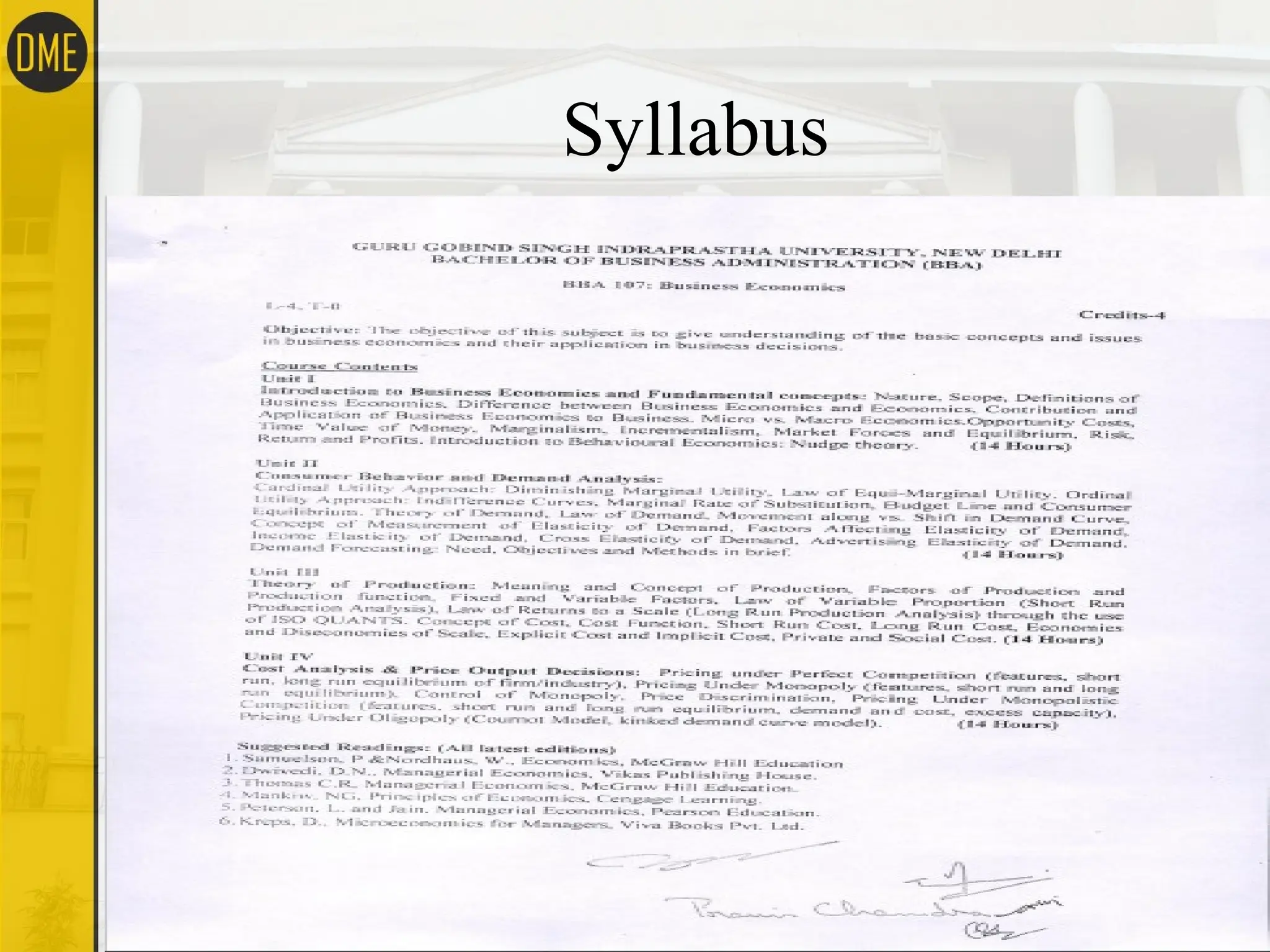
Syllabus
Unit-III : (Theory of Production)
5
3.1 MEANING AND CONCEPT OF PRODUCTION
3.2FACTORS OF PRODUCTION AND PRODUCTION FUNCTION
3.3 FIXED AND VARIABLE FACTORS
3.4LAW OF VARIABLE PROPORTION (SHORT RUN PRODUCTION ANALYSIS)-Part 1
3.5 LAW OF VARIABLE PROPORTION (SHORT RUN PRODUCTION ANALYSIS)-Part
2
3.6 LAW OF VARIABLE PROPORTION (SHORT RUN PRODUCTION ANALYSIS)-Part
3
3.7 LAW OF VARIABLE PROPORTION (SHORT RUN PRODUCTION ANALYSIS)-Part
4
3.8 LAW OF RETURNS TO A SCALE(LONG RUN PRODUCTION ANALYSIS)
THROUGH THE USE OF ISOQUANTS- Part 2
3.9 LAW OF RETURNS TO A SCALE(LONG RUN PRODUCTION ANALYSIS)
THROUGH THE USE OF ISOQUANTS-Part 3
3.10 LAW OF RETURNS TO A SCALE(LONG RUN PRODUCTION ANALYSIS)
THROUGH THE USE OF ISOQUANTS- Part 4
3.11 LAW OF RETURNS TO A SCALE(LONG RUN PRODUCTION ANALYSIS)
THROUGH THE USE OF ISOQUANTS- Part 5
3.4
• Assumptions
• Law of Variable
Proportion
• Causes
6
By: Shuchi Goel 7
3.4 LAW OF VARIABLE
PROPORTION
(SHORT RUN
PRODUCTION
ANALYSIS)-Part 1
By: Shuchi Goel 8
Suggested Readings
1. Author: Christopher R. Thomas & S. Charles Maurice
Title of the Book: Managerial Economics-Foundations of
Business Analysis and Strategy
Chapter’s Name: Production and Cost in the Short Run
2. Author: A. Koutsoyiannis
Title of the Book: Modern Microeconomics
Chapter’s Name: Theory of Production
https://www.toppr.com/guides/fundamentals-of-economics-and-management/theory-
of-production/law-of-variable-proportions
/
By: Shuchi Goel 9
3.4 LAW OF VARIABLE PROPORTION (SHORT RUN
PRODUCTION ANALYSIS)-Part 1
• The laws of production describe the technically possible ways of increasing the
level of production. Output may increase in various ways.
• Output can be increased by changing all factors of production. This is possible
only in the long run. Thus, returns to scale refers to the long-run analysis of
production.
By: Shuchi Goel 10
• In the short run, output may be increased by using more of the variable factor
while capital (or other factors) are kept constant.
• The marginal product of the variable factor will decline eventually as more and
more quantities of this factor are combined with other constant factors.
• The expansion of output with one factor (at least) constant is described by
the law of diminishing returns of the variable factor, which is often referred
to as the law of variable proportions or returns to factor.
By: Shuchi Goel 11
• The law of variable proportions states that as we use more and more units of
some factor of production to work with one or more fixed factors, the
marginal product of that factor will eventually decline.
• When the quantity of one input is varied, keeping other inputs constant, the
proportion between factors changes. This is why the law is named ‘Law of
Variable proportions’.
By: Shuchi Goel 12
Assumptions:
Law of Variable proportions is based upon the following assumptions:
1. The state of technology is given and constant.
2. Quantity of at least one factor input is constant and one factor input is variable.
It is only in this way that the firm can alter the factor proportions and know its
effect on output.
3. All the units of variable factor are homogenous, i.e, equal in efficiency.
4. Input prices remain unchanged.
5. Output is measured in physical units.
By: Shuchi Goel 13
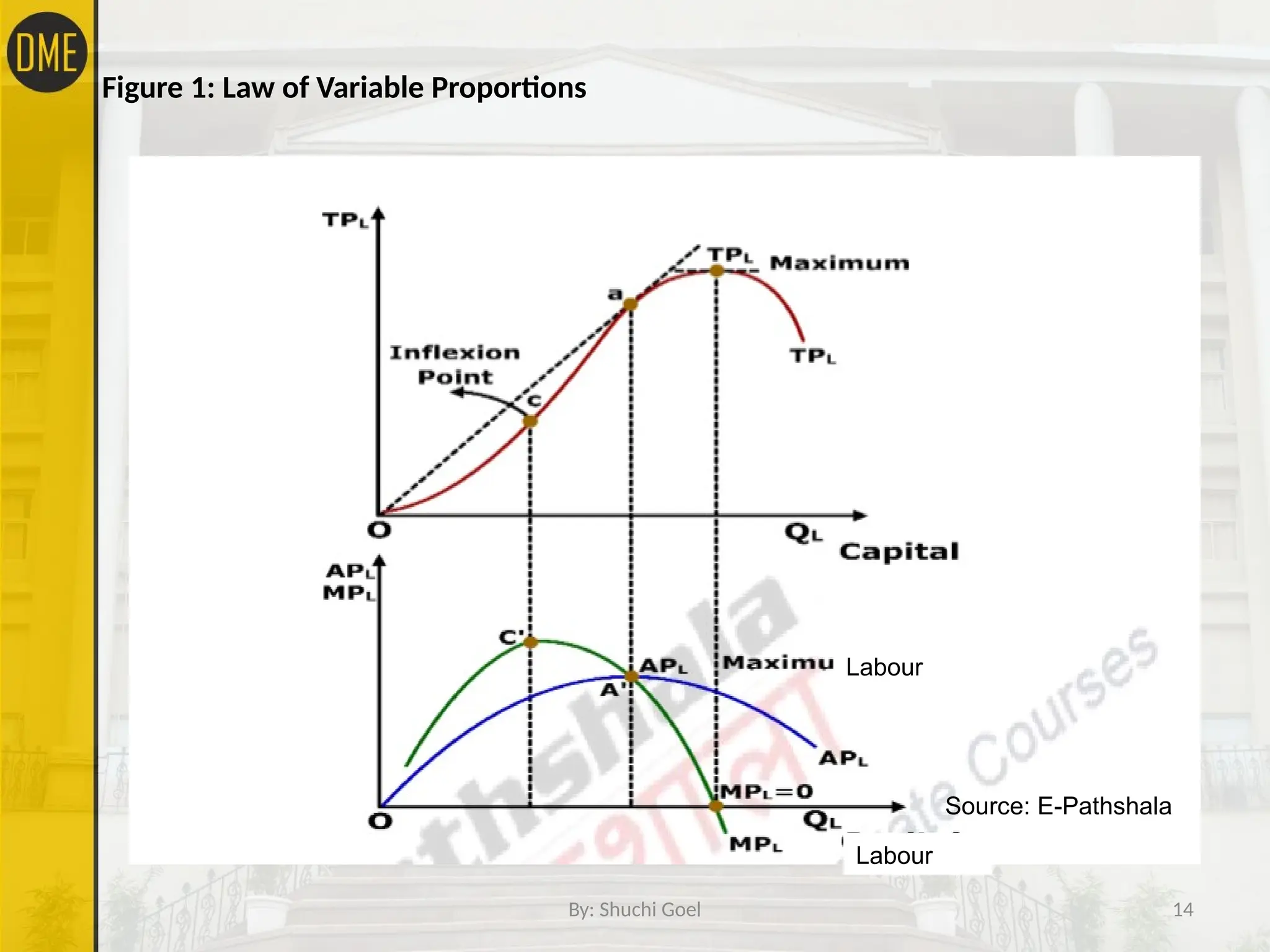
Three Stages of Law of Variable Proportions
• In the short run, output may be varied by varying the quantity of the variable
factor(s) while keeping the quantity of other factors constant.
• The behaviour of output in such situation falls into three distinct stages, as
illustrated in figure 1
By: Shuchi Goel 14
Figure 1: Law of Variable Proportions
Source: E-Pathshala
Labour
Labour
By: Shuchi Goel 15
Conclusion
• The law of variable proportions states that as we use more and more units of some
factor of production to work with one or more fixed factors, the marginal product
of that factor will eventually decline

3.4.pptx-LAW OF VARIABLE PROPORTION (SHORT RUN PRODUCTION ANALYSIS)

  • 1.
    BUSINESS ECONOMICS 107 UNIT- 3 FacultyName: Dr. Shuchi Singhal Designation: Associate Professor School/Dept: Management Email address of Faculty Member: s.singhal@dme.ac.in
  • 2.
    Programme Outcomes 2 PO1: Applyknowledge of various functional areas of business PO2: Develop communication and professional presentation skills PO3: Demonstrate critical thinking and Analytical skills for business decision making PO4: Illustrate leadership abilities to make effective and productive teams PO5: Explore the implications and understanding of the process of starting a new venture PO6: Imbibe responsible citizenship towards a sustainable society and ecological environment PO7: Appreciate inclusivity towards diverse cultures and imbibe universal values PO8: Foster Creative thinking to find innovative solutions for various business situations
  • 3.
    Course Objective andCourse Outcomes 3 CO1:Understand the fundamental concepts of Business Economics. CO2:Analyze the relationship between consumer behaviour and demand. CO3:Explore the theory of production through the use of ISO-QUANTS. CO4:Understand the concept and relevance of short- term and long-term cost. CO5:Examine pricing decisions under various market conditions. CO6:Analyse economic challenges posed to
  • 4.
  • 5.
    Unit-III : (Theoryof Production) 5 3.1 MEANING AND CONCEPT OF PRODUCTION 3.2FACTORS OF PRODUCTION AND PRODUCTION FUNCTION 3.3 FIXED AND VARIABLE FACTORS 3.4LAW OF VARIABLE PROPORTION (SHORT RUN PRODUCTION ANALYSIS)-Part 1 3.5 LAW OF VARIABLE PROPORTION (SHORT RUN PRODUCTION ANALYSIS)-Part 2 3.6 LAW OF VARIABLE PROPORTION (SHORT RUN PRODUCTION ANALYSIS)-Part 3 3.7 LAW OF VARIABLE PROPORTION (SHORT RUN PRODUCTION ANALYSIS)-Part 4 3.8 LAW OF RETURNS TO A SCALE(LONG RUN PRODUCTION ANALYSIS) THROUGH THE USE OF ISOQUANTS- Part 2 3.9 LAW OF RETURNS TO A SCALE(LONG RUN PRODUCTION ANALYSIS) THROUGH THE USE OF ISOQUANTS-Part 3 3.10 LAW OF RETURNS TO A SCALE(LONG RUN PRODUCTION ANALYSIS) THROUGH THE USE OF ISOQUANTS- Part 4 3.11 LAW OF RETURNS TO A SCALE(LONG RUN PRODUCTION ANALYSIS) THROUGH THE USE OF ISOQUANTS- Part 5
  • 6.
    3.4 • Assumptions • Lawof Variable Proportion • Causes 6
  • 7.
    By: Shuchi Goel7 3.4 LAW OF VARIABLE PROPORTION (SHORT RUN PRODUCTION ANALYSIS)-Part 1
  • 8.
    By: Shuchi Goel8 Suggested Readings 1. Author: Christopher R. Thomas & S. Charles Maurice Title of the Book: Managerial Economics-Foundations of Business Analysis and Strategy Chapter’s Name: Production and Cost in the Short Run 2. Author: A. Koutsoyiannis Title of the Book: Modern Microeconomics Chapter’s Name: Theory of Production https://www.toppr.com/guides/fundamentals-of-economics-and-management/theory- of-production/law-of-variable-proportions /
  • 9.
    By: Shuchi Goel9 3.4 LAW OF VARIABLE PROPORTION (SHORT RUN PRODUCTION ANALYSIS)-Part 1 • The laws of production describe the technically possible ways of increasing the level of production. Output may increase in various ways. • Output can be increased by changing all factors of production. This is possible only in the long run. Thus, returns to scale refers to the long-run analysis of production.
  • 10.
    By: Shuchi Goel10 • In the short run, output may be increased by using more of the variable factor while capital (or other factors) are kept constant. • The marginal product of the variable factor will decline eventually as more and more quantities of this factor are combined with other constant factors. • The expansion of output with one factor (at least) constant is described by the law of diminishing returns of the variable factor, which is often referred to as the law of variable proportions or returns to factor.
  • 11.
    By: Shuchi Goel11 • The law of variable proportions states that as we use more and more units of some factor of production to work with one or more fixed factors, the marginal product of that factor will eventually decline. • When the quantity of one input is varied, keeping other inputs constant, the proportion between factors changes. This is why the law is named ‘Law of Variable proportions’.
  • 12.
    By: Shuchi Goel12 Assumptions: Law of Variable proportions is based upon the following assumptions: 1. The state of technology is given and constant. 2. Quantity of at least one factor input is constant and one factor input is variable. It is only in this way that the firm can alter the factor proportions and know its effect on output. 3. All the units of variable factor are homogenous, i.e, equal in efficiency. 4. Input prices remain unchanged. 5. Output is measured in physical units.
  • 13.
    By: Shuchi Goel13 Three Stages of Law of Variable Proportions • In the short run, output may be varied by varying the quantity of the variable factor(s) while keeping the quantity of other factors constant. • The behaviour of output in such situation falls into three distinct stages, as illustrated in figure 1
  • 14.
    By: Shuchi Goel14 Figure 1: Law of Variable Proportions Source: E-Pathshala Labour Labour
  • 15.
    By: Shuchi Goel15 Conclusion • The law of variable proportions states that as we use more and more units of some factor of production to work with one or more fixed factors, the marginal product of that factor will eventually decline