Collection, packaging and
Blood typing
Dr.Priyanka Verma
.
• SUBJECT- Advanced Biology And Serology.
• Subject code- FSS 755
• Faculty Name- Dr. Priyanka Verma
• Topic- Collection, packaging and Blood
typing
• Video lecture No.- 2
2/8/2023 2
Objectives
• To collect, preserve, and analyze
scientific evidence during the course of an
investigation.
• How does the blood sample as an evidence be
stored and examined.
• Differentiate secretors and non-secretors.
Learning outcomes
• They can understand the evidentiary value of
each evidence.
• After studying this module students shall be
able to know the typing methods of blood
group.
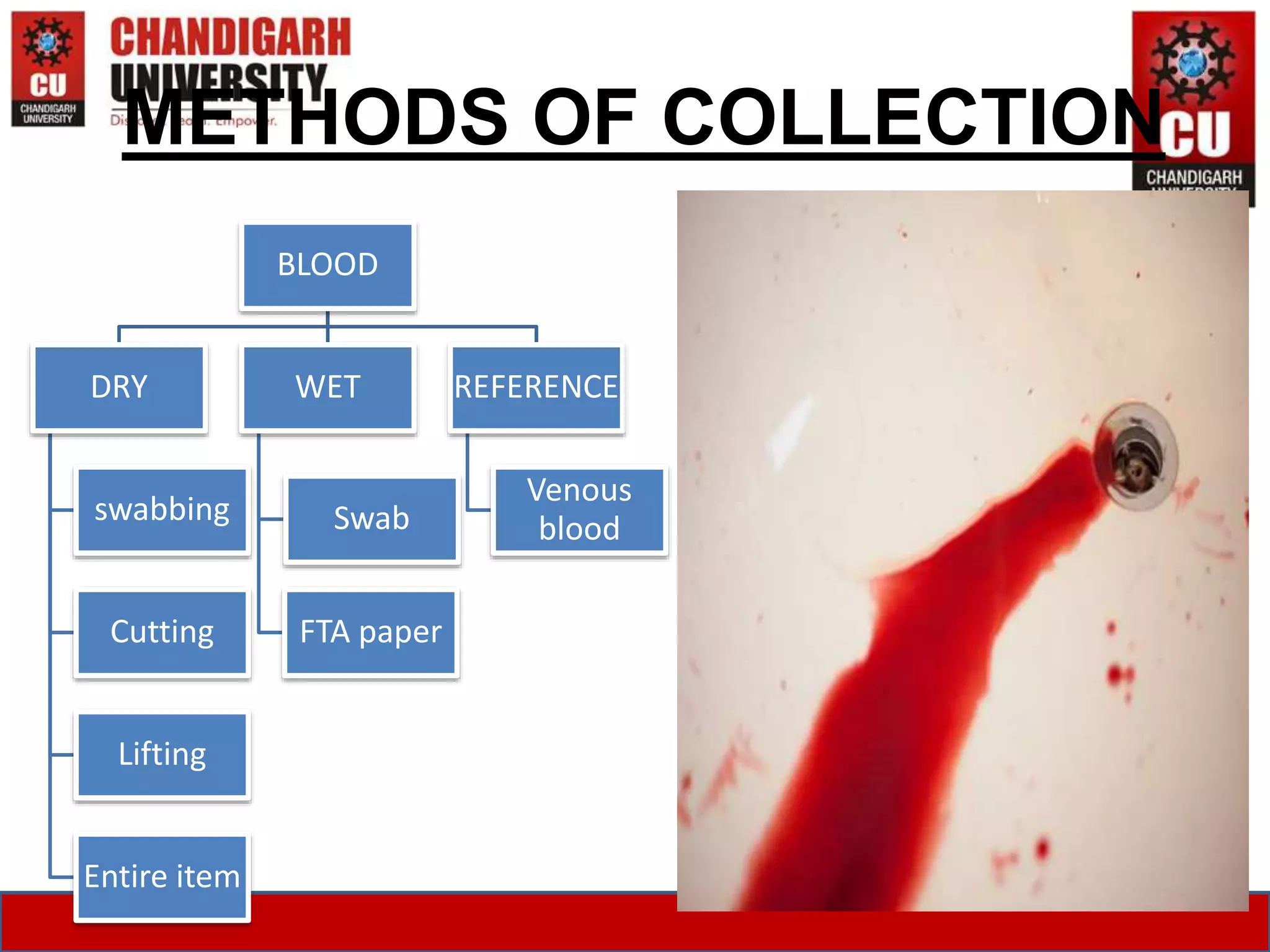
METHODS OF COLLECTION
BLOOD
DRY
swabbing
Cutting
Lifting
Entire item
WET
Swab
FTA paper
REFERENCE
Venous
blood
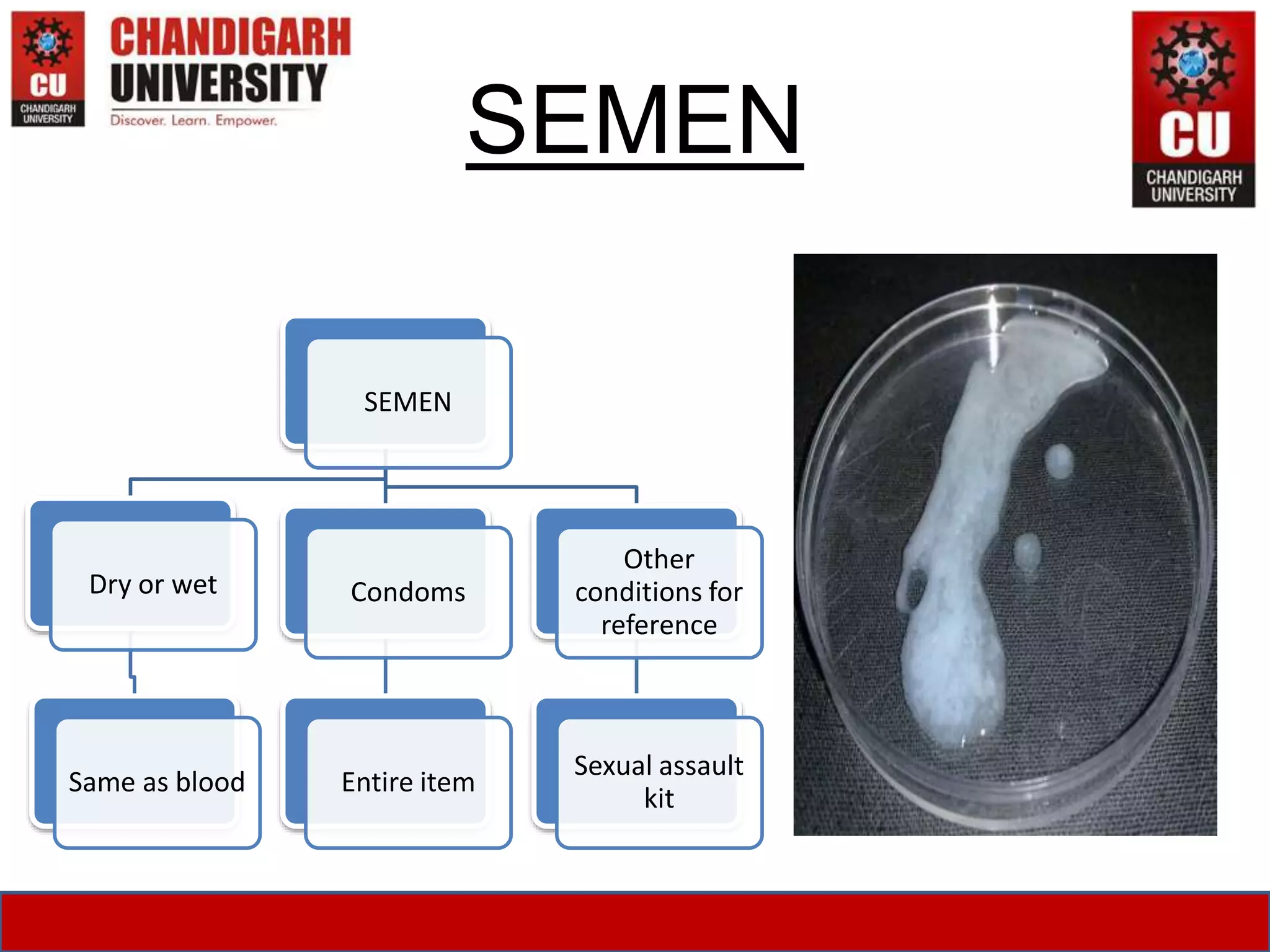
SEMEN
SEMEN
Dry or wet
Same as blood
Condoms
Entire item
Other
conditions for
reference
Sexual assault
kit
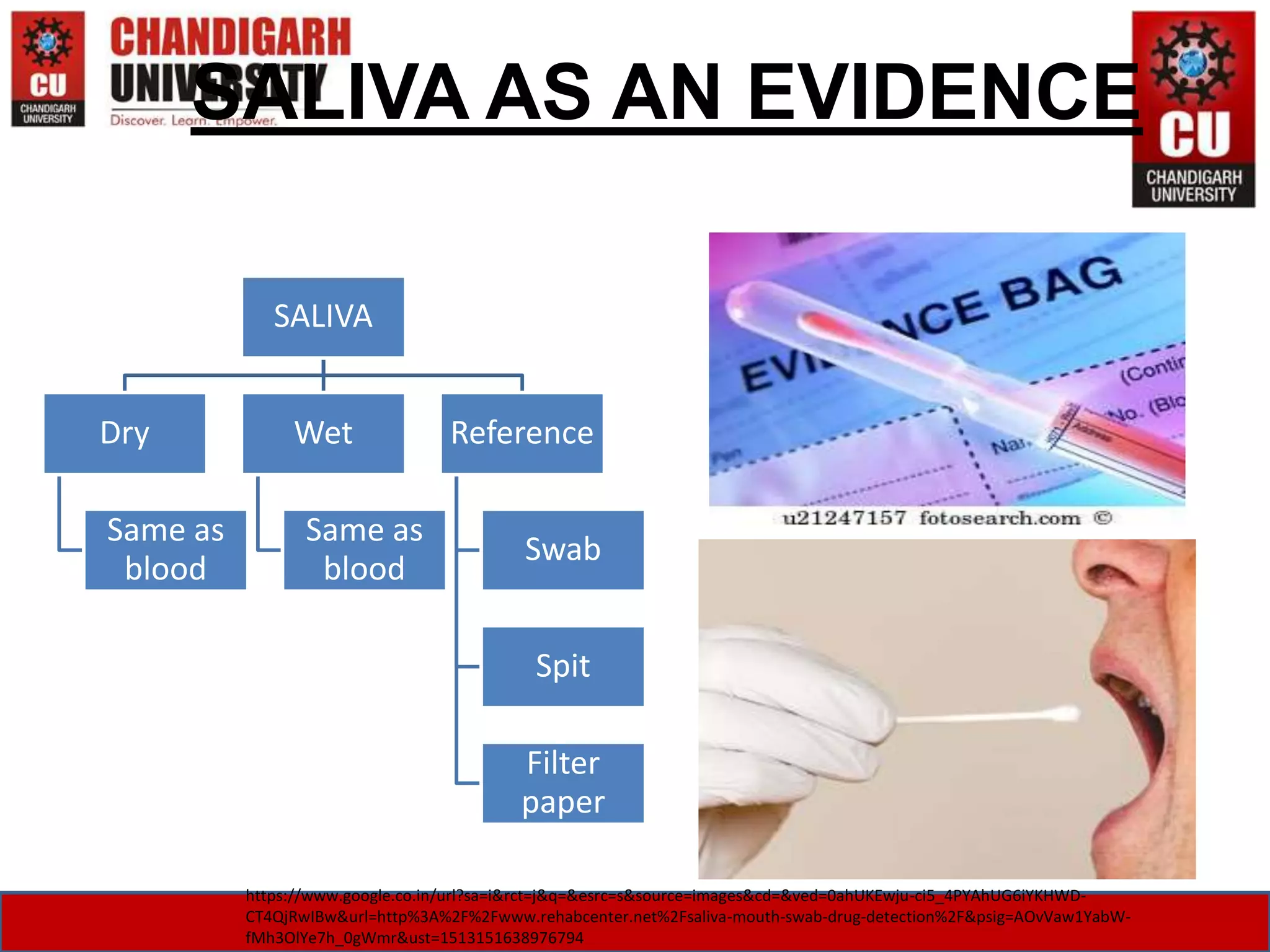
SALIVA AS AN EVIDENCE
SALIVA
Dry
Same as
blood
Wet
Same as
blood
Reference
Swab
Spit
Filter
paper
https://www.google.co.in/url?sa=i&rct=j&q=&esrc=s&source=images&cd=&ved=0ahUKEwju-ci5_4PYAhUG6iYKHWD-
CT4QjRwIBw&url=http%3A%2F%2Fwww.rehabcenter.net%2Fsaliva-mouth-swab-drug-detection%2F&psig=AOvVaw1YabW-
fMh3OlYe7h_0gWmr&ust=1513151638976794
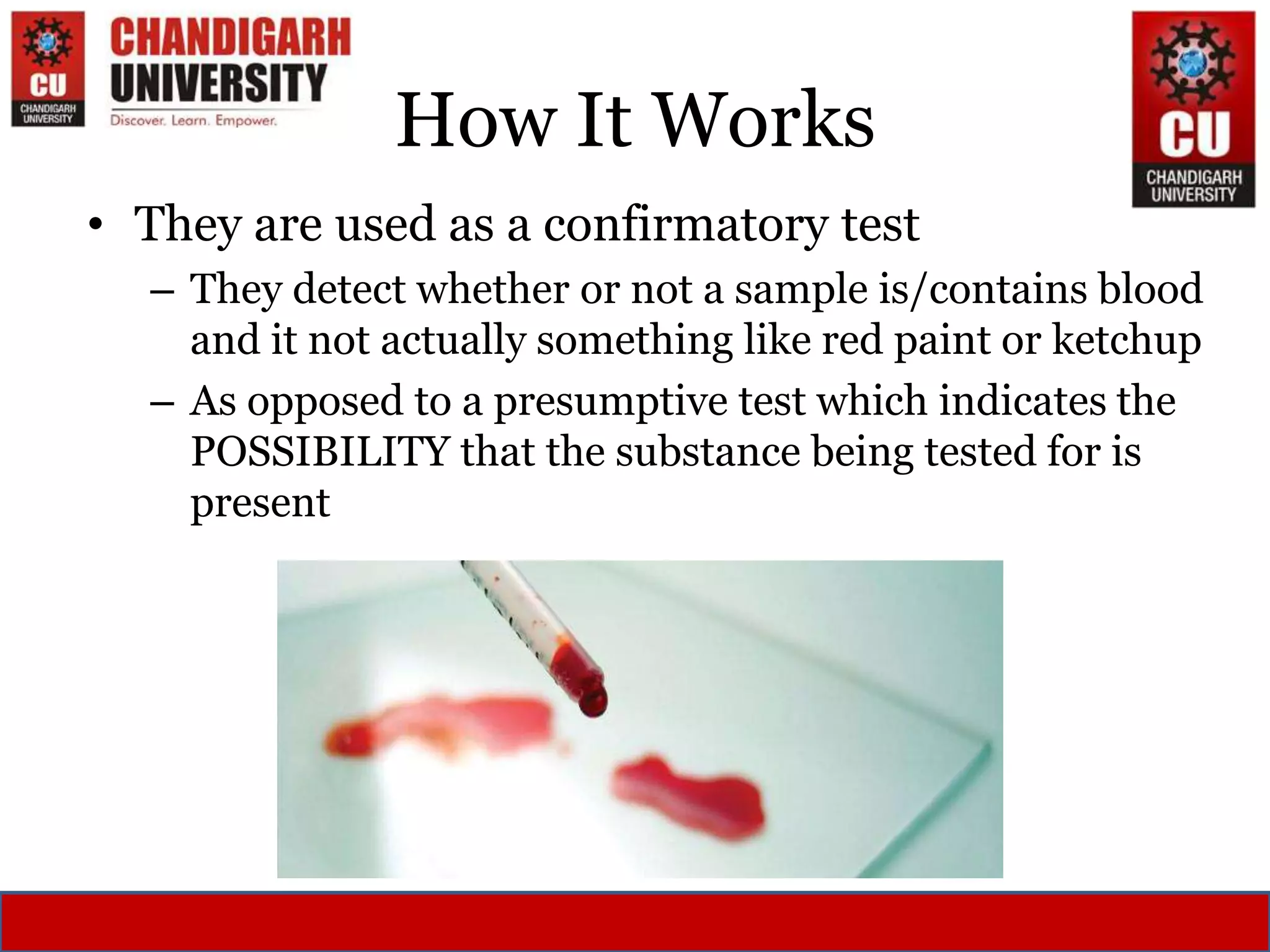
How It Works
• They are used as a confirmatory test
– They detect whether or not a sample is/contains blood
and it not actually something like red paint or ketchup
– As opposed to a presumptive test which indicates the
POSSIBILITY that the substance being tested for is
present
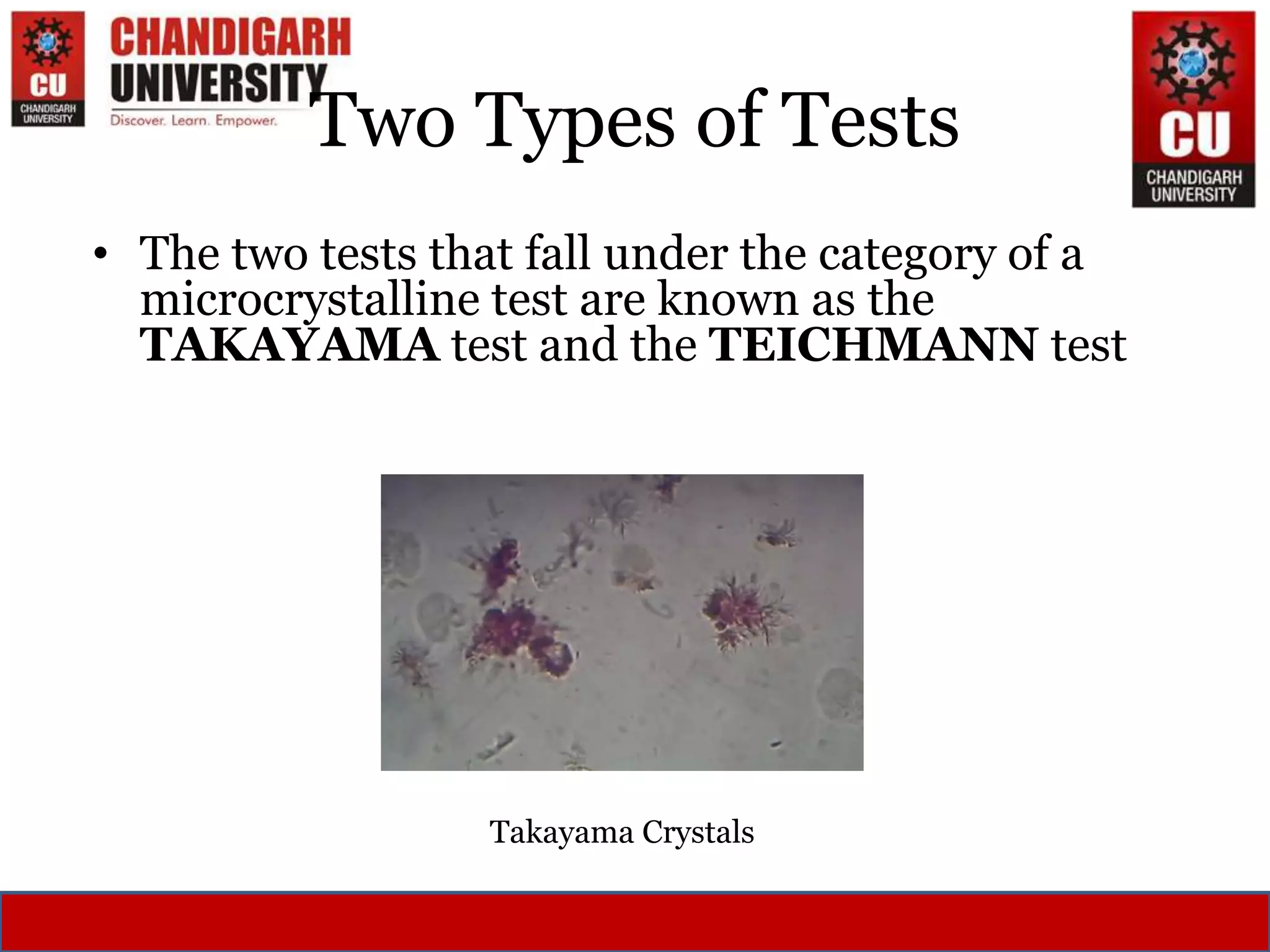
Two Types of Tests
• The two tests that fall under the category of a
microcrystalline test are known as the
TAKAYAMA test and the TEICHMANN test
Takayama Crystals
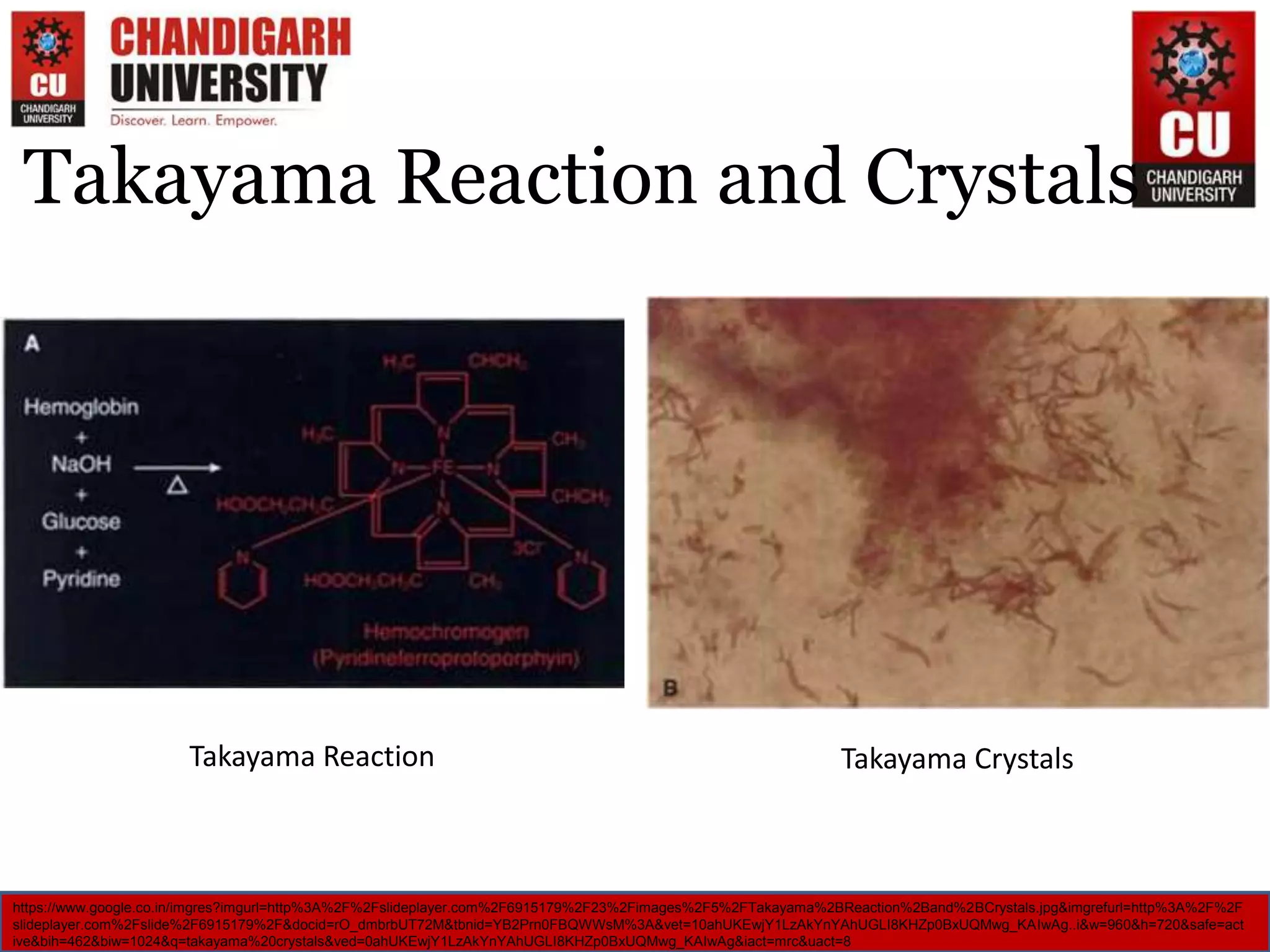
Takayama Reaction and Crystals
Takayama Reaction Takayama Crystals
https://www.google.co.in/imgres?imgurl=http%3A%2F%2Fslideplayer.com%2F6915179%2F23%2Fimages%2F5%2FTakayama%2BReaction%2Band%2BCrystals.jpg&imgrefurl=http%3A%2F%2F
slideplayer.com%2Fslide%2F6915179%2F&docid=rO_dmbrbUT72M&tbnid=YB2Prn0FBQWWsM%3A&vet=10ahUKEwjY1LzAkYnYAhUGLI8KHZp0BxUQMwg_KAIwAg..i&w=960&h=720&safe=act
ive&bih=462&biw=1024&q=takayama%20crystals&ved=0ahUKEwjY1LzAkYnYAhUGLI8KHZp0BxUQMwg_KAIwAg&iact=mrc&uact=8
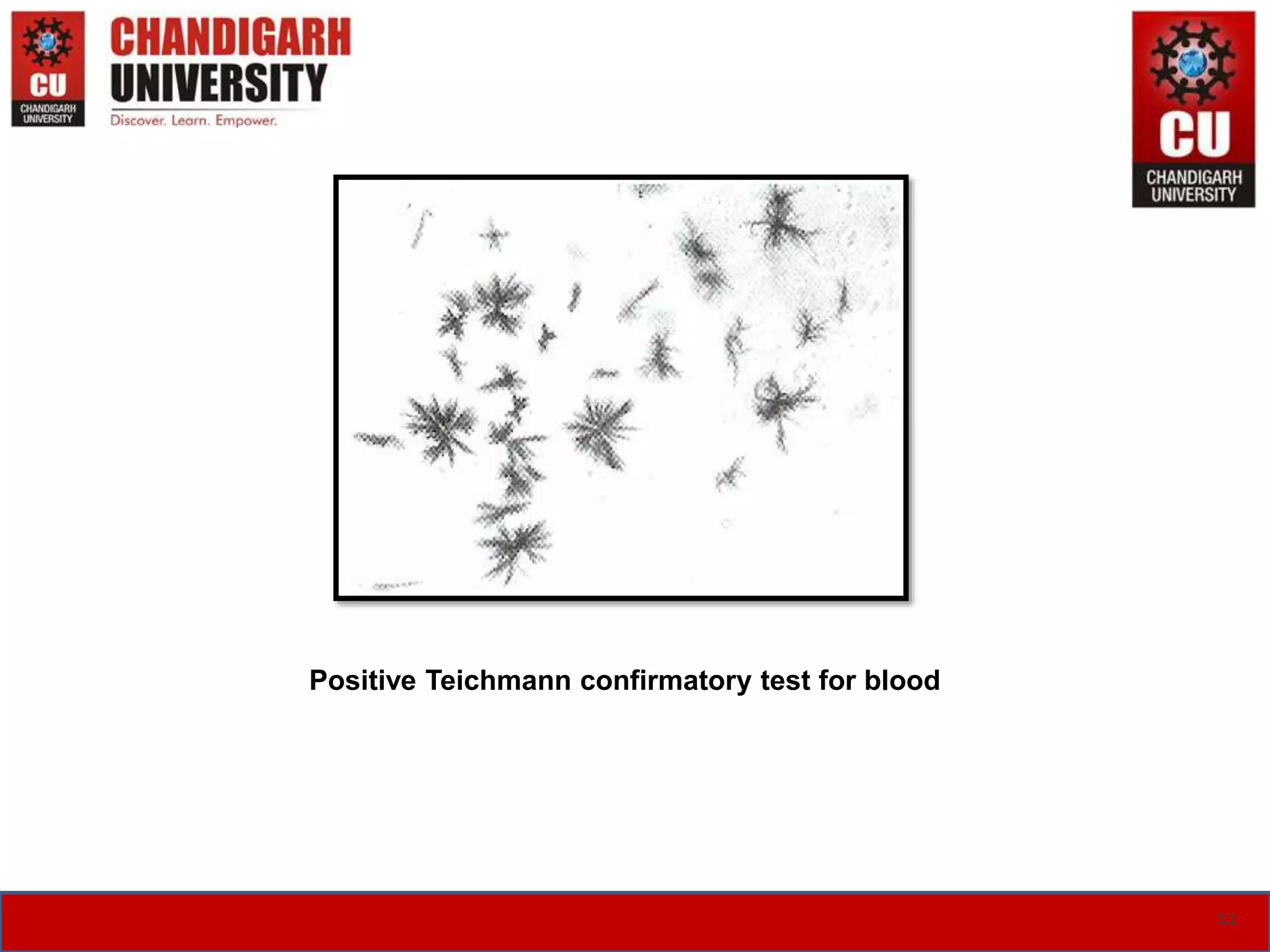
Teichmann Test
• This test determines if there is blood present
on suspected dried blood stains.
• The hematin crystals begin to form when
heated blood is mixed with glacial acetic acid
where there is salt.
• The positive result is caused by the
combination of a halogen with
ferriprotoporphyrin (red-brown to blue-black
crystalline salt containing iron).
• This test produces pink crystals that can
reach up to 10 micrometers in size.
12
Positive Teichmann confirmatory test for blood
ABO Typing
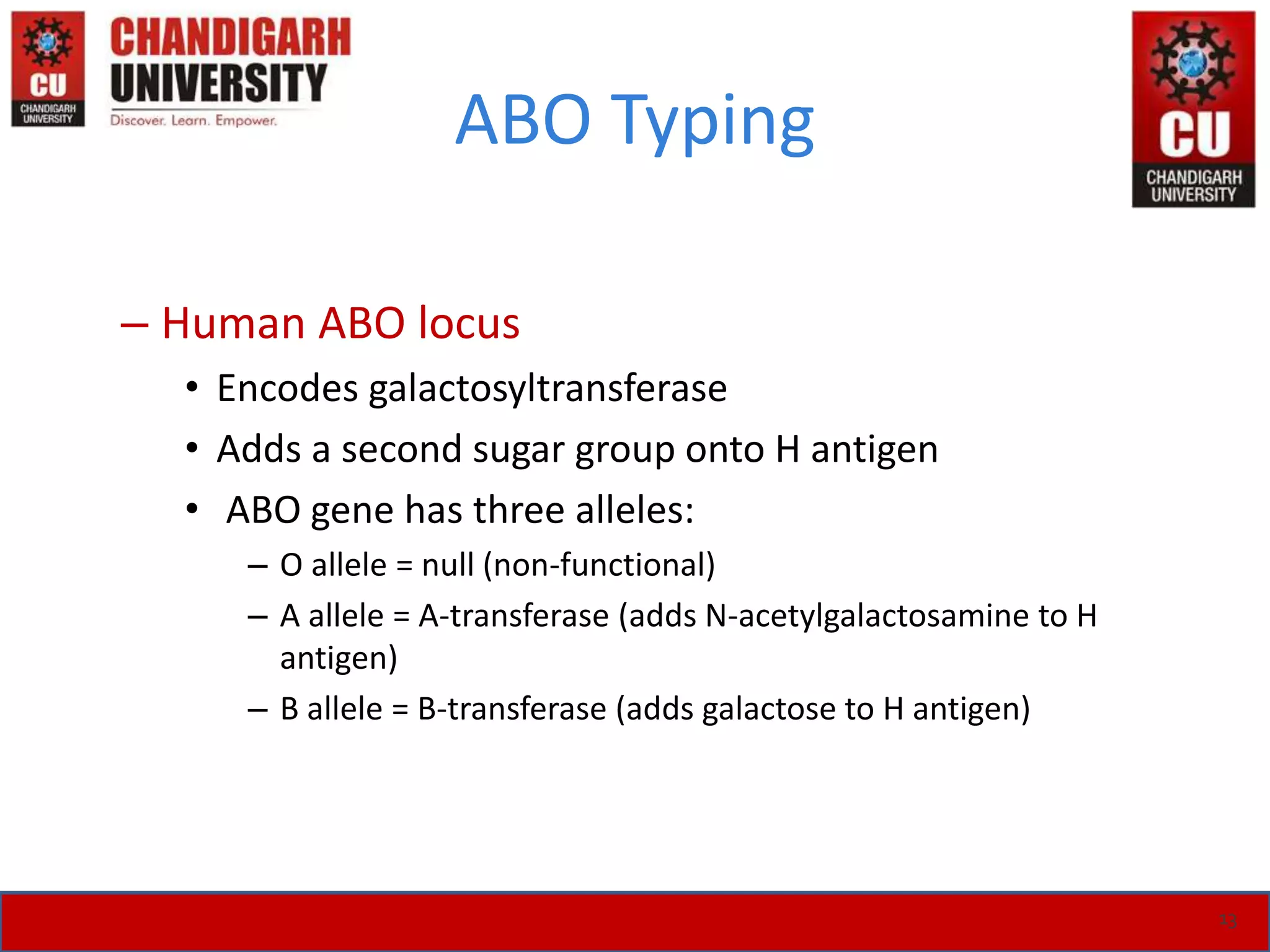
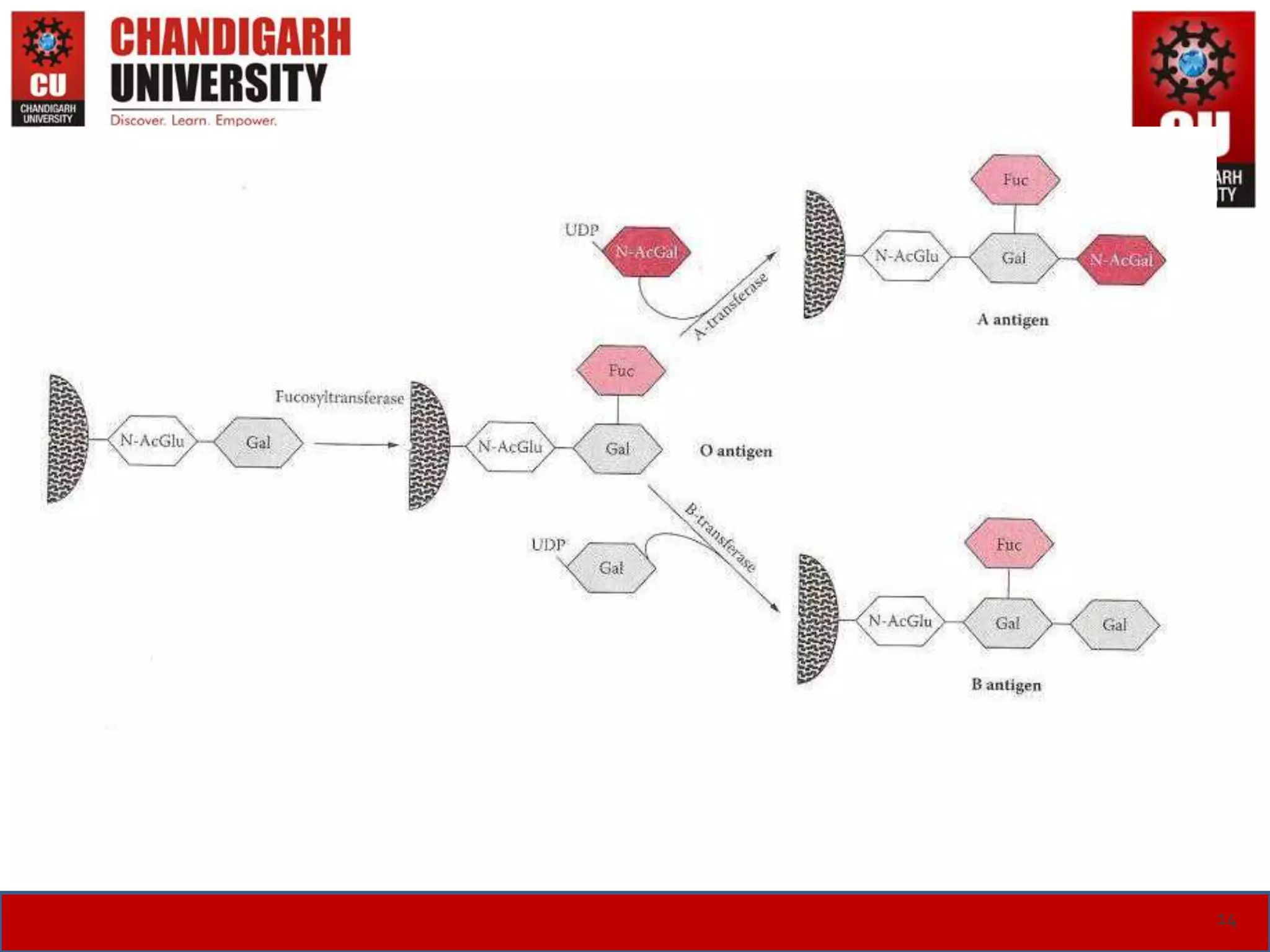
– Human ABO locus
• Encodes galactosyltransferase
• Adds a second sugar group onto H antigen
• ABO gene has three alleles:
– O allele = null (non-functional)
– A allele = A-transferase (adds N-acetylgalactosamine to H
antigen)
– B allele = B-transferase (adds galactose to H antigen)
13
14
ABO Typing
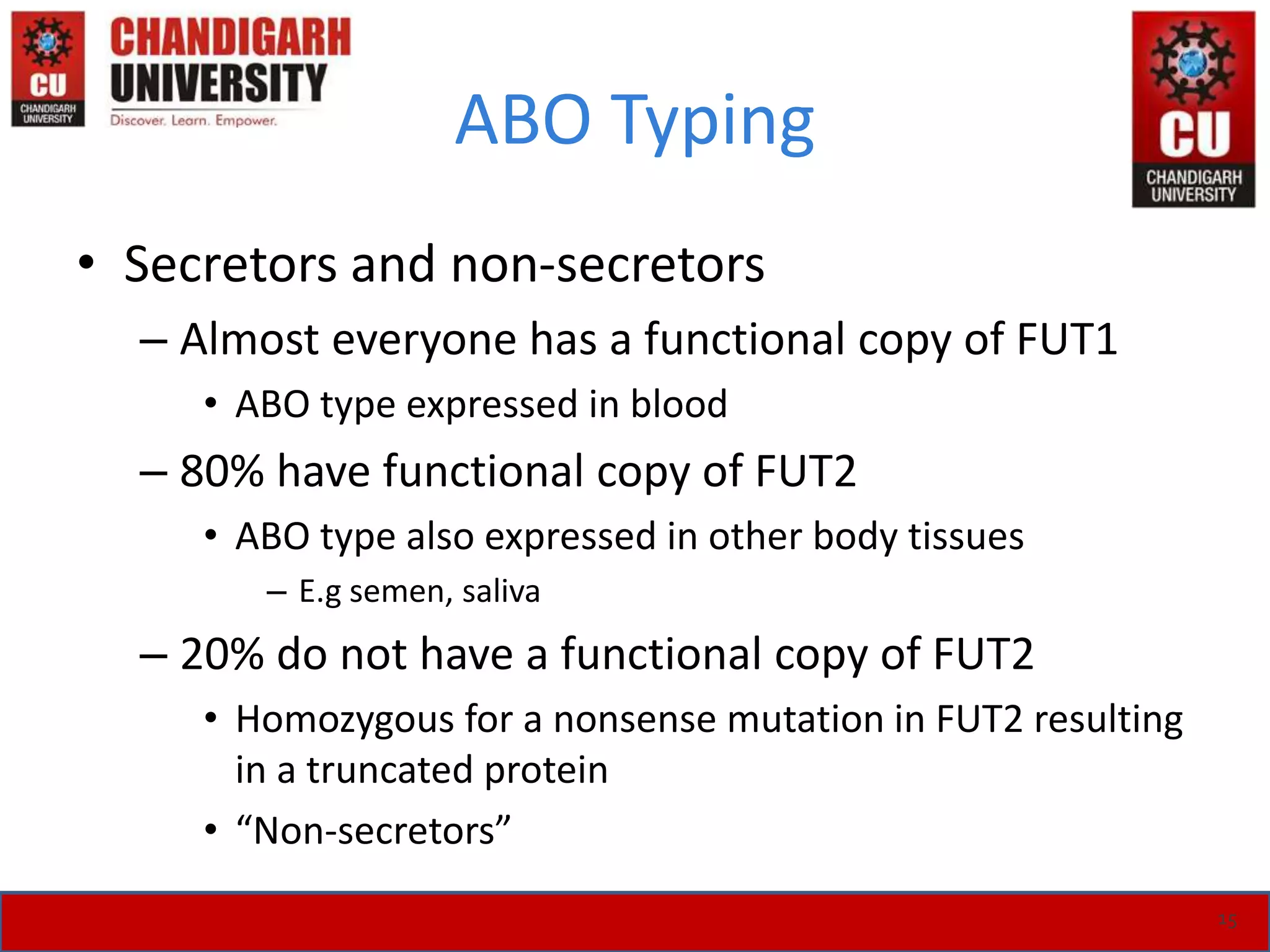
• Secretors and non-secretors
– Almost everyone has a functional copy of FUT1
• ABO type expressed in blood
– 80% have functional copy of FUT2
• ABO type also expressed in other body tissues
– E.g semen, saliva
– 20% do not have a functional copy of FUT2
• Homozygous for a nonsense mutation in FUT2 resulting
in a truncated protein
• “Non-secretors”
15
ABO Typing
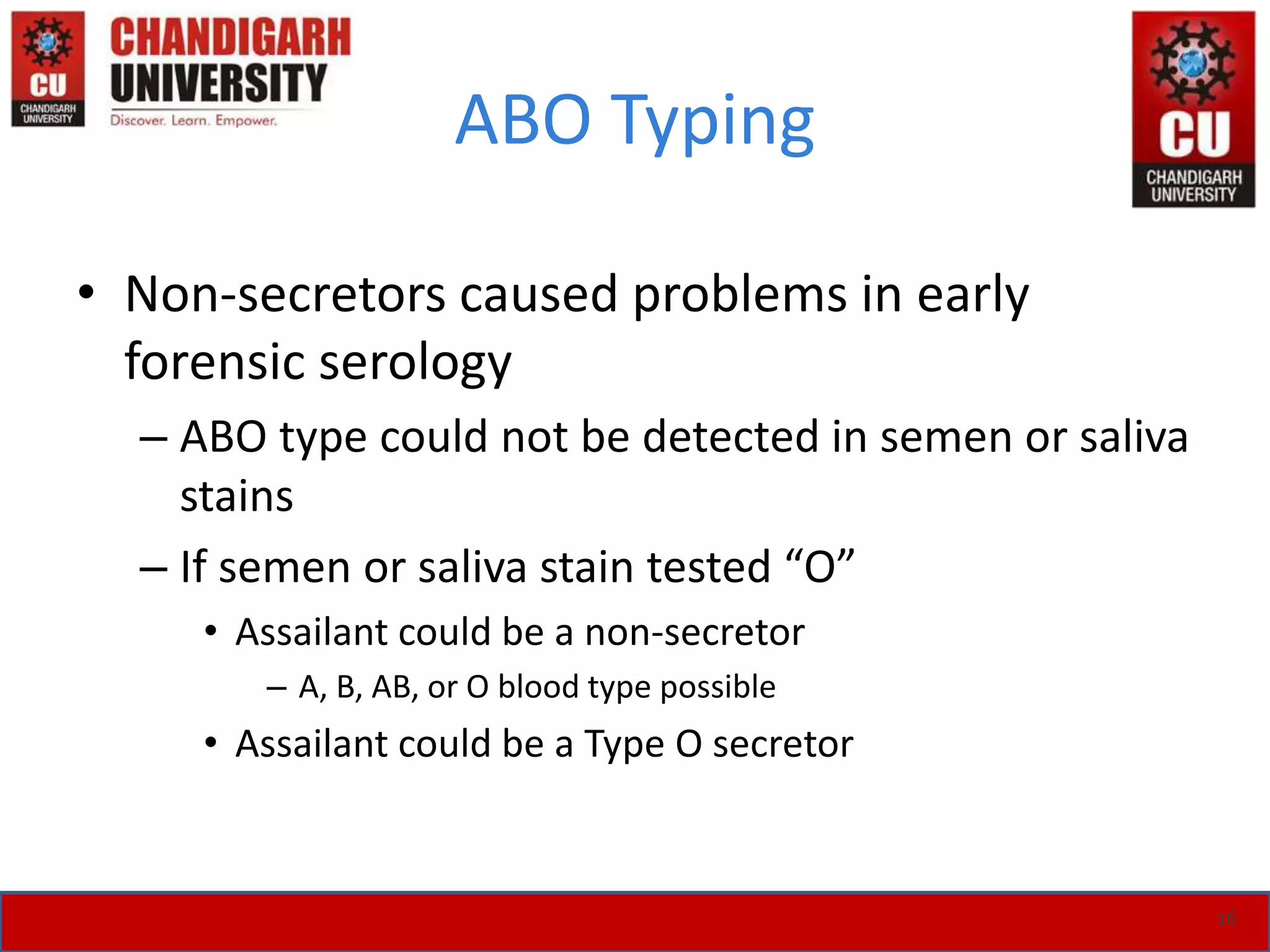
• Non-secretors caused problems in early
forensic serology
– ABO type could not be detected in semen or saliva
stains
– If semen or saliva stain tested “O”
• Assailant could be a non-secretor
– A, B, AB, or O blood type possible
• Assailant could be a Type O secretor
16
FAQ’s
• What can you tell from blood test collected
from crime scene.
• How blood typing can be possible from dried
samples also.
• Solve the Case. The body of a 27 year old was found in a wooded picnic area.
Investigators searched the area and found what appeared to be a red substance near a picnic
bench. Hoping it was going to be helpful in the investigation, they sent a sample to a forensics
lab where they did a Takayama test. Results showed that no crystals appeared in microscopic
analysis, What was ruled out as part of the crime scene.
References
• www.forensicsciencesimplified.org/blood/ho
w.html
• KS Reddy (2007):The essentials
of forensic medicine and toxicology, pg 366
• Richard Li (2008):Forensic Biology edition 2nd
Crc press publication pg 22-24.

2.collection and identification (1) (1).ppt

  • 1.
    Collection, packaging and Bloodtyping Dr.Priyanka Verma
  • 2.
    . • SUBJECT- AdvancedBiology And Serology. • Subject code- FSS 755 • Faculty Name- Dr. Priyanka Verma • Topic- Collection, packaging and Blood typing • Video lecture No.- 2 2/8/2023 2
  • 3.
    Objectives • To collect,preserve, and analyze scientific evidence during the course of an investigation. • How does the blood sample as an evidence be stored and examined. • Differentiate secretors and non-secretors.
  • 4.
    Learning outcomes • Theycan understand the evidentiary value of each evidence. • After studying this module students shall be able to know the typing methods of blood group.
  • 5.
    METHODS OF COLLECTION BLOOD DRY swabbing Cutting Lifting Entireitem WET Swab FTA paper REFERENCE Venous blood
  • 6.
    SEMEN SEMEN Dry or wet Sameas blood Condoms Entire item Other conditions for reference Sexual assault kit
  • 7.
    SALIVA AS ANEVIDENCE SALIVA Dry Same as blood Wet Same as blood Reference Swab Spit Filter paper https://www.google.co.in/url?sa=i&rct=j&q=&esrc=s&source=images&cd=&ved=0ahUKEwju-ci5_4PYAhUG6iYKHWD- CT4QjRwIBw&url=http%3A%2F%2Fwww.rehabcenter.net%2Fsaliva-mouth-swab-drug-detection%2F&psig=AOvVaw1YabW- fMh3OlYe7h_0gWmr&ust=1513151638976794
  • 8.
    How It Works •They are used as a confirmatory test – They detect whether or not a sample is/contains blood and it not actually something like red paint or ketchup – As opposed to a presumptive test which indicates the POSSIBILITY that the substance being tested for is present
  • 9.
    Two Types ofTests • The two tests that fall under the category of a microcrystalline test are known as the TAKAYAMA test and the TEICHMANN test Takayama Crystals
  • 10.
    Takayama Reaction andCrystals Takayama Reaction Takayama Crystals https://www.google.co.in/imgres?imgurl=http%3A%2F%2Fslideplayer.com%2F6915179%2F23%2Fimages%2F5%2FTakayama%2BReaction%2Band%2BCrystals.jpg&imgrefurl=http%3A%2F%2F slideplayer.com%2Fslide%2F6915179%2F&docid=rO_dmbrbUT72M&tbnid=YB2Prn0FBQWWsM%3A&vet=10ahUKEwjY1LzAkYnYAhUGLI8KHZp0BxUQMwg_KAIwAg..i&w=960&h=720&safe=act ive&bih=462&biw=1024&q=takayama%20crystals&ved=0ahUKEwjY1LzAkYnYAhUGLI8KHZp0BxUQMwg_KAIwAg&iact=mrc&uact=8
  • 11.
    Teichmann Test • Thistest determines if there is blood present on suspected dried blood stains. • The hematin crystals begin to form when heated blood is mixed with glacial acetic acid where there is salt. • The positive result is caused by the combination of a halogen with ferriprotoporphyrin (red-brown to blue-black crystalline salt containing iron). • This test produces pink crystals that can reach up to 10 micrometers in size.
  • 12.
  • 13.
    ABO Typing – HumanABO locus • Encodes galactosyltransferase • Adds a second sugar group onto H antigen • ABO gene has three alleles: – O allele = null (non-functional) – A allele = A-transferase (adds N-acetylgalactosamine to H antigen) – B allele = B-transferase (adds galactose to H antigen) 13
  • 14.
  • 15.
    ABO Typing • Secretorsand non-secretors – Almost everyone has a functional copy of FUT1 • ABO type expressed in blood – 80% have functional copy of FUT2 • ABO type also expressed in other body tissues – E.g semen, saliva – 20% do not have a functional copy of FUT2 • Homozygous for a nonsense mutation in FUT2 resulting in a truncated protein • “Non-secretors” 15
  • 16.
    ABO Typing • Non-secretorscaused problems in early forensic serology – ABO type could not be detected in semen or saliva stains – If semen or saliva stain tested “O” • Assailant could be a non-secretor – A, B, AB, or O blood type possible • Assailant could be a Type O secretor 16
  • 17.
    FAQ’s • What canyou tell from blood test collected from crime scene. • How blood typing can be possible from dried samples also. • Solve the Case. The body of a 27 year old was found in a wooded picnic area. Investigators searched the area and found what appeared to be a red substance near a picnic bench. Hoping it was going to be helpful in the investigation, they sent a sample to a forensics lab where they did a Takayama test. Results showed that no crystals appeared in microscopic analysis, What was ruled out as part of the crime scene.
  • 18.
    References • www.forensicsciencesimplified.org/blood/ho w.html • KSReddy (2007):The essentials of forensic medicine and toxicology, pg 366 • Richard Li (2008):Forensic Biology edition 2nd Crc press publication pg 22-24.