Writing for News - Rules
    and Techniques
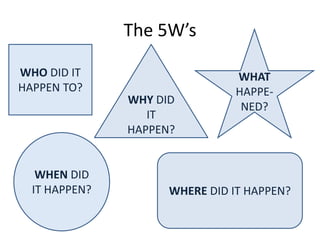
The 5W’s

WHO DID IT                     WHAT
HAPPEN TO?                     HAPPE-
               WHY DID
                                NED?
                  IT
               HAPPEN?


   WHEN DID
  IT HAPPEN?         WHERE DID IT HAPPEN?
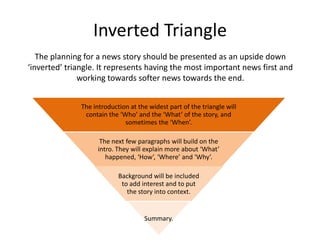
Inverted Triangle
   The planning for a news story should be presented as an upside down
‘inverted’ triangle. It represents having the most important news first and
               working towards softer news towards the end.


               The introduction at the widest part of the triangle will
                contain the ‘Who’ and the ‘What’ of the story, and
                              sometimes the ‘When’.

                      The next few paragraphs will build on the
                     intro. They will explain more about ‘What’
                        happened, ‘How’, ‘Where’ and ‘Why’.

                            Background will be included
                             to add interest and to put
                               the story into context.


                                     Summary.
The 3 C’s
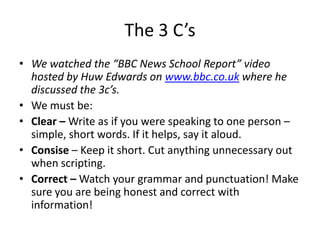
• We watched the “BBC News School Report” video
  hosted by Huw Edwards on www.bbc.co.uk where he
  discussed the 3c’s.
• We must be:
• Clear – Write as if you were speaking to one person –
  simple, short words. If it helps, say it aloud.
• Consise – Keep it short. Cut anything unnecessary out
  when scripting.
• Correct – Watch your grammar and punctuation! Make
  sure you are being honest and correct with
  information!
‘3 Words per Second’ Table
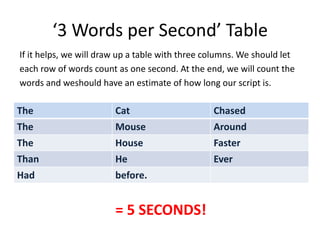
If it helps, we will draw up a table with three columns. We should let
each row of words count as one second. At the end, we will count the
words and weshould have an estimate of how long our script is.

The                     Cat                      Chased
The                     Mouse                    Around
The                     House                    Faster
Than                    He                       Ever
Had                     before.


                        = 5 SECONDS!
Tips, tips, tips!!
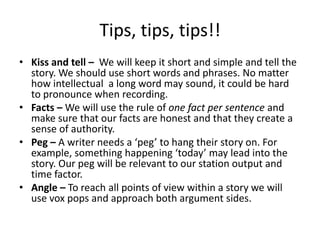
• Kiss and tell – We will keep it short and simple and tell the
  story. We should use short words and phrases. No matter
  how intellectual a long word may sound, it could be hard
  to pronounce when recording.
• Facts – We will use the rule of one fact per sentence and
  make sure that our facts are honest and that they create a
  sense of authority.
• Peg – A writer needs a ‘peg’ to hang their story on. For
  example, something happening ‘today’ may lead into the
  story. Our peg will be relevant to our station output and
  time factor.
• Angle – To reach all points of view within a story we will
  use vox pops and approach both argument sides.

2c

  • 1.
    Writing for News- Rules and Techniques
  • 2.
    The 5W’s WHO DIDIT WHAT HAPPEN TO? HAPPE- WHY DID NED? IT HAPPEN? WHEN DID IT HAPPEN? WHERE DID IT HAPPEN?
  • 3.
    Inverted Triangle The planning for a news story should be presented as an upside down ‘inverted’ triangle. It represents having the most important news first and working towards softer news towards the end. The introduction at the widest part of the triangle will contain the ‘Who’ and the ‘What’ of the story, and sometimes the ‘When’. The next few paragraphs will build on the intro. They will explain more about ‘What’ happened, ‘How’, ‘Where’ and ‘Why’. Background will be included to add interest and to put the story into context. Summary.
  • 4.
    The 3 C’s •We watched the “BBC News School Report” video hosted by Huw Edwards on www.bbc.co.uk where he discussed the 3c’s. • We must be: • Clear – Write as if you were speaking to one person – simple, short words. If it helps, say it aloud. • Consise – Keep it short. Cut anything unnecessary out when scripting. • Correct – Watch your grammar and punctuation! Make sure you are being honest and correct with information!
  • 5.
    ‘3 Words perSecond’ Table If it helps, we will draw up a table with three columns. We should let each row of words count as one second. At the end, we will count the words and weshould have an estimate of how long our script is. The Cat Chased The Mouse Around The House Faster Than He Ever Had before. = 5 SECONDS!
  • 6.
    Tips, tips, tips!! •Kiss and tell – We will keep it short and simple and tell the story. We should use short words and phrases. No matter how intellectual a long word may sound, it could be hard to pronounce when recording. • Facts – We will use the rule of one fact per sentence and make sure that our facts are honest and that they create a sense of authority. • Peg – A writer needs a ‘peg’ to hang their story on. For example, something happening ‘today’ may lead into the story. Our peg will be relevant to our station output and time factor. • Angle – To reach all points of view within a story we will use vox pops and approach both argument sides.