BLOOD
PHYSIOLOGY
INTRODUCTION
 The branch of physiology dealing with blood is
called haematology.
 Haemato –Blood and Logy - Study
 "Blood is a fluid connective tissue of the body".
 Blood connects different parts of the body.
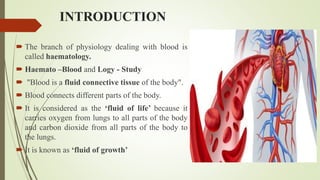
 It is considered as the ‘fluid of life’ because it
carries oxygen from lungs to all parts of the body
and carbon dioxide from all parts of the body to
the lungs.
 It is known as ‘fluid of growth’
PROPERTIES
 Volume of blood :
Male - 5-6 litres
Female – 4-5 litres
New born baby – 450 ml
 Color of blood : Arterial blood - is scarlet red because it contains more oxygen
Venous blood - is purple red because of more carbon dioxide.
 pH of blood : Slightly alkaline, with a pH of ~ 7.4
 Specific gravity : 1.052 to 1.061
 Viscosity means thickness of any fluid compared to water.
Viscosity of blood is 5 times greater than water.
Blood is thicker than water
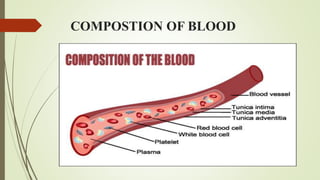
COMPOSTION OF BLOOD
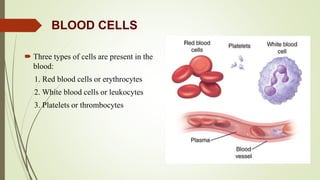
BLOOD CELLS
 Three types of cells are present in the
blood:
1. Red blood cells or erythrocytes
2. White blood cells or leukocytes
3. Platelets or thrombocytes
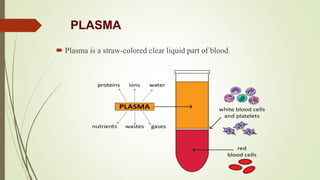
PLASMA
 Plasma is a straw-colored clear liquid part of blood.
FUNCTION OF BLOOD
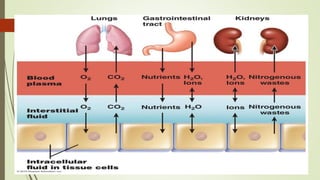
1. NUTRITIVE FUNCTION
 Nutritive substances like glucose, amino acids, lipids and vitamins
derived from digested food are absorbed from gastrointestinal tract
and carried by blood to different parts of the body for growth and
production of energy.
2. RESPIRATORY FUNCTION
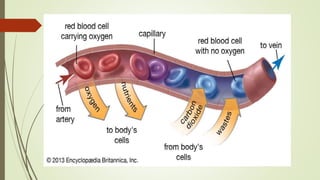
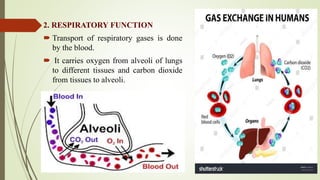
 Transport of respiratory gases is done
by the blood.
 It carries oxygen from alveoli of lungs
to different tissues and carbon dioxide
from tissues to alveoli.
3. EXCRETORY FUNCTION
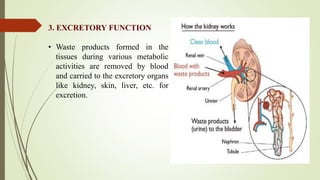
• Waste products formed in the
tissues during various metabolic
activities are removed by blood
and carried to the excretory organs
like kidney, skin, liver, etc. for
excretion.
5. REGULATION OF WATER BALANCE
Water content of the blood is freely interchangeable with interstitial
fluid. This helps in the regulation of water content of the body.
6. REGULATION OF ACID-BASE BALANCE
Plasma proteins and hemoglobin act as buffers and help in the
regulation of acid-base balance
7. REGULATION OF BODY TEMPERATURE
Because of the high specific heat of blood, it is responsible for
maintaining the thermoregulatory mechanism in the body, i.e. the
balance between heat loss and heat gain in the body.
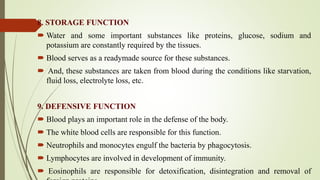
8. STORAGE FUNCTION
 Water and some important substances like proteins, glucose, sodium and
potassium are constantly required by the tissues.
 Blood serves as a readymade source for these substances.
 And, these substances are taken from blood during the conditions like starvation,
fluid loss, electrolyte loss, etc.
9. DEFENSIVE FUNCTION
 Blood plays an important role in the defense of the body.
 The white blood cells are responsible for this function.
 Neutrophils and monocytes engulf the bacteria by phagocytosis.
 Lymphocytes are involved in development of immunity.
 Eosinophils are responsible for detoxification, disintegration and removal of
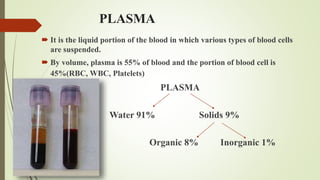
PLASMA
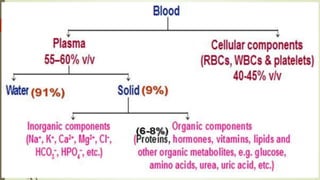
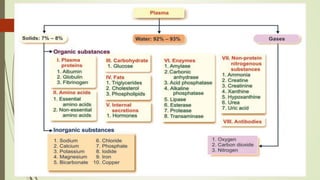
 It is the liquid portion of the blood in which various types of blood cells
are suspended.
 By volume, plasma is 55% of blood and the portion of blood cell is
45%(RBC, WBC, Platelets)
PLASMA
Water 91% Solids 9%
Organic 8% Inorganic 1%
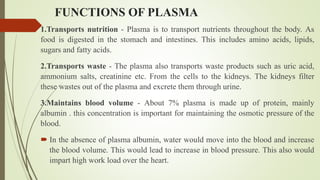
FUNCTIONS OF PLASMA
1.Transports nutrition - Plasma is to transport nutrients throughout the body. As
food is digested in the stomach and intestines. This includes amino acids, lipids,
sugars and fatty acids.
2.Transports waste - The plasma also transports waste products such as uric acid,
ammonium salts, creatinine etc. From the cells to the kidneys. The kidneys filter
these wastes out of the plasma and excrete them through urine.
3.Maintains blood volume - About 7% plasma is made up of protein, mainly
albumin . this concentration is important for maintaining the osmotic pressure of the
blood.
 In the absence of plasma albumin, water would move into the blood and increase
the blood volume. This would lead to increase in blood pressure. This also would
impart high work load over the heart.
4.Balance electrolytes - They include sodium, calcium, potassium, magnesium,
chloride and bicarbonate.
Example, contraction of muscles, transmission of nerve impulses and signals etc
are some of the important functions of electrolytes.
5.Provides body defense or immunity - Plasma also carries other proteins called
immune-globulins (antibodies). They fight off foreign substances like bacteria
and protect the body.
1. PLASMA PROTEINS
Serum is plasma minus clotting factors.
The defibrinated plasma is called serum.
Serum is present only in albumin and globulin.
Plasma without the clotting protein is called serum.
PLASMA PROTEINS ARE :
1. Albumin : Help in osmotic balance.
2.Globulin : Defense mechanism of the body.
3 types:
A) Alpha
B) Beta
C) Gama – antibodies
3.Fibrinogen : Important clotting factor
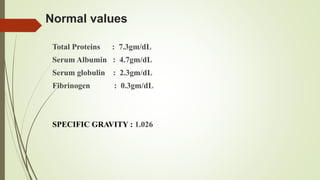
Normal values
Total Proteins : 7.3gm/dL
Serum Albumin : 4.7gm/dL
Serum globulin : 2.3gm/dL
Fibrinogen : 0.3gm/dL
SPECIFIC GRAVITY : 1.026
ALBUMIN
 Albumin is the major protein in human plasma (3.4-4.7 g/dl)
 It makes up approximately 60% of the total plasma protein .
 About 40% of albumin is present in the plasma, and the other 60% is present in
the extracellular space.
 It plays a predominant role in maintaining blood volume and body fluid
distribution .
 Hypoalbuminemia leads to retention of fluid in the tissue spaces(Edema)
 It transported compounds -
free fatty acids (FFA),calcium, steroid, hormones , bilirubin , Heavy metals
variety of drags etc.
ORIGIN OF PLASMA PROTEINS
IN EMBRYO
 In embryonic stage, the plasma proteins are synthesized by the mesenchyme
cells.
 The albumin is synthesized first and other proteins are synthesized later.
IN ADULTS
 In adults, the plasma proteins are synthesized mainly from reticuloendothelial
cells of liver.
 The plasma proteins are synthesized also from spleen, bone marrow.
FUNCTION OF PLASMA PROTEINS
1.ROLE IN COAGULATION OF BLOOD
 Fibrinogen is essential for the coagulation of blood.
2.ROLE IN TRANSPORT MECHANISM
 Albumin, alpha globulin and beta globulin are responsible for the transport of the
hormones, enzymes, etc.
3.ROLE IN DEFENCIVE MECHANISM OF THE BODY
 Gamma globulins play an important role in the defence mechanism of the body
by acting as antibodies
4.REGULATION OF ACID-BASE BALANCE
 Plasma proteins, particularly the albumin, play an important role in regulating the acid-
base balance in the blood.
5. ROLE IN VISCOSITY OF BLOOD
 Plasma proteins provide viscosity to the blood, which is important to maintain the blood
pressure.
6. ROLE IN MAINTENANCE OF OSMOTIC PRESSURE IN BLOOD
 At the capillary level, most of the substances are exchanged between the blood and the
tissues. However, auto because of their large size, the plasma proteins cannot pass
through the capillary membrane easily and remain in the blood.
 In the blood, these proteins exert the osmotic (oncotic) pressure.
 Osmotic pressure exerted by the plasma proteins .
 Since the concentration of albumin is more than the other plasma proteins, it exerts
maximum pressure.
 Globulin is the next and fibrinogen exerts least pressure.

2.BLOOD & PLASMA.pptx

  • 1.
  • 2.
    INTRODUCTION  The branchof physiology dealing with blood is called haematology.  Haemato –Blood and Logy - Study  "Blood is a fluid connective tissue of the body".  Blood connects different parts of the body.  It is considered as the ‘fluid of life’ because it carries oxygen from lungs to all parts of the body and carbon dioxide from all parts of the body to the lungs.  It is known as ‘fluid of growth’
  • 3.
    PROPERTIES  Volume ofblood : Male - 5-6 litres Female – 4-5 litres New born baby – 450 ml  Color of blood : Arterial blood - is scarlet red because it contains more oxygen Venous blood - is purple red because of more carbon dioxide.  pH of blood : Slightly alkaline, with a pH of ~ 7.4  Specific gravity : 1.052 to 1.061  Viscosity means thickness of any fluid compared to water. Viscosity of blood is 5 times greater than water. Blood is thicker than water
  • 6.
  • 7.
    BLOOD CELLS  Threetypes of cells are present in the blood: 1. Red blood cells or erythrocytes 2. White blood cells or leukocytes 3. Platelets or thrombocytes
  • 8.
    PLASMA  Plasma isa straw-colored clear liquid part of blood.
  • 9.
    FUNCTION OF BLOOD 1.NUTRITIVE FUNCTION  Nutritive substances like glucose, amino acids, lipids and vitamins derived from digested food are absorbed from gastrointestinal tract and carried by blood to different parts of the body for growth and production of energy.
  • 10.
    2. RESPIRATORY FUNCTION Transport of respiratory gases is done by the blood.  It carries oxygen from alveoli of lungs to different tissues and carbon dioxide from tissues to alveoli.
  • 11.
    3. EXCRETORY FUNCTION •Waste products formed in the tissues during various metabolic activities are removed by blood and carried to the excretory organs like kidney, skin, liver, etc. for excretion.
  • 12.
    5. REGULATION OFWATER BALANCE Water content of the blood is freely interchangeable with interstitial fluid. This helps in the regulation of water content of the body. 6. REGULATION OF ACID-BASE BALANCE Plasma proteins and hemoglobin act as buffers and help in the regulation of acid-base balance 7. REGULATION OF BODY TEMPERATURE Because of the high specific heat of blood, it is responsible for maintaining the thermoregulatory mechanism in the body, i.e. the balance between heat loss and heat gain in the body.
  • 13.
    8. STORAGE FUNCTION Water and some important substances like proteins, glucose, sodium and potassium are constantly required by the tissues.  Blood serves as a readymade source for these substances.  And, these substances are taken from blood during the conditions like starvation, fluid loss, electrolyte loss, etc. 9. DEFENSIVE FUNCTION  Blood plays an important role in the defense of the body.  The white blood cells are responsible for this function.  Neutrophils and monocytes engulf the bacteria by phagocytosis.  Lymphocytes are involved in development of immunity.  Eosinophils are responsible for detoxification, disintegration and removal of
  • 15.
    PLASMA  It isthe liquid portion of the blood in which various types of blood cells are suspended.  By volume, plasma is 55% of blood and the portion of blood cell is 45%(RBC, WBC, Platelets) PLASMA Water 91% Solids 9% Organic 8% Inorganic 1%
  • 16.
    FUNCTIONS OF PLASMA 1.Transportsnutrition - Plasma is to transport nutrients throughout the body. As food is digested in the stomach and intestines. This includes amino acids, lipids, sugars and fatty acids. 2.Transports waste - The plasma also transports waste products such as uric acid, ammonium salts, creatinine etc. From the cells to the kidneys. The kidneys filter these wastes out of the plasma and excrete them through urine. 3.Maintains blood volume - About 7% plasma is made up of protein, mainly albumin . this concentration is important for maintaining the osmotic pressure of the blood.  In the absence of plasma albumin, water would move into the blood and increase the blood volume. This would lead to increase in blood pressure. This also would impart high work load over the heart.
  • 17.
    4.Balance electrolytes -They include sodium, calcium, potassium, magnesium, chloride and bicarbonate. Example, contraction of muscles, transmission of nerve impulses and signals etc are some of the important functions of electrolytes. 5.Provides body defense or immunity - Plasma also carries other proteins called immune-globulins (antibodies). They fight off foreign substances like bacteria and protect the body.
  • 18.
    1. PLASMA PROTEINS Serumis plasma minus clotting factors. The defibrinated plasma is called serum. Serum is present only in albumin and globulin. Plasma without the clotting protein is called serum.
  • 19.
    PLASMA PROTEINS ARE: 1. Albumin : Help in osmotic balance. 2.Globulin : Defense mechanism of the body. 3 types: A) Alpha B) Beta C) Gama – antibodies 3.Fibrinogen : Important clotting factor
  • 20.
    Normal values Total Proteins: 7.3gm/dL Serum Albumin : 4.7gm/dL Serum globulin : 2.3gm/dL Fibrinogen : 0.3gm/dL SPECIFIC GRAVITY : 1.026
  • 21.
    ALBUMIN  Albumin isthe major protein in human plasma (3.4-4.7 g/dl)  It makes up approximately 60% of the total plasma protein .  About 40% of albumin is present in the plasma, and the other 60% is present in the extracellular space.  It plays a predominant role in maintaining blood volume and body fluid distribution .  Hypoalbuminemia leads to retention of fluid in the tissue spaces(Edema)  It transported compounds - free fatty acids (FFA),calcium, steroid, hormones , bilirubin , Heavy metals variety of drags etc.
  • 22.
    ORIGIN OF PLASMAPROTEINS IN EMBRYO  In embryonic stage, the plasma proteins are synthesized by the mesenchyme cells.  The albumin is synthesized first and other proteins are synthesized later. IN ADULTS  In adults, the plasma proteins are synthesized mainly from reticuloendothelial cells of liver.  The plasma proteins are synthesized also from spleen, bone marrow.
  • 23.
    FUNCTION OF PLASMAPROTEINS 1.ROLE IN COAGULATION OF BLOOD  Fibrinogen is essential for the coagulation of blood. 2.ROLE IN TRANSPORT MECHANISM  Albumin, alpha globulin and beta globulin are responsible for the transport of the hormones, enzymes, etc. 3.ROLE IN DEFENCIVE MECHANISM OF THE BODY  Gamma globulins play an important role in the defence mechanism of the body by acting as antibodies
  • 24.
    4.REGULATION OF ACID-BASEBALANCE  Plasma proteins, particularly the albumin, play an important role in regulating the acid- base balance in the blood. 5. ROLE IN VISCOSITY OF BLOOD  Plasma proteins provide viscosity to the blood, which is important to maintain the blood pressure.
  • 26.
    6. ROLE INMAINTENANCE OF OSMOTIC PRESSURE IN BLOOD  At the capillary level, most of the substances are exchanged between the blood and the tissues. However, auto because of their large size, the plasma proteins cannot pass through the capillary membrane easily and remain in the blood.  In the blood, these proteins exert the osmotic (oncotic) pressure.  Osmotic pressure exerted by the plasma proteins .  Since the concentration of albumin is more than the other plasma proteins, it exerts maximum pressure.  Globulin is the next and fibrinogen exerts least pressure.