Big Questions in Science
   Scientific revolutions
   Copernicus: the Solar System
   Newton: gravity
   Today's idea of unification


             Big Questions in Science, fall 2012. SdH, AUC   2
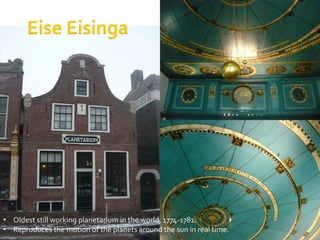
• Oldest still working planetarium in the world, 1774-1781.
• Reproduces the motion of the planets around the sun in real time.
                           Big Questions in Science, fall 2012. SdH, AUC   3
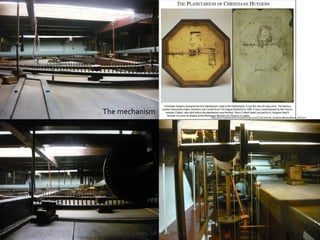
The mechanism
                                                http://www.planetariumzuylenburgh.com/CZ/Collectie_Z/Globes/Blaeu/Blaeu_EN.htm


Big Questions in Science, fall 2012. SdH, AUC                                                                                    4
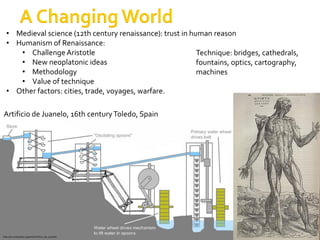
• Medieval science (12th century renaissance): trust in human reason
  • Humanism of Renaissance:
     • Challenge Aristotle                                  Technique: bridges, cathedrals,
     • New neoplatonic ideas                                fountains, optics, cartography,
     • Methodology                                          machines
     • Value of technique
  • Other factors: cities, trade, voyages, warfare.

Artificio de Juanelo, 16th century Toledo, Spain


                                                    Big Questions in Science, fall 2012. SdH, AUC   5
http://en.wikipedia.org/wiki/Artificio_de_Juanelo
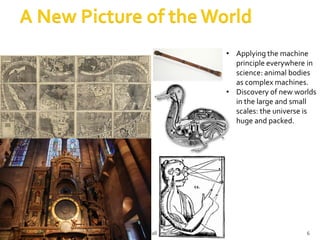
• Applying the machine
                                                                                                               principle everywhere in
                                                                                                               science: animal bodies
                                                                                                               as complex machines.
                                                                                                             • Discovery of new worlds
                                                                                                               in the large and small
                                                                                                               scales: the universe is
                                                                                                               huge and packed.


                                                             Big Questions in Science, fall 2012. SdH, AUC                         6
http://en.wikipedia.org/wiki/Strasbourg_astronomical_clock
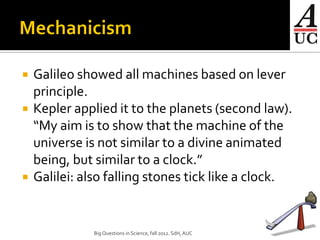
   Galileo showed all machines based on lever
    principle.
   Kepler applied it to the planets (second law).
    “My aim is to show that the machine of the
    universe is not similar to a divine animated
    being, but similar to a clock.”
   Galilei: also falling stones tick like a clock.


               Big Questions in Science, fall 2012. SdH, AUC   7
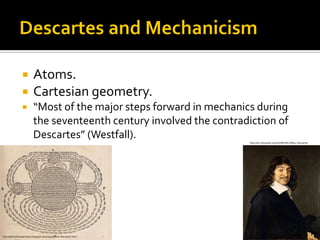
         Atoms.
                          Cartesian geometry.
                          “Most of the major steps forward in mechanics during
                           the seventeenth century involved the contradiction of
                           Descartes” (Westfall).                       http://en.wikipedia.org/wiki/Ren%C3%A9_Descartes


http://800millionparticles.blogspot.nl/2009/09/rene-descartes.html
                                                                                                                       8
Big Questions in Science, fall 2012. SdH, AUC   9
Big Questions in Science, fall 2012. SdH, AUC   10
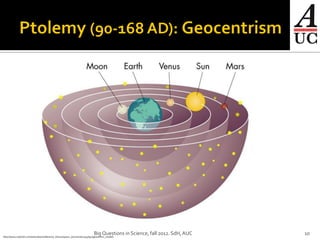
http://www.redorbit.com/education/reference_library/space_1/universe/2574692/geocentric_model/
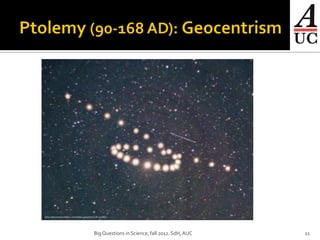
http://astronomy.libsyn.com/index.php?post_id=203863


                                         Big Questions in Science, fall 2012. SdH, AUC   11
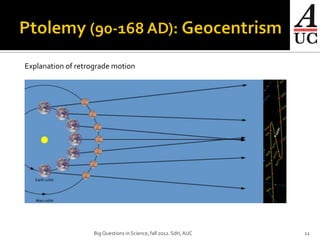
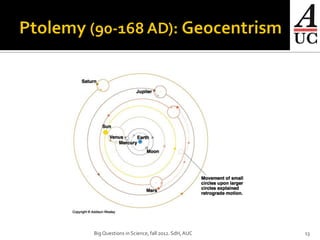
Explanation of retrograde motion


                    Big Questions in Science, fall 2012. SdH, AUC   12
Big Questions in Science, fall 2012. SdH, AUC   13
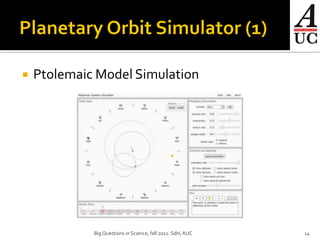
   Ptolemaic Model Simulation


             Big Questions in Science, fall 2012. SdH, AUC   14
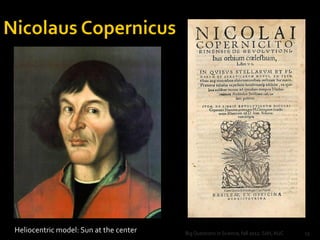
Heliocentric model: Sun at the center   Big Questions in Science, fall 2012. SdH, AUC   15
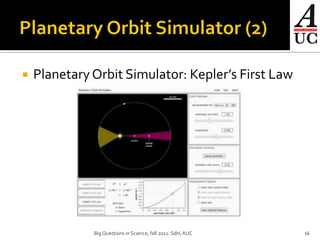
   Planetary Orbit Simulator: Kepler’s First Law


              Big Questions in Science, fall 2012. SdH, AUC   16
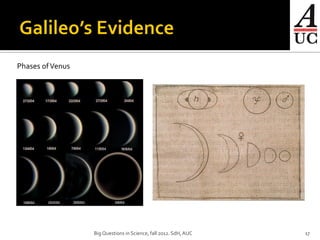
Phases of Venus


                  Big Questions in Science, fall 2012. SdH, AUC   17
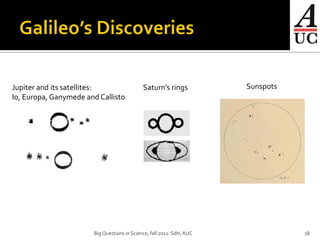
Jupiter and its satellites:                  Saturn’s rings            Sunspots
Io, Europa, Ganymede and Callisto


                       Big Questions in Science, fall 2012. SdH, AUC              18
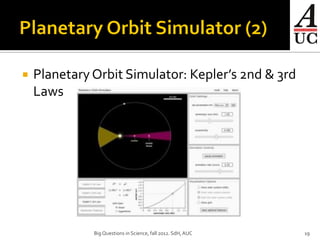
   Planetary Orbit Simulator: Kepler’s 2nd & 3rd
    Laws


              Big Questions in Science, fall 2012. SdH, AUC   19
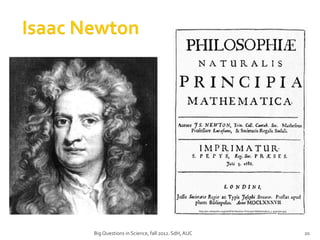
http://en.wikipedia.org/wiki/File:Newton-Principia-Mathematica_1-500x700.jpg


Big Questions in Science, fall 2012. SdH, AUC                                                                                  20
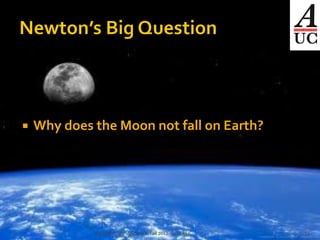
   Why does the Moon not fall on Earth?


             Big Questions in Science, fall 2012. SdH, AUC   21
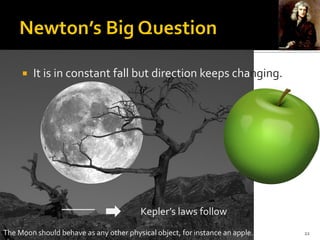
   It is in constant fall but direction keeps changing.


                                              Kepler’s laws follow
The Moon should behave asBig Questions in physical 2012. SdH, AUC instance an apple.
                          any other Science, fall object, for                          22
Big Questions in Science, fall 2012. SdH, AUC   23
Big Questions in Science, fall 2012. SdH, AUC   24
Big Questions in Science, fall 2012. SdH, AUC   25
Big Questions in Science, fall 2012. SdH, AUC   26
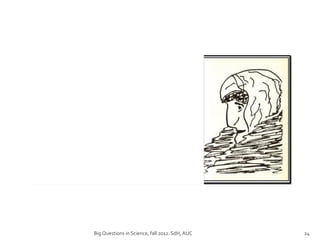
   Read the first page of Kuhn’s “Revolutions as
    Changes of World View”.
     What does he mean by “scientists see… different
      things”, “scientists are responding to a different
      world”?
     Give examples (dealt with in class and not dealt
      with in class).
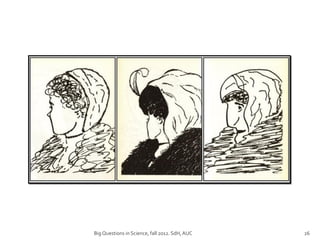
     Explain how the gestalt experiment relates to this.


               Big Questions in Science, fall 2012. SdH, AUC   27
http://www.platypusart.com/


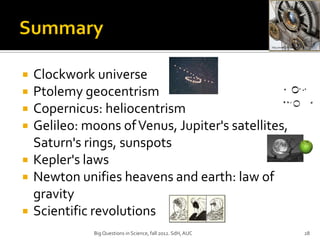
   Clockwork universe
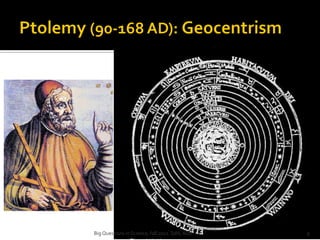
   Ptolemy geocentrism
   Copernicus: heliocentrism
   Gelileo: moons of Venus, Jupiter's satellites,
    Saturn's rings, sunspots
   Kepler's laws
   Newton unifies heavens and earth: law of
    gravity
   Scientific revolutions
              Big Questions in Science, fall 2012. SdH, AUC                                 28
The Unity of Science

   Goal: unity of knowledge.
   Place of science within the pursuit of truth.
   Common to modern science, Greek tradition,
    Enlightenment.
   Unity of science can no longer be taken for
    granted:
     Exponential growth of factual knowledge.
     Increasing specialization and fragmentation.
     Skepticism towards grand unifying schemes.
                        Big Questions in Science, fall 2012. SdH, AUC   29
   Big Question: what justifies our belief in the
    underlying unity of knowledge?
   Interdisciplinary approach assumes this.
    Disciplines are communicating vessels.
   Success of LAS program hinges on this
    assumption.
   Possible answer: reductionism. Everything
    can be reduced to physics.

                       Big Questions in Science, fall 2012. SdH, AUC   30
   Reduction still the goal in the natural
    sciences.
   Explain new kinds of phenomena:
    complexity, pattern formation, emergence,
    self-organization, information.
   New paradigm includes cultural and social
    dimensions of natural science.


                     Big Questions in Science, fall 2012. SdH, AUC   31
   Ethics, cosmos, logos:
     Man is central to the stage of science
      (Kuhn’s revolution).
     Complexity of the world rooted on order
      accessible to human enquiry and
      experimentation.


                Big Questions in Science, fall 2012. SdH, AUC   32
   Education should reflect both order and
    complexity of nature.
     Approach problems from a multitude of academic
      disciplines.
     Adopt and adapt different methodologies.
     Aim at synthesis.


               Big Questions in Science, fall 2012. SdH, AUC   33

3 The Scientific Revolution

  • 1.
  • 2.
    Scientific revolutions  Copernicus: the Solar System  Newton: gravity  Today's idea of unification Big Questions in Science, fall 2012. SdH, AUC 2
  • 3.
    • Oldest stillworking planetarium in the world, 1774-1781. • Reproduces the motion of the planets around the sun in real time. Big Questions in Science, fall 2012. SdH, AUC 3
  • 4.
    The mechanism http://www.planetariumzuylenburgh.com/CZ/Collectie_Z/Globes/Blaeu/Blaeu_EN.htm Big Questions in Science, fall 2012. SdH, AUC 4
  • 5.
    • Medieval science(12th century renaissance): trust in human reason • Humanism of Renaissance: • Challenge Aristotle Technique: bridges, cathedrals, • New neoplatonic ideas fountains, optics, cartography, • Methodology machines • Value of technique • Other factors: cities, trade, voyages, warfare. Artificio de Juanelo, 16th century Toledo, Spain Big Questions in Science, fall 2012. SdH, AUC 5 http://en.wikipedia.org/wiki/Artificio_de_Juanelo
  • 6.
    • Applying themachine principle everywhere in science: animal bodies as complex machines. • Discovery of new worlds in the large and small scales: the universe is huge and packed. Big Questions in Science, fall 2012. SdH, AUC 6 http://en.wikipedia.org/wiki/Strasbourg_astronomical_clock
  • 7.
    Galileo showed all machines based on lever principle.  Kepler applied it to the planets (second law). “My aim is to show that the machine of the universe is not similar to a divine animated being, but similar to a clock.”  Galilei: also falling stones tick like a clock. Big Questions in Science, fall 2012. SdH, AUC 7
  • 8.
    Atoms.  Cartesian geometry.  “Most of the major steps forward in mechanics during the seventeenth century involved the contradiction of Descartes” (Westfall). http://en.wikipedia.org/wiki/Ren%C3%A9_Descartes http://800millionparticles.blogspot.nl/2009/09/rene-descartes.html 8
  • 9.
    Big Questions inScience, fall 2012. SdH, AUC 9
  • 10.
    Big Questions inScience, fall 2012. SdH, AUC 10 http://www.redorbit.com/education/reference_library/space_1/universe/2574692/geocentric_model/
  • 11.
    http://astronomy.libsyn.com/index.php?post_id=203863 Big Questions in Science, fall 2012. SdH, AUC 11
  • 12.
    Explanation of retrogrademotion Big Questions in Science, fall 2012. SdH, AUC 12
  • 13.
    Big Questions inScience, fall 2012. SdH, AUC 13
  • 14.
    Ptolemaic Model Simulation Big Questions in Science, fall 2012. SdH, AUC 14
  • 15.
    Heliocentric model: Sunat the center Big Questions in Science, fall 2012. SdH, AUC 15
  • 16.
    Planetary Orbit Simulator: Kepler’s First Law Big Questions in Science, fall 2012. SdH, AUC 16
  • 17.
    Phases of Venus Big Questions in Science, fall 2012. SdH, AUC 17
  • 18.
    Jupiter and itssatellites: Saturn’s rings Sunspots Io, Europa, Ganymede and Callisto Big Questions in Science, fall 2012. SdH, AUC 18
  • 19.
    Planetary Orbit Simulator: Kepler’s 2nd & 3rd Laws Big Questions in Science, fall 2012. SdH, AUC 19
  • 20.
  • 21.
    Why does the Moon not fall on Earth? Big Questions in Science, fall 2012. SdH, AUC 21
  • 22.
    It is in constant fall but direction keeps changing. Kepler’s laws follow The Moon should behave asBig Questions in physical 2012. SdH, AUC instance an apple. any other Science, fall object, for 22
  • 23.
    Big Questions inScience, fall 2012. SdH, AUC 23
  • 24.
    Big Questions inScience, fall 2012. SdH, AUC 24
  • 25.
    Big Questions inScience, fall 2012. SdH, AUC 25
  • 26.
    Big Questions inScience, fall 2012. SdH, AUC 26
  • 27.
    Read the first page of Kuhn’s “Revolutions as Changes of World View”.  What does he mean by “scientists see… different things”, “scientists are responding to a different world”?  Give examples (dealt with in class and not dealt with in class).  Explain how the gestalt experiment relates to this. Big Questions in Science, fall 2012. SdH, AUC 27
  • 28.
    http://www.platypusart.com/  Clockwork universe  Ptolemy geocentrism  Copernicus: heliocentrism  Gelileo: moons of Venus, Jupiter's satellites, Saturn's rings, sunspots  Kepler's laws  Newton unifies heavens and earth: law of gravity  Scientific revolutions Big Questions in Science, fall 2012. SdH, AUC 28
  • 29.
    The Unity ofScience  Goal: unity of knowledge.  Place of science within the pursuit of truth.  Common to modern science, Greek tradition, Enlightenment.  Unity of science can no longer be taken for granted:  Exponential growth of factual knowledge.  Increasing specialization and fragmentation.  Skepticism towards grand unifying schemes. Big Questions in Science, fall 2012. SdH, AUC 29
  • 30.
    Big Question: what justifies our belief in the underlying unity of knowledge?  Interdisciplinary approach assumes this. Disciplines are communicating vessels.  Success of LAS program hinges on this assumption.  Possible answer: reductionism. Everything can be reduced to physics. Big Questions in Science, fall 2012. SdH, AUC 30
  • 31.
    Reduction still the goal in the natural sciences.  Explain new kinds of phenomena: complexity, pattern formation, emergence, self-organization, information.  New paradigm includes cultural and social dimensions of natural science. Big Questions in Science, fall 2012. SdH, AUC 31
  • 32.
    Ethics, cosmos, logos:  Man is central to the stage of science (Kuhn’s revolution).  Complexity of the world rooted on order accessible to human enquiry and experimentation. Big Questions in Science, fall 2012. SdH, AUC 32
  • 33.
    Education should reflect both order and complexity of nature.  Approach problems from a multitude of academic disciplines.  Adopt and adapt different methodologies.  Aim at synthesis. Big Questions in Science, fall 2012. SdH, AUC 33