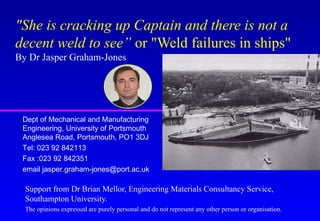
"She is cracking up Captain and there is not a
decent weld to see” or "Weld failures in ships"
By Dr Jasper Graham-Jones
Support from Dr Brian Mellor, Engineering Materials Consultancy Service,
Southampton University.
The opinions expressed are purely personal and do not represent any other person or organisation.
Dept of Mechanical and Manufacturing
Engineering, University of Portsmouth
Anglesea Road, Portsmouth, PO1 3DJ
Tel: 023 92 842113
Fax :023 92 842351
email jasper.graham-jones@port.ac.uk
Ship Failure & Loss of Life
1930’s Welded ships, Manual Metal Arc
Liberty Ship failures. WW2 +250 ships fractured or
cracked; 19 of these broke completely in two.
Fracture Mechanics comes of age!
Factors:- stress concentration, high tensile stress,
relatively low temperature, susceptible steel
•Titanic (14 April 1912) Weak rivets
and Brittle steel hull.
Esso
Manhattan
29 March
1943 at the
entrance to
New York
Harbour
John P. Gaines,
November 1943. Vessel
broke in two off Shumagin
Aleutians With the loss of
ten lives
Schenectady,
A liberty Tanker,
16 January 1943,
split in two while
moored in calm
water.
Only 24 hrs old
Post-War Ship Failures
Tyne Bridge, Kow loon Bridge, Longitudinal beam cut
and weld either side of the bulk head frame 65. Poor
welding design, laminar tearing, fractures, etc?
Derbyshire 9/10 Sept 1980, associated with poor
structural strength, and poor design of hatch covers.
(doubled skinned)
Torrey Canyon, Ran aground (19th March 1967)
Costly £ Billions: insurance and life expectancy
Many Lives, Environmental Damage: who is affected?
Welding Methods
Manual Metal Arc (Most common in ship building)
MIG (Easy to use, but not as portable)
TIG (Mix of above, but harder)
Submerged metal arc.
Gas welding
Solid phase bonding (explosive welding, Friction Stir)
Electron beam & Laser Welding
Welding Defects
Solidification cracking
Lack of fusion
Lack of penetration
Porosity (Hydrogen)
Distortion
Fatigue, Corrosion, Embrittlement, etc….
Welded Joints & Defects
Butt Joint
Lap Joint
Tee, joint
Corner Joint
Edge weld
Fillet and
Full
Penetration
Ship Failure 2
Tanker 1 Failure
Force 8 gale in the Indian Ocean, land 800 mile.
Noise & vibration at the bow
Witness:- Irish deckhand, Mast Lights
•Bow disappears???
•What would YOU do next?
•Sailed 1200 miles in reverse to destination in India.
No.1
No.2
Photo 37, Side longitudinal 27 Cracked through
(1) Fatigue crack at toe of Bracket
(2)Longitudinal detached (cracked or never connected?)
1
2
Photo 38 Bracket at side longitudinal 29, Note renewed bracket is smaller
than original. Remains of original bracket are visible
Not renewed and L26 fractured at weld
Highly corroded non-renewed longitudinal (see photo 46)
What happen?
Many experts sent to photograph and assess ship.
Design change to a fuel efficient engine thus no bow
fuel tank installed.
Fuel tank considered as a stressed member.
Corrosion Fatigue, cracks originating from the welds
on one side. Rapid crack growth, considerable
distortion, and final fracture on far side.
Tanker Failure 2
Background, Super tanker 250,000 Tonnes, 20,000 T
water ballast, Oil cargo just unloaded.
Greek owners, Japanese built, USA standards, British
Insurer (Lloyds), repaired in Singapore.
Failed in Amsterdam, Holland at Shell Oil terminal.
Loud bang and ship moved and strained on it’s ropes
from the quay side.
Ship Failures30metreFracturein
25-30mmSteelplate
Failure
Initial unexpected soft grounding
Loud bang, and ship movement caused by 20kT of
water.
Dry dock: 30m (90ft) crack through 25-30 mm thick
steel plate.
Many internal weld failures and buckled steel
members.
Repair cost £10 million, not including loss of trade
What happened?
30m brittle fracture, then escaping ballast water causes
bent steel sections and failed welds.
Material of poor quality. (low temperature brittleness,
sulfide inclusions)
Weld failures, Examine Standards, for general ships.
Fillet or Fully Penetrating welds
Fracture in bottom
plating of oil tanker
18 m fracture in 25 mm thick bottom plating.
Inside the
centre ballast
tank
Port transverse web frames.
Initial examination of ship.
Design specified fully penetration welds.
Although corrosion within standard (25% thickness).
Many welds pulled out, many crack originate from
welds.
Fillet welds not as strong, but easier and quicker to do
compared to fully penetrating.
Ship has fillet welds????
Selection of samples for laboratory
examination
Setup Metallurgical Inspection
Visit site, cut out 3/4 Tonne of samples.
Take before and after photos, detail exact locations
and record on samples. Securely pack in box for
shipping
Set up lab, dry storage, logging samples, photographs,
agree samples with all parties.
Layout in lab and agree which smaller samples to cut
from the main samples. Concentrated on fracture path.
Agree cutting method as some methods can damage
samples. (Make sure samples are not cleaned)
Laboratory
investigation
Underside of face plate on
transverse web just above
diagonal stiffener.
Transverse section at S. 16 mm gap
between transverse web and face
plate has been “filled” with weld
metal.
Laboratory
investigation
continued
Transverse section through
diagonal stiffener and upper and
lower sections of transverse web.
Results
Lack of penetration and fusion
Mix of old and new repair welds
Considerable weld build up to conceal poor fit up.
Some cracked welds not repaired (old fatigue marks)
and painted over (paint deep inside cracks).
Although outside profile good, large pores at weld
centre.
Weld details
Poor fit up “cured” by filling gap with weld metal.
Misalignment of upper and lower sections of
transverse web.
True weld leg lengths as small as 2 mm. Corrosion
reduced effective weld throat size.
Weld details continued
Weld between upper and lower sections of transverse
web should be a butt weld not a fillet weld.
This had no effect on the static strength of the joint but
the fatigue strength of a butt weld is 1.6 times that of a
well prepared fillet weld.
Welds and structural failure
Welded structures fracture
along welds so FE models
must replicate this.
Use sub-models of weld details
Load elongation on 5 mm
element corresponding to fillet
weld leg length.
Input into main FE model.
Pull off failure of fillet welded bracket.
Local Materials Properties
•Use an instrumented
microhardness technique with a
spherical indenter to derive the
stress-strain curve for local
regions of a weld.
•Modelling of complex failure
sequences in welded structures
using FE is hampered by lack of
local material properties.
Conclusions continued
The failure mode is only part of the story.
Need to answer question, “What is special about this
part?”.
Tanker 2 failure conclusions
Poor build and repair, (likely known to owner??)
Uneven loading with full ballast tanks.
Soft mud grounding. (Owners requested non-
grounding berth)
Ship unable to support own weight and that of ballast.
Longitudinal split allowing water to rush out
(10KT/min) causing further damage.
Some damage possible from dry dock.
Inspection, What happened?
One man (US) to inspect a 250,000 t Tanker, built in
Japan. Language problem?
Ship access, individual weld inspection problems?
Poor inspection in difficult conditions.
Why can’t ships be inspected like planes????
MONEY (Cost to benefit)
Overview
Ship losses are primarily caused by a number of
events, perhaps even minor when considered
individually in isolation, which conspire together in a
sequence which leads inevitably to the loss
Failures will occur, and are required to be managed
(Failure Management)
There will be the inevitable differences of opinion
depending upon particular points of view and interest.
You have to strive throughout to treat all possible
scenarios equally in terms of effort, time and depth of
analysis.
Areas of Future Research
Structural Design
– Modelling & Analysis of loading
Life Cycle Risk Management
– Corrosion rates, time variable stresses
Production Technology
– Good fit-ups & Production design detail
People Dynamics & concepts of risk assessment.
– ’Groupthink’ & ’Risky shift phenomenon'
Seacat propeller failure.
New in service, Vibration from propeller.
Dry dock, Half a blade missing (1 of 3).
Initial inspection, fatigue and brittle overload failure.
Detailed inspection, small pore, and welding heat
affected zones around fatigue initiation sites.
Cause of propeller failure
Overlay welded to repair a casting problem.
Poor finishing and NDT (Dye penetrate).
Small pore, stress concentration, leading to fatigue
initiation.
Crack growth, followed by multiple fatigue initiation
sites and rapid crack growth around welds
Possible damage or excessive wear to bearings.
Metallurgical testing methods
Eye, magnifying glass, (cracks, distortion)
Stereo low powered microscope. Cut samples, polish
smooth (stain) and examine for heat affected zones.
High power microscope, Electron beam microscope
(Fatigue striations, inclusions, etc).
Local materials properties
Use an instrumented microhardness technique with a
spherical indenter to derive the stress-strain curve for local
regions of a weld.

Welded Ship failures

  • 1.
    "She is crackingup Captain and there is not a decent weld to see” or "Weld failures in ships" By Dr Jasper Graham-Jones Support from Dr Brian Mellor, Engineering Materials Consultancy Service, Southampton University. The opinions expressed are purely personal and do not represent any other person or organisation. Dept of Mechanical and Manufacturing Engineering, University of Portsmouth Anglesea Road, Portsmouth, PO1 3DJ Tel: 023 92 842113 Fax :023 92 842351 email jasper.graham-jones@port.ac.uk
  • 2.
    Ship Failure &Loss of Life 1930’s Welded ships, Manual Metal Arc Liberty Ship failures. WW2 +250 ships fractured or cracked; 19 of these broke completely in two. Fracture Mechanics comes of age! Factors:- stress concentration, high tensile stress, relatively low temperature, susceptible steel •Titanic (14 April 1912) Weak rivets and Brittle steel hull.
  • 3.
    Esso Manhattan 29 March 1943 atthe entrance to New York Harbour John P. Gaines, November 1943. Vessel broke in two off Shumagin Aleutians With the loss of ten lives
  • 4.
    Schenectady, A liberty Tanker, 16January 1943, split in two while moored in calm water. Only 24 hrs old
  • 5.
    Post-War Ship Failures TyneBridge, Kow loon Bridge, Longitudinal beam cut and weld either side of the bulk head frame 65. Poor welding design, laminar tearing, fractures, etc? Derbyshire 9/10 Sept 1980, associated with poor structural strength, and poor design of hatch covers. (doubled skinned) Torrey Canyon, Ran aground (19th March 1967) Costly £ Billions: insurance and life expectancy Many Lives, Environmental Damage: who is affected?
  • 6.
    Welding Methods Manual MetalArc (Most common in ship building) MIG (Easy to use, but not as portable) TIG (Mix of above, but harder) Submerged metal arc. Gas welding Solid phase bonding (explosive welding, Friction Stir) Electron beam & Laser Welding
  • 7.
    Welding Defects Solidification cracking Lackof fusion Lack of penetration Porosity (Hydrogen) Distortion Fatigue, Corrosion, Embrittlement, etc….
  • 8.
    Welded Joints &Defects Butt Joint Lap Joint Tee, joint Corner Joint Edge weld Fillet and Full Penetration
  • 9.
  • 10.
    Tanker 1 Failure Force8 gale in the Indian Ocean, land 800 mile. Noise & vibration at the bow Witness:- Irish deckhand, Mast Lights •Bow disappears??? •What would YOU do next? •Sailed 1200 miles in reverse to destination in India.
  • 11.
  • 12.
  • 17.
    Photo 37, Sidelongitudinal 27 Cracked through (1) Fatigue crack at toe of Bracket (2)Longitudinal detached (cracked or never connected?) 1 2
  • 18.
    Photo 38 Bracketat side longitudinal 29, Note renewed bracket is smaller than original. Remains of original bracket are visible
  • 19.
    Not renewed andL26 fractured at weld
  • 20.
    Highly corroded non-renewedlongitudinal (see photo 46)
  • 21.
    What happen? Many expertssent to photograph and assess ship. Design change to a fuel efficient engine thus no bow fuel tank installed. Fuel tank considered as a stressed member. Corrosion Fatigue, cracks originating from the welds on one side. Rapid crack growth, considerable distortion, and final fracture on far side.
  • 22.
    Tanker Failure 2 Background,Super tanker 250,000 Tonnes, 20,000 T water ballast, Oil cargo just unloaded. Greek owners, Japanese built, USA standards, British Insurer (Lloyds), repaired in Singapore. Failed in Amsterdam, Holland at Shell Oil terminal. Loud bang and ship moved and strained on it’s ropes from the quay side.
  • 23.
  • 24.
    Failure Initial unexpected softgrounding Loud bang, and ship movement caused by 20kT of water. Dry dock: 30m (90ft) crack through 25-30 mm thick steel plate. Many internal weld failures and buckled steel members. Repair cost £10 million, not including loss of trade
  • 26.
    What happened? 30m brittlefracture, then escaping ballast water causes bent steel sections and failed welds. Material of poor quality. (low temperature brittleness, sulfide inclusions) Weld failures, Examine Standards, for general ships. Fillet or Fully Penetrating welds
  • 27.
    Fracture in bottom platingof oil tanker 18 m fracture in 25 mm thick bottom plating.
  • 30.
  • 32.
    Initial examination ofship. Design specified fully penetration welds. Although corrosion within standard (25% thickness). Many welds pulled out, many crack originate from welds. Fillet welds not as strong, but easier and quicker to do compared to fully penetrating. Ship has fillet welds????
  • 34.
    Selection of samplesfor laboratory examination
  • 36.
    Setup Metallurgical Inspection Visitsite, cut out 3/4 Tonne of samples. Take before and after photos, detail exact locations and record on samples. Securely pack in box for shipping Set up lab, dry storage, logging samples, photographs, agree samples with all parties. Layout in lab and agree which smaller samples to cut from the main samples. Concentrated on fracture path. Agree cutting method as some methods can damage samples. (Make sure samples are not cleaned)
  • 37.
    Laboratory investigation Underside of faceplate on transverse web just above diagonal stiffener. Transverse section at S. 16 mm gap between transverse web and face plate has been “filled” with weld metal.
  • 38.
    Laboratory investigation continued Transverse section through diagonalstiffener and upper and lower sections of transverse web.
  • 39.
    Results Lack of penetrationand fusion Mix of old and new repair welds Considerable weld build up to conceal poor fit up. Some cracked welds not repaired (old fatigue marks) and painted over (paint deep inside cracks). Although outside profile good, large pores at weld centre.
  • 40.
    Weld details Poor fitup “cured” by filling gap with weld metal. Misalignment of upper and lower sections of transverse web. True weld leg lengths as small as 2 mm. Corrosion reduced effective weld throat size.
  • 41.
    Weld details continued Weldbetween upper and lower sections of transverse web should be a butt weld not a fillet weld. This had no effect on the static strength of the joint but the fatigue strength of a butt weld is 1.6 times that of a well prepared fillet weld.
  • 42.
    Welds and structuralfailure Welded structures fracture along welds so FE models must replicate this.
  • 43.
    Use sub-models ofweld details Load elongation on 5 mm element corresponding to fillet weld leg length. Input into main FE model. Pull off failure of fillet welded bracket.
  • 44.
    Local Materials Properties •Usean instrumented microhardness technique with a spherical indenter to derive the stress-strain curve for local regions of a weld. •Modelling of complex failure sequences in welded structures using FE is hampered by lack of local material properties.
  • 45.
    Conclusions continued The failuremode is only part of the story. Need to answer question, “What is special about this part?”.
  • 46.
    Tanker 2 failureconclusions Poor build and repair, (likely known to owner??) Uneven loading with full ballast tanks. Soft mud grounding. (Owners requested non- grounding berth) Ship unable to support own weight and that of ballast. Longitudinal split allowing water to rush out (10KT/min) causing further damage. Some damage possible from dry dock.
  • 47.
    Inspection, What happened? Oneman (US) to inspect a 250,000 t Tanker, built in Japan. Language problem? Ship access, individual weld inspection problems? Poor inspection in difficult conditions. Why can’t ships be inspected like planes???? MONEY (Cost to benefit)
  • 48.
    Overview Ship losses areprimarily caused by a number of events, perhaps even minor when considered individually in isolation, which conspire together in a sequence which leads inevitably to the loss Failures will occur, and are required to be managed (Failure Management) There will be the inevitable differences of opinion depending upon particular points of view and interest. You have to strive throughout to treat all possible scenarios equally in terms of effort, time and depth of analysis.
  • 49.
    Areas of FutureResearch Structural Design – Modelling & Analysis of loading Life Cycle Risk Management – Corrosion rates, time variable stresses Production Technology – Good fit-ups & Production design detail People Dynamics & concepts of risk assessment. – ’Groupthink’ & ’Risky shift phenomenon'
  • 50.
    Seacat propeller failure. Newin service, Vibration from propeller. Dry dock, Half a blade missing (1 of 3). Initial inspection, fatigue and brittle overload failure. Detailed inspection, small pore, and welding heat affected zones around fatigue initiation sites.
  • 51.
    Cause of propellerfailure Overlay welded to repair a casting problem. Poor finishing and NDT (Dye penetrate). Small pore, stress concentration, leading to fatigue initiation. Crack growth, followed by multiple fatigue initiation sites and rapid crack growth around welds Possible damage or excessive wear to bearings.
  • 52.
    Metallurgical testing methods Eye,magnifying glass, (cracks, distortion) Stereo low powered microscope. Cut samples, polish smooth (stain) and examine for heat affected zones. High power microscope, Electron beam microscope (Fatigue striations, inclusions, etc).
  • 53.
    Local materials properties Usean instrumented microhardness technique with a spherical indenter to derive the stress-strain curve for local regions of a weld.