U.S. Fish & Wildlife Service
Planning Update
Comprehensive Conservation Plan
Rocky Mountain Arsenal National Wildlife Refuge
Issue 1, June 2013
The National Wildlife
Refuge System
The Rocky Mountain Arsenal
National Wildlife Refuge is part of the
National Wildlife Refuge System,
which began in 1903 when President
Theodore Roosevelt established Peli-
can Island in Florida as the Nation’s
first bird sanctuary. He went on to
establish many other sanctuaries for
wildlife during his presidency. This
small network of sanctuaries grew to
become the largest system of lands in
the world dedicated to the conserva-
tion of wildlife. We, the U.S. Fish and
Wildlife Service, an agency within the
Department of the Interior, administer
the National Wildlife Refuge System.
In 1997, Congress passed the
National Wildlife Refuge System
Improvement Act. This legislation pro-
vides clear guidance for our manage-
ment of the National Wildlife Refuge
System and includes our mission:
The act directs us to manage the
National Wildlife Refuge System as a
national system of lands and waters
devoted to the conservation of wildlife
and the maintenance of the biological
integrity of ecosystems.
Rocky Mountain Arsenal
National Wildlife Refuge
The Rocky Mountain Arsenal
National Wildlife Refuge is the nation’s
premier urban national wildlife refuge.
Located just outside of Denver, Colo-
rado, it is approximately 16,000 acres
in size and consists of a number of
important fish and wildlife habitats,
including native shortgrass and mixed-
grass prairies, riparian corridors,
numerous wetlands, and multiple lakes.
The U.S. Army and Shell have fin-
ished their remediation of the site,
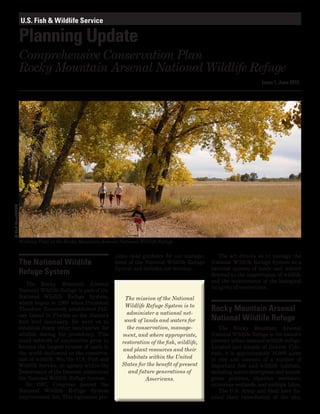
Walking Trail at the Rocky Mountain Arsenal National Wildlife Refuge
©RichKeen/DPRA
which included restoring thousands of
acres of native grasslands. We are
beginning a new chapter at the refuge
by managing the site solely for wildlife
conservation. Now bison, deer, bald
eagles, Swainson’s hawks, burrowing
owls, and numerous other wildlife spe-
cies can be seen there.
Without traveling far, people have
a unique opportunity to connect with
their natural environment. There are a
variety of wildlife-dependent recre-
ational opportunities available to the
over 300,000 annual visitors. They can
hike trails, observe wildlife from the
Auto Tour Route or the Wildlife
Drive, participate in environmental
education programs, and experience
one of the best catch-and-release fish-
eries in Colorado.
What is a Comprehensive
Conservation Plan?
To support and fulfill our mission,
the National Wildlife Refuge System
Improvement Act requires that all
national wildlife refuges be managed
under comprehensive conservation
plans. To meet this requirement, we
have started work to revise the 1996
comprehensive management plan for
the Rocky Mountain Arsenal National
Wildlife Refuge. A draft plan and
accompanying environmental impact
statement, as required by the National
Environmental Policy Act, will
describe the management alternatives
we considered for the refuge and their
effects on the environment.
This 15-year plan will provide long-
range guidance and management
direction for all of the refuge’s pro-
grams. The plan will outline a vision
statement and supporting goals, objec-
tives, and strategies. It will be a “liv-
ing” document that is updated every
15 years.
In summary, the final comprehen-
sive conservation plan will do the
following:
■■ Outline a vision for the
refuge.
■■ Guide management decisions.
■■ Set goals and specify objec-
tives and strategies to
achieve the refuge’s vision
and purposes.
■■ Provide other agencies and
the public with an under-
standing of the management
to be carried out at the
refuge.
Reintroduction of the
Black-footed Ferret
The Rocky Mountain Arsenal
National Wildlife Refuge is consider-
ing reintroducing the black-footed fer-
ret (Mustela nigripes) as a part of its
planning process. The black-footed
ferret is the only ferret native to
North America and is considered to be
one of the most endangered mammals
in the world. Historically, they lived
throughout the Great Plains wherever
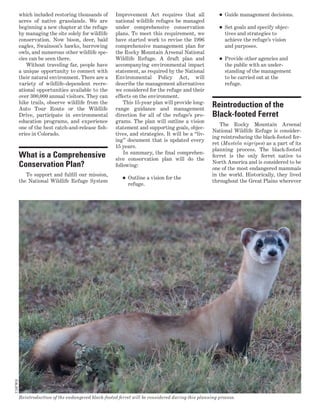
Reintroduction of the endangered black-footed ferret will be considered during this planning process.
USFWS
prairie dogs (Cynomys spp.) were
found. As a specialized predator,
black-footed ferrets prey upon prairie
dogs and use their underground bur-
rows for shelter. Black-footed ferrets
and prairie dogs are part of an ecosys-
tem that has been dramatically altered
and reduced in size over the past cen-
tury. The proposed reintroduction of
the black-footed ferret to the refuge is
a positive step toward the recovery of
this iconic prairie species.
Public Involvement
and Scoping
A series of public scoping meetings
are scheduled for late July and early
August. These meetings are essential
for us to develop a list of issues that
the comprehensive conservation plan
will address. You are invited to drop
by anytime after at 5:30 p.m., with
each meeting beginning at 6 p.m. and
ending at 7:30 p.m. These meetings
will provide you with an opportunity
to get to know our personnel, learn
more about the planning process, and
provide input.
We will accept your comments dur-
ing the scoping portion of the planning
process, through October 11. You may
submit written letters or emails, and
these can be mailed, emailed, or faxed
to the planning team leaders (see
Contacts).
Scoping Meeting
Schedule
Reunion Recreation Center
Thursday, July 25, 5:30 to 7:30 p.m.
17910 E. Parkside Dr. North
Commerce City, Colorado
Central Park Recreation Center
Tuesday, July 30, 5:30 to 7:30 p.m.
9651 E. Martin Luther King Blvd.
Denver, Colorado
Commerce City Recreation Center
Monday, August 5, 5:30 to 7:30 p.m.
6060 E. Parkway Drive
Commerce City, Colorado
Why Did You Receive This
Update?
We are widely distributing this
planning update to generate interest
in the planning process and to collect
ideas and thoughts from the public,
State and local governments, organi-
zations, and other partners.
Since the mailing list may be
requested by the public under the
Freedom of Information Act, your per-
mission is needed for us to place your
name on it. If you do not request to be
on the mailing list, we will assume
that you do not wish to receive further
information on this planning process.
If you would like to continue
receiving planning updates, please
complete the mailing list consent form
enclosed and return it to the address
noted on the form. You may also
phone, fax, or email Bernardo Garza or
Toni Griffin (planning team leaders,
see Contacts) and request that your
name be placed on the mailing list.
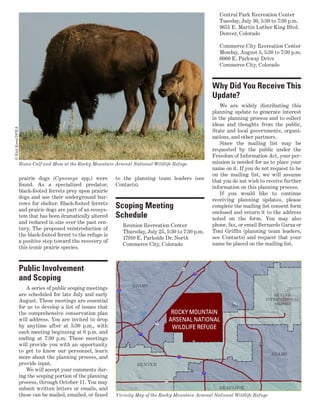
Bison Calf and Mom at the Rocky Mountain Arsenal National Wildlife Refuge
©RichKeen/DPRA
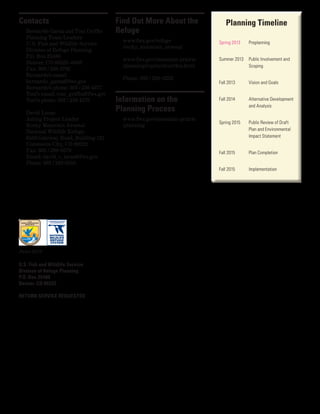
Vicinity Map of the Rocky Mountain Arsenal National Wildlife Refuge
Contacts
Bernardo Garza and Toni Griffin
Planning Team Leaders
U.S. Fish and Wildlife Service
Division of Refuge Planning
P.O. Box 25486
Denver, CO 80225–0486
Fax: 303 / 236 4792
Bernardo’s email:
bernardo_garza@fws.gov
Bernardo’s phone: 303 / 236 4377
Toni’s email: toni_griffin@fws.gov
Toni’s phone: 303 / 236 4378
David Lucas
Acting Project Leader
Rocky Mountain Arsenal
National Wildlife Refuge
6550 Gateway Road, Building 121
Commerce City, CO 80022
Fax: 303 / 289-0579
Email: david_c_lucas@fws.gov
Phone: 303 / 289 0350
U.S. Fish and Wildlife Service
Division of Refuge Planning
P.O. Box 25486
Denver, CO 80225
RETURN SERVICE REQUESTED
June 2013
Spring 2013Spring 2013
Find Out More About the
Refuge
www.fws.gov/refuge
/rocky_mountain_arsenal
www.fws.gov/mountain-prairie
/planning/ccp/co/rkm/rkm.html
Phone: 303 / 289-0232
Information on the
Planning Process
www.fws.gov/mountain-prairie
/planning

28008_planning_update_1

  • 1.
    U.S. Fish &Wildlife Service Planning Update Comprehensive Conservation Plan Rocky Mountain Arsenal National Wildlife Refuge Issue 1, June 2013 The National Wildlife Refuge System The Rocky Mountain Arsenal National Wildlife Refuge is part of the National Wildlife Refuge System, which began in 1903 when President Theodore Roosevelt established Peli- can Island in Florida as the Nation’s first bird sanctuary. He went on to establish many other sanctuaries for wildlife during his presidency. This small network of sanctuaries grew to become the largest system of lands in the world dedicated to the conserva- tion of wildlife. We, the U.S. Fish and Wildlife Service, an agency within the Department of the Interior, administer the National Wildlife Refuge System. In 1997, Congress passed the National Wildlife Refuge System Improvement Act. This legislation pro- vides clear guidance for our manage- ment of the National Wildlife Refuge System and includes our mission: The act directs us to manage the National Wildlife Refuge System as a national system of lands and waters devoted to the conservation of wildlife and the maintenance of the biological integrity of ecosystems. Rocky Mountain Arsenal National Wildlife Refuge The Rocky Mountain Arsenal National Wildlife Refuge is the nation’s premier urban national wildlife refuge. Located just outside of Denver, Colo- rado, it is approximately 16,000 acres in size and consists of a number of important fish and wildlife habitats, including native shortgrass and mixed- grass prairies, riparian corridors, numerous wetlands, and multiple lakes. The U.S. Army and Shell have fin- ished their remediation of the site, Walking Trail at the Rocky Mountain Arsenal National Wildlife Refuge ©RichKeen/DPRA
  • 2.
    which included restoringthousands of acres of native grasslands. We are beginning a new chapter at the refuge by managing the site solely for wildlife conservation. Now bison, deer, bald eagles, Swainson’s hawks, burrowing owls, and numerous other wildlife spe- cies can be seen there. Without traveling far, people have a unique opportunity to connect with their natural environment. There are a variety of wildlife-dependent recre- ational opportunities available to the over 300,000 annual visitors. They can hike trails, observe wildlife from the Auto Tour Route or the Wildlife Drive, participate in environmental education programs, and experience one of the best catch-and-release fish- eries in Colorado. What is a Comprehensive Conservation Plan? To support and fulfill our mission, the National Wildlife Refuge System Improvement Act requires that all national wildlife refuges be managed under comprehensive conservation plans. To meet this requirement, we have started work to revise the 1996 comprehensive management plan for the Rocky Mountain Arsenal National Wildlife Refuge. A draft plan and accompanying environmental impact statement, as required by the National Environmental Policy Act, will describe the management alternatives we considered for the refuge and their effects on the environment. This 15-year plan will provide long- range guidance and management direction for all of the refuge’s pro- grams. The plan will outline a vision statement and supporting goals, objec- tives, and strategies. It will be a “liv- ing” document that is updated every 15 years. In summary, the final comprehen- sive conservation plan will do the following: ■■ Outline a vision for the refuge. ■■ Guide management decisions. ■■ Set goals and specify objec- tives and strategies to achieve the refuge’s vision and purposes. ■■ Provide other agencies and the public with an under- standing of the management to be carried out at the refuge. Reintroduction of the Black-footed Ferret The Rocky Mountain Arsenal National Wildlife Refuge is consider- ing reintroducing the black-footed fer- ret (Mustela nigripes) as a part of its planning process. The black-footed ferret is the only ferret native to North America and is considered to be one of the most endangered mammals in the world. Historically, they lived throughout the Great Plains wherever Reintroduction of the endangered black-footed ferret will be considered during this planning process. USFWS
  • 3.
    prairie dogs (Cynomysspp.) were found. As a specialized predator, black-footed ferrets prey upon prairie dogs and use their underground bur- rows for shelter. Black-footed ferrets and prairie dogs are part of an ecosys- tem that has been dramatically altered and reduced in size over the past cen- tury. The proposed reintroduction of the black-footed ferret to the refuge is a positive step toward the recovery of this iconic prairie species. Public Involvement and Scoping A series of public scoping meetings are scheduled for late July and early August. These meetings are essential for us to develop a list of issues that the comprehensive conservation plan will address. You are invited to drop by anytime after at 5:30 p.m., with each meeting beginning at 6 p.m. and ending at 7:30 p.m. These meetings will provide you with an opportunity to get to know our personnel, learn more about the planning process, and provide input. We will accept your comments dur- ing the scoping portion of the planning process, through October 11. You may submit written letters or emails, and these can be mailed, emailed, or faxed to the planning team leaders (see Contacts). Scoping Meeting Schedule Reunion Recreation Center Thursday, July 25, 5:30 to 7:30 p.m. 17910 E. Parkside Dr. North Commerce City, Colorado Central Park Recreation Center Tuesday, July 30, 5:30 to 7:30 p.m. 9651 E. Martin Luther King Blvd. Denver, Colorado Commerce City Recreation Center Monday, August 5, 5:30 to 7:30 p.m. 6060 E. Parkway Drive Commerce City, Colorado Why Did You Receive This Update? We are widely distributing this planning update to generate interest in the planning process and to collect ideas and thoughts from the public, State and local governments, organi- zations, and other partners. Since the mailing list may be requested by the public under the Freedom of Information Act, your per- mission is needed for us to place your name on it. If you do not request to be on the mailing list, we will assume that you do not wish to receive further information on this planning process. If you would like to continue receiving planning updates, please complete the mailing list consent form enclosed and return it to the address noted on the form. You may also phone, fax, or email Bernardo Garza or Toni Griffin (planning team leaders, see Contacts) and request that your name be placed on the mailing list. Bison Calf and Mom at the Rocky Mountain Arsenal National Wildlife Refuge ©RichKeen/DPRA Vicinity Map of the Rocky Mountain Arsenal National Wildlife Refuge
  • 4.
    Contacts Bernardo Garza andToni Griffin Planning Team Leaders U.S. Fish and Wildlife Service Division of Refuge Planning P.O. Box 25486 Denver, CO 80225–0486 Fax: 303 / 236 4792 Bernardo’s email: bernardo_garza@fws.gov Bernardo’s phone: 303 / 236 4377 Toni’s email: toni_griffin@fws.gov Toni’s phone: 303 / 236 4378 David Lucas Acting Project Leader Rocky Mountain Arsenal National Wildlife Refuge 6550 Gateway Road, Building 121 Commerce City, CO 80022 Fax: 303 / 289-0579 Email: david_c_lucas@fws.gov Phone: 303 / 289 0350 U.S. Fish and Wildlife Service Division of Refuge Planning P.O. Box 25486 Denver, CO 80225 RETURN SERVICE REQUESTED June 2013 Spring 2013Spring 2013 Find Out More About the Refuge www.fws.gov/refuge /rocky_mountain_arsenal www.fws.gov/mountain-prairie /planning/ccp/co/rkm/rkm.html Phone: 303 / 289-0232 Information on the Planning Process www.fws.gov/mountain-prairie /planning