Computer Operating Systems
BLG 312E
Week-9
Prof. Dr. Kemal Bıçakcı
Review of Last Week
Review Question
• Which of the following is true regarding the codes below for
implementing Parent waiting for Child:
a) The codes work correctly.
b) The codes do not work as desired because the Parent may sleep forever.
c) The codes do not work as desired because the Child may sleep forever.
d) The codes do not work as desired because the Parent may exit earlier than Child.
1 void thr_exit() {
2 Pthread_mutex_lock(&m);
3 Pthread_cond_signal(&c);
4 Pthread_mutex_unlock(&m);
5 }
6
7 void thr_join() {
8 Pthread_mutex_lock(&m);
9 Pthread_cond_wait(&c, &m);
10 Pthread_mutex_unlock(&m);
11 }
Correct Code
1 void thr_exit() {
2 Pthread_mutex_lock(&m);
3 done = 1;
4 Pthread_cond_signal(&c);
5 Pthread_mutex_unlock(&m);
6 }
7
8
9 void thr_join() {
10 Pthread_mutex_lock(&m);
11 while (done == 0)
12 Pthread_cond_wait(&c, &m);
13 Pthread_mutex_unlock(&m);
14 }
Note: state variable vs. condition variable?
32. Common Concurrency Problems
Operating System: Three Easy Pieces
Common Concurrency Problems
• Recent work has studied the types of common concurrency bugs.
• We will have a brief look at some example concurrency problems
found in real code bases.
What Types Of Bugs Exist?
• Focus on four major open-source applications
• MySQL, Apache, Mozilla, OpenOffice.
Application What it does Non-Deadlock Deadlock
MySQL Database Server 14 9
Apache Web Server 13 4
Mozilla Web Browser 41 16
Open Office Office Suite 6 2
Total 74 31
Bugs In Modern Applications
Non-Deadlock Bugs
• Make up a majority of concurrency bugs.
• Two major types of non deadlock bugs:
• Atomicity violation
• Order violation
Atomicity-Violation Bugs
• The desired serializability among multiple memory accesses is
violated.
• Simple Example found in MySQL:
• Two different threads access the field proc_info in the struct thd.
1 Thread1::
2 if(thd->proc_info){
3 …
4 fputs(thd->proc_info , …);
5 …
6 }
7
8 Thread2::
9 thd->proc_info = NULL;
Atomicity-Violation Bugs (Cont.)
• Solution: Simply add locks around the shared-variable references.
1 pthread_mutex_t lock = PTHREAD_MUTEX_INITIALIZER;
2
3 Thread1::
4 pthread_mutex_lock(&lock);
5 if(thd->proc_info){
6 …
7 fputs(thd->proc_info , …);
8 …
9 }
10 pthread_mutex_unlock(&lock);
11
12 Thread2::
13 pthread_mutex_lock(&lock);
14 thd->proc_info = NULL;
15 pthread_mutex_unlock(&lock);
Order-Violation Bugs
• The desired order between two memory accesses is flipped.
• i.e., A should always be executed before B, but the order is not enforced
during execution.
• Example:
• The code in Thread2 seems to assume that the variable mThread has already
been initialized (and is not NULL).
1 Thread1::
2 void init(){
3 mThread = PR_CreateThread(mMain, …);
4 }
5
6 Thread2::
7 void mMain(…){
8 mState = mThread->State
9 }
Order-Violation Bugs (Cont.)
• Solution: Enforce ordering using condition variables
1 pthread_mutex_t mtLock = PTHREAD_MUTEX_INITIALIZER;
2 pthread_cond_t mtCond = PTHREAD_COND_INITIALIZER;
3 int mtInit = 0;
4
5 Thread 1::
6 void init(){
7 …
8 mThread = PR_CreateThread(mMain,…);
9
10 // signal that the thread has been created.
11 pthread_mutex_lock(&mtLock);
12 mtInit = 1;
13 pthread_cond_signal(&mtCond);
14 pthread_mutex_unlock(&mtLock);
15 …
16 }
17
18 Thread2::
19 void mMain(…){
20 …
Order-Violation Bugs (Cont.)
21 // wait for the thread to be initialized …
22 pthread_mutex_lock(&mtLock);
23 while(mtInit == 0)
24 pthread_cond_wait(&mtCond, &mtLock);
25 pthread_mutex_unlock(&mtLock);
26
27 mState = mThread->State;
28 …
29 }
Deadlock Bugs
• The presence of a cycle
• Thread1 is holding a lock L1 and waiting for another one, L2.
• Thread2 is holding a lock L2 and waiting for another one, L1.
Thread 1:
lock(L1);
lock(L2);
Thread 2:
lock(L2);
lock(L1);
Lock L1
Thread 1
Lock L2 Thread 2
Holds
Wanted
by
Holds
Wanted
by
Why Do Deadlocks Occur?
• Reason 1:
• In large code bases, complex dependencies arise between components.
• Reason 2:
• Due to the nature of encapsulation:
• Hide details of implementations and make software easier to build in a modular way.
• Such modularity does not mesh well with locking.
Why Do Deadlocks Occur? (Cont.)
• Example: Java Vector class and the method AddAll()
• Locks for both the vector being added to (v1) and the parameter (v2)
need to be acquired.
• The routine acquires said locks in some arbitrary order (v1 then v2).
• If some other thread calls v2.AddAll(v1)at nearly the same time  We
have the potential for deadlock.
1 Vector v1,v2;
2 v1.AddAll(v2);
Conditions for Deadlock
• Four conditions need to hold for a deadlock to occur.
• If any of these four conditions are not met, deadlock cannot occur.
Condition Description
Mutual Exclusion Threads claim exclusive control of resources that they require.
Hold-and-wait
Threads hold resources allocated to them while waiting for additional
resources
No preemption Resources cannot be forcibly removed from threads that are holding them.
Circular wait
There exists a circular chain of threads such that each thread holds one more
resources that are being requested by the next thread in the chain
Prevention – Circular Wait
• Provide a total ordering on lock acquisition
• This approach requires careful design of global locking strategies.
• Example:
• There are two locks in the system (L1 and L2)
• We can prevent deadlock by always acquiring L1 before L2.
Prevention – Hold-and-wait
• Acquire all locks at once, atomically.
• This code guarantees that no untimely thread switch can occur in the
midst of lock acquisition.
• Problem:
• Require us to know when calling a routine exactly which locks must be held
and to acquire them ahead of time.
• Decrease concurrency
1 lock(prevention);
2 lock(L1);
3 lock(L2);
4 …
5 unlock(prevention);
Prevention – No Preemption
• Multiple lock acquisition often gets us into trouble because when
waiting for one lock we are holding another.
• trylock()
• Used to build a deadlock-free, ordering-robust lock acquisition protocol.
• Grab the lock (if it is available).
• Or, return -1: you should try again later.
1 top:
2 lock(L1);
3 if( tryLock(L2) == -1 ){
4 unlock(L1);
5 goto top;
6 }
Prevention – No Preemption (Cont.)
• livelock
• Both systems are running through the code sequence over and over again.
• Progress is not being made.
• Solution:
• Add a random delay before looping back and trying the entire thing over
again.
Prevention – Mutual Exclusion
• wait-free
• Using powerful hardware instructions.
• You can build data structures in a manner that do not require explicit locking.
1 int CompareAndSwap(int *address, int expected, int new){
2 if(*address == expected){
3 *address = new;
4 return 1; // success
5 }
6 return 0;
7 }
Prevention – Mutual Exclusion (Cont.)
• We now want to atomically increment a value by a certain amount:
• Repeatedly tries to update the value to the new amount and uses the
compare-and-swap to do so.
• No lock is acquired
• No deadlock can arise
• livelock is still a possibility.
1 void AtomicIncrement(int *value, int amount){
2 do{
3 int old = *value;
4 }while( CompareAndSwap(value, old, old+amount)==0);
5 }
Prevention – Mutual Exclusion (Cont.)
• A more complex example: list insertion
• If called by multiple threads at the “same time”, this code has a race
condition.
1 void insert(int value){
2 node_t * n = malloc(sizeof(node_t));
3 assert( n != NULL );
4 n->value = value ;
5 n->next = head;
6 head = n;
7 }
Prevention – Mutual Exclusion (Cont.)
• Solution:
• Surrounding this code with a lock acquire and release.
• wait-free manner using the compare-and-swap instruction
1 void insert(int value){
2 node_t * n = malloc(sizeof(node_t));
3 assert( n != NULL );
4 n->value = value ;
5 lock(listlock); // begin critical section
6 n->next = head;
7 head = n;
8 unlock(listlock) ; //end critical section
9 }
1 void insert(int value) {
2 node_t *n = malloc(sizeof(node_t));
3 assert(n != NULL);
4 n->value = value;
5 do {
6 n->next = head;
7 } while (CompareAndSwap(&head, n->next, n));
8 }
Deadlock Avoidance via Scheduling
• In some scenarios deadlock avoidance is preferable.
• Global knowledge is required:
• Which locks various threads might grab during their execution?
• Subsequently schedules said threads in a way as to guarantee no deadlock
can occur.
Example of Deadlock Avoidance via
Scheduling (1)
• We have two processors and four threads.
• Lock acquisition demands of the threads:
• A smart scheduler could compute that as long as T1 and T2 are not run at the
same time, no deadlock could ever arise.
T1 T2 T3 T4
L1 yes yes no no
L2 yes yes yes no
CPU 1
CPU 2
T3 T4
T1 T2
Example of Deadlock Avoidance via
Scheduling (2)
• More contention for the same resources
• A possible schedule that guarantees that no deadlock could ever occur.
• The total time to complete the jobs is lengthened considerably.
T1 T2 T3 T4
L1 Yes Yes Yes No
L2 Yes Yes Yes No
CPU 1
CPU 2 T3
T4
T1 T2
The Banker’s Algorithm in OS?
Which one of these allocation states are safe?
Detect and Recover
• Allow deadlock to occasionally occur and then take some action.
• Example: if an OS froze, you would reboot it.
• Many database systems employ deadlock detection and recovery
techniques.
• A deadlock detector runs periodically.
• Building a resource graph and checking it for cycles.
• In deadlock, the system needs to be restarted.
33. Event-based Concurrency (Advanced)
Operating System: Three Easy Pieces
Event-based Concurrency
• A different style of concurrent programming
• Used in GUI-based applications, some types of Internet servers.
• The problem that event-based concurrency addresses is two-fold:
• Managing concurrency correctly in multi-threaded applications.
• Missing locks, deadlock, and other nasty problems can arise.
• The developer has little or no control over what is scheduled at a given
moment in time.
Three Ways to Build a Server
The Basic Idea: An Event Loop
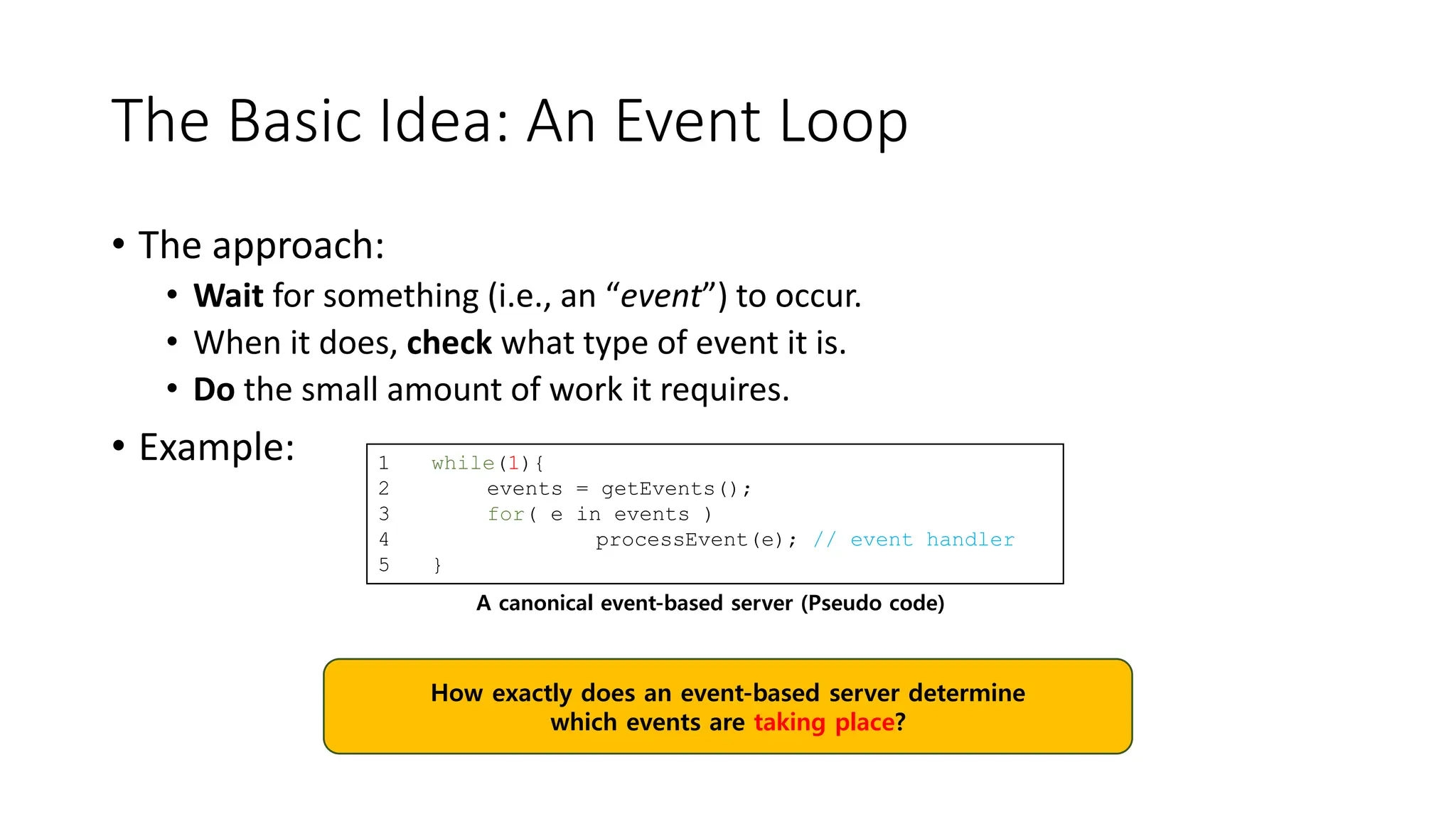
• The approach:
• Wait for something (i.e., an “event”) to occur.
• When it does, check what type of event it is.
• Do the small amount of work it requires.
• Example: 1 while(1){
2 events = getEvents();
3 for( e in events )
4 processEvent(e); // event handler
5 }
How exactly does an event-based server determine
which events are taking place?
A canonical event-based server (Pseudo code)
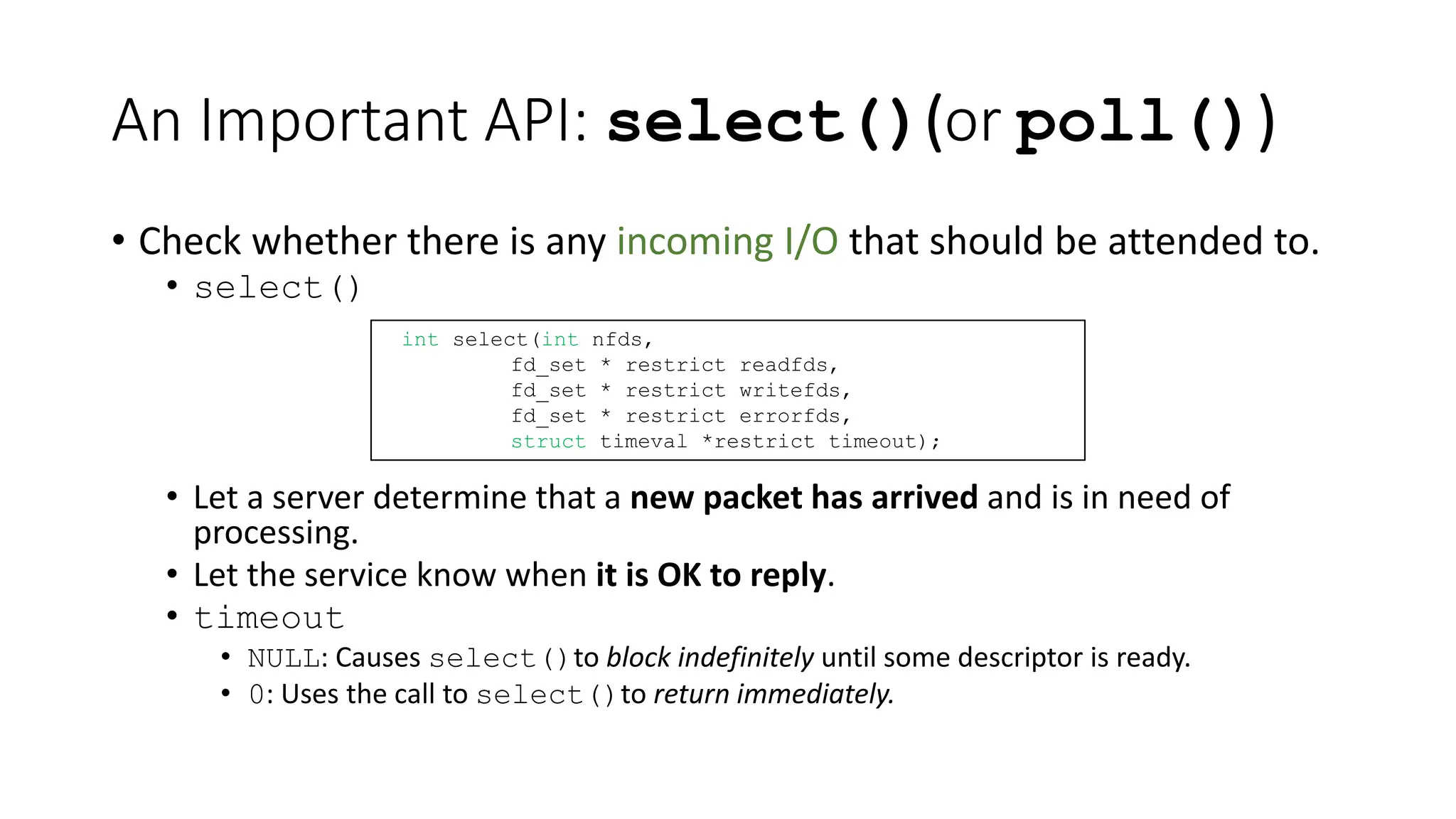
An Important API: select()(or poll())
• Check whether there is any incoming I/O that should be attended to.
• select()
• Let a server determine that a new packet has arrived and is in need of
processing.
• Let the service know when it is OK to reply.
• timeout
• NULL: Causes select()to block indefinitely until some descriptor is ready.
• 0: Uses the call to select()to return immediately.
int select(int nfds,
fd_set * restrict readfds,
fd_set * restrict writefds,
fd_set * restrict errorfds,
struct timeval *restrict timeout);
Using select()
• How to use select()to see which network descriptors have
incoming messages upon them.
1 #include <stdio.h>
2 #include <stdlib.h>
3 #include <sys/time.h>
4 #include <sys/types.h>
5 #include <unistd.h>
6
7 int main(void) {
8 // open and set up a bunch of sockets (not shown)
9 // main loop
10 while (1) {
11 // initialize the fd_set to all zero
12 fd_set readFDs;
13 FD_ZERO(&readFDs);
14
15 // now set the bits for the descriptors
16 // this server is interested in
17 // (for simplicity, all of them from min to max)
18 …
Simple Code using select()
Using select()(Cont.)
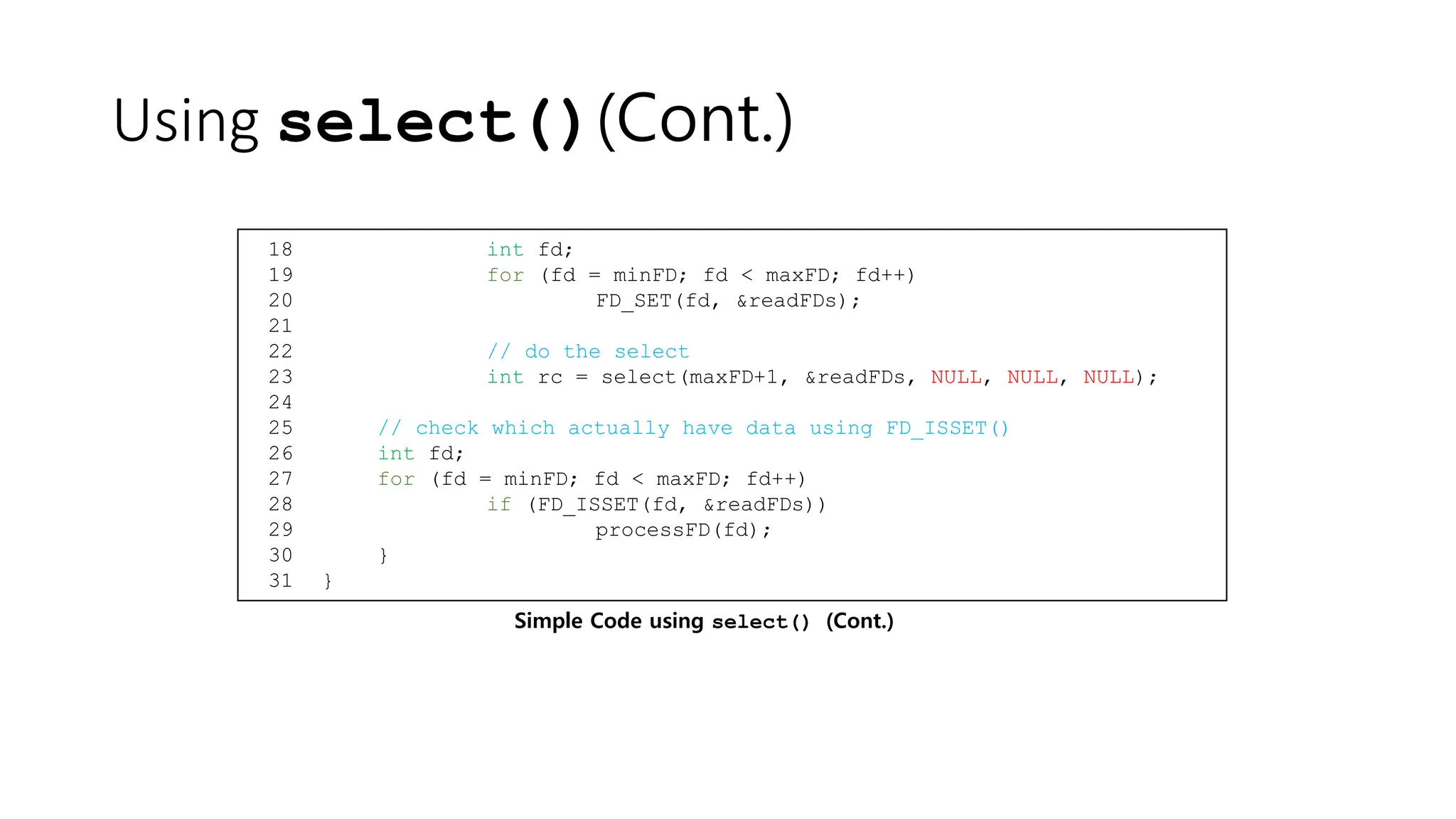
18 int fd;
19 for (fd = minFD; fd < maxFD; fd++)
20 FD_SET(fd, &readFDs);
21
22 // do the select
23 int rc = select(maxFD+1, &readFDs, NULL, NULL, NULL);
24
25 // check which actually have data using FD_ISSET()
26 int fd;
27 for (fd = minFD; fd < maxFD; fd++)
28 if (FD_ISSET(fd, &readFDs))
29 processFD(fd);
30 }
31 }
Simple Code using select() (Cont.)
Why Simpler? No Locks Needed
• The event-based server cannot be interrupted by another thread.
• With a single CPU and an event-based application.
• It is decidedly single threaded.
• Thus, concurrency bugs common in threaded programs do not manifest in
the basic event-based approach.
A Problem: Blocking System Calls
• What if an event requires that you issue a system call that might
block?
• There are no other threads to run: just the main event loop
• The entire server will do just that: block until the call completes.
• Huge potential waste of resources
In event-based systems: no blocking calls are allowed.
Three Ways to Build a Server
A Solution: Asynchronous I/O
• Enable an application to issue an I/O request and return control
immediately to the caller, before the I/O has completed.
• Example:
• An Interface provided on Max OS X
• The APIs revolve around a basic structure, the struct aiocb or AIO control block in
common terminology.
struct aiocb {
int aio_fildes; /* File descriptor */
off_t aio_offset; /* File offset */
volatile void *aio_buf; /* Location of buffer */
size_t aio_nbytes; /* Length of transfer */
};
A Solution: Asynchronous I/O (Cont.)
• Asynchronous API:
• To issue an asynchronous read to a file
• If successful, it returns right away and the application can continue with its work.
• Checks whether the request referred to by aiocbp has completed.
• An application can periodically pool the system via aio_error().
• If it has completed, returns success.
• If not, EINPROGRESS is returned.
int aio_read(struct aiocb *aiocbp);
int aio_error(const struct aiocb *aiocbp);
Another Solution for Asynchronous I/O
• It may be painful to check whether an I/O has completed
• To remedy this issue: use Interrupts
• Remedy the overhead to check whether an I/O has completed
• Using UNIX signals to inform applications when an asynchronous I/O
completes.
• Removing the need to repeatedly ask the system.
Another Problem: State Management
• The code of event-based approach is generally more complicated to
write than traditional thread-based code.
• It must package up some program state for the next event handler to use
when the I/O completes.
• With threads, the state the program needs is on the stack of the thread.
• Manual stack management is needed in event-based approach.
Another Problem: State Management (Cont.)
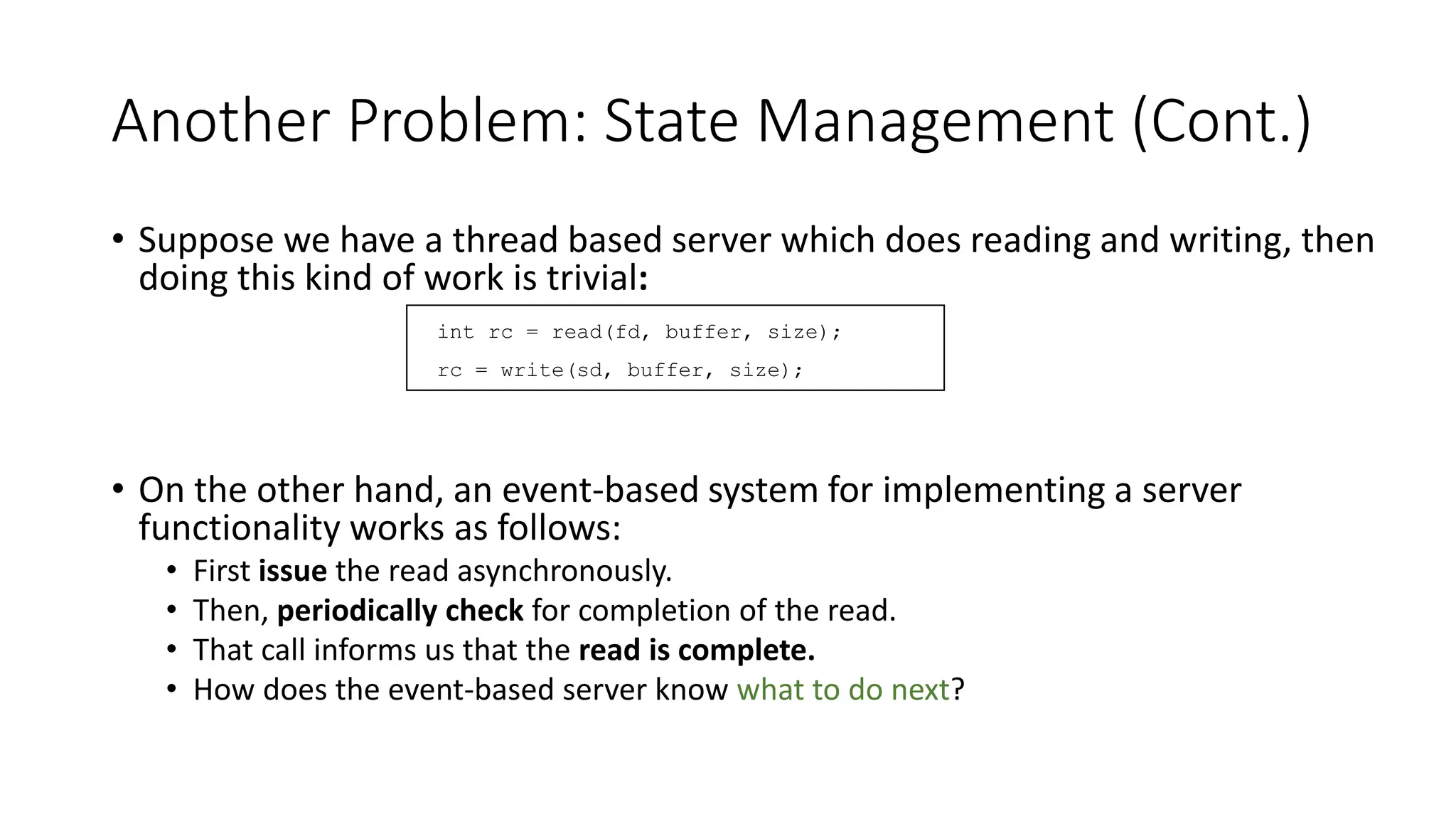
• Suppose we have a thread based server which does reading and writing, then
doing this kind of work is trivial:
• On the other hand, an event-based system for implementing a server
functionality works as follows:
• First issue the read asynchronously.
• Then, periodically check for completion of the read.
• That call informs us that the read is complete.
• How does the event-based server know what to do next?
int rc = read(fd, buffer, size);
rc = write(sd, buffer, size);
Another Problem: State Management (Cont.)
• Solution: continuation
• Record the needed information to finish processing this event in some data
structure.
• When the event happens (i.e., when the disk I/O completes), look up the
needed information and process the event.
What is still difficult with Events?
• Systems moved from a single CPU to multiple CPUs.
• Some of the simplicity of the event-based approach disappeared.
• It does not integrate well with certain kinds of systems activity.
• Example: Paging
• A server will not make progress until page fault completes (implicit blocking).
• Hard to manage over time: The exact semantics of various routines changes.
• Asynchronous disk I/O never quite integrates with asynchronous network I/O in a
simple and uniform manner.
ASIDE: Unix Signals
• Provide a way to communicate with a process.
• HUP (hang up), INT(interrupt), SEGV(segmentation violation), and etc.
• Example: When your program encounters a segmentation violation, the OS
sends it a SIGSEGV.
#include <stdio.h>
#include <signal.h>
void handle(int arg) {
printf("stop wakin’ me up...n");
}
int main(int argc, char *argv[]) {
signal(SIGHUP, handle);
while (1)
; // doin’ nothin’ except catchin’ some sigs
return 0;
}
A simple program that goes into an infinite loop
ASIDE: Unix Signals (Cont.)
• You can send signals to it with the kill command line tool.
• Doing so will interrupt the main while loop in the program and run the
handler code handle().
prompt> ./main &
[3] 36705
prompt> kill -HUP 36705
stop wakin’ me up...
prompt> kill -HUP 36705
stop wakin’ me up...
prompt> kill -HUP 36705
stop wakin’ me up...

Computer Operating Systems Concurrency Slide

  • 1.
    Computer Operating Systems BLG312E Week-9 Prof. Dr. Kemal Bıçakcı
  • 2.
  • 3.
    Review Question • Whichof the following is true regarding the codes below for implementing Parent waiting for Child: a) The codes work correctly. b) The codes do not work as desired because the Parent may sleep forever. c) The codes do not work as desired because the Child may sleep forever. d) The codes do not work as desired because the Parent may exit earlier than Child. 1 void thr_exit() { 2 Pthread_mutex_lock(&m); 3 Pthread_cond_signal(&c); 4 Pthread_mutex_unlock(&m); 5 } 6 7 void thr_join() { 8 Pthread_mutex_lock(&m); 9 Pthread_cond_wait(&c, &m); 10 Pthread_mutex_unlock(&m); 11 }
  • 4.
    Correct Code 1 voidthr_exit() { 2 Pthread_mutex_lock(&m); 3 done = 1; 4 Pthread_cond_signal(&c); 5 Pthread_mutex_unlock(&m); 6 } 7 8 9 void thr_join() { 10 Pthread_mutex_lock(&m); 11 while (done == 0) 12 Pthread_cond_wait(&c, &m); 13 Pthread_mutex_unlock(&m); 14 } Note: state variable vs. condition variable?
  • 6.
    32. Common ConcurrencyProblems Operating System: Three Easy Pieces
  • 7.
    Common Concurrency Problems •Recent work has studied the types of common concurrency bugs. • We will have a brief look at some example concurrency problems found in real code bases.
  • 8.
    What Types OfBugs Exist? • Focus on four major open-source applications • MySQL, Apache, Mozilla, OpenOffice. Application What it does Non-Deadlock Deadlock MySQL Database Server 14 9 Apache Web Server 13 4 Mozilla Web Browser 41 16 Open Office Office Suite 6 2 Total 74 31 Bugs In Modern Applications
  • 9.
    Non-Deadlock Bugs • Makeup a majority of concurrency bugs. • Two major types of non deadlock bugs: • Atomicity violation • Order violation
  • 10.
    Atomicity-Violation Bugs • Thedesired serializability among multiple memory accesses is violated. • Simple Example found in MySQL: • Two different threads access the field proc_info in the struct thd. 1 Thread1:: 2 if(thd->proc_info){ 3 … 4 fputs(thd->proc_info , …); 5 … 6 } 7 8 Thread2:: 9 thd->proc_info = NULL;
  • 11.
    Atomicity-Violation Bugs (Cont.) •Solution: Simply add locks around the shared-variable references. 1 pthread_mutex_t lock = PTHREAD_MUTEX_INITIALIZER; 2 3 Thread1:: 4 pthread_mutex_lock(&lock); 5 if(thd->proc_info){ 6 … 7 fputs(thd->proc_info , …); 8 … 9 } 10 pthread_mutex_unlock(&lock); 11 12 Thread2:: 13 pthread_mutex_lock(&lock); 14 thd->proc_info = NULL; 15 pthread_mutex_unlock(&lock);
  • 12.
    Order-Violation Bugs • Thedesired order between two memory accesses is flipped. • i.e., A should always be executed before B, but the order is not enforced during execution. • Example: • The code in Thread2 seems to assume that the variable mThread has already been initialized (and is not NULL). 1 Thread1:: 2 void init(){ 3 mThread = PR_CreateThread(mMain, …); 4 } 5 6 Thread2:: 7 void mMain(…){ 8 mState = mThread->State 9 }
  • 13.
    Order-Violation Bugs (Cont.) •Solution: Enforce ordering using condition variables 1 pthread_mutex_t mtLock = PTHREAD_MUTEX_INITIALIZER; 2 pthread_cond_t mtCond = PTHREAD_COND_INITIALIZER; 3 int mtInit = 0; 4 5 Thread 1:: 6 void init(){ 7 … 8 mThread = PR_CreateThread(mMain,…); 9 10 // signal that the thread has been created. 11 pthread_mutex_lock(&mtLock); 12 mtInit = 1; 13 pthread_cond_signal(&mtCond); 14 pthread_mutex_unlock(&mtLock); 15 … 16 } 17 18 Thread2:: 19 void mMain(…){ 20 …
  • 14.
    Order-Violation Bugs (Cont.) 21// wait for the thread to be initialized … 22 pthread_mutex_lock(&mtLock); 23 while(mtInit == 0) 24 pthread_cond_wait(&mtCond, &mtLock); 25 pthread_mutex_unlock(&mtLock); 26 27 mState = mThread->State; 28 … 29 }
  • 15.
    Deadlock Bugs • Thepresence of a cycle • Thread1 is holding a lock L1 and waiting for another one, L2. • Thread2 is holding a lock L2 and waiting for another one, L1. Thread 1: lock(L1); lock(L2); Thread 2: lock(L2); lock(L1); Lock L1 Thread 1 Lock L2 Thread 2 Holds Wanted by Holds Wanted by
  • 16.
    Why Do DeadlocksOccur? • Reason 1: • In large code bases, complex dependencies arise between components. • Reason 2: • Due to the nature of encapsulation: • Hide details of implementations and make software easier to build in a modular way. • Such modularity does not mesh well with locking.
  • 17.
    Why Do DeadlocksOccur? (Cont.) • Example: Java Vector class and the method AddAll() • Locks for both the vector being added to (v1) and the parameter (v2) need to be acquired. • The routine acquires said locks in some arbitrary order (v1 then v2). • If some other thread calls v2.AddAll(v1)at nearly the same time  We have the potential for deadlock. 1 Vector v1,v2; 2 v1.AddAll(v2);
  • 18.
    Conditions for Deadlock •Four conditions need to hold for a deadlock to occur. • If any of these four conditions are not met, deadlock cannot occur. Condition Description Mutual Exclusion Threads claim exclusive control of resources that they require. Hold-and-wait Threads hold resources allocated to them while waiting for additional resources No preemption Resources cannot be forcibly removed from threads that are holding them. Circular wait There exists a circular chain of threads such that each thread holds one more resources that are being requested by the next thread in the chain
  • 19.
    Prevention – CircularWait • Provide a total ordering on lock acquisition • This approach requires careful design of global locking strategies. • Example: • There are two locks in the system (L1 and L2) • We can prevent deadlock by always acquiring L1 before L2.
  • 20.
    Prevention – Hold-and-wait •Acquire all locks at once, atomically. • This code guarantees that no untimely thread switch can occur in the midst of lock acquisition. • Problem: • Require us to know when calling a routine exactly which locks must be held and to acquire them ahead of time. • Decrease concurrency 1 lock(prevention); 2 lock(L1); 3 lock(L2); 4 … 5 unlock(prevention);
  • 21.
    Prevention – NoPreemption • Multiple lock acquisition often gets us into trouble because when waiting for one lock we are holding another. • trylock() • Used to build a deadlock-free, ordering-robust lock acquisition protocol. • Grab the lock (if it is available). • Or, return -1: you should try again later. 1 top: 2 lock(L1); 3 if( tryLock(L2) == -1 ){ 4 unlock(L1); 5 goto top; 6 }
  • 22.
    Prevention – NoPreemption (Cont.) • livelock • Both systems are running through the code sequence over and over again. • Progress is not being made. • Solution: • Add a random delay before looping back and trying the entire thing over again.
  • 23.
    Prevention – MutualExclusion • wait-free • Using powerful hardware instructions. • You can build data structures in a manner that do not require explicit locking. 1 int CompareAndSwap(int *address, int expected, int new){ 2 if(*address == expected){ 3 *address = new; 4 return 1; // success 5 } 6 return 0; 7 }
  • 24.
    Prevention – MutualExclusion (Cont.) • We now want to atomically increment a value by a certain amount: • Repeatedly tries to update the value to the new amount and uses the compare-and-swap to do so. • No lock is acquired • No deadlock can arise • livelock is still a possibility. 1 void AtomicIncrement(int *value, int amount){ 2 do{ 3 int old = *value; 4 }while( CompareAndSwap(value, old, old+amount)==0); 5 }
  • 25.
    Prevention – MutualExclusion (Cont.) • A more complex example: list insertion • If called by multiple threads at the “same time”, this code has a race condition. 1 void insert(int value){ 2 node_t * n = malloc(sizeof(node_t)); 3 assert( n != NULL ); 4 n->value = value ; 5 n->next = head; 6 head = n; 7 }
  • 26.
    Prevention – MutualExclusion (Cont.) • Solution: • Surrounding this code with a lock acquire and release. • wait-free manner using the compare-and-swap instruction 1 void insert(int value){ 2 node_t * n = malloc(sizeof(node_t)); 3 assert( n != NULL ); 4 n->value = value ; 5 lock(listlock); // begin critical section 6 n->next = head; 7 head = n; 8 unlock(listlock) ; //end critical section 9 } 1 void insert(int value) { 2 node_t *n = malloc(sizeof(node_t)); 3 assert(n != NULL); 4 n->value = value; 5 do { 6 n->next = head; 7 } while (CompareAndSwap(&head, n->next, n)); 8 }
  • 27.
    Deadlock Avoidance viaScheduling • In some scenarios deadlock avoidance is preferable. • Global knowledge is required: • Which locks various threads might grab during their execution? • Subsequently schedules said threads in a way as to guarantee no deadlock can occur.
  • 28.
    Example of DeadlockAvoidance via Scheduling (1) • We have two processors and four threads. • Lock acquisition demands of the threads: • A smart scheduler could compute that as long as T1 and T2 are not run at the same time, no deadlock could ever arise. T1 T2 T3 T4 L1 yes yes no no L2 yes yes yes no CPU 1 CPU 2 T3 T4 T1 T2
  • 29.
    Example of DeadlockAvoidance via Scheduling (2) • More contention for the same resources • A possible schedule that guarantees that no deadlock could ever occur. • The total time to complete the jobs is lengthened considerably. T1 T2 T3 T4 L1 Yes Yes Yes No L2 Yes Yes Yes No CPU 1 CPU 2 T3 T4 T1 T2
  • 30.
  • 31.
    Which one ofthese allocation states are safe?
  • 33.
    Detect and Recover •Allow deadlock to occasionally occur and then take some action. • Example: if an OS froze, you would reboot it. • Many database systems employ deadlock detection and recovery techniques. • A deadlock detector runs periodically. • Building a resource graph and checking it for cycles. • In deadlock, the system needs to be restarted.
  • 34.
    33. Event-based Concurrency(Advanced) Operating System: Three Easy Pieces
  • 35.
    Event-based Concurrency • Adifferent style of concurrent programming • Used in GUI-based applications, some types of Internet servers. • The problem that event-based concurrency addresses is two-fold: • Managing concurrency correctly in multi-threaded applications. • Missing locks, deadlock, and other nasty problems can arise. • The developer has little or no control over what is scheduled at a given moment in time.
  • 36.
    Three Ways toBuild a Server
  • 37.
    The Basic Idea:An Event Loop • The approach: • Wait for something (i.e., an “event”) to occur. • When it does, check what type of event it is. • Do the small amount of work it requires. • Example: 1 while(1){ 2 events = getEvents(); 3 for( e in events ) 4 processEvent(e); // event handler 5 } How exactly does an event-based server determine which events are taking place? A canonical event-based server (Pseudo code)
  • 38.
    An Important API:select()(or poll()) • Check whether there is any incoming I/O that should be attended to. • select() • Let a server determine that a new packet has arrived and is in need of processing. • Let the service know when it is OK to reply. • timeout • NULL: Causes select()to block indefinitely until some descriptor is ready. • 0: Uses the call to select()to return immediately. int select(int nfds, fd_set * restrict readfds, fd_set * restrict writefds, fd_set * restrict errorfds, struct timeval *restrict timeout);
  • 39.
    Using select() • Howto use select()to see which network descriptors have incoming messages upon them. 1 #include <stdio.h> 2 #include <stdlib.h> 3 #include <sys/time.h> 4 #include <sys/types.h> 5 #include <unistd.h> 6 7 int main(void) { 8 // open and set up a bunch of sockets (not shown) 9 // main loop 10 while (1) { 11 // initialize the fd_set to all zero 12 fd_set readFDs; 13 FD_ZERO(&readFDs); 14 15 // now set the bits for the descriptors 16 // this server is interested in 17 // (for simplicity, all of them from min to max) 18 … Simple Code using select()
  • 40.
    Using select()(Cont.) 18 intfd; 19 for (fd = minFD; fd < maxFD; fd++) 20 FD_SET(fd, &readFDs); 21 22 // do the select 23 int rc = select(maxFD+1, &readFDs, NULL, NULL, NULL); 24 25 // check which actually have data using FD_ISSET() 26 int fd; 27 for (fd = minFD; fd < maxFD; fd++) 28 if (FD_ISSET(fd, &readFDs)) 29 processFD(fd); 30 } 31 } Simple Code using select() (Cont.)
  • 41.
    Why Simpler? NoLocks Needed • The event-based server cannot be interrupted by another thread. • With a single CPU and an event-based application. • It is decidedly single threaded. • Thus, concurrency bugs common in threaded programs do not manifest in the basic event-based approach.
  • 42.
    A Problem: BlockingSystem Calls • What if an event requires that you issue a system call that might block? • There are no other threads to run: just the main event loop • The entire server will do just that: block until the call completes. • Huge potential waste of resources In event-based systems: no blocking calls are allowed.
  • 43.
    Three Ways toBuild a Server
  • 44.
    A Solution: AsynchronousI/O • Enable an application to issue an I/O request and return control immediately to the caller, before the I/O has completed. • Example: • An Interface provided on Max OS X • The APIs revolve around a basic structure, the struct aiocb or AIO control block in common terminology. struct aiocb { int aio_fildes; /* File descriptor */ off_t aio_offset; /* File offset */ volatile void *aio_buf; /* Location of buffer */ size_t aio_nbytes; /* Length of transfer */ };
  • 45.
    A Solution: AsynchronousI/O (Cont.) • Asynchronous API: • To issue an asynchronous read to a file • If successful, it returns right away and the application can continue with its work. • Checks whether the request referred to by aiocbp has completed. • An application can periodically pool the system via aio_error(). • If it has completed, returns success. • If not, EINPROGRESS is returned. int aio_read(struct aiocb *aiocbp); int aio_error(const struct aiocb *aiocbp);
  • 46.
    Another Solution forAsynchronous I/O • It may be painful to check whether an I/O has completed • To remedy this issue: use Interrupts • Remedy the overhead to check whether an I/O has completed • Using UNIX signals to inform applications when an asynchronous I/O completes. • Removing the need to repeatedly ask the system.
  • 47.
    Another Problem: StateManagement • The code of event-based approach is generally more complicated to write than traditional thread-based code. • It must package up some program state for the next event handler to use when the I/O completes. • With threads, the state the program needs is on the stack of the thread. • Manual stack management is needed in event-based approach.
  • 48.
    Another Problem: StateManagement (Cont.) • Suppose we have a thread based server which does reading and writing, then doing this kind of work is trivial: • On the other hand, an event-based system for implementing a server functionality works as follows: • First issue the read asynchronously. • Then, periodically check for completion of the read. • That call informs us that the read is complete. • How does the event-based server know what to do next? int rc = read(fd, buffer, size); rc = write(sd, buffer, size);
  • 49.
    Another Problem: StateManagement (Cont.) • Solution: continuation • Record the needed information to finish processing this event in some data structure. • When the event happens (i.e., when the disk I/O completes), look up the needed information and process the event.
  • 50.
    What is stilldifficult with Events? • Systems moved from a single CPU to multiple CPUs. • Some of the simplicity of the event-based approach disappeared. • It does not integrate well with certain kinds of systems activity. • Example: Paging • A server will not make progress until page fault completes (implicit blocking). • Hard to manage over time: The exact semantics of various routines changes. • Asynchronous disk I/O never quite integrates with asynchronous network I/O in a simple and uniform manner.
  • 51.
    ASIDE: Unix Signals •Provide a way to communicate with a process. • HUP (hang up), INT(interrupt), SEGV(segmentation violation), and etc. • Example: When your program encounters a segmentation violation, the OS sends it a SIGSEGV. #include <stdio.h> #include <signal.h> void handle(int arg) { printf("stop wakin’ me up...n"); } int main(int argc, char *argv[]) { signal(SIGHUP, handle); while (1) ; // doin’ nothin’ except catchin’ some sigs return 0; } A simple program that goes into an infinite loop
  • 52.
    ASIDE: Unix Signals(Cont.) • You can send signals to it with the kill command line tool. • Doing so will interrupt the main while loop in the program and run the handler code handle(). prompt> ./main & [3] 36705 prompt> kill -HUP 36705 stop wakin’ me up... prompt> kill -HUP 36705 stop wakin’ me up... prompt> kill -HUP 36705 stop wakin’ me up...