Mr.Anas Lahrichi
 Listen carefully to the instructions
 5 min
 Individual/no discussions
 Raise your hand quietly for questions and
wait for me to come
 Stay seated until I ask you to give me back
the papers
 WALT : Lesson 10 and 11 : relative and
conditional relative frequencies
 WILF : Seatings in semi-circles and focused
class work
 TIB : There are many versions of frequency
tables and each version helps us peek at the
data from a different perspective. This opens
insights.
 Quiz 2 and entry tickets will be graded by
tomorrow (apologies for the delay)
 Quiz 3 from lesson 7 to 10 on Monday 1st of
October
 My next office hours (in ASI) are Tuesday
after school.
 Today’s word is very connected
 We need to deal with big data and statistical
methods are key
 https://www.youtube.com/watch?v=LtScY2gu
Zpo
 Frequency Tables deal with categorical data
 Bivariate means two variables,we could have
more
 Frequency refers to the number of occurences
of a variable
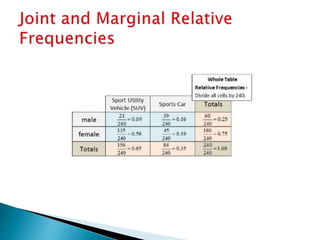
 Joint Frequency : Joining two variables,
Marginal Frequency : involving total
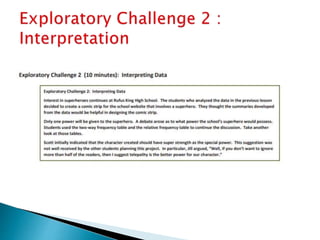
 Exploratory challenge 2 in lesson 11 page 68
(pdf)
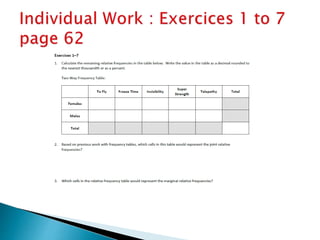
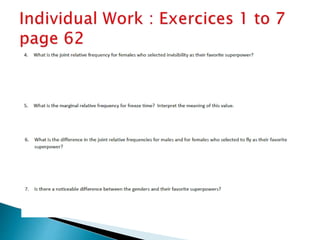
 Exercices 6 to 10 in lesson 11 page 69
 Was posted in classroom
 Remind of Homework Expectations
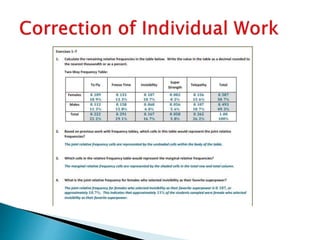
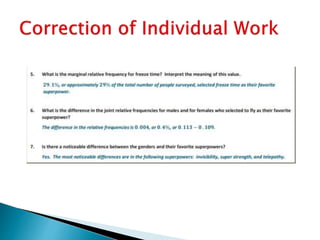
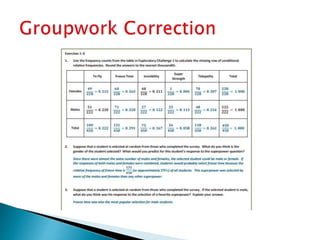
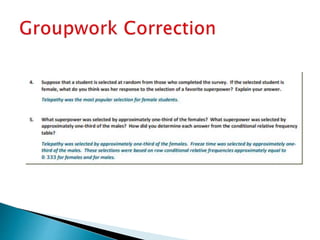
 Go over correction
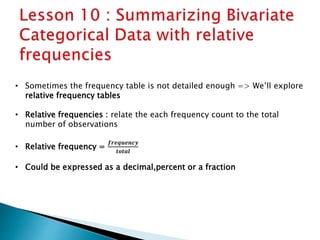
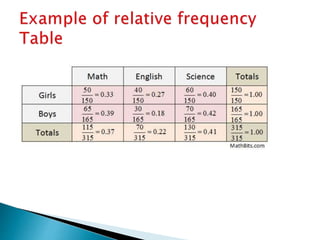
• Sometimes the frequency table is not detailed enough => We’ll explore
relative frequency tables
• Relative frequencies : relate the each frequency count to the total
number of observations
• Relative frequency =
𝒇𝒓𝒆𝒒𝒖𝒆𝒏𝒄𝒚
𝒕𝒐𝒕𝒂𝒍
• Could be expressed as a decimal,percent or a fraction
 Instructions :
• Listen carefully to the instructions
• Take 5 minutes to do the exercises on your
own
• Individual/no discussions
• Raise your hand quietly for questions and wait
for me to come
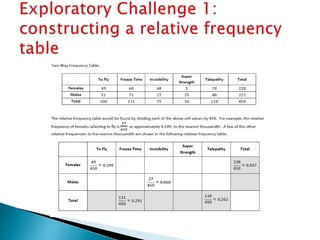
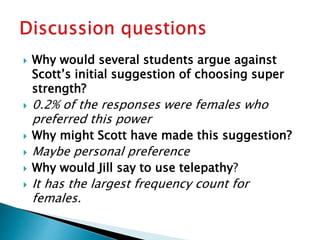
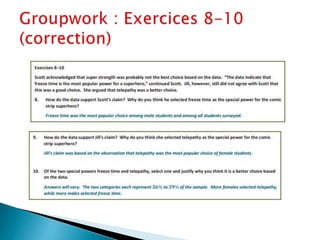
 Why would several students argue against
Scott’s initial suggestion of choosing super
strength?
 0.2% of the responses were females who
preferred this power
 Why might Scott have made this suggestion?
 Maybe personal preference
 Why would Jill say to use telepathy?
 It has the largest frequency count for
females.
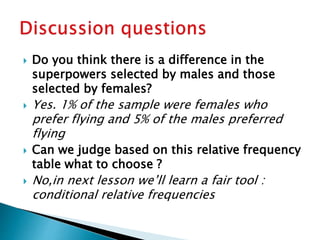
 Do you think there is a difference in the
superpowers selected by males and those
selected by females?
 Yes. 1% of the sample were females who
prefer flying and 5% of the males preferred
flying
 Can we judge based on this relative frequency
table what to choose ?
 No,in next lesson we’ll learn a fair tool :
conditional relative frequencies
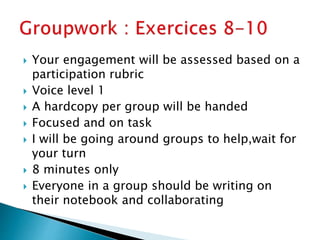
 Your engagement will be assessed based on a
participation rubric
 Voice level 1
 A hardcopy per group will be handed
 Focused and on task
 I will be going around groups to help,wait for
your turn
 8 minutes only
 Everyone in a group should be writing on
their notebook and collaborating
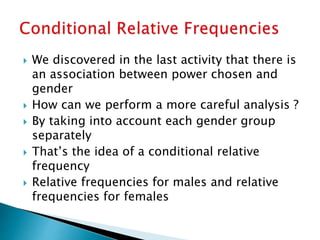
 We discovered in the last activity that there is
an association between power chosen and
gender
 How can we perform a more careful analysis ?
 By taking into account each gender group
separately
 That’s the idea of a conditional relative
frequency
 Relative frequencies for males and relative
frequencies for females
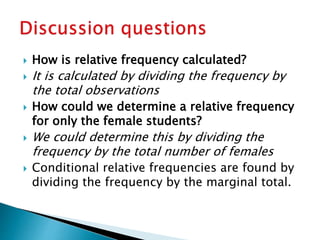
 How is relative frequency calculated?
 It is calculated by dividing the frequency by
the total observations
 How could we determine a relative frequency
for only the female students?
 We could determine this by dividing the
frequency by the total number of females
 Conditional relative frequencies are found by
dividing the frequency by the marginal total.
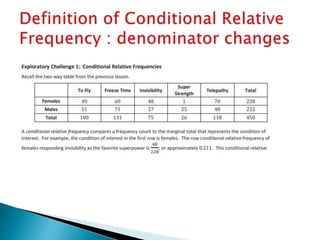
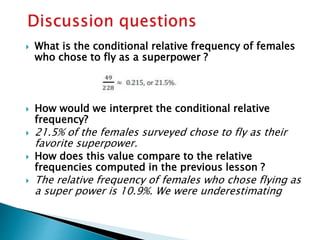
 What is the conditional relative frequency of females
who chose to fly as a superpower ?
 How would we interpret the conditional relative
frequency?
 21.5% of the females surveyed chose to fly as their
favorite superpower.
 How does this value compare to the relative
frequencies computed in the previous lesson ?
 The relative frequency of females who chose flying as
a super power is 10.9%. We were underestimating
 Your engagement will be assessed based on a
participation rubric
 Voice level 1
 A hardcopy per group will be handed
 Focused and on task
 I will be going around groups to help,wait for
your turn
 15 minutes only
 Everyone in a group should be writing on
their notebook and collaborating
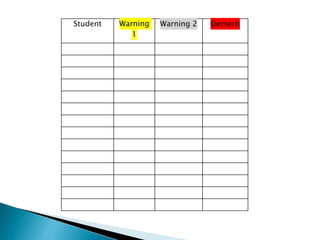
Student Warning
1
Warning 2 Demerit
 Do not talk unless you have
permission (Raise your hand)
 No talking back (Come see in end
of class)
 Stay focused and on task
 Respect your classmates and
teacher
 Be prepared
 You are expected to do your homework on the
due date (no excuses)
 Every time you miss a homework you get a
strike,after 3 your parents are informed
 Not doing your homework will negatively affect
your grade in participation and quizzes
 The corrected quiz as well as rubrics will be posted on
Engrade.
 An individual assesment means no discussion at all. Any
talking will result in a 0.
 If you missed a quiz/test, you are responsible to come to
office hours to retake it.
 Come see me right after class or office hours to discuss
your copy, do not bring it up inside class.
 Any copy written in pencil cannot be considered for re-
grading, use a pen.

27thseptemberalg2

  • 1.
  • 2.
     Listen carefullyto the instructions  5 min  Individual/no discussions  Raise your hand quietly for questions and wait for me to come  Stay seated until I ask you to give me back the papers
  • 3.
     WALT :Lesson 10 and 11 : relative and conditional relative frequencies  WILF : Seatings in semi-circles and focused class work  TIB : There are many versions of frequency tables and each version helps us peek at the data from a different perspective. This opens insights.
  • 4.
     Quiz 2and entry tickets will be graded by tomorrow (apologies for the delay)  Quiz 3 from lesson 7 to 10 on Monday 1st of October  My next office hours (in ASI) are Tuesday after school.
  • 5.
     Today’s wordis very connected  We need to deal with big data and statistical methods are key  https://www.youtube.com/watch?v=LtScY2gu Zpo
  • 6.
     Frequency Tablesdeal with categorical data  Bivariate means two variables,we could have more  Frequency refers to the number of occurences of a variable  Joint Frequency : Joining two variables, Marginal Frequency : involving total
  • 7.
     Exploratory challenge2 in lesson 11 page 68 (pdf)  Exercices 6 to 10 in lesson 11 page 69
  • 8.
     Was postedin classroom  Remind of Homework Expectations  Go over correction
  • 9.
    • Sometimes thefrequency table is not detailed enough => We’ll explore relative frequency tables • Relative frequencies : relate the each frequency count to the total number of observations • Relative frequency = 𝒇𝒓𝒆𝒒𝒖𝒆𝒏𝒄𝒚 𝒕𝒐𝒕𝒂𝒍 • Could be expressed as a decimal,percent or a fraction
  • 13.
     Instructions : •Listen carefully to the instructions • Take 5 minutes to do the exercises on your own • Individual/no discussions • Raise your hand quietly for questions and wait for me to come
  • 20.
     Why wouldseveral students argue against Scott’s initial suggestion of choosing super strength?  0.2% of the responses were females who preferred this power  Why might Scott have made this suggestion?  Maybe personal preference  Why would Jill say to use telepathy?  It has the largest frequency count for females.
  • 21.
     Do youthink there is a difference in the superpowers selected by males and those selected by females?  Yes. 1% of the sample were females who prefer flying and 5% of the males preferred flying  Can we judge based on this relative frequency table what to choose ?  No,in next lesson we’ll learn a fair tool : conditional relative frequencies
  • 22.
     Your engagementwill be assessed based on a participation rubric  Voice level 1  A hardcopy per group will be handed  Focused and on task  I will be going around groups to help,wait for your turn  8 minutes only  Everyone in a group should be writing on their notebook and collaborating
  • 24.
     We discoveredin the last activity that there is an association between power chosen and gender  How can we perform a more careful analysis ?  By taking into account each gender group separately  That’s the idea of a conditional relative frequency  Relative frequencies for males and relative frequencies for females
  • 26.
     How isrelative frequency calculated?  It is calculated by dividing the frequency by the total observations  How could we determine a relative frequency for only the female students?  We could determine this by dividing the frequency by the total number of females  Conditional relative frequencies are found by dividing the frequency by the marginal total.
  • 27.
     What isthe conditional relative frequency of females who chose to fly as a superpower ?  How would we interpret the conditional relative frequency?  21.5% of the females surveyed chose to fly as their favorite superpower.  How does this value compare to the relative frequencies computed in the previous lesson ?  The relative frequency of females who chose flying as a super power is 10.9%. We were underestimating
  • 28.
     Your engagementwill be assessed based on a participation rubric  Voice level 1  A hardcopy per group will be handed  Focused and on task  I will be going around groups to help,wait for your turn  15 minutes only  Everyone in a group should be writing on their notebook and collaborating
  • 31.
  • 32.
     Do nottalk unless you have permission (Raise your hand)  No talking back (Come see in end of class)  Stay focused and on task  Respect your classmates and teacher  Be prepared
  • 33.
     You areexpected to do your homework on the due date (no excuses)  Every time you miss a homework you get a strike,after 3 your parents are informed  Not doing your homework will negatively affect your grade in participation and quizzes
  • 34.
     The correctedquiz as well as rubrics will be posted on Engrade.  An individual assesment means no discussion at all. Any talking will result in a 0.  If you missed a quiz/test, you are responsible to come to office hours to retake it.  Come see me right after class or office hours to discuss your copy, do not bring it up inside class.  Any copy written in pencil cannot be considered for re- grading, use a pen.