GUJARAT TECHNOLOGICAL UNIVERSITY
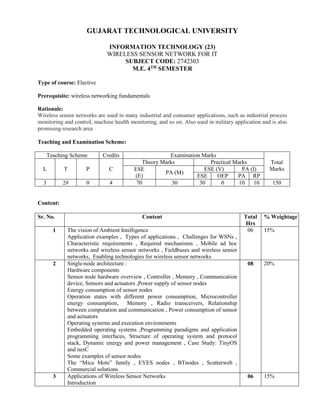
INFORMATION TECHNOLOGY (23)
WIRELESS SENSOR NETWORK FOR IT
SUBJECT CODE: 2742303
M.E. 4TH SEMESTER
Type of course: Elective
Prerequisite: wireless networking fundamentals
Rationale:
Wireless sensor networks are used in many industrial and consumer applications, such as industrial process
monitoring and control, machine health monitoring, and so on. Also used in military application and is also
promising research area
Teaching and Examination Scheme:
Teaching Scheme Credits Examination Marks
Total
Marks
L T P C
Theory Marks Practical Marks
ESE
(E)
PA (M)
ESE (V) PA (I)
ESE OEP PA RP
3 2# 0 4 70 30 30 0 10 10 150
Content:
Sr. No. Content Total
Hrs
% Weightage
1 The vision of Ambient Intelligence
Application examples , Types of applications , Challenges for WSNs ,
Characteristic requirements , Required mechanisms , Mobile ad hoc
networks and wireless sensor networks , Fieldbuses and wireless sensor
networks, Enabling technologies for wireless sensor networks
06 15%
2 Single-node architecture :
Hardware components
Sensor node hardware overview , Controller , Memory , Communication
device, Sensors and actuators ,Power supply of sensor nodes
Energy consumption of sensor nodes
Operation states with different power consumption, Microcontroller
energy consumption, Memory , Radio transceivers, Relationship
between computation and communication , Power consumption of sensor
and actuators
Operating systems and execution environments
Embedded operating systems ,Programming paradigms and application
programming interfaces, Structure of operating system and protocol
stack, Dynamic energy and power management , Case Study: TinyOS
and nesC
Some examples of sensor nodes
The “Mica Mote” family , EYES nodes , BTnodes , Scatterweb ,
Commercial solutions
08 20%
3 Applications of Wireless Sensor Networks
Introduction
06 15%
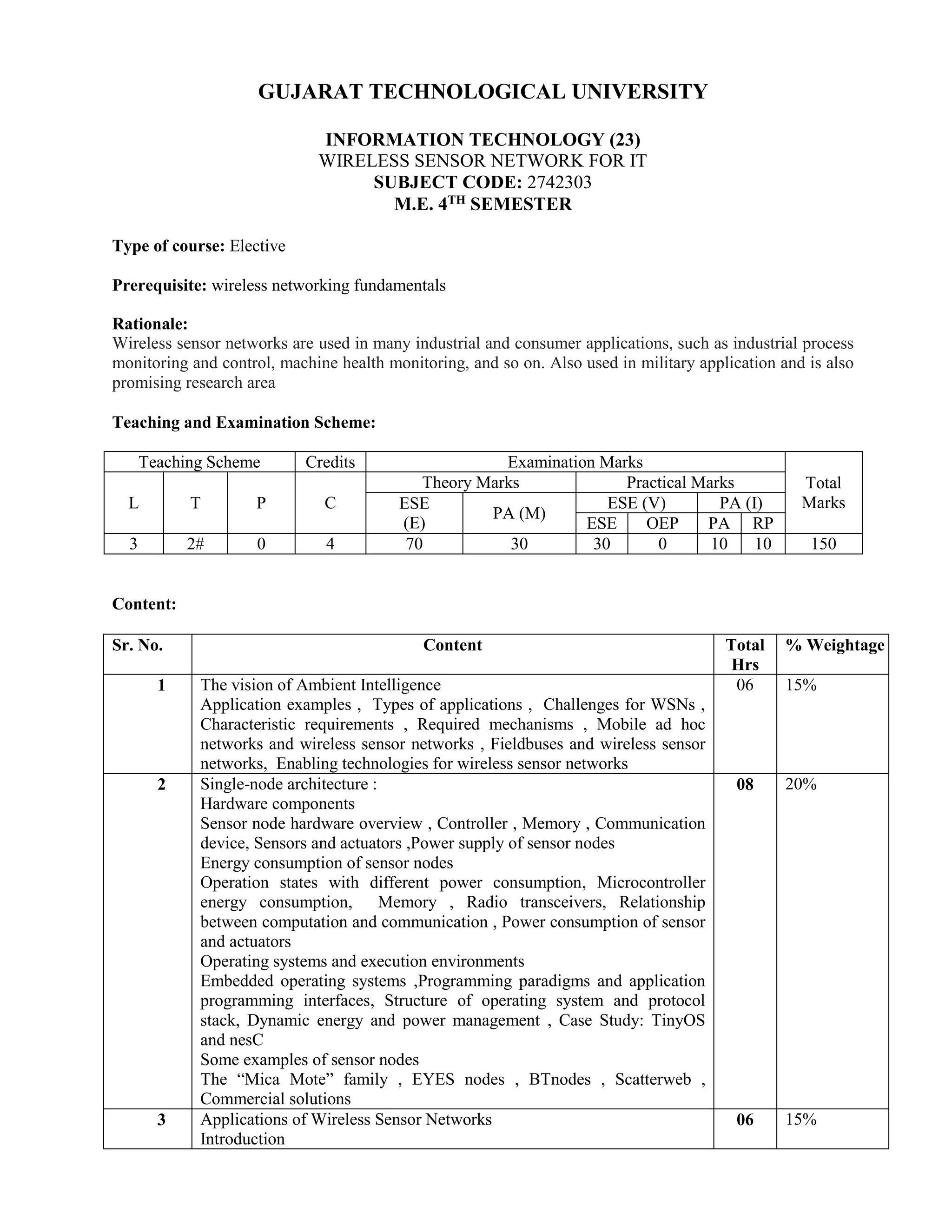
Range of Applications
Examples of Category 2 WSN Applications
Home Control, Building Automation, Industrial Automation, Medical
Applications
Examples of Category 1 WSN Applications
Sensor and Robots, Reconfigurable Sensor Networks, Highway
Monitoring, Military Applications, Civil and Environmental
Engineering Applications, Wildfire Instrumentation, Habitat Monitoring,
Nanoscopic Sensor Applications
4 Medium Access Control Protocols for Wireless Sensor Networks
Introduction
Fundamentals of MAC Protocols
Performance Requirements, Common Protocols
MAC Protocols for WSNs
Schedule-Based Protocols, Random Access-Based Protocols,
Sensor-MAC Case Study
Protocol Overview, Periodic Listen and Sleep Operations, Schedule
Selection and Coordination, Schedule Synchronization, Adaptive
Listening, Access Control and Data Exchange, Message Passing
IEEE 802.15.4 LR-WPANs Standard Case Study
PHY Layer, MAC Layer
06 15%
5 Routing Protocols for Wireless Sensor Networks
Introduction
Data Dissemination and Gathering
Routing Challenges and Design Issues in Wireless
Sensor Networks
Network Scale and Time-Varying Characteristics, Resource Constraints,
Sensor Applications Data Models
Routing Strategies in Wireless Sensor Networks
WSN Routing Techniques, Flooding and Its Variants, Sensor Protocols
for Information via Negotiation, Low-Energy Adaptive Clustering
Hierarchy, Power-Efficient Gathering in Sensor Information
Systems, Directed Diffusion, Geographical Routing
08 20%
6 Transport Control Protocols for Wireless Sensor Networks
Traditional Transport Control Protocols
TCP (RFC 793), UDP (RFC 768)
Mobile IP
Feasibility of Using TCP or UDP for WSNs
Transport Protocol Design Issues
Examples of Existing Transport Control Protocols
CODA (Congestion Detection and Avoidance), ESRT (Event-to-Sink
Reliable Transport), RMST (Reliable Multisegment Transport), PSFQ
(Pump Slowly, Fetch Quickly), GARUDA, ATP (Ad Hoc Transport
Protocol), Problems with Transport Control Protocols
Performance of Transport Control Protocols
Congestion, Packet Loss Recovery
08 15%
7 Network Management for Wireless Sensor Networks
Introduction
Network Management Requirements
Traditional Network Management Models,
Simple Network Management Protocol, Telecom Operation Map
Network Management Design Issues
Example of Management Architecture: MANNA
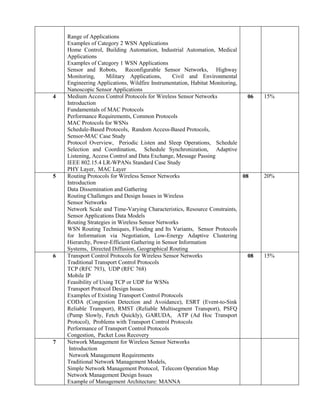
Reference Books:
1. Kazem Sohraby, Daniel Minoli and TaiebZnati, “ Wireless Sensor Networks Technology,
Protocols, and Applications“, John Wiley & Sons, 2007
2. Holger Karl and Andreas Willig, “Protocols and Architectures for Wireless Sensor Networks”, John
Wiley & Sons, Ltd, 2005.
3. C.S. Raghavendra, Krishna M. Sivalingam and TaiebZnati, Wireless Sensor Networks, Springer,
2005
4. Anna Hac, Wireless Sensor Network Designs, John Wiley & Sons Ltd., 2003
5. Jr. Edgar H. Callaway, Wireless Sensor Networks: Architecture and Protocols, Auerbach, 2003
6. Fundamentals of Sensor Network Programming: Applications and Technology By Sridhar S.
Iyengar, NandanParameshwaran, Vir V. Phoha, N. Balakrishnan, Chuka D. Okoye, Wiley
7. AzzedineBoukerche, Handbook of Algorithms for Wireless Networking and Mobile Computing,
Chapman & Hall/CRC, 2006
8. Philip Levis, “ TinyOS Programming”
9. The Internet of Things: Do-It-Yourself at Home Projects for Arduino, Raspberry Pi and
BeagleBone Black Paperback – Import, 16 Feb 2015 by Donald Norris
10. Designing the Internet of Things Paperback by Adrian McEwen, Hakim Cassimally
Course Outcome:
After learning the course the students should be able to:
1) Understand and explain working of various protocols working at various layers of wireless sensor
node.
2) Understand, install and work with operating system installed on wireless sensor node.
3) Develop applications using wireless sensor nodes.
Review Presentation (RP): The concerned faculty member shall provide the list of peer reviewed Journals
and Tier-I and Tier-II Conferences relating to the subject (or relating to the area of thesis for seminar) to the
students in the beginning of the semester. The same list will be uploaded on GTU website during the first
two weeks of the start of the semester. Every student or a group of students shall critically study 2 papers,
integrate the details and make presentation in the last two weeks of the semester. The GTU marks entry
portal will allow entry of marks only after uploading of the best 3 presentations. A unique id number will be
generated only after uploading the presentations. Thereafter the entry of marks will be allowed. The best 3
presentations of each college will be uploaded on GTU website.
Other Issues Related to Network Management
Naming, Localization
8 Operating Systems for Wireless Sensor Networks
Introduction
Operating System Design Issues
Examples of Operating Systems
Mate, MagnetOS, MANTIS, OSPM, EYES OS, SenOS, EMERALDS,
PicOS
07 8
9 Internet of things
Introduction to IoT, Brief introduction to devises like: Raspberry Pi,
Arduino, BeagleBone Black
01 2

2742303.pdf

  • 1.
    GUJARAT TECHNOLOGICAL UNIVERSITY INFORMATIONTECHNOLOGY (23) WIRELESS SENSOR NETWORK FOR IT SUBJECT CODE: 2742303 M.E. 4TH SEMESTER Type of course: Elective Prerequisite: wireless networking fundamentals Rationale: Wireless sensor networks are used in many industrial and consumer applications, such as industrial process monitoring and control, machine health monitoring, and so on. Also used in military application and is also promising research area Teaching and Examination Scheme: Teaching Scheme Credits Examination Marks Total Marks L T P C Theory Marks Practical Marks ESE (E) PA (M) ESE (V) PA (I) ESE OEP PA RP 3 2# 0 4 70 30 30 0 10 10 150 Content: Sr. No. Content Total Hrs % Weightage 1 The vision of Ambient Intelligence Application examples , Types of applications , Challenges for WSNs , Characteristic requirements , Required mechanisms , Mobile ad hoc networks and wireless sensor networks , Fieldbuses and wireless sensor networks, Enabling technologies for wireless sensor networks 06 15% 2 Single-node architecture : Hardware components Sensor node hardware overview , Controller , Memory , Communication device, Sensors and actuators ,Power supply of sensor nodes Energy consumption of sensor nodes Operation states with different power consumption, Microcontroller energy consumption, Memory , Radio transceivers, Relationship between computation and communication , Power consumption of sensor and actuators Operating systems and execution environments Embedded operating systems ,Programming paradigms and application programming interfaces, Structure of operating system and protocol stack, Dynamic energy and power management , Case Study: TinyOS and nesC Some examples of sensor nodes The “Mica Mote” family , EYES nodes , BTnodes , Scatterweb , Commercial solutions 08 20% 3 Applications of Wireless Sensor Networks Introduction 06 15%
  • 2.
    Range of Applications Examplesof Category 2 WSN Applications Home Control, Building Automation, Industrial Automation, Medical Applications Examples of Category 1 WSN Applications Sensor and Robots, Reconfigurable Sensor Networks, Highway Monitoring, Military Applications, Civil and Environmental Engineering Applications, Wildfire Instrumentation, Habitat Monitoring, Nanoscopic Sensor Applications 4 Medium Access Control Protocols for Wireless Sensor Networks Introduction Fundamentals of MAC Protocols Performance Requirements, Common Protocols MAC Protocols for WSNs Schedule-Based Protocols, Random Access-Based Protocols, Sensor-MAC Case Study Protocol Overview, Periodic Listen and Sleep Operations, Schedule Selection and Coordination, Schedule Synchronization, Adaptive Listening, Access Control and Data Exchange, Message Passing IEEE 802.15.4 LR-WPANs Standard Case Study PHY Layer, MAC Layer 06 15% 5 Routing Protocols for Wireless Sensor Networks Introduction Data Dissemination and Gathering Routing Challenges and Design Issues in Wireless Sensor Networks Network Scale and Time-Varying Characteristics, Resource Constraints, Sensor Applications Data Models Routing Strategies in Wireless Sensor Networks WSN Routing Techniques, Flooding and Its Variants, Sensor Protocols for Information via Negotiation, Low-Energy Adaptive Clustering Hierarchy, Power-Efficient Gathering in Sensor Information Systems, Directed Diffusion, Geographical Routing 08 20% 6 Transport Control Protocols for Wireless Sensor Networks Traditional Transport Control Protocols TCP (RFC 793), UDP (RFC 768) Mobile IP Feasibility of Using TCP or UDP for WSNs Transport Protocol Design Issues Examples of Existing Transport Control Protocols CODA (Congestion Detection and Avoidance), ESRT (Event-to-Sink Reliable Transport), RMST (Reliable Multisegment Transport), PSFQ (Pump Slowly, Fetch Quickly), GARUDA, ATP (Ad Hoc Transport Protocol), Problems with Transport Control Protocols Performance of Transport Control Protocols Congestion, Packet Loss Recovery 08 15% 7 Network Management for Wireless Sensor Networks Introduction Network Management Requirements Traditional Network Management Models, Simple Network Management Protocol, Telecom Operation Map Network Management Design Issues Example of Management Architecture: MANNA
  • 3.
    Reference Books: 1. KazemSohraby, Daniel Minoli and TaiebZnati, “ Wireless Sensor Networks Technology, Protocols, and Applications“, John Wiley & Sons, 2007 2. Holger Karl and Andreas Willig, “Protocols and Architectures for Wireless Sensor Networks”, John Wiley & Sons, Ltd, 2005. 3. C.S. Raghavendra, Krishna M. Sivalingam and TaiebZnati, Wireless Sensor Networks, Springer, 2005 4. Anna Hac, Wireless Sensor Network Designs, John Wiley & Sons Ltd., 2003 5. Jr. Edgar H. Callaway, Wireless Sensor Networks: Architecture and Protocols, Auerbach, 2003 6. Fundamentals of Sensor Network Programming: Applications and Technology By Sridhar S. Iyengar, NandanParameshwaran, Vir V. Phoha, N. Balakrishnan, Chuka D. Okoye, Wiley 7. AzzedineBoukerche, Handbook of Algorithms for Wireless Networking and Mobile Computing, Chapman & Hall/CRC, 2006 8. Philip Levis, “ TinyOS Programming” 9. The Internet of Things: Do-It-Yourself at Home Projects for Arduino, Raspberry Pi and BeagleBone Black Paperback – Import, 16 Feb 2015 by Donald Norris 10. Designing the Internet of Things Paperback by Adrian McEwen, Hakim Cassimally Course Outcome: After learning the course the students should be able to: 1) Understand and explain working of various protocols working at various layers of wireless sensor node. 2) Understand, install and work with operating system installed on wireless sensor node. 3) Develop applications using wireless sensor nodes. Review Presentation (RP): The concerned faculty member shall provide the list of peer reviewed Journals and Tier-I and Tier-II Conferences relating to the subject (or relating to the area of thesis for seminar) to the students in the beginning of the semester. The same list will be uploaded on GTU website during the first two weeks of the start of the semester. Every student or a group of students shall critically study 2 papers, integrate the details and make presentation in the last two weeks of the semester. The GTU marks entry portal will allow entry of marks only after uploading of the best 3 presentations. A unique id number will be generated only after uploading the presentations. Thereafter the entry of marks will be allowed. The best 3 presentations of each college will be uploaded on GTU website. Other Issues Related to Network Management Naming, Localization 8 Operating Systems for Wireless Sensor Networks Introduction Operating System Design Issues Examples of Operating Systems Mate, MagnetOS, MANTIS, OSPM, EYES OS, SenOS, EMERALDS, PicOS 07 8 9 Internet of things Introduction to IoT, Brief introduction to devises like: Raspberry Pi, Arduino, BeagleBone Black 01 2