MS&E 270: STRATEGY IN TECHNOLOGY-BASED COMPANIES Chris Mocko, Lakshmi Mohan, Sohail Razzaq, and Jun Jiang
Initial Position
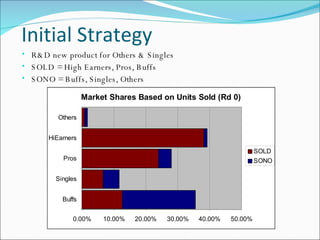
Initial Strategy R&D new product for Others & Singles SOLD = High Earners, Pros, Buffs SONO = Buffs, Singles, Others
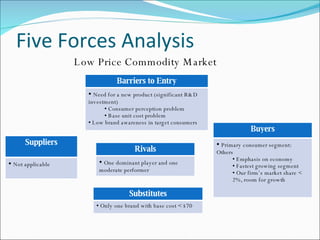
Five Forces Analysis Low Price Commodity Market Barriers to Entry Need for a new product (significant R&D investment) Consumer perception problem Base unit cost problem Low brand awareness in target consumers Rivals One dominant player and one moderate performer Substitutes Only one brand with base cost < $70 Buyers Primary consumer segment: Others Emphasis on economy Fastest growing segment Our firm’s market share < 2%, room for growth Suppliers Not applicable
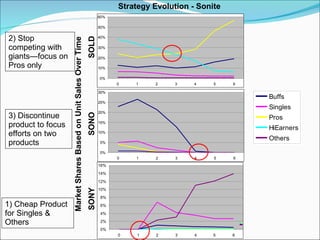
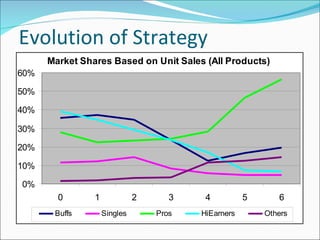
Market Shares Based on Unit Sales Over Time SOLD SONO SONY Strategy Evolution - Sonite 1) Cheap Product for Singles & Others 3) Discontinue product to focus efforts on two products 2) Stop competing with giants—focus on Pros only
Evolution of Strategy
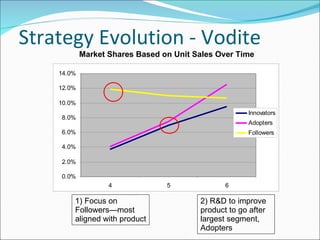
Strategy Evolution - Vodite Market Shares Based on Unit Sales Over Time 1) Focus on Followers—most aligned with product 2) R&D to improve product to go after largest segment, Adopters
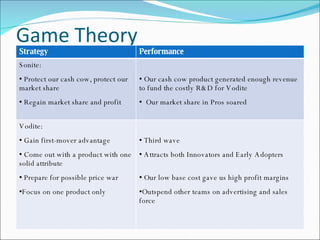
Game Theory Strategy Performance Sonite: Protect our cash cow, protect our market share Regain market share and profit Our cash cow product generated enough revenue to fund the costly R&D for Vodite Our market share in Pros soared Vodite: Gain first-mover advantage Come out with a product with one solid attribute Prepare for possible price war Focus on one product only Third wave Attracts both Innovators and Early Adopters Our low base cost gave us high profit margins Outspend other teams on advertising and sales force
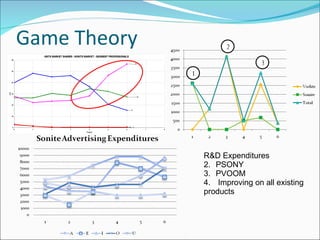
Game Theory 1 2 3 R&D Expenditures PSONY PVOOM Improving on all existing  products
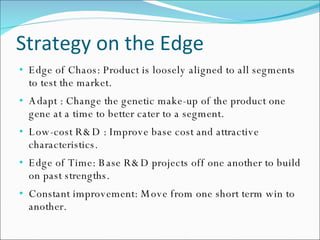
Strategy on the Edge Edge of Chaos: Product is loosely aligned to all segments to test the market. Adapt : Change the genetic make-up of the product one gene at a time to better cater to a segment. Low-cost R&D : Improve base cost and attractive characteristics. Edge of Time: Base R&D projects off one another to build on past strengths. Constant improvement: Move from one short term win to another.
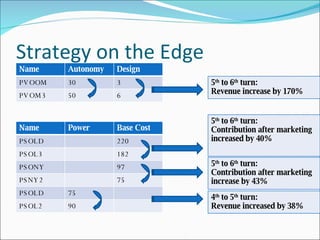
Strategy on the Edge Name Autonomy Design PVOOM 30 3 PVOM3 50 6 Name Power Base Cost PSOLD 220 PSOL3 182 PSONY 97 PSNY2 75 PSOLD 75 PSOL2 90 5 th  to 6 th  turn: Revenue increase by 170% 5 th  to 6 th  turn: Contribution after marketing increased by 40% 5 th  to 6 th  turn: Contribution after marketing increase by 43% 4 th  to 5 th  turn: Revenue increased by 38%
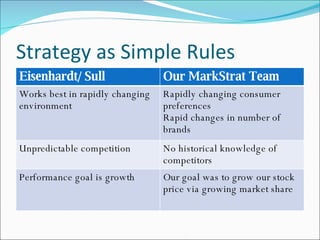
Strategy as Simple Rules Eisenhardt/ Sull Our MarkStrat Team Works best in rapidly changing environment Rapidly changing consumer preferences Rapid changes in number of brands Unpredictable competition No historical knowledge of competitors Performance goal is growth Our goal was to grow our stock price via growing market share
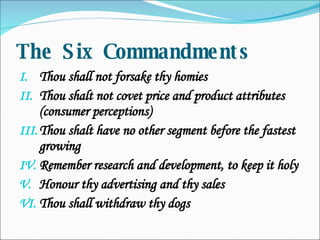
The Six Commandments Thou shall not forsake thy homies Thou shalt not covet price and product attributes (consumer perceptions) Thou shalt have no other segment before the fastest growing Remember research and development, to keep it holy Honour thy advertising and thy sales Thou shall withdraw thy dogs
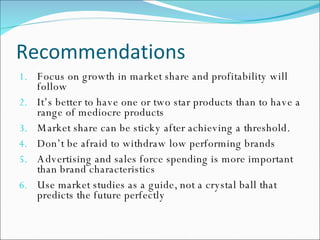
Recommendations Focus on growth in market share and profitability will follow It’s better to have one or two star products than to have a range of mediocre products Market share can be sticky after achieving a threshold.  Don’t be afraid to withdraw low performing brands Advertising and sales force spending is more important than brand characteristics Use market studies as a guide, not a crystal ball that predicts the future perfectly

270 Presentation2

  • 1.
    MS&E 270: STRATEGYIN TECHNOLOGY-BASED COMPANIES Chris Mocko, Lakshmi Mohan, Sohail Razzaq, and Jun Jiang
  • 2.
  • 3.
    Initial Strategy R&Dnew product for Others & Singles SOLD = High Earners, Pros, Buffs SONO = Buffs, Singles, Others
  • 4.
    Five Forces AnalysisLow Price Commodity Market Barriers to Entry Need for a new product (significant R&D investment) Consumer perception problem Base unit cost problem Low brand awareness in target consumers Rivals One dominant player and one moderate performer Substitutes Only one brand with base cost < $70 Buyers Primary consumer segment: Others Emphasis on economy Fastest growing segment Our firm’s market share < 2%, room for growth Suppliers Not applicable
  • 5.
    Market Shares Basedon Unit Sales Over Time SOLD SONO SONY Strategy Evolution - Sonite 1) Cheap Product for Singles & Others 3) Discontinue product to focus efforts on two products 2) Stop competing with giants—focus on Pros only
  • 6.
  • 7.
    Strategy Evolution -Vodite Market Shares Based on Unit Sales Over Time 1) Focus on Followers—most aligned with product 2) R&D to improve product to go after largest segment, Adopters
  • 8.
    Game Theory StrategyPerformance Sonite: Protect our cash cow, protect our market share Regain market share and profit Our cash cow product generated enough revenue to fund the costly R&D for Vodite Our market share in Pros soared Vodite: Gain first-mover advantage Come out with a product with one solid attribute Prepare for possible price war Focus on one product only Third wave Attracts both Innovators and Early Adopters Our low base cost gave us high profit margins Outspend other teams on advertising and sales force
  • 9.
    Game Theory 12 3 R&D Expenditures PSONY PVOOM Improving on all existing products
  • 10.
    Strategy on theEdge Edge of Chaos: Product is loosely aligned to all segments to test the market. Adapt : Change the genetic make-up of the product one gene at a time to better cater to a segment. Low-cost R&D : Improve base cost and attractive characteristics. Edge of Time: Base R&D projects off one another to build on past strengths. Constant improvement: Move from one short term win to another.
  • 11.
    Strategy on theEdge Name Autonomy Design PVOOM 30 3 PVOM3 50 6 Name Power Base Cost PSOLD 220 PSOL3 182 PSONY 97 PSNY2 75 PSOLD 75 PSOL2 90 5 th to 6 th turn: Revenue increase by 170% 5 th to 6 th turn: Contribution after marketing increased by 40% 5 th to 6 th turn: Contribution after marketing increase by 43% 4 th to 5 th turn: Revenue increased by 38%
  • 12.
    Strategy as SimpleRules Eisenhardt/ Sull Our MarkStrat Team Works best in rapidly changing environment Rapidly changing consumer preferences Rapid changes in number of brands Unpredictable competition No historical knowledge of competitors Performance goal is growth Our goal was to grow our stock price via growing market share
  • 13.
    The Six CommandmentsThou shall not forsake thy homies Thou shalt not covet price and product attributes (consumer perceptions) Thou shalt have no other segment before the fastest growing Remember research and development, to keep it holy Honour thy advertising and thy sales Thou shall withdraw thy dogs
  • 14.
    Recommendations Focus ongrowth in market share and profitability will follow It’s better to have one or two star products than to have a range of mediocre products Market share can be sticky after achieving a threshold. Don’t be afraid to withdraw low performing brands Advertising and sales force spending is more important than brand characteristics Use market studies as a guide, not a crystal ball that predicts the future perfectly