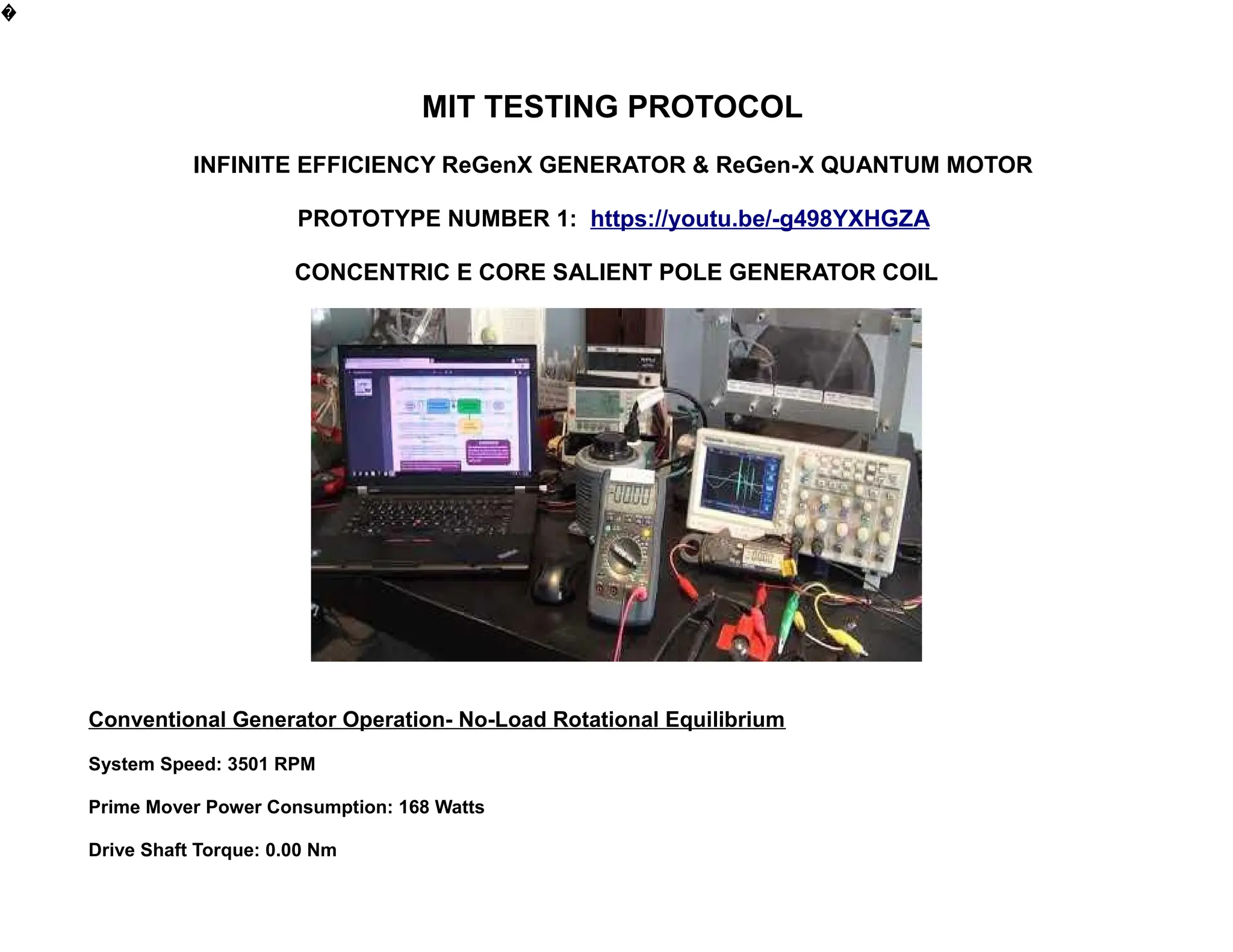
MIT TESTING PROTOCOL
INFINITE EFFICIENCY ReGenX GENERATOR & ReGen-X QUANTUM MOTOR
PROTOTYPE NUMBER 1: https://youtu.be/-g498YXHGZA
CONCENTRIC E CORE SALIENT POLE GENERATOR COIL
Conventional Generator Operation- No-Load Rotational Equilibrium
System Speed: 3501 RPM
Prime Mover Power Consumption: 168 Watts
Drive Shaft Torque: 0.00 Nm
�
Drive Shaft Power: 0.00 Watts
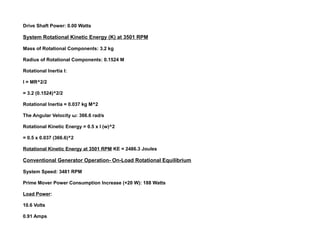
System Rotational Kinetic Energy (K) at 3501 RPM
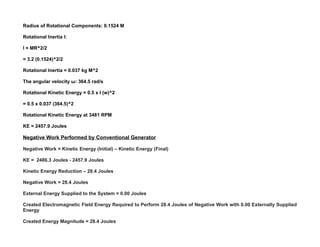
Mass of Rotational Components: 3.2 kg
Radius of Rotational Components: 0.1524 M
Rotational Inertia I:
I = MR^2/2
= 3.2 (0.1524)^2/2
Rotational Inertia = 0.037 kg M^2
The Angular Velocity ω: 366.6 rad/s
Rotational Kinetic Energy = 0.5 x I (w)^2
= 0.5 x 0.037 (366.6)^2
Rotational Kinetic Energy at 3501 RPM KE = 2486.3 Joules
Conventional Generator Operation- On-Load Rotational Equilibrium
System Speed: 3481 RPM
Prime Mover Power Consumption Increase (+20 W): 188 Watts
Load Power:
10.6 Volts
0.91 Amps
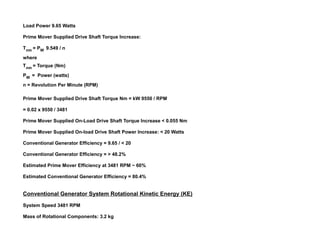
Load Power 9.65 Watts
Prime Mover Supplied Drive Shaft Torque Increase:
Tnm = PW 9.549 / n
where
Tnm = Torque (Nm)
PW = Power (watts)
n = Revolution Per Minute (RPM)
Prime Mover Supplied Drive Shaft Torque Nm = kW 9550 / RPM
= 0.02 x 9550 / 3481
Prime Mover Supplied On-Load Drive Shaft Torque Increase < 0.055 Nm
Prime Mover Supplied On-load Drive Shaft Power Increase: < 20 Watts
Conventional Generator Efficiency = 9.65 / < 20
Conventional Generator Efficiency = > 48.2%
Estimated Prime Mover Efficiency at 3481 RPM ~ 60%
Estimated Conventional Generator Efficiency = 80.4%
Conventional Generator System Rotational Kinetic Energy (KE)
System Speed 3481 RPM
Mass of Rotational Components: 3.2 kg
Radius of Rotational Components: 0.1524 M
Rotational Inertia I:
I = MR^2/2
= 3.2 (0.1524)^2/2
Rotational Inertia = 0.037 kg M^2
The angular velocity ω: 364.5 rad/s
Rotational Kinetic Energy = 0.5 x I (w)^2
= 0.5 x 0.037 (364.5)^2
Rotational Kinetic Energy at 3481 RPM
KE = 2457.9 Joules
Negative Work Performed by Conventional Generator
Negative Work = Kinetic Energy (Initial) – Kinetic Energy (Final)
KE = 2486.3 Joules - 2457.9 Joules
Kinetic Energy Reduction – 28.4 Joules
Negative Work = 28.4 Joules
External Energy Supplied to the System = 0.00 Joules
Created Electromagnetic Field Energy Required to Perform 28.4 Joules of Negative Work with 0.00 Externally Supplied
Energy
Created Energy Magnitude = 28.4 Joules
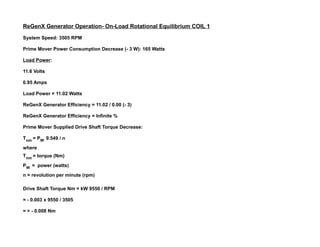
ReGenX Generator Operation- On-Load Rotational Equilibrium COIL 1
System Speed: 3505 RPM
Prime Mover Power Consumption Decrease (- 3 W): 165 Watts
Load Power:
11.6 Volts
0.95 Amps
Load Power = 11.02 Watts
ReGenX Generator Efficiency = 11.02 / 0.00 (- 3)
ReGenX Generator Efficiency = Infinite %
Prime Mover Supplied Drive Shaft Torque Decrease:
Tnm = PW 9.549 / n
where
Tnm = torque (Nm)
PW = power (watts)
n = revolution per minute (rpm)
Drive Shaft Torque Nm = kW 9550 / RPM
= - 0.003 x 9550 / 3505
= > - 0.008 Nm
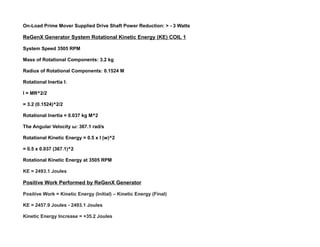
On-Load Prime Mover Supplied Drive Shaft Power Reduction: > - 3 Watts
ReGenX Generator System Rotational Kinetic Energy (KE) COIL 1
System Speed 3505 RPM
Mass of Rotational Components: 3.2 kg
Radius of Rotational Components: 0.1524 M
Rotational Inertia I:
I = MR^2/2
= 3.2 (0.1524)^2/2
Rotational Inertia = 0.037 kg M^2
The Angular Velocity ω: 367.1 rad/s
Rotational Kinetic Energy = 0.5 x I (w)^2
= 0.5 x 0.037 (367.1)^2
Rotational Kinetic Energy at 3505 RPM
KE = 2493.1 Joules
Positive Work Performed by ReGenX Generator
Positive Work = Kinetic Energy (Initial) – Kinetic Energy (Final)
KE = 2457.9 Joules - 2493.1 Joules
Kinetic Energy Increase = +35.2 Joules
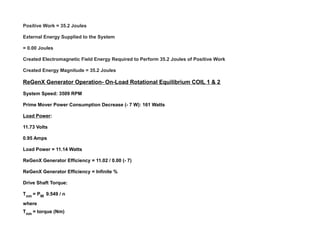
Positive Work = 35.2 Joules
External Energy Supplied to the System
= 0.00 Joules
Created Electromagnetic Field Energy Required to Perform 35.2 Joules of Positive Work
Created Energy Magnitude = 35.2 Joules
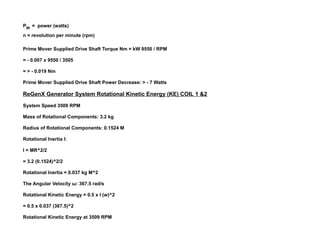
ReGenX Generator Operation- On-Load Rotational Equilibrium COIL 1 & 2
System Speed: 3509 RPM
Prime Mover Power Consumption Decrease (- 7 W): 161 Watts
Load Power:
11.73 Volts
0.95 Amps
Load Power = 11.14 Watts
ReGenX Generator Efficiency = 11.02 / 0.00 (- 7)
ReGenX Generator Efficiency = Infinite %
Drive Shaft Torque:
Tnm = PW 9.549 / n
where
Tnm = torque (Nm)
PW = power (watts)
n = revolution per minute (rpm)
Prime Mover Supplied Drive Shaft Torque Nm = kW 9550 / RPM
= - 0.007 x 9550 / 3505
= > - 0.019 Nm
Prime Mover Supplied Drive Shaft Power Decrease: > - 7 Watts
ReGenX Generator System Rotational Kinetic Energy (KE) COIL 1 &2
System Speed 3509 RPM
Mass of Rotational Components: 3.2 kg
Radius of Rotational Components: 0.1524 M
Rotational Inertia I:
I = MR^2/2
= 3.2 (0.1524)^2/2
Rotational Inertia = 0.037 kg M^2
The Angular Velocity ω: 367.5 rad/s
Rotational Kinetic Energy = 0.5 x I (w)^2
= 0.5 x 0.037 (367.5)^2
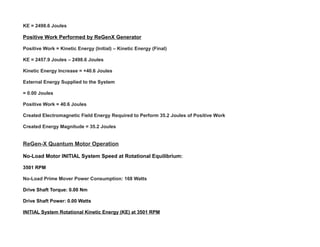
Rotational Kinetic Energy at 3509 RPM
KE = 2498.6 Joules
Positive Work Performed by ReGenX Generator
Positive Work = Kinetic Energy (Initial) – Kinetic Energy (Final)
KE = 2457.9 Joules – 2498.6 Joules
Kinetic Energy Increase = +40.6 Joules
External Energy Supplied to the System
= 0.00 Joules
Positive Work = 40.6 Joules
Created Electromagnetic Field Energy Required to Perform 35.2 Joules of Positive Work
Created Energy Magnitude = 35.2 Joules
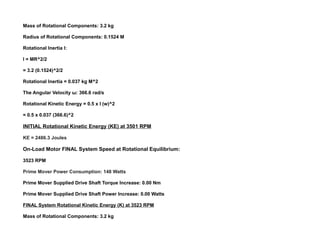
ReGen-X Quantum Motor Operation
No-Load Motor INITIAL System Speed at Rotational Equilibrium:
3501 RPM
No-Load Prime Mover Power Consumption: 168 Watts
Drive Shaft Torque: 0.00 Nm
Drive Shaft Power: 0.00 Watts
INITIAL System Rotational Kinetic Energy (KE) at 3501 RPM
Mass of Rotational Components: 3.2 kg
Radius of Rotational Components: 0.1524 M
Rotational Inertia I:
I = MR^2/2
= 3.2 (0.1524)^2/2
Rotational Inertia = 0.037 kg M^2
The Angular Velocity ω: 366.6 rad/s
Rotational Kinetic Energy = 0.5 x I (w)^2
= 0.5 x 0.037 (366.6)^2
INITIAL Rotational Kinetic Energy (KE) at 3501 RPM
KE = 2486.3 Joules
On-Load Motor FINAL System Speed at Rotational Equilibrium:
3523 RPM
Prime Mover Power Consumption: 148 Watts
Prime Mover Supplied Drive Shaft Torque Increase: 0.00 Nm
Prime Mover Supplied Drive Shaft Power Increase: 0.00 Watts
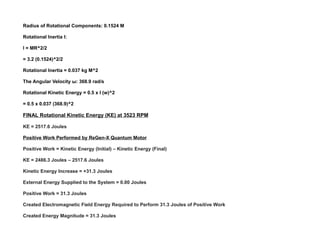
FINAL System Rotational Kinetic Energy (K) at 3523 RPM
Mass of Rotational Components: 3.2 kg
Radius of Rotational Components: 0.1524 M
Rotational Inertia I:
I = MR^2/2
= 3.2 (0.1524)^2/2
Rotational Inertia = 0.037 kg M^2
The Angular Velocity ω: 368.9 rad/s
Rotational Kinetic Energy = 0.5 x I (w)^2
= 0.5 x 0.037 (368.9)^2
FINAL Rotational Kinetic Energy (KE) at 3523 RPM
KE = 2517.6 Joules
Positive Work Performed by ReGen-X Quantum Motor
Positive Work = Kinetic Energy (Initial) – Kinetic Energy (Final)
KE = 2486.3 Joules – 2517.6 Joules
Kinetic Energy Increase = +31.3 Joules
External Energy Supplied to the System = 0.00 Joules
Positive Work = 31.3 Joules
Created Electromagnetic Field Energy Required to Perform 31.3 Joules of Positive Work
Created Energy Magnitude = 31.3 Joules
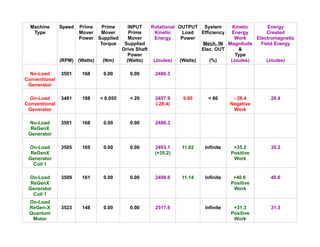
Machine
Type
Speed
(RPM)
Prime
Mover
Power
(Watts)
Prime
Mover
Supplied
Torque
(Nm)
INPUT
Prime
Mover
Supplied
Drive Shaft
Power
(Watts)
Rotational
Kinetic
Energy
(Joules)
OUTPUT
Load
Power
(Watts)
System
Efficiency
Mech. IN
Elec. OUT
(%)
Kinetic
Energy
Work
Magnitude
&
Type
(Joules)
Energy
Created
Electromagnetic
Field Energy
(Joules)
No-Load
Conventional
Generator
3501 168 0.00 0.00 2486.3
On-Load
Conventional
Generator
3481 188 < 0.055 < 20 2457.9
(-28.4)
9.65 < 80 - 28.4
Negative
Work
28.4
No-Load
ReGenX
Generator
3501 168 0.00 0.00 2486.3
On-Load
ReGenX
Generator
Coil 1
3505 165 0.00 0.00 2493.1
(+35.2)
11.02 Infinite +35.2
Positive
Work
35.2
On-Load
ReGenX
Generator
Coil 1
3509 161 0.00 0.00 2498.6 11.14 Infinite +40.6
Positive
Work
40.6
On-Load
ReGen-X
Quantum
Motor
3523 148 0.00 0.00 2517.6 Infinite +31.3
Positive
Work
31.3
Thane C. Heins
President and CEO, Potential +/- Difference Inc. R&D
Ottawa, Canada
thaneh@potentialdifference.ca
613.293.1131
“The future depends on what we do today... in a gentle way, we can shake the world”
— Mahatma Gandhi

#27 MIT TESTING PROTOCOL - INFINITE EFFICIENCY ReGenX GENERATOR & QUANTUM MOTOR.pdf

  • 1.
    MIT TESTING PROTOCOL INFINITEEFFICIENCY ReGenX GENERATOR & ReGen-X QUANTUM MOTOR PROTOTYPE NUMBER 1: https://youtu.be/-g498YXHGZA CONCENTRIC E CORE SALIENT POLE GENERATOR COIL Conventional Generator Operation- No-Load Rotational Equilibrium System Speed: 3501 RPM Prime Mover Power Consumption: 168 Watts Drive Shaft Torque: 0.00 Nm �
  • 2.
    Drive Shaft Power:0.00 Watts System Rotational Kinetic Energy (K) at 3501 RPM Mass of Rotational Components: 3.2 kg Radius of Rotational Components: 0.1524 M Rotational Inertia I: I = MR^2/2 = 3.2 (0.1524)^2/2 Rotational Inertia = 0.037 kg M^2 The Angular Velocity ω: 366.6 rad/s Rotational Kinetic Energy = 0.5 x I (w)^2 = 0.5 x 0.037 (366.6)^2 Rotational Kinetic Energy at 3501 RPM KE = 2486.3 Joules Conventional Generator Operation- On-Load Rotational Equilibrium System Speed: 3481 RPM Prime Mover Power Consumption Increase (+20 W): 188 Watts Load Power: 10.6 Volts 0.91 Amps
  • 3.
    Load Power 9.65Watts Prime Mover Supplied Drive Shaft Torque Increase: Tnm = PW 9.549 / n where Tnm = Torque (Nm) PW = Power (watts) n = Revolution Per Minute (RPM) Prime Mover Supplied Drive Shaft Torque Nm = kW 9550 / RPM = 0.02 x 9550 / 3481 Prime Mover Supplied On-Load Drive Shaft Torque Increase < 0.055 Nm Prime Mover Supplied On-load Drive Shaft Power Increase: < 20 Watts Conventional Generator Efficiency = 9.65 / < 20 Conventional Generator Efficiency = > 48.2% Estimated Prime Mover Efficiency at 3481 RPM ~ 60% Estimated Conventional Generator Efficiency = 80.4% Conventional Generator System Rotational Kinetic Energy (KE) System Speed 3481 RPM Mass of Rotational Components: 3.2 kg
  • 4.
    Radius of RotationalComponents: 0.1524 M Rotational Inertia I: I = MR^2/2 = 3.2 (0.1524)^2/2 Rotational Inertia = 0.037 kg M^2 The angular velocity ω: 364.5 rad/s Rotational Kinetic Energy = 0.5 x I (w)^2 = 0.5 x 0.037 (364.5)^2 Rotational Kinetic Energy at 3481 RPM KE = 2457.9 Joules Negative Work Performed by Conventional Generator Negative Work = Kinetic Energy (Initial) – Kinetic Energy (Final) KE = 2486.3 Joules - 2457.9 Joules Kinetic Energy Reduction – 28.4 Joules Negative Work = 28.4 Joules External Energy Supplied to the System = 0.00 Joules Created Electromagnetic Field Energy Required to Perform 28.4 Joules of Negative Work with 0.00 Externally Supplied Energy Created Energy Magnitude = 28.4 Joules
  • 5.
    ReGenX Generator Operation-On-Load Rotational Equilibrium COIL 1 System Speed: 3505 RPM Prime Mover Power Consumption Decrease (- 3 W): 165 Watts Load Power: 11.6 Volts 0.95 Amps Load Power = 11.02 Watts ReGenX Generator Efficiency = 11.02 / 0.00 (- 3) ReGenX Generator Efficiency = Infinite % Prime Mover Supplied Drive Shaft Torque Decrease: Tnm = PW 9.549 / n where Tnm = torque (Nm) PW = power (watts) n = revolution per minute (rpm) Drive Shaft Torque Nm = kW 9550 / RPM = - 0.003 x 9550 / 3505 = > - 0.008 Nm
  • 6.
    On-Load Prime MoverSupplied Drive Shaft Power Reduction: > - 3 Watts ReGenX Generator System Rotational Kinetic Energy (KE) COIL 1 System Speed 3505 RPM Mass of Rotational Components: 3.2 kg Radius of Rotational Components: 0.1524 M Rotational Inertia I: I = MR^2/2 = 3.2 (0.1524)^2/2 Rotational Inertia = 0.037 kg M^2 The Angular Velocity ω: 367.1 rad/s Rotational Kinetic Energy = 0.5 x I (w)^2 = 0.5 x 0.037 (367.1)^2 Rotational Kinetic Energy at 3505 RPM KE = 2493.1 Joules Positive Work Performed by ReGenX Generator Positive Work = Kinetic Energy (Initial) – Kinetic Energy (Final) KE = 2457.9 Joules - 2493.1 Joules Kinetic Energy Increase = +35.2 Joules
  • 7.
    Positive Work =35.2 Joules External Energy Supplied to the System = 0.00 Joules Created Electromagnetic Field Energy Required to Perform 35.2 Joules of Positive Work Created Energy Magnitude = 35.2 Joules ReGenX Generator Operation- On-Load Rotational Equilibrium COIL 1 & 2 System Speed: 3509 RPM Prime Mover Power Consumption Decrease (- 7 W): 161 Watts Load Power: 11.73 Volts 0.95 Amps Load Power = 11.14 Watts ReGenX Generator Efficiency = 11.02 / 0.00 (- 7) ReGenX Generator Efficiency = Infinite % Drive Shaft Torque: Tnm = PW 9.549 / n where Tnm = torque (Nm)
  • 8.
    PW = power(watts) n = revolution per minute (rpm) Prime Mover Supplied Drive Shaft Torque Nm = kW 9550 / RPM = - 0.007 x 9550 / 3505 = > - 0.019 Nm Prime Mover Supplied Drive Shaft Power Decrease: > - 7 Watts ReGenX Generator System Rotational Kinetic Energy (KE) COIL 1 &2 System Speed 3509 RPM Mass of Rotational Components: 3.2 kg Radius of Rotational Components: 0.1524 M Rotational Inertia I: I = MR^2/2 = 3.2 (0.1524)^2/2 Rotational Inertia = 0.037 kg M^2 The Angular Velocity ω: 367.5 rad/s Rotational Kinetic Energy = 0.5 x I (w)^2 = 0.5 x 0.037 (367.5)^2 Rotational Kinetic Energy at 3509 RPM
  • 9.
    KE = 2498.6Joules Positive Work Performed by ReGenX Generator Positive Work = Kinetic Energy (Initial) – Kinetic Energy (Final) KE = 2457.9 Joules – 2498.6 Joules Kinetic Energy Increase = +40.6 Joules External Energy Supplied to the System = 0.00 Joules Positive Work = 40.6 Joules Created Electromagnetic Field Energy Required to Perform 35.2 Joules of Positive Work Created Energy Magnitude = 35.2 Joules ReGen-X Quantum Motor Operation No-Load Motor INITIAL System Speed at Rotational Equilibrium: 3501 RPM No-Load Prime Mover Power Consumption: 168 Watts Drive Shaft Torque: 0.00 Nm Drive Shaft Power: 0.00 Watts INITIAL System Rotational Kinetic Energy (KE) at 3501 RPM
  • 10.
    Mass of RotationalComponents: 3.2 kg Radius of Rotational Components: 0.1524 M Rotational Inertia I: I = MR^2/2 = 3.2 (0.1524)^2/2 Rotational Inertia = 0.037 kg M^2 The Angular Velocity ω: 366.6 rad/s Rotational Kinetic Energy = 0.5 x I (w)^2 = 0.5 x 0.037 (366.6)^2 INITIAL Rotational Kinetic Energy (KE) at 3501 RPM KE = 2486.3 Joules On-Load Motor FINAL System Speed at Rotational Equilibrium: 3523 RPM Prime Mover Power Consumption: 148 Watts Prime Mover Supplied Drive Shaft Torque Increase: 0.00 Nm Prime Mover Supplied Drive Shaft Power Increase: 0.00 Watts FINAL System Rotational Kinetic Energy (K) at 3523 RPM Mass of Rotational Components: 3.2 kg
  • 11.
    Radius of RotationalComponents: 0.1524 M Rotational Inertia I: I = MR^2/2 = 3.2 (0.1524)^2/2 Rotational Inertia = 0.037 kg M^2 The Angular Velocity ω: 368.9 rad/s Rotational Kinetic Energy = 0.5 x I (w)^2 = 0.5 x 0.037 (368.9)^2 FINAL Rotational Kinetic Energy (KE) at 3523 RPM KE = 2517.6 Joules Positive Work Performed by ReGen-X Quantum Motor Positive Work = Kinetic Energy (Initial) – Kinetic Energy (Final) KE = 2486.3 Joules – 2517.6 Joules Kinetic Energy Increase = +31.3 Joules External Energy Supplied to the System = 0.00 Joules Positive Work = 31.3 Joules Created Electromagnetic Field Energy Required to Perform 31.3 Joules of Positive Work Created Energy Magnitude = 31.3 Joules
  • 12.
    Machine Type Speed (RPM) Prime Mover Power (Watts) Prime Mover Supplied Torque (Nm) INPUT Prime Mover Supplied Drive Shaft Power (Watts) Rotational Kinetic Energy (Joules) OUTPUT Load Power (Watts) System Efficiency Mech. IN Elec.OUT (%) Kinetic Energy Work Magnitude & Type (Joules) Energy Created Electromagnetic Field Energy (Joules) No-Load Conventional Generator 3501 168 0.00 0.00 2486.3 On-Load Conventional Generator 3481 188 < 0.055 < 20 2457.9 (-28.4) 9.65 < 80 - 28.4 Negative Work 28.4 No-Load ReGenX Generator 3501 168 0.00 0.00 2486.3 On-Load ReGenX Generator Coil 1 3505 165 0.00 0.00 2493.1 (+35.2) 11.02 Infinite +35.2 Positive Work 35.2 On-Load ReGenX Generator Coil 1 3509 161 0.00 0.00 2498.6 11.14 Infinite +40.6 Positive Work 40.6 On-Load ReGen-X Quantum Motor 3523 148 0.00 0.00 2517.6 Infinite +31.3 Positive Work 31.3
  • 13.
    Thane C. Heins Presidentand CEO, Potential +/- Difference Inc. R&D Ottawa, Canada thaneh@potentialdifference.ca 613.293.1131 “The future depends on what we do today... in a gentle way, we can shake the world” — Mahatma Gandhi