DATA WAREHOUSING
DATA WAREHOUSING TOOLS
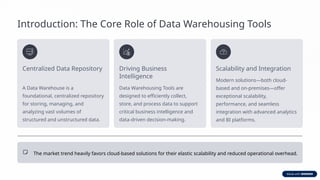
Introduction: The Core Role of Data Warehousing Tools
Centralized Data Repository
A Data Warehouse is a
foundational, centralized repository
for storing, managing, and
analyzing vast volumes of
structured and unstructured data.
Driving Business
Intelligence
Data Warehousing Tools are
designed to efficiently collect,
store, and process data to support
critical business intelligence and
data-driven decision-making.
Scalability and Integration
Modern solutions—both cloud-
based and on-premises—offer
exceptional scalability,
performance, and seamless
integration with advanced analytics
and BI platforms.
The market trend heavily favors cloud-based solutions for their elastic scalability and reduced operational overhead.
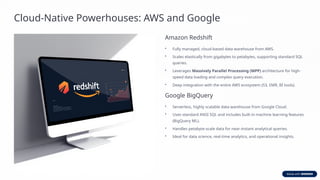
Cloud-Native Powerhouses: AWS and Google
Amazon Redshift
• Fully managed, cloud-based data warehouse from AWS.
• Scales elastically from gigabytes to petabytes, supporting standard SQL
queries.
• Leverages Massively Parallel Processing (MPP) architecture for high-
speed data loading and complex query execution.
• Deep integration with the entire AWS ecosystem (S3, EMR, BI tools).
Google BigQuery
• Serverless, highly scalable data warehouse from Google Cloud.
• Uses standard ANSI SQL and includes built-in machine learning features
(BigQuery ML).
• Handles petabyte-scale data for near-instant analytical queries.
• Ideal for data science, real-time analytics, and operational insights.
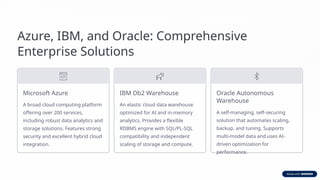
Azure, IBM, and Oracle: Comprehensive
Enterprise Solutions
Microsoft Azure
A broad cloud computing platform
offering over 200 services,
including robust data analytics and
storage solutions. Features strong
security and excellent hybrid cloud
integration.
IBM Db2 Warehouse
An elastic cloud data warehouse
optimized for AI and in-memory
analytics. Provides a flexible
RDBMS engine with SQL/PL-SQL
compatibility and independent
scaling of storage and compute.
Oracle Autonomous
Warehouse
A self-managing, self-securing
solution that automates scaling,
backup, and tuning. Supports
multi-model data and uses AI-
driven optimization for
performance.
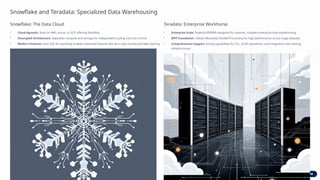
Snowflake and Teradata: Specialized Data Warehousing
Snowflake: The Data Cloud
• Cloud-Agnostic: Built on AWS, Azure, or GCP, offering flexibility.
• Decoupled Architecture: Separates compute and storage for independent scaling and cost control.
• Modern Features: Uses SQL for querying; enables advanced features like zero-copy cloning and data sharing.
Teradata: Enterprise Workhorse
• Enterprise Scale: Powerful RDBMS designed for massive, complex enterprise data warehousing.
• MPP Foundation: Utilizes Massively Parallel Processing for high performance across huge datasets.
• Comprehensive Support: Strong capabilities for ETL, OLAP operations, and integration into existing
infrastructures.
Database Ecosystems: SQL and NoSQL
Selecting the right database type is crucial. While OLAP systems handle complex queries, OLTP systems prioritize transaction speed and
volume.
Amazon DynamoDB (NoSQL)
A fully managed, serverless NoSQL service from AWS. Highly
scalable and supports key-value and document models,
primarily used for high-speed Online Transaction Processing
(OLTP).
PostgreSQL (RDBMS)
Robust, open-source RDBMS known for strong data
integrity. Suitable for both OLTP and OLAP systems, offering
advanced SQL features and extensibility.
Amazon RDS (PaaS)
Platform as a Service (PaaS) solution automating
management (backups, scaling, maintenance) for popular
relational engines like MySQL, PostgreSQL, and SQL Server. MariaDB (RDBMS)
An open-source fork of MySQL, offering faster query
execution and cross-platform support. Excellent for
transactional and light analytical workloads.
Focus: Real-Time & Advanced Analytics
Micro Focus Vertica
MPP analytical database utilizing
column-oriented storage to
significantly improve query speed.
Specialized for real-time and
advanced analytics workloads,
including predictive modeling.
Cloudera
An enterprise data platform that
unifies analytics, machine learning,
and BI tools. Provides robust data
integration and governance
running across multi-cloud and
hybrid environments.
MarkLogic
A multi-model NoSQL database
that efficiently handles billions of
documents (XML, JSON). Used for
creating real-time operational data
hubs requiring flexibility and high
data volume management.
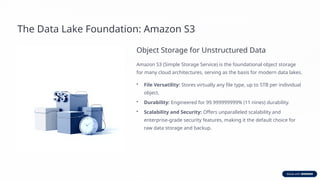
The Data Lake Foundation: Amazon S3
Object Storage for Unstructured Data
Amazon S3 (Simple Storage Service) is the foundational object storage
for many cloud architectures, serving as the basis for modern data lakes.
• File Versatility: Stores virtually any file type, up to 5TB per individual
object.
• Durability: Engineered for 99.999999999% (11 nines) durability.
• Scalability and Security: Offers unparalleled scalability and
enterprise-grade security features, making it the default choice for
raw data storage and backup.
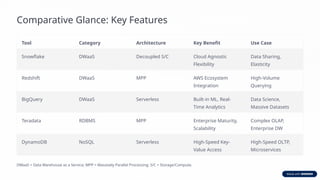
Comparative Glance: Key Features
Tool Category Architecture Key Benefit Use Case
Snowflake DWaaS Decoupled S/C Cloud Agnostic
Flexibility
Data Sharing,
Elasticity
Redshift DWaaS MPP AWS Ecosystem
Integration
High-Volume
Querying
BigQuery DWaaS Serverless Built-in ML, Real-
Time Analytics
Data Science,
Massive Datasets
Teradata RDBMS MPP Enterprise Maturity,
Scalability
Complex OLAP,
Enterprise DW
DynamoDB NoSQL Serverless High-Speed Key-
Value Access
High-Speed OLTP,
Microservices
DWaaS = Data Warehouse as a Service; MPP = Massively Parallel Processing; S/C = Storage/Compute.
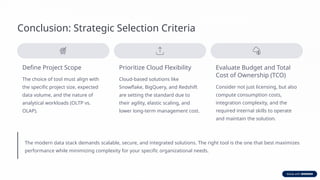
Conclusion: Strategic Selection Criteria
Define Project Scope
The choice of tool must align with
the specific project size, expected
data volume, and the nature of
analytical workloads (OLTP vs.
OLAP).
Prioritize Cloud Flexibility
Cloud-based solutions like
Snowflake, BigQuery, and Redshift
are setting the standard due to
their agility, elastic scaling, and
lower long-term management cost.
Evaluate Budget and Total
Cost of Ownership (TCO)
Consider not just licensing, but also
compute consumption costs,
integration complexity, and the
required internal skills to operate
and maintain the solution.
The modern data stack demands scalable, secure, and integrated solutions. The right tool is the one that best maximizes
performance while minimizing complexity for your specific organizational needs.
THANK YOU!

the understanding of data warehouse tools

  • 1.
  • 2.
    Introduction: The CoreRole of Data Warehousing Tools Centralized Data Repository A Data Warehouse is a foundational, centralized repository for storing, managing, and analyzing vast volumes of structured and unstructured data. Driving Business Intelligence Data Warehousing Tools are designed to efficiently collect, store, and process data to support critical business intelligence and data-driven decision-making. Scalability and Integration Modern solutions—both cloud- based and on-premises—offer exceptional scalability, performance, and seamless integration with advanced analytics and BI platforms. The market trend heavily favors cloud-based solutions for their elastic scalability and reduced operational overhead.
  • 3.
    Cloud-Native Powerhouses: AWSand Google Amazon Redshift • Fully managed, cloud-based data warehouse from AWS. • Scales elastically from gigabytes to petabytes, supporting standard SQL queries. • Leverages Massively Parallel Processing (MPP) architecture for high- speed data loading and complex query execution. • Deep integration with the entire AWS ecosystem (S3, EMR, BI tools). Google BigQuery • Serverless, highly scalable data warehouse from Google Cloud. • Uses standard ANSI SQL and includes built-in machine learning features (BigQuery ML). • Handles petabyte-scale data for near-instant analytical queries. • Ideal for data science, real-time analytics, and operational insights.
  • 4.
    Azure, IBM, andOracle: Comprehensive Enterprise Solutions Microsoft Azure A broad cloud computing platform offering over 200 services, including robust data analytics and storage solutions. Features strong security and excellent hybrid cloud integration. IBM Db2 Warehouse An elastic cloud data warehouse optimized for AI and in-memory analytics. Provides a flexible RDBMS engine with SQL/PL-SQL compatibility and independent scaling of storage and compute. Oracle Autonomous Warehouse A self-managing, self-securing solution that automates scaling, backup, and tuning. Supports multi-model data and uses AI- driven optimization for performance.
  • 5.
    Snowflake and Teradata:Specialized Data Warehousing Snowflake: The Data Cloud • Cloud-Agnostic: Built on AWS, Azure, or GCP, offering flexibility. • Decoupled Architecture: Separates compute and storage for independent scaling and cost control. • Modern Features: Uses SQL for querying; enables advanced features like zero-copy cloning and data sharing. Teradata: Enterprise Workhorse • Enterprise Scale: Powerful RDBMS designed for massive, complex enterprise data warehousing. • MPP Foundation: Utilizes Massively Parallel Processing for high performance across huge datasets. • Comprehensive Support: Strong capabilities for ETL, OLAP operations, and integration into existing infrastructures.
  • 6.
    Database Ecosystems: SQLand NoSQL Selecting the right database type is crucial. While OLAP systems handle complex queries, OLTP systems prioritize transaction speed and volume. Amazon DynamoDB (NoSQL) A fully managed, serverless NoSQL service from AWS. Highly scalable and supports key-value and document models, primarily used for high-speed Online Transaction Processing (OLTP). PostgreSQL (RDBMS) Robust, open-source RDBMS known for strong data integrity. Suitable for both OLTP and OLAP systems, offering advanced SQL features and extensibility. Amazon RDS (PaaS) Platform as a Service (PaaS) solution automating management (backups, scaling, maintenance) for popular relational engines like MySQL, PostgreSQL, and SQL Server. MariaDB (RDBMS) An open-source fork of MySQL, offering faster query execution and cross-platform support. Excellent for transactional and light analytical workloads.
  • 7.
    Focus: Real-Time &Advanced Analytics Micro Focus Vertica MPP analytical database utilizing column-oriented storage to significantly improve query speed. Specialized for real-time and advanced analytics workloads, including predictive modeling. Cloudera An enterprise data platform that unifies analytics, machine learning, and BI tools. Provides robust data integration and governance running across multi-cloud and hybrid environments. MarkLogic A multi-model NoSQL database that efficiently handles billions of documents (XML, JSON). Used for creating real-time operational data hubs requiring flexibility and high data volume management.
  • 8.
    The Data LakeFoundation: Amazon S3 Object Storage for Unstructured Data Amazon S3 (Simple Storage Service) is the foundational object storage for many cloud architectures, serving as the basis for modern data lakes. • File Versatility: Stores virtually any file type, up to 5TB per individual object. • Durability: Engineered for 99.999999999% (11 nines) durability. • Scalability and Security: Offers unparalleled scalability and enterprise-grade security features, making it the default choice for raw data storage and backup.
  • 9.
    Comparative Glance: KeyFeatures Tool Category Architecture Key Benefit Use Case Snowflake DWaaS Decoupled S/C Cloud Agnostic Flexibility Data Sharing, Elasticity Redshift DWaaS MPP AWS Ecosystem Integration High-Volume Querying BigQuery DWaaS Serverless Built-in ML, Real- Time Analytics Data Science, Massive Datasets Teradata RDBMS MPP Enterprise Maturity, Scalability Complex OLAP, Enterprise DW DynamoDB NoSQL Serverless High-Speed Key- Value Access High-Speed OLTP, Microservices DWaaS = Data Warehouse as a Service; MPP = Massively Parallel Processing; S/C = Storage/Compute.
  • 10.
    Conclusion: Strategic SelectionCriteria Define Project Scope The choice of tool must align with the specific project size, expected data volume, and the nature of analytical workloads (OLTP vs. OLAP). Prioritize Cloud Flexibility Cloud-based solutions like Snowflake, BigQuery, and Redshift are setting the standard due to their agility, elastic scaling, and lower long-term management cost. Evaluate Budget and Total Cost of Ownership (TCO) Consider not just licensing, but also compute consumption costs, integration complexity, and the required internal skills to operate and maintain the solution. The modern data stack demands scalable, secure, and integrated solutions. The right tool is the one that best maximizes performance while minimizing complexity for your specific organizational needs.
  • 11.