1
new functions by shifting, stretching, and reflecting their graphs. We also show how to
combine pairs of functions by the standard arithmetic operations and by composition.
Transformations of Functions
By applying certain transformations to the graph of a given function we can obtain
the graphs of related functions. This will give us the ability to sketch the graphs of
many functions quickly by hand. It will also enable us to write equations for given graphs.
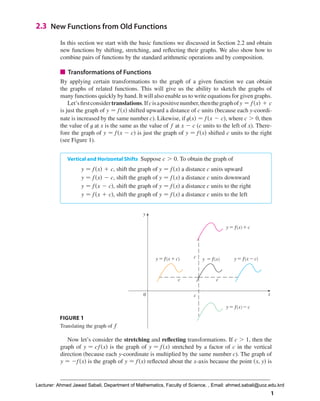
Let’sfirstconsidertranslations.Ifcisapositivenumber,thenthegraphofy − fsxd 1 c
is just the graph of y − fsxd shifted upward a distance of c units (because each y-coordi-
nate is increased by the same number c). Likewise, if tsxd − fsx 2 cd, where c . 0, then
the value of t at x is the same as the value of f at x 2 c (c units to the left of x). There-
fore the graph of y − fsx 2 cd is just the graph of y − fsxd shifted c units to the right
(see Figure 1).
Vertical and Horizontal Shifts Suppose c . 0. To obtain the graph of
y − fsxd 1 c, shift the graph of y − fsxd a distance c units upward
y − fsxd 2 c, shift the graph of y − fsxd a distance c units downward
y − fsx 2 cd, shift the graph of y − fsxd a distance c units to the right
y − fsx 1 cd, shift the graph of y − fsxd a distance c units to the left
x
y
0
y=f(x-c)
y=f(x+c) y =ƒ
y=ƒ-c
y=ƒ+c
c
c
c c
FIGURE 1
Translating the graph of f
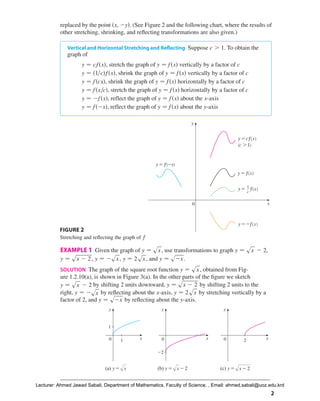
Now let’s consider the stretching and reflecting transformations. If c . 1, then the
graph of y − cfsxd is the graph of y − fsxd stretched by a factor of c in the vertical
direction (because each y-coordinate is multiplied by the same number c). The graph of
y − 2fsxd is the graph of y − fsxd reflected about the x-axis because the point sx, yd is
In this section we start with the basic functions we discussed in Section 2.2 and obtain
Lecturer: Ahmed Jawad Sabali, Department of Mathematics, Faculty of Science. , Email: ahmed.sabali@uoz.edu.krd
2
replaced by the point sx, 2yd. (See Figure 2 and the following chart, where the results of
other stretching, shrinking, and reflecting transformations are also given.)
Vertical and Horizontal Stretching and Reflecting Suppose c . 1. To obtain the
graph of
y − cfsxd, stretch the graph of y − fsxd vertically by a factor of c
y − s1ycdfsxd, shrink the graph of y − fsxd vertically by a factor of c
y − fscxd, shrink the graph of y − fsxd horizontally by a factor of c
y − fsxycd, stretch the graph of y − fsxd horizontally by a factor of c
y − 2fsxd, reflect the graph of y − fsxd about the x-axis
y − fs2xd, reflect the graph of y − fsxd about the y-axis
y= ƒ
1
c
x
y
0
y=f(_x)
y=ƒ
y=_ƒ
y=cƒ
(c>1)
FIGURE 2
Stretching and reflecting the graph of f
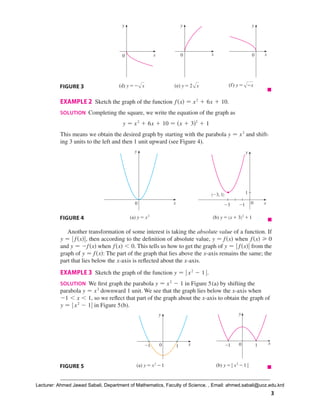
EXAMPLE 1 Given the graph of y − sx, use transformations to graph y − sx 2 2,
y − sx 2 2, y − 2sx, y − 2sx, and y − s2x.
SOLUTION The graph of the square root function y − sx, obtained from Fig-
y − sx 2 2 by shifting 2 units downward, y − sx 2 2 by shifting 2 units to the
right, y − 2sx by reflecting about the x-axis, y − 2sx by stretching vertically by a
factor of 2, and y − s2x by reflecting about the y-axis.
(a) y=œ„
x (b) y=œ„-2
x (c) y=œ„„„„
x-2
2
0 x
y
_2
0 x
y
1
1
0 x
y
ure 1.2.10(a), is shown in Figure 3(a). In the other parts of the figure we sketch
Lecturer: Ahmed Jawad Sabali, Department of Mathematics, Faculty of Science. , Email: ahmed.sabali@uoz.edu.krd
3
(d) y=_œ„
x (e) y=2œ„
x (f) y=œ„„
_x
0 x
y
0 x
y
0 x
y
FIGURE 3
Q
EXAMPLE 2 Sketch the graph of the function fsxd − x2
1 6x 1 10.
SOLUTION Completing the square, we write the equation of the graph as
y − x2
1 6x 1 10 − sx 1 3d2
1 1
This means we obtain the desired graph by starting with the parabola y − x2
and shift-
(a) y=≈ (b) y=(x+3)@+1
x
0
_1
_3
1
y
(_3, 1)
x
0
y
Q
ing 3 units to the left and then 1 unit upward (see Figure 4).
FIGURE 4
Another transformation of some interest is taking the absolute value of a function. If
y − |fsxd|, then according to the definition of absolute value, y − fsxd when fsxd > 0
and y − 2fsxd when fsxd , 0. This tells us how to get the graph of y − |fsxd|from the
graph of y − fsxd: The part of the graph that lies above the x-axis remains the same; the
part that lies below the x-axis is reflected about the x-axis.
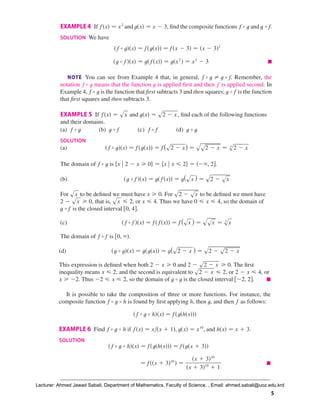
EXAMPLE 3 Sketch the graph of the function y − |x2
2 1|.
SOLUTION We first graph the parabola y − x2
2 1
parabola y − x2
downward 1 unit. We see that the graph lies below the x-axis when
21 , x , 1, so we reflect that part of the graph about the x-axis to obtain the graph of
y − |x2
2 1| 
Q
(a) y=≈-1
0 x
y
_1 1
FIGURE 5
0 x
y
_1 1
(b) y=| ≈-1 |
in Figure 5(b).
in Figure 5(a) by shifting the
Lecturer: Ahmed Jawad Sabali, Department of Mathematics, Faculty of Science. , Email: ahmed.sabali@uoz.edu.krd
4
Combinations of Functions
Two functions f and t can be combined to form new functions f 1 t, f 2 t, ft, and fyt
in a manner similar to the way we add, subtract, multiply, and divide real numbers. The
sum and difference functions are defined by
s f 1 tdsxd − f sxd 1 tsxd s f 2 tdsxd − fsxd 2 tsxd
If the domain of f is A and the domain of t is B, then the domain of f 1 t is the inter-
section A  B because both fsxd and tsxd have to be defined. For example, the domain
of fsxd − sx is A − f0, `d and the domain of tsxd − s2 2 x is B − s2`, 2g, so the
domain of s f 1 tdsxd − sx 1 s2 2 x is A  B − f0, 2g.
Similarly, the product and quotient functions are defined by
s ftdsxd − fsxdtsxd Sf
t
Dsxd −
fsxd
tsxd
The domain of ft is A  B, but we can’t divide by 0 and so the domain of fyt is
hx [ A  B | tsxd ± 0j. For instance, if fsxd − x2
and tsxd − x 2 1, then the domain
of the rational function s fytdsxd − x2
ysx 2 1d is hx | x ± 1j, or s2`, 1d ø s1, `d.
There is another way of combining two functions to obtain a new function. For
example, suppose that y − fsud − su and u − tsxd − x2
1 1. Since y is a function
of u and u is, in turn, a function of x, it follows that y is ultimately a function of x.
We compute this by substitution:
y − fsud − fstsxdd − fsx2
1 1d − sx2
1 1
The procedure is called composition because the new function is composed of the two
given functions f and t.
In general, given any two functions f and t, we start with a number x in the domain
of t and calculate tsxd. If this number tsxd is in the domain of f, then we can calculate
the value of fstsxdd. Notice that the output of one function is used as the input to the next
function. The result is a new function hsxd − fstsxdd obtained by substituting t into f. It is
called the composition (or composite) of f and t and is denoted by f 8 t (“f circle t”).
Definition Given two functions f and t, the composite function f 8 t (also called
the composition of f and t) is defined by
s f 8 tdsxd − fstsxdd
The domain of f 8 t is the set of all x in the domain of t such that tsxd is in the domain
of f. In other words, s f 8 tdsxd is defined whenever both tsxd and fstsxdd are defined.
f 8 t in terms of machines.
Figure 6 shows how to picture
FIGURE 6
The f 8 t machine is composed of
the t machine (first) and then the
f machine.
g g(x) f
x f{©}
Lecturer: Ahmed Jawad Sabali, Department of Mathematics, Faculty of Science. , Email: ahmed.sabali@uoz.edu.krd
5
EXAMPLE4 If fsxd − x2
and tsxd − x 2 3, find the composite functions f 8 t and t 8 f.
SOLUTION We have
s f 8 tdsxd − fstsxdd − fsx 2 3d − sx 2 3d2
st 8 f dsxd − ts fsxdd − tsx2
d − x2
2 3 Q
EXAMPLE 5 If fsxd − sx and tsxd − s2 2 x, find each of the following functions
and their domains.
(a) f 8 t (b) t 8 f (c) f 8 f (d) t 8 t
SOLUTION
(a) s f 8 tdsxd − fstsxdd − f (s2 2 x) − ss2 2 x − s
4
2 2 x
The domain of f 8 t is hx | 2 2 x  0j − hx | x  2j − s2`, 2g.
(b) st 8 f dsxd − ts fsxdd − t(sx ) − s2 2 sx
For sx to be defined we must have x  0. For s2 2 sx to be defined we must have
2 2 sx  0, that is, sx  2, or x  4. Thus we have 0  x  4, so the domain of
t 8 f is the closed interval f0, 4g.
(c) s f 8 f dsxd − fs fsxdd − f (sx ) − ssx − s
4
x
The domain of f 8 f is f0, `d.
(d) st 8 tdsxd − tstsxdd − t(s2 2 x ) − s2 2 s2 2 x
This expression is defined when both 2 2 x  0 and 2 2 s2 2 x  0. The first
inequality means x  2, and the second is equivalent to s2 2 x  2, or 2 2 x  4, or
x  22. Thus 22  x  2, so the domain of t 8 t is the closed interval f22, 2g. Q
It is possible to take the composition of three or more functions. For instance, the
composite function f 8 t 8 h is found by first applying h, then t, and then f as follows:
s f 8 t 8 hdsxd − fstshsxddd
EXAMPLE 6 Find f 8 t 8 h if fsxd − xysx 1 1d, tsxd − x10
, and hsxd − x 1 3.
SOLUTION
s f 8 t 8 hdsxd − fstshsxddd − fstsx 1 3dd
− fssx 1 3d10
d −
sx 1 3d10
sx 1 3d10
1 1
Q
NOTE f 8 t ± t 8 f. Remember, the
notation f 8 t means that the function t is applied first and then f is applied second. In
f 8 t is the function that first subtracts 3 and then squares; t 8 f is the function
that first squares and then subtracts 3.
Example 4,
You can see from Example 4 that, in general,
Lecturer: Ahmed Jawad Sabali, Department of Mathematics, Faculty of Science. , Email: ahmed.sabali@uoz.edu.krd
6
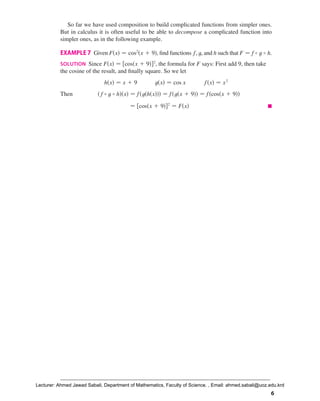
So far we have used composition to build complicated functions from simpler ones.
But in calculus it is often useful to be able to decompose a complicated function into
simpler ones, as in the following example.
EXAMPLE7 Given Fsxd − cos2
sx 1 9d, find functions f, t, and h such that F − f 8 t 8 h.
SOLUTION Since Fsxd − fcossx 1 9dg2
, the formula for F says: First add 9, then take
the cosine of the result, and finally square. So we let
hsxd − x 1 9 tsxd − cos x fsxd − x2
Then s f 8 t 8 hdsxd − fstshsxddd − fstsx 1 9dd − fscossx 1 9dd
− fcossx 1 9dg2
− Fsxd Q
Lecturer: Ahmed Jawad Sabali, Department of Mathematics, Faculty of Science. , Email: ahmed.sabali@uoz.edu.krd

2.3 new functions from old functions

  • 1.
    1 new functions byshifting, stretching, and reflecting their graphs. We also show how to combine pairs of functions by the standard arithmetic operations and by composition. Transformations of Functions By applying certain transformations to the graph of a given function we can obtain the graphs of related functions. This will give us the ability to sketch the graphs of many functions quickly by hand. It will also enable us to write equations for given graphs. Let’sfirstconsidertranslations.Ifcisapositivenumber,thenthegraphofy − fsxd 1 c is just the graph of y − fsxd shifted upward a distance of c units (because each y-coordi- nate is increased by the same number c). Likewise, if tsxd − fsx 2 cd, where c . 0, then the value of t at x is the same as the value of f at x 2 c (c units to the left of x). There- fore the graph of y − fsx 2 cd is just the graph of y − fsxd shifted c units to the right (see Figure 1). Vertical and Horizontal Shifts Suppose c . 0. To obtain the graph of y − fsxd 1 c, shift the graph of y − fsxd a distance c units upward y − fsxd 2 c, shift the graph of y − fsxd a distance c units downward y − fsx 2 cd, shift the graph of y − fsxd a distance c units to the right y − fsx 1 cd, shift the graph of y − fsxd a distance c units to the left x y 0 y=f(x-c) y=f(x+c) y =ƒ y=ƒ-c y=ƒ+c c c c c FIGURE 1 Translating the graph of f Now let’s consider the stretching and reflecting transformations. If c . 1, then the graph of y − cfsxd is the graph of y − fsxd stretched by a factor of c in the vertical direction (because each y-coordinate is multiplied by the same number c). The graph of y − 2fsxd is the graph of y − fsxd reflected about the x-axis because the point sx, yd is In this section we start with the basic functions we discussed in Section 2.2 and obtain Lecturer: Ahmed Jawad Sabali, Department of Mathematics, Faculty of Science. , Email: ahmed.sabali@uoz.edu.krd
  • 2.
    2 replaced by thepoint sx, 2yd. (See Figure 2 and the following chart, where the results of other stretching, shrinking, and reflecting transformations are also given.) Vertical and Horizontal Stretching and Reflecting Suppose c . 1. To obtain the graph of y − cfsxd, stretch the graph of y − fsxd vertically by a factor of c y − s1ycdfsxd, shrink the graph of y − fsxd vertically by a factor of c y − fscxd, shrink the graph of y − fsxd horizontally by a factor of c y − fsxycd, stretch the graph of y − fsxd horizontally by a factor of c y − 2fsxd, reflect the graph of y − fsxd about the x-axis y − fs2xd, reflect the graph of y − fsxd about the y-axis y= ƒ 1 c x y 0 y=f(_x) y=ƒ y=_ƒ y=cƒ (c>1) FIGURE 2 Stretching and reflecting the graph of f EXAMPLE 1 Given the graph of y − sx, use transformations to graph y − sx 2 2, y − sx 2 2, y − 2sx, y − 2sx, and y − s2x. SOLUTION The graph of the square root function y − sx, obtained from Fig- y − sx 2 2 by shifting 2 units downward, y − sx 2 2 by shifting 2 units to the right, y − 2sx by reflecting about the x-axis, y − 2sx by stretching vertically by a factor of 2, and y − s2x by reflecting about the y-axis. (a) y=œ„ x (b) y=œ„-2 x (c) y=œ„„„„ x-2 2 0 x y _2 0 x y 1 1 0 x y ure 1.2.10(a), is shown in Figure 3(a). In the other parts of the figure we sketch Lecturer: Ahmed Jawad Sabali, Department of Mathematics, Faculty of Science. , Email: ahmed.sabali@uoz.edu.krd
  • 3.
    3 (d) y=_œ„ x (e)y=2œ„ x (f) y=œ„„ _x 0 x y 0 x y 0 x y FIGURE 3 Q EXAMPLE 2 Sketch the graph of the function fsxd − x2 1 6x 1 10. SOLUTION Completing the square, we write the equation of the graph as y − x2 1 6x 1 10 − sx 1 3d2 1 1 This means we obtain the desired graph by starting with the parabola y − x2 and shift- (a) y=≈ (b) y=(x+3)@+1 x 0 _1 _3 1 y (_3, 1) x 0 y Q ing 3 units to the left and then 1 unit upward (see Figure 4). FIGURE 4 Another transformation of some interest is taking the absolute value of a function. If y − |fsxd|, then according to the definition of absolute value, y − fsxd when fsxd > 0 and y − 2fsxd when fsxd , 0. This tells us how to get the graph of y − |fsxd|from the graph of y − fsxd: The part of the graph that lies above the x-axis remains the same; the part that lies below the x-axis is reflected about the x-axis. EXAMPLE 3 Sketch the graph of the function y − |x2 2 1|. SOLUTION We first graph the parabola y − x2 2 1 parabola y − x2 downward 1 unit. We see that the graph lies below the x-axis when 21 , x , 1, so we reflect that part of the graph about the x-axis to obtain the graph of y − |x2 2 1| Q (a) y=≈-1 0 x y _1 1 FIGURE 5 0 x y _1 1 (b) y=| ≈-1 | in Figure 5(b). in Figure 5(a) by shifting the Lecturer: Ahmed Jawad Sabali, Department of Mathematics, Faculty of Science. , Email: ahmed.sabali@uoz.edu.krd
  • 4.
    4 Combinations of Functions Twofunctions f and t can be combined to form new functions f 1 t, f 2 t, ft, and fyt in a manner similar to the way we add, subtract, multiply, and divide real numbers. The sum and difference functions are defined by s f 1 tdsxd − f sxd 1 tsxd s f 2 tdsxd − fsxd 2 tsxd If the domain of f is A and the domain of t is B, then the domain of f 1 t is the inter- section A B because both fsxd and tsxd have to be defined. For example, the domain of fsxd − sx is A − f0, `d and the domain of tsxd − s2 2 x is B − s2`, 2g, so the domain of s f 1 tdsxd − sx 1 s2 2 x is A B − f0, 2g. Similarly, the product and quotient functions are defined by s ftdsxd − fsxdtsxd Sf t Dsxd − fsxd tsxd The domain of ft is A B, but we can’t divide by 0 and so the domain of fyt is hx [ A B | tsxd ± 0j. For instance, if fsxd − x2 and tsxd − x 2 1, then the domain of the rational function s fytdsxd − x2 ysx 2 1d is hx | x ± 1j, or s2`, 1d ø s1, `d. There is another way of combining two functions to obtain a new function. For example, suppose that y − fsud − su and u − tsxd − x2 1 1. Since y is a function of u and u is, in turn, a function of x, it follows that y is ultimately a function of x. We compute this by substitution: y − fsud − fstsxdd − fsx2 1 1d − sx2 1 1 The procedure is called composition because the new function is composed of the two given functions f and t. In general, given any two functions f and t, we start with a number x in the domain of t and calculate tsxd. If this number tsxd is in the domain of f, then we can calculate the value of fstsxdd. Notice that the output of one function is used as the input to the next function. The result is a new function hsxd − fstsxdd obtained by substituting t into f. It is called the composition (or composite) of f and t and is denoted by f 8 t (“f circle t”). Definition Given two functions f and t, the composite function f 8 t (also called the composition of f and t) is defined by s f 8 tdsxd − fstsxdd The domain of f 8 t is the set of all x in the domain of t such that tsxd is in the domain of f. In other words, s f 8 tdsxd is defined whenever both tsxd and fstsxdd are defined. f 8 t in terms of machines. Figure 6 shows how to picture FIGURE 6 The f 8 t machine is composed of the t machine (first) and then the f machine. g g(x) f x f{©} Lecturer: Ahmed Jawad Sabali, Department of Mathematics, Faculty of Science. , Email: ahmed.sabali@uoz.edu.krd
  • 5.
    5 EXAMPLE4 If fsxd− x2 and tsxd − x 2 3, find the composite functions f 8 t and t 8 f. SOLUTION We have s f 8 tdsxd − fstsxdd − fsx 2 3d − sx 2 3d2 st 8 f dsxd − ts fsxdd − tsx2 d − x2 2 3 Q EXAMPLE 5 If fsxd − sx and tsxd − s2 2 x, find each of the following functions and their domains. (a) f 8 t (b) t 8 f (c) f 8 f (d) t 8 t SOLUTION (a) s f 8 tdsxd − fstsxdd − f (s2 2 x) − ss2 2 x − s 4 2 2 x The domain of f 8 t is hx | 2 2 x 0j − hx | x 2j − s2`, 2g. (b) st 8 f dsxd − ts fsxdd − t(sx ) − s2 2 sx For sx to be defined we must have x 0. For s2 2 sx to be defined we must have 2 2 sx 0, that is, sx 2, or x 4. Thus we have 0 x 4, so the domain of t 8 f is the closed interval f0, 4g. (c) s f 8 f dsxd − fs fsxdd − f (sx ) − ssx − s 4 x The domain of f 8 f is f0, `d. (d) st 8 tdsxd − tstsxdd − t(s2 2 x ) − s2 2 s2 2 x This expression is defined when both 2 2 x 0 and 2 2 s2 2 x 0. The first inequality means x 2, and the second is equivalent to s2 2 x 2, or 2 2 x 4, or x 22. Thus 22 x 2, so the domain of t 8 t is the closed interval f22, 2g. Q It is possible to take the composition of three or more functions. For instance, the composite function f 8 t 8 h is found by first applying h, then t, and then f as follows: s f 8 t 8 hdsxd − fstshsxddd EXAMPLE 6 Find f 8 t 8 h if fsxd − xysx 1 1d, tsxd − x10 , and hsxd − x 1 3. SOLUTION s f 8 t 8 hdsxd − fstshsxddd − fstsx 1 3dd − fssx 1 3d10 d − sx 1 3d10 sx 1 3d10 1 1 Q NOTE f 8 t ± t 8 f. Remember, the notation f 8 t means that the function t is applied first and then f is applied second. In f 8 t is the function that first subtracts 3 and then squares; t 8 f is the function that first squares and then subtracts 3. Example 4, You can see from Example 4 that, in general, Lecturer: Ahmed Jawad Sabali, Department of Mathematics, Faculty of Science. , Email: ahmed.sabali@uoz.edu.krd
  • 6.
    6 So far wehave used composition to build complicated functions from simpler ones. But in calculus it is often useful to be able to decompose a complicated function into simpler ones, as in the following example. EXAMPLE7 Given Fsxd − cos2 sx 1 9d, find functions f, t, and h such that F − f 8 t 8 h. SOLUTION Since Fsxd − fcossx 1 9dg2 , the formula for F says: First add 9, then take the cosine of the result, and finally square. So we let hsxd − x 1 9 tsxd − cos x fsxd − x2 Then s f 8 t 8 hdsxd − fstshsxddd − fstsx 1 9dd − fscossx 1 9dd − fcossx 1 9dg2 − Fsxd Q Lecturer: Ahmed Jawad Sabali, Department of Mathematics, Faculty of Science. , Email: ahmed.sabali@uoz.edu.krd