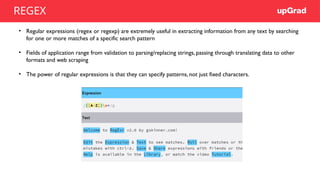
• Regular expressions(regex or regexp) are extremely useful in extracting information from any text by searching
for one or more matches of a specific search pattern
• Fields of application range from validation to parsing/replacing strings, passing through translating data to other
formats and web scraping
• The power of regular expressions is that they can specify patterns, not just fixed characters.
REGEX
6.
^ Matches thebeginning of a line
$ Matches the end of the line
. Matches any character
s Matches whitespace
S Matches any non-whitespace character
* Repeats a character zero or more times
*? Repeats a character zero or more times (non-greedy)
+ Repeats a character one or more times
+? Repeats a character one or more times (non-greedy)
[aeiou] Matches a single character in the listed set
[^XYZ] Matches a single character not in the listed set
[a-z0-9] The set of characters can include a range
( Indicates where string extraction is to start
) Indicates where string extraction is to end
Common Regex Patterns
REGEX
7.
• A bag-of-wordsmodel, or BOW for short, is a way of extracting features from text for use in modeling, such as
with machine learning algorithms.
• The approach is very simple and flexible, and can be used in a myriad of ways for extracting features from
documents.
• A bag-of-words is a representation of text that describes the occurrence of words within a document.
• Unique Words (Bag of words) = [“it”, “was”, “the”, “best”, “of”, “times”, “worst”]
• Representations:
"it was the best of times" = [1,1,1,1,1,1,0]
"it was the worst of times" =[1,1,1,0,1,1,1]
Sentence 1 : It was the best of times.
Sentence 2 : It was the worst of times.
Example
BAG OF WORDS
8.
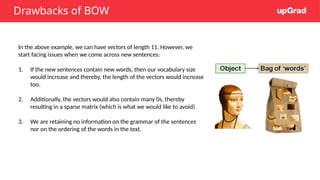
Drawbacks of BOW
Inthe above example, we can have vectors of length 11. However, we
start facing issues when we come across new sentences:
1. If the new sentences contain new words, then our vocabulary size
would increase and thereby, the length of the vectors would increase
too.
2. Additionally, the vectors would also contain many 0s, thereby
resulting in a sparse matrix (which is what we would like to avoid)
3. We are retaining no information on the grammar of the sentences
nor on the ordering of the words in the text.
9.
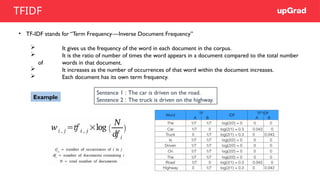
• TF-IDF standsfor “Term Frequency—Inverse Document Frequency”
It gives us the frequency of the word in each document in the corpus.
It is the ratio of number of times the word appears in a document compared to the total number
of words in that document.
It increases as the number of occurrences of that word within the document increases.
Each document has its own term frequency.
Sentence 1 : The car is driven on the road.
Sentence 2 : The truck is driven on the highway.
Example
TFIDF
10.
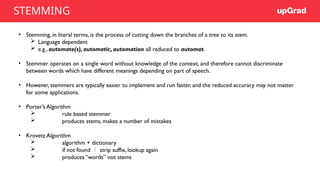
• Stemming, inliteral terms, is the process of cutting down the branches of a tree to its stem.
Language dependent
e.g., automate(s), automatic, automation all reduced to automat.
• Stemmer operates on a single word without knowledge of the context, and therefore cannot discriminate
between words which have different meanings depending on part of speech.
• However, stemmers are typically easier to implement and run faster, and the reduced accuracy may not matter
for some applications.
• Porter’s Algorithm
rule based stemmer
produces stems, makes a number of mistakes
• Krovetz Algorithm
algorithm + dictionary
if not found strip suffix, lookup again
produces “words” not stems
STEMMING
11.
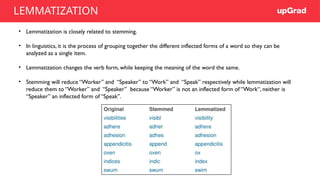
• Lemmatization isclosely related to stemming.
• In linguistics, it is the process of grouping together the different inflected forms of a word so they can be
analyzed as a single item.
• Lemmatization changes the verb form, while keeping the meaning of the word the same.
• Stemming will reduce “Worker” and “Speaker” to “Work” and “Speak” respectively while lemmatization will
reduce them to “Worker” and “Speaker” because “Worker” is not an inflected form of “Work“, neither is
“Speaker” an inflected form of “Speak”.
LEMMATIZATION
12.
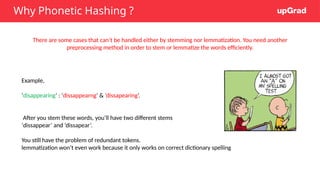
Why Phonetic Hashing?
There are some cases that can’t be handled either by stemming nor lemmatization. You need another
preprocessing method in order to stem or lemmatize the words efficiently.
Example,
‘disappearing’ : ‘dissappearng’ & ’dissapearing’.
After you stem these words, you’ll have two different stems
‘dissappear’ and ‘dissapear’.
You still have the problem of redundant tokens.
lemmatization won’t even work because it only works on correct dictionary spelling
13.
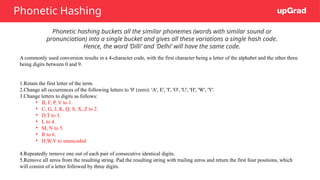
Phonetic Hashing
Phonetic hashingbuckets all the similar phonemes (words with similar sound or
pronunciation) into a single bucket and gives all these variations a single hash code.
Hence, the word ‘Dilli’ and ‘Delhi’ will have the same code.
A commonly used conversion results in a 4-character code, with the first character being a letter of the alphabet and the other three
being digits between 0 and 9.
1.Retain the first letter of the term.
2.Change all occurrences of the following letters to '0' (zero): 'A', E', 'I', 'O', 'U', 'H', 'W', 'Y'.
3.Change letters to digits as follows:
• B, F, P, V to 1.
• C, G, J, K, Q, S, X, Z to 2.
• D,T to 3.
• L to 4.
• M, N to 5.
• R to 6.
• H,W,Y to unencoded
4.Repeatedly remove one out of each pair of consecutive identical digits.
5.Remove all zeros from the resulting string. Pad the resulting string with trailing zeros and return the first four positions, which
will consist of a letter followed by three digits.
14.
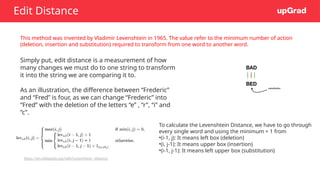
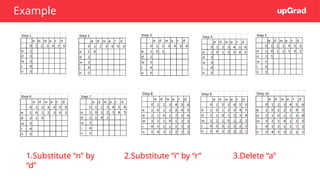
Edit Distance
This methodwas invented by Vladimir Levenshtein in 1965. The value refer to the minimum number of action
(deletion, insertion and substitution) required to transform from one word to another word.
Simply put, edit distance is a measurement of how
many changes we must do to one string to transform
it into the string we are comparing it to.
As an illustration, the difference between “Frederic”
and “Fred” is four, as we can change “Frederic” into
“Fred” with the deletion of the letters “e” , “r”, “i” and
”c”.
To calculate the Levenshtein Distance, we have to go through
every single word and using the minimum + 1 from
•(i-1, j): It means left box (deletion)
•(i, j-1): It means upper box (insertion)
•(i-1, j-1): It means left upper box (substitution)
https://en.wikipedia.org/wiki/Levenshtein_distance
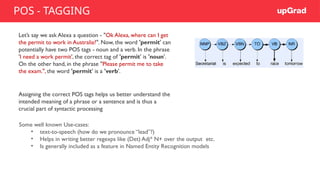
Some well knownUse-cases:
• text-to-speech (how do we pronounce “lead”?)
• Helps in writing better regexps like (Det) Adj* N+ over the output etc.
• Is generally included as a feature in Named Entity Recognition models
Let’s say we ask Alexa a question - "Ok Alexa, where can I get
the permit to work in Australia?". Now, the word 'permit' can
potentially have two POS tags - noun and a verb. In the phrase
'I need a work permit', the correct tag of 'permit' is 'noun'.
On the other hand, in the phrase "Please permit me to take
the exam.", the word 'permit' is a 'verb'.
Assigning the correct POS tags helps us better understand the
intended meaning of a phrase or a sentence and is thus a
crucial part of syntactic processing
POS - TAGGING
18.
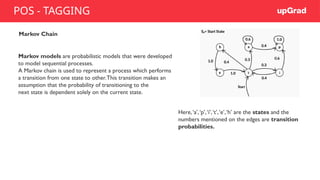
Markov Chain
Markov modelsare probabilistic models that were developed
to model sequential processes.
A Markov chain is used to represent a process which performs
a transition from one state to other.This transition makes an
assumption that the probability of transitioning to the
next state is dependent solely on the current state.
Here,‘a’,‘p’,‘i’,‘t’,‘e’,‘h’ are the states and the
numbers mentioned on the edges are transition
probabilities.
POS - TAGGING
19.
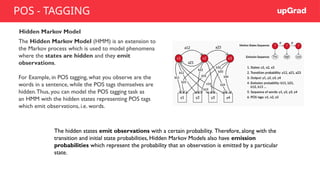
Hidden Markov Model
TheHidden Markov Model (HMM) is an extension to
the Markov process which is used to model phenomena
where the states are hidden and they emit
observations.
For Example, in POS tagging, what you observe are the
words in a sentence, while the POS tags themselves are
hidden.Thus, you can model the POS tagging task as
an HMM with the hidden states representing POS tags
which emit observations, i.e. words.
The hidden states emit observations with a certain probability. Therefore, along with the
transition and initial state probabilities, Hidden Markov Models also have emission
probabilities which represent the probability that an observation is emitted by a particular
state.
POS - TAGGING
20.
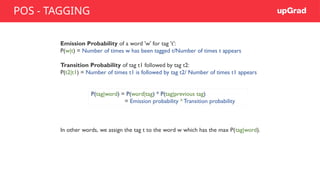
Emission Probability ofa word 'w' for tag 't':
P(w|t) = Number of times w has been tagged t/Number of times t appears
Transition Probability of tag t1 followed by tag t2:
P(t2|t1) = Number of times t1 is followed by tag t2/ Number of times t1 appears
In other words, we assign the tag t to the word w which has the max P(tag|word).
P(tag|word) = P(word|tag) * P(tag|previous tag)
= Emission probability * Transition probability
POS - TAGGING
21.
22/06/2025 21
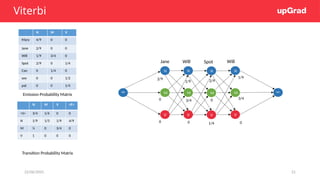
Viterbi
N MV <E>
<S> 3/4 1/4 0 0
N 1/9 1/3 1/9 4/9
M ¼ 0 3/4 0
V 1 0 0 0
N M V
Mary 4/9 0 0
Jane 2/9 0 0
Will 1/9 3/4 0
Spot 2/9 0 1/4
Can 0 1/4 0
see 0 0 1/2
pat 0 0 1/4
Emission Probability Matrix
Transition Probability Matrix
N N
M M
V V
N
M
V
N
M
V
<S> <e>
Jane Will Spot Will
2/9
0
0
1/9
3/4
0
2/9
0
1/4
1/9
3/4
0
22.
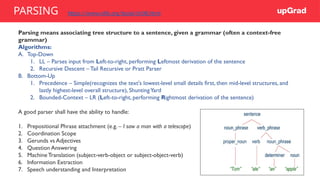
Parsing means associatingtree structure to a sentence, given a grammar (often a context-free
grammar)
Algorithms:
A. Top-Down
1. LL – Parses input from Left-to-right, performing Leftmost derivation of the sentence
2. Recursive Descent –Tail Recursive or Pratt Parser
B. Bottom-Up
1. Precedence – Simple(recognizes the text's lowest-level small details first, then mid-level structures, and
lastly highest-level overall structure), ShuntingYard
2. Bounded-Context – LR (Left-to-right, performing Rightmost derivation of the sentence)
A good parser shall have the ability to handle:
1. Prepositional Phrase attachment (e.g. – I saw a man with a telescope)
2. Coordination Scope
3. Gerunds vs Adjectives
4. Question Answering
5. Machine Translation (subject-verb-object or subject-object-verb)
6. Information Extraction
7. Speech understanding and Interpretation
PARSING https://www.nltk.org/book/ch08.html
23.
22/06/2025 23
Probabilistic CFGs
ProbabilisticContext-Free Grammars (PCFGs) are used when we want to find the
most probable parsed structure of the sentence. PCFGs are grammar rules, similar to
what you have seen, along with probabilities associated with each production rule.
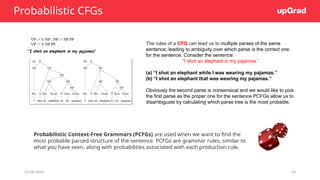
The rules of a CFG can lead us to multiple parses of the same
sentence, leading to ambiguity over which parse is the correct one
for the sentence. Consider the sentence:
“I shot an elephant in my pajamas.”
(a) “I shot an elephant while I was wearing my pajamas.”
(b) “I shot an elephant that was wearing my pajamas.”
Obviously the second parse is nonsensical and we would like to pick
the first parse as the proper one for the sentence PCFGs allow us to
disambiguate by calculating which parse tree is the most probable.
24.
22/06/2025 24
Deriving aPCFG from a Corpus
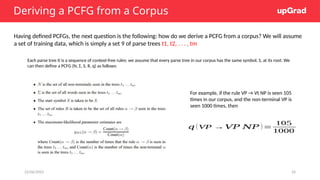
Having defined PCFGs, the next question is the following: how do we derive a PCFG from a corpus? We will assume
a set of training data, which is simply a set 9 of parse trees t1, t2, . . . , tm
Each parse tree ti is a sequence of context-free rules: we assume that every parse tree in our corpus has the same symbol, S, at its root. We
can then define a PCFG (N, Σ, S, R, q) as follows:
For example, if the rule VP → Vt NP is seen 105
times in our corpus, and the non-terminal VP is
seen 1000 times, then
𝑞 (VP →𝑉𝑃 𝑁𝑃 )=
105
1000
25.
Click to addTitle
23/05/19 Footer
• Practice in teams of 4 students
• Industry expert mentoring to learn better
• Get personalised feedback for improvements
25
Poll
23/05/19 11
Given the Grammar which tree seems more probable ?
S -> NP VP [1.0]
PP -> P NP [1.0]
VP -> V NP [0.9] | VP PP [0.1]
NP -> NP PP [0.4]
P -> 'with' [1.0]
V -> 'saw' [1.0]
NP -> 'astronomer' [0.1] | 'ears' [0.18] | 'saw' [0.04] | 'stars' [0.18] | 'telescope' [0.1]
(S
(NP astronomer)
(VP (V saw) (NP (NP stars) (PP (P with) (NP telescope)))))
(S
(NP astronomer)
(VP (VP (V saw) (NP stars)) (PP (P with) (NP telescope))))
A
B
26.
Click to addTitle
23/05/19 Footer
• Practice in teams of 4 students
• Industry expert mentoring to learn better
• Get personalised feedback for improvements
26
Poll (Answer)
23/05/19 11
Given the Grammar which tree seems more probable ?
S -> NP VP [1.0]
PP -> P NP [1.0]
VP -> V NP [0.9] | VP PP [0.1]
NP -> NP PP [0.4]
P -> 'with' [1.0]
V -> 'saw' [1.0]
NP -> 'astronomer' [0.1] | 'ears' [0.18] | 'saw' [0.04] | 'stars' [0.18] | 'telescope' [0.1]
(S
(NP astronomer)
(VP (V saw) (NP (NP stars) (PP (P with) (NP telescope)))))
(S
(NP astronomer)
(VP (VP (V saw) (NP stars)) (PP (P with) (NP telescope))))
A
B
( P = 0.000648 )
( P = 0.000162 )
27.
22/06/2025 27
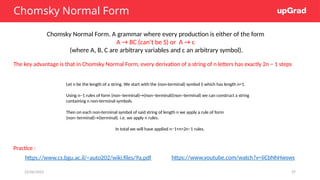
Chomsky NormalForm
Chomsky Normal Form. A grammar where every production is either of the form
A → BC (can’t be S) or A → c
(where A, B, C are arbitrary variables and c an arbitrary symbol).
The key advantage is that in Chomsky Normal Form, every derivation of a string of n letters has exactly 2n − 1 steps
https://www.cs.bgu.ac.il/~auto202/wiki.files/9a.pdf
Let n be the length of a string. We start with the (non-terminal) symbol S which has length n=1.
Using n−1 rules of form (non−terminal)→(non−terminal)(non−terminal) we can construct a string
containing n non-terminal symbols.
Then on each non-terminal symbol of said string of length n we apply a rule of form
(non−terminal)→(terminal). i.e. we apply n rules.
In total we will have applied n−1+n=2n−1 rules.
https://www.youtube.com/watch?v=IiCbNhHwsws
Practice :
28.
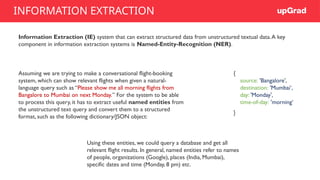
Information Extraction (IE)system that can extract structured data from unstructured textual data.A key
component in information extraction systems is Named-Entity-Recognition (NER).
Assuming we are trying to make a conversational flight-booking
system, which can show relevant flights when given a natural-
language query such as “Please show me all morning flights from
Bangalore to Mumbai on next Monday.” For the system to be able
to process this query, it has to extract useful named entities from
the unstructured text query and convert them to a structured
format, such as the following dictionary/JSON object:
{
source: 'Bangalore',
destination: 'Mumbai‘,
day: 'Monday',
time-of-day: 'morning‘
}
Using these entities, we could query a database and get all
relevant flight results. In general, named entities refer to names
of people, organizations (Google), places (India, Mumbai),
specific dates and time (Monday, 8 pm) etc.
INFORMATION EXTRACTION
29.
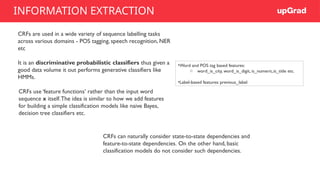
CRFs are usedin a wide variety of sequence labelling tasks
across various domains - POS tagging, speech recognition, NER
etc
It is an discriminative probabilistic classifiers thus given a
good data volume it out performs generative classifiers like
HMMs.
CRFs use ‘feature functions’ rather than the input word
sequence x itself.The idea is similar to how we add features
for building a simple classification models like naive Bayes,
decision tree classifiers etc.
•Word and POS tag based features:
o word_is_city, word_is_digit, is_numeric,is_title etc.
•Label-based features: previous_label
CRFs can naturally consider state-to-state dependencies and
feature-to-state dependencies. On the other hand, basic
classification models do not consider such dependencies.
INFORMATION EXTRACTION
22/06/2025 33
Semantic processing
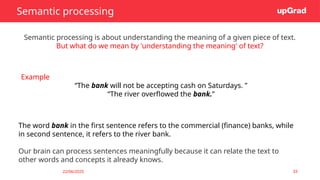
Semanticprocessing is about understanding the meaning of a given piece of text.
But what do we mean by 'understanding the meaning' of text?
Example
“The bank will not be accepting cash on Saturdays. ”
“The river overflowed the bank.”
The word bank in the first sentence refers to the commercial (finance) banks, while
in second sentence, it refers to the river bank.
Our brain can process sentences meaningfully because it can relate the text to
other words and concepts it already knows.
32.
22/06/2025 34
Semantic processing
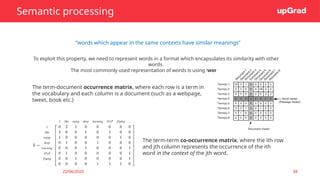
“wordswhich appear in the same contexts have similar meanings”
To exploit this property, we need to represent words in a format which encapsulates its similarity with other
words.
The most commonly used representation of words is using 'word vectors‘.
The term-document occurrence matrix, where each row is a term in
the vocabulary and each column is a document (such as a webpage,
tweet, book etc.)
The term-term co-occurrence matrix, where the ith row
and jth column represents the occurrence of the ith
word in the context of the jth word.
33.
22/06/2025 38
co-occurrence matrix
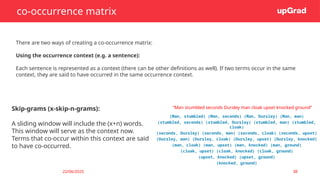
Thereare two ways of creating a co-occurrence matrix:
Using the occurrence context (e.g. a sentence):
Each sentence is represented as a context (there can be other definitions as well). If two terms occur in the same
context, they are said to have occurred in the same occurrence context.
Skip-grams (x-skip-n-grams):
A sliding window will include the (x+n) words.
This window will serve as the context now.
Terms that co-occur within this context are said
to have co-occurred.
“Man stumbled seconds Dursley man cloak upset knocked ground”
(Man, stumbled) (Man, seconds) (Man, Dursley) (Man, man)
(stumbled, seconds) (stumbled, Dursley) (stumbled, man) (stumbled,
cloak)
(seconds, Dursley) (seconds, man) (seconds, cloak) (seconds, upset)
(Dursley, man) (Dursley, cloak) (Dursley, upset) (Dursley, knocked)
(man, cloak) (man, upset) (man, knocked) (man, ground)
(cloak, upset) (cloak, knocked) (cloak, ground)
(upset, knocked) (upset, ground)
(knocked, ground)
34.
Word2Vec
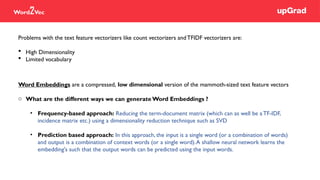
Word Embeddings area compressed, low dimensional version of the mammoth-sized text feature vectors
o What are the different ways we can generate Word Embeddings ?
• Frequency-based approach: Reducing the term-document matrix (which can as well be a TF-IDF,
incidence matrix etc.) using a dimensionality reduction technique such as SVD
• Prediction based approach: In this approach, the input is a single word (or a combination of words)
and output is a combination of context words (or a single word).A shallow neural network learns the
embedding's such that the output words can be predicted using the input words.
Problems with the text feature vectorizers like count vectorizers andTFIDF vectorizers are:
High Dimensionality
Limited vocabulary
35.
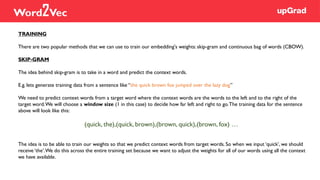
TRAINING
There are twopopular methods that we can use to train our embedding's weights: skip-gram and continuous bag of words (CBOW).
SKIP-GRAM
The idea behind skip-gram is to take in a word and predict the context words.
E.g. lets generate training data from a sentence like “the quick brown fox jumped over the lazy dog”
We need to predict context words from a target word where the context words are the words to the left and to the right of the
target word.We will choose a window size (1 in this case) to decide how far left and right to go.The training data for the sentence
above will look like this:
(quick, the),(quick, brown),(brown, quick),(brown, fox) …
The idea is to be able to train our weights so that we predict context words from target words. So when we input ‘quick’, we should
receive ‘the’.We do this across the entire training set because we want to adjust the weights for all of our words using all the context
we have available.
Word2Vec
36.
CBOW
The continuous bagof words method allows us to create the training data for adjusting our embedding weights in a different way.
Instead of predicting context words from target, we will feed in context words and try to predict the target word. So now the
training data (with window of 1) will look something like
( [ ‘the’ , ‘brown’ ] , ‘quick’ )
where we sum the embeddings of ‘the’ and ‘brown’ and expect to predict ‘quick’.
COMPARISON
Though CBOW (predict target from context) and skip-gram (predict context words from target) are just inverted methods to each
other, each have their advantages/disadvantage.
Since CBOW can use many context words to predict the target word, it acts like regularization and offers very good performance
when our input data is not so large.
However the skip-gram model is more fine grained so we are able to extract more information and essentially have more
accurate embeddings when we have a large data set
( Large data is the best regularizer )
Word2Vec
37.
After the successof Word2Vec, several other effective word embedding techniques have been developed by
various teams. One of the most popular is GloVe (Global Vectors for Words) developed by a Stanford research
group. Another recently developed and fast-growing word embedding library is fastText developed by Facebook AI
Research (FAIR).
These embeddings are trained on billions of words (i.e. unique tokens), and thankfully, are available as pre-trained
word vectors ready to use for text applications (for free!).
Additional Readings
Word2Vec: Original paper of word2vec by Mikolov et al.
GloVe vectors: Homepage (contains downloadable trained GloVe vectors, training methodology etc.).
fastText:Word embeddings developed by FAIR on multiple languages, available for download here
Other Word Embeddings
Word2Vec
38.
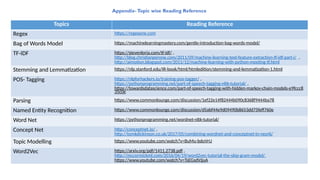
Appendix-Topic wise ReadingReference
Topics Reading Reference
Regex https://regexone.com
Bag of Words Model https://machinelearningmastery.com/gentle-introduction-bag-words-model/
TF-IDF https://stevenloria.com/tf-idf/ ,
http://blog.christianperone.com/2011/09/machine-learning-text-feature-extraction-tf-idf-part-i/ ,
http://aimotion.blogspot.com/2011/12/machine-learning-with-python-meeting-tf.html
Stemming and Lemmatization https://nlp.stanford.edu/IR-book/html/htmledition/stemming-and-lemmatization-1.html
POS- Tagging https://nlpforhackers.io/training-pos-tagger/ ,
https://pythonprogramming.net/part-of-speech-tagging-nltk-tutorial/ ,
https://towardsdatascience.com/part-of-speech-tagging-with-hidden-markov-chain-models-e9fccc8
35c0e
,
Parsing https://www.commonlounge.com/discussion/1ef22e14f82444b090c8368f9444ba78
Named Entity Recognition https://www.commonlounge.com/discussion/d5abf44e9d09490b8653dd75feff760e
Word Net https://pythonprogramming.net/wordnet-nltk-tutorial/
Concept Net http://conceptnet.io/ ,
http://tomkdickinson.co.uk/2017/05/combining-wordnet-and-conceptnet-in-neo4j/
Topic Modelling https://www.youtube.com/watch?v=BuMu-bdoVrU
Word2Vec https://arxiv.org/pdf/1411.2738.pdf ,
http://mccormickml.com/2016/04/19/word2vec-tutorial-the-skip-gram-model/
https://www.youtube.com/watch?v=TsEGsdVJjuA
39.
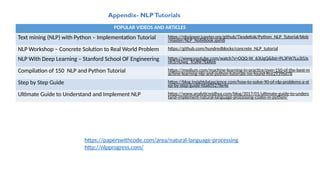
Appendix- NLPTutorials
POPULAR VIDEOSAND ARTICLES
Text mining (NLP) with Python – Implementation Tutorial https://nbviewer.jupyter.org/github/TiesdeKok/Python_NLP_Tutorial/blob
/master/NLP_Notebook.ipynb
NLP Workshop – Concrete Solution to Real World Problem https://github.com/hundredblocks/concrete_NLP_tutorial
NLP With Deep Learning – Stanford School OF Engineering https://www.youtube.com/watch?v=OQQ-W_63UgQ&list=PL3FW7Lu3i5Js
nh1rnUwq_TcylNr7EkRe6
Compilation of 150 NLP and Python Tutorial https://medium.com/machine-learning-in-practice/over-150-of-the-best-m
achine-learning-nlp-and-python-tutorials-ive-found-ffce2939bd78
Step by Step Guide https://blog.insightdatascience.com/how-to-solve-90-of-nlp-problems-a-st
ep-by-step-guide-fda605278e4e
Ultimate Guide to Understand and Implement NLP https://www.analyticsvidhya.com/blog/2017/01/ultimate-guide-to-unders
tand-implement-natural-language-processing-codes-in-python/
https://paperswithcode.com/area/natural-language-processing
http://nlpprogress.com/
#25 for any non-terminal X, the parameter values for all rules with that non-terminal on the left-hand-side of the rule must sum to one. We can verify that this property holds for the PCFG
#40 Intuitively, a term has a large weight when it occurs frequently across the document but infrequently across the corpus. The word “build” might appear often in a document, but because it’s likely fairly common in the rest of the corpus, it will not have a high tf-idf score. However, if the word “gentrification” appears often in a document, because it is rarer in the rest of the corpus, it will have a higher tf-idf score.
#41 singular value decomposition, is a technique in linear algebra that factorizes any matrix M into the product of 3 separate matrices: M=U*S*V, where S is a diagonal matrix of the singular values of M





![^ Matches the beginning of a line
$ Matches the end of the line
. Matches any character
s Matches whitespace
S Matches any non-whitespace character
* Repeats a character zero or more times
*? Repeats a character zero or more times (non-greedy)
+ Repeats a character one or more times
+? Repeats a character one or more times (non-greedy)
[aeiou] Matches a single character in the listed set
[^XYZ] Matches a single character not in the listed set
[a-z0-9] The set of characters can include a range
( Indicates where string extraction is to start
) Indicates where string extraction is to end
Common Regex Patterns
REGEX](https://image.slidesharecdn.com/nlp-250622031031-2dcbcfec/85/Natural-Language-Processing-Datascience-pptx-6-320.jpg)
![• A bag-of-words model, or BOW for short, is a way of extracting features from text for use in modeling, such as
with machine learning algorithms.
• The approach is very simple and flexible, and can be used in a myriad of ways for extracting features from
documents.
• A bag-of-words is a representation of text that describes the occurrence of words within a document.
• Unique Words (Bag of words) = [“it”, “was”, “the”, “best”, “of”, “times”, “worst”]
• Representations:
"it was the best of times" = [1,1,1,1,1,1,0]
"it was the worst of times" =[1,1,1,0,1,1,1]
Sentence 1 : It was the best of times.
Sentence 2 : It was the worst of times.
Example
BAG OF WORDS](https://image.slidesharecdn.com/nlp-250622031031-2dcbcfec/85/Natural-Language-Processing-Datascience-pptx-7-320.jpg)

![Click to add Title
23/05/19 Footer
• Practice in teams of 4 students
• Industry expert mentoring to learn better
• Get personalised feedback for improvements
25
Poll
23/05/19 11
Given the Grammar which tree seems more probable ?
S -> NP VP [1.0]
PP -> P NP [1.0]
VP -> V NP [0.9] | VP PP [0.1]
NP -> NP PP [0.4]
P -> 'with' [1.0]
V -> 'saw' [1.0]
NP -> 'astronomer' [0.1] | 'ears' [0.18] | 'saw' [0.04] | 'stars' [0.18] | 'telescope' [0.1]
(S
(NP astronomer)
(VP (V saw) (NP (NP stars) (PP (P with) (NP telescope)))))
(S
(NP astronomer)
(VP (VP (V saw) (NP stars)) (PP (P with) (NP telescope))))
A
B](https://image.slidesharecdn.com/nlp-250622031031-2dcbcfec/85/Natural-Language-Processing-Datascience-pptx-25-320.jpg)
![Click to add Title
23/05/19 Footer
• Practice in teams of 4 students
• Industry expert mentoring to learn better
• Get personalised feedback for improvements
26
Poll (Answer)
23/05/19 11
Given the Grammar which tree seems more probable ?
S -> NP VP [1.0]
PP -> P NP [1.0]
VP -> V NP [0.9] | VP PP [0.1]
NP -> NP PP [0.4]
P -> 'with' [1.0]
V -> 'saw' [1.0]
NP -> 'astronomer' [0.1] | 'ears' [0.18] | 'saw' [0.04] | 'stars' [0.18] | 'telescope' [0.1]
(S
(NP astronomer)
(VP (V saw) (NP (NP stars) (PP (P with) (NP telescope)))))
(S
(NP astronomer)
(VP (VP (V saw) (NP stars)) (PP (P with) (NP telescope))))
A
B
( P = 0.000648 )
( P = 0.000162 )](https://image.slidesharecdn.com/nlp-250622031031-2dcbcfec/85/Natural-Language-Processing-Datascience-pptx-26-320.jpg)

![CBOW
The continuous bag of words method allows us to create the training data for adjusting our embedding weights in a different way.
Instead of predicting context words from target, we will feed in context words and try to predict the target word. So now the
training data (with window of 1) will look something like
( [ ‘the’ , ‘brown’ ] , ‘quick’ )
where we sum the embeddings of ‘the’ and ‘brown’ and expect to predict ‘quick’.
COMPARISON
Though CBOW (predict target from context) and skip-gram (predict context words from target) are just inverted methods to each
other, each have their advantages/disadvantage.
Since CBOW can use many context words to predict the target word, it acts like regularization and offers very good performance
when our input data is not so large.
However the skip-gram model is more fine grained so we are able to extract more information and essentially have more
accurate embeddings when we have a large data set
( Large data is the best regularizer )
Word2Vec](https://image.slidesharecdn.com/nlp-250622031031-2dcbcfec/85/Natural-Language-Processing-Datascience-pptx-36-320.jpg)