21cm cosmology with machine learning
@清华⼤学(2022/6/6)
Hayato Shimabukuro(島袋隼⼠)
(Yunnan university, Nagoya university)
1
Introduction
2
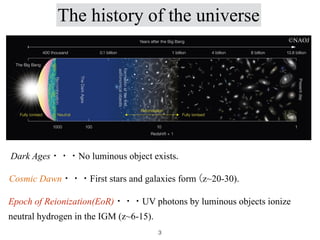
The history of the universe
©NAOJ
Dark Ages・・・No luminous object exists.
Epoch of Reionization(EoR)・・・UV photons by luminous objects ionize
neutral hydrogen in the IGM (z~6-15).
Cosmic Dawn・・・First stars and galaxies form (z~20-30).
3
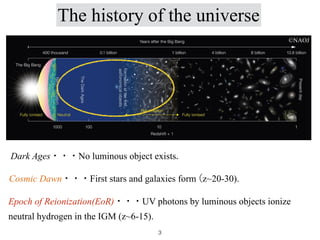
The history of the universe
©NAOJ
Dark Ages・・・No luminous object exists.
Epoch of Reionization(EoR)・・・UV photons by luminous objects ionize
neutral hydrogen in the IGM (z~6-15).
Cosmic Dawn・・・First stars and galaxies form (z~20-30).
3
(C)Kenji Hasegawa(Nagoya University)
Credit: M. Alvarez, R. Kaehler and T.Abel
(C)Kenji Hasegawa(Nagoya University)
Credit: M. Alvarez, R. Kaehler and T.Abel
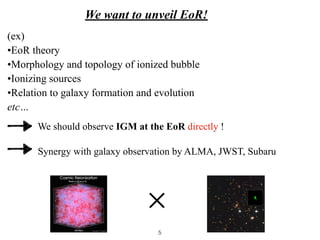
We want to unveil EoR!
(ex)


•EoR theory


•Morphology and topology of ionized bubble


•Ionizing sources


•Relation to galaxy formation and evolution


etc…
5
We want to unveil EoR!
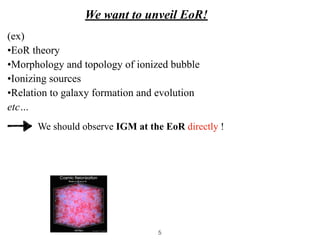
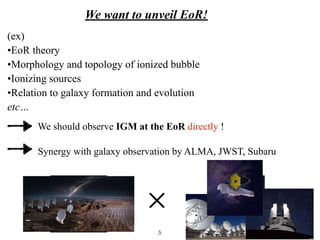
We should observe IGM at the EoR directly !
(ex)


•EoR theory


•Morphology and topology of ionized bubble


•Ionizing sources


•Relation to galaxy formation and evolution


etc…
5
We want to unveil EoR!
We should observe IGM at the EoR directly !
(ex)


•EoR theory


•Morphology and topology of ionized bubble


•Ionizing sources


•Relation to galaxy formation and evolution


etc…
✕
Synergy with galaxy observation by ALMA, JWST, Subaru
5
We want to unveil EoR!
We should observe IGM at the EoR directly !
(ex)


•EoR theory


•Morphology and topology of ionized bubble


•Ionizing sources


•Relation to galaxy formation and evolution


etc…
✕
Synergy with galaxy observation by ALMA, JWST, Subaru
5
We want to unveil EoR!
We should observe IGM at the EoR directly !
(ex)


•EoR theory


•Morphology and topology of ionized bubble


•Ionizing sources


•Relation to galaxy formation and evolution


etc…
✕
Synergy with galaxy observation by ALMA, JWST, Subaru
5
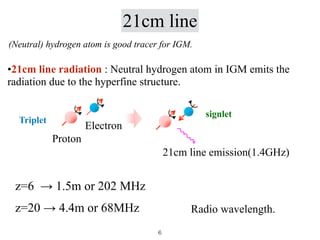
21cm line
•21cm line radiation : Neutral hydrogen atom in IGM emits the
radiation due to the hyperfine structure.
z=6 → 1.5m or 202 MHz


z=20 → 4.4m or 68MHz Radio wavelength.
Proton
Electron
21cm line emission(1.4GHz)
(Neutral) hydrogen atom is good tracer for IGM.
6
signlet
Triplet
21cm line signal
Red : cosmology Blue : astrophysics
Tb =
TS T
1 + z
(1 exp(⌧⌫))
⇠ 27xH(1 + m)
✓
H
dvr/dr + H
◆ ✓
1
T
TS
◆ ✓
1 + z
10
0.15
⌦mh2
◆1/2 ✓
⌦bh2
0.023
◆
[mK]
Brightness temperature
We can map the distribution of HI in the IGM with 21cm line
7
21cm line signal
Red : cosmology Blue : astrophysics
Tb =
TS T
1 + z
(1 exp(⌧⌫))
⇠ 27xH(1 + m)
✓
H
dvr/dr + H
◆ ✓
1
T
TS
◆ ✓
1 + z
10
0.15
⌦mh2
◆1/2 ✓
⌦bh2
0.023
◆
[mK]
Brightness temperature
We can map the distribution of HI in the IGM with 21cm line
7
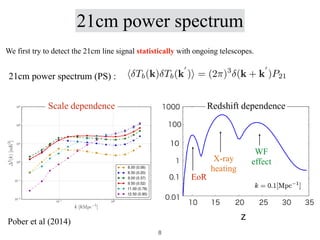
21cm power spectrum (PS) :
Scale dependence
Pober et al (2014)
EoR
X-ray
heating
WF
effect
z
Redshift dependence
21cm power spectrum
h Tb(k) Tb(k
0
)i = (2⇡)3
(k + k
0
)P21
We first try to detect the 21cm line signal statistically with ongoing telescopes.
8
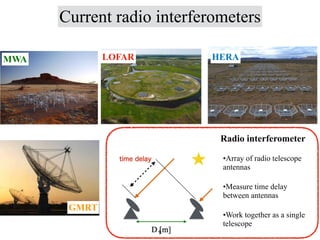
Current radio interferometers
MWA LOFAR HERA
GMRT
Radio interferometer
•Array of radio telescope
antennas
•Measure time delay
between antennas
•Work together as a single
telescope
9
10
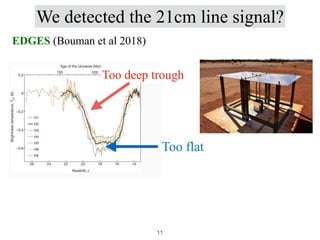
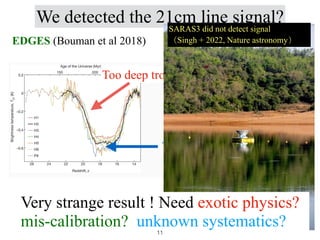
EDGES (Bouman et al 2018)
Too deep trough
Too flat
We detected the 21cm line signal?
11
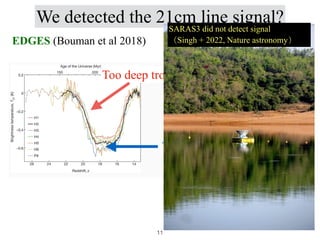
EDGES (Bouman et al 2018)
Too deep trough
Too flat
We detected the 21cm line signal?
SARAS3 did not detect signal


(Singh + 2022, Nature astronomy)
11
EDGES (Bouman et al 2018)
Too deep trough
Too flat
We detected the 21cm line signal?
SARAS3 did not detect signal


(Singh + 2022, Nature astronomy)
Very strange result ! Need exotic physics?
mis-calibration? unknown systematics?
11
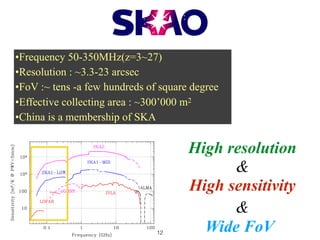
SKA-Low
•Frequency 50-350MHz(z=3~27)


&


High sensitivity


Wide FoV
&
12
21cm signal analysis with


Arti
fi
cial neural network(ANN)
13
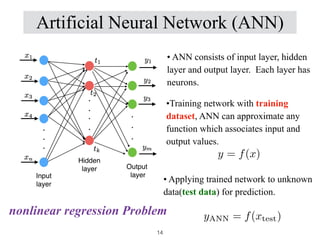
Artificial Neural Network (ANN)
•Training network with training
dataset, ANN can approximate any
function which associates input and
output values.
y = f(x)
• Applying trained network to unknown
data(test data) for prediction.
yANN = f(xtest)
• ANN consists of input layer, hidden
layer and output layer. Each layer has
neurons.
nonlinear regression Problem
14
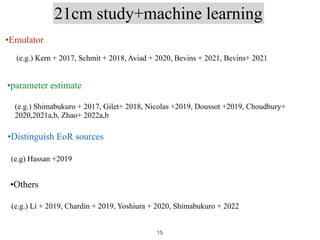
•Emulator
•parameter estimate
•Distinguish EoR sources
(e.g) Hassan +2019
•Others
(e.g.) Li + 2019, Chardin + 2019, Yoshiura + 2020, Shimabukuro + 2022
(e.g.) Kern + 2017, Schmit + 2018, Aviad + 2020, Bevins + 2021, Bevins+ 2021
(e.g.) Shimabukuro + 2017, Gilet+ 2018, Nicolas +2019, Doussot +2019, Choudhury+
2020,2021a,b, Zhao+ 2022a,b
21cm study+machine learning
15
EoR parameter estimation
with ANN
Based on Shimabukuro and Semelin 2017
16
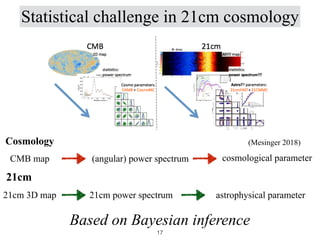
Statistical challenge in 21cm cosmology
(Mesinger 2018)
Cosmology
CMB map (angular) power spectrum cosmological parameter
21cm
21cm 3D map 21cm power spectrum astrophysical parameter
Based on Bayesian inference
17
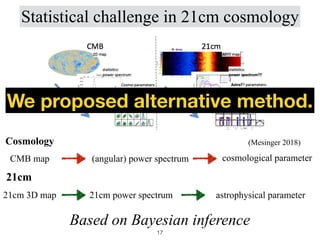
Statistical challenge in 21cm cosmology
(Mesinger 2018)
Cosmology
CMB map (angular) power spectrum cosmological parameter
21cm
21cm 3D map 21cm power spectrum astrophysical parameter
Based on Bayesian inference
We proposed alternative method.
17
Dataset
⇣ : the ionizing efficiency.
: the minimum viral temperature of halos producing ionizing
photons
: the mean free path of ionizing photons through the IGM
(Maximum HII bubble size)
Tvir
Rmfp
~
d = [P(k), ~
✓]
21cm power spectrum (input)
EoR parameter (output)
EoR Parameter
✓EoR = f(P21)
18
z=9, 10, 11. PS with thermal noise and cosmic variance
Reconstructed by 21cm PS at z=9,10,11
Rmfp ⇣
Tvir
10
20
30
40
50
60
10 20 30 40 50 60
R
mfp,ANN
[Mpc]
Rmfp,true[Mpc]
10
20
30
40
50
60
10 20 30 40 50 60
ANN
true
1
10
100
1 10 100
T
vir,ANN
[K/10
3
]
Tvir,true[K/10
3
]
Red : z=9,10,11


Blue : z=9
The parameters obtained by the ANN
match true values. ANN work well !
19
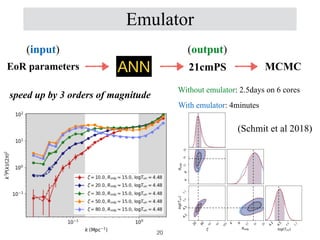
Emulator
EoR parameters 21cmPS
ANN MCMC
Without emulator: 2.5days on 6 cores
With emulator: 4minutes
speed up by 3 orders of magnitude
(Schmit et al 2018)
(input) (output)
20
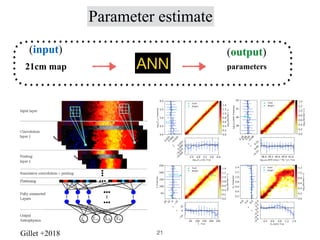
parameters
21cm map ANN
(input) (output)
Parameter estimate
Gillet +2018 21
Recovering HII bubble size
distribution with ANN
Based on Shimabukuro et al 2022
22
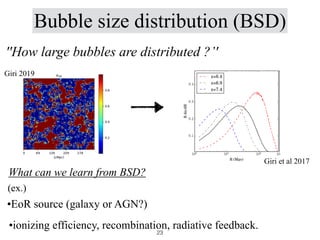
Bubble size distribution (BSD)
''How large bubbles are distributed ?’'
Giri 2019
What can we learn from BSD?
Giri et al 2017
•EoR source (galaxy or AGN?)
•ionizing efficiency, recombination, radiative feedback.
(ex.)
23
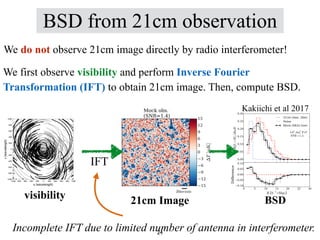
BSD from 21cm observation
Kakiichi et al 2017
IFT
21cm Image BSD
Incomplete IFT due to limited number of antenna in interferometer.
visibility
We do not observe 21cm image directly by radio interferometer!
We first observe visibility and perform Inverse Fourier
Transformation (IFT) to obtain 21cm image. Then, compute BSD.
24
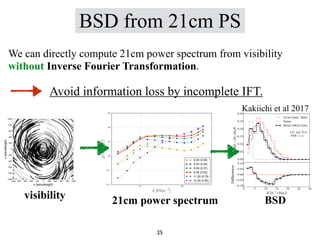
BSD from 21cm PS
Kakiichi et al 2017
21cm power spectrum BSD
visibility
We can directly compute 21cm power spectrum from visibility
without Inverse Fourier Transformation.
Avoid information loss by incomplete IFT.
25
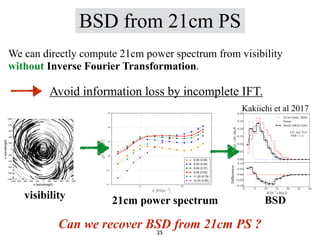
BSD from 21cm PS
Kakiichi et al 2017
21cm power spectrum BSD
visibility
We can directly compute 21cm power spectrum from visibility
without Inverse Fourier Transformation.
Can we recover BSD from 21cm PS ?
Avoid information loss by incomplete IFT.
25
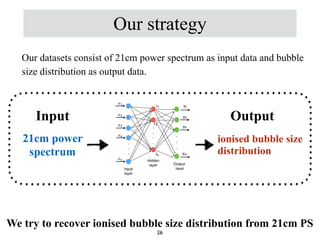
21cm power
spectrum
Input Output
ionised bubble size
distribution
Our datasets consist of 21cm power spectrum as input data and bubble
size distribution as output data.
Our strategy
We try to recover ionised bubble size distribution from 21cm PS
26
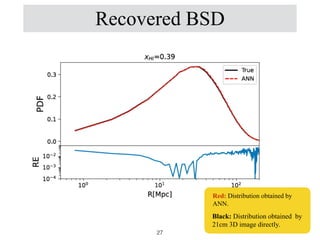
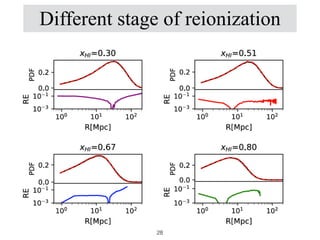
Recovered BSD
Black: Distribution obtained by
21cm 3D image directly.
Red: Distribution obtained by
ANN.
27
Different stage of reionization
28
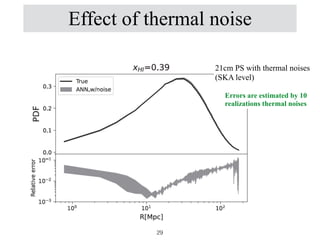
Effect of thermal noise
29
21cm PS with thermal noises
(SKA level)


Errors are estimated by 10
realizations thermal noises
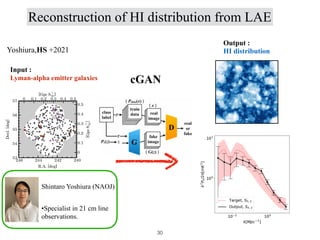
Reconstruction of HI distribution from LAE
map is marked in angles (degrees) and the projected distances (comoving megaparsecs).
Fig. 5. Same as Figure 4, but for the LAEs z = 6.6. The large red open squares indicate the LAEs with spatially extended Lyα emission including Himiko
(Ouchi et al. 2009a) and CR7 (Sobral et al. 2015). See Shibuya et al. (2017b) for more details.
Input :


Lyman-alpha emitter galaxies
Output :


HI distribution
Yoshiura,HS +2021
30
cGAN
Shintaro Yoshiura (NAOJ)
•Specialist in 21 cm line
observations.
Take home messages of my talk are…
•The epoch from the Dark Ages to cosmic reionization is the
frontier in the history of the universe.
•21cm signal is a promising tool to study this epoch.
•We proposed a method based on machine learning to
analyze the 21cm line signal.
31
bakcup
HII bubble
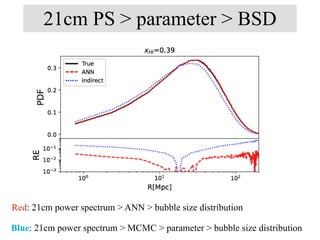
Red: 21cm power spectrum > ANN > bubble size distribution
Blue: 21cm power spectrum > MCMC > parameter > bubble size distribution
21cm PS > parameter > BSD
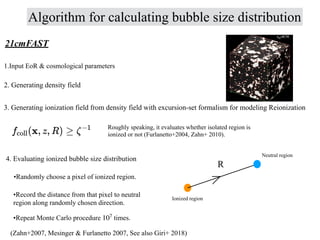
Algorithm for calculating bubble size distribution
2. Generating density field
3. Generating ionization field from density field with excursion-set formalism for modeling Reionization
1.Input EoR & cosmological parameters
21cmFAST
Roughly speaking, it evaluates whether isolated region is
ionized or not (Furlanetto+2004, Zahn+ 2010).
4. Evaluating ionized bubble size distribution
(Zahn+2007, Mesinger & Furlanetto 2007, See also Giri+ 2018)
•Randomly choose a pixel of ionized region.
•Record the distance from that pixel to neutral
region along randomly chosen direction.
•Repeat Monte Carlo procedure times.
107
Ionized region
R
Neutral region
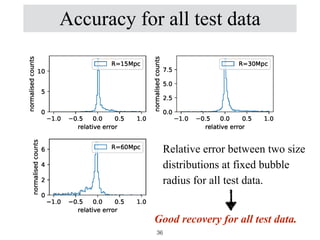
Accuracy for all test data
Relative error between two size
distributions at fixed bubble
radius for all test data.
Good recovery for all test data.
36
EoR parameter with ANN
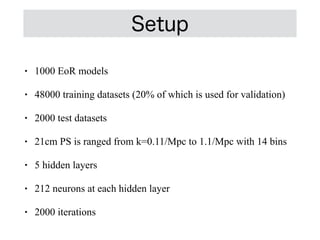
• 1000 EoR models


• 48000 training datasets (20% of which is used for validation)


• 2000 test datasets


• 21cm PS is ranged from k=0.11/Mpc to 1.1/Mpc with 14 bins


• 5 hidden layers


• 212 neurons at each hidden layer


• 2000 iterations
Setup
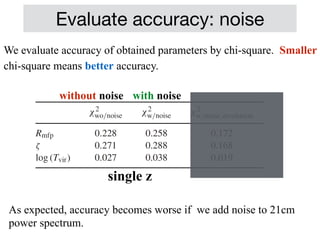
Evaluate accuracy: noise
We evaluate accuracy of obtained parameters by chi-square. Smaller
chi-square means better accuracy.
single z
As expected, accuracy becomes worse if we add noise to 21cm
power spectrum.
without noise with noise
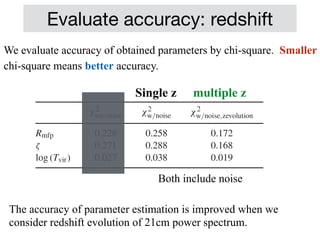
Evaluate accuracy: redshift
We evaluate accuracy of obtained parameters by chi-square. Smaller
chi-square means better accuracy.
multiple z
The accuracy of parameter estimation is improved when we
consider redshift evolution of 21cm power spectrum.
Single z
Both include noise

21cm cosmology with machine learning

  • 1.
    21cm cosmology withmachine learning @清华⼤学(2022/6/6) Hayato Shimabukuro(島袋隼⼠) (Yunnan university, Nagoya university) 1
  • 2.
  • 3.
    The history ofthe universe ©NAOJ Dark Ages・・・No luminous object exists. Epoch of Reionization(EoR)・・・UV photons by luminous objects ionize neutral hydrogen in the IGM (z~6-15). Cosmic Dawn・・・First stars and galaxies form (z~20-30). 3
  • 4.
    The history ofthe universe ©NAOJ Dark Ages・・・No luminous object exists. Epoch of Reionization(EoR)・・・UV photons by luminous objects ionize neutral hydrogen in the IGM (z~6-15). Cosmic Dawn・・・First stars and galaxies form (z~20-30). 3
  • 5.
    (C)Kenji Hasegawa(Nagoya University) Credit:M. Alvarez, R. Kaehler and T.Abel
  • 6.
    (C)Kenji Hasegawa(Nagoya University) Credit:M. Alvarez, R. Kaehler and T.Abel
  • 7.
    We want tounveil EoR! (ex) •EoR theory •Morphology and topology of ionized bubble •Ionizing sources •Relation to galaxy formation and evolution etc… 5
  • 8.
    We want tounveil EoR! We should observe IGM at the EoR directly ! (ex) •EoR theory •Morphology and topology of ionized bubble •Ionizing sources •Relation to galaxy formation and evolution etc… 5
  • 9.
    We want tounveil EoR! We should observe IGM at the EoR directly ! (ex) •EoR theory •Morphology and topology of ionized bubble •Ionizing sources •Relation to galaxy formation and evolution etc… ✕ Synergy with galaxy observation by ALMA, JWST, Subaru 5
  • 10.
    We want tounveil EoR! We should observe IGM at the EoR directly ! (ex) •EoR theory •Morphology and topology of ionized bubble •Ionizing sources •Relation to galaxy formation and evolution etc… ✕ Synergy with galaxy observation by ALMA, JWST, Subaru 5
  • 11.
    We want tounveil EoR! We should observe IGM at the EoR directly ! (ex) •EoR theory •Morphology and topology of ionized bubble •Ionizing sources •Relation to galaxy formation and evolution etc… ✕ Synergy with galaxy observation by ALMA, JWST, Subaru 5
  • 12.
    21cm line •21cm lineradiation : Neutral hydrogen atom in IGM emits the radiation due to the hyperfine structure. z=6 → 1.5m or 202 MHz z=20 → 4.4m or 68MHz Radio wavelength. Proton Electron 21cm line emission(1.4GHz) (Neutral) hydrogen atom is good tracer for IGM. 6 signlet Triplet
  • 13.
    21cm line signal Red: cosmology Blue : astrophysics Tb = TS T 1 + z (1 exp(⌧⌫)) ⇠ 27xH(1 + m) ✓ H dvr/dr + H ◆ ✓ 1 T TS ◆ ✓ 1 + z 10 0.15 ⌦mh2 ◆1/2 ✓ ⌦bh2 0.023 ◆ [mK] Brightness temperature We can map the distribution of HI in the IGM with 21cm line 7
  • 14.
    21cm line signal Red: cosmology Blue : astrophysics Tb = TS T 1 + z (1 exp(⌧⌫)) ⇠ 27xH(1 + m) ✓ H dvr/dr + H ◆ ✓ 1 T TS ◆ ✓ 1 + z 10 0.15 ⌦mh2 ◆1/2 ✓ ⌦bh2 0.023 ◆ [mK] Brightness temperature We can map the distribution of HI in the IGM with 21cm line 7
  • 15.
    21cm power spectrum(PS) : Scale dependence Pober et al (2014) EoR X-ray heating WF effect z Redshift dependence 21cm power spectrum h Tb(k) Tb(k 0 )i = (2⇡)3 (k + k 0 )P21 We first try to detect the 21cm line signal statistically with ongoing telescopes. 8
  • 16.
    Current radio interferometers MWALOFAR HERA GMRT Radio interferometer •Array of radio telescope antennas •Measure time delay between antennas •Work together as a single telescope 9
  • 17.
  • 18.
    EDGES (Bouman etal 2018) Too deep trough Too flat We detected the 21cm line signal? 11
  • 19.
    EDGES (Bouman etal 2018) Too deep trough Too flat We detected the 21cm line signal? SARAS3 did not detect signal (Singh + 2022, Nature astronomy) 11
  • 20.
    EDGES (Bouman etal 2018) Too deep trough Too flat We detected the 21cm line signal? SARAS3 did not detect signal (Singh + 2022, Nature astronomy) Very strange result ! Need exotic physics? mis-calibration? unknown systematics? 11
  • 21.
  • 22.
    21cm signal analysiswith Arti fi cial neural network(ANN) 13
  • 23.
    Artificial Neural Network(ANN) •Training network with training dataset, ANN can approximate any function which associates input and output values. y = f(x) • Applying trained network to unknown data(test data) for prediction. yANN = f(xtest) • ANN consists of input layer, hidden layer and output layer. Each layer has neurons. nonlinear regression Problem 14
  • 24.
    •Emulator •parameter estimate •Distinguish EoRsources (e.g) Hassan +2019 •Others (e.g.) Li + 2019, Chardin + 2019, Yoshiura + 2020, Shimabukuro + 2022 (e.g.) Kern + 2017, Schmit + 2018, Aviad + 2020, Bevins + 2021, Bevins+ 2021 (e.g.) Shimabukuro + 2017, Gilet+ 2018, Nicolas +2019, Doussot +2019, Choudhury+ 2020,2021a,b, Zhao+ 2022a,b 21cm study+machine learning 15
  • 25.
    EoR parameter estimation withANN Based on Shimabukuro and Semelin 2017 16
  • 26.
    Statistical challenge in21cm cosmology (Mesinger 2018) Cosmology CMB map (angular) power spectrum cosmological parameter 21cm 21cm 3D map 21cm power spectrum astrophysical parameter Based on Bayesian inference 17
  • 27.
    Statistical challenge in21cm cosmology (Mesinger 2018) Cosmology CMB map (angular) power spectrum cosmological parameter 21cm 21cm 3D map 21cm power spectrum astrophysical parameter Based on Bayesian inference We proposed alternative method. 17
  • 28.
    Dataset ⇣ : theionizing efficiency. : the minimum viral temperature of halos producing ionizing photons : the mean free path of ionizing photons through the IGM (Maximum HII bubble size) Tvir Rmfp ~ d = [P(k), ~ ✓] 21cm power spectrum (input) EoR parameter (output) EoR Parameter ✓EoR = f(P21) 18
  • 29.
    z=9, 10, 11.PS with thermal noise and cosmic variance Reconstructed by 21cm PS at z=9,10,11 Rmfp ⇣ Tvir 10 20 30 40 50 60 10 20 30 40 50 60 R mfp,ANN [Mpc] Rmfp,true[Mpc] 10 20 30 40 50 60 10 20 30 40 50 60 ANN true 1 10 100 1 10 100 T vir,ANN [K/10 3 ] Tvir,true[K/10 3 ] Red : z=9,10,11 Blue : z=9 The parameters obtained by the ANN match true values. ANN work well ! 19
  • 30.
    Emulator EoR parameters 21cmPS ANNMCMC Without emulator: 2.5days on 6 cores With emulator: 4minutes speed up by 3 orders of magnitude (Schmit et al 2018) (input) (output) 20
  • 31.
    parameters 21cm map ANN (input)(output) Parameter estimate Gillet +2018 21
  • 32.
    Recovering HII bubblesize distribution with ANN Based on Shimabukuro et al 2022 22
  • 33.
    Bubble size distribution(BSD) ''How large bubbles are distributed ?’' Giri 2019 What can we learn from BSD? Giri et al 2017 •EoR source (galaxy or AGN?) •ionizing efficiency, recombination, radiative feedback. (ex.) 23
  • 34.
    BSD from 21cmobservation Kakiichi et al 2017 IFT 21cm Image BSD Incomplete IFT due to limited number of antenna in interferometer. visibility We do not observe 21cm image directly by radio interferometer! We first observe visibility and perform Inverse Fourier Transformation (IFT) to obtain 21cm image. Then, compute BSD. 24
  • 35.
    BSD from 21cmPS Kakiichi et al 2017 21cm power spectrum BSD visibility We can directly compute 21cm power spectrum from visibility without Inverse Fourier Transformation. Avoid information loss by incomplete IFT. 25
  • 36.
    BSD from 21cmPS Kakiichi et al 2017 21cm power spectrum BSD visibility We can directly compute 21cm power spectrum from visibility without Inverse Fourier Transformation. Can we recover BSD from 21cm PS ? Avoid information loss by incomplete IFT. 25
  • 37.
    21cm power spectrum Input Output ionisedbubble size distribution Our datasets consist of 21cm power spectrum as input data and bubble size distribution as output data. Our strategy We try to recover ionised bubble size distribution from 21cm PS 26
  • 38.
    Recovered BSD Black: Distributionobtained by 21cm 3D image directly. Red: Distribution obtained by ANN. 27
  • 39.
    Different stage ofreionization 28
  • 40.
    Effect of thermalnoise 29 21cm PS with thermal noises (SKA level) Errors are estimated by 10 realizations thermal noises
  • 41.
    Reconstruction of HIdistribution from LAE map is marked in angles (degrees) and the projected distances (comoving megaparsecs). Fig. 5. Same as Figure 4, but for the LAEs z = 6.6. The large red open squares indicate the LAEs with spatially extended Lyα emission including Himiko (Ouchi et al. 2009a) and CR7 (Sobral et al. 2015). See Shibuya et al. (2017b) for more details. Input : Lyman-alpha emitter galaxies Output : HI distribution Yoshiura,HS +2021 30 cGAN Shintaro Yoshiura (NAOJ) •Specialist in 21 cm line observations.
  • 42.
    Take home messagesof my talk are… •The epoch from the Dark Ages to cosmic reionization is the frontier in the history of the universe. •21cm signal is a promising tool to study this epoch. •We proposed a method based on machine learning to analyze the 21cm line signal. 31
  • 43.
  • 44.
  • 45.
    Red: 21cm powerspectrum > ANN > bubble size distribution Blue: 21cm power spectrum > MCMC > parameter > bubble size distribution 21cm PS > parameter > BSD
  • 46.
    Algorithm for calculatingbubble size distribution 2. Generating density field 3. Generating ionization field from density field with excursion-set formalism for modeling Reionization 1.Input EoR & cosmological parameters 21cmFAST Roughly speaking, it evaluates whether isolated region is ionized or not (Furlanetto+2004, Zahn+ 2010). 4. Evaluating ionized bubble size distribution (Zahn+2007, Mesinger & Furlanetto 2007, See also Giri+ 2018) •Randomly choose a pixel of ionized region. •Record the distance from that pixel to neutral region along randomly chosen direction. •Repeat Monte Carlo procedure times. 107 Ionized region R Neutral region
  • 47.
    Accuracy for alltest data Relative error between two size distributions at fixed bubble radius for all test data. Good recovery for all test data. 36
  • 48.
  • 49.
    • 1000 EoRmodels • 48000 training datasets (20% of which is used for validation) • 2000 test datasets • 21cm PS is ranged from k=0.11/Mpc to 1.1/Mpc with 14 bins • 5 hidden layers • 212 neurons at each hidden layer • 2000 iterations Setup
  • 50.
    Evaluate accuracy: noise Weevaluate accuracy of obtained parameters by chi-square. Smaller chi-square means better accuracy. single z As expected, accuracy becomes worse if we add noise to 21cm power spectrum. without noise with noise
  • 51.
    Evaluate accuracy: redshift Weevaluate accuracy of obtained parameters by chi-square. Smaller chi-square means better accuracy. multiple z The accuracy of parameter estimation is improved when we consider redshift evolution of 21cm power spectrum. Single z Both include noise