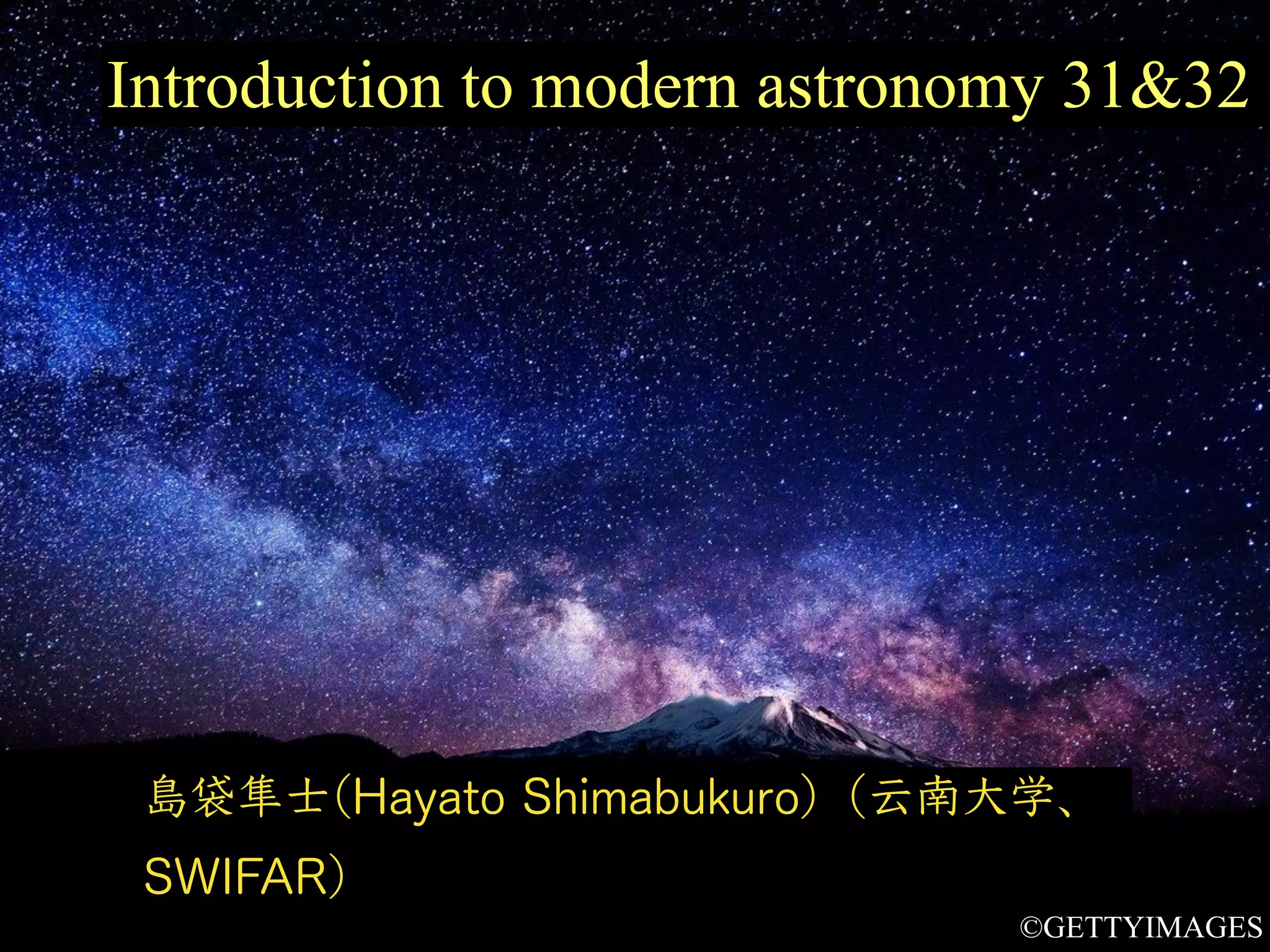
Introduction to modern astronomy 31&32
島袋隼⼠(Hayato Shimabukuro)(云南⼤学、
SWIFAR)
©GETTYIMAGES
18.Astrobiology(宇宙中的⽣命)
Is there life in the universe other than us?
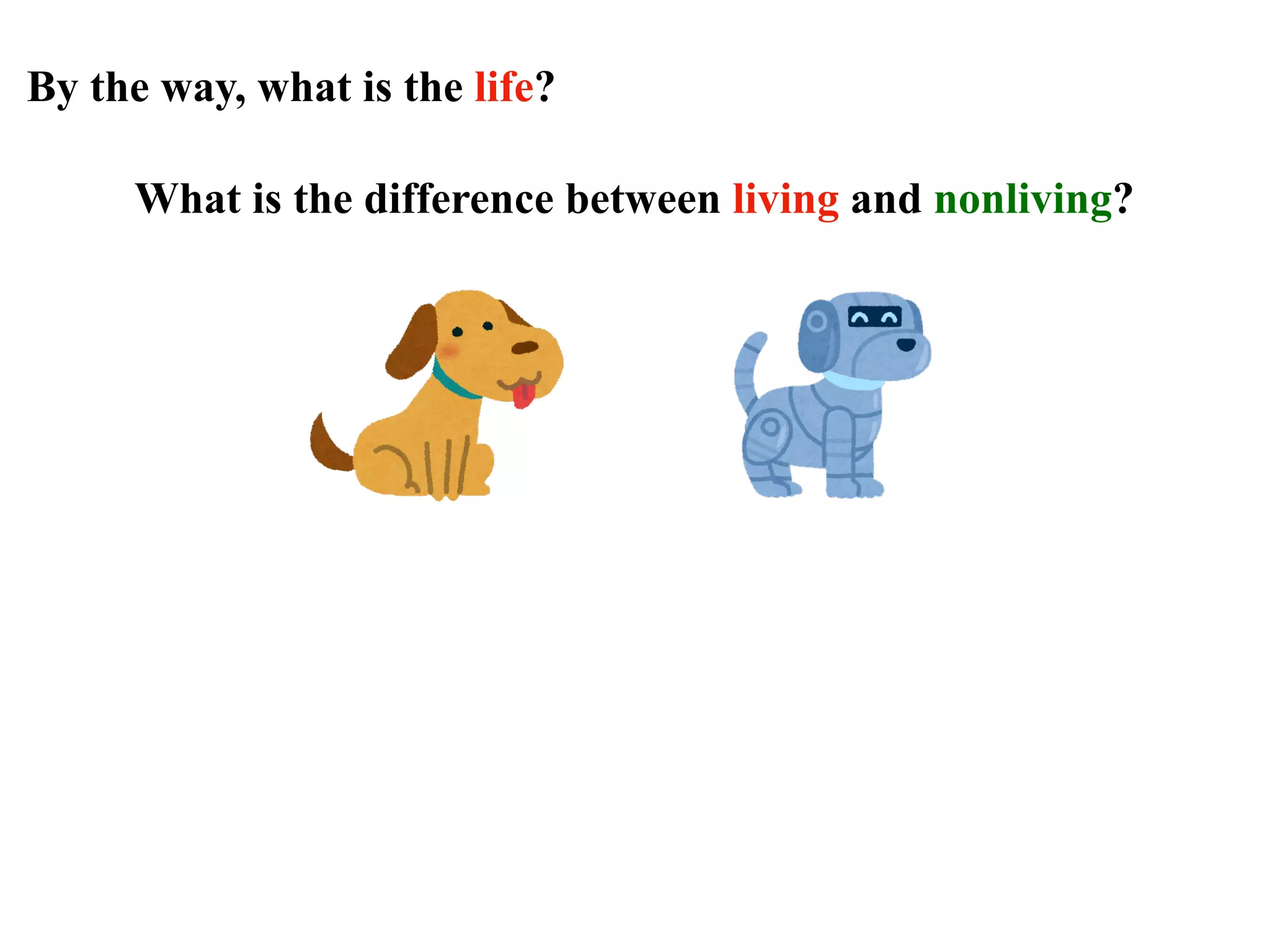
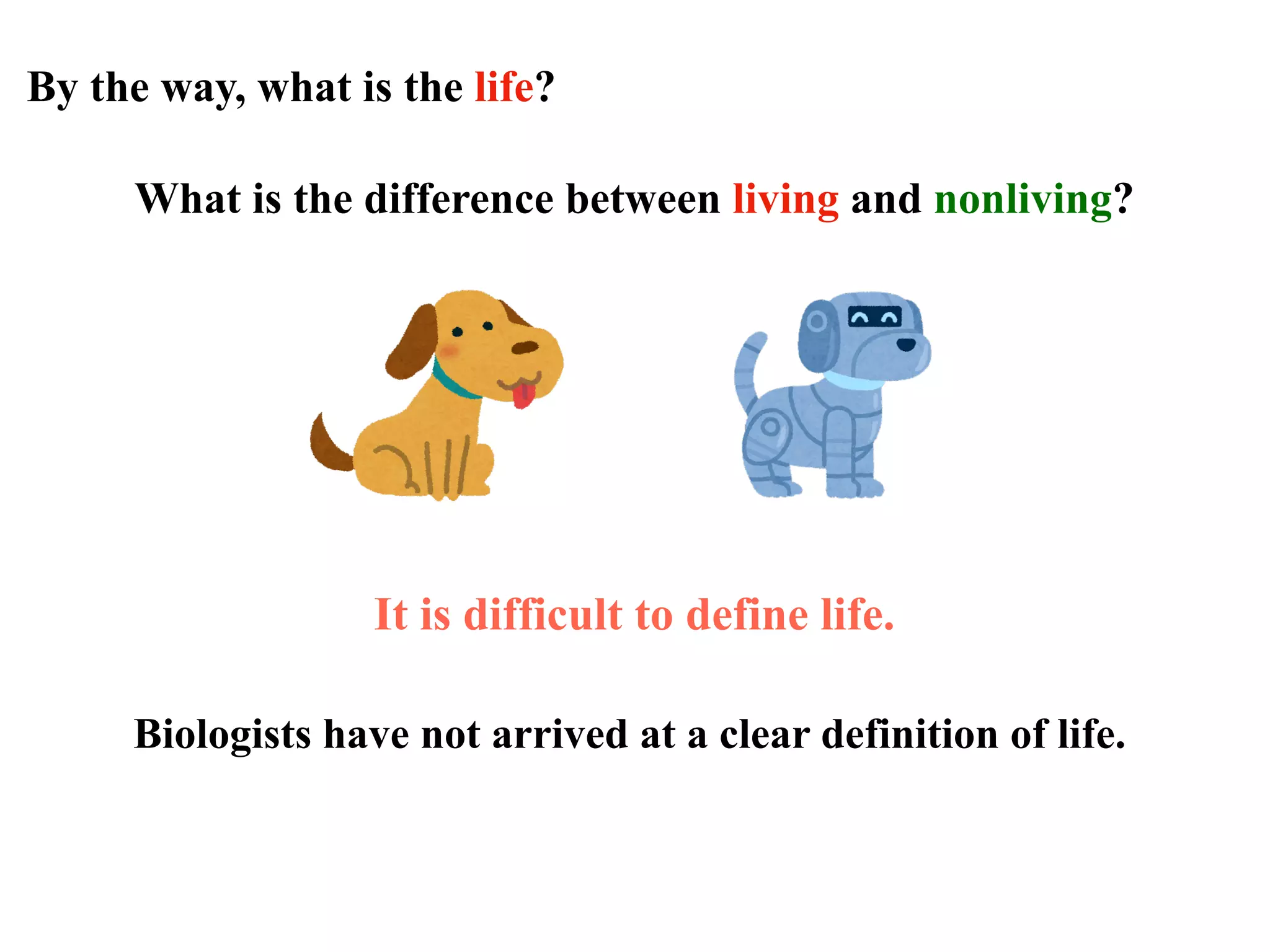
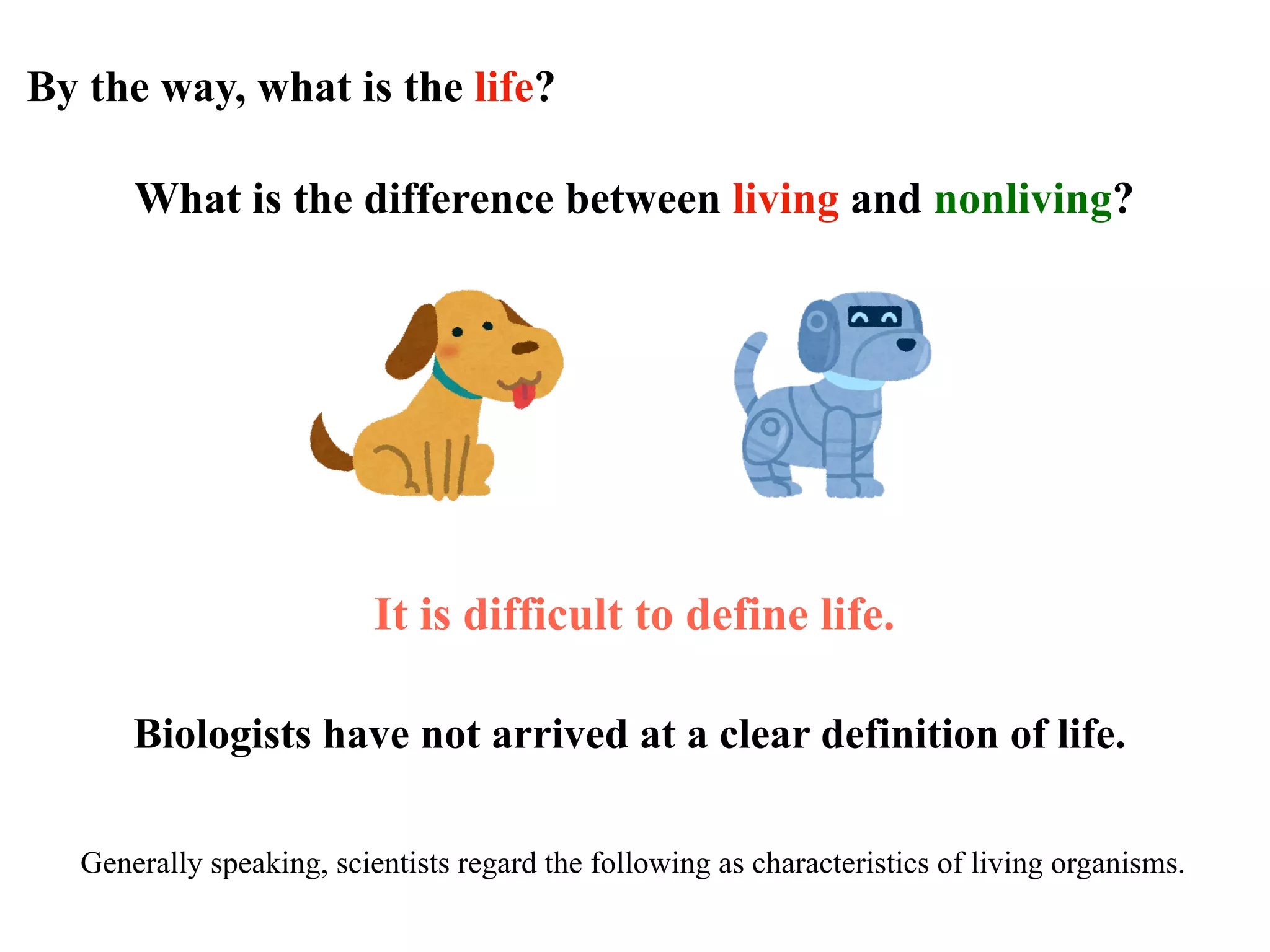
By the way, what is the life?
What is the difference between living and nonliving?
By the way, what is the life?
What is the difference between living and nonliving?
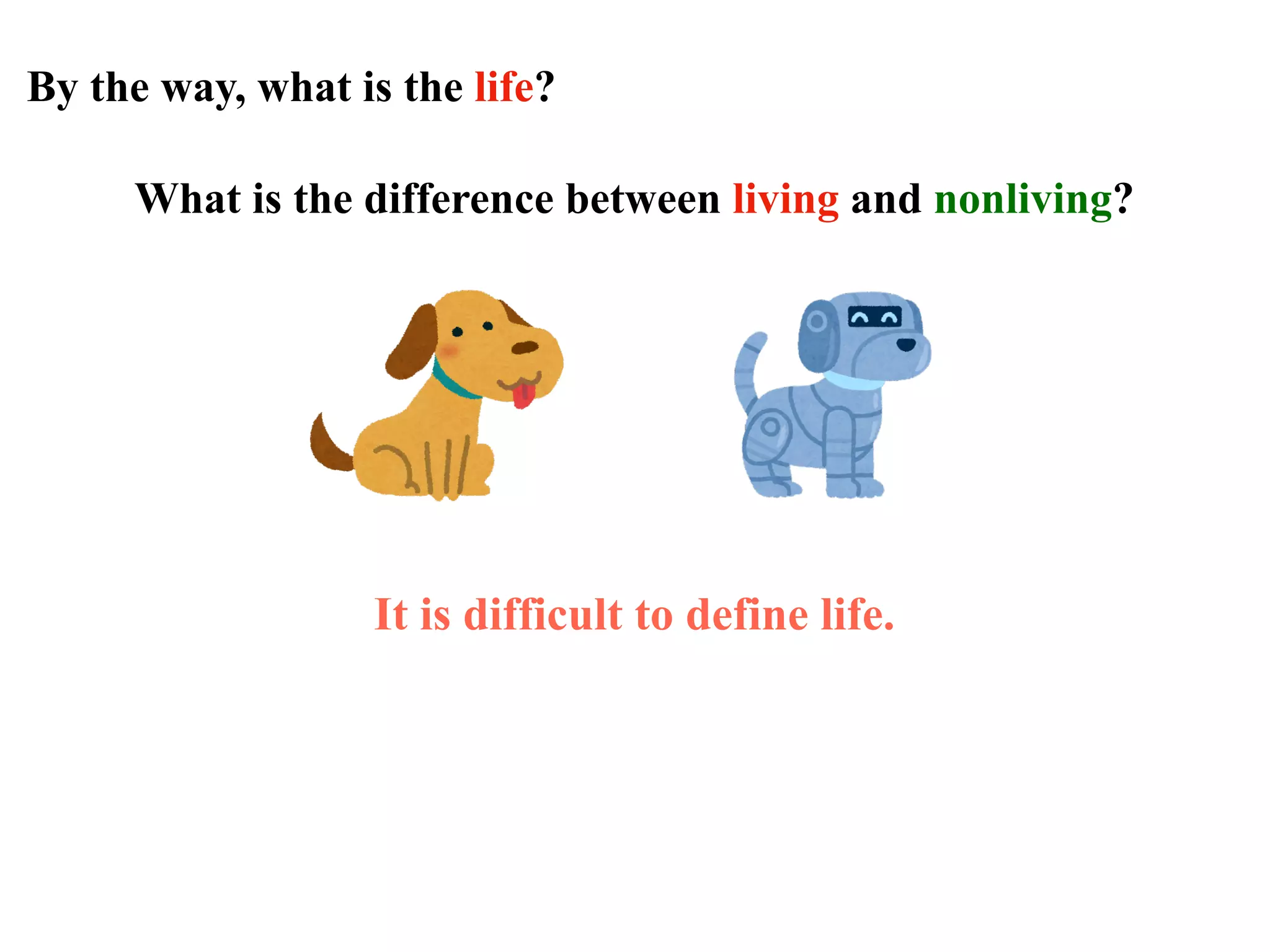
It is difficult to define life.
By the way, what is the life?
What is the difference between living and nonliving?
It is difficult to define life.
Biologists have not arrived at a clear definition of life.
By the way, what is the life?
What is the difference between living and nonliving?
It is difficult to define life.
Biologists have not arrived at a clear definition of life.
Generally speaking, scientists regard the following as characteristics of living organisms.
1. They can react to their environment and can often heal themselves when damaged.
The definition of life
2. They can grow by taking in nourishment from their surroundings and processing
it into energy.
3. They can reproduce, passing along some of their own characteristics to their
offspring.
4. They have the capacity for generic change and can therefore evolve from
generation to generation and adapt to a changing environment.
它们可以对环境做出响应,⽽且常常可以在受伤时⾃我治疗
它们可以通过周围的环境汲取养分,并将其加⼯成能量⽽⽣⻓
它们可以繁殖,并将⾃⼰的⼀些特性遗传给后代
它们有基因变化能⼒,因此可以世代进化,并适应不断变化的环境
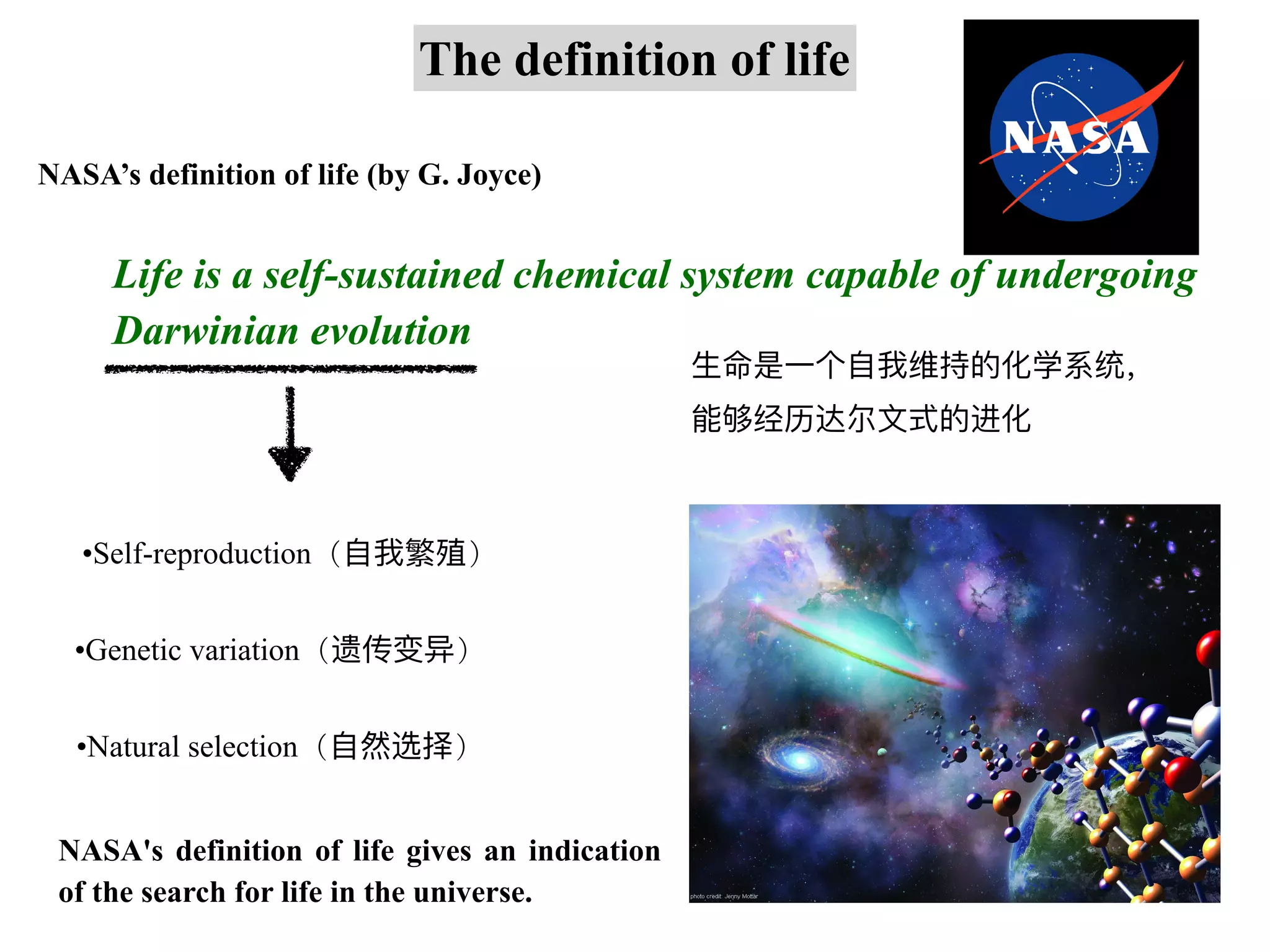
NASA’s definition of life (by G. Joyce)
The definition of life
Life is a self-sustained chemical system capable of undergoing
Darwinian evolution
⽣命是⼀个⾃我维持的化学系统,
能够经历达尔⽂式的进化
•Self-reproduction(⾃我繁殖)
•Genetic variation(遗传变异)
•Natural selection(⾃然选择)
NASA's definition of life gives an indication
of the search for life in the universe.
Assumptions to search for life in the universe
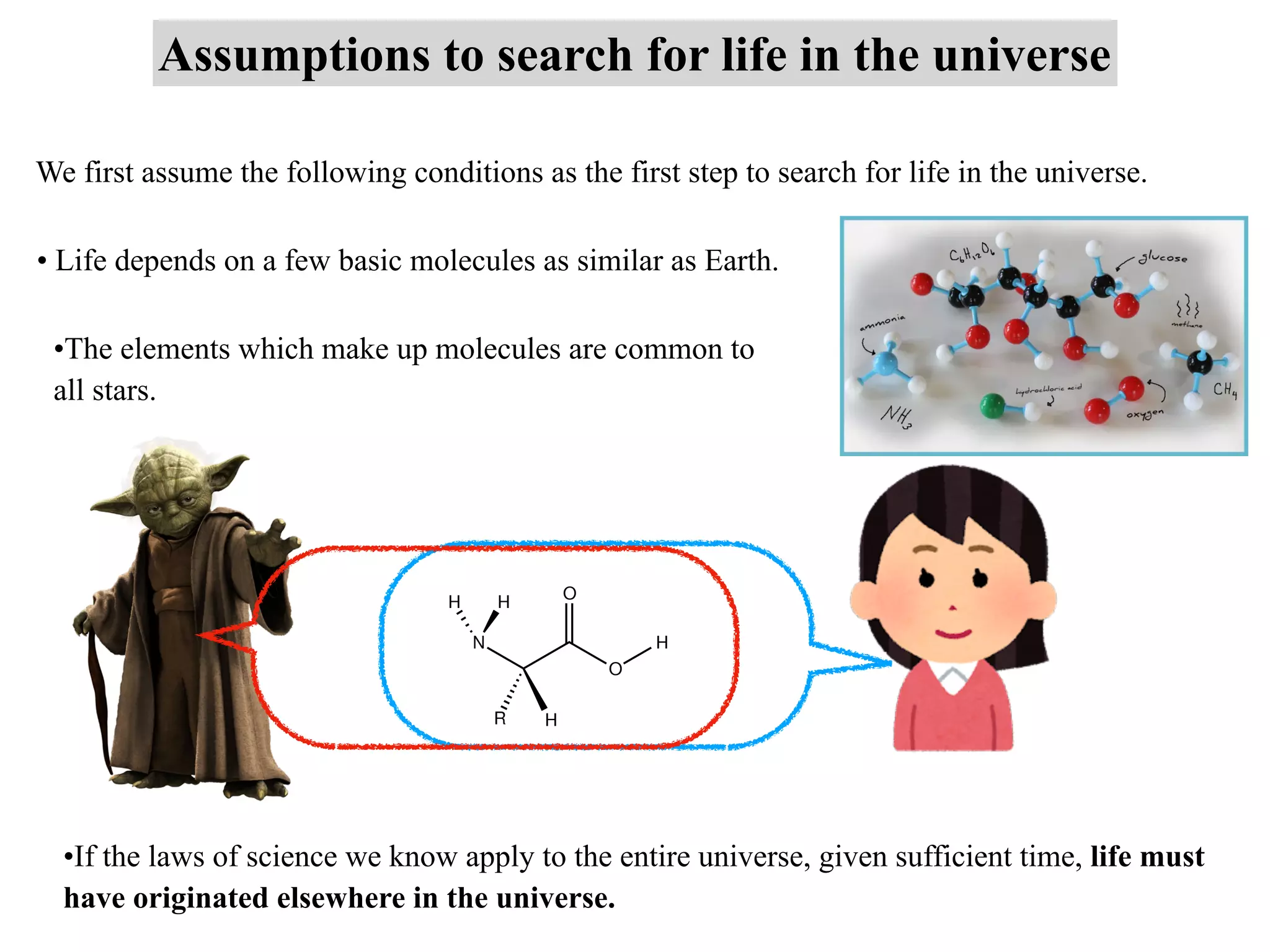
We first assume the following conditions as the first step to search for life in the universe.
• Life depends on a few basic molecules as similar as Earth.
•The elements which make up molecules are common to
all stars.
•If the laws of science we know apply to the entire universe, given sufficient time, life must
have originated elsewhere in the universe.
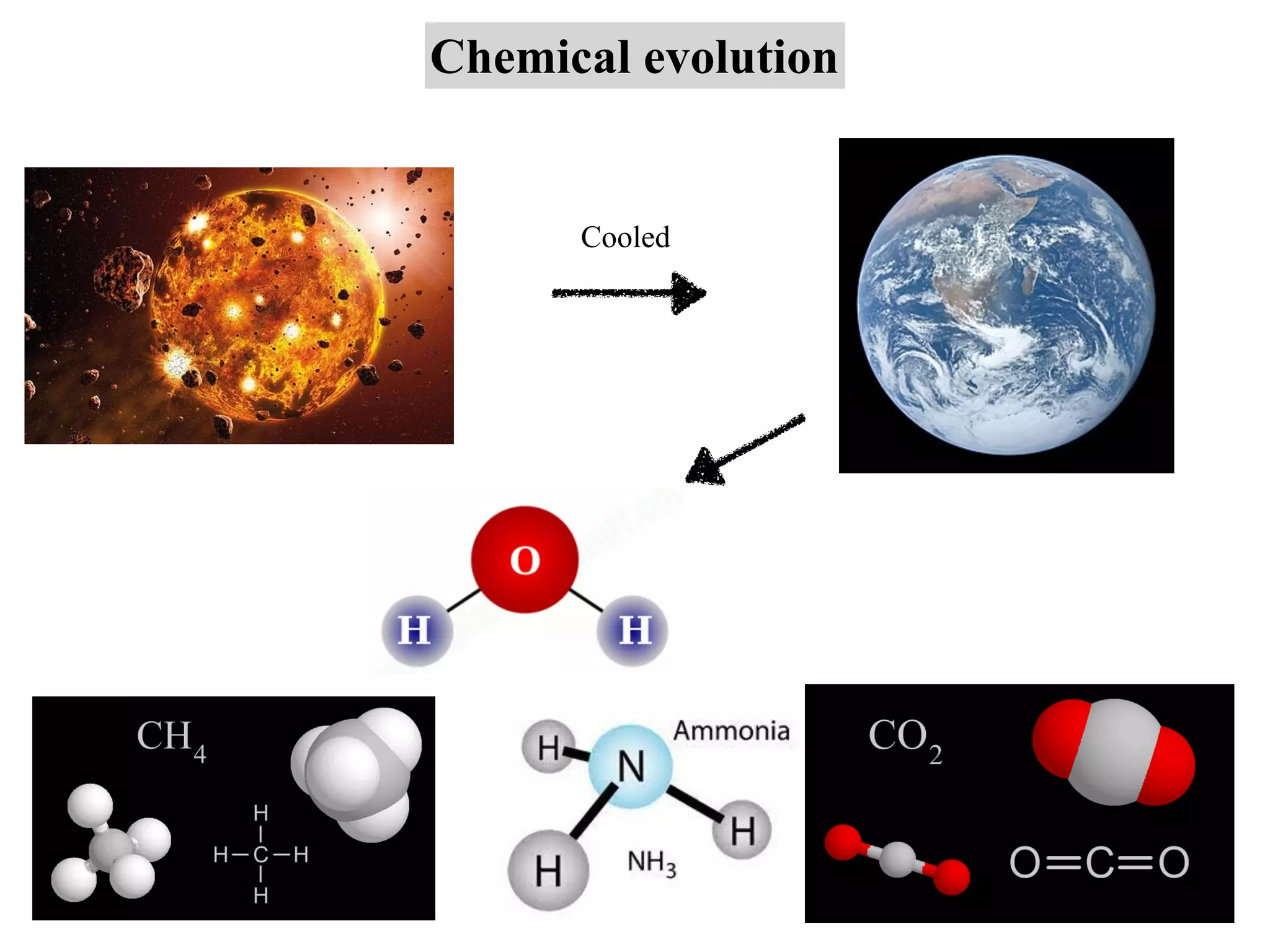
Chemical evolution
Cooled
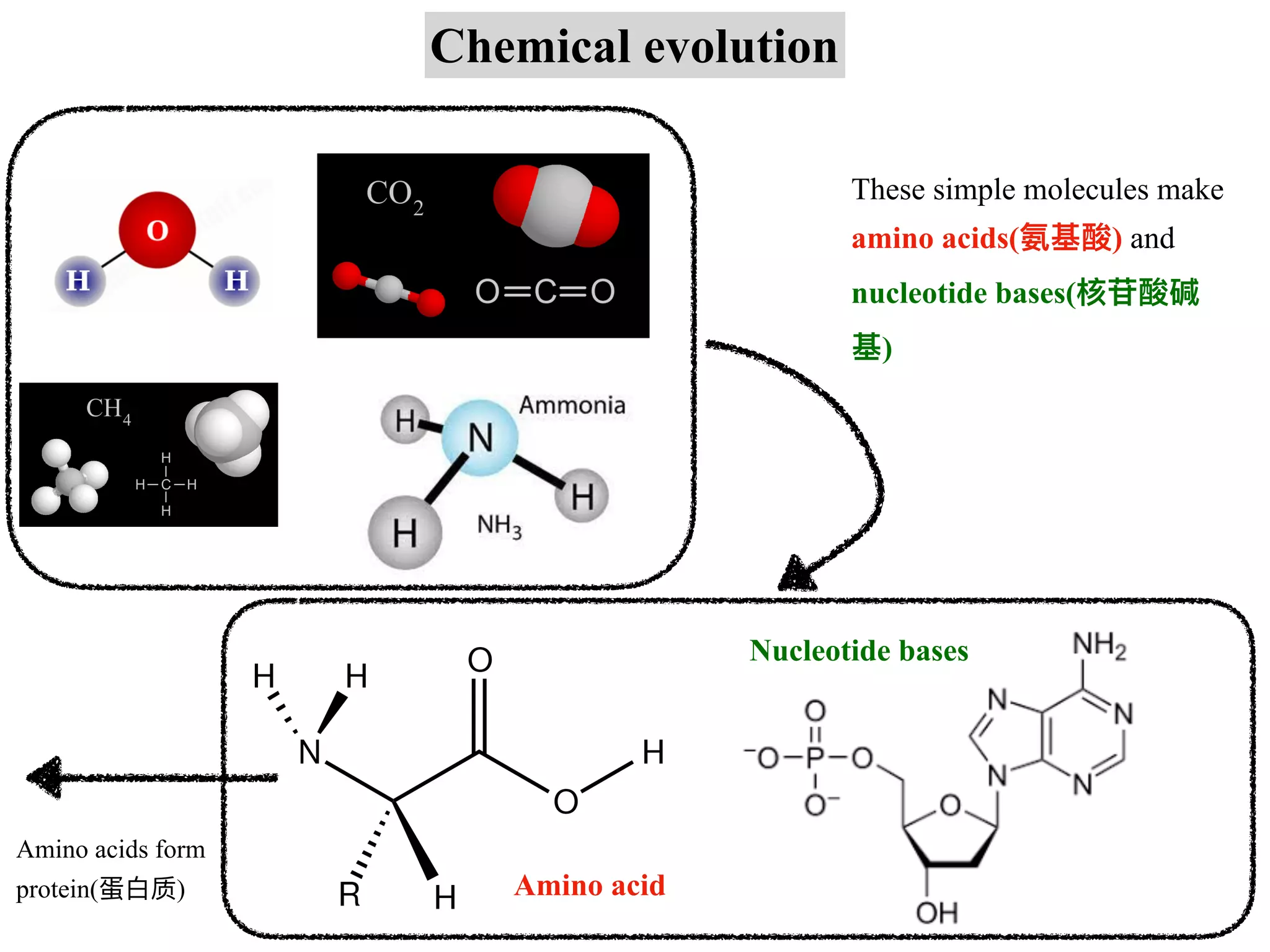
Chemical evolution
Amino acid
Nucleotide bases
These simple molecules make
amino acids(氨基酸) and
nucleotide bases(核苷酸碱
基)
Amino acids form
protein(蛋⽩质)
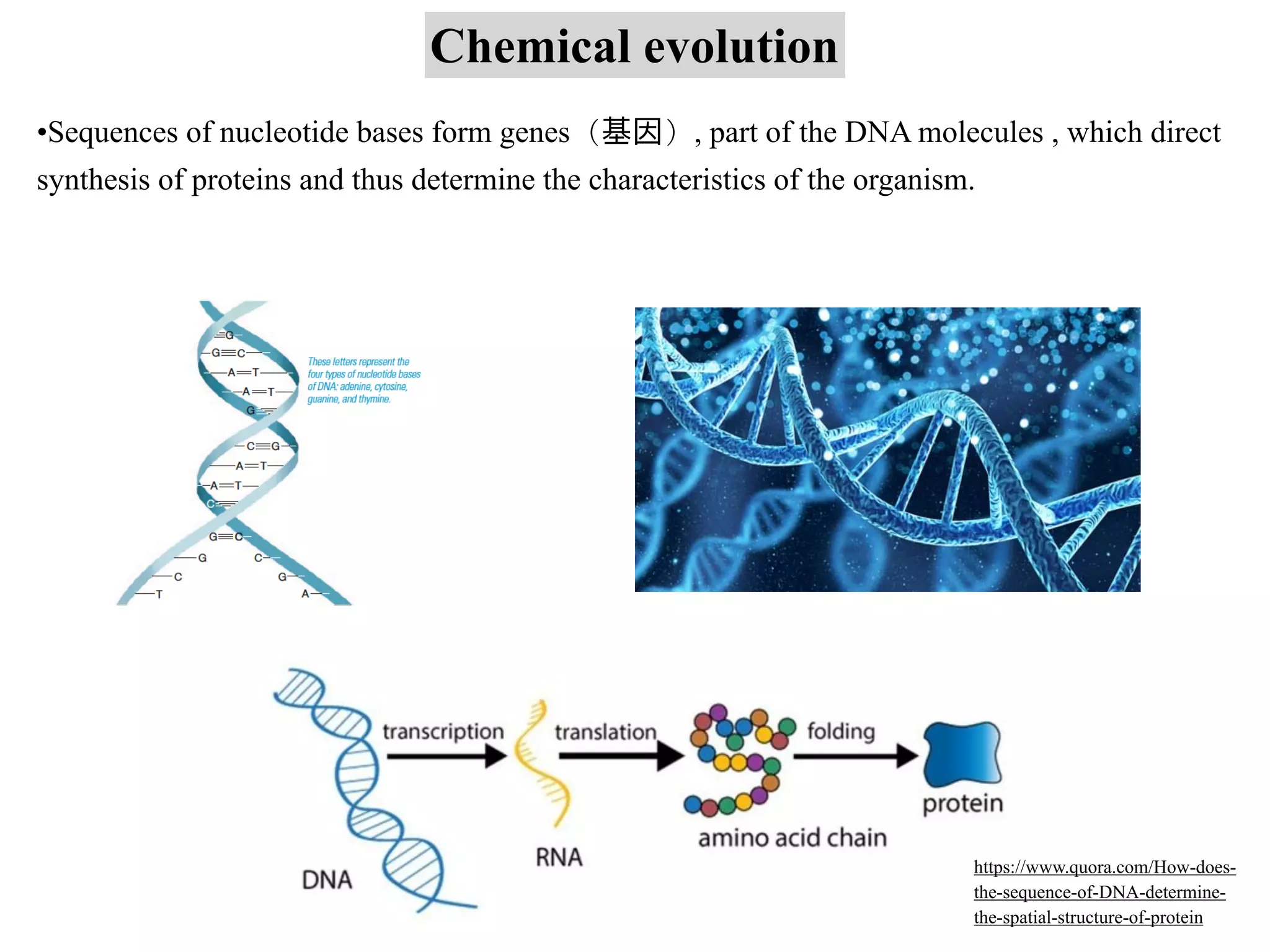
Chemical evolution
•Sequences of nucleotide bases form genes(基因), part of the DNA molecules , which direct
synthesis of proteins and thus determine the characteristics of the organism.
https://www.quora.com/How-does-
the-sequence-of-DNA-determine-
the-spatial-structure-of-protein
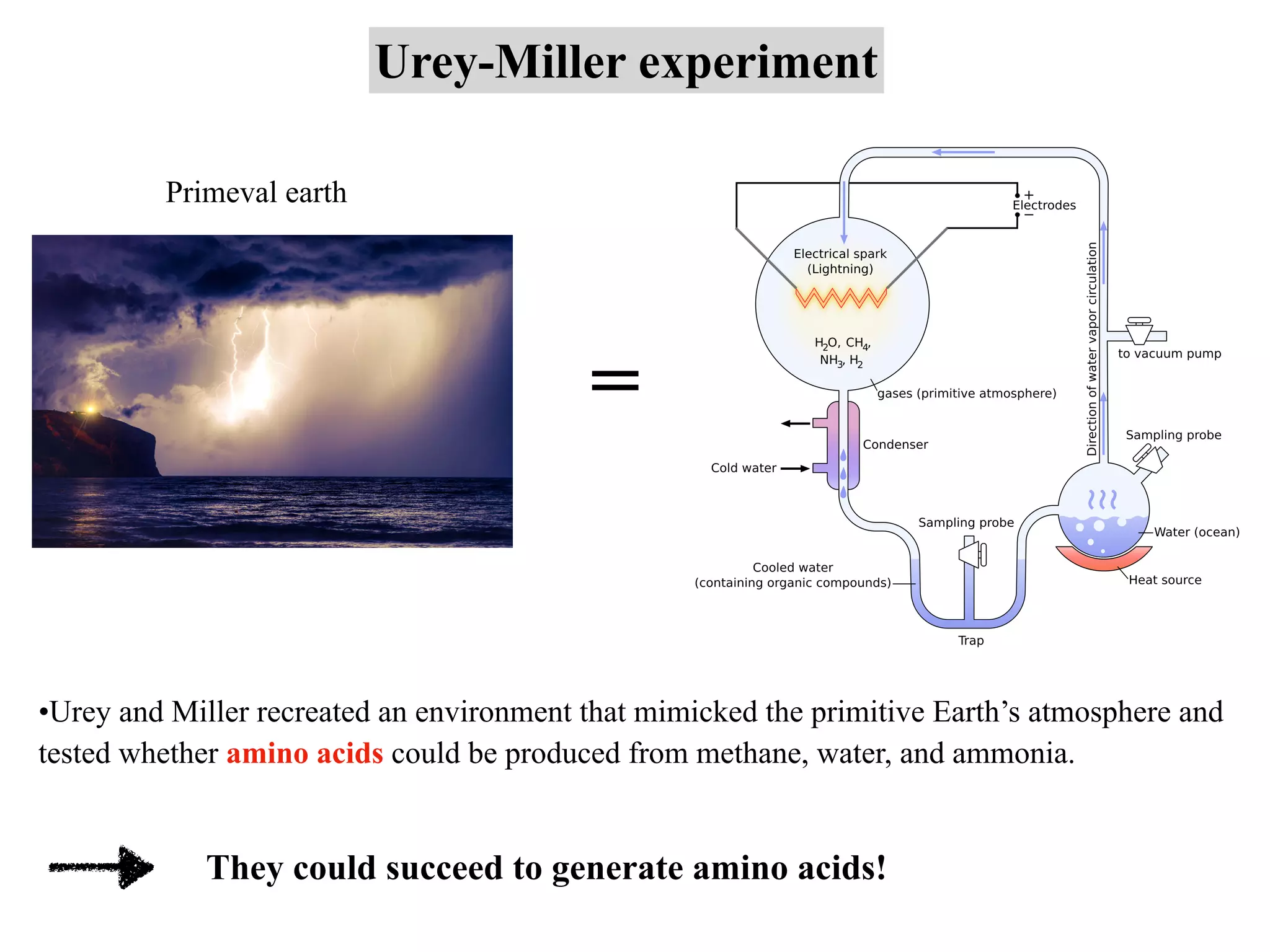
Urey-Miller experiment
=
Primeval earth
•Urey and Miller recreated an environment that mimicked the primitive Earth’s atmosphere and
tested whether amino acids could be produced from methane, water, and ammonia.
They could succeed to generate amino acids!
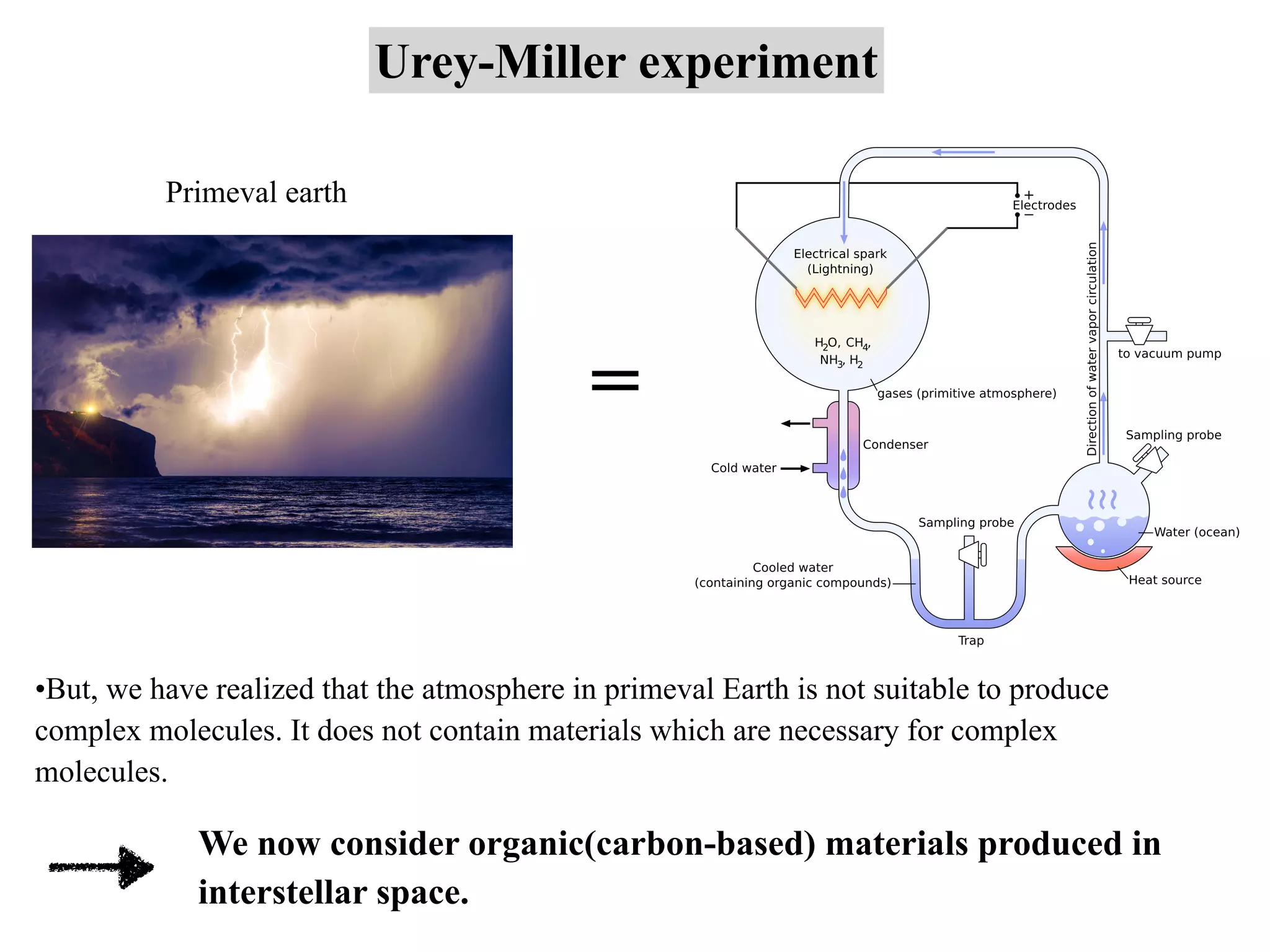
Urey-Miller experiment
=
Primeval earth
•But, we have realized that the atmosphere in primeval Earth is not suitable to produce
complex molecules. It does not contain materials which are necessary for complex
molecules.
We now consider organic(carbon-based) materials produced in
interstellar space.
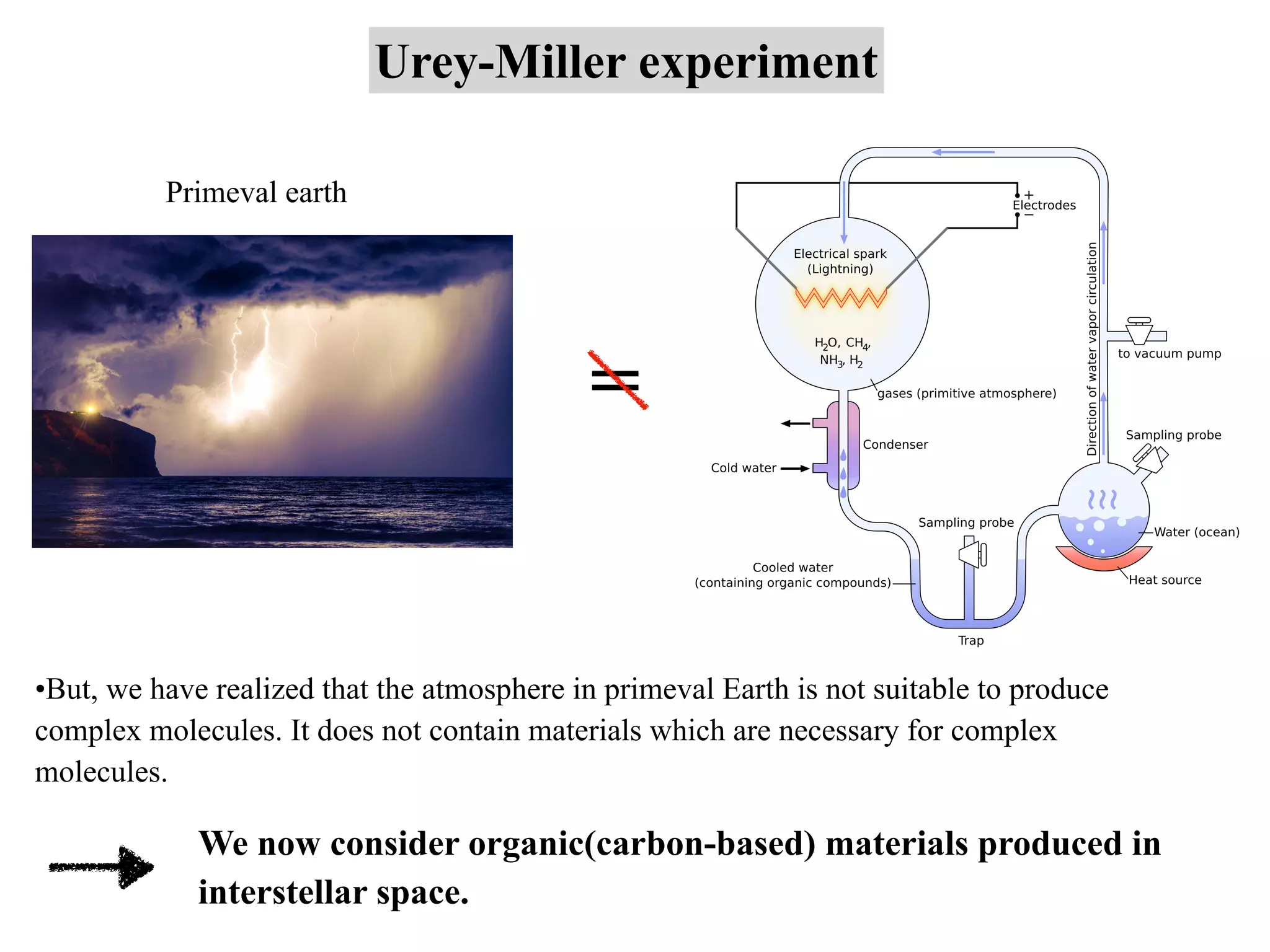
Urey-Miller experiment
=
Primeval earth
•But, we have realized that the atmosphere in primeval Earth is not suitable to produce
complex molecules. It does not contain materials which are necessary for complex
molecules.
We now consider organic(carbon-based) materials produced in
interstellar space.
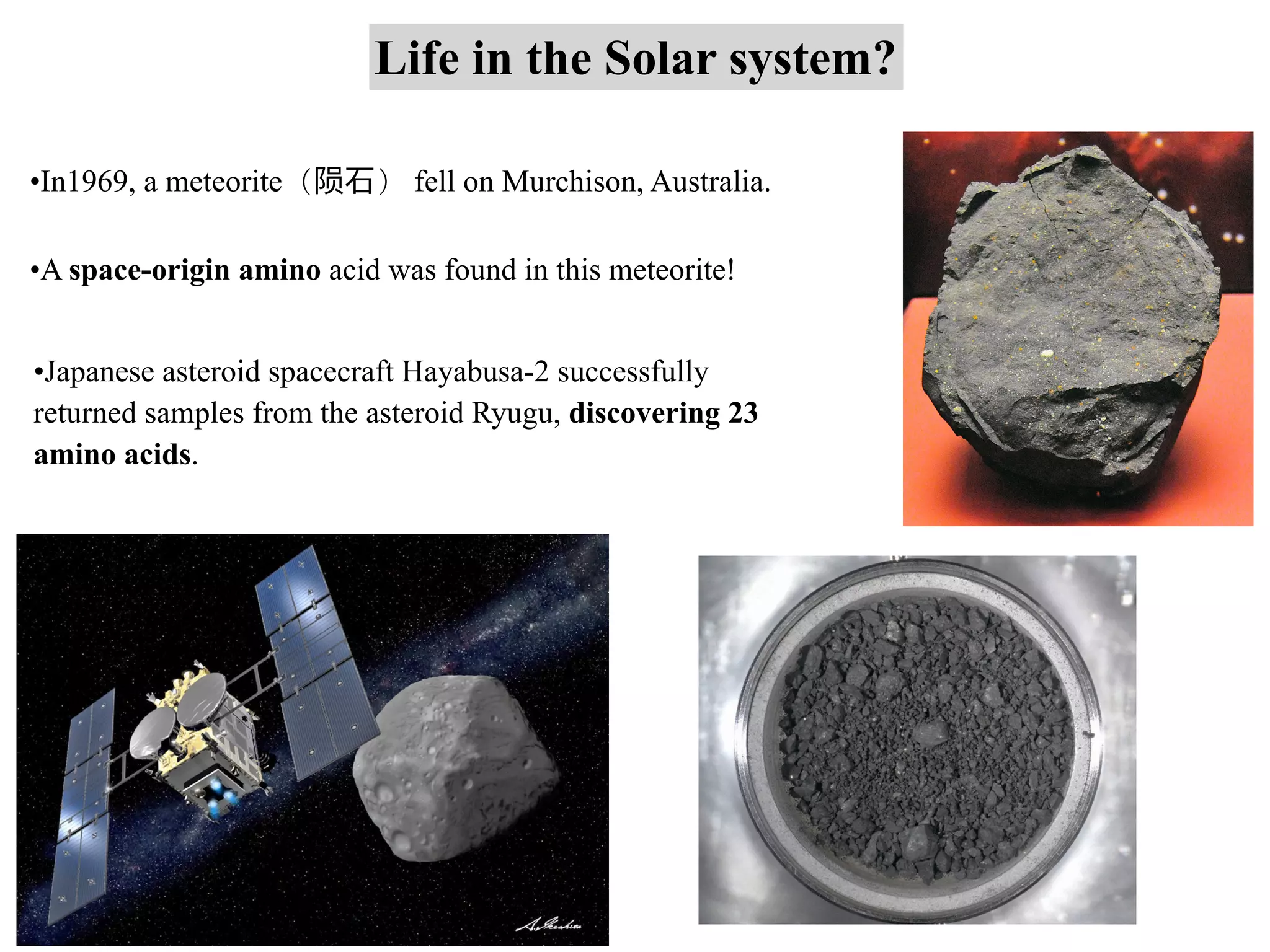
Life in the Solar system?
•In1969, a meteorite(陨⽯) fell on Murchison, Australia.
•A space-origin amino acid was found in this meteorite!
•Japanese asteroid spacecraft Hayabusa-2 successfully
returned samples from the asteroid Ryugu, discovering 23
amino acids.
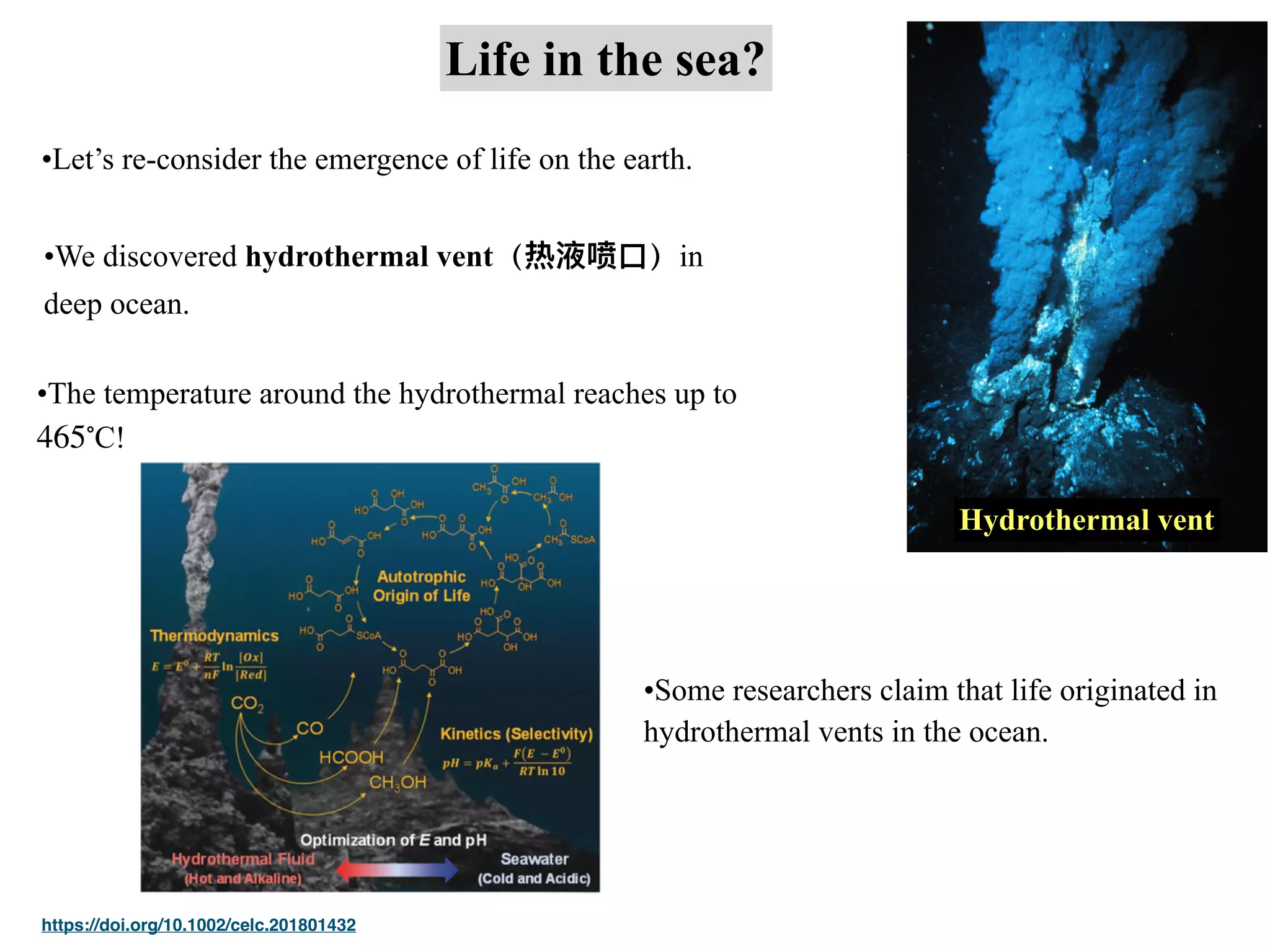
Life in the sea?
•Let’s re-consider the emergence of life on the earth.
•We discovered hydrothermal vent(热液喷⼝)in
deep ocean.
Hydrothermal vent
•The temperature around the hydrothermal reaches up to
!
465∘
C
https://doi.org/10.1002/celc.201801432
•Some researchers claim that life originated in
hydrothermal vents in the ocean.
Does life on Earth comes from space or
emerge in the sea??
Does life on Earth comes from space or
emerge in the sea??
We have not known the answer! It is
very mysterious and fascinating
question!
Does life on Earth comes from space or
emerge in the sea??
We have not known the answer! It is
very mysterious and fascinating
question!
Which scenario do you support?
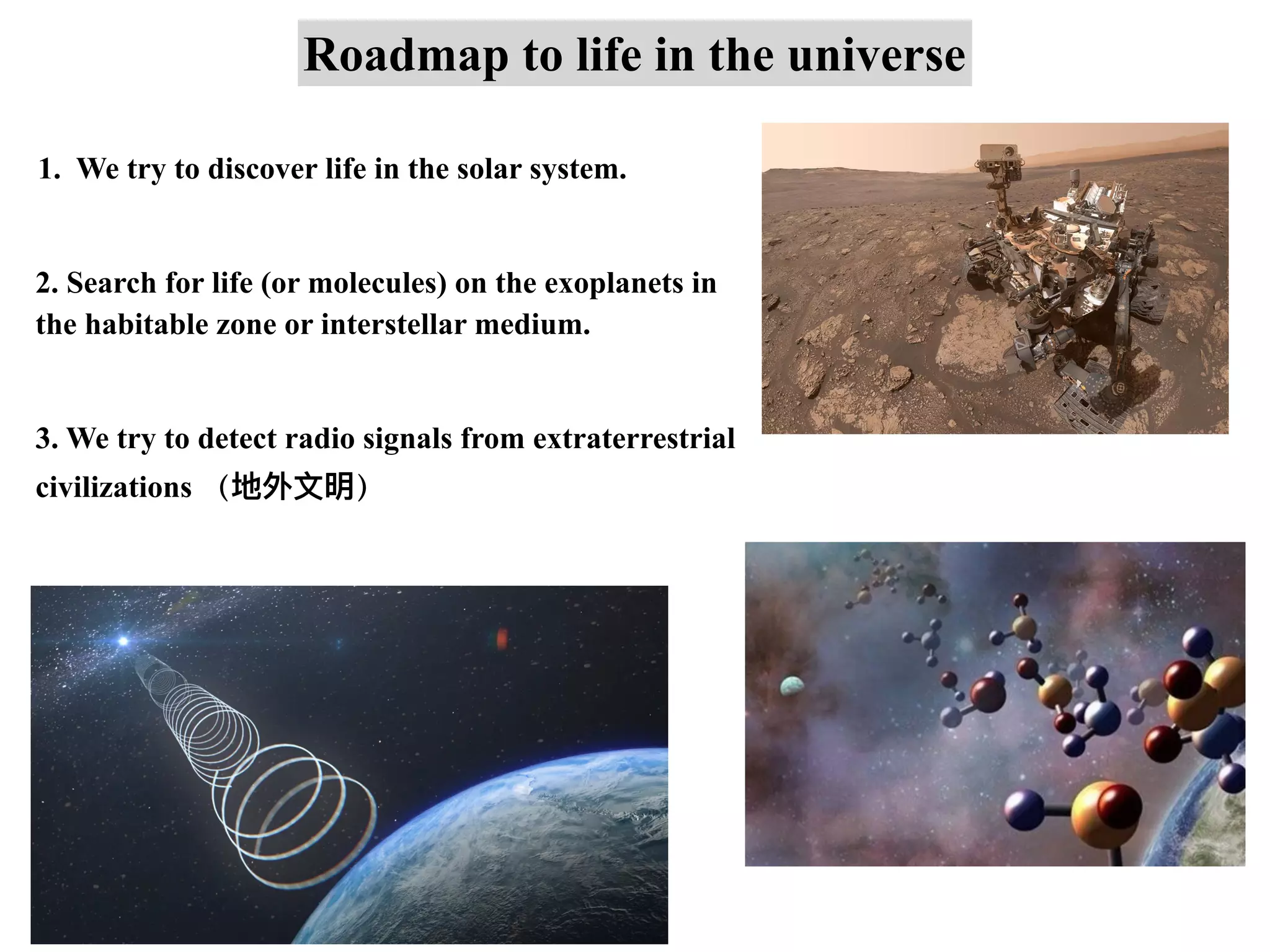
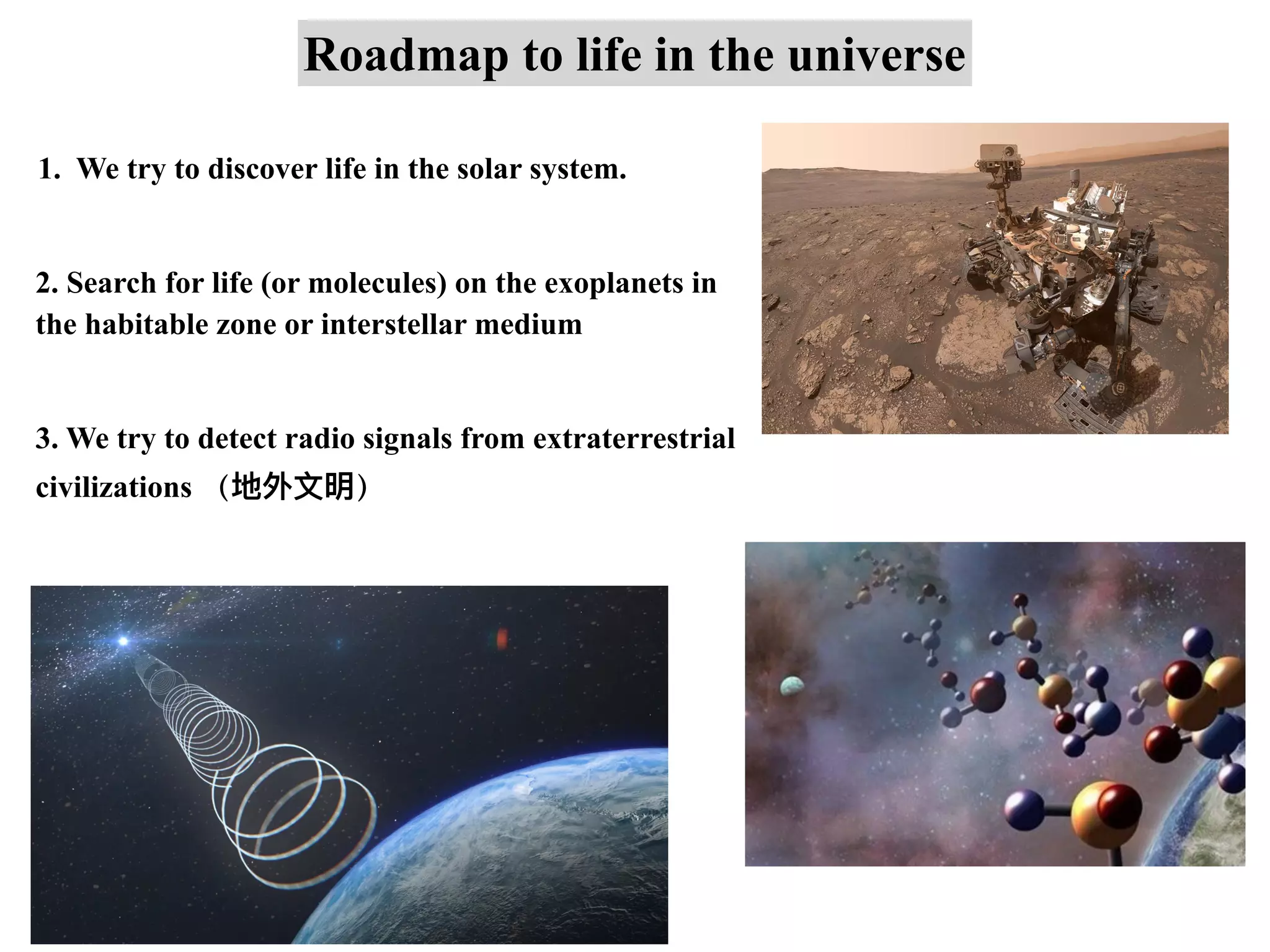
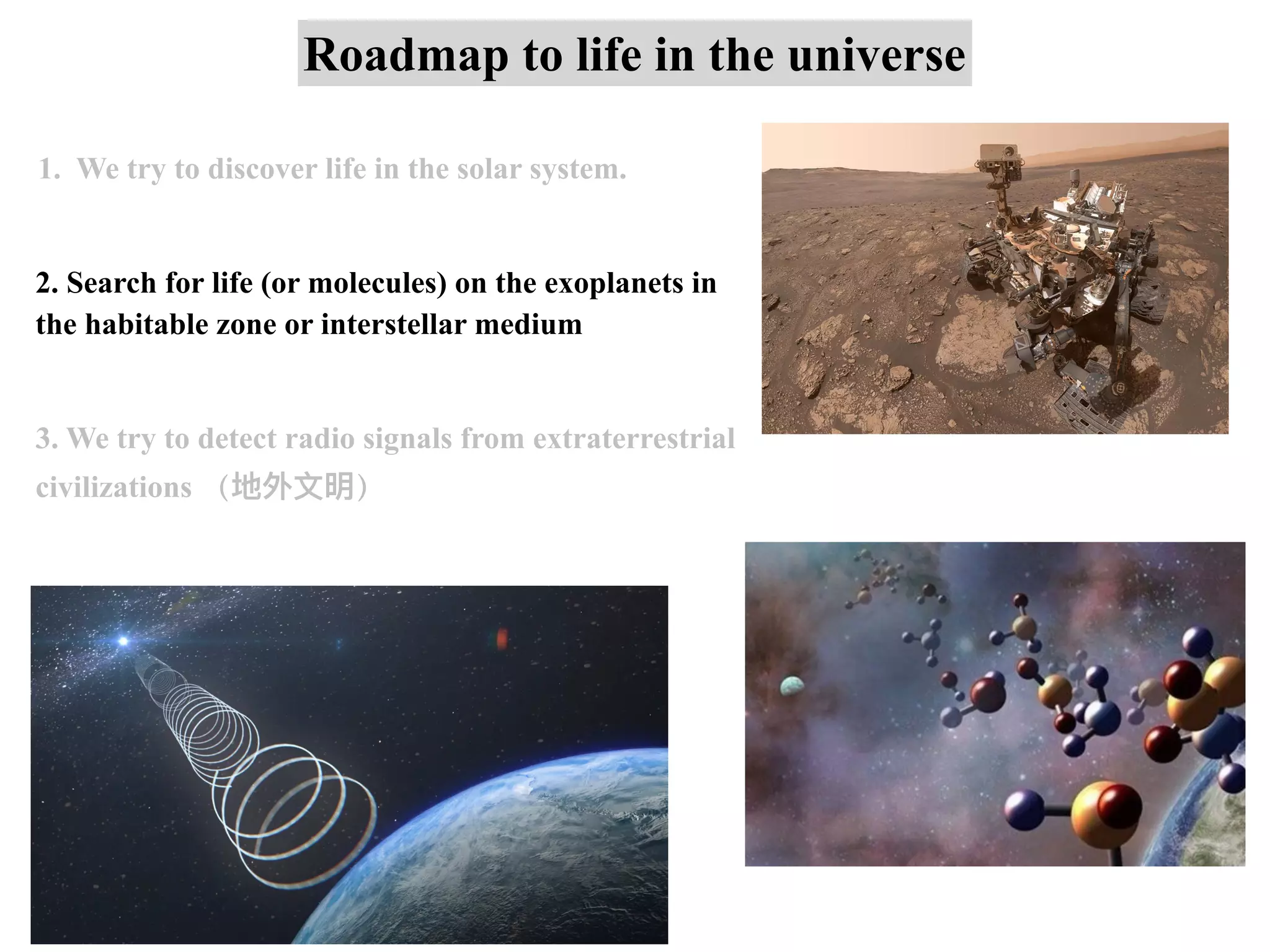
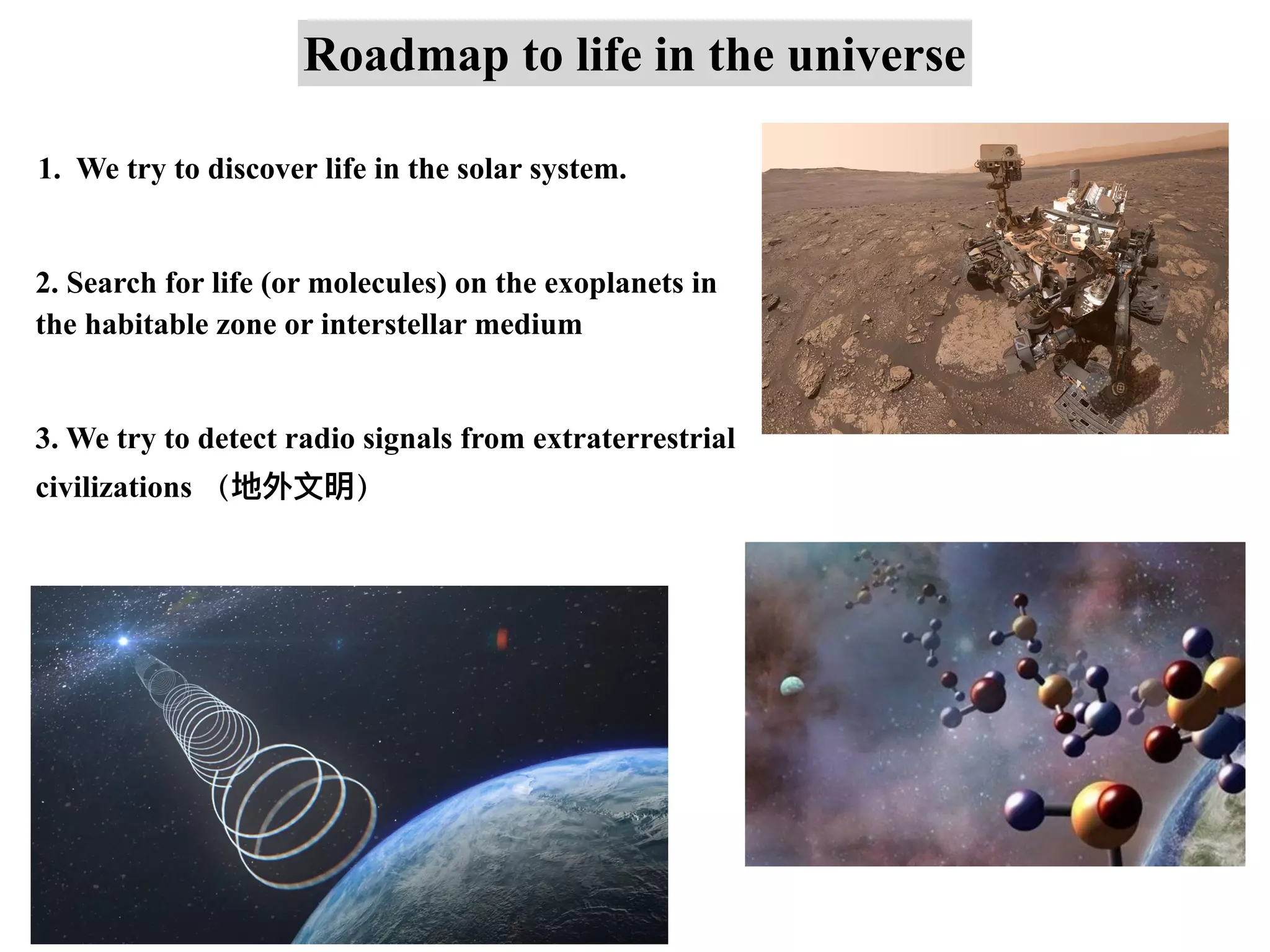
Roadmap to life in the universe
1. We try to discover life in the solar system.
2. Search for life (or molecules) on the exoplanets in
the habitable zone or interstellar medium.
3. We try to detect radio signals from extraterrestrial
civilizations (地外⽂明)
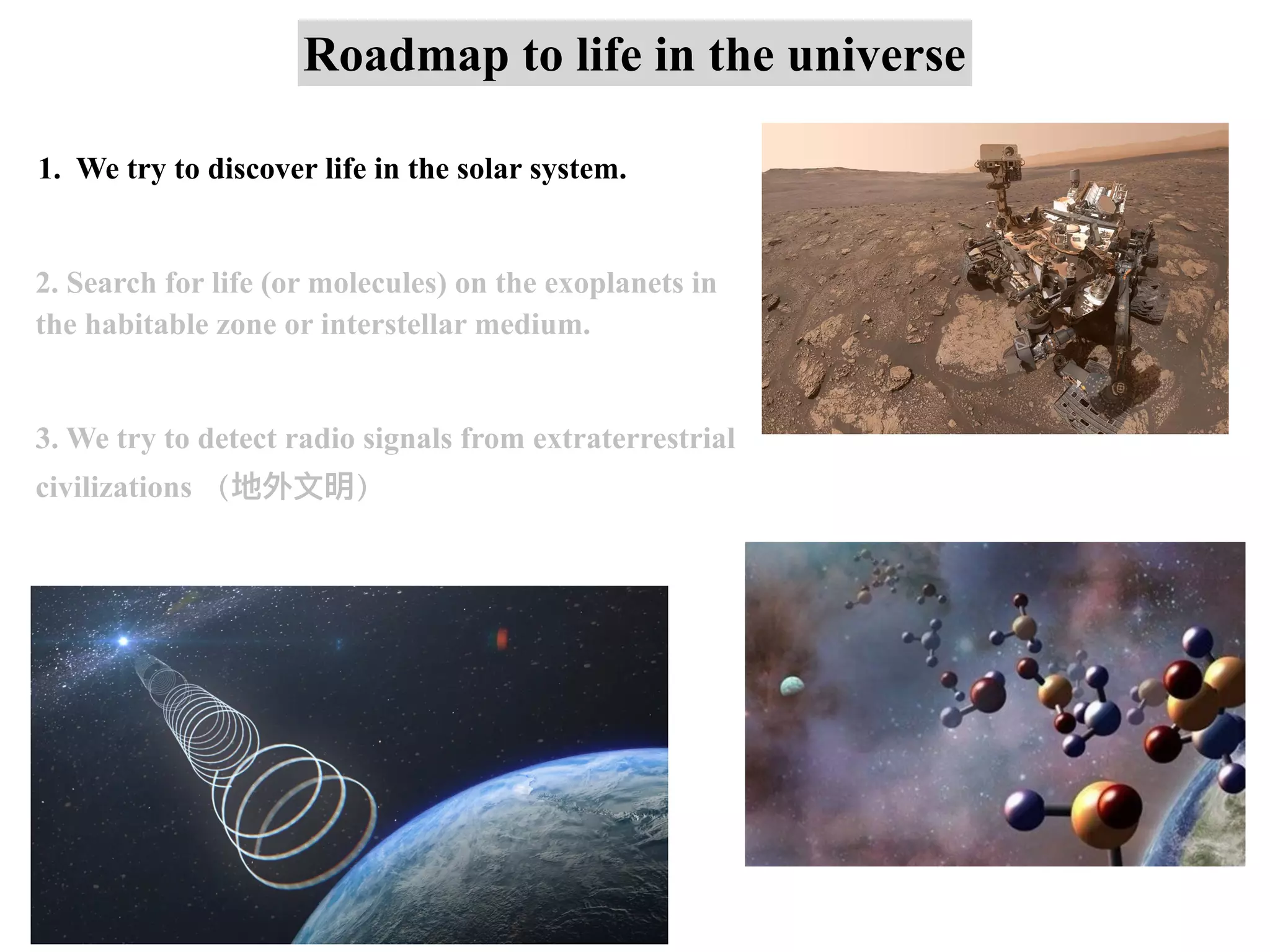
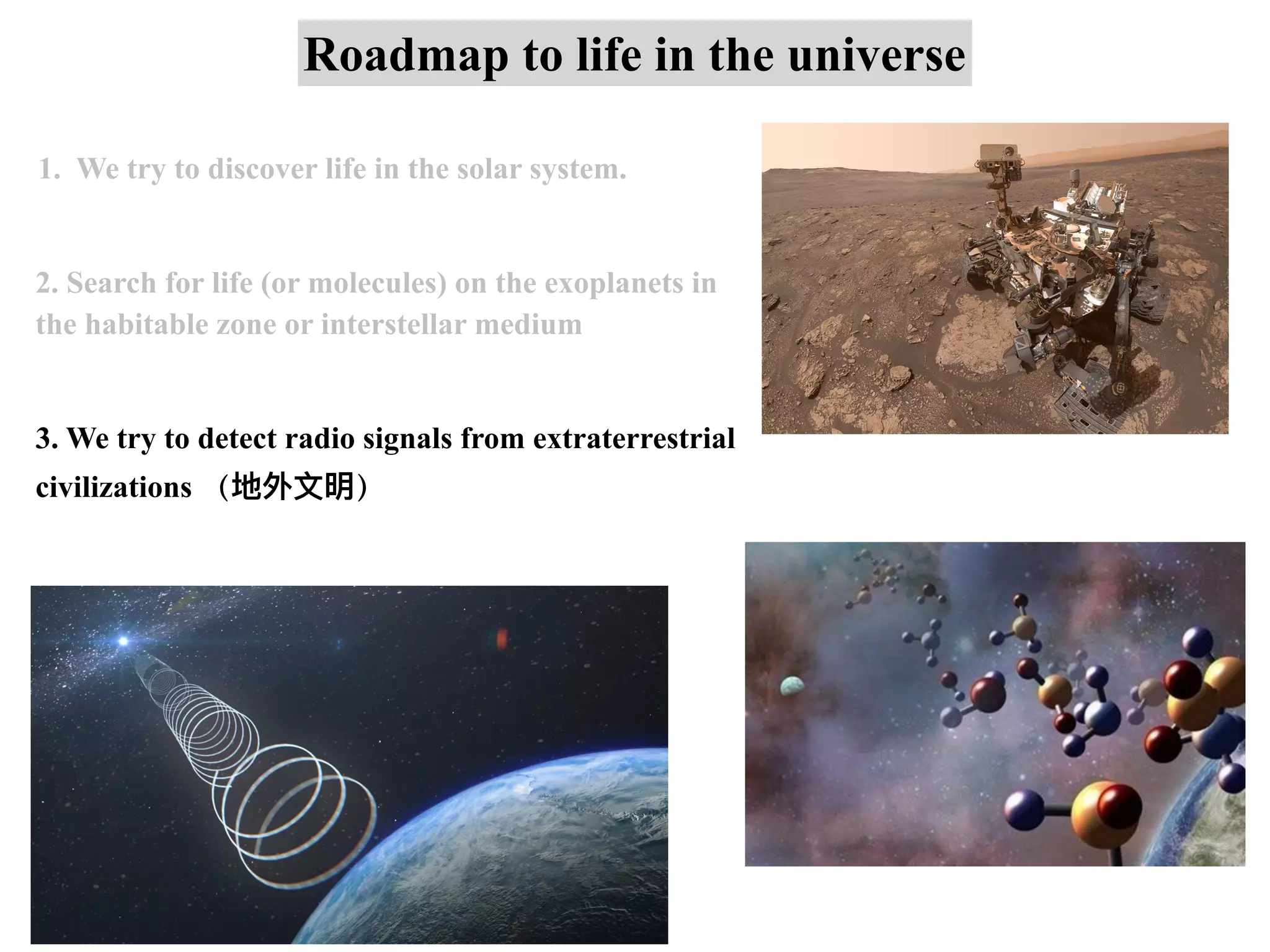
Roadmap to life in the universe
1. We try to discover life in the solar system.
2. Search for life (or molecules) on the exoplanets in
the habitable zone or interstellar medium.
3. We try to detect radio signals from extraterrestrial
civilizations (地外⽂明)
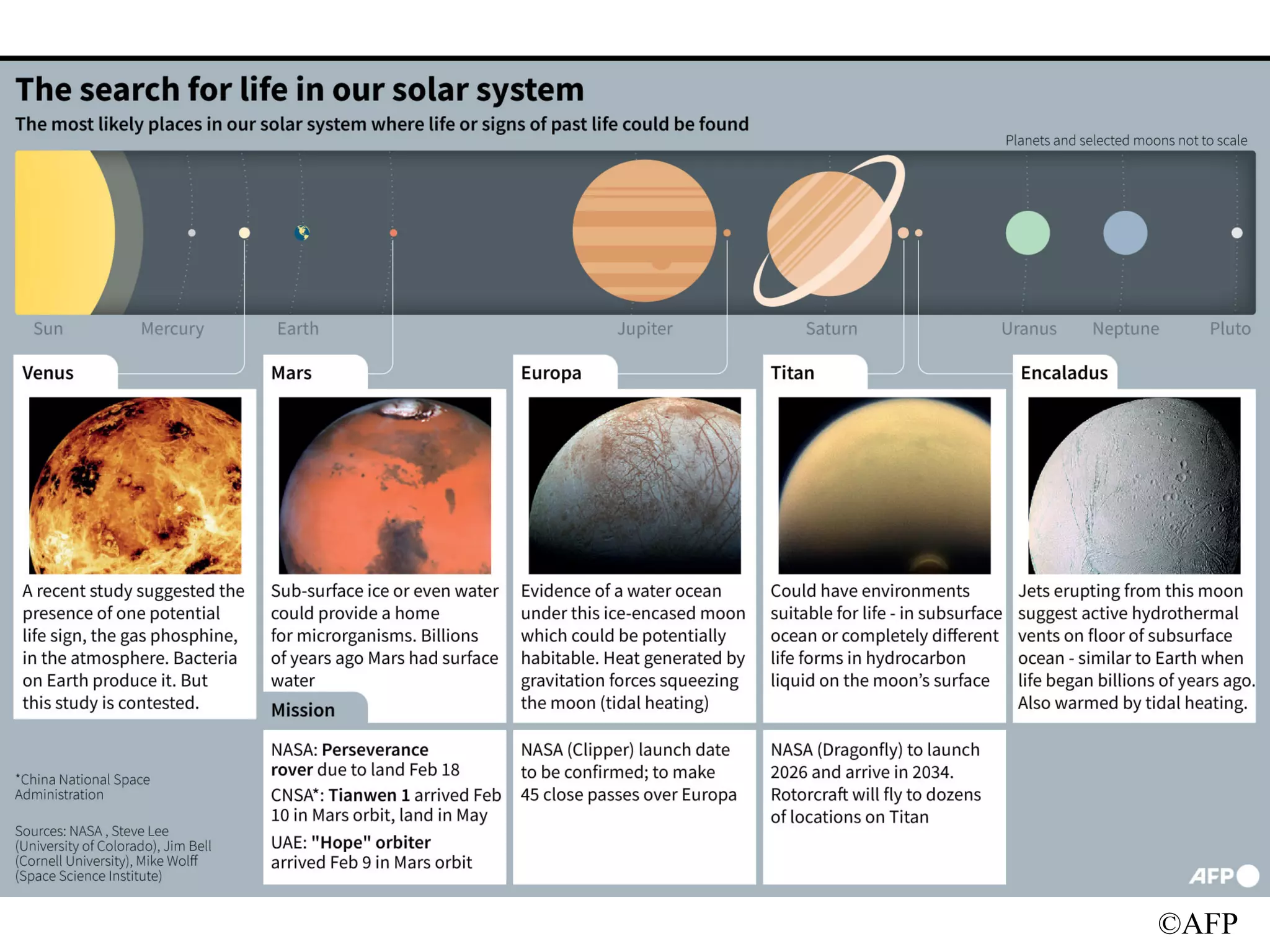
©AFP
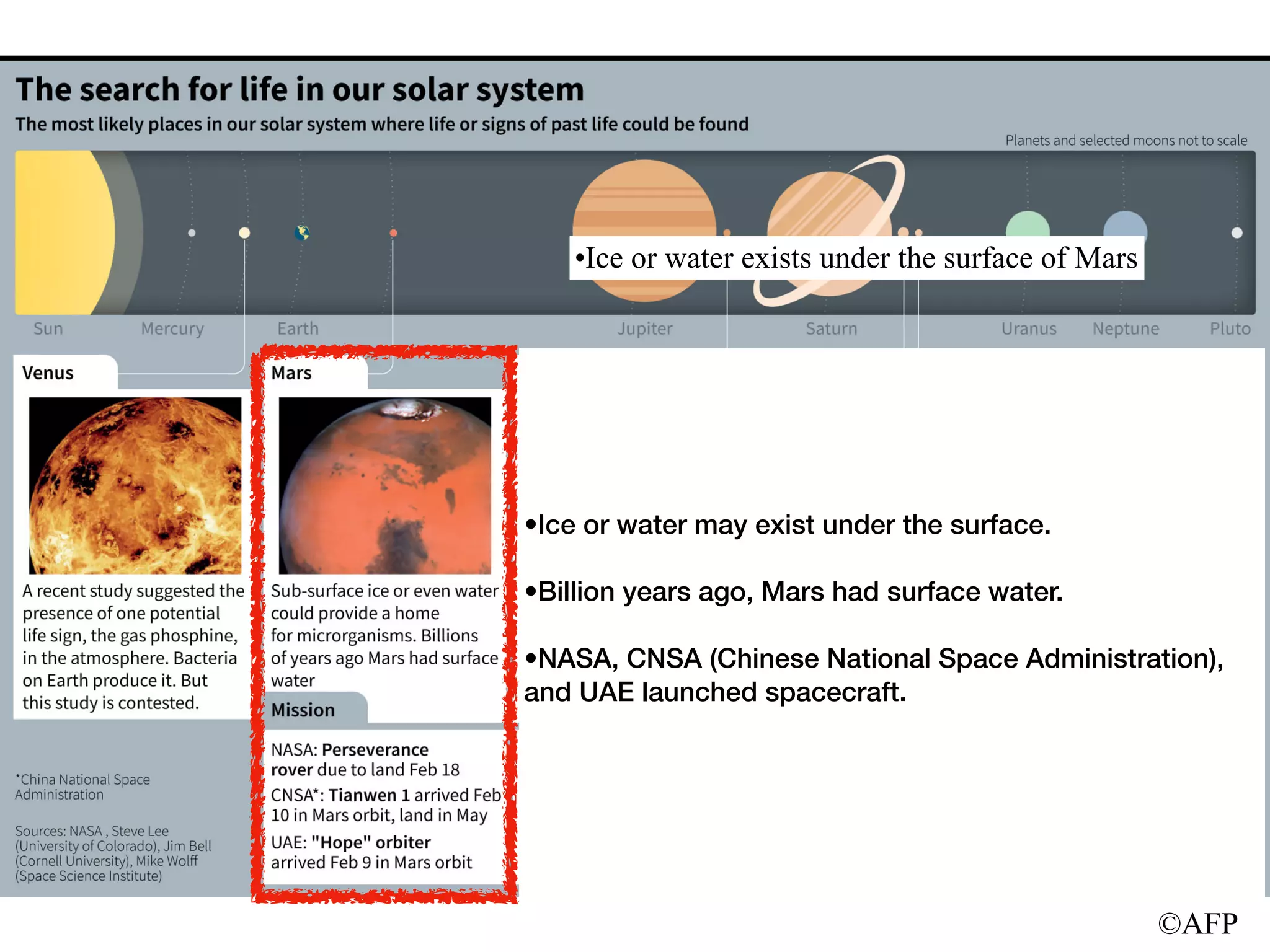
©AFP
•Ice or water exists under the surface of Mars
•Ice or water may exist under the surface.
•Billion years ago, Mars had surface water.
•NASA, CNSA (Chinese National Space Administration),
and UAE launched spacecraft.
©AFP
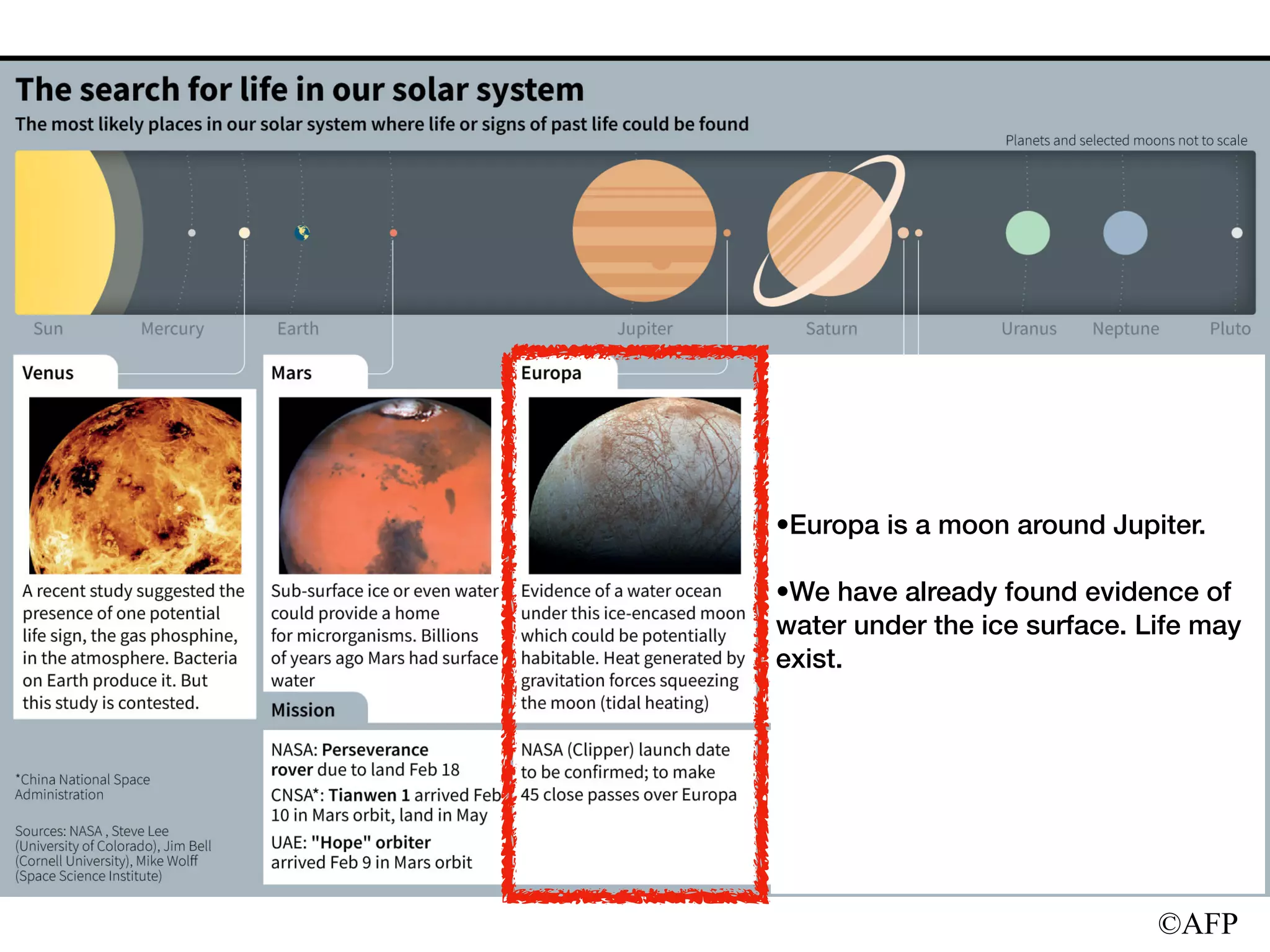
•Europa is a moon around Jupiter.
•We have already found evidence of
water under the ice surface. Life may
exist.
©AFP
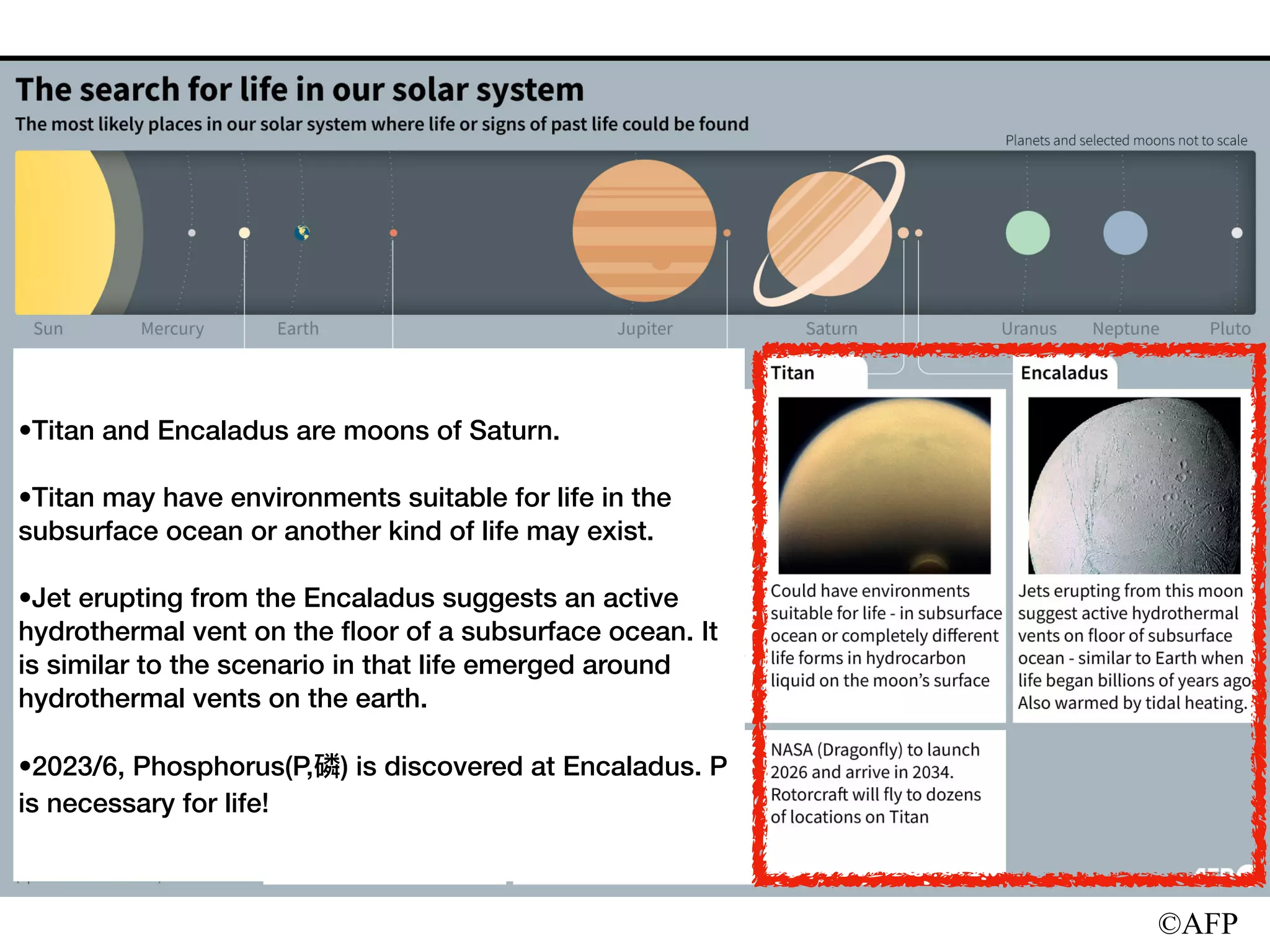
•Titan and Encaladus are moons of Saturn.
•Titan may have environments suitable for life in the
subsurface ocean or another kind of life may exist.
•Jet erupting from the Encaladus suggests an active
hydrothermal vent on the
fl
oor of a subsurface ocean. It
is similar to the scenario in that life emerged around
hydrothermal vents on the earth.
•2023/6, Phosphorus(P,磷) is discovered at Encaladus. P
is necessary for life!
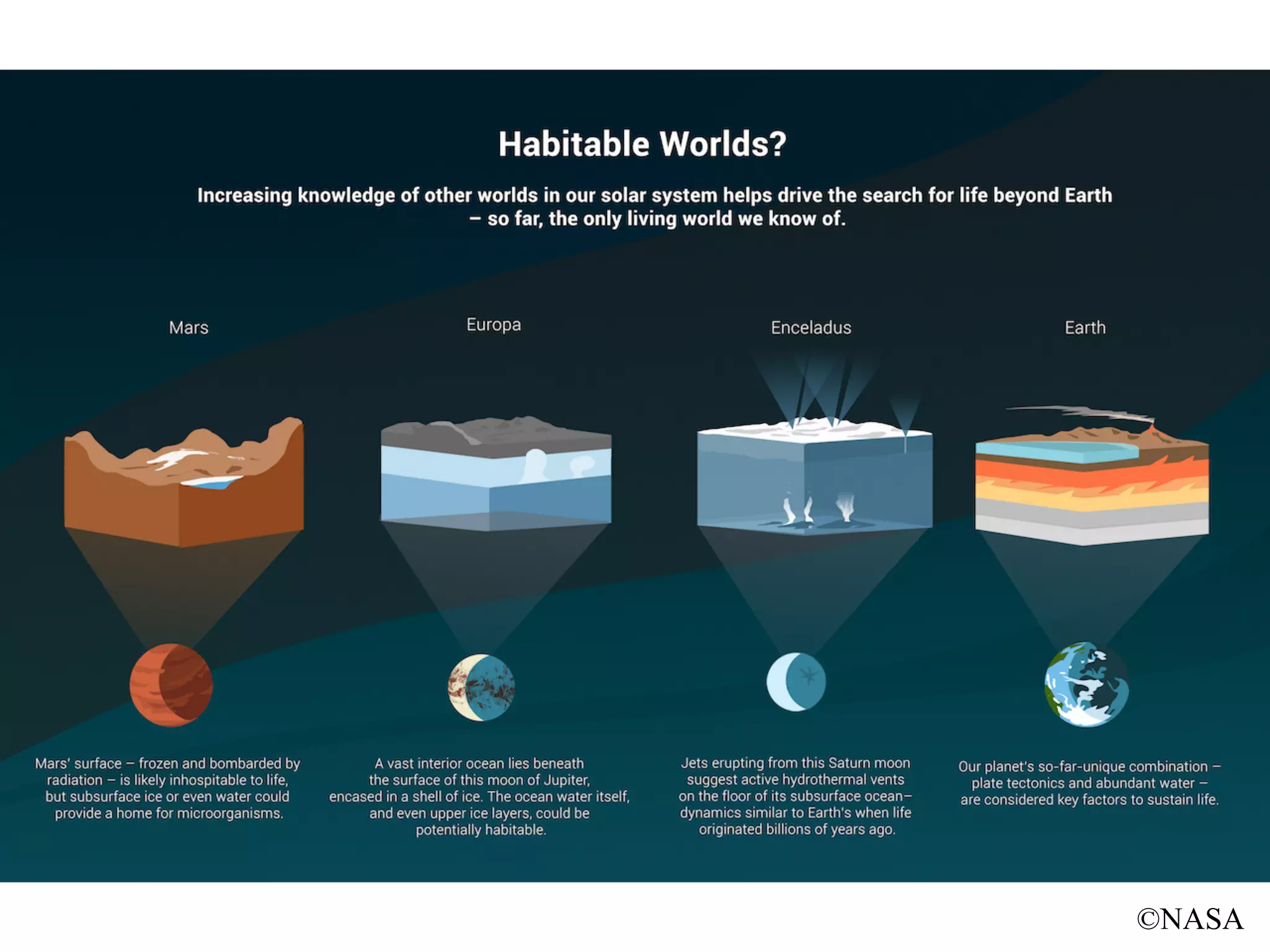
©NASA
Roadmap to life in the universe
1. We try to discover life in the solar system.
2. Search for life (or molecules) on the exoplanets in
the habitable zone or interstellar medium
3. We try to detect radio signals from extraterrestrial
civilizations (地外⽂明)
Roadmap to life in the universe
1. We try to discover life in the solar system.
2. Search for life (or molecules) on the exoplanets in
the habitable zone or interstellar medium
3. We try to detect radio signals from extraterrestrial
civilizations (地外⽂明)
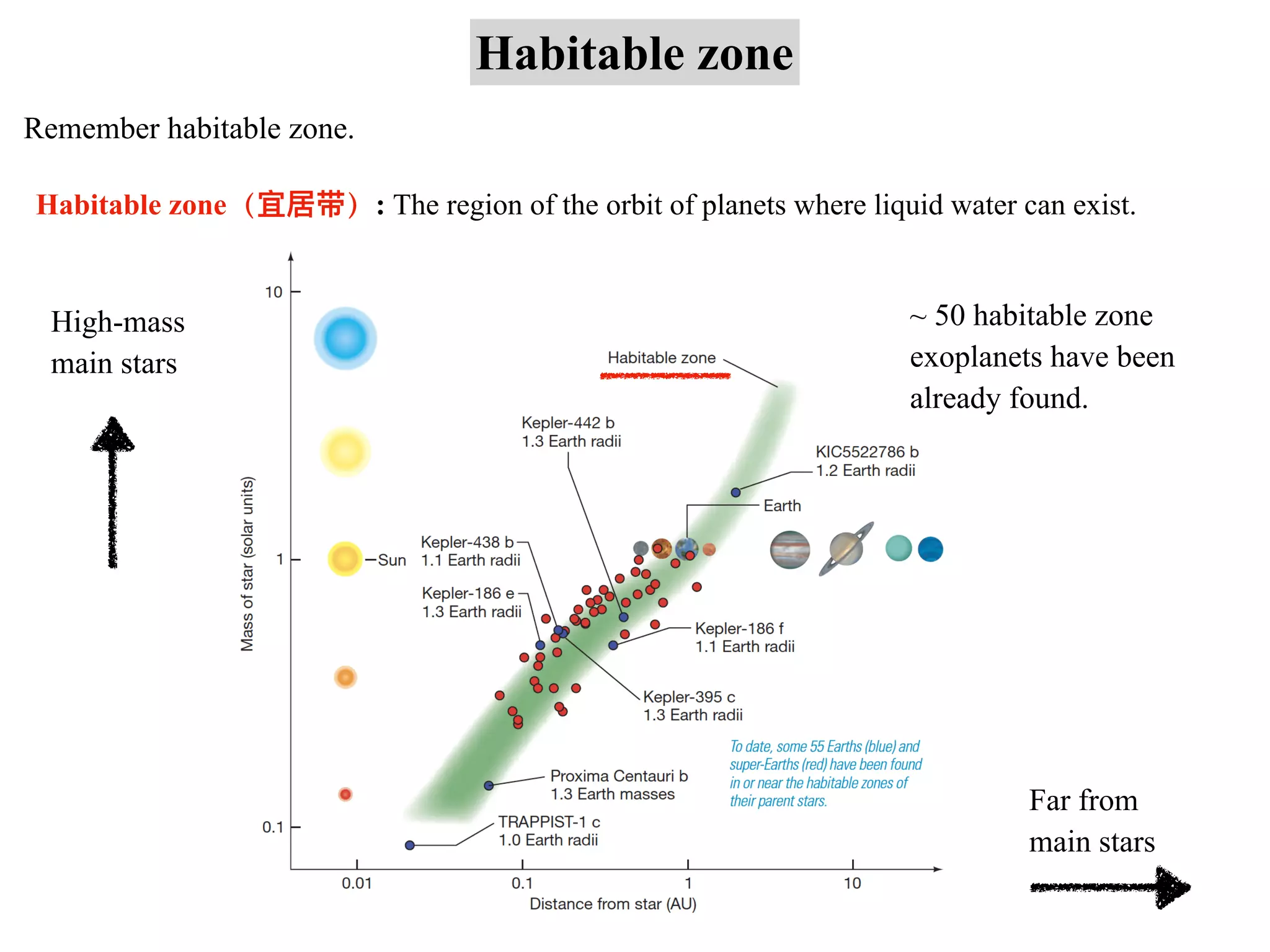
Habitable zone
High-mass
main stars
Far from
main stars
Habitable zone(宜居带): The region of the orbit of planets where liquid water can exist.
Remember habitable zone.
~ 50 habitable zone
exoplanets have been
already found.
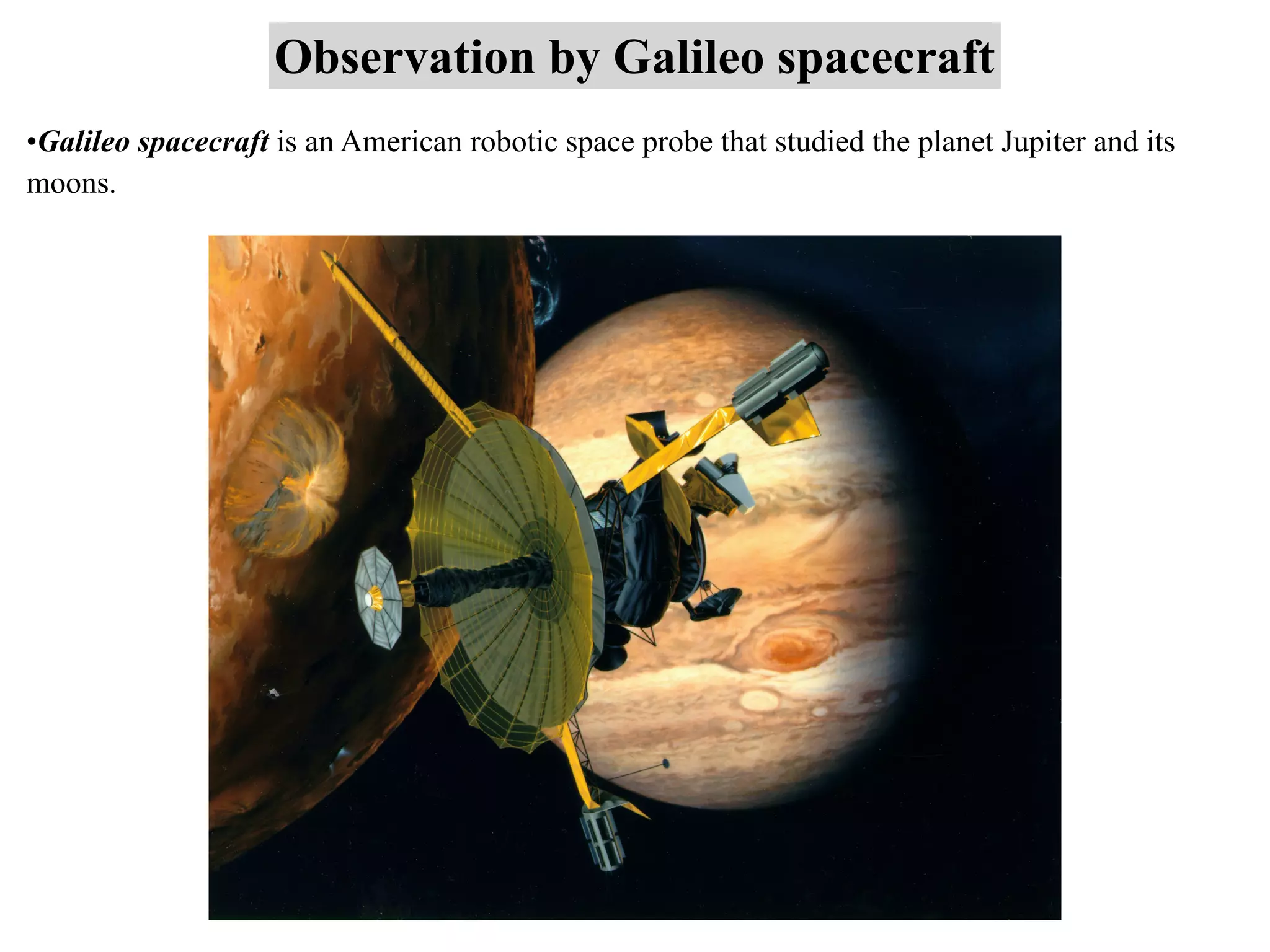
Observation by Galileo spacecraft
•Galileo spacecraft is an American robotic space probe that studied the planet Jupiter and its
moons.
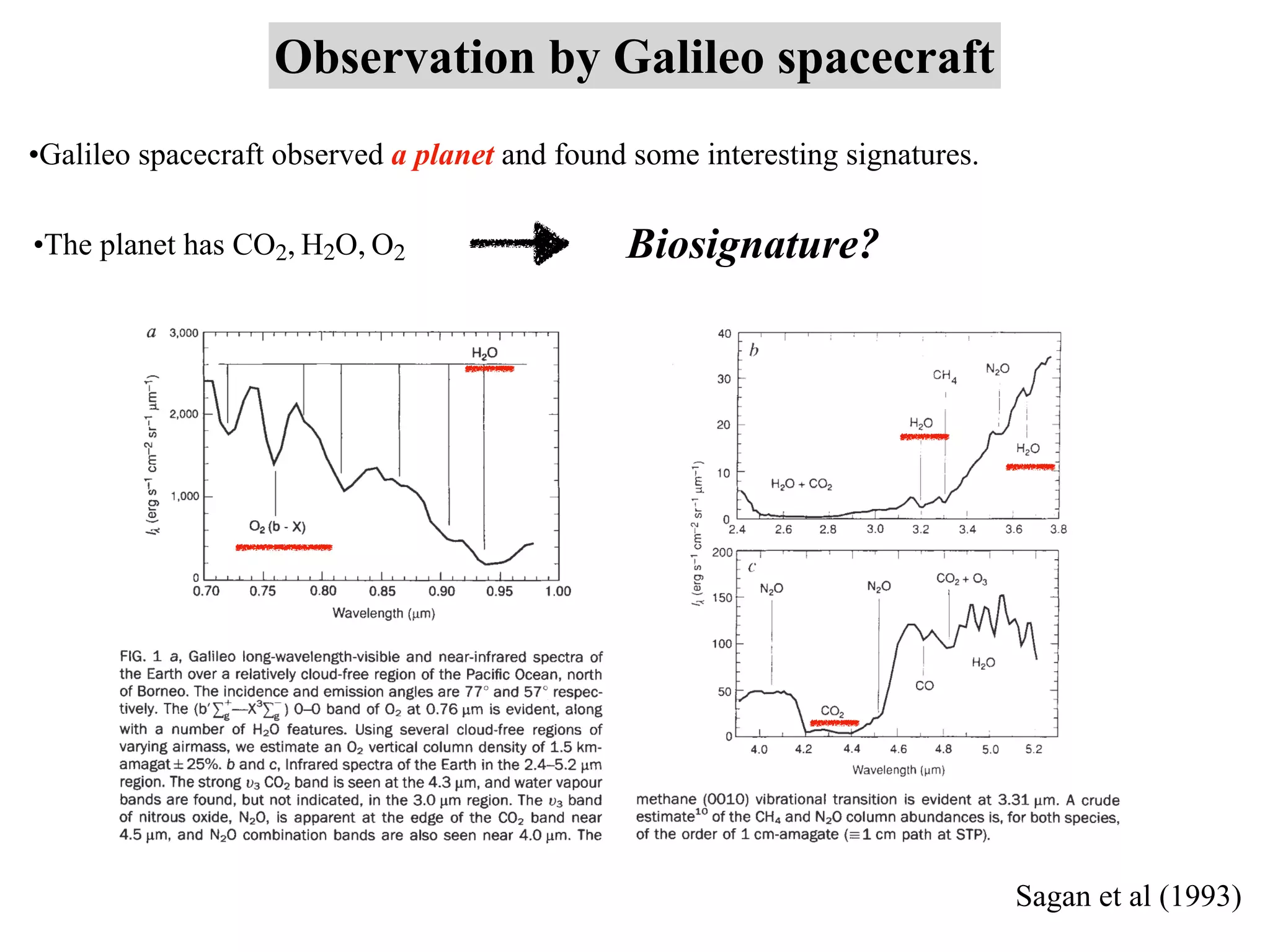
Observation by Galileo spacecraft
•Galileo spacecraft observed a planet and found some interesting signatures.
Sagan et al (1993)
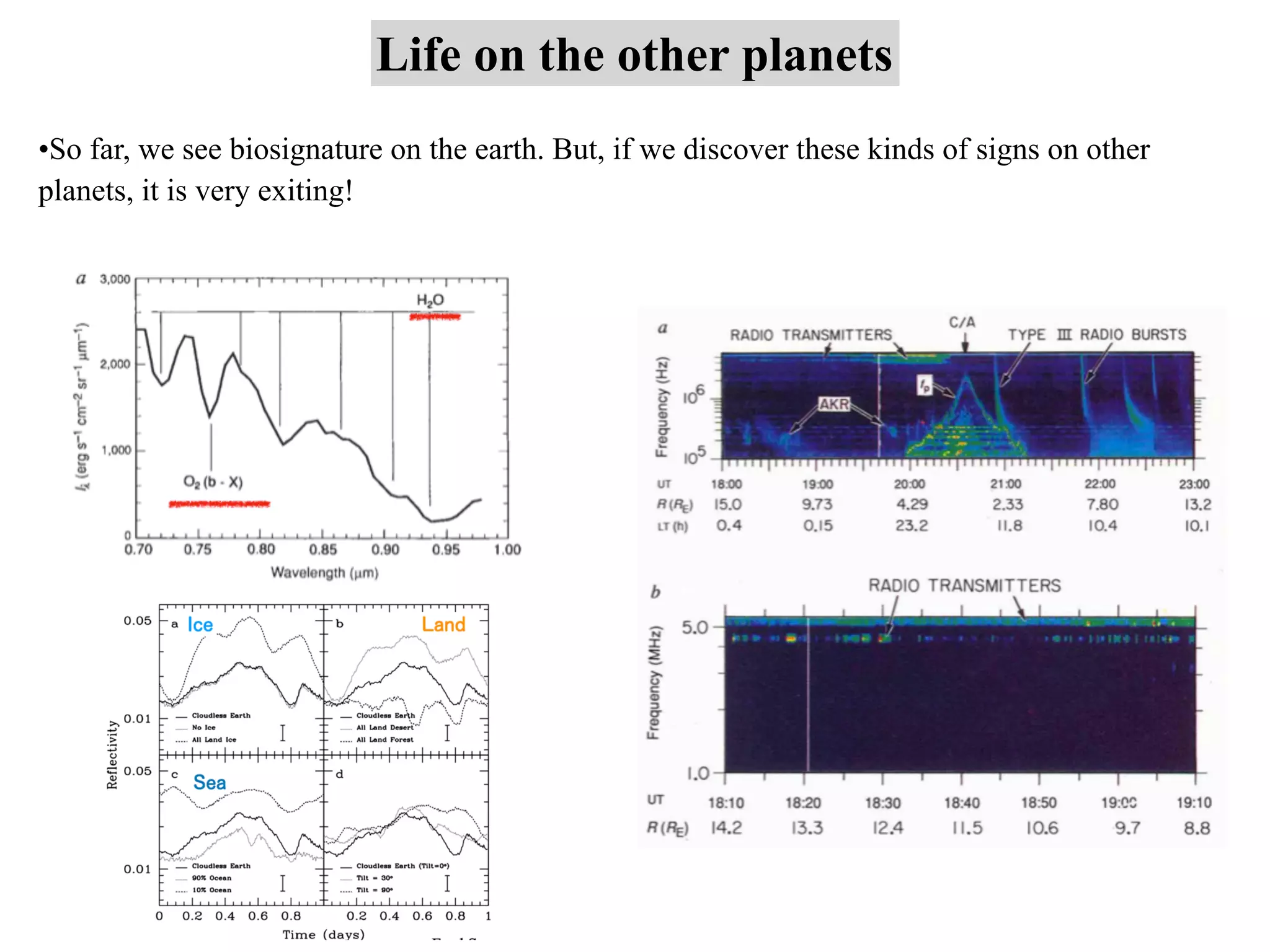
•The planet has CO2, H2O, O2 Biosignature?
Observation by Galileo spacecraft
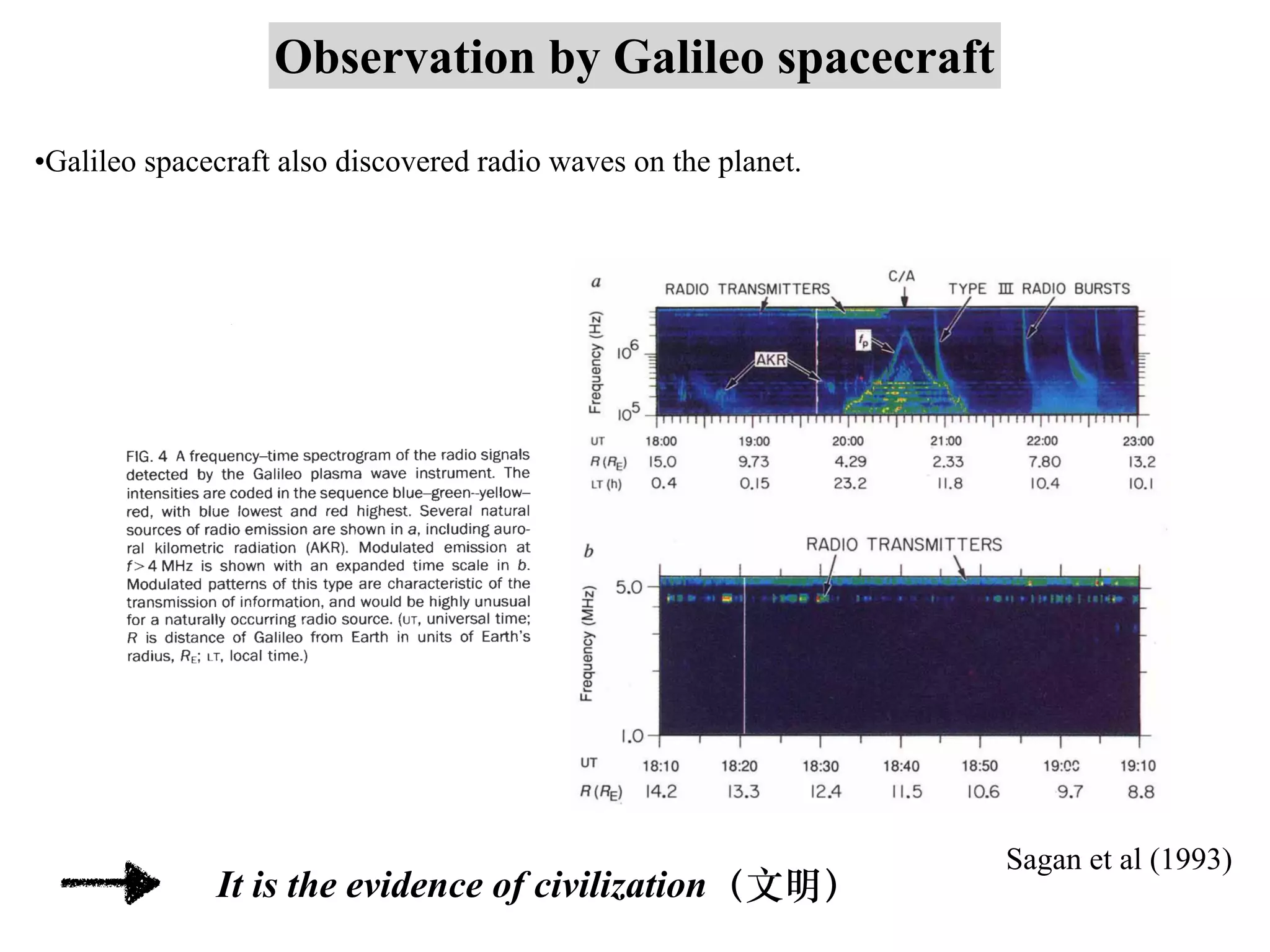
•Galileo spacecraft also discovered radio waves on the planet.
It is the evidence of civilization(⽂明)
Sagan et al (1993)
Observation by Galileo spacecraft
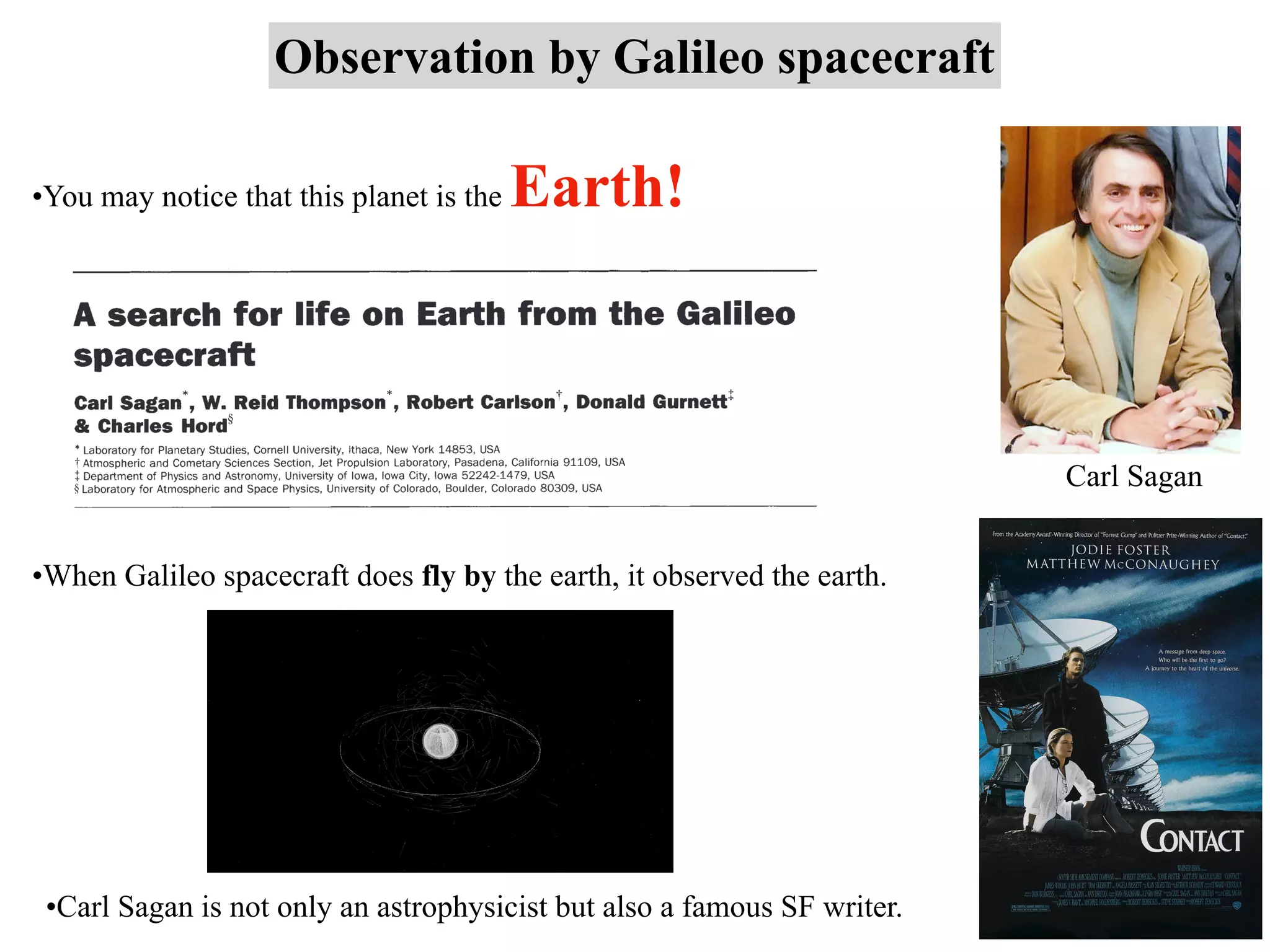
•You may notice that this planet is the Earth!
Carl Sagan
•When Galileo spacecraft does fly by the earth, it observed the earth.
•Carl Sagan is not only an astrophysicist but also a famous SF writer.
Observation by Galileo spacecraft
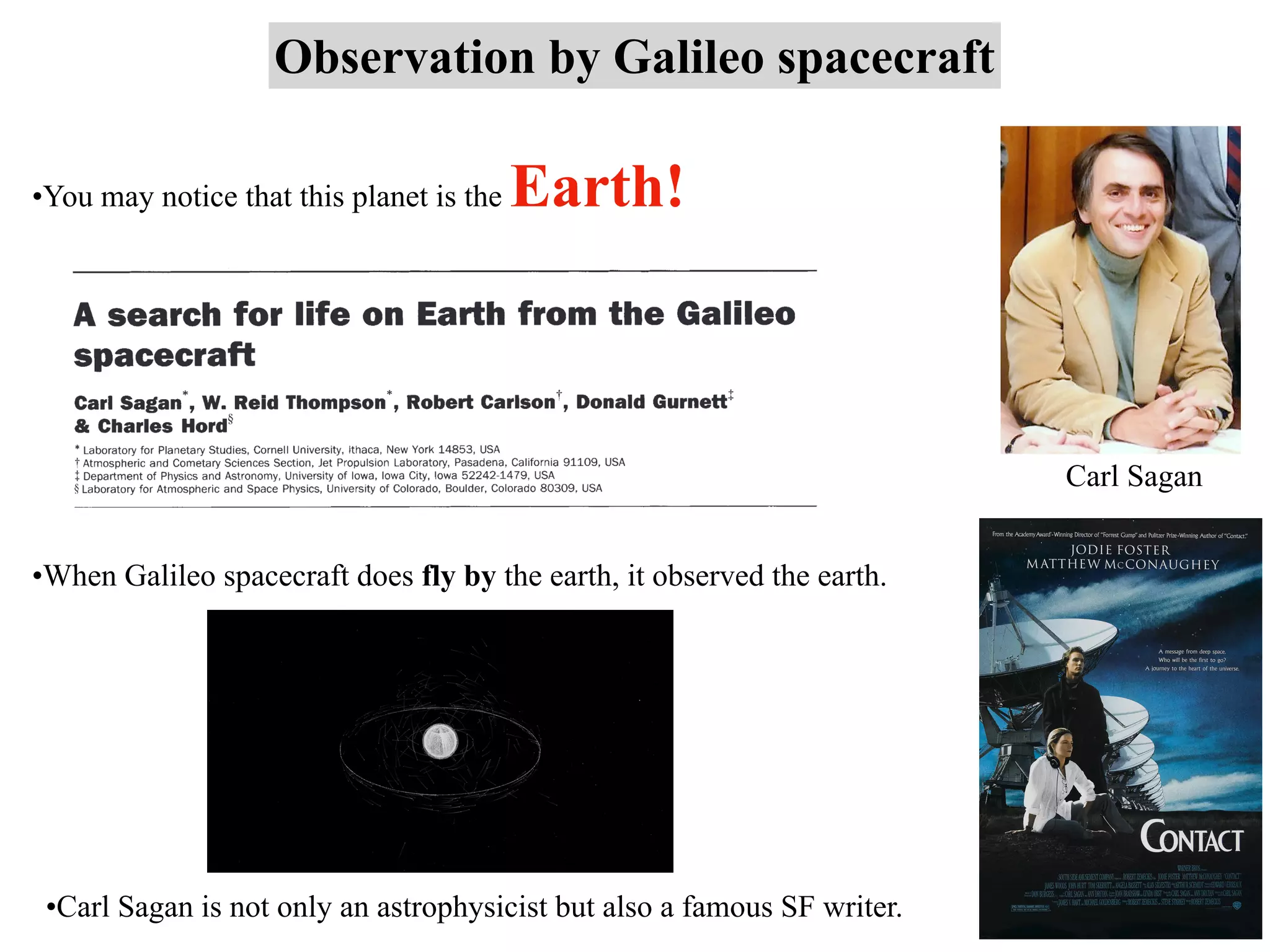
•You may notice that this planet is the Earth!
Carl Sagan
•When Galileo spacecraft does fly by the earth, it observed the earth.
•Carl Sagan is not only an astrophysicist but also a famous SF writer.
Observation by Galileo spacecraft
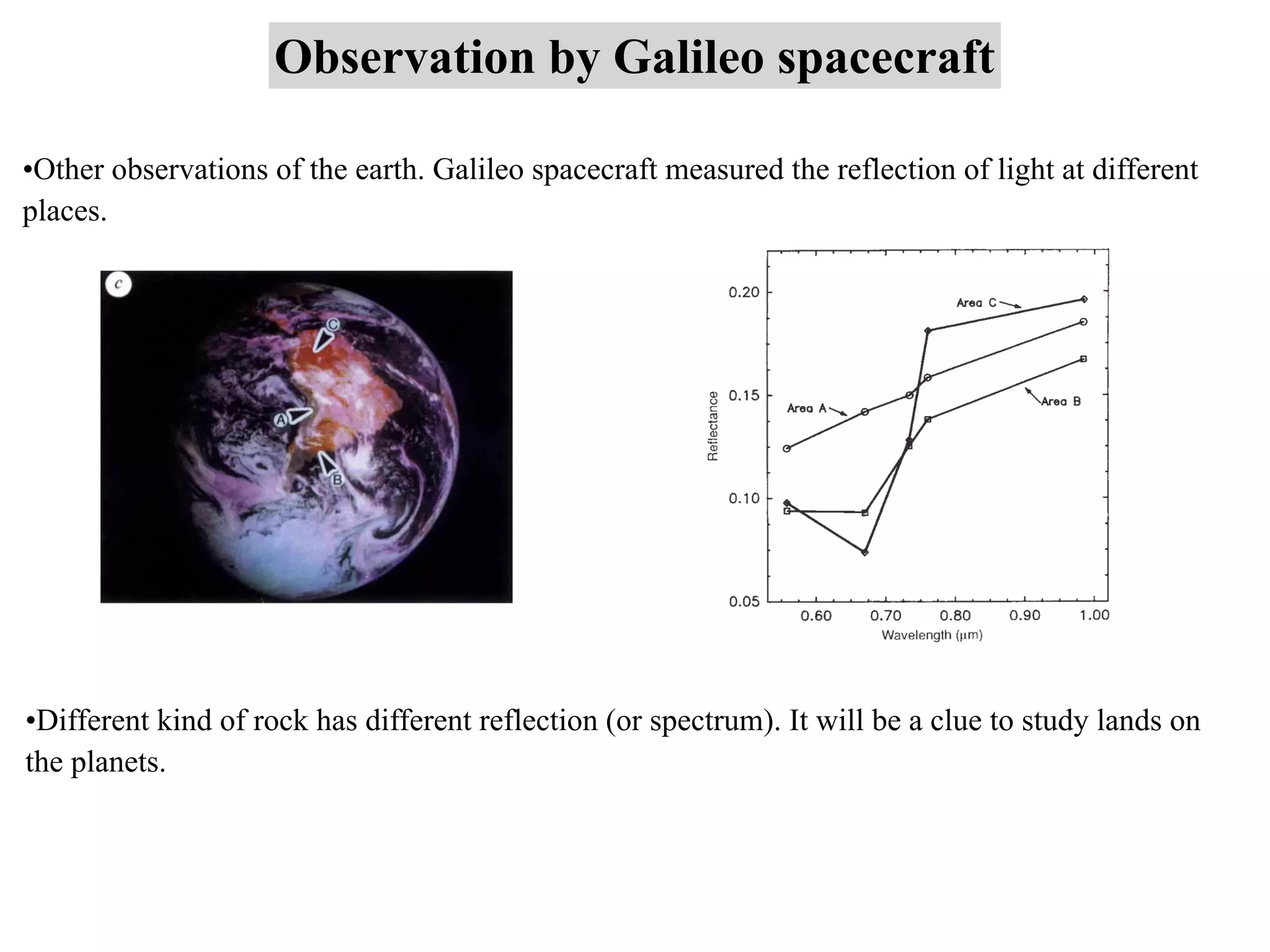
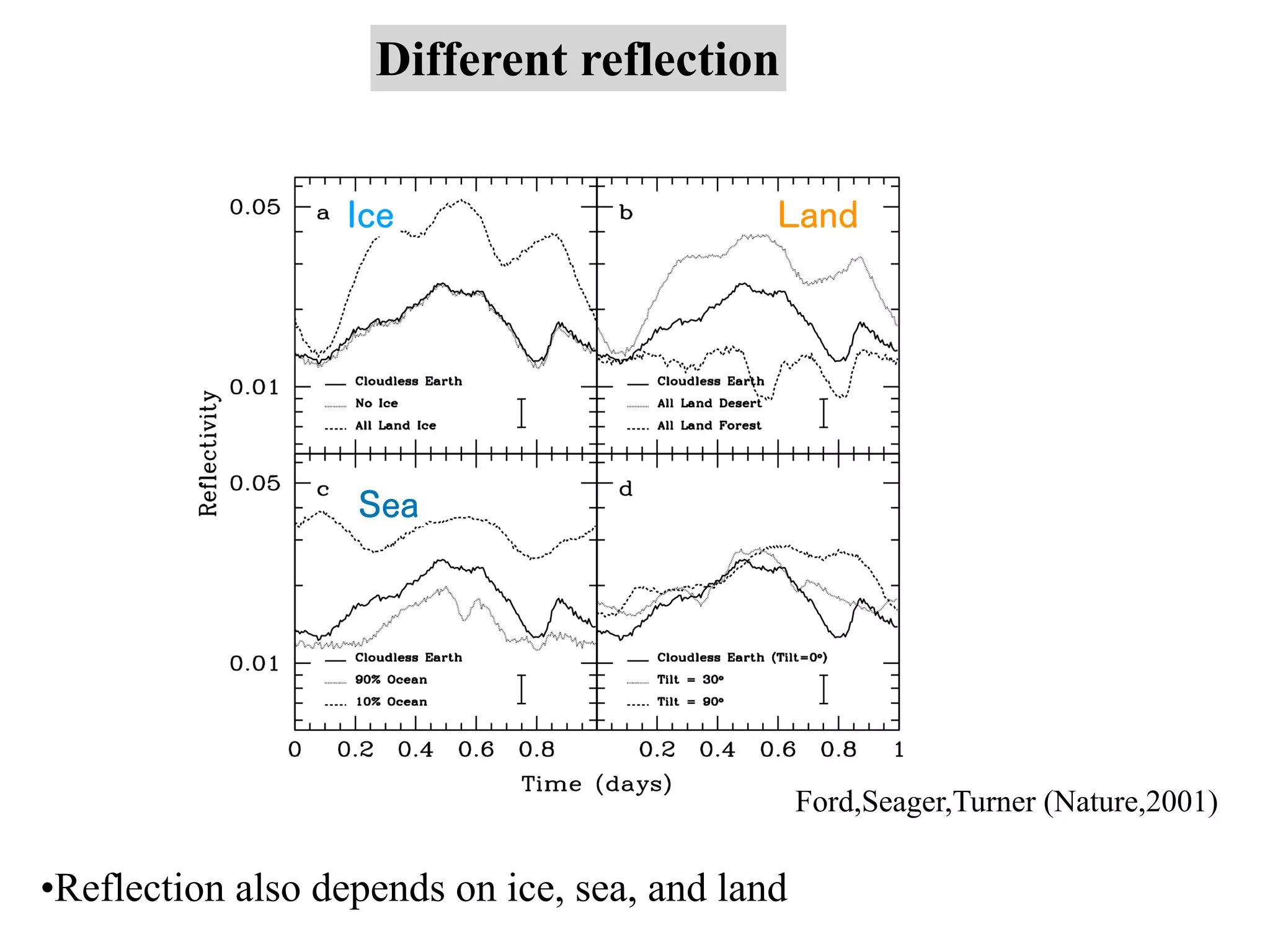
•Other observations of the earth. Galileo spacecraft measured the reflection of light at different
places.
•Different kind of rock has different reflection (or spectrum). It will be a clue to study lands on
the planets.
Ford,Seager,Turner (Nature,2001)
Different reflection
Ice Land
Sea
•Reflection also depends on ice, sea, and land
•So far, we see biosignature on the earth. But, if we discover these kinds of signs on other
planets, it is very exiting!
Life on the other planets
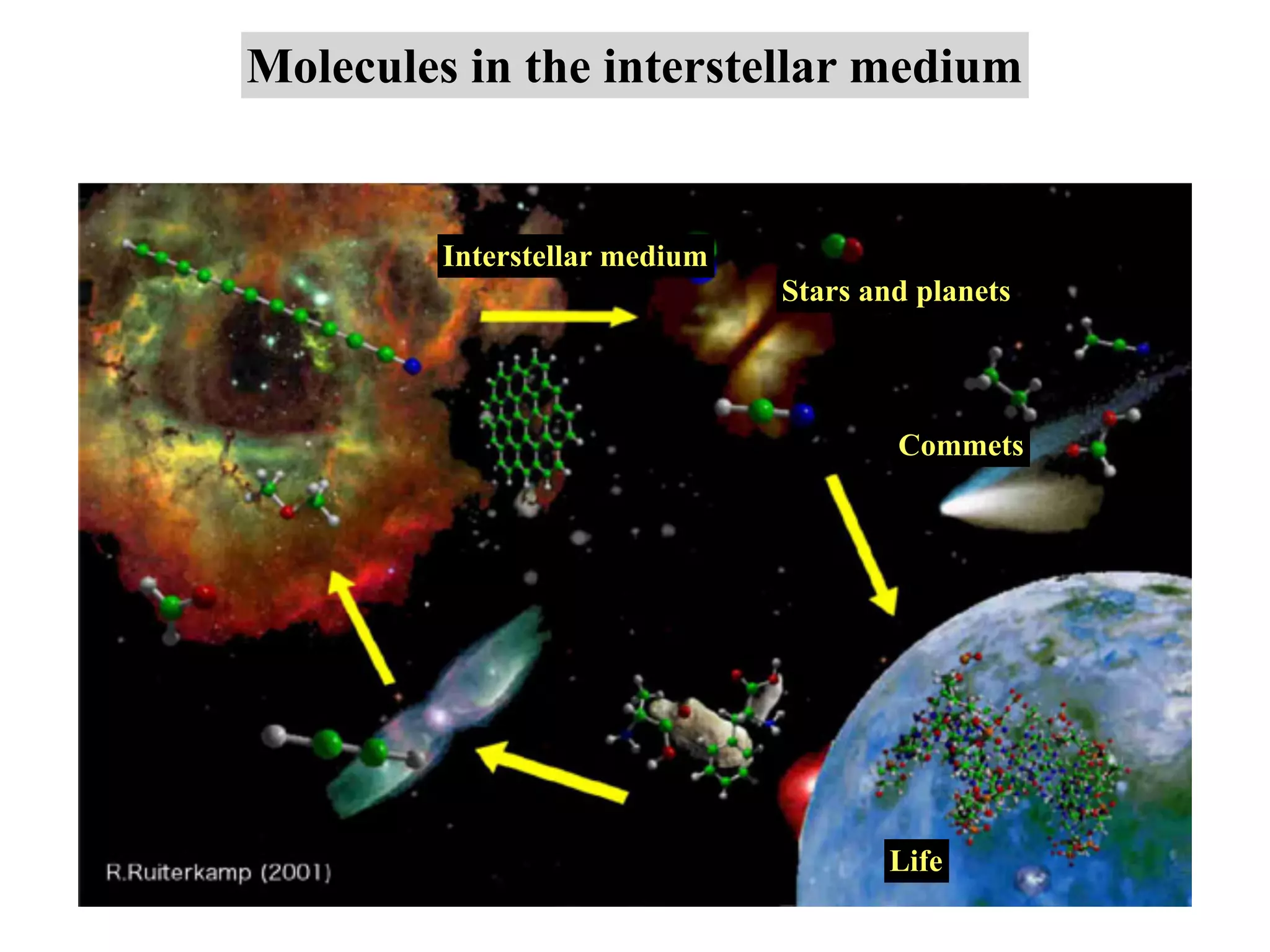
Molecules in the interstellar medium
Interstellar medium
Stars and planets
Commets
Life
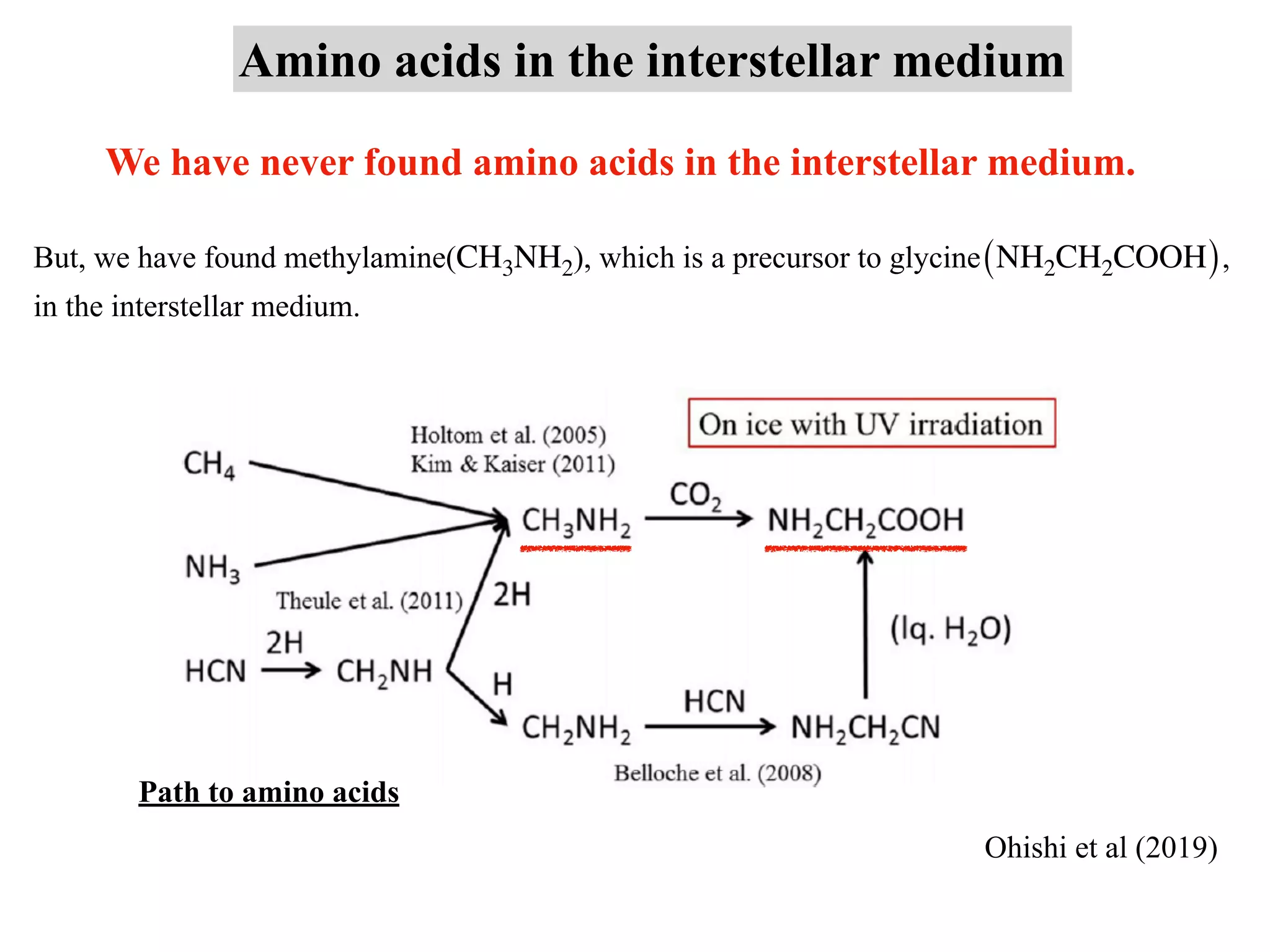
Amino acids in the interstellar medium
We have never found amino acids in the interstellar medium.
But, we have found methylamine( ), which is a precursor to glycine ,
in the interstellar medium.
CH3NH2 (NH2CH2COOH)
Ohishi et al (2019)
Path to amino acids
Roadmap to life in the universe
1. We try to discover life in the solar system.
2. Search for life (or molecules) on the exoplanets in
the habitable zone or interstellar medium
3. We try to detect radio signals from extraterrestrial
civilizations (地外⽂明)
Roadmap to life in the universe
1. We try to discover life in the solar system.
2. Search for life (or molecules) on the exoplanets in
the habitable zone or interstellar medium
3. We try to detect radio signals from extraterrestrial
civilizations (地外⽂明)
(Question)
What do you think how much extraterrestrial
life(地外⽣命) is expected to exist in our galaxy?
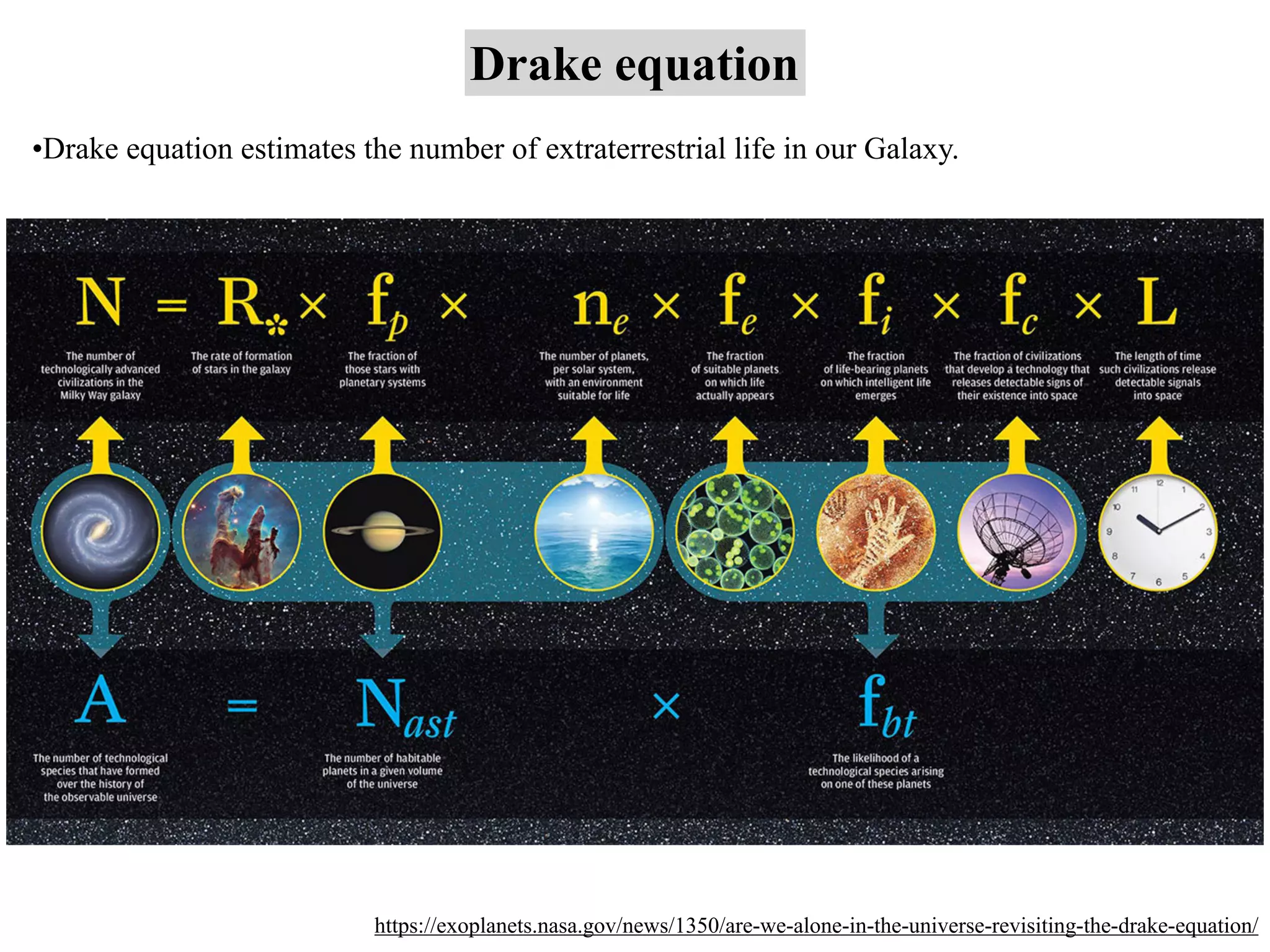
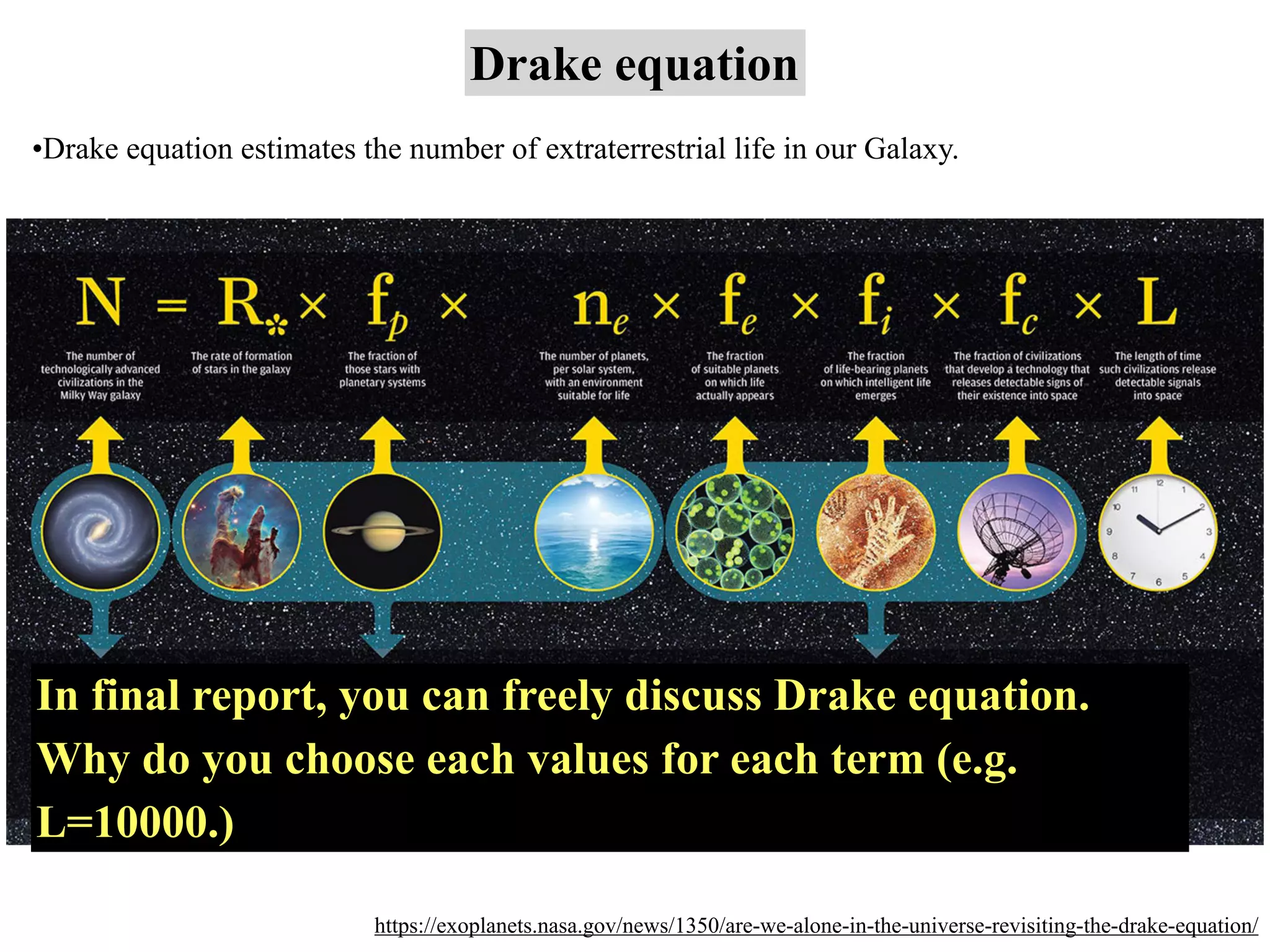
Drake equation
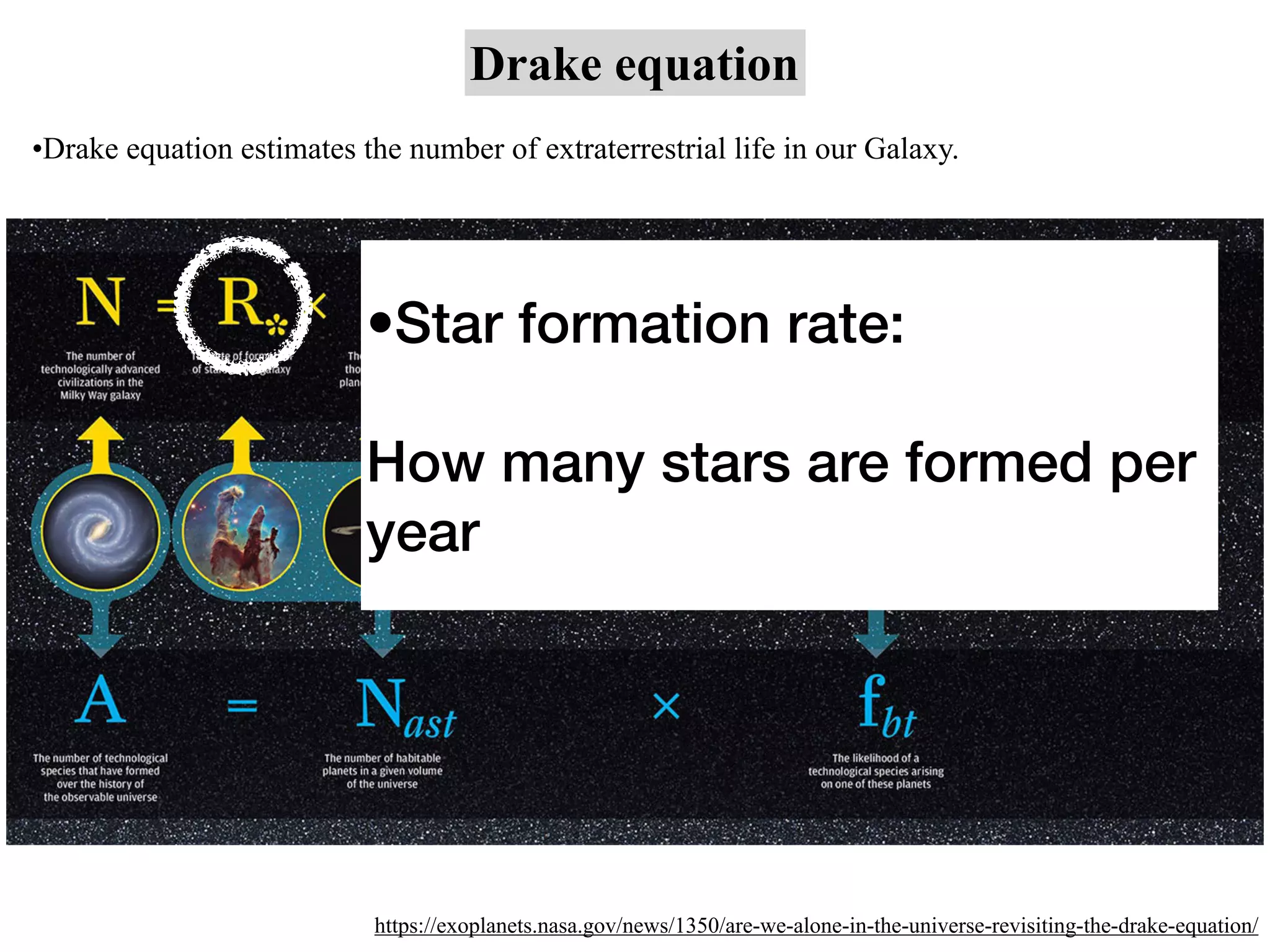
https://exoplanets.nasa.gov/news/1350/are-we-alone-in-the-universe-revisiting-the-drake-equation/
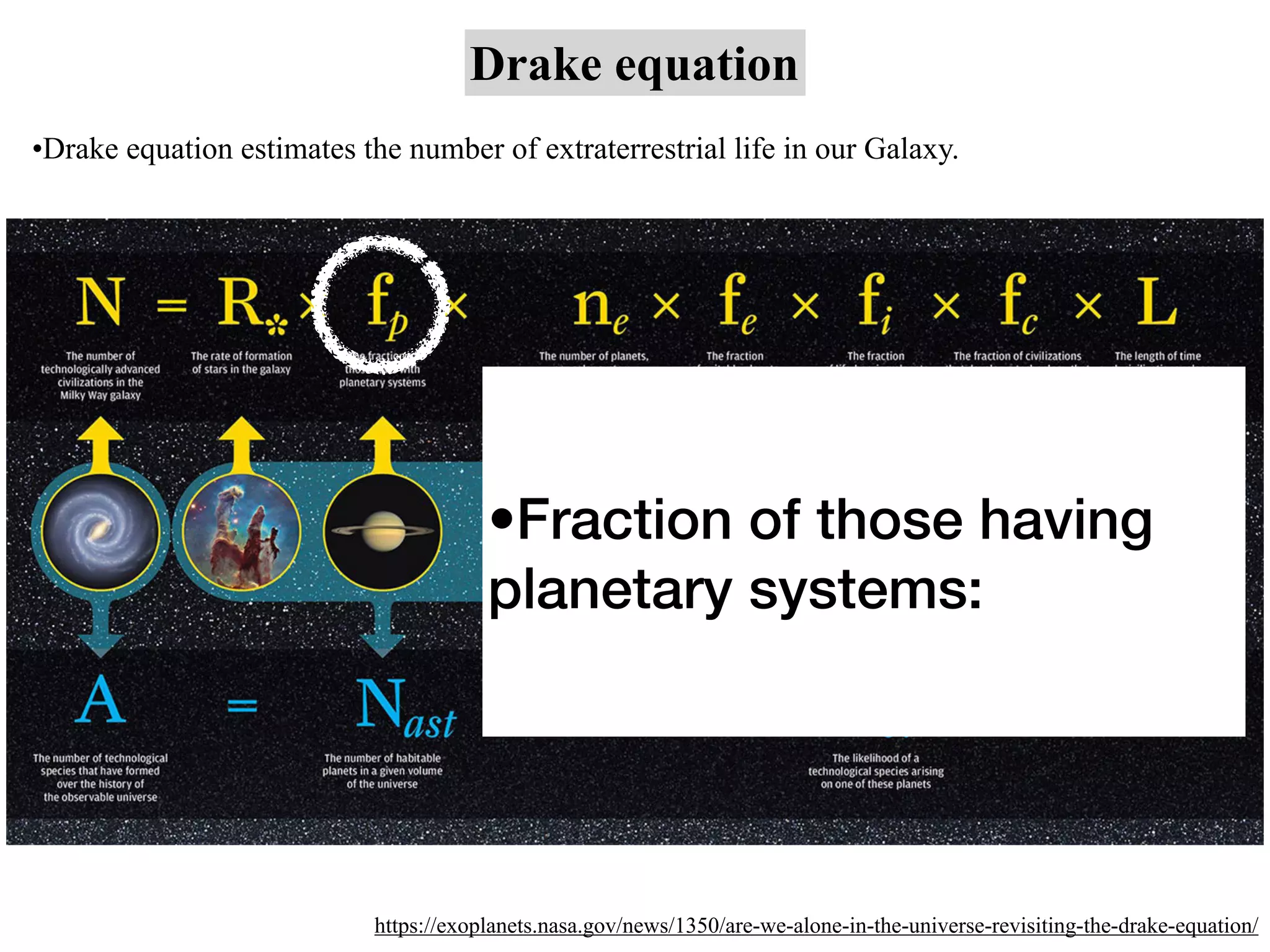
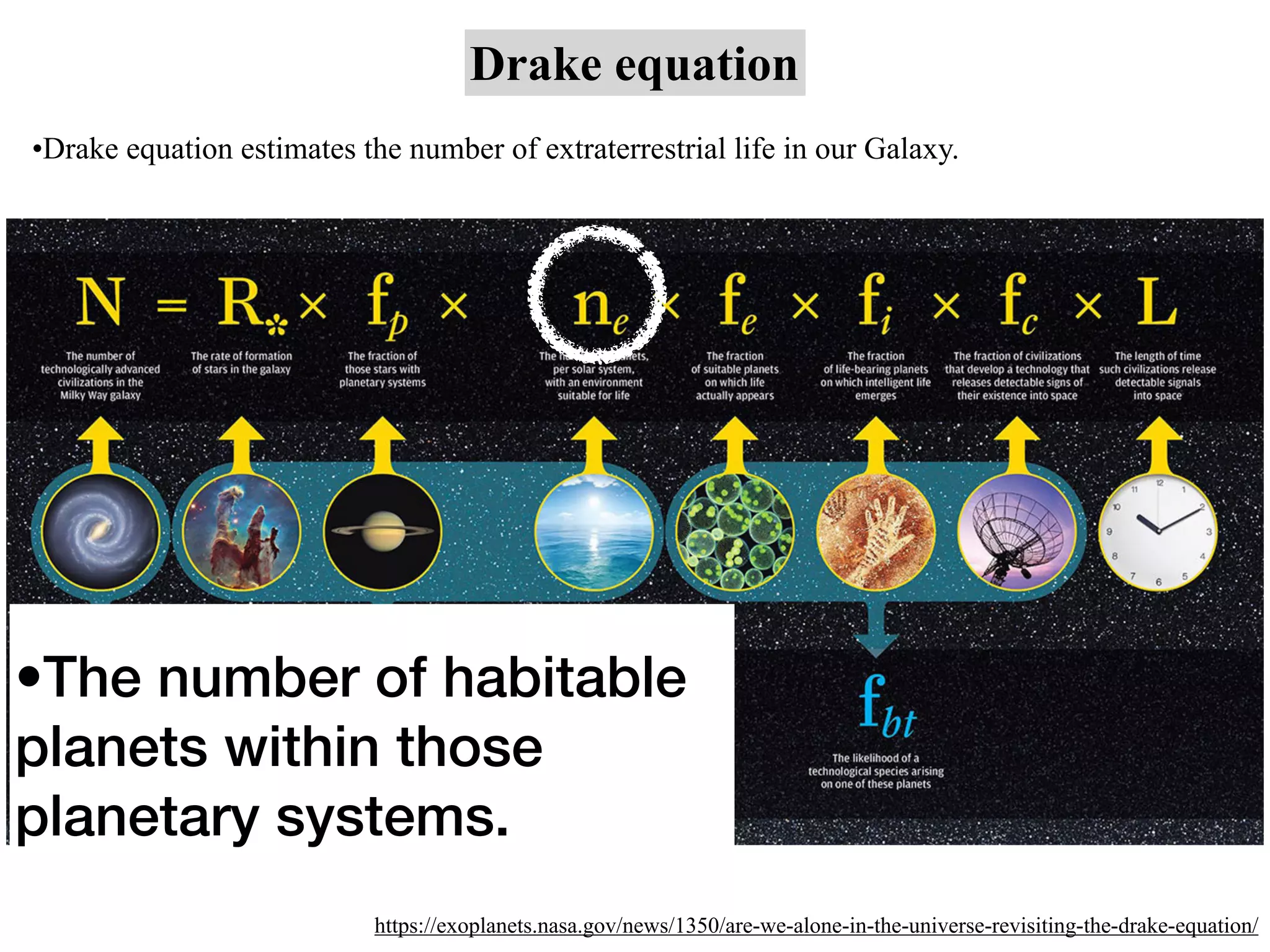
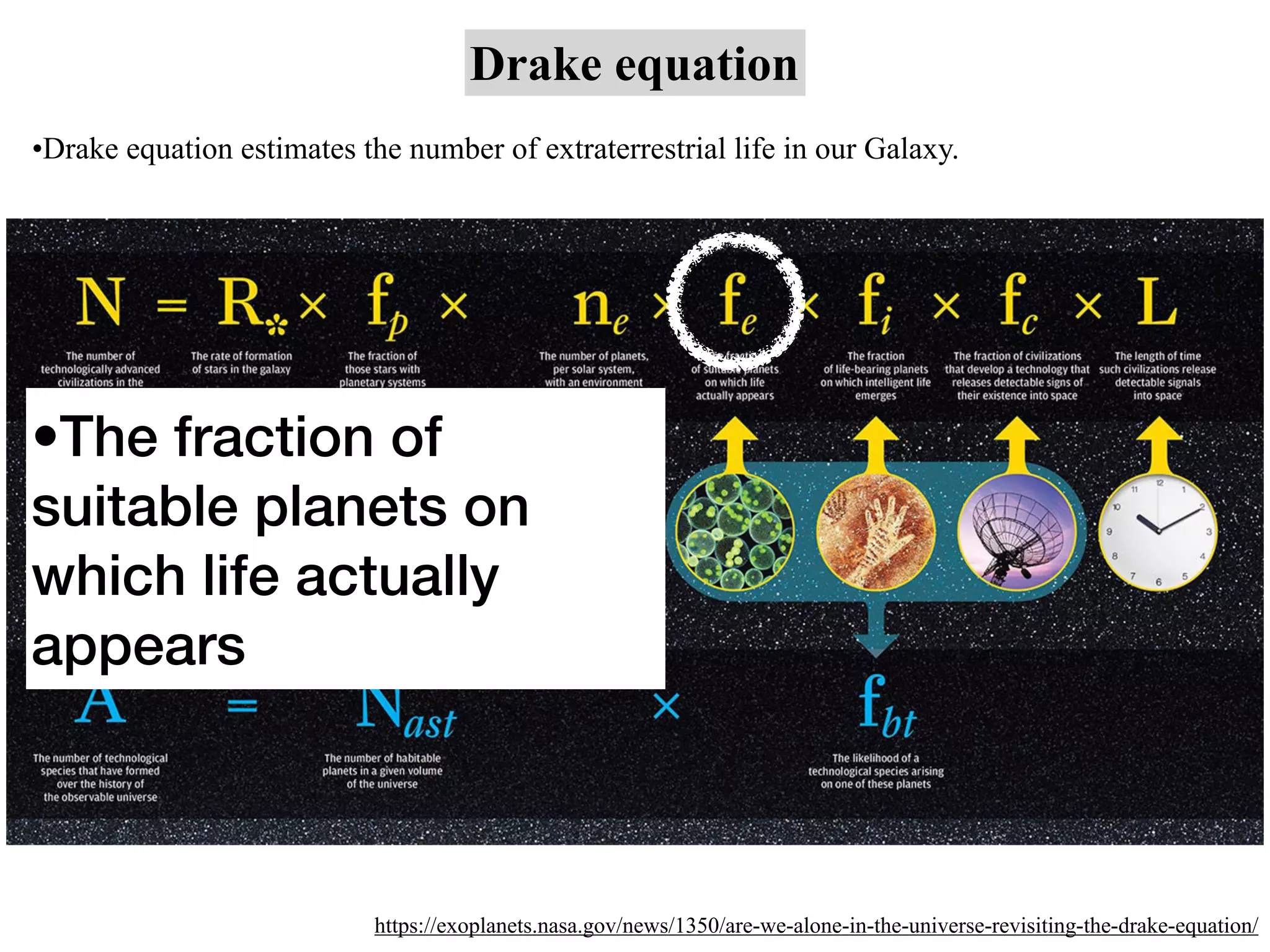
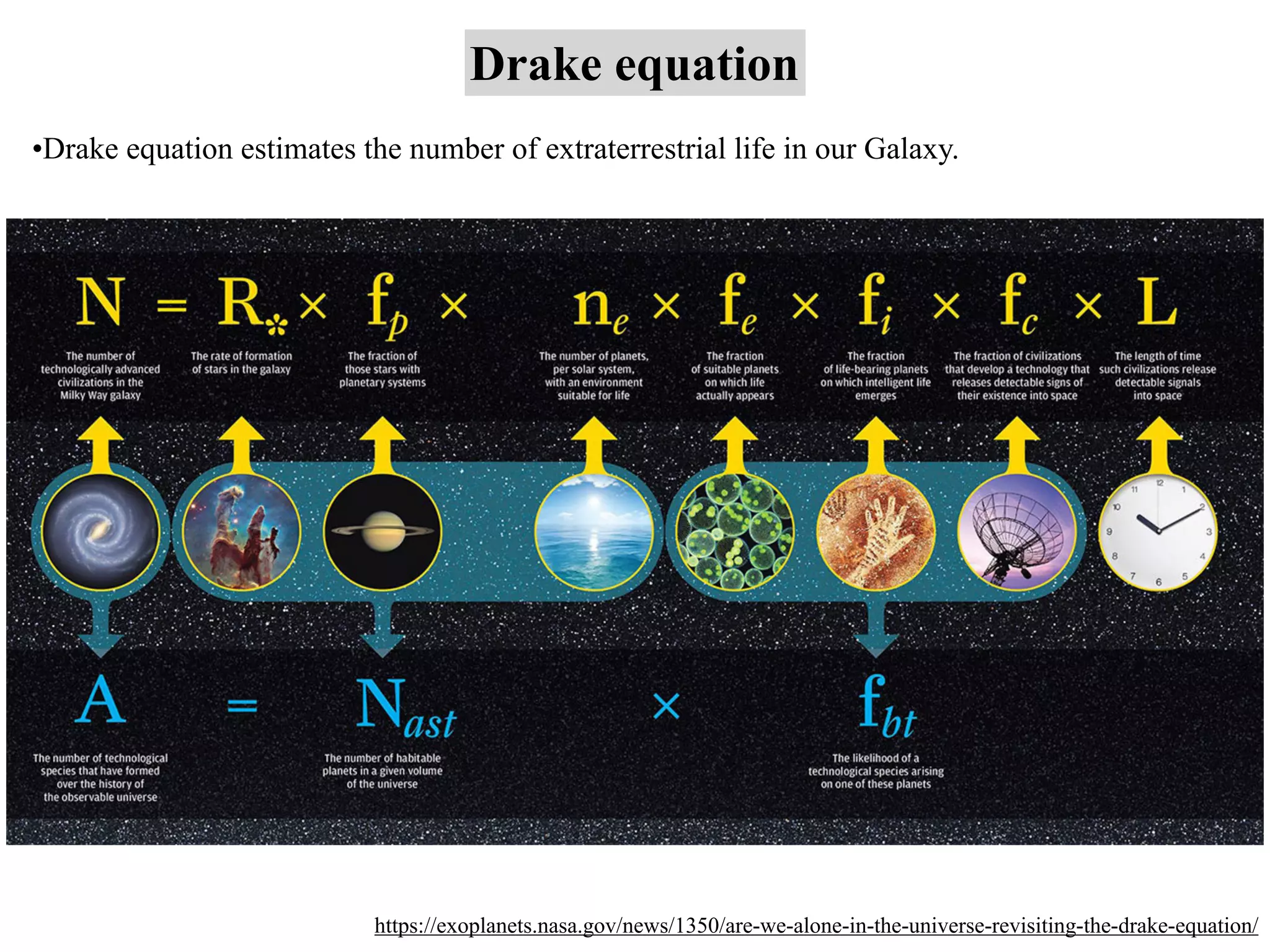
•Drake equation estimates the number of extraterrestrial life in our Galaxy.
Drake equation
https://exoplanets.nasa.gov/news/1350/are-we-alone-in-the-universe-revisiting-the-drake-equation/
•Drake equation estimates the number of extraterrestrial life in our Galaxy.
•Star formation rate:
How many stars are formed per
year
Drake equation
https://exoplanets.nasa.gov/news/1350/are-we-alone-in-the-universe-revisiting-the-drake-equation/
•Drake equation estimates the number of extraterrestrial life in our Galaxy.
•Fraction of those having
planetary systems:
Drake equation
https://exoplanets.nasa.gov/news/1350/are-we-alone-in-the-universe-revisiting-the-drake-equation/
•Drake equation estimates the number of extraterrestrial life in our Galaxy.
•The number of habitable
planets within those
planetary systems.
Drake equation
https://exoplanets.nasa.gov/news/1350/are-we-alone-in-the-universe-revisiting-the-drake-equation/
•Drake equation estimates the number of extraterrestrial life in our Galaxy.
•The fraction of
suitable planets on
which life actually
appears
Drake equation
https://exoplanets.nasa.gov/news/1350/are-we-alone-in-the-universe-revisiting-the-drake-equation/
•Drake equation estimates the number of extraterrestrial life in our Galaxy.
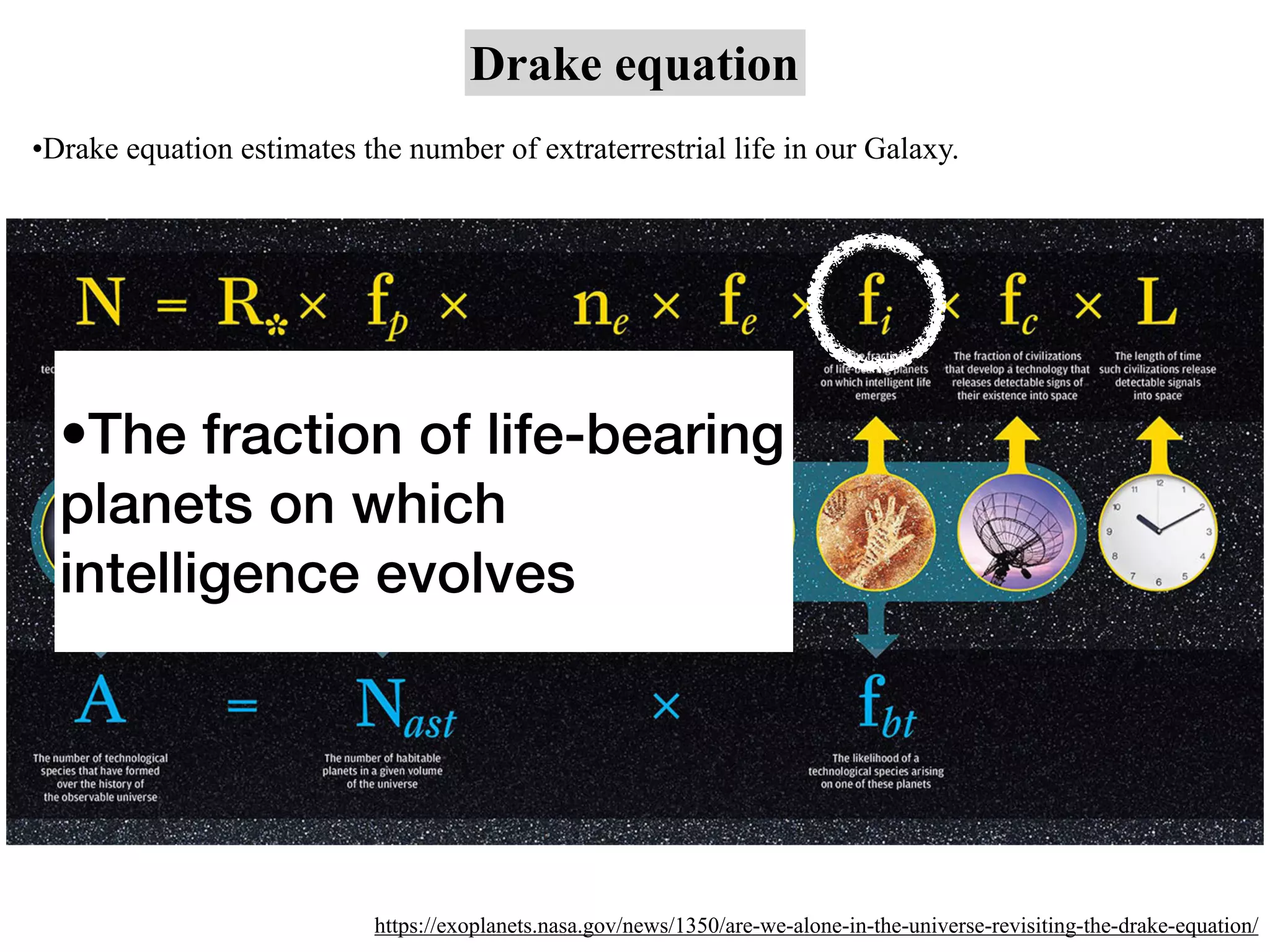
•The fraction of life-bearing
planets on which
intelligence evolves
Drake equation
https://exoplanets.nasa.gov/news/1350/are-we-alone-in-the-universe-revisiting-the-drake-equation/
•Drake equation estimates the number of extraterrestrial life in our Galaxy.
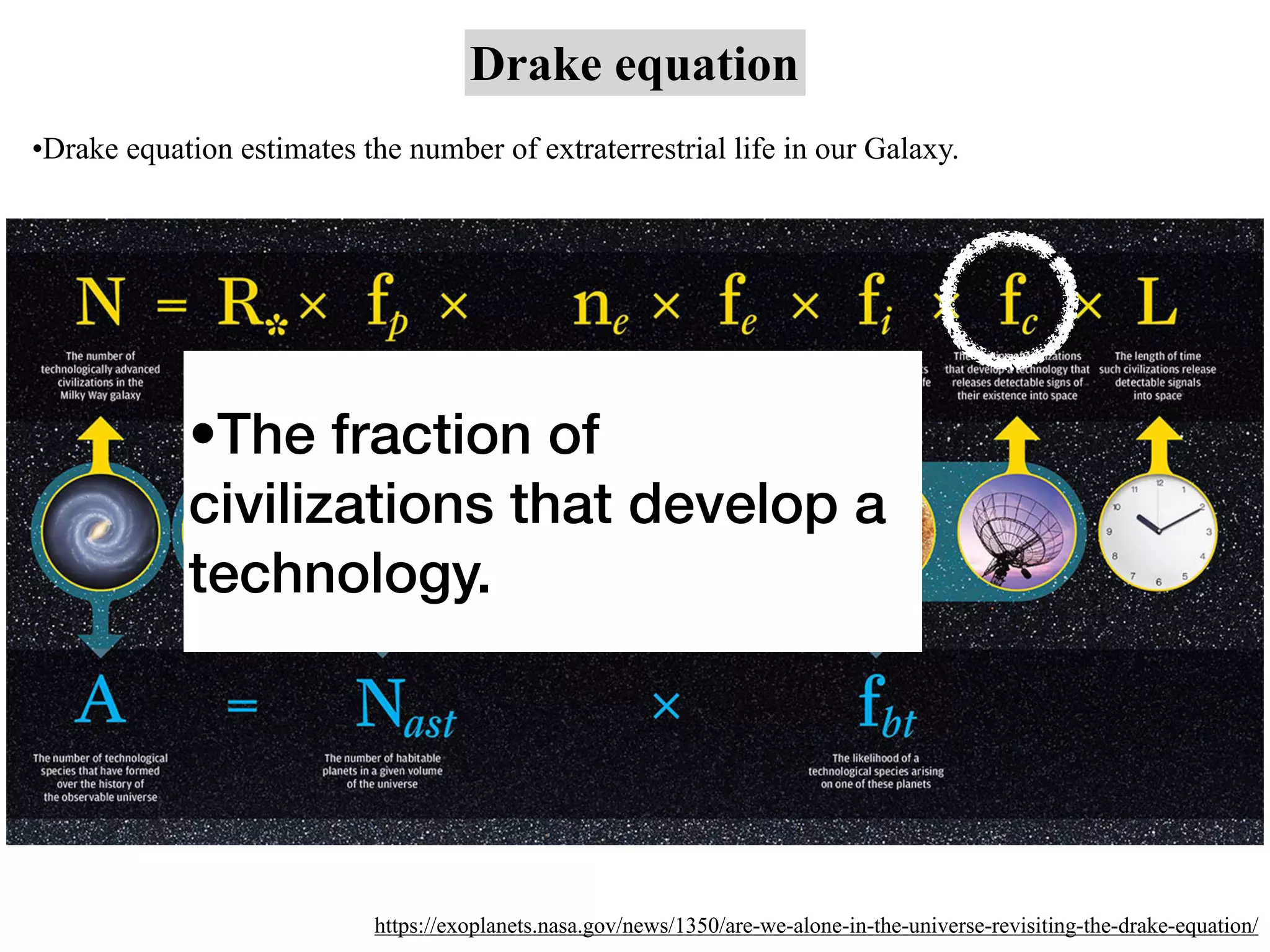
•The fraction of
civilizations that develop a
technology.
Drake equation
https://exoplanets.nasa.gov/news/1350/are-we-alone-in-the-universe-revisiting-the-drake-equation/
•Drake equation estimates the number of extraterrestrial life in our Galaxy.
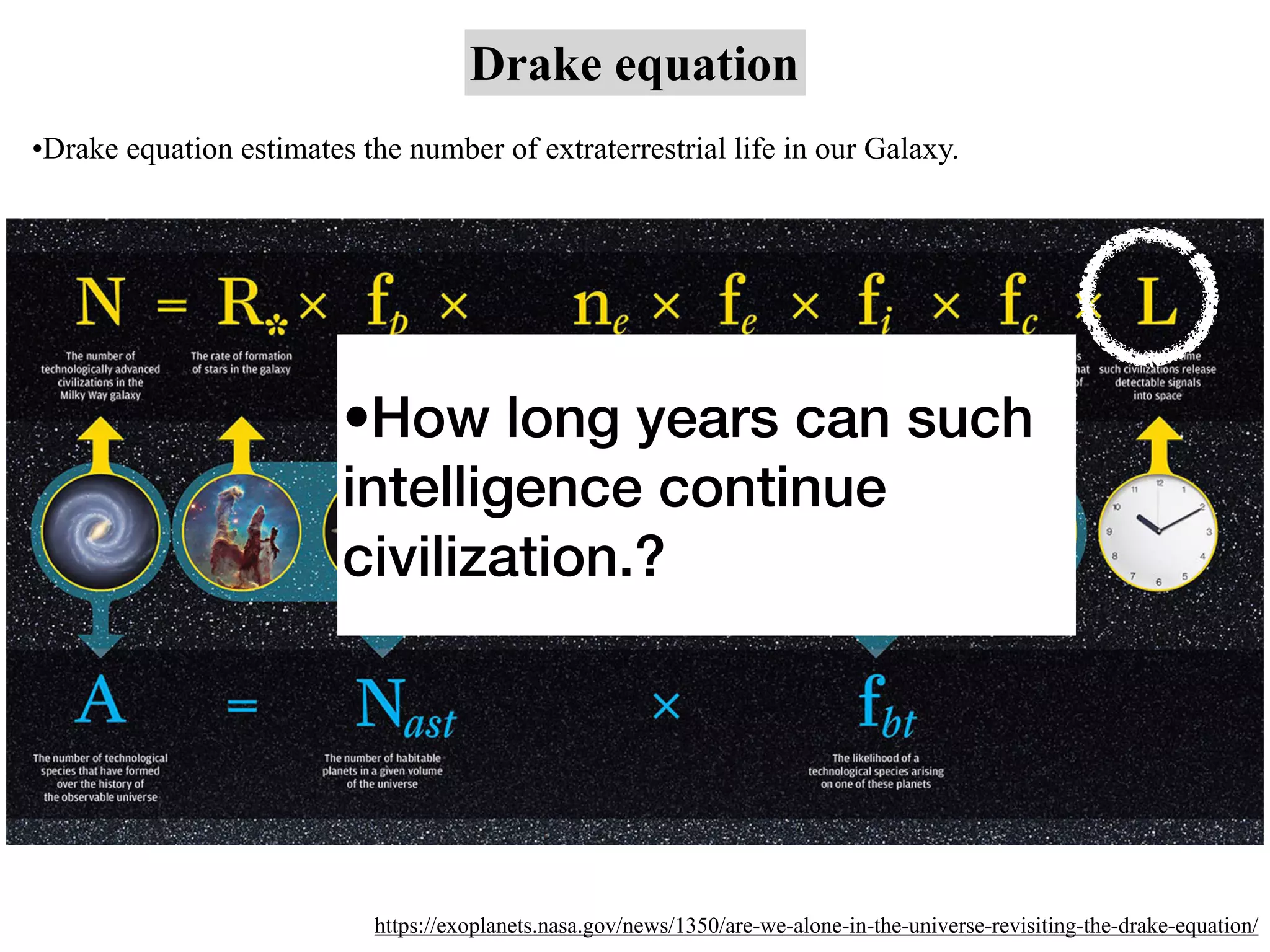
•How long years can such
intelligence continue
civilization.?
Drake equation
https://exoplanets.nasa.gov/news/1350/are-we-alone-in-the-universe-revisiting-the-drake-equation/
•Drake equation estimates the number of extraterrestrial life in our Galaxy.
Drake equation
https://exoplanets.nasa.gov/news/1350/are-we-alone-in-the-universe-revisiting-the-drake-equation/
•Drake equation estimates the number of extraterrestrial life in our Galaxy.
In final report, you can freely discuss Drake equation.
Why do you choose each values for each term (e.g.
L=10000.)
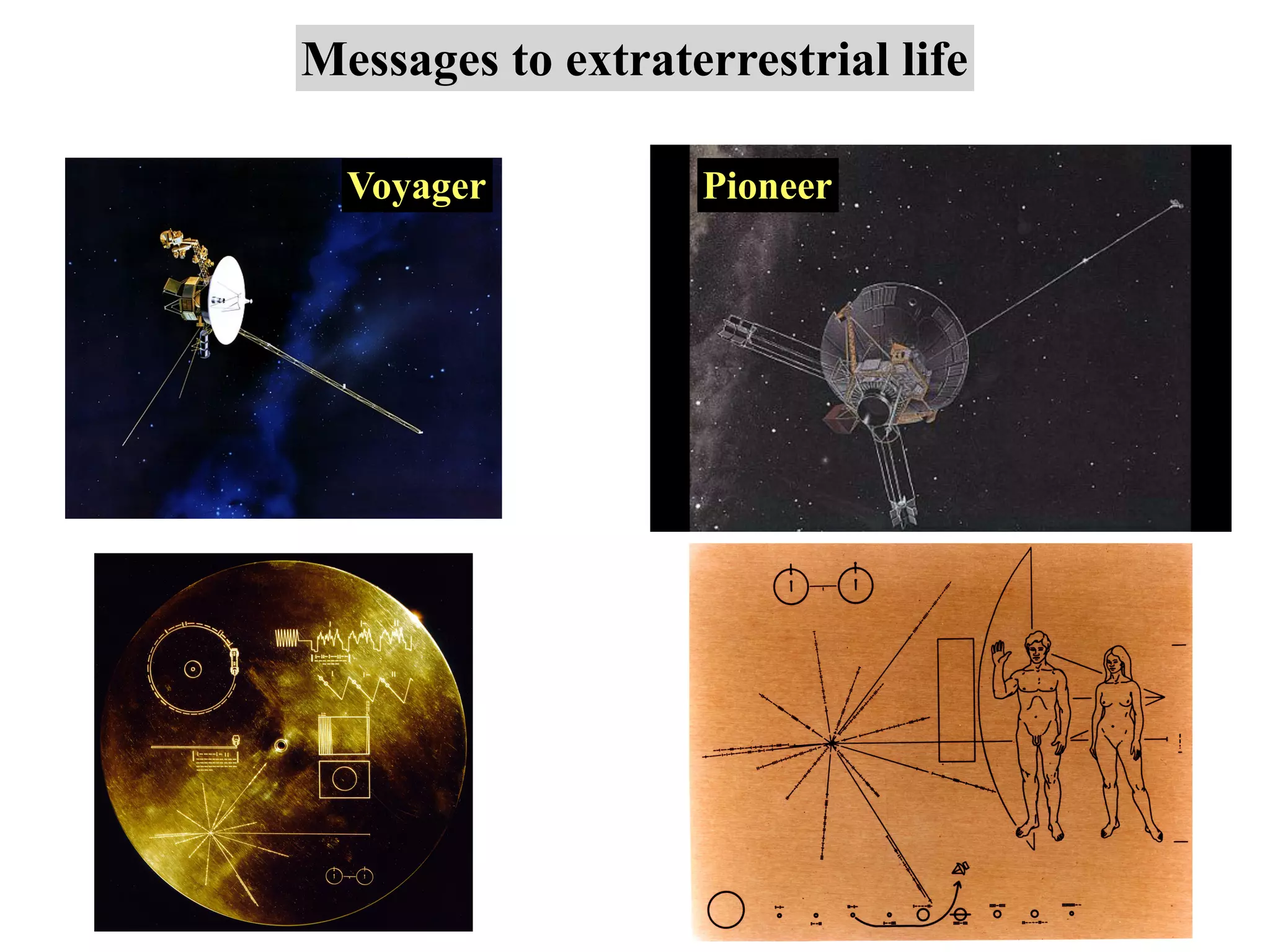
Messages to extraterrestrial life
Voyager Pioneer
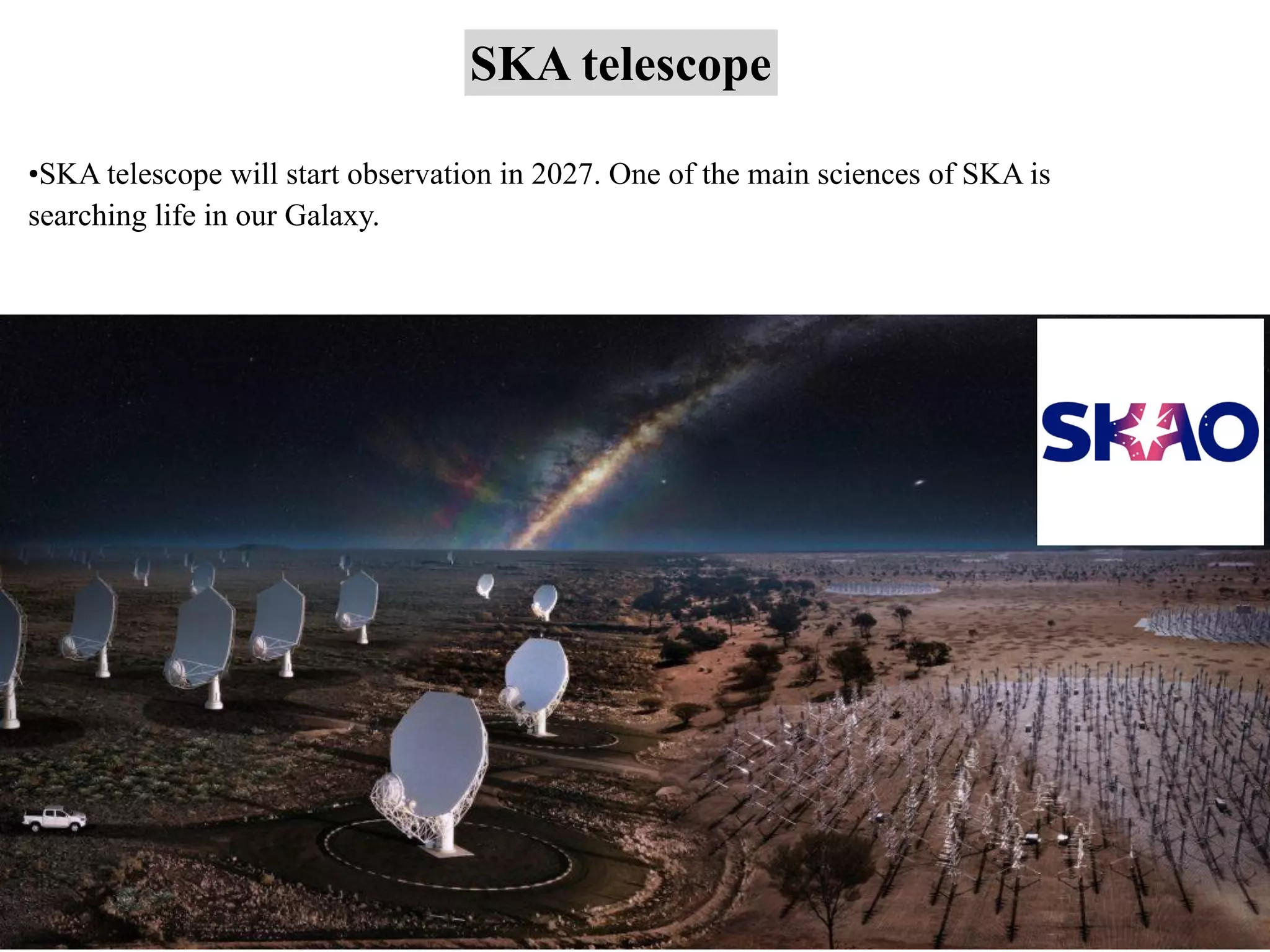
SKA telescope
•SKA telescope will start observation in 2027. One of the main sciences of SKA is
searching life in our Galaxy.
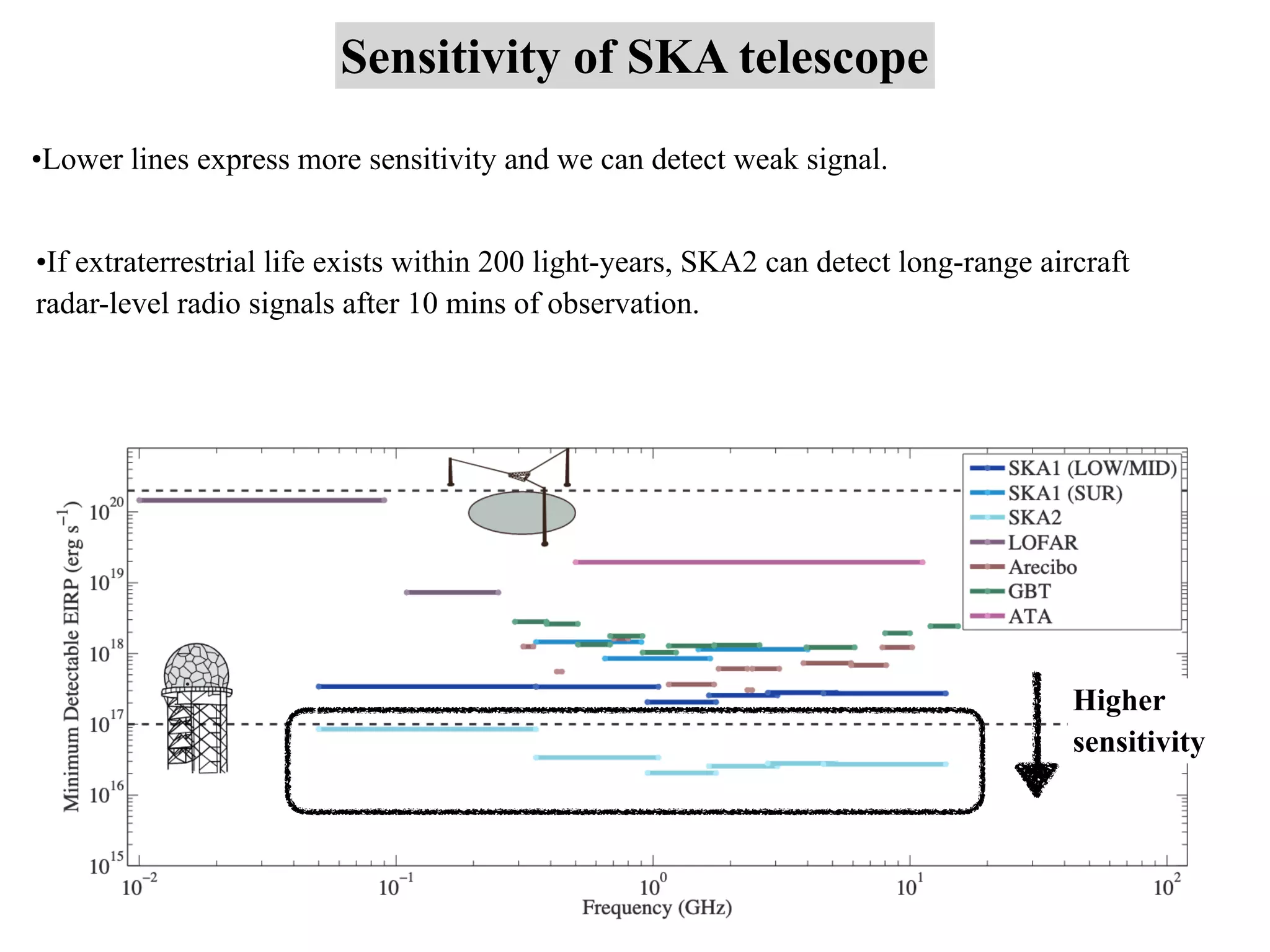
Sensitivity of SKA telescope
•Lower lines express more sensitivity and we can detect weak signal.
Higher
sensitivity
•If extraterrestrial life exists within 200 light-years, SKA2 can detect long-range aircraft
radar-level radio signals after 10 mins of observation.
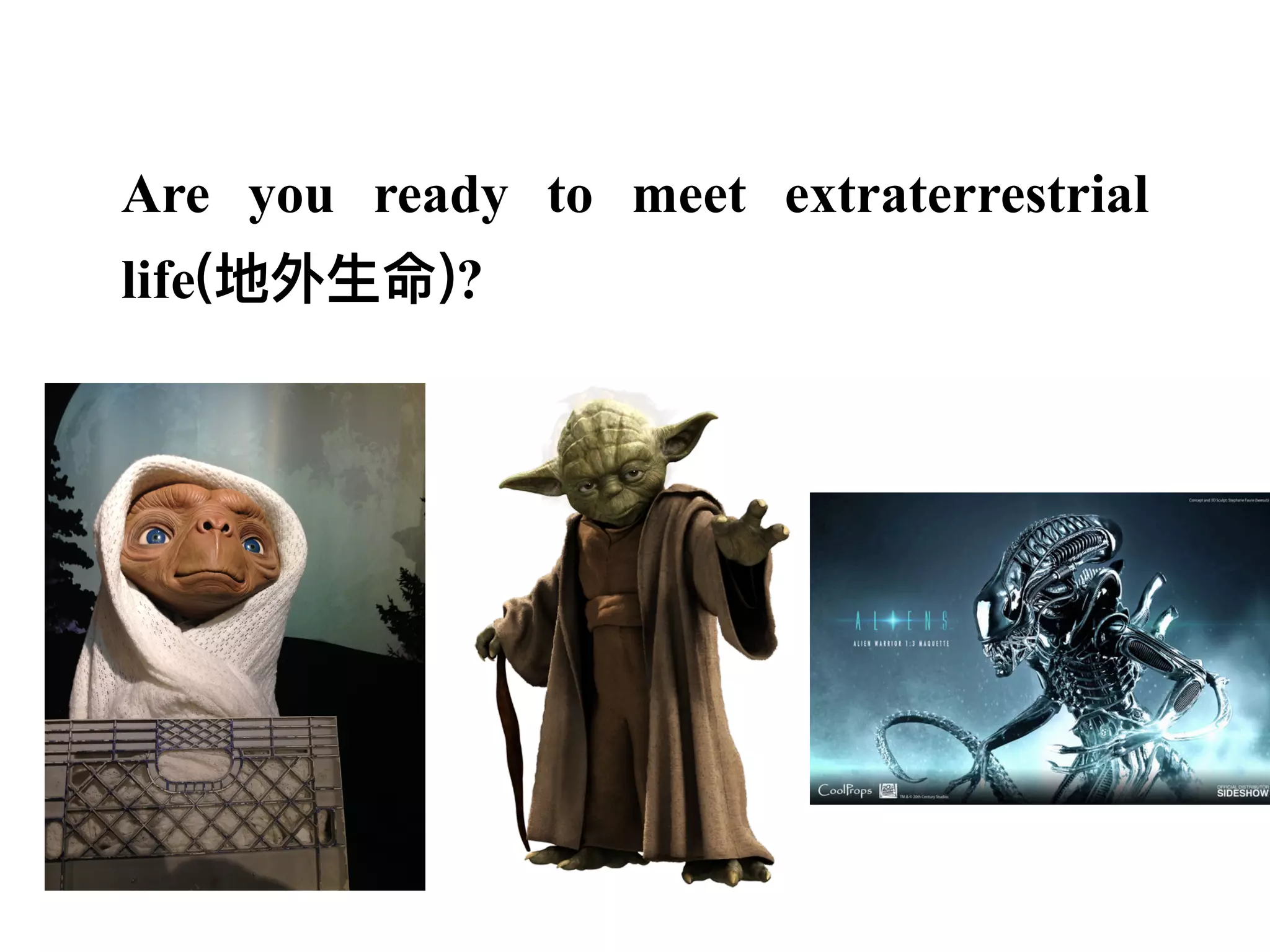
Are you ready to meet extraterrestrial
life(地外⽣命)?
Summary
• Searching for Life in our Galaxy is not an SF story, but a
science now.
• SKA telescope is a very powerful tool to search for life.
All lectures have been finished!
Did you get a new view of the universe?

lecture31&32

  • 1.
    Introduction to modernastronomy 31&32 島袋隼⼠(Hayato Shimabukuro)(云南⼤学、 SWIFAR) ©GETTYIMAGES
  • 2.
  • 3.
    Is there lifein the universe other than us?
  • 4.
    By the way,what is the life? What is the difference between living and nonliving?
  • 5.
    By the way,what is the life? What is the difference between living and nonliving? It is difficult to define life.
  • 6.
    By the way,what is the life? What is the difference between living and nonliving? It is difficult to define life. Biologists have not arrived at a clear definition of life.
  • 7.
    By the way,what is the life? What is the difference between living and nonliving? It is difficult to define life. Biologists have not arrived at a clear definition of life. Generally speaking, scientists regard the following as characteristics of living organisms.
  • 8.
    1. They canreact to their environment and can often heal themselves when damaged. The definition of life 2. They can grow by taking in nourishment from their surroundings and processing it into energy. 3. They can reproduce, passing along some of their own characteristics to their offspring. 4. They have the capacity for generic change and can therefore evolve from generation to generation and adapt to a changing environment. 它们可以对环境做出响应,⽽且常常可以在受伤时⾃我治疗 它们可以通过周围的环境汲取养分,并将其加⼯成能量⽽⽣⻓ 它们可以繁殖,并将⾃⼰的⼀些特性遗传给后代 它们有基因变化能⼒,因此可以世代进化,并适应不断变化的环境
  • 9.
    NASA’s definition oflife (by G. Joyce) The definition of life Life is a self-sustained chemical system capable of undergoing Darwinian evolution ⽣命是⼀个⾃我维持的化学系统, 能够经历达尔⽂式的进化 •Self-reproduction(⾃我繁殖) •Genetic variation(遗传变异) •Natural selection(⾃然选择) NASA's definition of life gives an indication of the search for life in the universe.
  • 10.
    Assumptions to searchfor life in the universe We first assume the following conditions as the first step to search for life in the universe. • Life depends on a few basic molecules as similar as Earth. •The elements which make up molecules are common to all stars. •If the laws of science we know apply to the entire universe, given sufficient time, life must have originated elsewhere in the universe.
  • 11.
  • 12.
    Chemical evolution Amino acid Nucleotidebases These simple molecules make amino acids(氨基酸) and nucleotide bases(核苷酸碱 基) Amino acids form protein(蛋⽩质)
  • 13.
    Chemical evolution •Sequences ofnucleotide bases form genes(基因), part of the DNA molecules , which direct synthesis of proteins and thus determine the characteristics of the organism. https://www.quora.com/How-does- the-sequence-of-DNA-determine- the-spatial-structure-of-protein
  • 14.
    Urey-Miller experiment = Primeval earth •Ureyand Miller recreated an environment that mimicked the primitive Earth’s atmosphere and tested whether amino acids could be produced from methane, water, and ammonia. They could succeed to generate amino acids!
  • 15.
    Urey-Miller experiment = Primeval earth •But,we have realized that the atmosphere in primeval Earth is not suitable to produce complex molecules. It does not contain materials which are necessary for complex molecules. We now consider organic(carbon-based) materials produced in interstellar space.
  • 16.
    Urey-Miller experiment = Primeval earth •But,we have realized that the atmosphere in primeval Earth is not suitable to produce complex molecules. It does not contain materials which are necessary for complex molecules. We now consider organic(carbon-based) materials produced in interstellar space.
  • 17.
    Life in theSolar system? •In1969, a meteorite(陨⽯) fell on Murchison, Australia. •A space-origin amino acid was found in this meteorite! •Japanese asteroid spacecraft Hayabusa-2 successfully returned samples from the asteroid Ryugu, discovering 23 amino acids.
  • 18.
    Life in thesea? •Let’s re-consider the emergence of life on the earth. •We discovered hydrothermal vent(热液喷⼝)in deep ocean. Hydrothermal vent •The temperature around the hydrothermal reaches up to ! 465∘ C https://doi.org/10.1002/celc.201801432 •Some researchers claim that life originated in hydrothermal vents in the ocean.
  • 21.
    Does life onEarth comes from space or emerge in the sea??
  • 22.
    Does life onEarth comes from space or emerge in the sea?? We have not known the answer! It is very mysterious and fascinating question!
  • 23.
    Does life onEarth comes from space or emerge in the sea?? We have not known the answer! It is very mysterious and fascinating question! Which scenario do you support?
  • 24.
    Roadmap to lifein the universe 1. We try to discover life in the solar system. 2. Search for life (or molecules) on the exoplanets in the habitable zone or interstellar medium. 3. We try to detect radio signals from extraterrestrial civilizations (地外⽂明)
  • 25.
    Roadmap to lifein the universe 1. We try to discover life in the solar system. 2. Search for life (or molecules) on the exoplanets in the habitable zone or interstellar medium. 3. We try to detect radio signals from extraterrestrial civilizations (地外⽂明)
  • 26.
  • 27.
    ©AFP •Ice or waterexists under the surface of Mars •Ice or water may exist under the surface. •Billion years ago, Mars had surface water. •NASA, CNSA (Chinese National Space Administration), and UAE launched spacecraft.
  • 28.
    ©AFP •Europa is amoon around Jupiter. •We have already found evidence of water under the ice surface. Life may exist.
  • 29.
    ©AFP •Titan and Encaladusare moons of Saturn. •Titan may have environments suitable for life in the subsurface ocean or another kind of life may exist. •Jet erupting from the Encaladus suggests an active hydrothermal vent on the fl oor of a subsurface ocean. It is similar to the scenario in that life emerged around hydrothermal vents on the earth. •2023/6, Phosphorus(P,磷) is discovered at Encaladus. P is necessary for life!
  • 30.
  • 31.
    Roadmap to lifein the universe 1. We try to discover life in the solar system. 2. Search for life (or molecules) on the exoplanets in the habitable zone or interstellar medium 3. We try to detect radio signals from extraterrestrial civilizations (地外⽂明)
  • 32.
    Roadmap to lifein the universe 1. We try to discover life in the solar system. 2. Search for life (or molecules) on the exoplanets in the habitable zone or interstellar medium 3. We try to detect radio signals from extraterrestrial civilizations (地外⽂明)
  • 33.
    Habitable zone High-mass main stars Farfrom main stars Habitable zone(宜居带): The region of the orbit of planets where liquid water can exist. Remember habitable zone. ~ 50 habitable zone exoplanets have been already found.
  • 34.
    Observation by Galileospacecraft •Galileo spacecraft is an American robotic space probe that studied the planet Jupiter and its moons.
  • 35.
    Observation by Galileospacecraft •Galileo spacecraft observed a planet and found some interesting signatures. Sagan et al (1993) •The planet has CO2, H2O, O2 Biosignature?
  • 36.
    Observation by Galileospacecraft •Galileo spacecraft also discovered radio waves on the planet. It is the evidence of civilization(⽂明) Sagan et al (1993)
  • 37.
    Observation by Galileospacecraft •You may notice that this planet is the Earth! Carl Sagan •When Galileo spacecraft does fly by the earth, it observed the earth. •Carl Sagan is not only an astrophysicist but also a famous SF writer.
  • 38.
    Observation by Galileospacecraft •You may notice that this planet is the Earth! Carl Sagan •When Galileo spacecraft does fly by the earth, it observed the earth. •Carl Sagan is not only an astrophysicist but also a famous SF writer.
  • 39.
    Observation by Galileospacecraft •Other observations of the earth. Galileo spacecraft measured the reflection of light at different places. •Different kind of rock has different reflection (or spectrum). It will be a clue to study lands on the planets.
  • 40.
    Ford,Seager,Turner (Nature,2001) Different reflection IceLand Sea •Reflection also depends on ice, sea, and land
  • 41.
    •So far, wesee biosignature on the earth. But, if we discover these kinds of signs on other planets, it is very exiting! Life on the other planets
  • 42.
    Molecules in theinterstellar medium Interstellar medium Stars and planets Commets Life
  • 43.
    Amino acids inthe interstellar medium We have never found amino acids in the interstellar medium. But, we have found methylamine( ), which is a precursor to glycine , in the interstellar medium. CH3NH2 (NH2CH2COOH) Ohishi et al (2019) Path to amino acids
  • 44.
    Roadmap to lifein the universe 1. We try to discover life in the solar system. 2. Search for life (or molecules) on the exoplanets in the habitable zone or interstellar medium 3. We try to detect radio signals from extraterrestrial civilizations (地外⽂明)
  • 45.
    Roadmap to lifein the universe 1. We try to discover life in the solar system. 2. Search for life (or molecules) on the exoplanets in the habitable zone or interstellar medium 3. We try to detect radio signals from extraterrestrial civilizations (地外⽂明)
  • 46.
    (Question) What do youthink how much extraterrestrial life(地外⽣命) is expected to exist in our galaxy?
  • 47.
  • 48.
    Drake equation https://exoplanets.nasa.gov/news/1350/are-we-alone-in-the-universe-revisiting-the-drake-equation/ •Drake equationestimates the number of extraterrestrial life in our Galaxy. •Star formation rate: How many stars are formed per year
  • 49.
    Drake equation https://exoplanets.nasa.gov/news/1350/are-we-alone-in-the-universe-revisiting-the-drake-equation/ •Drake equationestimates the number of extraterrestrial life in our Galaxy. •Fraction of those having planetary systems:
  • 50.
    Drake equation https://exoplanets.nasa.gov/news/1350/are-we-alone-in-the-universe-revisiting-the-drake-equation/ •Drake equationestimates the number of extraterrestrial life in our Galaxy. •The number of habitable planets within those planetary systems.
  • 51.
    Drake equation https://exoplanets.nasa.gov/news/1350/are-we-alone-in-the-universe-revisiting-the-drake-equation/ •Drake equationestimates the number of extraterrestrial life in our Galaxy. •The fraction of suitable planets on which life actually appears
  • 52.
    Drake equation https://exoplanets.nasa.gov/news/1350/are-we-alone-in-the-universe-revisiting-the-drake-equation/ •Drake equationestimates the number of extraterrestrial life in our Galaxy. •The fraction of life-bearing planets on which intelligence evolves
  • 53.
    Drake equation https://exoplanets.nasa.gov/news/1350/are-we-alone-in-the-universe-revisiting-the-drake-equation/ •Drake equationestimates the number of extraterrestrial life in our Galaxy. •The fraction of civilizations that develop a technology.
  • 54.
    Drake equation https://exoplanets.nasa.gov/news/1350/are-we-alone-in-the-universe-revisiting-the-drake-equation/ •Drake equationestimates the number of extraterrestrial life in our Galaxy. •How long years can such intelligence continue civilization.?
  • 55.
  • 56.
    Drake equation https://exoplanets.nasa.gov/news/1350/are-we-alone-in-the-universe-revisiting-the-drake-equation/ •Drake equationestimates the number of extraterrestrial life in our Galaxy. In final report, you can freely discuss Drake equation. Why do you choose each values for each term (e.g. L=10000.)
  • 57.
    Messages to extraterrestriallife Voyager Pioneer
  • 58.
    SKA telescope •SKA telescopewill start observation in 2027. One of the main sciences of SKA is searching life in our Galaxy.
  • 59.
    Sensitivity of SKAtelescope •Lower lines express more sensitivity and we can detect weak signal. Higher sensitivity •If extraterrestrial life exists within 200 light-years, SKA2 can detect long-range aircraft radar-level radio signals after 10 mins of observation.
  • 60.
    Are you readyto meet extraterrestrial life(地外⽣命)?
  • 61.
    Summary • Searching forLife in our Galaxy is not an SF story, but a science now. • SKA telescope is a very powerful tool to search for life.
  • 62.
    All lectures havebeen finished! Did you get a new view of the universe?